
 By
By 
Contents
A well-defined mobile app development strategy is essential for businesses launching their first app or rethinking an existing one that is not delivering the expected results. Without it, even a technically sound app can miss the mark on user adoption, revenue generation, and long-term growth.
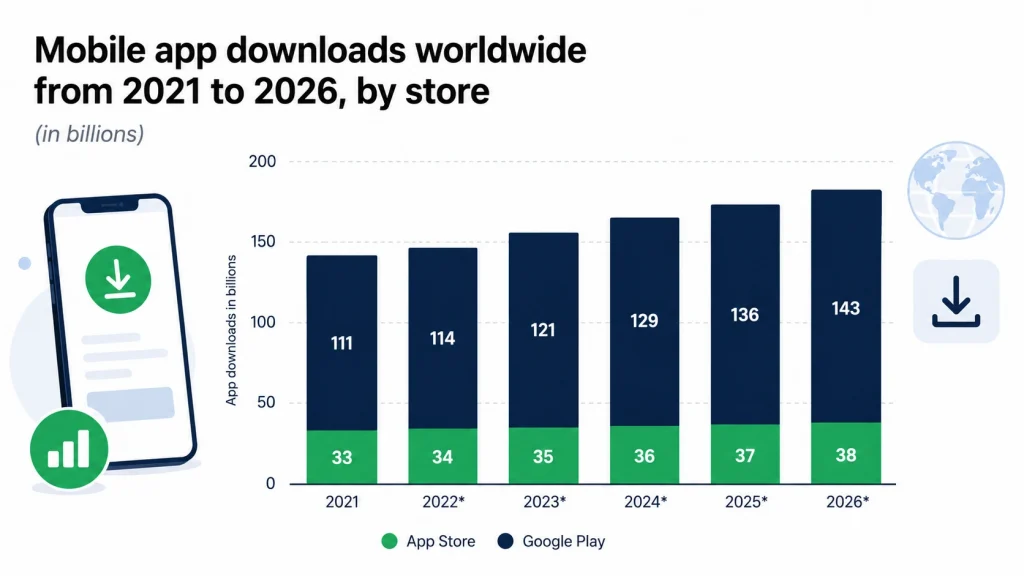
According to Statista, consumers are projected to download over 181 billion mobile apps across Google Play and the Apple App Store in 2026. With that volume of competition, launching an app without a clear strategy is the fastest way to get buried.
A mobile app strategy goes beyond choosing a tech stack or wireframing screens. It is a business-level framework that aligns your app’s purpose with your company’s goals, your users’ needs, and the competitive landscape you are entering. It answers the foundational questions: who is this app for, what problem does it solve, how will it generate value, and what does success look like after launch.
In this guide, we break down six proven mobile app development strategies that cover every critical decision point, from selecting the right development approach and tech stack to designing your monetization model and go-to-market plan. Being a leading mobile app development company, we have built these strategies from what works across 4,400+ app projects for startups and enterprises worldwide.
What is Mobile App Development Strategy?
A mobile app development strategy is a structured plan that aligns your business objectives with every decision involved in building, launching, and scaling a mobile application. It defines who your app is for, which platforms it will target, what features to prioritize, how it will generate revenue, and what success looks like after launch.
Unlike jumping straight into development, a strategy forces you to validate your app idea against real market demand before committing budget and resources. It covers both the business side (audience research, competitive positioning, monetization) and the technical side (platform selection, tech stack, infrastructure planning) in a single, connected framework.
Core Components of a Successful Mobile App Development Strategy
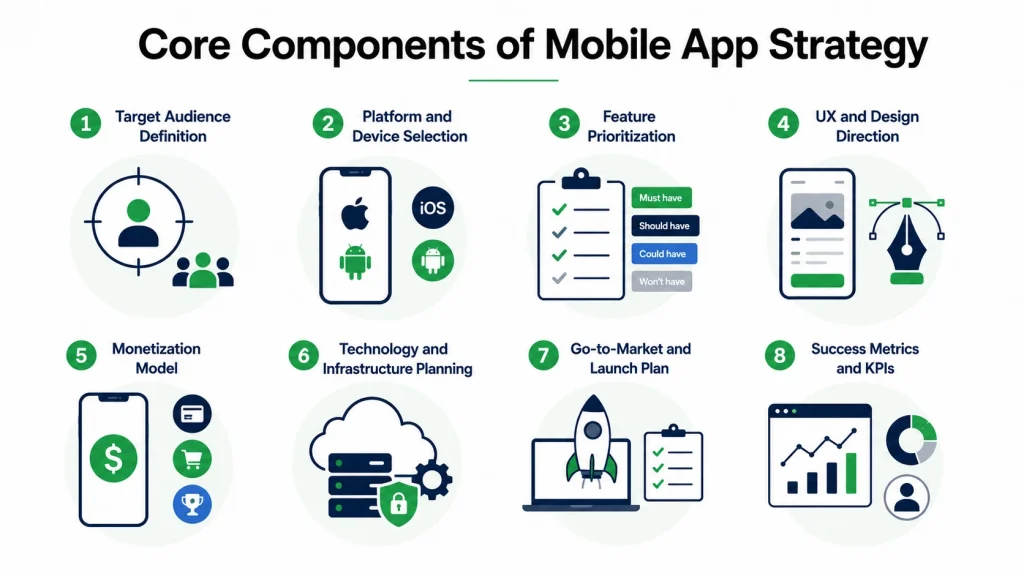
Before you start building your app, your strategy needs to cover a set of foundational components. These components act as the building blocks that guide every decision throughout the development lifecycle.
Here are the core elements that every mobile app development strategy should include:
1. Target Audience Definition
Your strategy starts with identifying exactly who will use your app. This goes beyond basic demographics. You need to define user personas that include their pain points, behavior patterns, preferred devices, and a clear value proposition that communicates why your app is the right solution for them.
For example, an app targeting field service technicians has very different UX requirements than one targeting retail shoppers. Getting this wrong means building an app with no product-market fit, where the solution exists but the demand does not.
2. Platform and Device Selection
Deciding whether to build for iOS, Android, or both platforms is a strategic decision, not a technical one. It depends on where your target audience is, your budget constraints, and your go-to-market timeline.
This is one of the key mobile app development tips that many businesses overlook. If 80% of your target users are on Android, launching iOS-first wastes time and limits your initial reach.
3. Feature Prioritization
Not every feature needs to be in version 1.0. A solid strategy separates must-have features from nice-to-have features using frameworks like MoSCoW (Must have, Should have, Could have, Won’t have).
This approach keeps your MVP development focused, your budget under control, and your launch timeline realistic. You can always add features in later versions based on real user feedback.
4. UX and Design Direction
Your strategy should outline the overall user experience philosophy for your app. This includes navigation patterns, interaction models, accessibility standards, and brand consistency.
A well-planned UX direction reduces design revisions during development and ensures your app delivers a seamless experience from the first interaction.
5. Monetization Model
How will your app generate revenue? Whether it is through subscriptions, in-app purchases, freemium tiers, or ad-based models, your monetization approach should be defined at the strategy stage. This decision influences your feature set, user flow, and even your UI design.
6. Technology and Infrastructure Planning
While detailed tech stack decisions happen during development planning, your strategy should outline the broad infrastructure requirements. This includes cloud hosting preferences, API integration with third-party services, app security protocols, and data privacy standards.
Following app development best practices means making these infrastructure decisions early, including compliance with data privacy regulations like GDPR and CCPA, so your development team can plan for scalability from day one.
7. Go-to-Market and Launch Plan
Your mobile app strategy should include a high-level launch plan covering QA testing, app store optimization (ASO), pre-launch marketing, beta testing, and initial user acquisition channels.
An app without a launch plan is like a product without a shelf. Even the best-built apps fail if no one knows they exist.
8. Success Metrics and KPIs
Finally, define how you will measure success. Common KPIs include daily active users (DAU), user retention rate, session duration, conversion rate, and customer acquisition cost (CAC).
Setting up app analytics from day one gives you a way to track these metrics, evaluate whether your strategy is working, and identify where you need to make adjustments post-launch.
When these core components are in place, developing a mobile strategy becomes a structured process rather than a guessing game. Each component feeds into the next, giving your development team, stakeholders, and marketing team a shared understanding of what the app needs to achieve.
With these fundamentals covered, you can now move into the specific strategies that will shape your app’s development and market success.
Need Help Building a Strategy for Your App?
Share your app idea with our consultants. Get a custom mobile app strategy with platform, tech stack, and launch recommendations.

Why Does Your Business Need a Mobile App Development Strategy
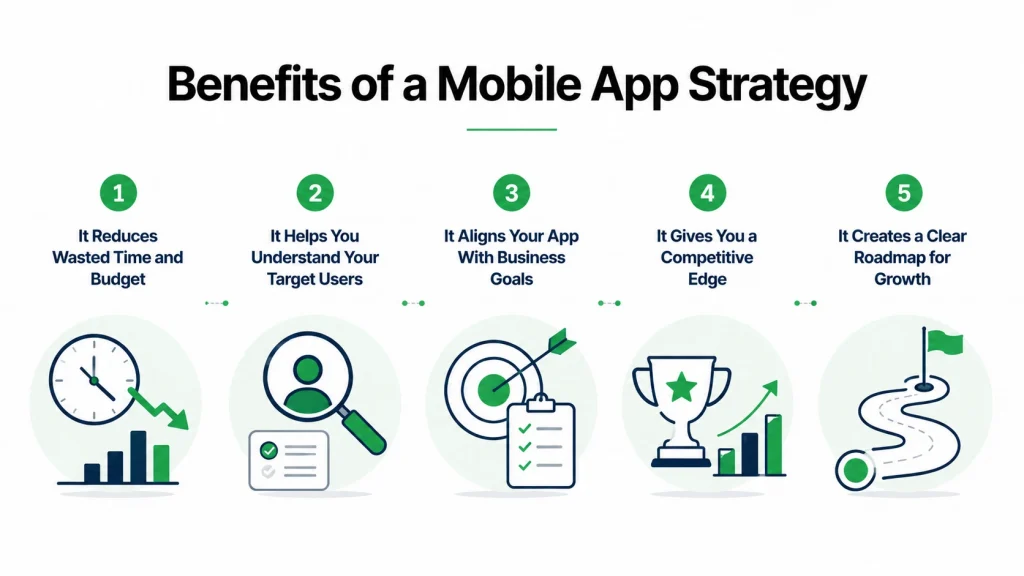
If you are investing time, money, and resources into building a mobile app, you need more than a good idea. You need a clear strategy that connects your app to real business outcomes.
Here is why a well-defined mobile app development strategy matters for your business:
1. It Reduces Wasted Time and Budget
Without a strategy, development teams often build features based on assumptions rather than validated user needs. This leads to multiple revision cycles, scope changes, and inflated costs. A clear strategy gives your team a single reference point, so every decision, from design to deployment, stays aligned with your goals and delivers measurable ROI.
2. It Helps You Understand Your Target Users
A strong mobile app business strategy starts with audience research. You define who your users are, what problems they face, and how your app solves those problems. This research directly shapes your feature set, UX design, and marketing approach, all before a single line of code is written.
3. It Aligns Your App With Business Goals
Your app should support your larger business objectives, whether that is increasing revenue, improving customer retention, entering a new market, or streamlining internal operations. A mobile application development strategy maps your app’s purpose to these objectives, so you are not just building an app for the sake of having one.
4. It Gives You a Competitive Edge
When you research your market as part of developing a mobile strategy, you also study your competitors. You identify gaps in their offerings that your app can fill. This competitive analysis helps you position your app in a way that stands out in a crowded marketplace.
5. It Creates a Clear Roadmap for Growth
A mobile app is not a one-time project. It needs updates, new features, and ongoing optimization. Your strategy defines a long-term product roadmap that guides post-launch decisions, from version 2.0 features to scaling infrastructure.
One of the most overlooked app development best practices is treating your strategy as a living document. Markets shift, user expectations change, and new technologies emerge. Your strategy should evolve alongside them.
In short, businesses that invest in a mobile app development strategy before writing code spend less, launch faster, and build apps that actually deliver results.
How a Mobile App Strategy Differs from a Development Plan
A mobile app development strategy and a development plan may sound similar, but they serve two very different purposes.
A mobile app strategy is a high-level business document. It answers the “why” and “what” behind your app. It defines your target audience, outlines your revenue model, identifies the platforms you want to target, and aligns your app with your overall business goals.
A development plan, on the other hand, is a technical document. It answers the “how” and “when.” It covers sprint timelines, developer assignments, QA cycles, tech stack selection, and deployment schedules.
Here is a quick comparison to make the difference clear:
| Aspect | Mobile App Strategy | Development Plan |
| Focus | Business goals, market positioning, and user needs | Technical execution and project timelines |
| Owned By | Business stakeholders, product managers | Development team, project managers |
| Covers | Target audience, monetization, platform choice, KPIs | Sprints, milestones, tech stack, testing schedules |
| When Created | Before development begins | After the strategy is finalized |
| Outcome | A validated direction for your app | A structured roadmap to build the app |
Think of it this way: your mobile app business strategy decides what to build and for whom. Your development plan decides how to build it and by when.
Many businesses skip the strategy phase and jump straight into development planning. This often leads to building features nobody asked for, targeting the wrong platform, or running out of budget before the app reaches the market. One of the most important tips for mobile app development is to treat strategy and planning as two separate but equally critical phases.
When both work together, developing a mobile strategy becomes the foundation, and your development plan becomes the blueprint that brings it to life.
What are the Best Mobile App Development Strategies to Follow
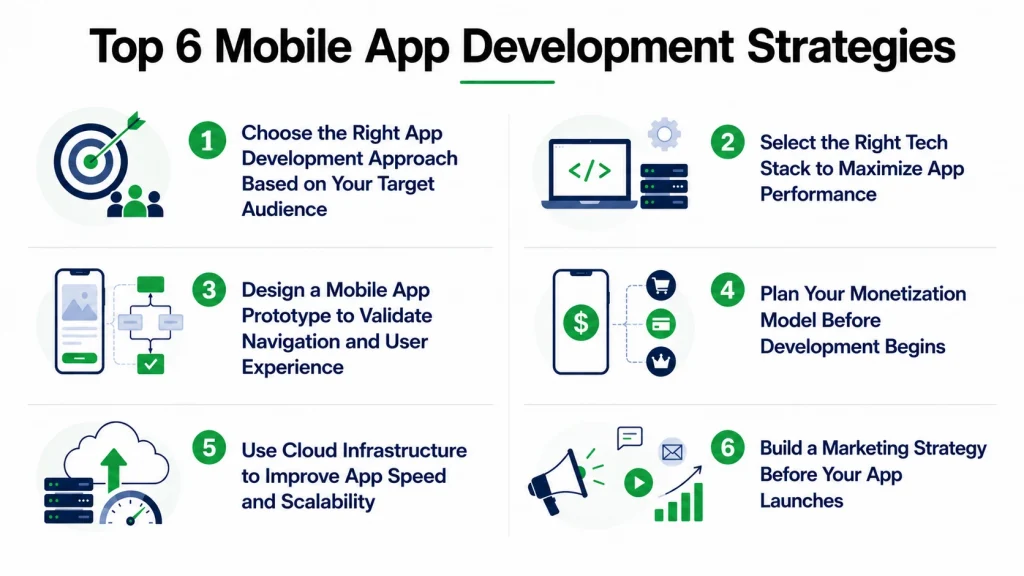
The right mobile app development strategy does not just guide your development team. It shapes every decision that determines whether your app gains traction or gets buried. In this section, we break down six strategies that define your mobile app development process and help you build an app aligned with your business goals, your users’ expectations, and the competitive market you are entering.
1. Choose the Right App Development Approach Based on Your Target Audience
One of the most expensive mistakes businesses make is starting development without evaluating which app type actually fits their audience, budget, and launch timeline. Choosing the wrong approach can double your cost of app development or result in launching on a platform where your target users do not exist.
Before writing a single line of code, you need to decide whether a native, cross-platform, or web app approach is the right fit for your application development strategy. Each comes with different trade-offs in performance, cost, and speed to market.
Here is how the three approaches compare:
| Factor | Native Apps | Cross-Platform Apps | Web Apps |
| Definition | Built for a single OS (Android or iOS) using platform-specific languages | Built with one codebase that runs across multiple platforms | Accessed through a browser without requiring a download |
| Languages | Swift, Kotlin, Java, Objective-C | Dart (Flutter), JavaScript (React Native), C# (.NET MAUI) | HTML, CSS, JavaScript |
| Performance | Highest | Medium to High | Medium |
| Development Cost | Higher (separate codebases) | Lower (single codebase) | Lowest |
| Time to Market | Longer | Faster | Fastest |
| Best For | Apps needing heavy device integration, complex animations, or maximum performance | Apps targeting both platforms with budget constraints and faster timelines | Apps requiring broad accessibility without app store distribution |
| Examples | Google Maps, LinkedIn | Instagram, Uber | Google Docs, Netflix (web) |
If your priority is reaching both Android and iOS users without doubling your budget, cross-platform development using frameworks like Flutter or React Native is typically the right choice. If your app demands deep hardware access or the highest possible performance, native development gives you the most control. Read our detailed guide on native vs hybrid app development to understand the key differences.
For businesses looking to enter the market quickly, a cross-platform approach significantly reduces your launch timeline. This is especially relevant if you want to know how to launch an app faster without compromising on user experience across platforms.
That said, every approach comes with a different set of advantages and limitations. Understanding the difference between native and cross-platform development at a deeper level helps you make a decision based on facts, not assumptions. Getting clarity on this early also helps you set realistic expectations around budget and app development timeline before the project kicks off.
What you gain by getting this right:
- A development approach that matches your actual user base, budget, and business goals
- Clear expectations on timeline and platform coverage from day one
- A faster path to market and a competitive edge in your category
Not Sure Which App Development Approach Fits You?
Our team evaluates your audience, budget, and timeline to recommend the right development approach. Talk to us before you commit.
2. Select the Right Tech Stack to Maximize App Performance
Your tech stack is the foundation your entire app runs on. Selecting it based on developer familiarity rather than project requirements is one of the most common reasons apps run into performance bottlenecks, scalability issues, and high maintenance costs after launch.
A solid app development plan starts with understanding three factors: the platform you are targeting, the type of app you are building (mobile, web, or both), and the long-term scalability requirements of your product. Your developers need a clear picture of the target operating system and devices before evaluating which stack fits best. Having clarity on mobile app development platforms simplifies this decision significantly.
Here is a simplified breakdown of the most commonly used tech stacks in 2026:
- For native Android apps: Kotlin (Google’s recommended language), Java, Android SDK
- For native iOS apps: Swift (Apple’s recommended language), Objective-C, Xcode, iOS SDK
- For cross-platform apps: Flutter (Dart), React Native (JavaScript), .NET MAUI (C#)
- For backend and APIs: Node.js, Python (Django/FastAPI), Ruby on Rails, Go
- For databases: PostgreSQL, MongoDB, Firebase, Redis
One of the latest mobile app development tips that experienced teams follow is evaluating the stack not just for version 1.0 but for where the app needs to be in two to three years. A stack that works for 5,000 users may collapse under 500,000 users if scalability was not factored in from the start.
Also, you need clarity on whether you want to build a mobile app or a web app, as this directly impacts your stack selection. Making this decision upfront simplifies the entire development workflow and reduces the chances of a mid-project tech migration.
What the right tech stack gives your business:
- A product team that can build, iterate, and maintain the app using agile development workflows without running into framework limitations
- An app that scales smoothly as your user base grows without requiring a full rebuild
- Fewer compatibility issues and less time spent on debugging
- Lower long-term maintenance costs by avoiding tech debt from day one
3. Design a Mobile App Prototype to Validate Navigation and User Experience
Building a full app before testing whether users can actually navigate it is a costly mistake. Redesigning screens and user flows after development is already underway can add weeks to your timeline and thousands to your budget. Starting with wireframing and then moving to a clickable prototype lets you catch these issues early
Your app’s user interface is the first thing users interact with, and it directly shapes whether they continue using the app after the first session. This is why prototyping is one of the most important mobile app development tips that teams should never skip.
When designing your prototype, keep these factors in mind:
- Design for the right devices: UI layouts depend heavily on the target device. A design that works on a 6.7-inch smartphone will not automatically translate to a tablet or foldable screen. If you are targeting the Android ecosystem specifically, working with experienced Android app development companies helps you build responsive layouts tailored to the wide range of Android screen sizes and device specifications.
- Follow platform-specific design guidelines: iOS follows Apple’s Human Interface Guidelines, and Android follows Material Design principles. Your mobile app strategy should respect the platform conventions your users are familiar with, rather than forcing a single design pattern across both operating systems.
- Validate the complete user flow: Prototyping is not just about visual design. It is about testing the full customer journey a user takes from onboarding to the core action you want them to complete, whether that is purchasing, booking, subscribing, or any other conversion step. Test this flow with real users before committing development resources.
- Align your UI with business objectives: Your interface should not just look good. It should guide users toward the actions that matter for your business. Every screen, button, and interaction should serve a purpose within your overall mobile app strategy.
What prototyping gives your business:
- Usability problems are identified and fixed before they become expensive development changes
- A validated user flow that reduces post-launch redesign costs
- A polished UI that builds brand credibility and increases engagement beyond the first session
- Lower maintenance costs over time because the design foundation was tested before the build
4. Plan Your Monetization Model Before Development Begins
Treating monetization as an afterthought is one of the fastest ways to compromise your app’s user experience. When revenue features are bolted on after the app is already built, they disrupt the user flow instead of enhancing it. The best app development best practices require your monetization model to be defined during the strategy phase, not after launch.
According to Statista, total revenue in the global app market is projected to reach $739.61 billion in 2026, with in-app purchases alone accounting for $475.84 billion. The opportunity is massive, but only if your mobile application strategy includes a clear revenue plan from the beginning.
Here are the most common monetization models and when each one makes the most sense:
- In-app purchases (IAP): Users pay for premium features, virtual goods, or content upgrades inside the app. This works best for gaming, productivity, and content apps where users see clear value in unlocking additional functionality.
- Freemium: Basic features are available for free, and users pay to access advanced capabilities. This model works well for SaaS apps, fitness apps, and productivity tools where the free tier demonstrates enough value to drive conversions. Explore our complete guide on how free apps make money to understand this model in depth.
- Subscriptions: Users pay a recurring fee (weekly, monthly, or annually) for ongoing access. Subscriptions are the fastest-growing monetization model in the app market and are ideal for streaming, education, health, and productivity apps.
- In-app advertising: Revenue comes from users viewing or interacting with ads inside the app. This works best when you have high user volume, but your audience is unlikely to pay for premium features.
- Hybrid models: A combination of two or more models, such as freemium with ads for free-tier users and a subscription for premium users. Over 60% of top-grossing apps now use hybrid monetization strategies.
We have applied this strategy in practice. The TOR App was built with a freemium model where basic VPN features were free and advanced capabilities were offered through subscription plans. The app crossed 100K downloads within its first year.
What a monetization strategy gives your business:
- Revenue features designed into the user flow from the start, not retrofitted later
- A clear understanding of which user segments are most likely to convert to paying customers
- A freemium or trial approach that builds a large user base before pushing for conversions
- Investor and stakeholder confidence backed by a defined revenue model
Want to Build an App That Generates Real Revenue?
We help startups and enterprises plan monetization models that align with user behavior. Discuss your app idea with our team today.
5. Use Cloud Infrastructure to Improve App Speed and Scalability
Apps built on traditional on-premise servers struggle to handle sudden traffic spikes, demand heavy upfront investment, and create ongoing maintenance overhead that slows your development team. Adopting cloud computing eliminates these bottlenecks and is now considered one of the core best practices for mobile app development.
Apps like Netflix, Uber, Dropbox, and Gmail run entirely on cloud platforms because cloud architecture delivers the flexibility, speed, and scalability that traditional infrastructure simply cannot match.
Here is why cloud infrastructure matters at every level:
- For your development team, cloud platforms like AWS, Google Cloud, and Microsoft Azure provide pre-built services for authentication, storage, databases, push notifications, and analytics. Your developers do not need to build these components from scratch. With cloud-based mobile app development tools, your team focuses on shipping core features instead of managing server configurations.
If you are starting from the ground up, learn how to build an app from scratch using a cloud-first architecture that supports rapid iteration and deployment.
- For scalability, cloud infrastructure auto-scales based on real-time demand. If your app jumps from 1,000 to 100,000 users overnight, cloud services handle the load without manual intervention or downtime. This is critical for making apps more scalable without overprovisioning resources during low-traffic periods.
- For your budget, cloud platforms operate on a pay-as-you-go model. You pay only for the compute, storage, and bandwidth your app actually uses, rather than investing upfront in physical servers that sit idle most of the time.
One of the key tips for mobile app development that experienced teams follow is choosing your cloud provider based on the specific services your app needs (ML capabilities, edge computing, serverless functions), not just on pricing. The provider you select will influence your architecture decisions for years.
What cloud infrastructure gives your business:
- An app that handles traffic spikes without crashing or slowing down
- No physical server management, reducing operational cost and complexity
- Faster feature delivery because common backend services are available out of the box
- Built-in monitoring and analytics tools for real-time performance visibility
6. Build a Marketing Strategy Before Your App Launches
Most app owners wait until after their app is live to start thinking about marketing. By that point, app store algorithms have already buried the app under thousands of competitors, and there is no existing audience waiting to download it. A strong mobile app growth strategy ensures that when your app goes live, there is already demand, awareness, and a pipeline of early adopters.
Developing a mobile strategy for marketing is not a post-launch task. It should begin during the development phase and cover both pre-launch and post-launch activities.
Here is what a complete app marketing strategy should include:
- App Store Optimization (ASO): Your app’s title, description, keywords, screenshots, and preview video directly affect its organic visibility on the App Store and Google Play. Optimizing these elements before launch gives your app a discoverability advantage from day one.
- Pre-launch audience building: Create a landing page, collect email signups, and build a waitlist before your app is available for download. This gives you a base of engaged users who are ready to install on launch day and provide early reviews and feedback.
- Social media and content marketing: Share development updates, feature previews, and problem-focused content that positions your app as the solution to a real user need. This builds anticipation and establishes credibility before the app is even available.
- PR and influencer outreach: Getting coverage from tech publications, industry blogs, and relevant influencers amplifies your launch beyond your existing network. A single well-placed feature can drive thousands of installs in the first week.
- Paid user acquisition: Running targeted install campaigns on platforms like Google Ads, Meta, and TikTok in the first 72 hours after launch can boost your app store ranking, which in turn drives more organic downloads.
- Post-launch retention: Push notifications, in-app onboarding sequences, and referral programs keep users active after the initial download. Retention is where most apps fail, so your marketing strategy must extend well beyond launch day. This is one of the most overlooked but critical elements of any mobile app development strategy.
What a marketing strategy gives your business:
- A launch-day audience that already knows about your app, instead of launching into silence
- Higher app store rankings from early download momentum, driving organic growth
- A structured post-launch plan focused on retention, not just acquisition
- Lower long-term customer acquisition costs through organic channels and referral loops
Ready to Turn Your App Idea Into a Product?
From strategy to launch, our team has delivered 4,400+ apps across healthcare, fintech, logistics, and on-demand services worldwide.
Build Your Mobile App With a Team That Has Delivered 4,400+ Apps
A strategy only works when it is backed by a team that knows how to execute it. Space-O Technologies is a leading mobile app development company with 15+ years of experience turning app ideas into products that drive real business outcomes.
From platform selection and UX prototyping to cloud architecture and go-to-market planning, our team works with you at every stage. We have built apps for startups raising their first round and enterprises scaling to millions of users, across industries including healthcare, fintech, logistics, and on-demand services.
If you are ready to apply these strategies to your own app, get in touch with our team. We will help you define a mobile app development strategy that fits your goals, timeline, and budget.
Schedule your free consultation to get started.
Frequently Asked Questions
What is the first step in creating a mobile app development strategy?
The first step is identifying your target audience and validating whether the problem your app solves has real market demand. This involves conducting competitor research, analyzing user behavior, and creating user personas before deciding on your platform, technology stack, or feature set.
How much does it cost to develop a mobile app from scratch?
A simple mobile app typically costs between $25,000 and $60,000. Medium-complexity apps with custom UI and backend integrations generally range from $60,000 to $150,000. Enterprise-grade applications with AI, real-time functionality, or complex workflows can cost $150,000 to $300,000 or more, depending on project scope and technical requirements.
How long does it take to build and launch a mobile app?
Simple apps usually take 3 to 4 months to build, while medium-complexity applications require approximately 4 to 8 months. Enterprise-level apps with advanced features often take 9 to 12 months or longer. Launching with a Minimum Viable Product (MVP) is the fastest way to validate your idea and reduce time to market.
Should I build a native app or a cross-platform app?
Native app development is ideal for applications requiring maximum performance, complex animations, or deep device integration. Cross-platform frameworks such as Flutter and React Native are better suited for businesses that want to launch on both iOS and Android quickly while maintaining a single codebase and lower development costs.
What is an MVP and why is it important for app development?
A Minimum Viable Product (MVP) is the simplest version of your application that includes only the essential features needed to validate your idea with real users. Building an MVP reduces development costs, shortens time to market, minimizes business risk, and helps prioritize features based on actual customer feedback.
How do I choose the right app monetization strategy?
Your monetization strategy should align with your app category and target audience. Subscription models work well for recurring services, freemium models with in-app purchases suit feature-rich applications, advertising performs best for high-volume free apps, and hybrid models combine multiple revenue streams to maximize profitability.
What are the biggest reasons mobile apps fail after launch?
The most common reasons include inadequate market research, poor user experience, choosing the wrong platform, weak onboarding, lack of a marketing strategy before launch, and failing to respond to user feedback. Most unsuccessful apps can trace their problems back to insufficient planning before development began.
How do I measure the success of my mobile app?
Key performance indicators include Daily Active Users (DAU), user retention rates, session duration, churn rate, Customer Acquisition Cost (CAC), and Lifetime Value (LTV). If your app generates revenue, you should also monitor Average Revenue Per User (ARPU), subscription growth, and free-to-paid conversion rates.
When should I outsource app development vs. building in-house?
Outsourcing is a good option when you need to launch quickly, lack internal technical expertise, or have a project-based requirement. Building an in-house team makes more sense for businesses developing a core product that requires continuous iteration and long-term ownership. Many companies outsource the initial development and later manage ongoing improvements internally.
How often should I update my mobile app after launch?
Most mobile apps should be updated every 2 to 4 weeks during the first three months after launch to resolve bugs, improve onboarding, and optimize performance. Once the product stabilizes, monthly or bi-monthly updates are recommended to introduce new features, maintain security, and ensure compatibility with the latest operating system releases.



 All our projects are secured by NDA




 4.8
4.8