
 By
By 
Table of Contents
You have a startup idea you genuinely believe in, but one question keeps coming back: What if I spend months building it and users still don’t care? That fear is real, and it’s one of the biggest reasons startups lose time, money, and momentum early on.
This is why MVP development for startups is often the smartest way to begin. Instead of building a full product upfront, you launch a simplified version of your web app, mobile app, or software with only the core features. This lets you validate the idea, learn what users actually want, and improve the product before scaling.
And the growing adoption of MVPs proves how valuable this approach has become. Intel Market Research estimates the global MVP development market was valued at USD 288 million in 2024 and reached around USD 315 million in 2025, with projections to grow to nearly USD 541 million by 2031.
In this complete guide, we cover everything you need to know about MVP development for startups, including the process, key benefits, estimated costs, timeline, and expert tips. We will also explain how partnering with an experienced MVP development company can help you build an MVP that is scalable, user-focused, and built for success.
What is MVP Development in a Startup?
The Minimum Viable Product is the most basic version of a product with just enough features to be usable by early customers and validate a business idea.
Startup MVP development is particularly beneficial because the approach enables you to test your assumptions, understand your audience’s true needs, and make data-driven improvements without committing substantial time or resources upfront. The method helps mitigate risk while ensuring that the product you are building is aligned with market demand.
Consider how the approach changes by product type. A web app built through the MVP development process for startups might focus on core functionalities such as account creation or content sharing, while deferring more complex features like analytics or user profiles to future iterations.
Whereas mvp app development for startups may prioritize intuitive navigation and essential interactions, such as booking or tracking, to quickly gauge user interest. MVP software development delivers the fundamental tools needed to solve a critical business challenge, without the inclusion of advanced features or integrations.
MVP vs. Prototype vs. Proof of Concept: What is the Difference?
Startups often confuse MVPs with prototypes and proof of concepts. All three are pre-launch tools, yet each serves a different purpose at a different stage. Building MVP for startups without understanding those distinctions leads to wasted budget and rework.
A proof of concept (PoC) answers one question: Is this idea technically feasible? It is an internal exercise that tests whether the core technology works. A PoC is not designed for end users. It is built for the founding team and technical stakeholders to confirm that the solution can be built before investing further.
A prototype is a visual or interactive representation of how the product will look and feel. It tests the design, layout, and user flow. Prototypes are clickable mockups, not functional products. Users cannot complete real tasks with a prototype, but they can provide feedback on usability and experience.
An MVP is a fully functional product with a minimal set of features that real users can actually use. Product validation at this stage tests three things at once: desirability, meaning users want it, viability, meaning the business can sustain it, and feasibility, meaning the team can build it. Unlike a prototype, an MVP processes real data, supports real transactions, and generates real feedback.
| Attribute | Proof of Concept | Prototype | MVP |
|---|---|---|---|
| Purpose | Test technical feasibility | Test design and usability | Test market demand and value |
| Audience | Internal team | Stakeholders, test users | Real end users |
| Functionality | Non-functional or partial | Clickable but not functional | Fully functional core features |
| Cost range | $2,000–$10,000 | $5,000–$15,000 | $10,000–$50,000+ |
| Timeline | 1–2 weeks | 2–4 weeks | 8–16 weeks |
| Outcome | “Can we build it?” | “Does it look and feel right?” | “Do users want and need this?” |
The typical startup MVP development sequence is to validate the concept with a PoC, test the user experience with a prototype, and then validate real market demand with an MVP. Skipping straight into MVP development without prototyping often results in expensive redesigns after launch, which is why founders need to understand the differences between these stages. Read our detailed guide on MVP vs Prototype vs PoC to choose the right approach for your startup.
6 Benefits of MVP Development for Startups
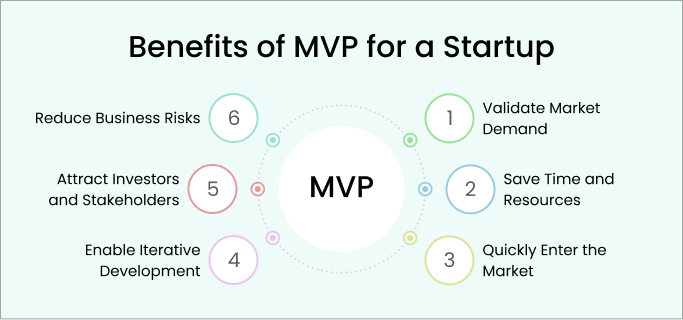
Startups operate in dynamic, high-pressure environments where every decision counts. Resources are often limited, timelines are tight, and there’s little room for error. Partnering with specialized MVP development companies offers startup businesses a practical, efficient approach to overcoming these challenges through MVP development. Here’s why MVPs are crucial for startups:
-
Validate market demand before building
An MVP helps startups validate market demand before investing in full-scale product development. By launching a product with only its core features, founders can test whether their solution solves a real customer pain point and gather user feedback from early adopters. This validation reduces guesswork and helps confirm product-market fit before scaling.
-
Save startup time and development resources
Instead of building every planned feature, an MVP focuses on the essential functionality required to deliver value. The lean approach shortens development time, lowers costs, and allows startups to allocate resources more efficiently. Agencies offering MVP development services for startups structure their sprints around exactly this trade-off, so teams prioritize high-impact features based on real user needs rather than assumptions.
-
Enter the market faster with an MVP
Speed is critical for startups. An MVP enables businesses to launch faster, reach early users, and start collecting market insights before competitors. Early market entry also creates opportunities to refine the product, build brand awareness, and establish a competitive advantage while demand is still growing.
-
Enable iterative, feedback-driven development
An MVP supports an iterative development process where each product update is guided by real customer feedback and product analytics. Startups can continuously improve features, fix usability issues, and adapt to changing market needs. This Build-Measure-Learn cycle results in a product that better aligns with user expectations.
-
Attract investors and stakeholders
A working MVP demonstrates that your idea has been tested in the market and backed by user validation. Showing customer adoption, engagement metrics, or early revenue makes it easier to build investor confidence. Founders moving from bootstrapping toward seed funding gain far more traction with a pitch deck backed by live usage data, whether they are approaching an angel investor, a venture capital firm, or an incubator or accelerator program. A validated MVP also provides stakeholders with tangible evidence that the business model has growth potential.
-
Reduce business risks
Developing a complete product without validating assumptions can lead to wasted time and budget. Building MVP for startups minimizes business risk by testing the core concept before major investments are made. Startups can identify product flaws, understand customer behavior, and make data-driven decisions that improve the chances of long-term success.
Launch Your Startup with an MVP Now
Our developers will work closely with you to create a tailored MVP that reflects your vision and meets the needs of your target audience.

Types of MVPs: Which One Fits Your Startup?
Startup MVP development takes several forms, each tailored to specific business goals and development stages. The breakdown below covers common MVP types, along with examples and when to use them:
-
Concierge MVP
A concierge MVP flips the idea of automation on its head. Instead of building a fully functional product, you manually deliver the service to early customers. This approach includes:
- Direct interaction with users: Spend time understanding individual needs and tailoring your service accordingly.
- Personalized experiences: Offer a high level of customization to showcase your product’s value.
Why use concierge MVP?
The hands-on approach lets you collect real-time feedback, learn about user preferences, and identify pain points without heavy investment in technology. This method is perfect for refining your service idea in its early stages.
-
Wizard of Oz MVP
With this approach, you create the illusion of a complete product, but behind the scenes, everything is operated manually. Here’s how it works:
- Simulated functionality: Design a user-facing interface that looks fully operational.
- Manual backend operations: Handle all processes, like data collection or customer support, manually.
Why use Wizard of Oz MVP?
The Wizard of Oz MVP allows you to test complex ideas, gauge user behavior, and validate interest without developing a fully automated system. It’s particularly useful for testing concepts that require significant technical investment.
-
Single-feature MVP
A single-feature MVP focuses on delivering one core functionality of the product that addresses a specific user problem. Instead of building a product with a suite of features, this approach prioritizes simplicity and direct value.
- Single focus: The MVP concentrates on one feature that solves a critical user pain point or highlights the product’s unique selling proposition.
- Ease of development: With fewer features, the product can be developed quickly and with minimal resources.
- User feedback: The simplicity of a single-feature MVP allows users to focus on evaluating the primary feature, making feedback more targeted and actionable.
Why use single-feature MVP?
- Testing core ideas: This approach is ideal for validating the core concept behind a product. By focusing on a single feature, startups can assess whether their idea resonates with potential users before investing in additional features.
- Differentiation in competitive markets: A single-feature MVP allows startups to showcase a unique feature that sets them apart from competitors. This differentiation can attract early adopters who are interested in innovative mvp solutions for startups.
-
Piecemeal MVP
A piecemeal MVP leverages existing tools, technologies, and services to create a functional product prototype without starting the development process from scratch. This type of MVP combines off-the-shelf components to deliver a coherent experience to users.
- Use of pre-built tools: This approach involves integrating various platforms and third-party APIs, such as WordPress, Google Forms, or other software solutions, to provide necessary functionalities without extensive coding. This allows startups to quickly assemble a product using readily available resources.
- Core functionality first: The primary focus is on solving the main user problem. The MVP should demonstrate the product’s potential value by showcasing its essential features without unnecessary complexity.
Why use piecemeal MVP?
- Cost and time efficiency: For startups operating with limited budgets and tight timelines, existing tools can significantly reduce both development time and costs. Piecemeal builds remain one of the fastest routes into MVP development for startups, and the approach allows for quicker market entry.
- Rapid testing and feedback: By assembling a functional product, businesses can test their concepts and gather customer feedback efficiently. This feedback is invaluable for refining the product before committing to full-scale development.
-
High-Fidelity MVP
A high-fidelity MVP is a more polished, functional version of your product. It closely resembles the final product, offering a better user experience but requiring more resources to develop.
- Advanced prototyping: High-fidelity MVPs are more polished and closely resemble the final product. They include a higher level of design and functionality, allowing for a more realistic user experience.
- Comprehensive features: These MVPs often incorporate multiple features, providing a better representation of how the product will function in its final form.
Why use high-fidelity MVP?
- Accurate user feedback: Because they mimic the final product closely, high-fidelity MVPs enable users to provide more detailed and actionable feedback based on their experience with the product.
- Engagement: Users are more likely to engage with a high-fidelity MVP due to its professional appearance and functionality, which can lead to better insights into user behavior and preferences.
- Market testing: High-fidelity MVP solutions for startups allow businesses to test their product in a competitive environment, helping to identify potential growth strategies and market fit.
-
Low-Fidelity MVP
A low-fidelity MVP is a basic and cost-effective prototype designed to test the core concept or validate the initial idea quickly.
- Simpler design: Focused on essential features and minimal design.
- Quick development: Requires fewer resources and can be built in a shorter timeframe.
Why use low-fidelity MVP?
- Cost-effective: Low-fidelity MVPs require less investment and can be produced quickly, making them ideal for startups with limited budgets.
- Rapid testing: They allow businesses to test assumptions about their market and gather initial feedback before committing significant resources to full-scale development.
- Flexibility: Startups can create multiple low-fidelity MVPs to explore different ideas or features without substantial costs.
-
Landing page MVP
A landing page MVP is one of the simplest and most effective ways to validate a product idea before diving into the full-scale development process. It involves creating a single webpage designed to:
- Introduce your product or service: Clearly explain what your product is about, the problem it solves, and the benefits it offers. Use simple, concise language to grab attention quickly.
- Include engaging visuals: Use images, graphics, or videos to make the page visually appealing and help users better understand the concept. Visuals are especially important for demonstrating the product’s value.
- Provide calls to action (CTAs): Add sign-up forms, “Learn More” buttons, or pre-order options to measure user interest. CTAs help collect valuable data, such as the number of visitors who are willing to engage or leave their email addresses.
Why use landing page MVP?
Landing page MVPs rank among the quickest and most cost-effective MVP solutions for startups, making them ideal for gauging initial interest in your idea. The data gathered, such as traffic, click-through rates, and sign-ups, can help determine whether your product has market potential.
Looking for an Affordable MVP Solution?
We can help. At Space-O, we deliver cost-effective MVPs with top-notch quality. Our agile process means you get your product fast and within budget.
Minimum Viable Product Examples from the Real World
Some of the most recognizable products today launched as stripped-down versions of themselves. Each one tested a single assumption before the full product existed. Here are examples of startup MVP development that worked, and what each team actually validated.
Dropbox validated demand with a video
Dropbox started as a simple MVP that let users upload files and access them from any device. File syncing was a hard engineering problem, so building first carried real risk.
Instead, the founders recorded a short demo video showing how syncing would work. The product was not built yet. Sign-ups and pre-orders climbed quickly after the video circulated, which confirmed the demand before development began.
What it validated: People wanted seamless file access across devices.
Instagram launched with photos, filters, and sharing
Instagram’s first version let users take photos, apply filters, and share them with friends. None of today’s advanced features existed. There were no stories, no messaging, and no reels.
MVP app development for startups rarely gets narrower than that, and the feature set was enough to answer the core question. Users adopted it quickly, which proved people wanted a social platform built specifically around photo sharing.
What it validated: Demand for a photo-first social network.
Buffer tested scheduling before building analytics
Buffer’s MVP did one thing, which was scheduling social media posts in advance. The version users first signed up for had no analytics dashboard and no team collaboration tools.
The founders also tested pricing early, not just interest. Sign-ups measured curiosity, while clicks on the pricing page measured willingness to pay. Those are two different signals, and most founders only test the first.
What it validated: Users would pay to schedule posts ahead of time.
Fyule Video Lab validated engagement before scaling
Space-O Technologies built Fyule Video Lab, a video learning platform for an EdTech startup. The first release focused only on the core loop, which was uploading content, structuring lessons, and letting students engage with them.
We used Flutter, PHP, Laravel, and MySQL to launch across iOS, Android, and the web from a single codebase. That choice kept the build lean while covering all three platforms.
The validated product later secured $1.4 million in funding through an Angel syndicate backed by senior leaders from Google, Deloitte, Tata 1mg, and Axis Capital.
What it validated: Students would engage with structured video learning at scale.
The pattern behind every example:
Each of these MVP solutions for startups was designed to test one specific hypothesis, quickly and cost-effectively. None of them launched with the feature set the product is known for today.
The discipline is the same in every case. Identify the assumption that would sink the business if it were wrong, then find the cheapest honest way to test it. Let the result decide what gets built next.
How to Build an MVP for Your Startup: Step-by-Step Process
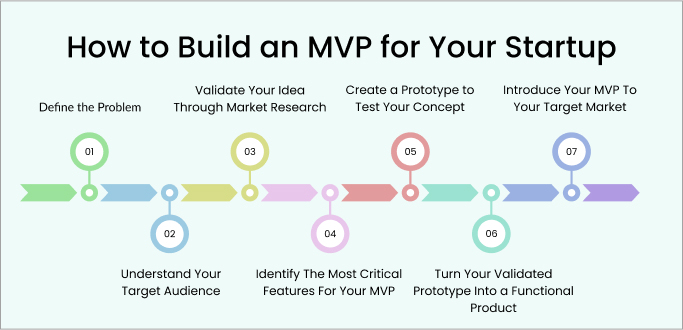
Building an MVP for startups requires a strategic approach to ensure your product addresses user needs effectively and provides valuable insights for future development. Here’s a step-by-step guide to help you get started:
-
Define the problem
Every successful product solves a specific problem. Start by deeply understanding the issue your MVP aims to address. Clarity here establishes problem-solution fit before a single line of code exists, and it protects you from the two most common early failures: unclear requirements that inflate the build, and poor validation that sends the team down the wrong path.
Questions to guide you:
- What is the specific problem you’re solving?
- Why is this problem worth solving now?
- How does solving it add value to your users?
-
Understand your target audience
To design an MVP that meets your users’ needs, you must first understand who they are. Build a detailed profile of your target users and target audience to ensure your solution aligns with their preferences and expectations.
Steps to execute:
- Create detailed user personas: Include demographic information (age, gender, income, etc.), behavioral traits, pain points, and goals.
- Map the customer journey: Outline how potential users discover, interact with, and experience your product. Identify friction points and opportunities to enhance their journey.
-
Validate your idea through market research
Thorough market research validates your idea and helps you position your MVP effectively. Understanding the competitive landscape and user demand is crucial to avoid building a product that doesn’t resonate.
Key actions:
- Analyze competitors: Study their features, strengths, and weaknesses. Look for gaps in their offerings that your MVP can fill.
- Engage with users: Use surveys, interviews, and focus groups to gather firsthand insights about their needs and preferences.
- Examine market trends: Stay updated on industry shifts and technological advancements to ensure your solution remains relevant.
- Run a smoke test: Publish a landing page or ad campaign for the product before it exists and measure sign-ups. The response tells you whether real demand backs your assumption.
- Map it on a Lean Canvas: Document your problem, customer segments, unique value proposition, and revenue streams on a single page so every assumption stays visible and testable.
-
Identify the most critical features for your MVP
An MVP should focus solely on the most essential features that demonstrate your product’s value. Feature bloat is the most common way early builds run over budget, so move anything non-essential into a backlog and place it on your product roadmap for a later release. An MVP roadmap keeps that separation explicit, so your first build stays lean while the longer-term plan stays visible to investors and your team.
How to prioritize:
- Brainstorm features: List all the features you envision for your product.
- Rank by importance: Use criteria such as relevance to the problem, user demand, and technical feasibility.
- Define the core set: Narrow down to the most critical features that showcase your product’s value.
-
Create a prototype to test your concept
Before committing to full development, create a prototype to visualize your product and gather initial feedback. A prototype helps validate your concept and refines the user experience.
Recommended tools:
- For design: Use tools like Figma or Sketch to create high-fidelity wireframes.
- For interactive mockups: Platforms like InVision enable you to simulate user flows.
- For functional prototypes: Use no-code platforms like Bubble to build a basic working model.
-
Turn your validated prototype into a functional product
With a validated prototype, move to the actual development of your MVP. Building MVP for startups at this stage means keeping focus on speed, quality, and delivery of core functionality, with usability testing running alongside development rather than after it.
Best practices:
- Stick to the prioritized features and avoid scope creep.
- Follow agile development methodologies to iterate quickly and respond to changes.
- Set up version control from day one so every change is traceable and reversible.
- Configure a CI/CD pipeline early. Automated builds and deployments cost a few hours to set up and save weeks across the project.
- Choose your database schema with future growth in mind, since data migrations get expensive after launch.
- Test frequently to ensure a seamless user experience before launch.
-
Introduce your MVP to your target market
Introducing your MVP to the market is a pivotal moment in startup MVP development. Your go-to-market strategy decides how much signal that product launch generates, so plan a staged beta launch that puts the product in front of a controlled group before wider release.
Steps to follow:
- Target a limited audience: Focus on early adopters or beta testers who can provide constructive feedback.
- Leverage promotion channels: Use platforms like Product Hunt, social media, or a dedicated landing page to generate interest.
- Incentivize participation: Offer rewards, such as discounts, exclusive features, or early access, to encourage user engagement.
We have covered the essential steps involved in MVP development for startups—from defining the problem and understanding your target audience to prototyping, validating, and finally launching your product.
This step-by-step guide is designed to equip you with practical insights and actionable strategies needed to build a successful MVP that truly resonates with your users.
If your startup operates in the SaaS industry, you may face unique challenges and opportunities. In that case, our detailed guide on SaaS MVP development offers an in-depth perspective tailored specifically to the needs of SaaS startups.
As you move forward in your MVP journey, it’s important to be aware of potential hurdles along the way.
AI in MVP Development: What Startups Need to Know
Artificial intelligence (AI) is transforming startup MVP development. Instead of spending months on manual research, development, and testing, startups can use AI to accelerate product development, analyze user behavior, and make informed decisions throughout the MVP lifecycle.
AI supports the MVP process by improving speed and efficiency. However, it does not replace the fundamentals of MVP development. Startups still need to identify a real customer problem, validate market demand, and collect user feedback before scaling their product.
How AI improves MVP development for startups
1. Faster market research
AI tools can analyze customer reviews, survey responses, competitor offerings, and online discussions to uncover market trends and customer pain points. This helps startups validate business ideas and understand customer needs before investing in product development.
2. Smarter feature prioritization
AI can process user feedback and product data to identify the features that deliver the most value. This allows startups to prioritize essential functionality, reduce feature creep, and focus on building an MVP that solves the primary user problem.
3. Faster MVP development
AI-powered coding assistants, no-code platforms, and low-code tools help development teams build prototypes and MVPs more efficiently. By automating repetitive tasks and generating code suggestions, AI reduces development time and helps startups launch their products sooner.
4. AI-assisted development in practice
Generative AI has moved from novelty to standard tooling in early-stage builds. Copilot tools suggest and complete code inside the editor, which cuts the time spent on boilerplate, tests, and documentation. Hosted LLM APIs let a small team ship intelligent features such as summarization, classification, or a support assistant without training a model. RAG, or retrieval-augmented generation, connects those models to your own documents so answers stay grounded in your data rather than invented. Prompt engineering is the skill that determines output quality across all of it, and it belongs with your engineering practice rather than treated as an afterthought.
5. Better user insights
Once the MVP is live, AI can analyze user behavior, customer feedback, and product analytics to identify usage patterns and improvement opportunities. These insights help teams make informed product decisions instead of relying on assumptions.
6. Continuous product improvement
AI enables startups to monitor key performance indicators such as user engagement, retention, feature adoption, and conversion rates. By tracking these metrics, teams can iterate quickly, improve the user experience, and move closer to achieving product-market fit.
Where AI adds the most value
AI can support MVP development for tech startup teams at every stage, including:
- Market research and idea validation
- Customer persona creation
- Feature prioritization
- Rapid prototyping
- MVP development
- Automated testing and quality assurance
- User behavior analysis
- Product analytics and reporting
- Product iteration based on real user data
AI supports decisions, not assumptions
AI is a powerful tool for improving productivity and accelerating development, but it should complement customer discovery rather than replace it. Successful MVPs are built by solving validated customer problems, testing assumptions with real users, and improving the product through continuous feedback. That cycle produces validated learning, which is the evidence you need to decide whether to persevere with the current direction or pivot to a different problem, segment, or business model. When startups combine AI with Lean Startup principles, they can reduce business risk, shorten time to market, and build products that better align with customer needs.
How to Measure MVP Success: Key Metrics for Startups
Launching your MVP is not the finish line. Measurement is the start of the most important phase in MVP development for startups, since real user behavior decides whether your startup idea is worth scaling. Many founders get distracted by vanity metrics like total downloads, sign-ups, or page views. These numbers may look impressive, but they rarely tell you if your product is truly solving a problem.
Instead, focus on the metrics below to evaluate traction, retention, and early product-market fit.
1. Activation rate
Activation rate measures the percentage of users who complete the core action after signing up. This is the first moment your users experience the real value of your product.
For example, in a booking app, the activation event could be completing the first booking.
- A healthy activation rate for a startup MVP is usually 20% to 40%.
- Below 15% often indicates weak onboarding, an unclear value proposition, or poor UX.
2. Day-7 retention rate
Day-7 retention tells you whether users find enough value to come back after the first experience. This is one of the strongest indicators of long-term potential.
According to Business of Apps, apps lose an average of 77% of daily active users within the first 3 days of installation. That is why retention matters more than downloads.
- If your MVP retains 20%+ users after Day 7, it is a strong early signal
- If retention drops below 10%, the problem may not be painful enough, or your solution is not sticky
3. Referral rate
Referral rate measures how often users recommend your MVP to others. Products that solve real problems naturally generate word-of-mouth growth, even at an early stage.
If you are spending heavily on acquisition and users are not referring others, your product-market fit is likely weak.
- Even 5% to 10% organic referrals at the MVP stage is a positive sign
4. Conversion rate (paid users)
If your MVP includes monetization, track the percentage of users who convert into paying customers. This validates whether users see enough value to pay, not just try the product.
- A 2% to 3% conversion rate at the MVP stage can be a strong signal
- If conversions are low, test pricing, packaging, and the value proposition before scaling
5. Customer acquisition cost (CAC)
CAC measures how much you spend to acquire one user through ads, campaigns, or outreach. The metric becomes critical once you start scaling marketing.
Compare CAC with expected lifetime value (LTV). Together the two define your unit economics, and if CAC exceeds LTV at the MVP stage, scaling will only amplify losses. Churn rate feeds directly into that calculation, since faster churn shortens LTV and breaks the math on whichever revenue model you have chosen.
- If CAC is too high, revisit your acquisition channels and positioning before growth efforts
Pro Tip for Startup Founders:Before launch, define 3 to 5 key metrics that align with your MVP goal and review them weekly. Building MVP for startups is not about proving your idea right. The job is to give you data so you can improve fast, iterate smarter, and scale with confidence.
How Much Does it Cost to Develop an MVP for Startups?
Costs for MVP development for startups vary widely depending on your project’s unique needs and the approach you take. Typically, the cost of developing an MVP for startups can range from $10,000 to $50,000. The final price depends on factors like feature complexity, platform choice (iOS, Android, or cross-platform), UI/UX design requirements, and your development team’s location.
- Basic MVP ($10,000–$25,000): Core features only, ideal for idea validation and early-stage startups. Takes 4–8 weeks to develop.
- Intermediate MVP ($25,000–$50,000): Enhanced UI/UX with essential integrations, suitable for startups seeking initial funding. Takes 2–4 months to develop.
- Advanced MVP ($50,000–$100,000+): Feature-rich product with third-party integrations and scalable architecture, designed for market-ready launch. Takes 4–6 months to develop.
What factors affect the cost of MVP solutions for startups?
Understanding the key cost drivers helps you plan your budget more effectively and avoid unexpected expenses. Several factors influence the final price of your MVP, from technical complexity to team composition. Here’s what impacts your MVP development cost the most:
- Scope of features: The more complex the features, the higher the MVP development cost. Starting with a streamlined feature set can help you reduce initial expenses while focusing on delivering core value to potential customers.
- Team structure: Team size and seniority drive your largest recurring cost. Hiring in-house adds salaries, benefits, and operational overheads. Many startups opt to outsource their projects to specialized MVP development companies, which often proves to be more cost-effective.
- Development approach: Choosing between web, mobile, or software development significantly affects the budget. A mobile app MVP built as part of MVP development for tech startup products may require additional investment if you target both iOS and Android.
- Location of the development team: Developers in regions like North America or Western Europe generally charge higher rates than those in Eastern Europe, Asia, or South America.
- Technology stack: The choice of technology (e.g., Python, React Native, Flutter) and integrations with third-party services or APIs can influence costs. Selecting modern, scalable technologies can save on long-term development and maintenance MVP costs.
- Timeline and development methodology: A shorter timeline or adopting agile methodologies can slightly increase initial costs but often leads to a better-quality MVP.
There’s a lot to think about, right? We’ve put together a detailed guide on the cost of building an MVP to help startups figure it all out.
At the end of the day, creating an MVP for startup companies is about striking the perfect balance between budget, timeline, and quality. With a clear plan and the right team, you can bring your idea to life without breaking the bank.
Common MVP Development Challenges for Startups
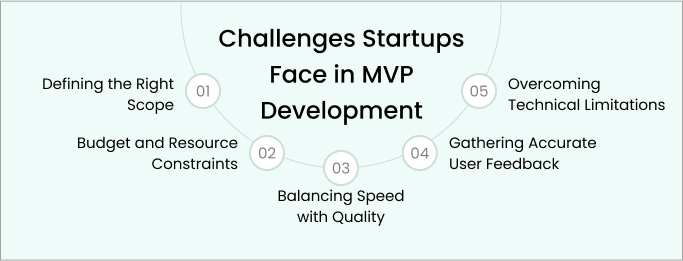
From balancing simplicity with functionality to navigating tight resources, startups must be prepared to tackle several hurdles during MVP development for startups.
Let’s explore the most common challenges and how to overcome them:
Challenge 1: Defining the right scope
One of the biggest hurdles in MVP development is deciding which features to include. Striking the right balance is critical an MVP with too many features can overwhelm users and drain resources, while one that’s too basic may fail to deliver sufficient value.
Why it’s challenging:
- Fear of missing out: Teams often worry that leaving out certain features might reduce user interest or competitiveness.
- Stakeholder pressure: There may be internal or external pressure to include every idea, request, or enhancement.
Challenge 2: Budget and resource constraints
Limited budgets and human resources are common for startups, making it challenging to deliver an MVP that balances quality, functionality, and cost-effectiveness.
Why it’s challenging:
- High development costs: Building even a basic product can be expensive, especially if technical expertise is required.
- Resource gaps: Startups may struggle to find skilled developers, designers, or marketers within budget constraints.
Challenge 3: Balancing speed with quality
Startups are often under pressure to launch quickly, but rushing development can lead to compromises in quality, usability, or functionality.
Why it’s challenging:
- Tight deadlines: Competitive pressures often demand rapid delivery, leaving little room for thorough testing.
- Stakeholder expectations: Early adopters and investors expect a polished experience, even for an MVP.
Challenge 4: Gathering accurate user feedback
Feedback from early adopters is crucial for refining the MVP, but startups often face challenges in collecting meaningful and actionable insights.
Why it’s challenging:
- Low user engagement: Without a well-defined target audience, users may not interact with the MVP as intended.
- Signal vs. noise: Separating valuable feedback from irrelevant or conflicting opinions can be difficult.
Challenge 5: Overcoming technical limitations
Technical challenges, such as choosing the wrong tools or building for scalability, can delay development or impact performance. MVP app development for startups adds platform-specific constraints on top of that.
Why it’s challenging:
- Limited technical expertise: Startups with small teams may lack access to skilled developers or advanced technologies.
- Scalability vs. simplicity: Building a product that can scale while keeping the MVP lightweight can be a complex balancing act.
Looking to Develop MVP Without Unnecessary Expenses?
Our expert team ensures you get the most out of your investment by building an MVP that’s both scalable and market-ready.
When to Hire an MVP Development Company vs. Build In-House
Choosing between an in-house team and an MVP development company depends on your startup’s budget, timeline, technical expertise, and long-term product goals. Some startups have the resources to build internally, while many compare the best MVP development companies for startups to accelerate product delivery and reduce development risks.
The table below compares both approaches to help you decide which option best fits your startup.
| Factor | Build In-House | Hire an MVP Development Company |
|---|---|---|
| Development Speed | Hiring and onboarding can delay the project. | Dedicated teams can start immediately and deliver faster. |
| Development Cost | Higher upfront costs for recruitment, salaries, and infrastructure. | Lower initial investment with predictable project costs. |
| Technical Expertise | Depends on your existing team’s skills. | Access to experienced developers, designers, QA engineers, and product experts. |
| Scalability | Scaling requires hiring additional team members. | Easily scale the team based on project requirements. |
| Product Strategy | Requires an experienced product manager to guide development. | Many companies provide product discovery, MVP planning, and feature prioritization. |
| Time to Market | May be longer due to team setup and internal processes. | Faster launch through established development workflows. |
| Long-Term Ownership | Full control over the team and development process. | Full ownership of the product remains with you after project delivery. |
Build in-house if
Choose an in-house team if you:
- Have an experienced product and engineering team.
- Plan to develop and maintain the product for the long term.
- Need complete control over day-to-day development, including your own Scrum or Kanban cadence and release planning.
- Have sufficient funding to hire and retain skilled professionals.
Hire an MVP development company if
Consider MVP development services for startups if you:
- Need to launch your MVP quickly.
- Want to validate your business idea before making significant investments.
- Lack an in-house development team.
- Need expertise in product discovery, UI/UX design, and software development.
- Want to reduce development costs and minimize project risks.
- Need a scalable team that can support future product iterations.
How to make the right choice
There is no one-size-fits-all approach. If your startup already has strong technical capabilities and plans to build multiple products, an in-house team may offer greater long-term value. However, if your primary goal is to validate market demand, collect user feedback, and reach the market faster, an experienced partner delivers the best MVP development for startups on a practical, cost-effective timeline. Founders can focus on business growth while experienced professionals handle product strategy, development, testing, and deployment.
Build Your Startup MVP with Space-O Technologies
For over 14 years, Space-O Technologies has been helping startups and enterprises businesses to develop MVP for healthcare , fintech, real estate, logistics, edtech, and e-commerce across globe. We blend Lean Startup principles with Agile development to make it easy to test your idea, get feedback fast, and fine-tune your product as you go with compliance and security in mind.
We focus on what matters most essential features so your MVP is cost-effective, validates your idea, and sets the stage for future growth.
Got an idea? Let’s make it happen. Our team of seasoned developers has run MVP development for startups at every stage, and we will guide you through each one. Schedule a meeting with our MVP development team today, and let’s build something amazing together.
Frequently Asked Questions
Can I build an MVP without a technical co-founder?
Yes, you can build an MVP without a technical co-founder. Many non-technical founders partner with an MVP development company that manages product architecture, development, and quality assurance while they focus on customer discovery, pricing, and market validation. Make sure you retain ownership of the source code, repository access, and project documentation from the beginning.
Should I hire an MVP development company or build my MVP in-house?
Hiring an MVP development company is often the fastest option if your goal is to launch within weeks rather than months. Building an in-house team typically requires 8 to 12 weeks per hire and increases long-term payroll costs. An experienced development partner provides designers, developers, QA engineers, and project managers from day one. Building in-house makes more sense after your startup has secured funding and requires continuous product development.
Can an MVP help my startup secure investor funding?
Yes. An MVP provides investors with real user data instead of assumptions, which turns a pitch deck from a set of projections into a record of measured behavior. Metrics such as user acquisition, activation, retention, and early revenue demonstrate product-market validation to any angel investor or fund. Space-O Technologies developed Fyule Video Lab, an eLearning platform that secured $1.4 million in angel funding after launch. The company also helped build Glovo, which later raised over $1.2 billion.
When should I start building a full product after launching an MVP?
Begin expanding your MVP once you consistently see strong user retention for two to three months, repeat usage, low churn, and customers requesting additional features. Paying customers are the clearest signal that your product is ready to move beyond MVP development into full-scale product development.
Can an MVP be scaled into a production-ready application?
Yes, provided the MVP is built using scalable architecture rather than disposable prototype code. Modular APIs, well-structured services, and deployment on cloud platforms such as AWS, Azure, or Google Cloud make it easier to evolve the MVP into a production-ready application without rebuilding from scratch.
How do startups collect and prioritize user feedback after launching an MVP?
Successful startups collect feedback through in-app surveys, customer interviews, analytics, session recordings, and support requests. They then prioritize improvements using frameworks such as RICE or MoSCoW. Focus on recurring feedback that improves user activation, retention, or reduces churn rather than isolated feature requests.
How do I choose the right technology stack for my startup MVP?
Select technologies that enable rapid development and are easy to scale later. React and Flutter are popular frontend choices, while Node.js, Laravel, and Python power many startup backends. On the database side, PostgreSQL works well for structured data, MongoDB suits applications with flexible schemas, and Firebase gives small teams authentication, hosting, and a realtime backend without dedicated infrastructure work. Choose your stack based on product requirements rather than industry trends.
How do I protect my startup idea before sharing it with an MVP development team?
Sign a non-disclosure agreement (NDA) before discussing confidential product details. Your agreement should also confirm intellectual property ownership, source code ownership, repository access, and documentation rights. Reputable MVP development companies include these protections as part of their standard engagement process.
What happens if my MVP fails to gain user traction?
A failed MVP still provides valuable market insights. Analyze user behavior to identify where customers drop off, then refine your messaging, target audience, or core functionality before iterating. The purpose of MVP development is to validate ideas at a lower cost before investing in a full-scale product.
How do I choose the right MVP development partner for my startup?
Look for a company with proven startup experience, successful funding case studies, transparent development processes, clear sprint planning, code ownership policies, and post-launch support. Ask for references and avoid companies that provide fixed pricing before understanding your product requirements.
Can AI speed up MVP development for startups?
Yes. AI tools accelerate software development by assisting with code generation, testing, documentation, and content creation. They can significantly reduce development time for boilerplate functionality and repetitive tasks. However, experienced developers are still essential for application architecture, security, business logic, and quality assurance.
What is an MVP in startup development?
An MVP (Minimum Viable Product) is the simplest working version of a product that solves one core problem for real users. Unlike a prototype, which validates an idea, an MVP validates market demand by collecting feedback from actual customers with a limited but functional feature set.
What is the 80/20 rule for startups?
The 80/20 rule, also known as the Pareto Principle, suggests that approximately 80% of business results come from 20% of efforts. During MVP development, founders apply this principle by building only the small set of features that delivers the highest value to users while avoiding unnecessary functionality.
How do I make an MVP for my startup?
Build an MVP by following six key steps: validate the problem, identify the core features, design user flows, develop the product, test it with early adopters, and launch to a limited audience. Most startup MVPs take between 8 and 16 weeks when the scope is clearly defined before development begins.
What makes MVP development valuable for startups?
MVP development helps startups validate market demand before making a significant investment. It reduces development costs, shortens time to market, generates early customer feedback, and provides real-world data that supports future product decisions and investor conversations.
How do startups use cloud IDEs for MVP development?
Cloud IDEs such as GitHub Codespaces, Replit, and AWS Cloud9 allow distributed development teams to code, review, and deploy applications directly from the browser without local environment setup. This improves collaboration, speeds onboarding, and ensures every developer works in a consistent development environment.



 All our projects are secured by NDA




 4.8
4.8