
 By
By 
Contents
The apps that make the most money are the ones that charge nothing to download. That sounds contradictory, but it answers the question of how do free apps make money in 2026.
Free apps make money by offering core features at no cost to build a large user base, then monetizing that audience through multiple revenue channels. The most common ones include in-app advertising, in-app purchases, subscriptions, freemium upgrades, data monetization, affiliate marketing, and sponsorships. The download is free. The revenue comes from what users do after the install, not before it.
Think about the apps on your phone right now. Spotify, Instagram, YouTube, Google Maps, Duolingo. None of them costs anything upfront. All of them generate billions in annual revenue. Even simple mobile app ideas to make money depend entirely on which monetization model gets built into the product.
Choosing the right monetization model is not a pricing decision. It is a product design decision that shapes how users sign up, stay engaged, and eventually pay.
Space-O Technologies has built 4,400+ mobile apps since 2010 across food delivery, healthcare, fintech, and education. Glovo, a free-to-download on-demand delivery app developed by Space-O Technologies, secured USD 1.2 billion in funding, crossed 100 million downloads, and was selected by Apple for its “Best of 2016” award.
This guide covers everything you need to know about how to create an app and make money in 2026, with 13 proven strategies, real examples, and common mistakes to avoid when making a free money app.
How Do Free Apps Make Money Without Charging Users?
Free apps make money through in-app ads, in-app purchases, subscriptions, freemium upgrades, and hybrid models that combine multiple revenue sources. This is why the vast majority of apps are free in the first place.
Charging upfront limits downloads. Offering a free app opens the door to millions of users who can be monetized over time. The larger the user base, the more revenue each of these models can generate. Understanding how free apps make money starts with looking at how heavily the market leans toward free downloads.
- As of May 2026, roughly 97% of apps on both Google Play and the Apple App Store were free to download. The remaining 3% were paid listings. (Statista)
- In April 2025, approximately 81% of all Android apps on the Amazon Appstore were free. The remaining 19% were paid downloads. (Statista)
These numbers confirm that free apps are not just more common but also more profitable. But not every free app earns the same way. Some lock features behind a paywall. Others stay entirely free and earn through ads alone. Anyone looking to make money from an app needs to understand how these models differ before choosing one.
What is the difference between free apps, freemium apps, and paid apps?
Free apps charge nothing to download and earn entirely through ads or data monetization. Freemium apps are also free to download, but lock premium features behind a paywall or subscription. Paid apps charge an upfront fee before the user can access anything.
Each model attracts a different type of user and generates revenue at a different stage of the user journey.
Free apps
Free apps offer full functionality at no cost to the user. The entire revenue comes from third-party sources, such as in-app advertising, sponsorships, or data monetization. Instagram, YouTube, Facebook, and TikTok follow this model. The app stays completely free, and advertisers pay to reach the user base.
This model works best for apps that can attract a massive user base quickly. The tradeoff is that revenue depends on user volume and engagement rather than direct payments from users.
Freemium apps
Freemium apps are free to download but restrict certain features, content, or tools behind a paywall. Users can access basic functionality without paying. Revenue comes when users upgrade to a premium tier through in-app purchases or subscriptions.
Spotify, Duolingo, and Canva follow this model. The free version builds habit and trust. The paid version removes limits, unlocks advanced tools, or removes ads. Most successful subscription apps in 2026 operate on a freemium-to-subscription pipeline.
Paid apps
Paid apps require an upfront payment before the user can download or access the app. Revenue is generated at the point of purchase itself. This model works for apps that offer clear, immediate, and specialized value.
However, paid apps face a significant barrier. Users expect to try before they pay, especially when free alternatives exist in the same category. This is why paid downloads now account for less than 1% of global app revenue.
Quick comparison
| Free Apps | Freemium Apps | Paid Apps | |
| Download cost | Free | Free | One-time fee |
| Revenue source | Ads, data, sponsorships | In-app purchases, subscriptions | Upfront payment |
| User barrier | None | None at entry, paywall inside | High at entry |
| Best for | High-volume, engagement-driven apps | Apps with a clear free-to-play upgrade path | Niche, specialized tools |
| Examples | Instagram, YouTube, TikTok | Spotify, Duolingo, Canva | Facetune, Dark Sky |
Most apps in 2026 use a freemium or hybrid model because it combines the user acquisition advantage of a free app with the direct revenue potential of a paid upgrade. Anyone looking to create an app and make money needs to pick the right model before writing a single line of code. The next section breaks down each monetization strategy in detail, starting with the most widely used one: in-app advertising.
Not Sure Which Monetization Model Fits Your App?
Our app experts can help you choose a revenue model based on your users, app type, features, and business goals before development begins.

What are the Best Ways to Make Money from a Free App?
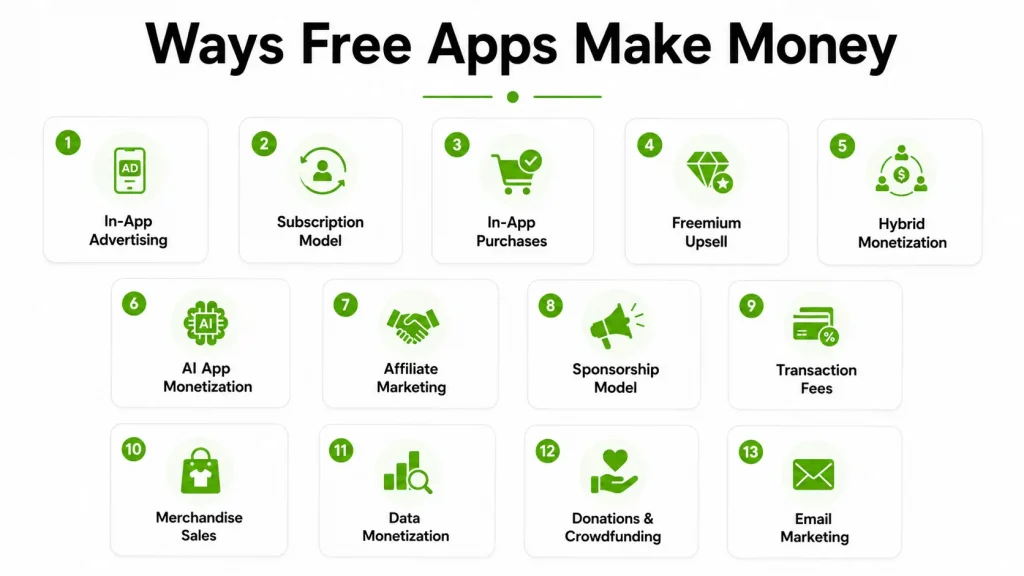
Free apps use different monetization strategies depending on the product type, user behavior, and how often people return. Some models generate revenue through ads. Others charge for premium access or take a cut of every transaction. Here is how each strategy works and which app categories benefit most from it.
1. In-App Advertising
In-app advertising lets free apps earn revenue by displaying ads from third-party networks such as Google AdMob, Meta Audience Network, or Unity Ads within the app. Developers earn based on CPC (cost per click) or CPM (cost per mille) every time a user views, clicks, or interacts with an ad. Rewarded video ads generate the highest earnings because users voluntarily watch them in exchange for in-app rewards. Banner ads earn the least per impression but run passively without interrupting the experience. Advertising remains the most accessible path to making money with free apps for developers just starting.
Common ad formats used in free apps
- Banner ads display at the top or bottom of the screen and earn through impressions.
- Interstitial ads appear full-screen at natural transition points, like between levels or after completing a task.
- Rewarded video ads give users in-app rewards like extra lives or coins in exchange for watching a short video.
- Native ads blend into the app layout and match the surrounding content, commonly used in news and social feeds.
2. Subscription Model
Subscription apps charge users a recurring weekly, monthly, or annual fee for ongoing access to premium features, content, or tools. The app offers a free version with limited functionality. Once users see enough value, they upgrade to a paid plan. Spotify, Duolingo, and Calm all use this freemium-to-subscription pipeline. Revenue is predictable, compounds over time, and generates the highest customer lifetime value (LTV) and average revenue per user (ARPU) across all models. Anyone exploring how to create an app for free and make money should consider this model early because recurring revenue multiplies with retention.
How subscriptions generate revenue
- Free tier attracts a large user base without any upfront cost.
- Premium tier unlocks advanced features, removes ads, or provides unlimited access.
- Recurring billing (weekly, monthly, or annual) creates a predictable income stream.
- Trial periods reduce churn rate by letting users experience premium value before committing, which strengthens user retention long term.
3. In-App Purchases
In-app purchases let users buy digital goods, features, or content inside a free app without paying for the download itself. Revenue comes from users who choose to spend on items that enhance their experience. Only a small percentage of users ever make a purchase, but those who do drive the majority of total revenue. This model dominates gaming, with Candy Crush, Clash of Clans, and Pokémon GO all relying on consumable IAPs. It also works in creative, productivity, and content apps.
Types of in-app purchases
- Consumables are items that get used up and can be bought again, like coins, gems, extra lives, or hints.
- Non-consumables are one-time purchases that unlock permanent features, like ad removal, premium filters, or extra storage.
- Subscription-based IAPs offer recurring access to gated content or tools processed through the app store’s purchase system.
Creative apps monetize this way too. We developed MyLovePics, a baby photo editor app where parents unlock premium themes and artwork individually. A Go Pro bundle covers the full library in one purchase, with restore support included.
4. Freemium Upsell Model
The freemium model offers core app features for free and charges for advanced functionality, premium tools, or an enhanced experience. The free version builds habit and trust. Users invest time in the app before hitting a natural limit where upgrading feels worthwhile. Canva, for example, lets users design for free but charges for premium templates, background removal, and brand kit access. Apps that place the upgrade prompt after a valuable moment convert better than those that paywall on first open. This is one of the clearest examples of how do free apps make money through product design rather than ad volume.
How freemium upsells work
- Basic features are fully accessible without payment.
- Advanced tools, content, or capabilities sit behind a one-time purchase or tiered plan.
- Upgrade prompts appear at natural friction points, like reaching a usage cap or needing a premium-only feature.
- The free experience serves as a product demo that builds long-term conversion intent.
5. Hybrid Monetization Model
Hybrid monetization combines two or more revenue models inside a single app to maximize earnings from different user segments. One group of users watches ads. Another pays for a subscription. A third buys one-time upgrades. Spotify runs ads for free users and subscriptions for premium users. Duolingo combines a free ad-supported tier, a Super subscription, and consumable purchases like streak freezes. Instead of depending on one revenue source, the app monetizes each user based on their behavior. This hybrid approach is the most complete answer to how do you make money from apps with a diverse user base.
Common hybrid combinations
- Free tier with ads combined with a paid subscription to remove ads and unlock premium features.
- In-app purchases layered with rewarded video ads are common in gaming apps.
- Freemium access with a subscription upgrade and one-time feature unlocks.
- Affiliate commissions combined with in-app advertising for shopping and comparison apps.
6. AI App Monetization Model
AI-powered apps monetize through tiered subscriptions, usage-based API access, and premium AI features locked behind a paywall. ChatGPT is the clearest example. The app is free to download with basic access. Revenue comes from Plus subscriptions, Team and Enterprise plans, and API billing based on token consumption. Other AI apps follow the same pattern through paid tiers, licensing their technology to third-party developers, or offering white-label solutions that let businesses reskin the app under their own brand.
How AI apps generate revenue
- Free tier offers basic AI functionality to attract a large user base.
- Premium subscriptions unlock higher usage limits, faster responses, or advanced models.
- API access charges developers based on usage volume, measured in tokens or requests.
- Conversational ads and sponsored AI responses are emerging as a newer revenue channel.
7. Affiliate and Referral Marketing
Affiliate apps earn a commission every time a user clicks a link inside the app and completes a purchase on a partner’s platform. The app acts as a discovery layer that connects users with third-party products or services. Cashback and coupon apps like Rakuten and Honey follow this model. The user gets a discount or reward. The partner gets a customer. The app earns a percentage of the transaction, measured on a CPA (cost per action) basis.
How affiliate revenue works in free apps
- The app displays partner products, deals, or offers within the user experience.
- Users click through and complete a purchase on the partner’s website or app.
- The developer earns a commission on each completed transaction.
- Referral programs reward existing users for inviting new ones, reducing paid acquisition costs.
8. Sponsorship Model
Sponsored apps partner with a brand that pays a fixed fee to be featured inside the app experience. The brand gets exclusive visibility. The developer gets guaranteed income independent of ad impressions or user purchases. Fitness apps might partner with a sportswear brand to sponsor a workout challenge. A recipe app might feature a specific ingredient brand across its content. These deals are negotiated directly, which means higher revenue per deal but also requires a sizable, engaged audience.
How sponsorship revenue works
- A brand pays a fixed fee for dedicated placement inside the app.
- Sponsorship can take the form of branded challenges, co-branded features, or dedicated sections.
- Revenue is guaranteed regardless of clicks or conversions, unlike performance-based ads.
- The app needs a well-defined, engaged audience that aligns with the sponsor’s target market.
9. Transaction Fee Model
Transaction fee apps take a small percentage of every transaction processed through the platform. The app itself is free. Revenue comes from facilitating exchanges between buyers and sellers, service providers and customers, or senders and receivers. Uber, Airbnb, and DoorDash all follow this model. Glovo, a free-to-download on-demand delivery app developed by Space-O Technologies, secured USD 1.2 billion in funding and crossed 30 million downloads using a similar marketplace approach.
How transaction fees generate revenue
- The app connects two sides of a marketplace (buyers and sellers, riders and drivers, hosts and guests).
- A commission is charged on each completed transaction.
- Revenue scales directly with transaction volume without requiring additional content or ad inventory.
- Payment processing fees on instant transfers or business transactions add a secondary income layer.
10. Selling Merchandise and Physical Goods
Some free apps generate revenue by selling physical products directly to users through an in-app storefront or integrated eCommerce experience. The app serves as a discovery and purchase channel rather than a standalone digital product. A fitness app might sell branded workout gear. A recipe app might offer curated ingredient kits. This model works when the app already has a strong brand or community that users trust enough to buy from.
How merchandise sales work in free apps
- The app includes a built-in storefront or links to an external eCommerce platform.
- Products align with the app’s core purpose, like fitness gear in a workout app or art supplies in a creative tool.
- Revenue comes from product margins rather than ads or subscriptions.
- A loyal user base with strong brand attachment drives repeat purchases.
11. Collecting and Selling Data
Some free apps generate revenue by collecting anonymized, aggregated user data and selling insights to third-party companies, market researchers, or advertisers. The app remains free. The data becomes the product. Weather apps, free VPNs, and utility apps commonly use this model. The data collected can include usage patterns, location data, and demographic information. This model requires strict compliance with privacy regulations like GDPR and CCPA.
How data monetization works
- The app collects behavioral, location, or demographic data during normal usage.
- Data is anonymized and aggregated before being sold to third parties.
- Buyers use insights for market research, ad targeting, and trend analysis.
- Transparent disclosure and user consent are mandatory under current privacy laws.
12. Crowdfunding and Donations
Crowdfunding and donation-based apps generate revenue by asking users to voluntarily contribute money to support the app’s development or mission. No features are locked. No ads are shown. The entire app stays free. Wikipedia funds its entire operation through user donations. How We Feel, a free emotional wellness tracker backed by the Yale Center for Emotional Intelligence, operates on a donation-only model with no ads, no subscriptions, and no data selling.
How donation-based revenue works
- The app offers full functionality at no cost with no paywalls or ads.
- Users contribute voluntarily through in-app prompts, Patreon, or Buy Me a Coffee integrations.
- Some apps run crowdfunding campaigns on Kickstarter or Indiegogo to fund initial development.
- This model depends entirely on user goodwill and works best when the app serves a clear mission.
13. Email Marketing Model
Email marketing apps collect user email addresses during sign-up or onboarding and generate revenue by nurturing those users into paying customers through targeted email campaigns. The app itself stays free. The email list becomes the revenue engine. Dormant users who stopped opening the app can be reactivated through well-timed email sequences offering personalized upgrades, exclusive content, or limited-time deals.
How email marketing generates app revenue
- Users provide email addresses during sign-up or in exchange for free content.
- The app sends re-engagement campaigns, premium upgrade prompts, and personalized offers.
- Facebook SDK or similar tools build lookalike audiences from the email list for cheaper paid acquisition.
- Newsletter sponsorships and lead generation partnerships create additional income streams from the same user base.
Knowing how free apps make money is only half the equation. The other half is building the app in a way that supports the chosen revenue model from the start. The monetization strategy shapes the onboarding flow, feature gating, user experience, and long-term retention. Getting the product right is what turns a free download into a sustainable business. The next section walks through the step-by-step process to build a free app designed to make money from day one.
Build Your App Around a Revenue Model That Works
Turn your monetization strategy into app features, user journeys, subscriptions, payments, and integrations designed around how your users actually spend.
How to Create an App for Free and Make Money
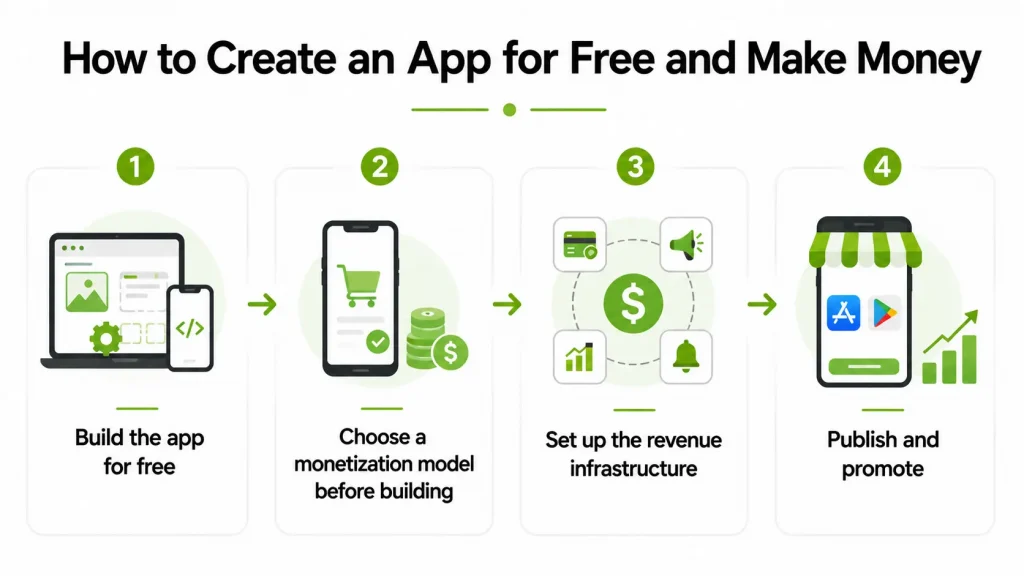
To create an app for free and make money, use no-code or AI-powered tools to build the app, choose a monetization model that fits the app type, and publish it on the App Store or Google Play with the right revenue infrastructure built in from day one.
Step 1: Build the app for free
Modern tools let anyone go from idea to a working product without coding skills or a development team.
- AI app builders: Platforms like Base 44 and Hostinger Horizons generate full applications from natural language prompts.
- No-code platforms: Tools like AppSheet, Appy Pie, Bubble, and Glide make creating an app for free possible through drag-and-drop interfaces for iOS and Android.
- When to go custom: No-code works for MVPs. When the app needs custom ad placements, subscription billing, or analytics SDKs, exploring low-code mobile app development platforms or custom development becomes essential.
Step: Choose a monetization model before building
Each strategy requires different features, user flows, and technical infrastructure baked into the app from the start.
- In-app advertising: Integrate ad networks like Google AdMob to display banners, rewarded videos, or interstitial ads.
- Freemium and in-app purchases: Make the core app free but charge for premium features, virtual goods, or advanced tools.
- Subscriptions: Charge a recurring fee for ongoing access to premium content or functionality.
- Hybrid model: Combine two or more strategies to monetize different user segments based on behavior.
Step 3: Set up the revenue infrastructure
Knowing how to make a money-making app goes beyond design and development. A structured mobile app development process ensures the technical foundation for collecting and tracking revenue is in place before launch.
- Payment gateway: Integrate App Store or Google Play billing for purchases and subscriptions.
- Ad mediation: Use platforms like AdMob or AppLovin MAX to manage multiple ad networks and maximize eCPM.
- Analytics SDK: Install Firebase or Mixpanel to track conversions, churn points, and revenue per user.
- Push notifications: Re-engage dormant users with personalized offers and upgrade prompts.
Step 4: Publish and promote
Creating an app for free is only the first step. Once the revenue infrastructure is in place, the next step is to launch an app on the App Store and Google Play.
- App Store and Google Play: Register as a developer and submit the app for review.
- Privacy policy: Both stores require a valid privacy policy before the app goes live.
- ASO: Optimize the title, description, and keywords to rank higher in store search results.
- Marketing: Use social media, content marketing, and paid acquisition to scale the user base.
Creating an app for free and launching it is the easier part. The real question is how much revenue it can actually generate once users start coming in. The answer depends on the monetization model, the user engagement level, and how effectively the app converts activity into income.
Ready to Build a Free App That Makes Money?
Turn your app idea into a monetizable product with the right features, revenue model, payment infrastructure, and development strategy from the start.
How Much Money Can a Free App With 100K Users Actually Make?
A free app with 100,000 users can realistically generate anywhere from USD 5,000 to over USD 100,000 per month. The exact amount depends on the monetization model, user engagement level, and geography of the user base.
1. Ad-Supported Apps
Apps that rely on displaying banner, interstitial, or rewarded video ads earn based on ad impressions and user engagement time.
- With 100,000 daily active users (DAU), ad revenue can range from USD 500 to USD 3,000 per day, translating to USD 15,000 to USD 90,000+ monthly.
- With 100,000 monthly active users (MAU), fewer impressions bring average ad revenue down to roughly USD 5,000 to USD 20,000 per month.
- Revenue varies by ad format. Rewarded video ads generate the highest eCPM, followed by interstitials, then banners.
2. Freemium and In-App Purchases
Apps that offer premium features, digital goods, or advanced tools for a fee earn based on conversion rates from free to paying users.
- Typically, only 1% to 5% of active users actually spend money inside the app.
- With 100,000 users and a 3% conversion rate at an average spend of USD 5 to USD 10 per month, the app can generate roughly USD 15,000 monthly.
- Apple and Google take a 15% to 30% cut of all in-app purchases, which reduces the developer’s net revenue.
3. Subscription Apps
Apps offering ongoing content or tools through recurring billing see revenue compound as the subscriber base grows.
- Subscription apps average USD 5 to USD 20 per user per month, depending on the category.
- Even with a modest 1% conversion rate (1,000 paying users out of 100,000), monthly recurring revenue reaches USD 5,000 to USD 20,000.
- Higher conversion rates in productivity and fitness apps (up to 10-15%) can push this figure significantly higher.
Revenue Comparison at 100K Users
| Monetization Model | Conversion/Engagement | Monthly Revenue Estimate |
| Banner Ads Only | 100K MAU | USD 5,000 – USD 8,000 |
| Interstitial + Rewarded Video | 100K DAU | USD 15,000 – USD 90,000+ |
| In-App Purchases (3% conversion) | USD 5 – USD 10 avg. spend | ~USD 15,000 |
| Subscription (USD 9.99/month, 3% conversion) | 3,000 paying users | ~USD 30,000 |
| Hybrid (Ads + Subscription + IAP) | Multiple segments | USD 20,000 – USD 100,000+ |
User count alone does not determine how much money you can make from apps. The revenue model, engagement depth, and how early the monetization infrastructure is built into the product are what separate a USD 5,000 month from a USD 100,000 month with the same number of users.
Turn Your App Idea Into a Revenue Plan
Estimate how your users, monetization model, features, and transaction volume could shape your app’s earning potential before you invest in development.
Top 4 Free Apps That Make the Most Money (And How They Do It)
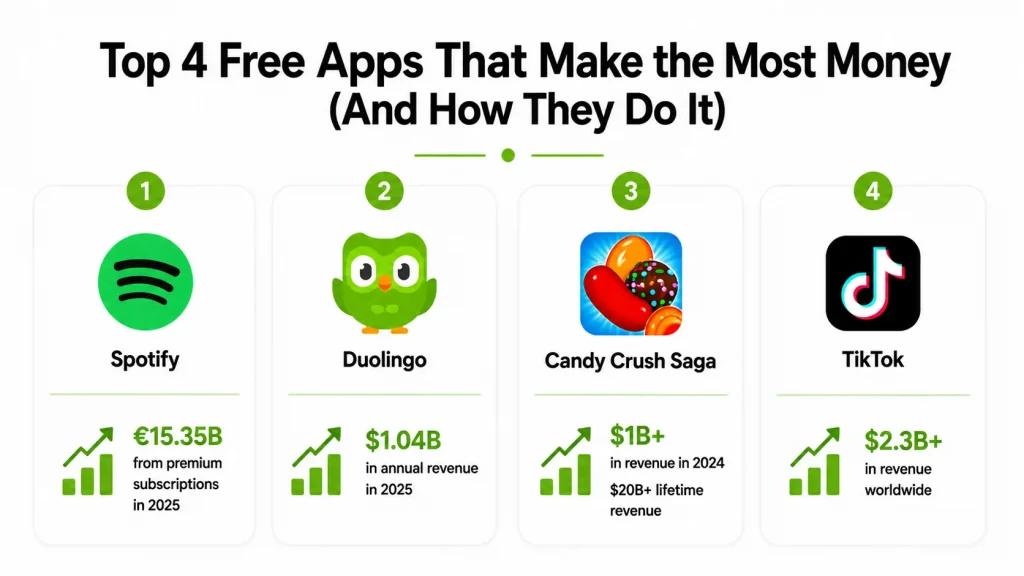
The highest-earning free apps all share one trait: the download costs nothing, and the revenue model is built into the product experience. Here is how four of them do it.
1. Spotify
As reported by Statista, Spotify generated approximately €15.35 billion in revenue from premium subscriptions and €1.84 billion from its ad-supported tier in 2025. This represents the company’s highest annual revenue to date, highlighting the significant growth of its subscription-based business over the past decade. The free tier runs ads. The paid tier removes them and unlocks offline listening and higher audio quality. Premium subscriptions accounted for 89% of total revenue.
2. Duolingo
Duolingo crossed USD 1.04 billion in annual revenue in 2025 with over 10 million paid subscribers and 38% year-over-year revenue growth. (Statista) The app combines a free ad-supported tier, a Super subscription, consumable purchases like streak freezes, and a premium Max tier powered by generative AI.
3. Candy Crush Saga
According to Business of Apps, Candy Crush Saga generated over USD 1 billion in 2024 with USD 20 billion+ in lifetime revenue. The app is free to play and earns through consumable in-app purchases (extra moves, lives, boosters) layered with rewarded video ads.
4. TikTok
TikTok earned over USD 2.3 billion worldwide through in-app coin purchases for creator tipping and a full-scale in-app advertising platform. (Coinlaw) The app is free. Revenue comes from both user spending and brand advertising.
Common Mistakes That Stop Free Apps From Making Money
Understanding how do free apps make money is the first step. The second is avoiding the mistakes that stop most apps from earning. Most free apps fail not because the product is bad, but because the monetization approach does not match how users actually use the app.
List of common mistakes to avoid
- Choosing a monetization model after launch instead of building it into the product design from the start.
- Placing aggressive ad formats too early in the user journey, which kills retention before the app delivers value.
- Using a subscription model for an app that users open once a week, where recurring billing feels unjustified.
- Relying on in-app purchases without understanding that only 2 to 5% of users ever pay, and revenue depends on that small group spending repeatedly.
- Ignoring analytics and not tracking conversion events, churn points, or revenue per user from day one.
- Copying a competitor’s monetization model without considering whether the user behavior in your app matches theirs.
- Skipping the free experience entirely and paywalling too many features before users see enough value to justify paying.
The difference between a free app that earns USD 5,000 a month and one that earns USD 100,000 with the same user count almost always comes down to how well the monetization model fits the product and when it was built into the experience.
How to Choose the Right App Monetization Model
Making money with free apps starts with one decision: the right monetization model. That depends on three factors: how often users open the app, what type of value it delivers, and how large the target audience is.
Match the model to user behavior
- Apps opened daily with long sessions (games, social, streaming) suit in-app advertising and hybrid models.
- Apps that deliver ongoing value, users return to weekly (fitness, productivity, education) suit subscriptions.
- Apps with a clear free-to-paid upgrade path (design tools, cloud storage, editing apps) suit freemium upsells.
- Apps that connect buyers and sellers (delivery, rideshare, marketplace) charge transaction fees.
- Apps with a niche, loyal audience suit sponsorships and affiliate marketing.
Questions to ask before choosing
- Will users open the app daily, weekly, or only when needed?
- Does the app deliver one-time value or ongoing value over time?
- Can you build a large enough user base to make ads profitable?
- Is there a natural upgrade moment where users would willingly pay?
- Does the app sit inside a purchase decision flow where affiliate or transaction fees make sense?
Most top-grossing free apps in 2026 do not rely on a single model. They layer strategies to maximize revenue while keeping user acquisition and customer acquisition cost (CAC) sustainable. The goal is to pick the right starting model and expand as the retention rate and user base grow.
Get a Custom Monetization Strategy for Your App
Space-O Technologies works with startups and enterprises to match the right revenue model to the product, audience, and growth plan before development begins.
Wrapping It Up
So that’s how free apps make money in 2026. As this guide showed, making money with free apps is not about choosing between free and profitable. It is about building the right revenue model into the product from the very beginning. The download is free. The revenue comes from what happens after it, through in-app ads, subscriptions, in-app purchases, freemium upgrades, and hybrid models that combine them all.
Every top-earning app proves it works. Spotify earns €16.9 billion a year. Duolingo crossed $1 billion. Candy Crush has generated over $20 billion in lifetime sales. All free to download. All generating revenue after the install, not before it.
Here is what the highest-earning free apps consistently get right:
- They choose how to make money from an app before writing a single line of code
- They layer multiple revenue streams instead of depending on just one
- They place paywalls, ad placements, and upgrade prompts at moments where users already feel value
- They track conversions, churn, and revenue per user from the very first version
- They treat the free experience as the product itself, not as a limited demo waiting to be monetized
- They match the monetization model to how users actually behave inside the app
The difference between a free app that earns $5,000 a month and one that earns $100,000 with the same user base is never the idea or the user count. It is always the revenue model, the infrastructure supporting it, and how early both get wired into the product experience.
Anyone researching how to create an app and make money needs to start with the monetization decision, not end with it. The strategy shapes everything, from onboarding to retention to long-term profitability.
Space-O Technologies has built 4,400+ mobile apps since 2010 across food delivery, healthcare, fintech, and education, including Glovo, a $1.2 billion on-demand delivery app with 30 million downloads. The team helps startups and enterprises build Android apps from idea to launch, while supporting every stage of the app development lifecycle.
Frequently Asked Questions
How do free apps make money if users never pay for them?
Free apps make money through advertising, data monetization, affiliate commissions, and sponsorships. Ad-supported apps earn revenue whenever users view or click ads. Some apps generate income by selling anonymized user insights to third parties, while affiliate-based apps earn commissions when users complete purchases through partner platforms. In these models, users do not pay directly, but their engagement creates value for advertisers and partners.
Why do companies offer apps for free instead of charging users?
Companies offer apps for free because eliminating the upfront cost increases user acquisition and reduces download friction. Free apps attract larger audiences, leading to more ad impressions, subscription upgrades, and monetization opportunities. As of 2026, the vast majority of apps on major app stores use free or freemium models because long-term revenue often exceeds what paid downloads can generate.
What are the most common ways free apps generate revenue?
The most common app monetization methods include in-app advertising, in-app purchases, subscriptions, freemium upgrades, and hybrid revenue models. Advertising earns money from impressions and clicks, while subscriptions and purchases generate direct revenue from users. Many successful apps combine multiple monetization strategies to maximize earnings from different user segments.
How much money can a free app make from advertising?
A free app with 100,000 daily active users can potentially generate between $15,000 and $90,000 per month through advertising, depending on engagement levels and ad formats. Rewarded video ads typically deliver the highest eCPM rates, while interstitial and banner ads generate varying levels of revenue based on audience demographics, geography, and session duration.
Can a free app be profitable without showing ads?
Yes. Many highly successful apps generate revenue without displaying advertisements. Subscription plans, in-app purchases, freemium upgrades, and transaction fees are common alternatives. Apps that provide ongoing value often monetize directly through premium features or recurring memberships, creating a better user experience while maintaining profitability.
What is the difference between free, freemium, and paid app business models?
Free apps typically earn money through ads, sponsorships, or data monetization. Freemium apps provide basic functionality at no cost while charging for advanced features or premium access. Paid apps require users to pay before downloading. Freemium models are especially popular because they allow users to experience the product before committing financially.
How do popular free apps like Spotify and Duolingo make money?
Spotify and Duolingo primarily use a freemium business model. Their free tiers attract large user bases, while premium subscriptions drive most revenue. Both platforms also offer additional paid features and benefits that encourage upgrades. This approach demonstrates how a strong free experience can successfully convert users into long-term paying customers.
Do free apps make money by collecting and using user data?
Some free apps monetize anonymized user data by providing aggregated insights to advertisers, researchers, or business partners. Common data points include usage behavior, location trends, and demographic information. However, apps that use this model must comply with privacy regulations such as GDPR and CCPA and clearly disclose their data practices to users.
What factors determine how much revenue a free app can generate?
App revenue depends on several factors, including the monetization model, daily active users, user engagement, conversion rates, retention levels, and geographic location of users. Apps with strong engagement and audiences in higher-value markets typically earn significantly more through advertising, subscriptions, and in-app purchases.
Which app monetization strategy is best for startups and new app owners?
A freemium model combined with a simple subscription offering is often the most effective monetization strategy for startups. The free version helps acquire users quickly, while premium features create a clear upgrade path for engaged customers. As the user base grows, additional monetization methods such as advertising, in-app purchases, or affiliate partnerships can be introduced to diversify revenue streams.



 All our projects are secured by NDA




 4.8
4.8