
 By
By 
Are you facing challenges like slow software development, budget overruns, or compatibility issues with third-party tools? Or are you looking to have a systematic approach to project planning? You can effectively address these challenges with a software consultant.
Software consultants are the problem-solving experts for your software projects. The demand for software consultants is increasing day by day. As per the reports of Grand View Research, the global software consulting industry is estimated to develop at a compound annual growth rate (CAGR) of 12.1% from 2023 to 2030.
Choosing the right development partner who offers end to end custom software development services can streamline the development process and guide businesses in implementing strategies that align with their specific goals and requirements.
Check out the report on the annual growth rate of software consultants.

Let’s help you get the answer to your question – what does a software consultant do?
Table of Contents
- What Does a Software Consultant Do?
- How a Software Consultant Differs from Other IT Roles
- The Roles and Responsibilities of a Software Consultant
- 9 Essential Skills for Software Consultants
- How to Choose the Right Software Consultant in 6 Steps
- 5 Benefits of Having a Software Consultant for Your Project
- Key Deliverables You Can Expect from a Software Consultant
- Hire the Best Software Consultant for Your Business
- FAQs About Software Consultants
What Does a Software Consultant Do?
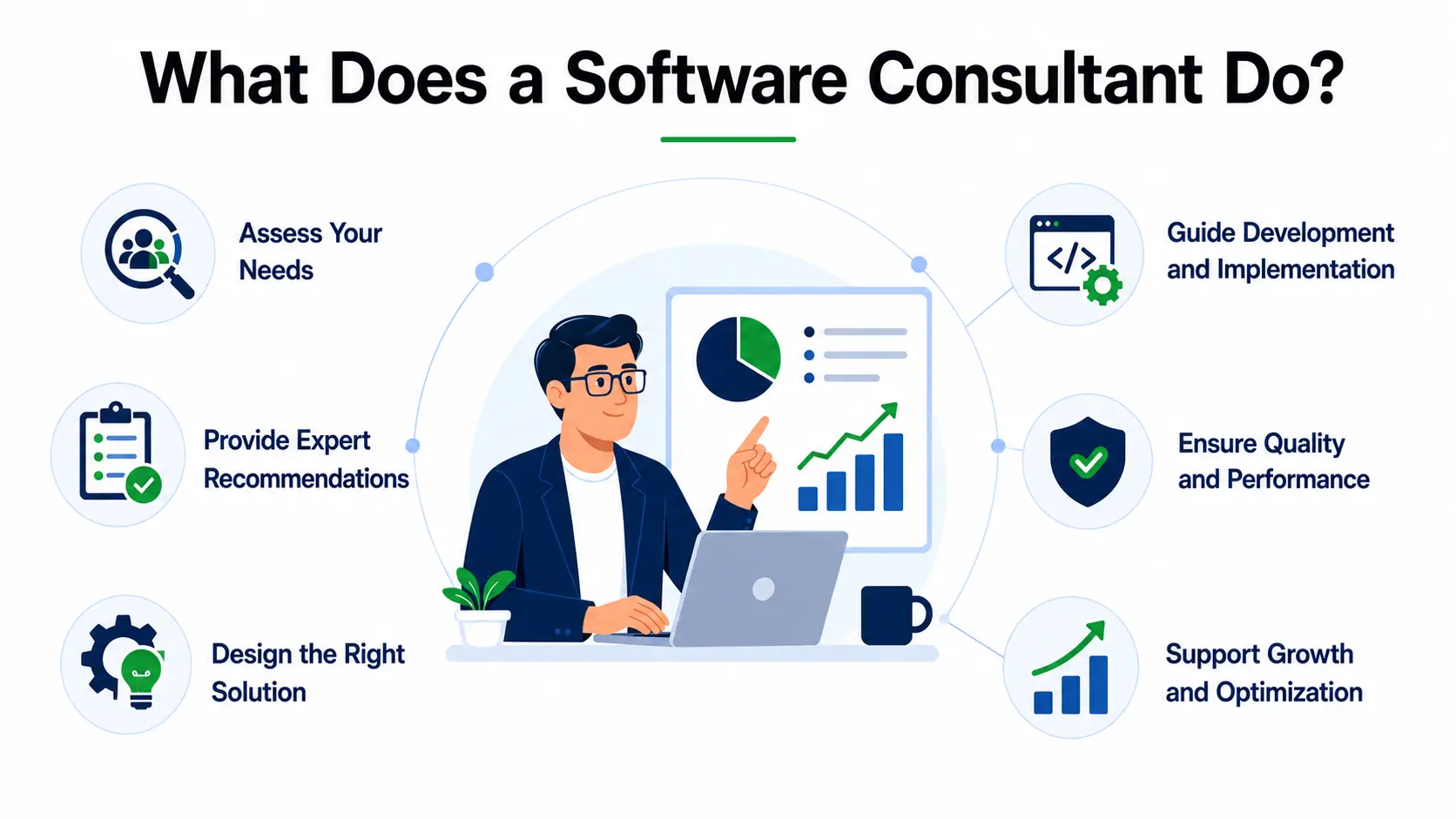
A software consultant is a technology expert who helps businesses connect their goals with the right software solutions. They assess a company’s requirements, recommend or design the most suitable software, and guide the implementation process to enhance efficiency, strengthen security, and increase profitability.
If you’re wondering, what is the role of a software consultant?, it involves a wide range of activities aimed at helping businesses choose, build, optimize, and scale software solutions. Here are some of the most common responsibilities and activities associated with a software consultant:
- Analyze the current systems, infrastructure, and procedures of a customer to discover areas for enhancement or optimization.
- Assess and analyze various technologies, platforms, and the software development process to identify the best match for a given project.
- Help with project planning by identifying the goals, the scope, the deadlines, and the resources needed.
- Guide the client through the software solution implementation process, ensuring effective integration, configuration, and deployment.
- Provide training and knowledge transfer sessions to the client’s team to use and maintain the software successfully.
- Address issues that might arise during or after the implementation phase, trying to find and implement solutions.
How a Software Consultant Differs from Other IT Roles
Understanding the difference between a software consultant and other IT roles helps businesses hire the right professional. While roles like IT consultant, technology consultant, and solutions architect share overlapping responsibilities, each serves a distinct purpose in the software development lifecycle.
Here is a comparison of how a software consultant differs from other IT roles.
| Role | Primary Focus | How It Differs from a Software Consultant |
|---|---|---|
| IT Consultant | Overall IT infrastructure, hardware, networking, and security. | Covers broad IT operations, while a software consultant specializes in software strategy, system design, and application-level solutions. |
| Technology Consultant | Enterprise-wide technology adoption and digital transformation strategy. | Addresses the full technology ecosystem, whereas a software consultant focuses on software selection, development, and implementation. |
| Digital Transformation Consultant | Organization-wide change management and business process modernization. | Drives strategic planning across departments, while a software consultant focuses on the software tools and platforms that support that transformation. |
| Solutions Architect | Technical blueprints and solution architecture for complex systems. | Focuses on system design and architecture diagrams, while a software consultant covers a broader scope including business process analysis, vendor evaluation, and project oversight. |
| Business Analyst | Requirements gathering and stakeholder management between business and development teams. | Documents what the software should do, while a software consultant advises on how to build it, which technology to use, and whether a feasibility study supports the investment. |
| Technical Consultant | Specialized expertise in a specific technology, platform, or tool. | Solves narrow technical problems, while a software consultant takes a holistic view covering software strategy to risk assessment. |
| Software Engineer | Writing, testing, and maintaining code for software applications. | Focuses on technical execution, while a software consultant provides strategic direction, technology assessment, and ensures the project delivers business value. |
| Product Manager | Product vision, roadmap, and feature prioritization based on user research. | Drives what gets built from a user perspective, while a software consultant advises on how it should be built from a technology and operational efficiency standpoint. |
While these roles often collaborate on the same project, a software consultant brings a unique combination of strategic planning, technical expertise, and business analysis that connects business objectives with the right software solutions.
Need a Software Consultant to Overcome Tech Challenges?
Contact us for expert technical advice and strategy implementation tailored to your project’s needs, drawing from our experience with over 1200 global clients.

What Does a Software Consultant Do? Roles and Responsibilities
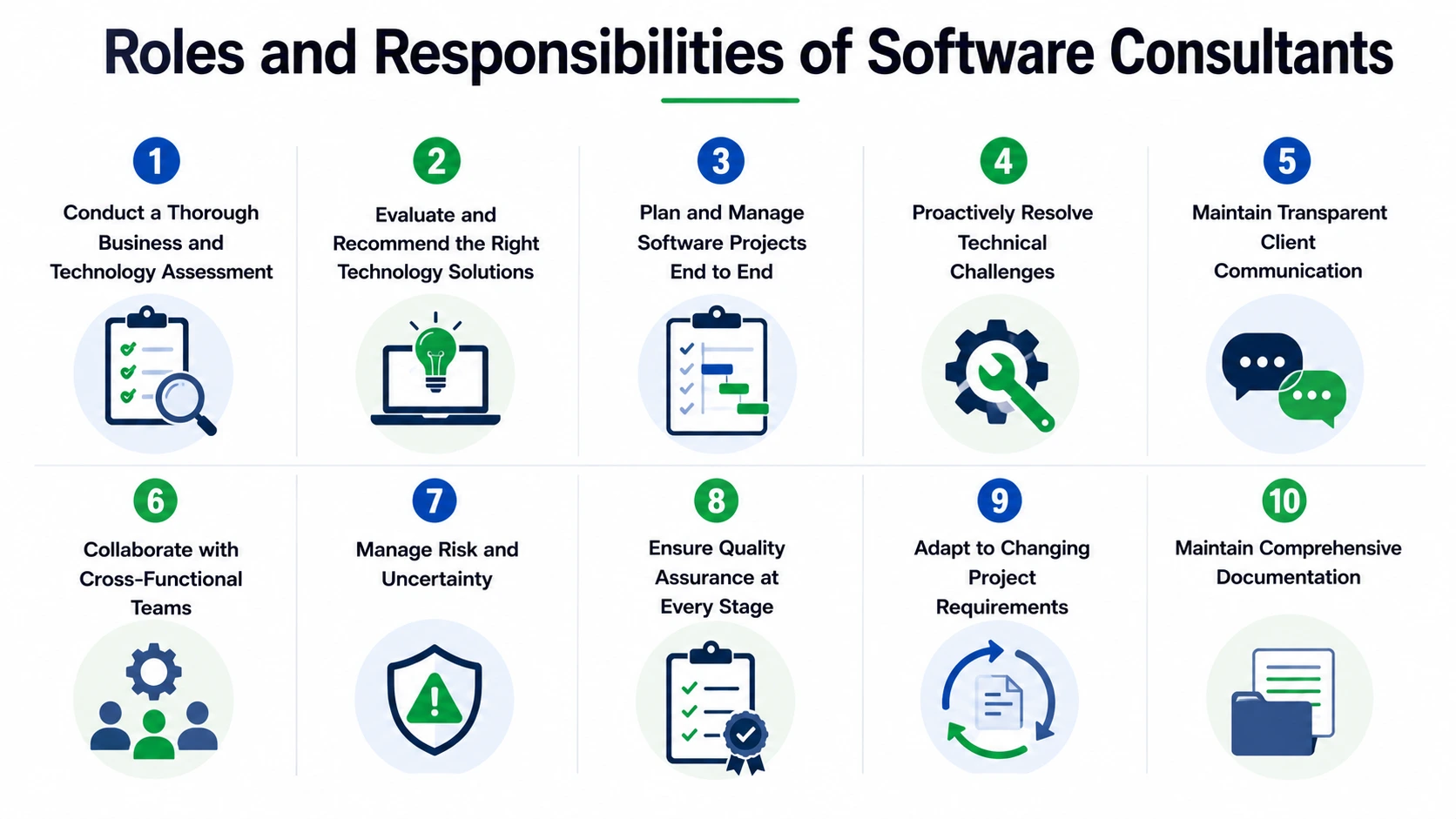
A software consultant plays a critical role in helping businesses make informed technology decisions that align with their objectives. Whether you hire a software consultant for a short-term project or long-term engagement, understanding their responsibilities helps you set clear expectations. To learn more about what a software consultant means and the value they bring, check out our detailed guide on what is software consulting.
Here are the key roles and responsibilities of a software consultant.
1. Conduct a Thorough Business and Technology Assessment
A software development consultant begins every engagement by understanding the client’s business objectives, operational workflows, and technology landscape. They evaluate existing software systems, identify inefficiencies, and pinpoint areas where technology can deliver measurable improvements.
2. Evaluate and Recommend the Right Technology Solutions
Software consultants stay current with emerging technologies and assess their relevance to each project. They recommend the most suitable technology stack, tools, and platforms that align with the project’s scope, budget, and long-term scalability requirements.
3. Plan and Manage Software Projects End to End
A business software consultant creates detailed project plans that define tasks, milestones, timelines, and resource allocation. They oversee execution at every stage to ensure deadlines are met, budgets are maintained, and resources are used efficiently.
4. Proactively Resolve Technical Challenges
What do software consultants do when technical roadblocks arise? They apply strong problem-solving skills to troubleshoot issues, eliminate bugs, optimize system performance, and implement solutions that prevent recurring problems.
5. Maintain Transparent Client Communication
A software advisor maintains consistent communication with clients throughout the project lifecycle. This includes providing regular progress updates, involving stakeholders in key decisions, and addressing concerns promptly to ensure full transparency and trust.
6. Collaborate with Cross-Functional Teams
Software consultants work closely with developers, designers, QA engineers, and project managers to keep every team aligned. They foster a collaborative environment that improves coordination, reduces miscommunication, and keeps the project moving forward.
7. Manage Risk and Uncertainty
Experienced software consultants identify potential risks early and develop mitigation strategies before issues escalate. They adapt quickly to unexpected challenges, adjust project plans when needed, and keep deliverables on track despite shifting conditions.
8. Ensure Quality Assurance at Every Stage
Quality is a non-negotiable responsibility for any software consultant. They implement rigorous testing and QA procedures throughout the development cycle, debug thoroughly, and verify that the final product meets defined performance and quality standards.
9. Adapt to Changing Project Requirements
Client needs evolve, and software consultants must respond strategically. They adjust plans, reallocate resources, and modify technical approaches to accommodate new requirements without compromising timelines or deliverable quality.
10. Maintain Comprehensive Documentation
A software development consultant documents every critical process, codebase decision, and project milestone. This ensures transparency, simplifies future maintenance, and provides a clear reference for internal teams and stakeholders.
Now that you know the complete role and responsibilities of a software consultant, let’s look at the essential skills every software consultant needs to succeed.
9 Essential Skills for Software Consultants
If you’re wondering, “What skills do you need to be a software consultant?”, the table below outlines the 9 essential skills every software consultant should develop. These skills enable consultants to analyze business challenges, recommend the right technology solutions, communicate effectively with stakeholders, and deliver successful software projects across industries.
| Skill | Description |
|---|---|
| Technical Proficiency | A deep understanding of coding, computer software architecture, and various development tools and languages. |
| Analytical Skills | The ability to break down difficult situations into smaller parts and find solutions. |
| Problem-solving | Creative problem-solving skills to address technical and non-technical challenges effectively. |
| Communication Skills | Strong communication, both verbal and written, for clear interaction with clients, the development team and other team members. |
| Project Management | Organizational skills and the ability to manage project timelines, tasks, and resources which helps in improving business operations. |
| Teamwork | Collaborative mindset for working effectively with multidisciplinary teams. |
| Negotiation and Conflict Resolution | Skills to resolve conflicts, negotiate with stakeholders, and find win-win software solutions. |
| Presentation Skills | Ability to present ideas, solutions, and project progress effectively to clients and colleagues. |
| Risk Management | Identifying and mitigating project risks to ensure smooth project execution. |
Now, you have a clear idea about the skills required for a software consultant. So, let’s discuss the process of choosing the right software consultant.
How to Choose the Right Software Consultant in 6 Steps
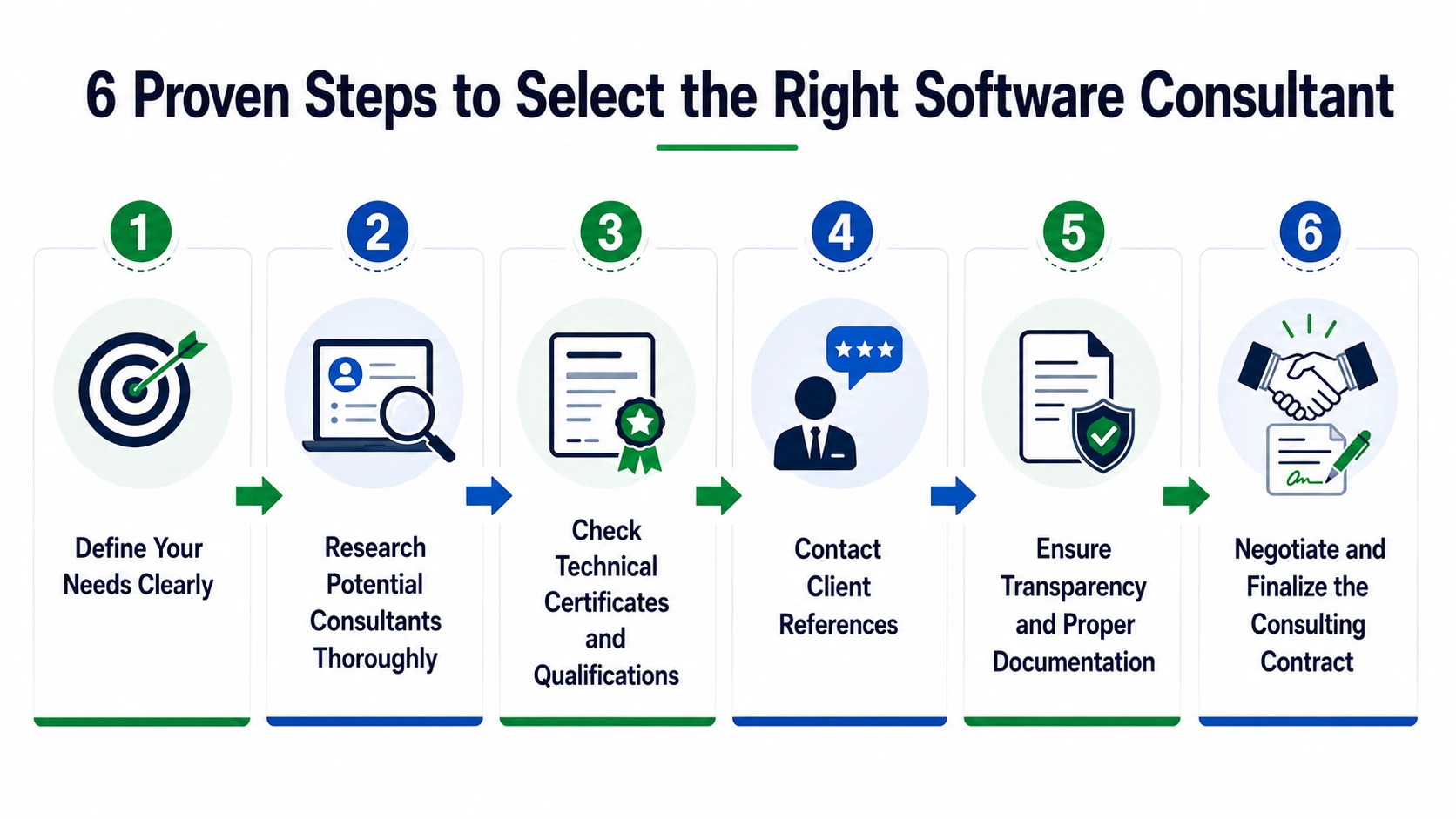
Here are the steps involved in choosing the right software consultant.
-
Define Your Needs Clearly
Before you begin looking for the right software consultant that suits your requirements, you must first understand the specifications of your project. These specifications involve:
- Clearly outline the software project’s purposes and objectives.
- Determine the project’s financial limitations and available budget.
- Create project schedules that include essential milestones and deadlines.
- Specify the core functions and features that the software must have.
- Decide which technologies, languages, and software development frameworks are appropriate or required.
Make the description of your software project precise and detailed to ensure that potential consultants understand what you want.
-
Research Potential Consultants Thoroughly
In this step, you need to begin your search for software consultants. There are various sources available in the market where you can find candidates that suit your requirements. These sources include online platforms, recommendations from colleagues, and industry groups. You should look for experts with suitable portfolios or other professionals with experience in your industry and knowledge of the technologies you wish to use.
-
Check Technical Certificates and Qualifications
Once you have a list of qualified candidates as a result of your research, you must now evaluate the technical certificates and qualifications of the candidates. Here are the points you need to consider during the evaluation process.
- Examine the candidate’s portfolio and past projects. Check out projects that are similar to yours in terms of difficulty and scope.
- Confirm that candidates know the programming languages, frameworks, and tools that will be used in your project.
- Check out the testimonies, ratings, and reviews posted online by previous clients.
- Assess the candidate’s credentials to see if they hold the necessary software development certifications.
-
Contact Client References
Connecting with former clients is one of the best and most effective ways to assess a software consultant’s abilities. Contact the consultant and request references. Inquire about their experience with the consultant while chatting with references. Here are some particular questions to ask:
- Did the consultant effectively fulfill project deadlines?
- How effectively did the software consultant communicate project progress and issues?
- Were there any unexpected challenges, and if so, how did the consultant address them?
- Did the consultant’s work align with the primary project specifications and requirements?
- Were there any budget overruns or unexpected charges?
These questions will provide you with a better understanding of the consultant’s performance and how the consultant deals with project challenges.
-
Ensure Transparency and Proper Documentation
When it comes to consulting partnerships, the most important thing is to have open communication. Ensure that the consultant offers you a full proposal and project plan. Milestones, deliverables, deadlines, and cost estimates all should be included in this plan. Also, you need to talk about how the consultant handles project documentation including specifications, design, and code documentation.
-
Negotiate and Finalize the Consulting Contract
The last but not least step is to negotiate the terms of the consulting contract. Check out the important points you need to consider while carrying out this phase.
- Define the project scope clearly, covering deliverables and objectives.
- Decide on the payment structure, this must include upfront fees, milestone payments, or hourly rates.
- Create realistic project timeframes and consider how to handle delays or scope modifications.
- Specify who owns the intellectual property rights to the project’s software.
- Ensure that the consultant promises to keep sensitive project information confidential.
Find Out How Much Your Software Will Cost
Plan smarter with our software cost calculator. Get a quick and transparent estimate for your custom software development needs.
If you are still confused then you might want to take a look the curated list of top software consulting companies in the USA.
Let’s discuss the benefits of having a consultant for your software project.
5 Benefits of Having a Software Consultant for Your Project
Here are the 5 core benefits of having a software consultant for your project.
-
Access to Specialized Expertise and Guidance
Software consultants have knowledge of coding languages, frameworks, and development techniques. These experts help you make well-informed decisions by offering insights into the most recent industry trends and best practices for software development.
-
Cost-effective Solutions Tailored to Your Budget
Software consultants evaluate the budget restrictions of your project and propose cost-effective alternatives. These professionals support the optimal allocation of resources, which guarantees your project stays under budget without sacrificing quality. This guidance is especially valuable for founders looking for end-to-end software development services for startups under tight budget constraints.
-
Enhanced Project Efficiency and Timely Delivery
Software consultants improve project workflows, shorten development cycles and ensure the timely fulfillment of milestones. This increased efficiency keeps your project on pace to be completed on time.
-
Customized Solutions Aligned with Your Unique Requirements
Consultants collaborate with you to fully comprehend your company operations and goals for the project. These professionals develop customized software solutions that properly fit your specific needs, ensuring optimal functionality.
-
Proactive Risk Management and Issue Resolution
Software consultants analyze potential risks associated with the project and propose mitigation approaches. These experts excel in quickly resolving problems, minimizing disruptions, and ensuring the project’s progress is uninterrupted.
Key Deliverables You Can Expect from a Software Consultant
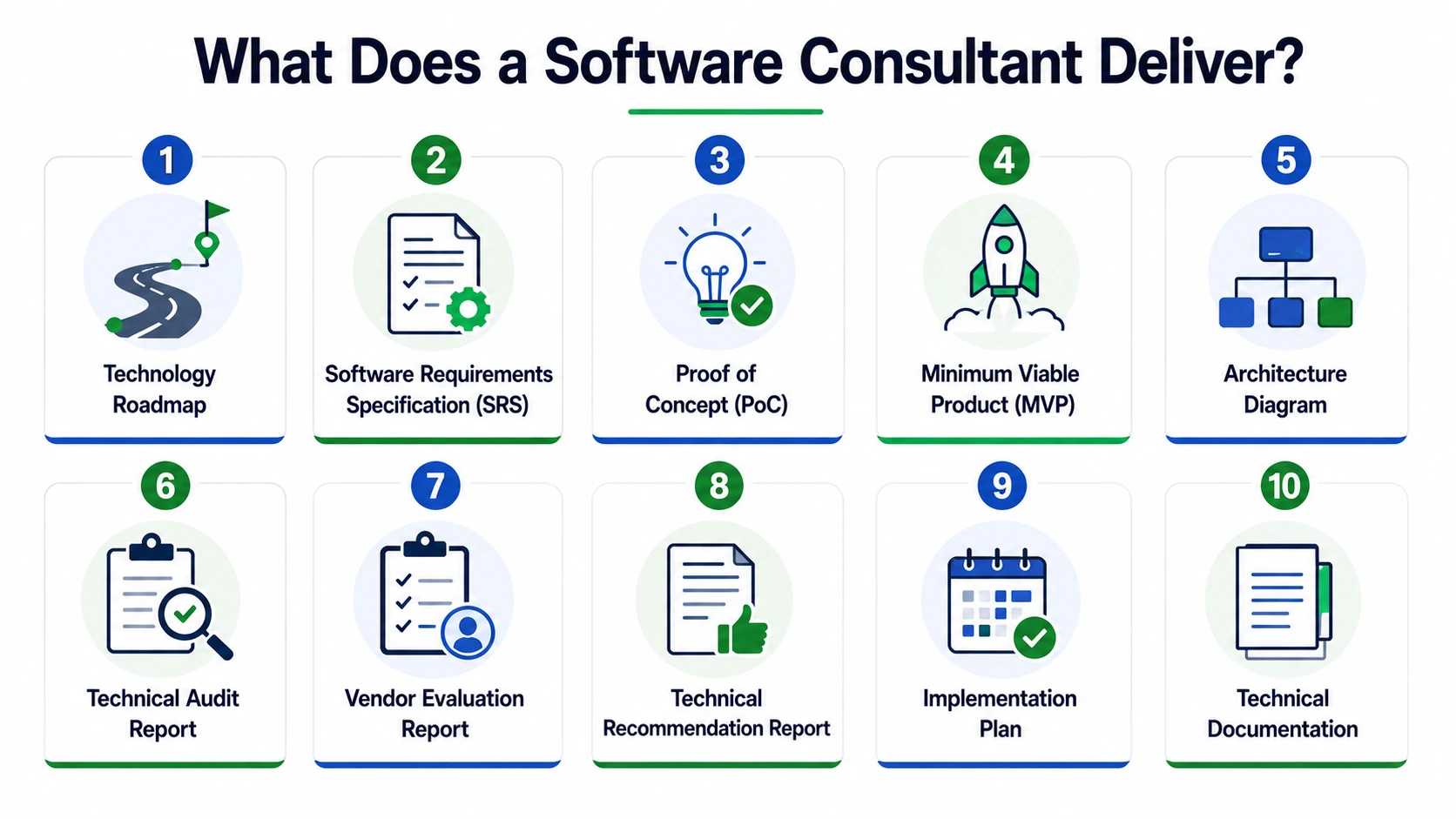
When you hire a software consultant, you receive a set of well-defined deliverables that guide your project from concept to completion. These deliverables ensure clarity, reduce risks, and keep development aligned with your business objectives.
Here are the key deliverables a software consultant provides.
1. Technology Roadmap
A technology roadmap outlines the step-by-step plan for adopting, upgrading, or building software solutions over a defined timeline. It maps current IT infrastructure to future goals and helps stakeholders visualize the path from where the business stands today to where it needs to be.
2. Software Requirements Specification (SRS)
The SRS document captures every functional and non-functional requirement the software must fulfill. It serves as the single source of truth for development teams, business analysts, and stakeholders throughout the project. A clear SRS minimizes scope creep and ensures all parties share the same expectations.
3. Proof of Concept (PoC)
A proof of concept validates whether a proposed solution is technically feasible before the business commits to full-scale development. Software consultants build PoCs to test core functionality, evaluate technology choices, and present evidence-based recommendations to decision-makers.
4. Minimum Viable Product (MVP)
For businesses launching new software products, a consultant helps define and develop the MVP. This is the simplest version of the product with just enough features to validate the concept with real users, gather feedback, and plan the next iteration without overinvesting upfront.
5. Architecture Diagram
An architecture diagram provides a visual representation of the software system’s structure, including components, databases, APIs, integrations, and data flow. This deliverable helps development teams, solutions architects, and stakeholders understand how the system is designed and how each component interacts.
6. Technical Audit Report
A technical audit evaluates the current state of existing software systems, IT infrastructure, and codebases. The report highlights technical debt, security vulnerabilities, performance bottlenecks, and areas where cost optimization is possible. This deliverable is essential for businesses considering legacy system modernization.
7. Vendor Evaluation Report
When businesses need to choose between off-the-shelf software or custom development, a software consultant conducts a vendor evaluation. This report compares platforms, tools, and service providers based on cost, scalability, support, and alignment with business requirements, helping the company make an informed build-vs-buy decision.
8. Technical Recommendation Report
This report consolidates all findings from the technology assessment, feasibility study, and risk assessment into actionable recommendations. It provides leadership with a clear, prioritized list of next steps, estimated software development costs, expected ROI, and a timeline for implementation.
9. Implementation Plan
The implementation plan defines how the recommended software solution will be deployed. It covers deployment phases, testing milestones, data migration steps, integration checkpoints, user training schedules, and change management protocols to ensure a smooth rollout with minimal disruption.
10. Technical Documentation
Comprehensive technical documentation covers system configurations, codebase architecture, API references, database schemas, and operational procedures. This deliverable ensures that internal teams can maintain, update, and scale the software independently after the consulting engagement ends.
These deliverables give businesses full visibility into their software investment and ensure that every decision is backed by data, strategy, and clear documentation.
Hire the Best Software Consultant for Your Business
Software consultants play an essential role in creating software development solutions . From conducting a detailed assessment of the needs to proactively resolving technical difficulties, software consultants ensure the projects are completed promptly and successfully.
In-depth knowledge of your project’s requirements, extensive research, verification of credentials, and maintaining transparency are important when selecting a great software consultant for your project.
Space-O Technologies, as a leading software development company, provides software consulting services for your project. Book your free call and we understand your needs, create a strategy, and present a plan. With 14+ years of experience, we have validated more than 300 software solutions. Contact us to get valuable guidance for your business.
Frequently Asked Questions
What are the main responsibilities of a software consultant?
A software consultant evaluates a company’s existing technology, identifies gaps, recommends suitable software solutions, creates implementation roadmaps, oversees development or integration, and provides post-launch optimization and support.
What problems does a software consultant solve?
They solve outdated legacy systems, inefficient workflows, poor software performance, lack of technical direction, failed or stalled projects, integration issues between platforms, scalability bottlenecks, and misalignment between business goals and technology.
What skills does a software consultant need?
They need technical architecture knowledge, proficiency in multiple programming languages and frameworks, business analysis capabilities, project management expertise, strong communication skills, problem-solving ability, and domain-specific industry understanding.
How does a software consultant help a business?
They help by reducing technology risks, cutting operational costs through automation, accelerating time-to-market, providing unbiased technology recommendations, filling internal skill gaps, and aligning software investments with measurable business outcomes.
How does a software consultant analyze business needs?
They conduct stakeholder interviews, audit current systems and workflows, map business processes, identify pain points and inefficiencies, define functional and non-functional requirements, and benchmark against industry standards to build a prioritized action plan.
When should a business hire a software consultant?
When launching a new product, modernizing legacy systems, scaling operations, lacking in-house technical expertise, experiencing repeated project failures, planning digital transformation, or needing an unbiased technology assessment before a major investment.
When does a company need software consulting?
When technology decisions are slowing growth, internal teams are stretched thin, software costs are rising without clear ROI, systems are not integrating properly, or the company is entering a new market that demands unfamiliar technology.
What types of software projects do consultants handle?
They handle custom software development, enterprise application integration, cloud migration, mobile and web app development, legacy system modernization, API development, SaaS product builds, ERP/CRM implementation, and AI or data analytics projects.



 All our projects are secured by NDA




 4.8
4.8