Have you ever wondered why you keep getting suggestions to watch videos from Netflix’s recommendations based on what you have watched earlier?
Is this magic? Machine learning is no less than magic. It gives you recommendations based on your saved data to create a user-friendly experience.
So, being an entrepreneur, if you have decided to develop machine learning-based apps, then you must know the ins and outs of machine learning platforms. This comprehensive guide will help you to find the best platform for machine learning.
Table of Contents
What is Machine Learning?
Machine learning is a branch of artificial intelligence that enables computers to learn from data and improve performance without explicit programming. Instead of following hard-coded rules, ML algorithms analyze large datasets to identify patterns. These patterns help the system make predictions or decisions on its own.
The learning process works through training. A model receives historical data, processes it through an algorithm, and adjusts its internal parameters based on results. Over time, the model becomes more accurate as it processes more data.
Machine learning operates through three core approaches:
- Supervised learning trains models on labeled datasets where the correct output is already known. Common applications include spam detection, image classification, and sales forecasting.
- Unsupervised learning works with unlabeled data to identify hidden patterns and groupings. Customer segmentation and anomaly detection are typical use cases.
- Reinforcement learning trains models through trial and error using rewards and penalties. This approach powers robotics, game-playing AI, and autonomous navigation.
Today, machine learning drives real-world applications across industries:
- Healthcare uses it for diagnostic imaging and drug discovery.
- Finance relies on it for fraud detection and credit scoring.
- Retail applies it for product recommendations and demand forecasting.
- Logistics companies use it for route optimization and predictive maintenance.
The growing availability of cloud computing, larger datasets, and open-source frameworks has made ML accessible to businesses of all sizes. Platforms like Amazon SageMaker, Databricks, and H2O.ai provide ready-to-use infrastructure for building and deploying models at scale.
We have experience developing machine learning-based apps for various use cases.

What is a Machine Learning Platform?
A machine learning platform is a software environment that provides tools, infrastructure, and workflows to build, train, deploy, and manage ML models at scale. These platforms combine data processing, model development, and deployment into a single integrated workspace. They eliminate the need to stitch together separate tools for each stage of the ML lifecycle.
Most ML platforms offer pre-built algorithms, drag-and-drop interfaces, and automated model training (AutoML). Enterprise-grade platforms also include features like model versioning, performance monitoring, and team collaboration. Cloud-based platforms such as Amazon SageMaker and Microsoft Azure ML Studio provide on-demand compute resources. This removes the need for expensive in-house hardware.
Businesses use ML platforms to reduce development time and lower the technical barrier to adopting machine learning. Data scientists, ML engineers, and even non-technical teams can use these platforms to extract insights from data. The right platform depends on factors like team expertise, deployment needs, and budget.
Key Features to Look for in a Machine Learning Platform
Not all machine learning platforms offer the same capabilities. Before evaluating specific options, it helps to understand the core features that separate a production-ready platform from a basic experimentation tool.
AutoML and automated model training
AutoML automates the process of selecting algorithms, tuning hyperparameters, and evaluating model performance. This feature reduces the time needed to build baseline models from weeks to hours. Platforms with strong AutoML capabilities, like DataRobot and H2O.ai, allow teams with limited ML expertise to produce competitive models.
Data pipeline management
A reliable ML platform should support end-to-end data pipeline management. This includes data ingestion, cleaning, transformation, and feature engineering. Built-in data connectors simplify integration with databases, cloud storage, and third-party APIs.
Model deployment and serving
Building a model is only half the challenge. The platform should support one-click or automated model deployment to production environments. Look for support for REST API endpoints, batch predictions, and edge deployment options.
MLOps and model monitoring
Production models degrade over time as data patterns shift. MLOps features like model versioning, automated retraining triggers, and performance drift detection help maintain model accuracy. Platforms such as Amazon SageMaker and Databricks offer built-in MLOps capabilities.
Collaboration and version control
Teams working on shared ML projects need features like experiment tracking, notebook sharing, and role-based access control. Version control for datasets and models ensures reproducibility and accountability across the development lifecycle.
Support for open-source frameworks
The best ML platforms integrate with popular frameworks like TensorFlow, PyTorch, Scikit-learn, and XGBoost. This flexibility avoids vendor lock-in and lets teams use familiar libraries within the platform environment.
Scalability and compute management
ML workloads vary dramatically depending on dataset size and model complexity. The platform should offer elastic compute scaling, GPU/TPU support, and distributed training. Cloud-native platforms handle this well by allocating resources on demand.
Choosing the right machine learning platform goes beyond comparing features on a checklist. The ideal platform should align with your team’s technical expertise, existing infrastructure, scalability requirements, and deployment goals. By prioritizing capabilities such as AutoML, MLOps, seamless data integration, and support for popular open-source frameworks, organizations can build, deploy, and manage machine learning models more efficiently while reducing development time and operational complexity.
Top 10 Machine Learning Platforms in 2026
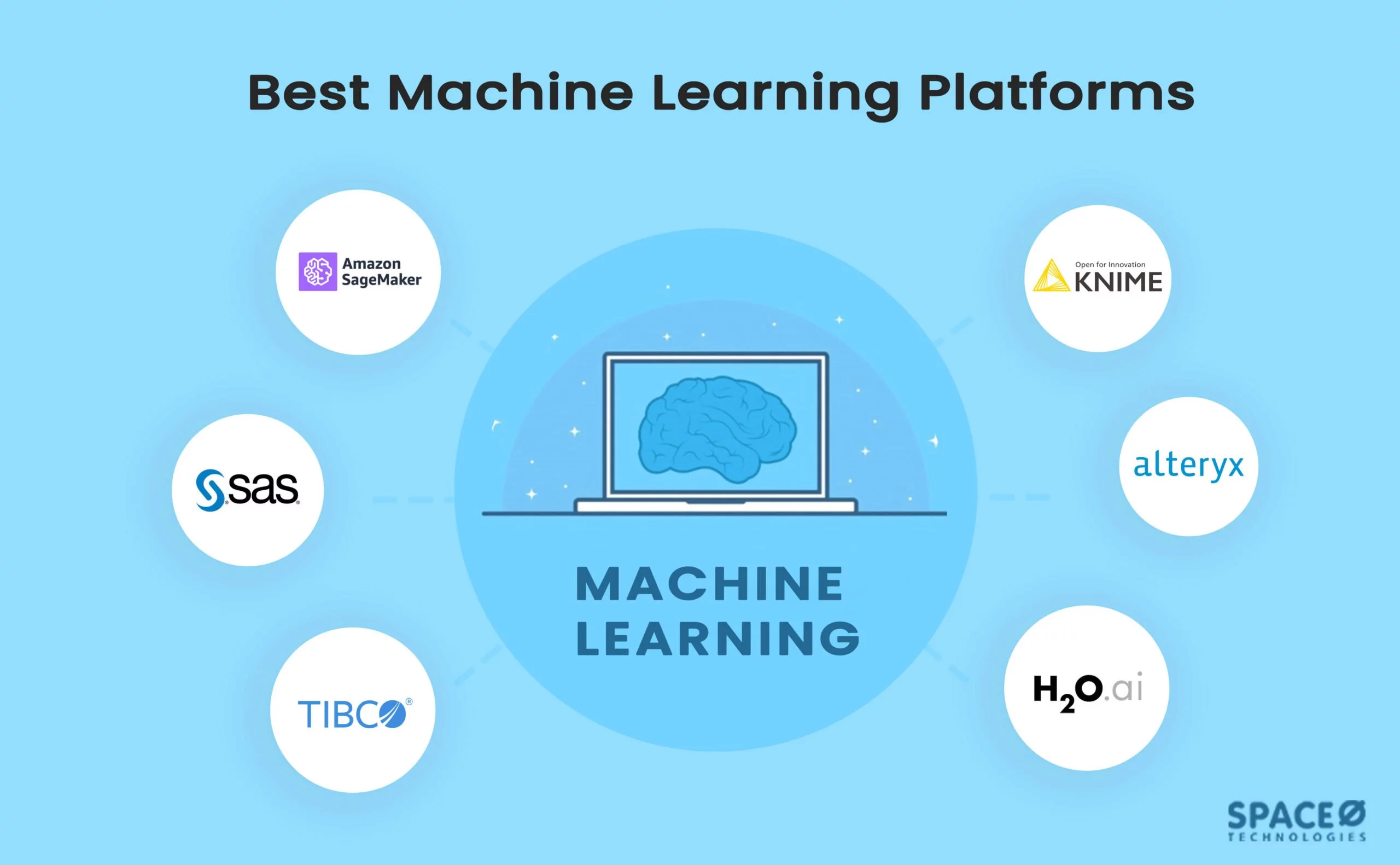
Face recognition, training and tuning are some of the essential machine learning capabilities. We have listed down the best machine learning software below.
-
KNIME Analytics Platform
KNIME Analytics Platform is a well-known online machine learning platform, which is a free open-source platform that provides end-to-end data analysis, integration, and reporting. With the KNIME Analytics Platform, data scientists can easily enable the creation of visual workflows via a drag-and-drop-style graphical interface. It will not require knowledge of coding.
To build workflows, a user gets to choose from more than 2000 nodes. KNIME Analytics allows developers to perform various actions; from basic I/O to data manipulations, transformations, and data mining. The best part of KNIME Analytics is that it consolidates the entire function process into a single workflow.
Top Features:
- Parallel execution on multi-core systems
- Offers scalability through sophisticated data handling
- Simple extensibility via a well-defined API for plugin extensions
Want to download and try KNIME Analytics Platform?
-
TIBCO Software
TIBCO is a data science platform that supports the entire analytics lifecycle with capabilities to include cloud-based analytics that integrates with many open source libraries.
TIBCO data science allows the user to prepare data and do the model building, deployment, and monitoring. It is widely known for use cases, such as product refinement and business exploration.
Top Features:
- Automatically detects the locations and visualizes those data as an interactive map
- Can analyze data in many visualization types, such as tables and charts
- Can access real-time streaming and spot issues
Want to download and try TIBCO Software?
-
Amazon SageMaker
Amazon SageMaker is a cloud machine-learning platform that allows developers to create, train, and deploy machine learning models. Data scientists or developers can easily deploy machine learning models on embedded systems and edge devices.
It is developed by Amazon Web Services (AWS) that offers the broadest machine and deepest set of learning services and supporting cloud infrastructure.
Top Features:
- Build highly accurate training datasets
- Provides a visual interface to analyze the debug data for the easy inspection process
- No need to break down the data set into multiple chunks
Want to try and download Amazon SageMaker?
-
Alteryx Analytics
Alteryx Analytics is one of the leading analytics platforms with machine learning capabilities built-in. It combines data preparation, blending, and advanced analytics in a single platform, making it ideal for business analysts who need ML-powered insights without deep coding knowledge..
Alteryx provides data scientists with a platform that helps them build models in a workflow.
Their vision is to make it easy to use for companies to cultivate a data analytics culture without the requirement of data scientists. In self-service data analytics, Alteryx always leads.
Top Features:
- Automate manual data tasks into repeatable analytics workflows
- Freedom to deploy and manage analytic models
- Support almost every data source and visualization tool
Want to try and download Alteryx Analytics?
-
SAS
SAS is a data science and analytics software vendor that offers a robust suite of advanced analytics and data science products. The best part of considering the SAS platform is that you can easily access data in any format and from any source.
It automatically generates a pipeline that dynamically adjusts to the data. It also includes natural language generation for project management. SAS Model Management allows users to register SAS and open-source models within projects or as standalone models.
Top Features:
- Allows to explore data from within Model Studio and launch directly into SAS Visual Analytics
- Visual interface for the entire analytical lifecycle process
- View training data within each node in Model Studio
Want to try and download SAS?
-
H2O.ai
H2O.ai offers a wide range of AI platforms and data science platforms to expert data scientists. It is a fully open-source platform, which is a distributed in-memory ML platform with linear scalability.
H2O supports statistical and machine learning algorithms for those who are looking for deep learning platforms because deep learning is one of the significant advantages of it.
It offers Deep Water for deep learning, where H2O continues to lead in data science and machine learning unified platforms.
Top Features:
- Process large text blocks and build models with Natural Language Processing
- Has image processing capabilities using over 30 pre-trained image transformers and models
- Automatically generates visualizations and creates data plots
Want to try and download H2O.ai?
-
Databricks Unified Analytics Platform
It offers a cloud and Apache Spark-based unified analytics platform, which is a combination of data engineering and data science functionality.
The one who is working on the Databricks Unified Analytics platform gets exclusive features for real-time enablement on AWS, high performance, and best operation results.
One can simply access the preconfigured ML environments with a single-click feature for Augmented Machine Learning with popular frameworks.
Top Features:
- Highly reliable and performant data pipelines
- Productive data science at scale
- End-to-end data security and compliance
Want to try and download Databricks Unified?
-
Microsoft Azure Machine Learning Studio
Microsoft offers its services in the data science and machine-learning markets through its Azure software products.
The cloud-based Azure Machine Learning Studio is perfectly designed for those who want to build, test, and execute predictive analytics, and machine learning solutions on their data. Azure is one of the most liked platforms in the data science and machine learning markets.
Apart from this, Microsoft Azure allows customers to easily build, deploy, and share advanced analytics solutions in the cloud.
Top Features:
- Integrates with existing DevOps processes and helps to manage the complete ML lifecycle
- Understand models with interpretability and protect data
- Provides the best support for open-source frameworks and languages
Want to try and download Microsoft Azure?
-
DataRobot
DataRobot offers an enterprise AI machine learning platform that makes it fast and easy to maintain, build, and deploy AI.
It includes Automated Machine Learning, Automated Time Series, and MLOps which are independent and fully integrated tools.
All can be easily deployed in various ways according to the business requirements. It helps you to solve business problems by finding the best predictive model for your data.
Top Features:
- Allows to build innovative new deep learning models from incredibly diverse types of data
- Monitor models via a centralized dashboard to see usage in real-time
- Provides fully explainable AI through human-friendly visual insights
Want to try and download DataRobot?
-
RapidMiner
RapidMiner offers a data science platform to help people for building and operating AI solutions. It covers the entire lifecycle of the AI production process; from data exploration and data preparation to model building, ML models deployment, and model operations.
It comes with the depth that is essential for a data scientist to simplify AI via a visual user interface that can easily streamline the process of building and understanding complex models.
Top Features:
- The powerful visual programming environment
- Access, load, and analyze any type of data
- Efficiently build and deliver better models faster
Want to try and download RapidMiner?
So, we have gone through the best platforms for machine learning along with their features and download option. In case, if you are finding it quite difficult to choose one, no problem. We have compared these platforms in the next section. Let’s have a look at the comparison.
Want to Hire ML Developers?
Want to validate your app idea? Get a free machine learning consulting for your project.
Machine Learning Platforms Comparison
With the help of Gartner, we have made a comparison table for ML platforms based on the reviews of clients and customers.
Many clients and customers rely on Gartner to look up for business suggestions because Gartner is a leading and advisory company. Please feel free to check machine learning platform comparison below.
| Logo | Platform | Overall Rating | Would Recommend |
|---|---|---|---|

| Alteryx | 4.7 | 94% Yes |

|
| AWS | 4.7 | 83% Yes |
|
| Databricks | 4.5 | 91% Yes |
|
| DataRobot | 4.8 | 94% Yes |
|
![]() |
H2O.ai | 4.8 | 96% Yes |
![]() |
KNIME | 4.8 | 100% Yes |
![]() |
Microsoft | 4.5 | 85% Yes |
| RapidMiner | 4.7 | 92% Yes |

|
| SAS | 4.6 | 86% Yes |
|
| TIBCO | 4.6 | 85% Yes |
To make it easy for you, we have compared all the platforms based on their ‘Overall Ratings’ and ‘Would Recommend’ percentages. You can check all the platforms with their received ratings & recommendation percentage and decide which platform is the best for your project.
Comparing all the platforms based on the recommendation percentage, KNIME has got 100%, which is the highest with 34 customer reviews. In fact, this platform is adopted by millions of customers.
Do You Have a Project in Mind?
Get a free consultation from a web expert to discuss your requirements and take your project to the next level.
How to Choose the Right Machine Learning Platform
With multiple ML platforms available, selecting the right one requires matching the platform’s strengths to your specific requirements. Here are the key factors to evaluate before making a decision.
Assess your team’s technical expertise
The skill level of your team determines whether you need a code-first platform or a no-code/low-code solution. Platforms like Amazon SageMaker and Databricks suit experienced data science teams. RapidMiner and KNIME are better suited for business analysts and teams with limited coding backgrounds.
Define your deployment requirements
Consider where your models need to run. Cloud-only platforms work well for SaaS products and web applications. On-premise or hybrid deployment options matter for industries with strict data residency requirements, such as healthcare and finance. Check whether the platform supports containerized deployment through Docker or Kubernetes.
Evaluate integration with your existing tech stack
The ML platform should connect easily with your current databases, cloud infrastructure, and business tools. Look for native integrations with services like AWS, Azure, or GCP. Also check for API support and pre-built connectors for CRM, ERP, and analytics tools. This avoids building custom middleware and reduces implementation time.
Compare pricing models
ML platform pricing varies significantly. Some platforms charge per compute hour, others use per-user licensing, and some offer free tiers with paid upgrades. Factor in costs for data storage, model training compute, and API call volumes. Free and open-source platforms like KNIME may have lower upfront costs but require more internal infrastructure management.
Check community support and documentation
Strong documentation, active user communities, and responsive vendor support reduce troubleshooting time. Open-source platforms like H2O.ai and RapidMiner benefit from active community forums. Enterprise platforms typically offer dedicated support tiers and SLAs.
Start with a proof of concept
Before committing to a full deployment, run a small-scale proof of concept on 2 to 3 shortlisted platforms. Test each platform against a real dataset and a specific business problem. This hands-on evaluation reveals usability gaps and performance limitations that feature lists alone cannot show.
Choosing the right machine learning platform depends on your team’s expertise, deployment needs, budget, and existing technology stack. By comparing key capabilities and validating your choice with a proof of concept, you can select a platform that supports efficient model development, deployment, and long-term scalability.
Common Use Cases of Machine Learning Platforms
Machine learning platforms power a wide range of applications across industries. Here are some of the most common use cases where businesses deploy ML models through these platforms.
Healthcare diagnostics and patient outcomes
ML platforms help healthcare organizations build models for early disease detection, medical image analysis, and patient readmission prediction. Platforms with HIPAA-compliant infrastructure, like Amazon SageMaker and Azure ML, are especially relevant for healthcare app development projects.
Financial fraud detection and risk scoring
Banks and fintech companies use ML platforms to identify fraudulent transactions in real time. Models trained on transaction history can flag anomalies and assign risk scores instantly. This reduces false positives and speeds up fraud response. ML platforms also support credit scoring and regulatory compliance modeling for fintech app development.
eCommerce personalization and recommendation engines
Online retailers rely on ML platforms to power product recommendations, dynamic pricing, and customer segmentation. Recommendation models analyze browsing history, purchase patterns, and demographic data to serve personalized experiences. These models directly impact conversion rates and average order values across eCommerce platforms.
Logistics route optimization and demand forecasting
Supply chain and logistics companies use ML platforms for route optimization, warehouse demand forecasting, and delivery time estimation. Models process variables like traffic patterns, weather data, and order volumes to improve delivery efficiency.
Predictive maintenance in manufacturing
Manufacturing operations deploy ML models to predict equipment failures before they occur. Sensor data from machinery is processed through the ML platform to detect early warning patterns. This reduces unplanned downtime and extends equipment lifespan.
Natural language processing for customer support
ML platforms support NLP model development for chatbots, sentiment analysis, and ticket classification. These models automate first-line customer support and route complex queries to human agents. Businesses building AI chatbot solutions benefit from platforms with pre-trained language models and fine-tuning support.
Machine learning platforms enable organizations to solve complex business challenges across industries, from healthcare and finance to retail and manufacturing. Whether it’s automating workflows, improving customer experiences, or generating predictive insights, the right ML platform provides the tools needed to build, deploy, and scale AI solutions that deliver measurable business value.
Introduction to Machine Learning Tools
Before you know the various tools for machine learning, you must know their importance because mastering ML will allow you to perform many tasks.
Machine learning comes with an extensive collection of ML tools, platforms, and software products that let you train your models, discover new methods, and create your own algorithms. Machine learning Here’s the list of machine learning tools:
Best Machine Learning Tools
Here, we have listed the best machine learning tools and compared them based on their platforms, language, features, benefits, and cost.
| Tool | Supported Platform | Language | Algorithms/ Features | Benefits | Tool Cost |
|---|---|---|---|---|---|
| Scikit-learn | Linux, Mac OS, Windows | Python, Cython, C, C++ |
|
|
Free |
| PyTorch | Linux, Mac OS, Windows | Python, C++, CUDA |
|
|
Free |
| TensorFlow | Linux, Mac OS, Windows | Python, C++, CUDA | Provides a library for dataflow programming |
|
Free |
| Weka | Linux, Mac OS, Windows | Java |
|
|
Free |
| KNIME | Linux, Mac OS, Windows | Java |
|
|
Free |
| Colab | Cloud Service | – | Supports libraries of PyTorch, Keras, TensorFlow, and OpenCV |
|
Free |
| Mahout – Apache | Cross-platform | Java Scala |
|
|
Free |
| Accord.Net | Cross-platform | C# |
|
|
Free |
| Shogun | Windows Linux UNIX Mac OS | C++ |
|
|
Free |
| Keras.io | Cross-platform | Python | API for neural networks |
|
Paid |
| RapidMiner | Cross-platform | Java |
|
|
|
So above we have listed the best ML platforms and ML tools with all their features. We have also compared them respectively to make it easy for the readers. You might also want to check out the popular AI tools and frameworks that you must try.
Conclusion
We hope that this information will help you to take the right action while selecting the best machine learning platform for your project. Our dedicated team of iOS developers is always committed to offer the best resolutions to your doubts.
The team understands the requirements of disruptive start-ups to large enterprises. Space-O Technologies is a leading machine learning consulting services provider, offering the best AI and ML development services.
In case, if you still have any queries or confusion with regards to machine learning software, what is the best platform for machine learning projects, then you can contact us. We will guide you further.

Frequently Asked Questions
What is a machine learning platform?
A machine learning platform is an integrated software environment that provides tools and infrastructure to build, train, deploy, and manage ML models across the entire development lifecycle. These platforms combine data preparation, algorithm selection, model training, and deployment into a single workspace. They eliminate the need to assemble separate tools for each stage. Examples include Amazon SageMaker, Databricks, Google Vertex AI, and H2O.ai.
Why do businesses use machine learning platforms?
Businesses use machine learning platforms to reduce the time, cost, and technical complexity of building and deploying ML models. These platforms provide pre-built algorithms, AutoML capabilities, and managed infrastructure that eliminate the need for custom setup. Teams can move from data exploration to production deployment within a single environment. This accelerates time-to-value and allows companies to apply ML to use cases like fraud detection, demand forecasting, and customer personalization without building everything from scratch.
How do machine learning platforms support the full ML workflow?
Machine learning platforms support the full ML workflow by providing integrated tools for data ingestion, feature engineering, model training, evaluation, deployment, and monitoring. Data connectors pull information from databases, APIs, and cloud storage. Built-in notebooks and visual editors handle experimentation and model building. Deployment pipelines push trained models to production as REST APIs or batch processes. Post-deployment monitoring tracks model performance and triggers retraining when accuracy drops.
Which are the best machine learning platforms for enterprises?
Amazon SageMaker, Databricks, Microsoft Azure ML Studio, Google Vertex AI, and DataRobot are among the most widely adopted machine learning platforms for enterprise use. Amazon SageMaker integrates natively with AWS services and supports end-to-end MLOps. Databricks unifies data engineering and ML workflows on a single lakehouse platform. Azure ML Studio connects with the Microsoft ecosystem. Google Vertex AI offers strong AutoML and pre-trained model support. DataRobot specializes in automated model building for business teams.
What features should I look for in a machine learning platform?
The most important features to look for in a machine learning platform include AutoML, data pipeline management, model deployment tools, MLOps capabilities, and support for open-source frameworks. AutoML automates algorithm selection and hyperparameter tuning. Data pipeline tools handle ingestion, cleaning, and feature engineering. One-click deployment simplifies pushing models to production. MLOps features like model versioning, drift detection, and automated retraining maintain long-term accuracy. Support for TensorFlow, PyTorch, and Scikit-learn ensures flexibility without vendor lock-in.
How is an ML platform different from an AI platform?
An ML platform focuses specifically on building, training, and deploying machine learning models, while an AI platform covers a broader range of artificial intelligence capabilities. ML platforms provide tools for data processing, algorithm development, model training, and MLOps. AI platforms extend beyond ML to include natural language processing, computer vision, speech recognition, generative AI, and robotic process automation. In practice, most enterprise AI platforms include ML capabilities as a core component alongside other AI services.
When should a company invest in a machine learning platform?
A company should invest in a machine learning platform when it has a clear business use case, sufficient data to train models, and a team ready to build or manage ML workflows. Common triggers include the need to automate repetitive decisions, extract insights from growing datasets, or improve prediction accuracy for processes like demand forecasting or fraud detection. Companies that rely on scattered tools for different ML tasks also benefit from consolidating onto a single platform for better efficiency and collaboration.
How do machine learning platforms help with model deployment?
Machine learning platforms simplify model deployment by providing built-in pipelines that move trained models from development to production with minimal manual configuration. Most platforms support one-click deployment as REST API endpoints for real-time predictions or batch processing for large-scale inference. They handle containerization, scaling, and load balancing automatically. Platforms like Amazon SageMaker and Databricks also support A/B testing, shadow deployments, and canary releases to validate model performance before full rollout.
What role does MLOps play in machine learning platforms?
MLOps plays a critical role in machine learning platforms by automating the operational lifecycle of ML models from deployment through monitoring and retraining. It brings DevOps principles to machine learning, covering model versioning, experiment tracking, automated testing, and CI/CD pipelines for model updates. MLOps features detect data drift and performance degradation in production models. They trigger automated retraining workflows when model accuracy falls below defined thresholds, ensuring models stay reliable over time.
How do cloud-based machine learning platforms compare to open-source options?
Cloud-based ML platforms offer managed infrastructure, scalability, and enterprise support, while open-source platforms provide greater flexibility, customization, and lower licensing costs. Cloud platforms like Amazon SageMaker and Azure ML handle compute provisioning, security, and maintenance automatically. Open-source options like KNIME and H2O.ai give teams full control over the environment but require internal infrastructure management. Cloud platforms suit teams that want faster deployment with minimal DevOps overhead. Open-source platforms work better for organizations with strong engineering teams and specific customization needs.
What are the benefits of using a managed ML platform?
A managed ML platform reduces operational overhead by handling infrastructure provisioning, security, scaling, and maintenance automatically. Teams can focus on model development instead of managing servers and environments. Managed platforms also provide built-in monitoring, automated backups, and compliance certifications. This accelerates deployment timelines and lowers the total cost of ownership compared to self-hosted solutions. Enterprise-managed platforms like Amazon SageMaker and Google Vertex AI offer SLAs, dedicated support, and seamless integration with existing cloud services.
How do machine learning platforms improve collaboration between data teams?
Machine learning platforms improve collaboration by providing shared workspaces, experiment tracking, and version control that keep data scientists, ML engineers, and analysts aligned. Shared notebooks allow team members to review and build on each other’s work. Experiment tracking logs every model run with parameters, metrics, and results for full reproducibility. Role-based access control manages permissions across projects. Platforms like Databricks and SageMaker also support real-time co-editing, model registries, and approval workflows that streamline handoffs between development and deployment teams.