
 By
Contents
- AI development cost ranges from $25,000 to $500,000+ in 2026. A proof of concept starts near $15,000, while enterprise platforms go beyond $500,000.
- Build cost is only part of the budget. Infrastructure, API usage, and maintenance add to the total, and maintenance alone typically costs 15% to 25% of the build every year.
- Data readiness, model approach, and integrations drive most of the price. Starting with an MVP on pre-trained models keeps your first investment low.
Key Takeaways
AI development cost typically ranges from $25,000 to $500,000 or more, depending on your business requirements. A focused proof of concept can start around $15,000. An enterprise AI platform with custom models, deep integrations, and compliance controls can go well past $500,000.
Each range covers the build only. Your full budget also includes cloud infrastructure, model or API usage fees, and maintenance. Maintenance alone usually adds 15% to 25% of the original build cost every year.
Most organizations have already started with AI. McKinsey State of AI survey found that 88% of organizations use AI in at least one business function. Yet only about one-third have scaled it across the enterprise. Scaling is where AI budgets get tested. Pilots are cheap, but data preparation, integrations, and ongoing model costs grow quickly once AI reaches production.
So why do two AI projects with similar feature lists get quotes that are far apart? Four variables explain most of the difference: how ready your data is, whether you use a pre-trained model or build a custom one, how many systems the AI connects to, and which regulations apply to your industry.
Space-O Technologies has built AI products like eComChat, a semantic search bot that grew a client’s revenue by 23%, and GPT Vix, an AI recruitment platform for a US hiring agency. Our AI development services team uses that delivery experience to break down AI development cost by project tier, use case, development phase, and hiring model. You will also see the ongoing costs most estimates leave out, so you can build a budget your finance team will approve.
Average AI Development Cost to Build AI Solutions
The AI development cost in 2026 typically ranges from US $25,000 to US $500,000 or more. So, how much does AI cost to develop in your specific case? The answer depends on project scope, data readiness, and integration depth. Simple AI features sit at the lower end, while enterprise platforms reach higher.
Here is a quick view of typical cost ranges by project tier.
| Project Tier | Cost Range | Typical Timeline |
|---|---|---|
| Proof of Concept (PoC) | US $15,000 to US $40,000 | 4 to 8 weeks |
| Basic AI Feature | US $40,000 to US $100,000 | 2 to 4 months |
| Mid-Level AI Application | US $80,000 to US $200,000 | 4 to 7 months |
| Advanced AI System | US $200,000 to US $500,000 | 6 to 12 months |
| Enterprise AI Platform | US $500,000 and above | 9 to 18 months |
These ranges cover engineering work only. Cloud infrastructure, ongoing maintenance, and compliance add to the total. Most businesses underestimate AI cost estimation by skipping these layers.
The first question is not “how much does AI cost?” but what scope you actually need. The right scope makes cost predictable from day one. When you match scope to budget, the numbers become clear. Disciplined scoping protects your timeline and your return on investment.
Why AI Development Is Worth the Investment in 2026
AI has shifted from experimental technology to a core business engine. Businesses now use it to automate operations, sharpen decisions, and unlock new revenue streams. This shift makes AI investment a strategic priority rather than an optional bet. Here is why the math favors action over delay in 2026.
Several big-picture trends explain the urgency:
- According to Fortune Business Insights, the global AI infrastructure market was valued at USD 58.78 billion in 2025 and is expected to reach USD 497.98 billion by 2034, growing from USD 75.40 billion in 2026 at a CAGR of 26.60%. North America held the largest market share of 37.10% in 2025.
- A UNCTAD report projects that the AI market will expand 25-fold, reaching US $4.8 trillion by 2033.
- According to McKinsey, around 65% of marketers are now using AI to optimize workflows, improve campaign efficiency, and make more data-driven decisions across their marketing strategies.
- As per StackOverflow, over 80% of software developers use AI tools for coding, with productivity gains reported up to 94%.
- Early adopters are achieving measurable gains in productivity, customer experience, and operating margins, creating a strong competitive advantage.
These numbers tell a clear story to decision-makers everywhere. Businesses that delay AI adoption risk falling behind competitors that invest early. Building AI now is a hedge against future disruption, not just a tech upgrade. The cost of AI development becomes easier to justify when you frame it as competitive insurance.
Disciplined investment requires understanding what AI development actually costs to build. Wild estimates and vague ranges help no one in budget meetings. The next sections give you grounded numbers to plan with confidence. Let us look at typical cost ranges first.
What Factors Affect AI Development Cost?
AI development cost depends on a handful of core factors. In most projects, data work, integrations, and production engineering cost more than the model itself.
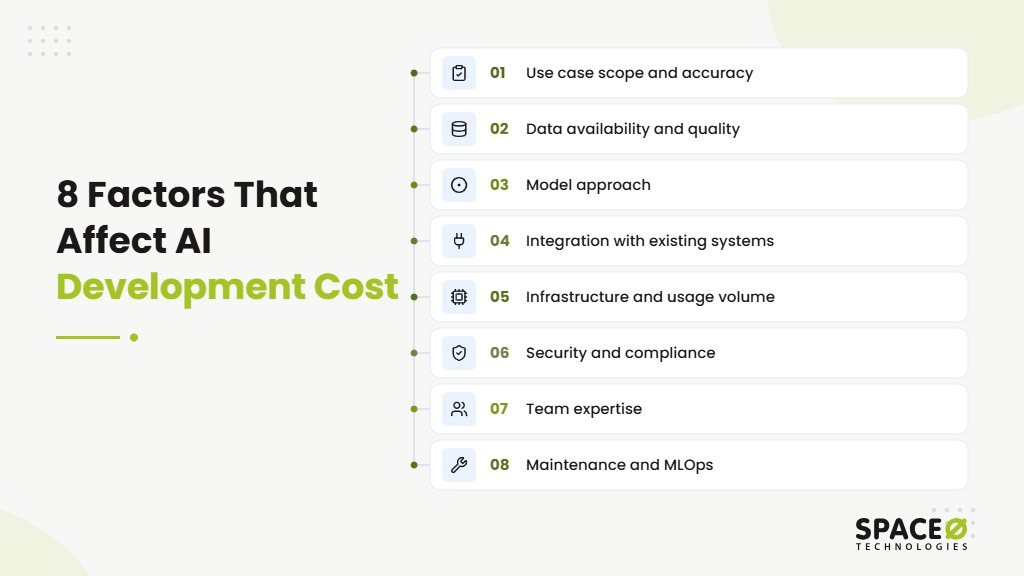
1. Use case scope and accuracy
A clearly defined use case keeps the budget stable, while vague goals lead to rework and extra testing. Complex tasks, such as processing images or making multi-step decisions, cost more than simple predictions. High-stakes outputs in finance or healthcare also need stricter accuracy testing and often human review.
2. Data availability and quality
Scattered, unlabeled, or inconsistent data must be cleaned and connected through pipelines before training starts. Data collection and preparation typically take 20% to 30% of the total budget.
3. Model approach
Pre-trained APIs and retrieval-augmented generation (RAG) cost the least. Fine-tuning adds dataset and compute costs, and custom models cost the most. Generative AI and deep learning also need more data and compute than traditional machine learning.
4. Integration with existing systems
Every CRM, ERP, or database the AI connects to adds engineering and testing time. Legacy systems with weak APIs often need custom middleware.
5. Infrastructure and usage volume
GPU workloads, low-latency responses, and hybrid or on-premises hosting raise both build and monthly costs. Generative AI costs also grow with usage, since every request consumes compute. Choosing the right AI frameworks and tools and estimating traffic early keep these costs predictable.
6. Security and compliance
Regulated projects need audit trails, access controls, explainability, and privacy safeguards under rules such as HIPAA, GDPR, and the EU AI Act. Planning compliance during discovery costs far less than adding it after the build.
7. Team expertise
Specialized AI engineers charge more per hour, but inexperienced teams usually cost more overall through ramp-up time and rework. Many businesses hire dedicated AI developers with production experience to avoid these delays.
8. Maintenance and MLOps
Models drift as data changes, so monitoring, retraining, and updates continue after launch. Annual maintenance typically costs 15% to 25% of the initial build.
How much does AI cost to develop for your project? The answer depends on a handful of core factors. Scoping these factors early with experienced AI consulting services helps you avoid paying for complexity your project does not need.
AI Development Cost by Use Case
AI development typically costs $25,000 to $500,000+, depending on the use case, technical complexity, data requirements, integrations, and security needs. A focused proof of concept can start around $15,000, while complex enterprise AI platforms can exceed $500,000.
| AI Use Case | Estimated Cost | Common Applications |
|---|---|---|
| AI Chatbots and Virtual Assistants | $25,000–$100,000 | Customer support, FAQ automation, internal assistance |
| Recommendation Engines | $50,000–$150,000 | Product suggestions, content personalization. |
| Predictive Analytics Tools | US $70,000 to US $200,000 | Demand forecasting, risk scoring. |
| Generative AI Applications | $75,000–$300,000 | Content generation, AI copilots. |
| Computer Vision Systems | $75,000–$300,000 | Image recognition, video analysis. |
| Custom Enterprise AI | $200,000–$500,000+ | End-to-end automation pipelines. |
These are indicative ranges rather than fixed prices. The final AI development cost depends on the features, AI models, data, integrations, infrastructure, and level of customization required.
For example, an AI chatbot built with a pre-trained model and a few API integrations may require less development than a computer vision system using proprietary datasets. An enterprise AI platform can cost significantly more when it requires custom models, multiple integrations, advanced security, compliance controls, and ongoing monitoring.
Businesses exploring potential applications can explore our guide to AI use cases to see how companies are applying AI across different business functions and industries.
The use case gives you a starting point for estimating your budget. A more accurate AI development estimate requires evaluating the required functionality, data, integrations, technology stack, security requirements, and deployment environment.
Build AI Around Your Business Use Case
Share your requirements and get a clear roadmap for developing an AI solution that fits your workflows.

Cost Breakdown Analysis by Development Phases
The cost of developing AI spreads across six clear phases. Each phase carries its own resource needs and timeline. Treating cost as a single line item leads to mid-project surprises. A phase-wise breakdown gives you full visibility before signing any contract.
| Development Phase | Cost Share | Estimated Cost Range |
|---|---|---|
| Discovery and Planning | 5 to 10% | US $5,000 to US $25,000 |
| Data Collection and Preparation | 20 to 30% | US $15,000 to US $150,000 |
| Model Development and Training | 25 to 35% | US $30,000 to US $200,000 |
| Software Engineering and Integration | 15 to 25% | US $25,000 to US $120,000 |
| Testing, QA, and Compliance | 10 to 15% | US $10,000 to US $50,000 |
| Deployment and Go-Live | 5 to 10% | US $5,000 to US $30,000 |
Data work often consumes the largest share of any AI budget. Cleaning, labeling, and structuring data takes longer than most teams expect. Model training adds compute costs that scale with model size. Integration with existing systems can stretch timelines if APIs are outdated.
The cost of implementing artificial intelligence rises sharply when phases are skipped or rushed. A short discovery phase can save significant budget downstream. Want to learn how Space-O builds AI step by step? Read our guide on how to build an AI app for a deeper look at each phase.
Building Your First AI Product? Here Is What It Costs
New to AI development? Describe your vision in the calculator, and our consultants break down the cost in a clear, jargon-free estimate.
AI Development Cost by Industry Vertical
The cost of developing AI varies sharply across industries. Data complexity, regulation, and integration depth shape the final number. Healthcare and finance carry strict compliance overhead that raises budgets. Retail and SaaS often run on lighter cost structures.
| Industry | AI Cost Range | Common Applications |
|---|---|---|
| Healthcare | US $80,000 to US $500,000 | Diagnostic tools, patient analytics. |
| Fintech | US $100,000 to US $400,000 | Fraud detection, risk scoring. |
| Retail and eCommerce | US $50,000 to US $250,000 | Recommendation engines, inventory forecasting. |
| Manufacturing | US $100,000 to US $400,000 | Predictive maintenance, quality control. |
| SaaS Platforms | US $40,000 to US $200,000 | Personalization, automation features. |
| Logistics | US $80,000 to US $300,000 | Route optimization, fleet analytics. |
| Education | US $40,000 to US $200,000 | Adaptive learning, performance analytics. |
Healthcare AI carries HIPAA compliance and high accuracy demands. Fintech AI requires fraud-grade security and strict regulatory adherence. Retail AI typically uses pre-trained models with light integration. Manufacturing AI often needs IoT data pipelines that drive up infrastructure costs.
Understanding industry context helps you set realistic expectations. Many businesses now extend AI capabilities through AI in mobile app development to reach end users directly. The earlier you map regulation and data needs, the more accurate your budget becomes. Industry context shapes scope as much as technology choice does.
Create Smart AI Systems That Drive Efficiency and Business Growth
Provide your requirements and receive a strategic roadmap for AI implementation designed to streamline operations, improve decision-making, and deliver long-term measurable business outcomes.
AI Development Cost by Region and Hiring Model
Where you hire matters as much as what you build. Region and hiring model can shift your budget by 50% or more. Two organizations building the same product can pay vastly different totals. Here is how location and team structure affect the cost of AI development.
| Region | Average Hourly Rate | Typical Project Cost |
|---|---|---|
| United States | US $150 to US $250 | US $200,000 to US $700,000 |
| Western Europe | US $80 to US $150 | US $120,000 to US $400,000 |
| Eastern Europe | US $40 to US $90 | US $80,000 to US $250,000 |
| India | US $25 to US $60 | US $40,000 to US $180,000 |
| Latin America | US $40 to US $80 | US $80,000 to US $200,000 |
| Southeast Asia | US $25 to US $55 | US $40,000 to US $150,000 |
The hiring model also reshapes total cost. In-house teams demand fixed salaries and infrastructure overhead year-round. Specialized AI agencies offer faster delivery with project-based pricing. Freelancers fit smaller scopes but require careful coordination from your side.
Three hiring models commonly compete for AI projects:
- In-house teams offer full control but cost US $500,000 or more annually.
- Specialized AI agencies deliver faster results with US $30,000 to US $150,000 per project.
- Freelance developers suit small scopes at US $25 to US $120 per hour.
The right AI development team structure depends on your scope, timeline, and budget control. The right provider also delivers 30 to 50% savings without quality trade-offs. Choose the model that matches your project complexity, not the cheapest hourly rate. Budget discipline starts with the right hiring decision.
Traditional AI suits prediction, automation, and structured decision-making. Generative AI fits assistants, content tools, and conversational systems. The cost gap shows up most clearly after launch. Generative systems consume compute every time a user interacts with the platform.
For predictable budgets, traditional AI usually wins out. For interactive products and natural language tools, generative AI delivers more value per dollar. Match the technology to the problem, not the latest trend. The right fit keeps the cost of AI development under firm control.
Hidden and Ongoing Cost of AI Development
Most AI budgets fall apart after launch, not before it. Hidden costs surface once the system goes live in production. Ignoring these layers leads to expensive surprises down the line. Realistic artificial intelligence cost planning includes ongoing expenses from day one.
Model retraining
Model retraining keeps your AI accurate as data patterns shift. User behavior changes, and external conditions evolve. Without retraining, performance drops silently within months of launch. Plan for US $15,000 to US $60,000 per year on retraining cycles.
Infrastructure scaling
Infrastructure scaling becomes a major cost as adoption grows. More users mean higher compute and storage demands across the platform. Real-time systems put constant pressure on infrastructure spend. Monthly costs can range from US $5,000 to US $50,000 at scale.
Data storage and processing
Data storage charges climb steadily with dataset size and frequency. Training data, model checkpoints, and output logs all add up fast. Healthcare and fintech projects face extra storage compliance requirements. Budget US $500 to US $5,000 monthly for data infrastructure costs.
Monitoring and observability
Monitoring tools track model accuracy, latency, and system health. Real-time alerting catches drift and errors before users notice issues. Observability platforms require dedicated subscriptions and tooling investment. Plan for US $300 to US $2,000 monthly across enterprise systems.
Compliance audits
Compliance audits add significant recurring overhead in regulated sectors. Healthcare, finance, and legal projects require regular external reviews. Each audit can cost US $10,000 to US $40,000 annually, depending on the scope. Skipping audits creates legal and operational risks down the line.
API usage fees
API usage fees scale fast for generative AI applications at production volume. Every user query consumes tokens that translate directly into bills. Heavy traffic can drive monthly API costs above US $50,000. Self-hosted models trade upfront cost for predictable inference economics.
Annual AI maintenance typically runs 15 to 25% of the original cost of AI development. A US $200,000 build means US $30,000 to US $50,000 in yearly upkeep. Generative AI systems can exceed this range due to inference costs. Skipping maintenance budgets leads to model drift and broken features.
Treat hidden costs as fixed budget lines, not optional add-ons. Build a 20% contingency buffer into every AI project from day one. This buffer absorbs scope changes, data issues, and infrastructure spikes. Realistic planning protects both your timeline and your long-term ROI.
Stop Guessing Your AI Budget. Get Real Numbers.
Get a transparent, line-item AI development quote based on your specific use case, data readiness, and integration needs, with no hidden fees or surprise costs.
Proven Strategies to Optimize AI Development Cost
Strategic cost optimization starts before the first line of code is written. The right strategies shave 30 to 50% off the cost of AI development. They also shorten timelines without sacrificing quality or business outcomes. Here are the strategies that consistently work for our clients.
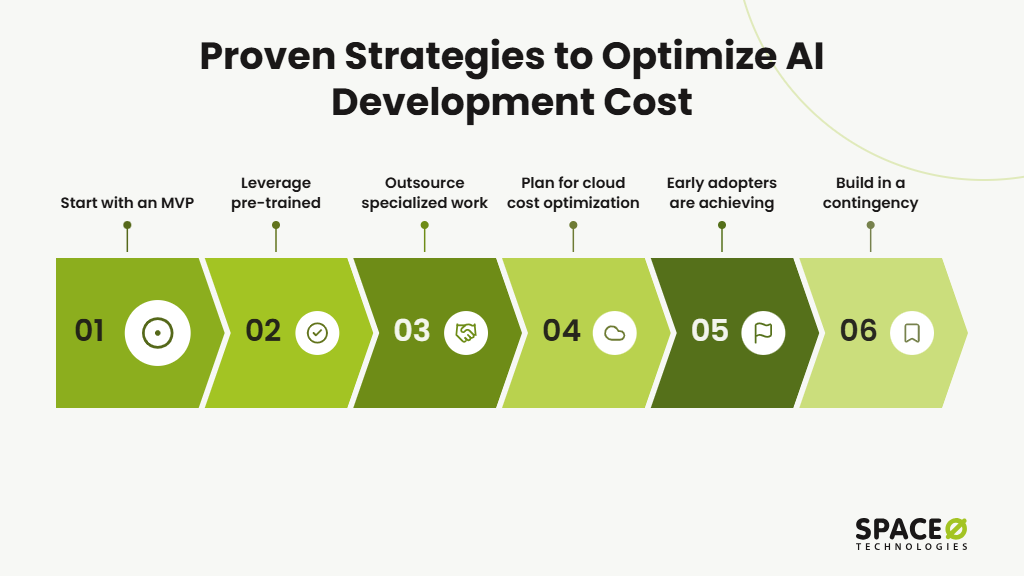
1. Start with an MVP
An MVP-first approach validates AI value before full-scale investment kicks in. You build a minimum viable version with only essential features. This approach reveals real user behavior and technical risks early. An AI MVP development cycle keeps initial spend as low as US $20,000.
2. Leverage pre-trained models
Pre-trained foundation models cut training costs sharply across most use cases. Providers like OpenAI, Google, and Anthropic offer mature, reliable options. Fine-tuning these models meets enterprise needs without full custom builds. Using pre-trained models can save US $100,000 or more on initial development.
3. Use modular architecture
Modular architecture splits the system into reusable, independent components. Each module handles a specific function, like data processing or model training. You can upgrade or replace modules without rewriting the entire system. This approach reduces long-term maintenance costs and supports incremental scaling.
4. Outsource specialized work
Outsourcing gives you access to senior AI expertise without payroll overhead. Working with leading AI development companies lets you complete projects 30 to 50% cheaper than in-house teams. You can scale teams up or down based on actual project needs. Strategic outsourcing fits MVPs, scaling phases, and cost-sensitive projects best.
5. Plan for cloud cost optimization
Cloud cost optimization uses spot instances, quantization, and autoscaling together. Spot instances cut training costs by up to 70% on non-critical workloads. Model quantization reduces inference compute by 50 to 80% in production. Autoscaling eliminates idle compute costs that quietly drain budgets.
6. Build in a contingency buffer
A 20% contingency buffer absorbs unexpected technical challenges across the project. Data quality issues, scope changes, and integration surprises happen on every build. The buffer protects your timeline without forcing mid-project budget battles. Smart project managers treat contingency as a planning tool, not a luxury.
Optimization is not about cutting corners on quality. It is about spending in the right places at the right time. Strategic sequencing and the right provider unlock measurable savings. The goal is value per dollar, not the lowest price possible.
Modernize Your Business With Custom AI Solutions
From AI chatbots to predictive analytics and computer vision systems, we build production-ready AI applications customized to your industry, workflows, and long-term growth goals.
Why Choose Space-O Technologies for Your AI Development Project
Space-O Technologies develops custom AI solutions designed around specific business requirements, workflows, data, and technology environments. Since 2010, we have delivered AI-powered products across recruitment, ecommerce, and intelligent content processing. Our portfolio includes GPTVix, an AI recruitment platform, EcomChat, an AI-powered ecommerce solution, and ReadGenie, an AI-based image-to-text application.
Our AI development services cover the complete development lifecycle, from use-case discovery and AI model selection to development, system integration, deployment, and optimization. We focus on building secure, scalable AI applications that integrate with existing business systems and deliver measurable outcomes in production.
How much does it cost to develop artificial intelligence for your specific use case? Share your requirements to get a clear development scope and cost estimate from our AI experts.
Watch this short showcase video for a wider look at the work our team has delivered.
Frequently Asked Questions
How much does it cost to build an AI system?
Most AI systems cost between $25,000 and $500,000 to build. Simple chatbots fall at the lower end, while enterprise platforms with custom models can reach the higher end. Final costs depend on data availability, project scope, and integration complexity.
How long does it take to develop an AI solution?
Simple AI solutions typically take 2 to 3 months, mid-level applications require 4 to 8 months, and enterprise systems may take 6 to 12 months. Highly customized large language model solutions can extend beyond a year depending on complexity and data readiness.
Can small businesses afford AI development?
Yes, small businesses can keep the cost of AI development manageable with MVP-first strategies, with initial costs ranging from $20,000 to $40,000. Leveraging pre-trained models and outsourcing helps reduce expenses, making AI accessible even with limited budgets.
How much does it cost to build an AI chatbot?
AI chatbot development costs between $40,000 and $100,000. Basic rule-based chatbots are on the lower end, while advanced NLP-powered assistants with integrations into CRM and backend systems are more expensive. Before estimating your chatbot budget, our guide to AI chatbot explains how each type works and where it fits.
What factors influence AI cost estimation the most?
Key cost drivers include data quality, model complexity, and integration depth. Compliance requirements, team expertise, and infrastructure choices also impact both initial development costs and long-term operational expenses.
How much does it cost to develop artificial intelligence with an in-house team versus an agency?
An in-house AI team typically costs $500,000 or more per year, including salaries and infrastructure. A specialized AI agency usually charges $30,000 to $150,000 per project, with no hiring or onboarding overhead. Agencies suit most first builds, while in-house teams fit companies with long-term AI roadmaps.



 All our projects are secured by NDA




 4.8


