
 By
By 
Contents
An AI chatbot is a software application that simulates human-like conversations through text or voice. Unlike scripted bots that follow fixed rules, AI chatbots understand natural language, learn from interactions, and generate contextual responses. Businesses use AI chatbot development services to build chatbots that power customer support, lead generation, sales, and internal operations across industries.
Businesses adopt AI chatbots to automate repetitive conversations that would otherwise require human agents. A single chatbot handles thousands of queries simultaneously, operates around the clock, and delivers consistent responses. The technology behind these systems ranges from basic NLP models to advanced large language models like GPT-4o and Claude. Businesses across industries hire chatbot developers to build solutions tailored to their specific workflows.
This guide covers everything from how AI chatbots work to how to build one from scratch. Each section includes practical insights, real-world examples, and technical depth to help you evaluate chatbot technology for your business.
AI Chatbots Explained! Everything You Need to Know
A chatbot is a software program that understands natural language and generates real-time responses instead of following fixed scripts. It uses natural language processing to interpret typed or spoken input, identify user intent, and produce a relevant reply.
Traditional rule-based bots match keywords to pre-written answers. AI chatbots interpret meaning, so they handle rephrased questions, follow-up queries, and unexpected wording. Modern versions run on large language models, which lets them hold multi-turn conversations and adapt tone to context.
The practical difference shows up in coverage. A scripted bot fails the moment a user asks something its author did not anticipate. An AI chatbot reasons over the query and either answers it or escalates cleanly to a human agent.
How does an AI chatbot work?
AI chatbots work by processing user input through layers of natural language understanding, generating a response using trained models, and delivering the output in conversational format. The technical architecture varies by chatbot type, but four core technologies power most modern implementations.
1. Natural language processing (NLP)
NLP enables chatbots to interpret human language, not just match keywords. The process involves tokenization (breaking text into words), part-of-speech tagging, named entity recognition, and intent classification. When a user types “Can I reschedule my appointment to Friday?”, NLP identifies the intent (reschedule), the entity (appointment), and the parameter (Friday).
NLP frameworks like Google Dialogflow, Rasa, and Microsoft LUIS handle this processing layer. The accuracy of intent recognition depends on training data quality and the number of intent categories the chatbot must distinguish.
2. Machine learning and deep learning
Machine learning allows chatbots to improve accuracy over time without manual rule updates. Supervised learning trains chatbots on labeled conversation datasets where each input is mapped to an intent. The model learns patterns and generalizes to new inputs it has not encountered before.
Deep learning uses neural networks to process more complex language patterns. Techniques like recurrent neural networks (RNNs) and transformer architectures enable chatbots to understand sentence structure, word relationships, and conversational context across multiple turns. For a deeper understanding of these technologies, explore this roadmap to AI development.
3. Large language models and generative AI
Large language models (LLMs) like GPT-4o, Claude, Gemini, and Llama 3 represent the most advanced chatbot technology. These models are trained on billions of text tokens and generate human-like responses to open-ended queries. They handle conversations that NLP-based chatbots cannot, including creative writing, summarization, and multi-step reasoning. Learning how to build an AI app using OpenAI provides a practical starting point for understanding LLM-powered chatbot development.
Generative AI chatbots do not rely on predefined response templates. They construct each response dynamically based on the input, conversation history, and model parameters. This flexibility comes with challenges, including hallucinations (generating plausible but incorrect information) and the need for guardrails to keep responses accurate and on-brand.
4. Retrieval-augmented generation (RAG)
RAG combines the generative power of LLMs with a retrieval system that pulls verified information from your documents, knowledge bases, or databases. Before generating a response, the system searches a vector database for relevant content and grounds the LLM’s output in factual data.
This architecture solves the hallucination problem for domain-specific chatbots. A healthcare chatbot using RAG retrieves answers from approved medical guidelines rather than generating responses from general training data. Organizations evaluating RAG architecture for knowledge-intensive chatbot applications typically begin with AI chatbot strategy consulting to assess data readiness before any build decision.
NLP, machine learning, LLMs, and RAG form the four technology layers behind modern chatbots. Understanding these layers helps you evaluate which chatbot type fits your specific use case.
Types of AI Chatbots and How They Work
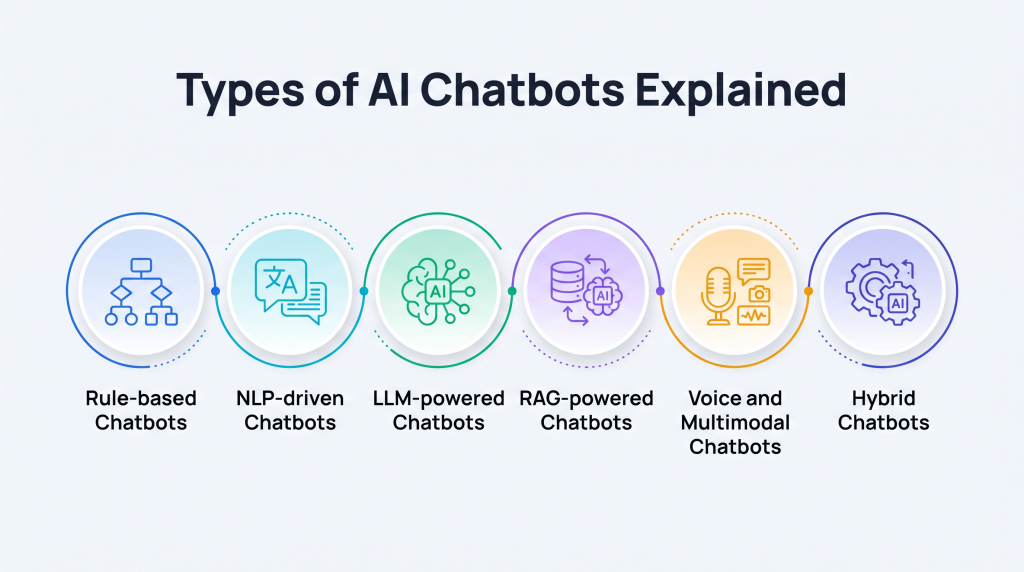
Six distinct chatbot types exist, each suited to different levels of conversation complexity, budget, and business requirements. Choosing the right type is the first and most consequential decision in any chatbot project.
1. Rule-based chatbots
Rule-based chatbots follow predefined scripts and decision trees. They respond to specific keywords or menu selections with fixed answers. These bots cannot understand natural language or handle unexpected queries. They work best for simple, structured interactions like FAQ responses and appointment booking.
2. NLP-driven chatbots
NLP-driven chatbots recognize user intent and extract entities from natural language input. They handle varied phrasing, typos, and conversational deviations that rule-based bots cannot process. Frameworks like Dialogflow, Rasa, and LUIS power this chatbot category.
3. LLM-powered chatbots
LLM-powered chatbots use large language models to generate dynamic, human-like responses. They handle open-ended conversations, maintain context across multiple turns, and adapt their tone to the interaction. Generative AI development teams build these chatbots with prompt engineering, content moderation guardrails, and model fine-tuning.
4. RAG-powered chatbots
RAG-powered chatbots retrieve verified information from proprietary documents before generating responses. They combine LLM capabilities with factual grounding, making them ideal for healthcare, legal, finance, and any domain where accuracy is critical.
5. Voice and multimodal chatbots
Voice chatbots process spoken input through speech-to-text, generate responses using AI models, and deliver audio output through text-to-speech engines. Multimodal chatbots extend this capability by processing images, documents, and video alongside text and voice.
6. Hybrid chatbots
Hybrid chatbots combine rule-based flows with AI capabilities. They use scripted paths for structured tasks (order tracking, form filling) and switch to AI-powered responses for open-ended queries. This approach balances cost efficiency with conversational flexibility.
| Chatbot Type | How It Works | Best For | Complexity |
|---|---|---|---|
| Rule-based | Fixed scripts and decision trees | FAQ, booking, lead capture | Low |
| NLP-driven | Intent recognition and entity extraction | Multi-turn support, varied queries | Medium |
| LLM-powered | Generative AI with dynamic responses | Open-ended conversations, content tasks | High |
| RAG-powered | LLM + retrieval from knowledge base | Domain-specific Q&A, compliance-heavy industries | High |
| Voice/multimodal | Speech-to-text + LLM + text-to-speech | IVR replacement, accessibility | Very high |
| Hybrid | Rule-based + AI for complex queries | Balanced cost and capability | Medium-high |
Each category sits at a different point between basic automation and advanced AI conversations. For a wider comparison of complexity, cost, and fit, see types of AI chatbots for business. Knowing how they compare to related technologies like virtual agents and AI agents clarifies what each category delivers.
Chatbot vs. AI Chatbot vs. Virtual Agent vs. AI Agent
These four terms describe different levels of conversational automation, from basic scripted bots to autonomous AI systems that take independent actions. Understanding the differences prevents misaligned expectations during vendor selection or development planning.
| Feature | Chatbot | AI Chatbot | Virtual Agent | AI Agent |
|---|---|---|---|---|
| Intelligence | Rule-based, scripted | NLP/ML/LLM-powered | AI + system integration | Autonomous AI + tool use |
| Conversation style | Fixed menu or keyword | Natural language, contextual | Natural language, personalized | Goal-oriented, multi-step |
| Learning ability | None | Improves over time | Learns from interactions | Learns and adapts strategy |
| System access | None or limited | API integrations | CRM, ERP, helpdesk access | Full system access + actions |
| Decision making | Follows rules only | Suggests responses | Handles queries end-to-end | Plans and executes tasks independently |
| Example | FAQ bot on a website | GPT-powered support chat | Insurance claims handler | AI agent that books, cancels, and refunds orders |
The key distinction between AI chatbots and AI agents is autonomy. An AI chatbot responds to questions. An AI agent plans a sequence of actions, uses external tools, and completes tasks without human intervention. Most businesses start with AI chatbots and evolve toward AI agents as their automation maturity grows.
Thinking About Building an AI Chatbot for Your Business?
Our AI consultants help you identify the right chatbot type, define conversation scope, and plan the technical architecture. Get a free consultation tailored to your business requirements.

Key Features of an AI Chatbot
The features built into an AI chatbot determine its effectiveness, user experience, and development complexity. Some features are essential for every chatbot, while others apply only to specific use cases or industries.
Essential features that define a functional AI chatbot include:
- Intent recognition: Identifies what the user wants from their message, even with varied phrasing or typos.
- Context retention: Remembers earlier messages within a conversation to deliver coherent, multi-turn responses.
- Entity extraction: Pulls specific data points (dates, names, product IDs, locations) from user input for processing.
- Live agent handoff: Transfers the conversation to a human agent when the chatbot cannot resolve the query.
- Multi-channel deployment: Operates across web, mobile app, WhatsApp, Messenger, Slack, and other platforms.
- Analytics dashboard: Tracks conversation volume, resolution rates, user satisfaction, and common drop-off points.
- Sentiment analysis: Detects user frustration, urgency, or satisfaction to adjust response tone or escalate.
- Personalization: Adapts responses based on user profile, past interactions, or behavioral data.
Advanced features like RAG-based knowledge retrieval, voice input/output, multi-language support, and payment processing integration add capability but also increase development scope and cost. Enterprise software development projects typically require most of these advanced features to handle complex internal workflows.
The right feature set determines chatbot effectiveness and development scope. The next section covers why businesses invest in these capabilities and what core purposes chatbots serve.
What is the Purpose of a Chatbot?
The primary function of a chatbot is to automate repetitive conversations and tasks that would otherwise require human agents. This frees human teams to focus on complex, high-value interactions while the chatbot handles volume.
Core purposes include customer support automation (answering FAQs, tracking orders, processing returns), lead qualification (collecting contact details, asking qualifying questions, routing prospects), and internal operations (IT helpdesk, HR onboarding, knowledge base access).
A chatbot does not replace human teams. It handles the predictable, high-volume interactions so that human agents can spend their time on conversations that require empathy, judgment, or creative problem-solving.
Chatbots automate repetitive conversations, qualify leads, and streamline internal operations. The business benefits that result from these capabilities drive measurable ROI across customer experience, cost savings, and revenue.
6 Key Benefits of AI Chatbots for Business
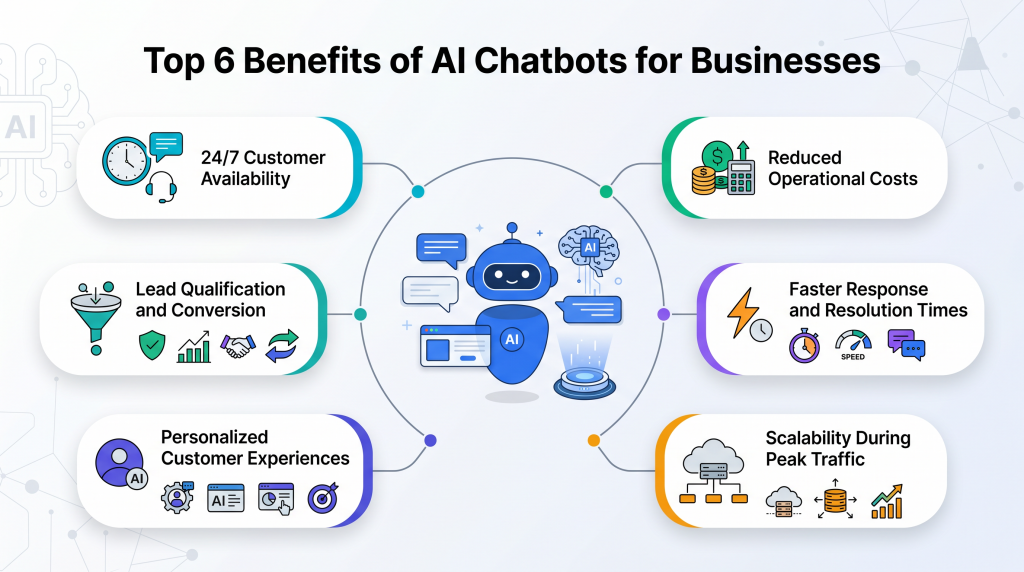
AI chatbots deliver measurable improvements across customer experience, operational efficiency, and revenue generation. These benefits compound over time as the chatbot learns from interactions and handles an increasing share of total conversations.
1. 24/7 customer availability
AI chatbots handle queries around the clock without overtime, shift scheduling, or staffing constraints. Customers in different time zones receive instant support at any hour. This constant availability improves satisfaction scores and reduces abandoned inquiries.
2. Reduced operational costs
A well-built chatbot resolves 40% to 60% of routine support queries without human escalation. Fewer tickets reaching human agents means lower staffing costs, shorter queues, and more efficient resource allocation across the support organization.
3. Faster response and resolution times
Chatbots respond instantly, eliminating the wait times that frustrate customers during peak hours. Average resolution time drops from minutes to seconds for common queries. Faster resolution improves retention and reduces ticket abandonment rates.
4. Scalability during peak traffic
Unlike human teams, chatbots handle 100 or 100,000 conversations without performance degradation. Seasonal events, product launches, and marketing campaigns generate traffic spikes that chatbots absorb without additional cost.
5. Personalized customer experiences
AI chatbots analyze user profiles, purchase history, and behavioral patterns to deliver tailored responses. Product recommendations, personalized offers, and context-aware support create interactions that feel relevant rather than generic.
6. Lead qualification and conversion
Chatbots qualify leads through conversational questions, collect contact information, and route high-intent prospects to sales teams in real time. eCommerce website development projects frequently integrate chatbots to recover abandoned carts, recommend products, and guide users toward purchase.
These benefits apply broadly across every industry, but the specific applications and ROI differ by sector. The following section maps chatbot use cases to five major verticals.
AI Chatbot Use Cases by Industry
AI chatbots serve different functions depending on the industry, with each vertical requiring specific integrations, compliance measures, and conversation designs. The use cases below reflect the most common and highest-ROI chatbot applications by sector.
Ecommerce chatbots
Ecommerce AI chatbots handle product search, personalized recommendations, order tracking, cart recovery, and post-purchase support. They connect to product catalogs, payment systems, and shipping APIs to resolve customer queries end-to-end without agent involvement.
Space-O Technologies built eComChat, an AI-powered e-commerce search solution using OpenAI. The system interprets customer intent through natural language processing and surfaces relevant products across a 20,000-item catalog. It delivered a 23% improvement in search speed compared to traditional keyword matching.
Healthcare chatbots
Healthcare app development projects increasingly include chatbot components for symptom checking, appointment scheduling, medication reminders, and patient intake. HIPAA-compliant infrastructure, encrypted data storage, and audit trails are mandatory for healthcare chatbots. See our breakdown of chatbot development for healthcare for compliance requirements and integration considerations.
Customer support chatbots
Customer support is the most common chatbot deployment. These bots handle FAQs, order status inquiries, password resets, billing questions, and return processing. Advanced support chatbots escalate complex cases to human agents with full conversation context.
Sales and lead generation chatbots
Sales chatbots engage website visitors, ask qualifying questions, collect contact details, and book demo calls. They operate 24/7, ensuring no lead goes unattended outside business hours. Integration with CRM platforms (Salesforce, HubSpot) ensures captured leads flow directly into the sales pipeline.
Marketing chatbots
Marketing chatbots deliver personalized content, run interactive campaigns, collect survey responses, and nurture leads through drip sequences. They operate on websites, landing pages, and messaging platforms to increase engagement and conversion rates.
Banking sits apart from these five because every conversation touches authentication, fraud, and regulated advice. Our guide to AI chatbots in banking covers those constraints in detail.
Want to Add an AI Chatbot to Your Product or Platform?
Share your use case with our development team. Get a clear recommendation on chatbot type, technology stack, and integration approach for your specific business requirements and industry.
Real-World AI Chatbot Examples
AI chatbots operate at every scale, from small business customer support bots to enterprise systems handling millions of conversations monthly. The examples below illustrate the range of chatbot applications across different industries and complexity levels.
- ChatGPT by OpenAI is the most widely recognized generative AI chatbot. It handles open-ended conversations, content creation, code generation, and research assistance using GPT-4o.
- Google Gemini serves as Google’s conversational AI assistant, integrated across Search, Workspace, and Android. It processes text, images, and code within a single interface.
- Amazon Alexa demonstrates voice-first chatbot architecture, processing spoken commands for smart home control, shopping, and information retrieval.
- eComChat by Space-O Technologies is an AI-powered eCommerce search solution built using OpenAI. It replaces keyword-based product search with intent-driven natural language queries across 20,000 products.
These examples show that chatbot complexity ranges from single-purpose FAQ bots to multi-model AI systems. The right complexity level depends on your specific use case, conversation volume, and integration requirements. The following section provides a step-by-step guide for building your own AI chatbot from scratch.
How to Create an AI Chatbot for Your Business
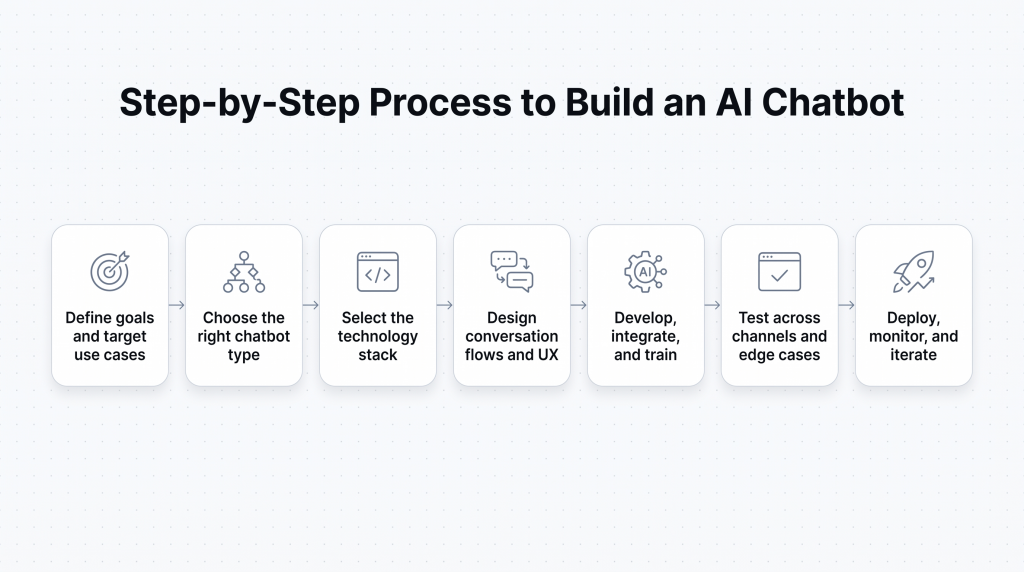
Building an AI chatbot follows a structured seven-step process, from goal definition to post-launch iteration. Skipping steps creates feature creep, weak conversation design, and post-launch failures.
- Define Goals and Target Use Cases – lock 2 to 3 high-impact use cases, then attach metrics like 30% lower ticket volume or 50% self-resolution.
- Choose the Right Chatbot Type – match complexity to use case. FAQ bots need rule-based logic, support bots need NLP or LLM, and internal knowledge assistants need RAG.
- Select the Technology Stack – decide the NLP/LLM framework, backend language, database, infrastructure, and chat interface. Each choice affects cost, scalability, and vendor lock-in.
- Design Conversation Flows and UX – map happy paths, edge cases, fallbacks, and escalation triggers. Allocate 10% to 15% of budget here using Voiceflow, Botmock, or Figma.
- Develop, Integrate, and Train – build backend logic, connect CRM, payment, and helpdesk APIs, then train on curated datasets. LLM bots also need prompt engineering and guardrails.
- Test Across Channels and Edge Cases – cover functional, conversation, edge case, load, and security testing. Include real beta users, not only QA engineers.
- Deploy, Monitor, and Iterate – configure the web widget, WhatsApp API, or Slack, then track resolution rate, escalation rate, CSAT, and drop-off points.
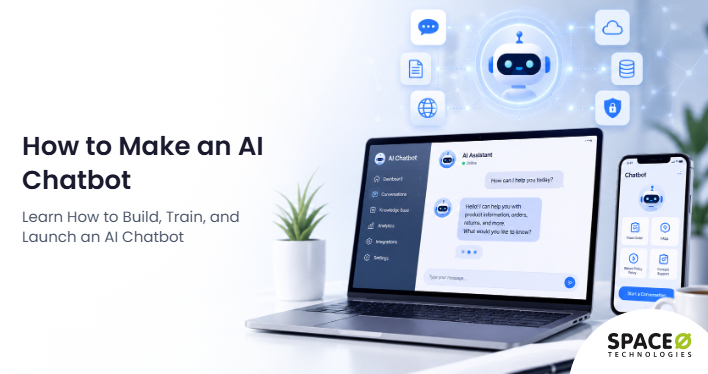
Each step carries technical decisions that shape cost and performance. For a detailed walkthrough of every stage, read our guide on how to make an AI chatbot.
Technology Stack to Build AI Chatbot Solutions
The technology stack you select shapes chatbot performance, scalability, development speed, and long-term maintenance cost. The table below maps common tools and frameworks across each layer of the chatbot architecture.
| Layer | Technology Options | Purpose |
|---|---|---|
| NLP frameworks | Dialogflow, Rasa, Microsoft LUIS, Amazon Lex | Intent recognition, entity extraction |
| LLM APIs | OpenAI GPT-4o, Anthropic Claude, Google Gemini, Meta Llama 3, Mistral | Generative responses, multi-turn conversations |
| Vector databases | Pinecone, Weaviate, pgvector, Chroma, Qdrant | RAG document storage and retrieval |
| Backend languages | Python, Node.js, Java, Go | API development, business logic |
| Frontend frameworks | React, Flutter, Vue.js | Chat interface, multi-platform deployment |
| Cloud platforms | AWS, Google Cloud, Microsoft Azure | Hosting, scaling, monitoring |
| DevOps tools | Docker, Kubernetes, GitHub Actions | Deployment, CI/CD pipelines |
| Analytics | Mixpanel, Amplitude, custom dashboards | Conversation tracking, performance metrics |
Python dominates chatbot backend development due to its extensive AI/ML library ecosystem (TensorFlow, PyTorch, LangChain, Hugging Face). Node.js is preferred for real-time applications requiring WebSocket connections.
Businesses exploring AI app development using OpenAI typically combine GPT-4o with a vector database for RAG, Python or Node.js for the backend, and React for the frontend interface. Technology decisions directly influence the project budget and timeline.
What Is the Cost of Developing an AI Chatbot?
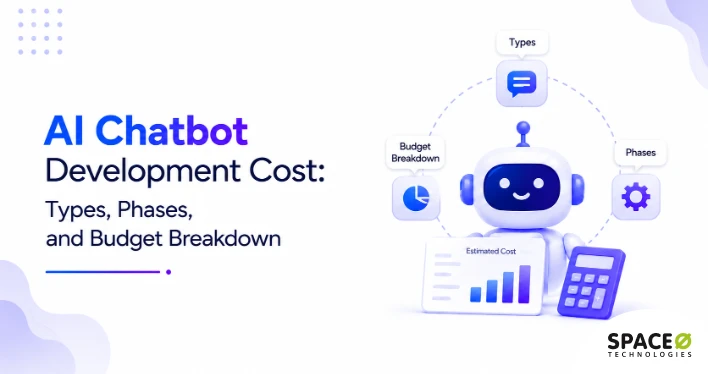
AI chatbot development costs range from $3,000 for a basic rule-based bot to $300,000+ for an enterprise-grade AI system. The cost depends on chatbot type, AI model selection, feature scope, integration depth, and team location.
Learn how much it costs to develop an AI chatbot with our detailed pricing guide covering development phases, industries, and engagement models.
Ready to Build an AI Chatbot That Solves Real Problems?
From architecture planning to deployment, our development team handles the full chatbot lifecycle. Share your requirements and receive a free consultation with a detailed cost estimate.
Technical Limitations of AI Chatbots
AI chatbots carry six technical limitations that affect accuracy, latency, and long-term cost. Understanding these constraints before development helps you scope architecture and budget realistically.
Hallucinations from probabilistic generation
LLM-powered chatbots generate plausible but incorrect information. The model predicts likely token sequences, not verified facts. RAG architecture, source-grounded prompting, and confidence thresholds reduce hallucination rates. None of these methods eliminate the problem entirely.
Context window and memory constraints
Every model has a fixed token limit per conversation. Long sessions push earlier turns out of context, so the bot forgets stated details. Summarization layers, vector-based conversation memory, and session state storage extend usable context at added infrastructure cost.
Intent recognition failures on ambiguous input
NLP models misclassify vague phrasing, typos, mixed-language queries, and multi-intent messages. Accuracy drops sharply on inputs outside the training distribution. Fallback logic, disambiguation prompts, and continuous intent library expansion contain the failure rate.
Integration constraints with legacy systems
Older CRM, ERP, and database systems often lack modern REST or GraphQL endpoints. Connecting them requires custom middleware, data mapping, and extensive regression testing. Legacy integration adds $10,000 to $30,000+ to development budgets and creates ongoing maintenance overhead.
Model drift and retraining overhead
Chatbot accuracy degrades as products, policies, and user language change. Retraining requires labeled conversation logs, evaluation datasets, and version-controlled deployment. Most businesses allocate 15% to 25% of initial development cost annually to keep performance stable.
Latency and inference cost at scale
Each LLM call adds response delay and per-token cost. High concurrency compounds both. Response caching, smaller models for routine intents, and streamed output keep latency acceptable. Architecture decisions here determine whether unit economics hold at volume.
These constraints are architectural, not permanent blockers. Each one has an established mitigation path that belongs in your scoping phase.
AI Chatbot Trends in 2026
The emerging trends are reshaping how businesses build and deploy AI chatbots. Staying aware of these shifts helps you make technology decisions that remain relevant as the market evolves.
1. Agentic AI chatbots
Agentic chatbots go beyond answering questions. They plan multi-step actions, use external tools (APIs, databases, web search), and complete tasks autonomously. Instead of telling a user their refund status, an agentic chatbot initiates the refund, sends the confirmation email, and updates the CRM record.
2. RAG-powered knowledge assistants
RAG architecture is becoming the default for enterprise chatbots that need factual accuracy. Connecting LLMs to proprietary knowledge bases eliminates hallucinations for domain-specific queries. Healthcare, legal, and financial services chatbots increasingly require this architecture.
3. Multimodal and voice-first interfaces
Chatbots that process text, voice, images, and documents within a single conversation are gaining adoption. Users photograph a damaged product and ask the chatbot to process a return. Voice-first chatbots replace traditional IVR phone systems with natural conversation.
4. Chatbot-to-AI agent evolution
The line between chatbots and AI agents continues to blur. Businesses that deploy chatbots today are building the conversation data and integration infrastructure needed to transition toward fully autonomous AI agents. Partnering with experienced GenAI consulting companies helps organizations plan this evolution deliberately rather than reactively.
These trends define where chatbot technology is heading. Applying this knowledge to your specific business requirements guides the right chatbot choice.
How to Choose the Right Chatbot for Your Business
Choosing the right chatbot requires matching your specific use case, conversation volume, technical environment, and budget to the appropriate chatbot type and deployment model.
Start by answering these questions:
- What conversations should the chatbot handle? Define the top 5 to 10 query types by volume.
- How complex are those conversations? Scripted (rule-based), intent-based (NLP), or open-ended (LLM/RAG)?
- Which systems must the chatbot connect to? CRM, helpdesk, payment, ERP, or custom databases?
- What channels do your users prefer? Web, mobile, WhatsApp, Slack, voice?
- Build or buy? Custom development offers full control and deep integration. SaaS platforms offer faster deployment with limited customization.
For businesses with standard use cases (FAQ, lead capture, basic support) and limited budgets, SaaS platforms provide quick time-to-value. For businesses needing deep system integration, data ownership, or compliance-grade accuracy, custom chatbot development delivers long-term ROI. Evaluating AI development companies with chatbot-specific experience ensures the right technical partnership.
Space-O Technologies, a custom software development company with expertise across AI and conversational systems, provides AI development services for chatbot projects spanning eCommerce, healthcare, fintech, and enterprise verticals.
Why Choose Space-O Technologies for Chatbot Development
Businesses comparing AI chatbot development companies typically evaluate delivery track record, in-house engineering depth, and security certifications. Space-O Technologies is a custom AI-powered software development company that serves 1,200+ clients across 25+ countries, backed by 140+ in-house developers and ISO 9001/27001 certifications for quality and data security. Projects like eComChat (23% search speed improvement using OpenAI) and GPT Vix (multi-model AI recruitment platform) demonstrate hands-on experience with the exact technologies that power modern chatbots.
Every chatbot project follows a structured six-phase process: discovery, conversation design, development, testing, deployment, and ongoing support. NLP/ML engineers, conversational designers, backend developers, and QA specialists work within Agile sprints with transparent documentation and regular progress updates. Businesses can also hire Generative AI experts for LLM-powered chatbot projects requiring specialized prompt engineering and model fine-tuning. This process eliminates the guesswork that causes chatbot projects to exceed budgets or miss deadlines.
Three flexible engagement models accommodate different project sizes and budget structures: dedicated team for long-term builds, time and materials for iterative development, and fixed cost for well-defined scopes. Each model includes a dedicated project manager, clear scope change protocols, and a 97% client retention rate that reflects consistent delivery quality across every engagement.
Frequently Asked Questions
What is a chatbot in simple words?
A chatbot is a software program that communicates with users through text or voice and answers questions automatically. Basic chatbots follow predefined rules and scripts, while AI chatbots understand natural language and generate contextual responses. Businesses commonly use chatbots for customer support, lead generation, and automating repetitive customer interactions.
What is the primary function of a chatbot?
The primary function of a chatbot is to automate repetitive conversations and routine tasks. Chatbots answer frequently asked questions, track orders, schedule appointments, qualify leads, and route support requests to the appropriate teams. By handling high-volume interactions, chatbots allow human agents to focus on more complex customer issues.
What are examples of AI chatbots?
Popular AI chatbots include ChatGPT, Google Gemini, Microsoft Copilot, Amazon Alexa, and Apple Siri. Businesses also build custom AI chatbots for specific use cases such as customer service, eCommerce search, employee support, healthcare assistance, and recruitment automation using large language models like GPT-4o and Claude.
What is the difference between a chatbot and an AI chatbot?
A traditional chatbot follows predefined rules and scripted conversation flows, whereas an AI chatbot uses natural language processing (NLP), machine learning, and large language models (LLMs) to understand intent and generate contextual responses. AI chatbots can interpret different ways of asking the same question and support more natural, human-like conversations.
What type of AI is used in chatbots?
Modern AI chatbots use a combination of Natural Language Processing (NLP), Machine Learning (ML), deep learning, and Large Language Models (LLMs). NLP enables language understanding, ML improves chatbot performance over time, and LLMs such as GPT-4o and Claude generate conversational, context-aware responses for complex user queries.
What is the difference between a chatbot and an AI agent?
A chatbot primarily responds to user queries within a conversation, while an AI agent can independently plan actions, interact with external systems, and complete multi-step workflows. For example, a chatbot may provide refund information, whereas an AI agent can initiate the refund, notify the customer, and update connected business systems without human intervention.



 All our projects are secured by NDA




 4.8
4.8