

Computer Vision Development Services
Computer vision development services companies build custom AI and machine learning systems that analyze visual data. These systems also process and interpret visual data that comes from images and from video. They automate tasks like object detection, facial recognition, optical character recognition (OCR), and quality inspection. These systems run in the cloud, on-premises, and on edge devices across manufacturing, healthcare, retail, and security.
Space-O Technologies builds these systems for startups, growing businesses, and enterprises. Since 2010, we have delivered 300+ software solutions and 50+ AI systems live in production. We have served 1,200+ clients worldwide and maintained a 97% client retention rate. Our computer vision engineers handle real-world variability, including changing lighting, camera angles, occlusion, and motion blur, with production-grade accuracy.
Looking to turn visual data into business outcomes? Hire computer vision developers to build production-ready solutions for manufacturing, healthcare, retail, logistics, automotive, and fintech.


Dream It, We Build It


What a Computer Vision Development Engagement Includes: The 5-Stage Lifecycle
A complete computer vision engagement runs a five-stage lifecycle, from feasibility through long-term maintenance. Naming the stages upfront keeps scope, cost, and accountability clear before any model is trained.

Feasibility and Consulting
During this stage, we assess your goals and audit your existing image and video sources. Then we pick the highest-impact use case and set a measurable accuracy target for it.

Data Collection and Annotation
We build training datasets through data collection and expert labeling, including bounding boxes, polygons, and keypoints. We also apply augmentation and use synthetic data in cases where real samples are scarce.

Model Training and Testing
We train and fine-tune models on your domain data, then benchmark precision, recall, and inference speed against real-world edge cases.

Integration and Deployment (Cloud or Edge)
First, we embed the model into your application, ERP, CRM, IoT device, or edge hardware. Then we deploy the model across cloud, on-premises, or edge environments, whichever your setup requires.

MLOps and Maintenance
We monitor accuracy, detect data drift, and trigger structured retraining under SLA-backed support.
This lifecycle maps to how the industry scopes computer vision work. Reference definitions from Microsoft Azure and IBM frame the same “analyze, process, and interpret visual data” core.
End-to-End Computer Vision Development Services
We deliver end-to-end computer vision software development services that take a system from idea to production. These services cover data annotation, custom model training, deployment, and cloud integration.

Computer Vision Consulting and Strategy
Our consultants evaluate your business goals, assess existing visual data sources, and identify the highest-impact use cases. We deliver a clear implementation roadmap covering model selection, data requirements, and deployment strategy. Every recommendation is grounded in technical feasibility and measurable business outcomes.

Custom Computer Vision Software Development
We design and build CV solutions tailored to your workflows and visual data challenges. Every system is built for real-world accuracy, long-term scalability, and compatibility with your existing infrastructure. From prototype to production, we own the full development lifecycle.
Computer Vision POC and MVP Development
We build focused proof-of-concept and minimum viable product solutions to validate your use case before full-scale investment. Our POC process tests model accuracy on your actual data, measures business impact, and identifies technical risks early. This reduces project risk and accelerates stakeholder buy-in.

Computer Vision Model Training and Optimization
We train and fine-tune models on your domain-specific datasets to maximize detection accuracy and inference speed. Our optimization work includes hyperparameter tuning, model compression, quantization, and ONNX conversion. Every model is benchmarked against real-world edge cases before production.

CV Data Services and Annotation
We build high-quality training datasets through structured collection, expert annotation, augmentation, and validation. Our data services cover bounding boxes, polygon segmentation, keypoint labeling, and synthetic data generation using generative adversarial networks (GANs). Clean, well-labeled data separates a working prototype from a production-grade solution.
Computer Vision System Integration
We embed computer vision into your existing software, mobile apps, ERPs, CRMs, IoT devices, and cloud platforms with minimal disruption. We ensure smooth data flow between CV models and your business systems. Every integration supports intelligent automation and infrastructure scalability.

Edge and Embedded Computer Vision Development
We build and deploy models optimized for edge devices, embedded hardware, and mobile platforms where cloud latency is not acceptable. Our edge solutions run on NVIDIA Jetson, Intel OpenVINO, TensorRT, and Core ML. They deliver real-time inference on factory floors, drones, smart cameras, and mobile apps. Every deployment is tuned for speed, power efficiency, and offline reliability.
Computer Vision API Development
We develop secure, documented, scalable APIs that expose your CV capabilities to internal systems, partner platforms, and customer-facing apps. Our APIs support real-time image and video inference, batch processing, and webhook event triggers. Every API ships with authentication, rate limiting, versioning, and documentation.

Computer Vision Deployment and MLOps Support
We deploy trained models across cloud, on-premises, and edge environments with full MLOps pipeline support. Our post-deployment services include performance monitoring, drift detection, automated retraining, and CI/CD pipeline management. Every launch is built for sustained accuracy and operational reliability.
Advanced Computer Vision Capabilities We Build
Our capabilities span the full range of visual AI techniques that power production systems. Each one is a building block our engineers combine and tune for your use case.

Object Detection
Locating and classifying multiple objects in images and video frames using bounding box prediction and confidence scoring. Our models handle overlapping objects, partial visibility, and varying scales in real time. This works across retail scanning, autonomous navigation, and industrial part identification.

Image Segmentation
Dividing images into pixel-level regions, where semantic segmentation labels every pixel by class and instance segmentation separates individual objects. Medical scan analysis, satellite imagery, agricultural monitoring, and autonomous driving rely on precise segmentation.

Facial Recognition
Detecting faces, mapping facial landmarks, encoding biometric features, and performing 1:1 verification or 1:N identification. Our models operate across diverse lighting, angles, and demographics with built-in bias mitigation and GDPR-compliant, privacy-by-design architecture.

OCR and ICR
Converting printed text (OCR) and handwritten text (intelligent character recognition, ICR) into structured, machine-readable formats. Our models handle multi-language recognition, rotated text, degraded documents, and complex tables for invoices, forms, labels, and IDs.

Video Analytics
Processing continuous video streams frame by frame to detect events and recognize patterns. The pipeline counts objects and triggers real-time alerts with minimal latency. Our pipelines handle multiple concurrent camera feeds for movement tracking, dwell time, and behavioral sequence detection.

Pose Estimation
Detecting human and object keypoints to understand posture, joint angles, movement direction, and spatial orientation across video. Our models track multiple subjects during fast movement and partial occlusion for ergonomics, sports analytics, and gesture interfaces.

Anomaly Detection
Identifying visual deviations from a learned baseline without labeling every fault type. Our models detect scratches, cracks, discoloration, and dimensional mismatches at the pixel level, catching rare defects that rule-based systems miss.

GAN-Based Generation
Generating photorealistic synthetic images and video using generative adversarial networks for training data augmentation and simulation. Our pipelines produce domain-specific datasets when real-world data is scarce, sensitive, or expensive to collect.

3D Scene Reconstruction
Building three-dimensional models from 2D images or video for spatial understanding, volume measurement, and environment mapping. Our models estimate depth from single images or calibrated camera systems. This supports construction monitoring, AR overlays, robotic navigation, and industrial measurement.
Computer Vision Solutions We Build for Business Automation
We combine multiple CV capabilities into production systems that automate specific operations. Each solution targets a real workflow, not a demo.

Automated Visual Inspection Systems
Real-time inspection systems that detect defects, surface anomalies, and dimensional deviations across manufacturing, packaging, and assembly lines. These systems process thousands of items per hour, replacing manual spot-checking with fully automated quality assurance.

Intelligent Document Processing Solutions
OCR- and ICR-powered solutions that extract structured data from invoices, contracts, forms, ID cards, and handwritten documents at scale. Each system validates extracted data against business rules and integrates with your ERP, CRM, or document platform. Applications include KYC verification, claims processing, and financial data entry.

Video surveillance and analytics platforms
Intelligent video analytics platforms that process live camera feeds to detect events, track objects, recognize faces, and trigger real-time alerts. These solutions turn passive CCTV into active monitoring. Applications include perimeter security, crowd management, workplace safety, and traffic analysis.

Visual search and product recognition systems
Visual search solutions let users find products by uploading images instead of typing keywords. They use deep learning-based image retrieval and similarity scoring. Applications include e-commerce product discovery, fashion matching, spare parts identification, and shoppable video.

Medical imaging analysis solutions
Solutions that analyze X-rays, MRIs, CT scans, pathology slides, and retinal images to assist clinical decisions. Each system is built with clinical validation workflows, HIPAA-compliant data handling, and integration with hospital information systems. Applications include diagnostic assistance, radiology screening, and surgical navigation support.

Facial recognition and access control systems
Systems verify identities, control access, automate attendance, and personalize experiences through real-time face detection and 1:1 or 1:N matching. All with a privacy-by-design architecture. Applications include secure facility access, event management, retail personalization, and identity verification.

Autonomous counting and tracking solutions
Systems that count and track objects, vehicles, people, or inventory across camera feeds without manual intervention. They combine object detection with multi-object tracking. Applications include warehouse inventory, retail footfall, traffic counting, and livestock monitoring.

Predictive maintenance through visual monitoring
Solutions that analyze equipment images, thermal scans, and video to spot early wear, corrosion, overheating, or mechanical failure. Early detection prevents downtime and reduces maintenance costs. Applications include industrial machinery inspection, power line monitoring, and fleet condition assessment.
AR-powered computer vision applications
Applications that combine computer vision with augmented reality to overlay digital information on real-world environments in real time. They use object recognition, spatial mapping, and depth estimation. Applications include virtual try-on, assembly guidance, remote maintenance assistance, and training simulations.
Scope Your Highest-Impact Computer Vision Task
Share your most valuable visual task with our computer vision team. We will review it and send you a clear build plan. Get My Build Plan
Business Benefits of Computer Vision Software Development
Computer vision lets organizations act on visual information with speed and accuracy that manual review cannot match. By automating visual tasks, businesses cut operational costs and remove human error in inspection. They also speed up decisions with real-time analytics.

Unmanned quality control
Real-time inspection detects micro-flaws on high-speed lines that human inspectors miss under fatigue and speed pressure. One trained model inspects every item instead of random sampling. It catches scratches, dimensional mismatches, and surface defects at the pixel level. This reduces scrap rates and recall costs.

Enhanced safety and security
Computer vision identifies workplace hazards and enforces compliance by detecting missing PPE in real time. It also enables biometric authentication for restricted areas. Continuous monitoring replaces periodic manual audits with 24/7 vigilance across manufacturing floors, construction sites, and facilities.

Automated inventory tracking
CV replaces manual stock counting with barcode scanning, label reading, and volumetric analysis across warehouses and retail. Real-time visibility reduces stockouts, eliminates counting errors, and improves throughput, handling what previously required multiple manual counts per week.

Data-driven customer insights
Existing cameras become spatial analytics tools that monitor foot traffic, map customer movement, and identify high-engagement zones. Retailers optimize store layouts, personalize experiences, and make merchandising decisions on real behavioral data.

Faster turnaround on visual analysis
Tasks that take human reviewers hundreds of images or video segments per day are completed in seconds through automated pipelines. Healthcare, insurance, logistics, and compliance teams reduce review backlogs and accelerate approval cycles.

Scale without proportional cost
Expanding to new locations, camera feeds, or product lines needs infrastructure investment, not more inspection teams. One trained model deploys across multiple sites with consistent accuracy through structured retraining. Cost per unit monitored falls as deployment grows.
Responsible AI by Default
We build computer vision systems with controls in place, so sensitive visual data and consequential decisions stay protected. Responsible AI is applied by default, not as an add-on.
On a lending client’s loan-origination workflow, the model drafts an approve or decline recommendation with a rationale. Underwriters approve every high-value decision before applicants see it, and the model only drafts and retrieves evidence.
No training on client data.
Your images, video, and documents are not used to train shared models.
PII masking.
Faces, documents, and identifiers are masked in pipelines where identity is not the task.
Bias and hallucination testing.
Models are tested for bias across demographics and evaluated against source data before release.
Human review for high-stakes decisions.
People approve consequential outcomes rather than the model acting alone.
What a Computer Vision Development Engagement Costs
A computer vision build is scoped by complexity, data readiness, and deployment target, with milestone-based payments tied to deliverables. No public source gives buyers a clear price, so here is how we scope one.

Proof of concept
$30,000 to $75,000 to validate accuracy on your real data before full commitment.

Production-grade system
$100,000 to $250,000 for edge deployment and enterprise integration.

Basic MVP
Starts at $15,000, with a feature-rich MVP running up to $50,000+.

Annual AI maintenance
Typically 15% to 25% of the original build cost per year.
Data readiness is the highest cost and timeline driver. If labeled data exists, training starts quickly; if it needs collection and annotation, preparation adds time before training begins. For a scoped, expert-reviewed estimate, use our AI development cost calculator or share your requirements.
How to Choose a Computer Vision Development Partner
Shortlist a partner by production track record, deployment flexibility, and compliance, not by demo polish. A working demo on clean data is not a production system.

Production track record
Ask how many systems a partner has running in production, not just built. Since 2010, we have shipped 50+ AI systems live in production, built by 30+ AI engineers. Structured retraining keeps them accurate over time.

Industry portfolio
Check whether the partner has delivered in your vertical, under your data and compliance conditions. We build across manufacturing, healthcare, retail, logistics, automotive, banking, agriculture, and energy.

Deployment flexibility
Not every use case belongs in the cloud. Factory floors need sub-100ms inference; mobile apps need on-device processing. We deploy across AWS, Azure, GCP, NVIDIA Jetson, Intel OpenVINO, and TensorRT based on your latency, bandwidth, and privacy needs.

Compliance and security
Computer vision processes faces, documents, and medical images. We are ISO 9001 and ISO 27001 certified, with GDPR and HIPAA-ready frameworks, encrypted pipelines, role-based access, and NDA-protected engagements.

Engagement model fit
Pick a model that matches your stage and internal capacity. We offer Dedicated Team, Time & Material, Fixed Cost, and Staff Augmentation models. Full code and IP ownership transfers to you at completion.
Industry-Specific Computer Vision Solutions
We build CV systems tailored to the workflows, compliance rules, and data environments of each vertical. From defect detection on production lines to medical scan analysis, the solution fits the sector.

Manufacturing
Automated defect detection, real-time quality control, and predictive maintenance through visual monitoring of equipment and output. Our systems inspect every manufactured item for scratches, dimensional mismatches, and surface irregularities.

Healthcare
Diagnostic assistance, surgical navigation, and patient monitoring built on medical imaging analysis, with HIPAA-compliant data handling and clinical validation workflows.

Retail and e-commerce
Visual product search, automated shelf monitoring, customer behavior heatmaps, and cashierless checkout. We help retailers reduce stockouts, optimize layouts, and personalize experiences using real-time visual data from existing cameras.

Logistics and supply chain
Automated package sorting, barcode and label reading, warehouse optimization, and shipment damage detection. Our systems track inventory movement, verify pallet loading, and provide last-mile delivery confirmation through photo proof.

Banking and finance
We automate check processing, signature verification, and KYC identity matching through ID scanning and facial recognition. We also detect fraud through behavioral video analysis. We accelerate onboarding and strengthen compliance with regulatory standards.

Automotive
Advanced driver assistance systems (ADAS), autonomous driving perception, vehicle damage assessment for insurance, license plate recognition, and in-cabin driver monitoring. We give manufacturers, fleet operators, and insurers visibility into performance and safety.

Agriculture
Crop health monitoring through drone and satellite imagery, with pest and disease detection. We also provide yield estimation, soil analysis, and weed identification for precision spraying. Our solutions reduce chemical usage and improve harvest timing.

Construction and real estate
Site progress monitoring through drone imagery, safety compliance verification including PPE detection, and 3D site mapping. We also power virtual property tours with spatial measurement.

Energy and utilities
Power line and pipeline inspection from drone footage, solar panel defect detection, thermal imaging for overheating, and vegetation encroachment monitoring. Our systems cut field inspection costs and catch deterioration before outages.
Success Stories That Delivered Real Business Impact
See how our visual AI work translated into measured results. Each example ships in production, not in a sandbox.
We developed ReadGenie, an iOS reading assistant that combines optical character recognition with OpenAI’s GPT-3.5 to extract text from images, summarize content, and translate across four languages. Built for students and professionals, it supports document scanning, research compilation, and cross-platform sharing from a single captured image.
-
Key Results:
- 525+ downloads within the first week of App Store launch.
- 10+ distinct use cases from a single scan, including summarization and translation.
- Multi-language translation across English, French, Spanish, and Japanese.

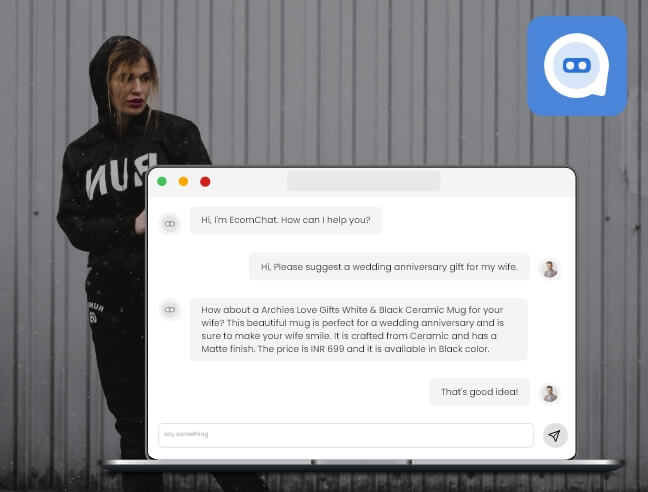
We developed eComChat, an AI-powered search bot for a US-based e-commerce store managing tens of thousands of products. Built using OpenAI technology and natural language processing (NLP), it understands intent across 20,000+ indexed products and handles misspelled terms. It integrates with Shopify, Magento, and WooCommerce.
-
Key Results:
- A faster store experience by replacing keyword search with intent-driven results.
- Zero-result queries eliminated across the full product catalog.
- Reduced operational costs by automating search handling
Clients Love Space-O Technologies

Project Summary
AI System Development for Gift Search Company
Space-O Technologies has developed an AI system for a gift search company. The team has built a recommendation engine, implemented dynamic pricing, and created tools for personalized marketing campaigns.
Project Summary
AI System Development for Christian Church
Space-O Technologies developed a private AI system for a Christian church. The team built a system capable of uploading research information, allowing other church workers to query information in a natural way.
Project Summary
Mobile App Dev & UX/UI Design for Behavioral AI Company
Space-O Technologies has designed and developed a mobile app for a behavioral AI company. The team is responsible for integrating patient management features, appointment scheduling, and communication tools.
Project Summary
POC Design & Dev for AI Technology Company
Space-O Technologies developed the POC of an AI product for life coaching conversations. Their work included wireframing, app design, engineering, and branding.
What Powers Our Computer Vision Development Services
We leverage artificial intelligence, deep learning, edge computing, generative AI, and cloud-native infrastructure to extract intelligence from visual data. Our engineers work across convolutional neural networks (CNNs), vision transformers, GANs, and multimodal architectures.
- Deep learning architectures, including CNNs, vision transformers, and U-Net, power every object detection, segmentation, and classification pipeline.
- Edge computing on NVIDIA Jetson, Intel OpenVINO, and TensorRT brings sub-100ms inference to factory cameras, drones, and mobile devices.
- Generative AI using GANs, diffusion models, and multimodal models like CLIP generates synthetic training data and enables zero-shot classification.
- Cloud-native ML infrastructure on AWS SageMaker, Google Vertex AI, and Azure AI handles distributed training. The same platforms also provide auto-scaling inference and handle real-time video processing for production computer vision systems.
Every technology choice is driven by your accuracy, latency, and deployment requirements.
Talk to Our Experts Now
Our Computer Vision Development Process
We follow a structured, six-step process so systems perform accurately in production. Every phase is measured against agreed goals to minimize risk.

Discovery and requirement analysis
Define objectives, identify high-impact use cases, assess existing image and video data, and set accuracy benchmarks and deployment targets.

Data assessment and preparation
Audit visual data, then build a pipeline for collection, cleaning, labeling, augmentation, and synthetic data. Every dataset is version-controlled.

Solution architecture and model selection
Design the blueprint, choosing architecture (YOLO for speed, Faster R-CNN for precision, U-Net for segmentation) and deployment targets.

Model development and training
Handle preprocessing, training, and iterative optimization, using transfer learning and fine-tuning with hyperparameter tuning and cross-validation.

Integration, testing, and deployment
Integrate the model, test accuracy and inference speed against edge cases, then manage containerization, API configuration, and load testing.

Monitoring, optimization, and support
Track accuracy, monitor latency, detect drift, and trigger retraining under SLA-backed commitments.
Flexible Engagement Models
Not every project follows the same timeline or team structure. We offer four engagement models so you can match stage and internal capacity.
| Engagement model | What you get | Billing and minimum | Best for |
|---|---|---|---|
| Dedicated Computer Vision Team | A full-time, project-exclusive team of CV engineers, annotators, and ML specialists | 160 hours/month, monthly billing, minimum 3 months | Long-term builds and multi-phase rollouts |
| Time and Material | Pay for actual hours as scope evolves | Bi-weekly billing, minimum 1 month | Iterative development with changing requirements |
| Fixed-Scope Project Delivery | Scope, timeline, budget, and deliverables defined upfront | Minimum 1 month | POCs, MVPs, and single-use-case builds |
| Staff Augmentation | Vetted CV engineers added to your in-house team inside your sprints and tools | Agreed with you at kickoff | Teams that need extra CV skills inside their own process and tools |
Technology Stack We Use for Computer Vision Development
Our services are powered by a production-tested stack across frameworks, architectures, platforms, and deployment targets. Our engineers select the right combination for your accuracy, latency, and scale needs.
 Python
- C++
- R
- Julia
- Scala
 Python
 C++
 R
 Julia
 Scala
- OpenCV
- MediaPipe
- Detectron2
- torchvision
- OpenMMLab
- Albumentations
- Kornia
- scikit-image
- Pillow
 OpenCV
 MediaPipe
 Detectron2
 torchvision
 OpenMMLab
 Albumentations
 Kornia
 scikit-image
 Pillow
- TensorFlow
- PyTorch
- scikit-learn
- Keras
- XGBoost
- Hugging Face
- ONNX
 TensorFlow
 PyTorch
 scikit-learn
 Keras
 XGBoost
 Hugging Face
 ONNX
- YOLO
- Faster R-CNN
- Mask R-CNN
- SSD
- U-Net
- ResNet
- MobileNet
- EfficientNet
- CLIP
- ViT
- Swin Transformer
- SAM 2
- DeepLabV3+
- DINOv2
- Grounding DINO
 YOLO
 Faster R-CNN
 Mask R-CNN
 SSD
 U-Net
 ResNet
 MobileNet
 EfficientNet
 CLIP
 ViT
 Swin Transformer
 SAM 2
 DeepLabV3+
 DINOv2
 Grounding DINO
- Label Studio
- CVAT
- Roboflow
- Labelbox
- V7
- SageMaker Ground Truth
- Supervision
 Label Studio
 CVAT
 Roboflow
 Labelbox
 V7
 SageMaker Ground Truth
 Supervision
- MLflow
- Kubeflow
- Weights & Biases
- NVIDIA Triton
- BentoML
- Docker
- Kubernetes
- Apache Kafka
- Apache Spark
- DVC
 MLflow
 Kubeflow
 Weights & Biases
 NVIDIA Triton
 BentoML
 Docker
 Kubernetes
 Apache Kafka
 Apache Spark
 DVC
- AWS SageMaker
- AWS Rekognition
- Google Vertex AI
- Google Cloud Vision API
- Microsoft Azure AI
- Azure Computer Vision
- AWS Bedrock
 AWS SageMaker
 AWS Rekognition
 Google Vertex AI
 Google Cloud Vision API
 Microsoft Azure AI
 Azure Computer Vision
 AWS Bedrock
- NVIDIA Jetson
- NVIDIA DeepStream
- Intel OpenVINO
- TensorRT
- ONNX Runtime
- TensorFlow Lite
- Core ML
- Google Coral
- Apache TVM
 NVIDIA Jetson
 NVIDIA DeepStream
 Intel OpenVINO
 TensorRT
 ONNX Runtime
 TensorFlow Lite
 Core ML
 Google Coral
 Apache TVM
- Stable Diffusion
- DALL-E 3
- GPT-4 Vision
- CLIP
- LLaVA
- Grounding DINO
- Florence-2
- Whisper
 Stable Diffusion
 GPT-4 Vision
 LLaVA
 Florence-2
 Whisper
Why Space-O Technologies Is Your Computer Vision Development Company
We combine specialized CV engineering, full pipeline ownership, and deployment flexibility. Our proof is production, not prototypes.
97% client retention across 1,200+ clients
Clients return because our systems perform reliably and improve over time through structured retraining. Since 2010, we have built long-term partnerships with startups, SMEs, and enterprises across 30+ countries.
End-to-end ownership from data to deployment
Most CV projects fail at handoffs. We own the entire pipeline under one roof: data, annotation, architecture, training, optimization, integration, and MLOps support. No third-party dependencies, no gaps between teams.
Production-grade solutions, not just prototypes
Every deployed model is tested against changing lighting, camera angles, occlusion, motion blur, and diverse object types. Each model is then monitored through drift detection and automated retraining once it is running in production.
Certified security and data compliance
We are ISO 9001 and ISO 27001 certified, with GDPR and HIPAA-ready frameworks. Data anonymization and the controls detailed under “Compliance and security” are applied by default.
Specialized computer vision engineering team
Our engineers focus on visual AI, not generalists reassigned to a vision project. The team has production experience across YOLO, Faster R-CNN, U-Net, ResNet, EfficientNet, and CLIP models. Beyond those models, the team is also fluent in OpenCV, TensorFlow, and PyTorch for vision development. This means fewer iterations and production-ready accuracy sooner.
Frequently Asked Questions
How much does a custom computer vision solution cost?
Pricing isn’t a single number, because it tracks the four pricing bands we publish above. Those bands are a $30,000-$75,000 POC, a $100,000-$250,000 production system, and an MVP from $15,000. The fastest way to narrow your figure is to settle data readiness before anything else. Unlabeled data pushes you toward the higher end of each band before any model is trained. Budget maintenance as an ongoing line item rather than a one-time cost.


 All our projects are secured by NDA




 4.8


