
 By
By 
Contents
Building an AI chatbot requires clarity on one critical factor before anything else: cost. AI chatbot development costs range from $3,000 for a basic rule-based bot to $300,000+ for an enterprise-grade conversational AI system. This range depends on chatbot type, AI model complexity, integration depth, and deployment channels.
A scripted FAQ bot with predefined responses costs a fraction of an LLM-powered assistant. That assistant might connect to your CRM, process payments, and pull answers from internal documents. The gap between these two builds explains the wide pricing spectrum. If you’re still exploring which type fits your business, our guide to AI chatbots covers how each category works and where it applies
This pricing question comes up constantly across Reddit, Quora, and developer forums. Freelancers quote $500 to $5,000, agencies quote $20,000 to $150,000, and enterprise vendors push past $100,000. Comparing quotes from established AI chatbot development companies gives a more reliable benchmark than forum estimates. The inconsistency makes budget planning difficult without a structured breakdown based on actual project variables.
This guide breaks down every factor that shapes chatbot development cost. Each section covers specific pricing data, real-world comparisons, and strategies to help you plan your chatbot budget with confidence. Whether evaluating a SaaS tool or planning a custom build, the numbers here will guide your decision.
Note: All prices listed in this guide are in USD. The cost ranges reflect Space-O Technologies’ evaluation of chatbot projects across varying complexity levels. Actual costs may differ based on types of AI-powered chatbots, requirements, feature scope, and technical specifications.
How Much Does AI Chatbot Development Cost?
The average cost to build an AI chatbot falls between $3,000 and $300,000+, depending on chatbot type and project complexity. A basic rule-based chatbot with scripted flows costs $3,000 to $15,000. An LLM-powered chatbot with custom integrations typically requires $30,000 to $150,000.
Here is a quick overview of AI chatbot cost by type:
| Chatbot Type | Cost Range | Development Timeline | Best For |
|---|---|---|---|
| Rule-based chatbot | $3,000 – $15,000 | 2 – 4 weeks | FAQ automation, lead capture |
| NLP-driven chatbot | $15,000 – $50,000 | 4 – 10 weeks | Intent recognition, multi-turn conversations |
| LLM-powered chatbot | $30,000 – $100,000 | 8 – 16 weeks | Open-ended queries, content generation |
| RAG-powered chatbot | $50,000 – $150,000 | 10 – 20 weeks | Knowledge base Q&A, document search |
| Voice and multimodal chatbot | $80,000 – $300,000+ | 12 – 24+ weeks | IVR replacement, accessibility interfaces |
These ranges reflect custom development costs. SaaS chatbot platforms follow subscription-based pricing, which is covered in a separate section below.
The cost also varies by team location. North American developers charge $100 to $200 per hour. South Asian development teams offer the same technical depth at $25 to $60 per hour. Space-O Technologies, an experienced AI development services provider, operates within this range.
Plan Your AI Chatbot Budget With Expert Guidance
Share your chatbot requirements with our AI consultants. Get a detailed cost estimate, feature roadmap, and development timeline tailored to your business goals and technical environment.

What Factors Affect the Cost to Build an AI Chatbot?
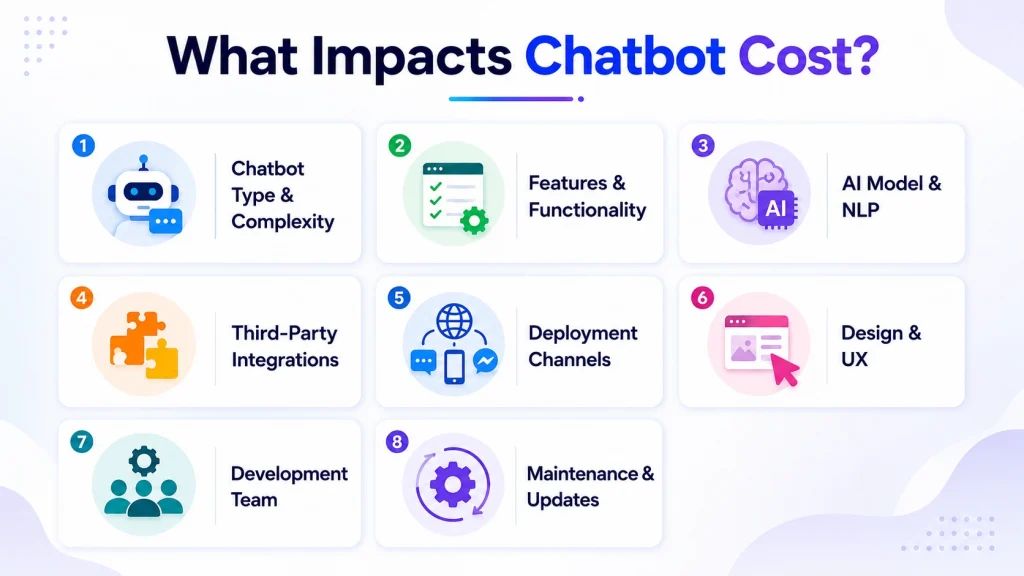
Eight core factors determine how much a chatbot costs to develop. Each factor independently impacts the budget, and most projects involve trade-offs across several of them simultaneously.
1. Chatbot type and conversation complexity
The biggest cost driver is the type of chatbot you need. Rule-based bots follow fixed decision trees and cost the least to develop. NLP-driven bots recognize user intent and handle varied phrasing, requiring trained models. LLM-powered and RAG-powered chatbots handle open-ended queries with contextual understanding, increasing both development time and cost.
A customer support bot that answers “Where is my order?” through keyword matching is straightforward. A bot that reads shipping documents, interprets delivery exceptions, and generates personalized updates requires significantly more engineering. That second scenario involves retrieval-augmented generation (RAG), vector databases, and prompt engineering.
2. Features and functional scope
Each additional feature increases the total chatbot development cost. Core features like text input, predefined responses, and basic analytics keep costs low. Advanced features like multi-language support, sentiment detection, live agent handoff, conversation memory, and personalized recommendations increase development hours significantly.
A basic chatbot with 5 to 8 features might require 200 to 400 development hours. A feature-rich build with 15+ capabilities can push the project past 1,000 hours, especially with custom dashboards and reporting modules.
3. AI model selection and NLP depth
The choice of AI model directly impacts both development cost and ongoing operational expenses. Using a pre-trained model like GPT-4o or Claude through API calls costs less upfront than fine-tuning a custom model. However, API usage carries per-token costs that scale with conversation volume.
Fine-tuning open-source models like Llama 3 or Mistral avoids recurring API fees. The trade-off is a higher initial investment in data preparation, model training, and infrastructure setup. Businesses processing thousands of conversations daily often find fine-tuned models more cost-effective over the long term. Consulting with machine learning consulting services helps identify the right model for your use case and budget.
4. Third-party integrations
Connecting a chatbot to external systems increases both complexity and cost. Common integrations include CRM platforms (Salesforce, HubSpot), payment gateways (Stripe, PayPal), ERP systems, helpdesk tools (Zendesk, Freshdesk), and eCommerce platforms (Shopify, Magento).
Each integration requires API development, authentication setup, data mapping, and error handling. Simple integrations add $2,000 to $5,000 per connection. Complex, bidirectional integrations with legacy systems can cost $10,000 to $25,000 or more.
5. Deployment channels and platforms
A chatbot deployed on a single channel costs less than one running across web, mobile app, WhatsApp, Slack, and Facebook Messenger simultaneously. Each channel has unique UI requirements, API specifications, and message format constraints.
Single-channel deployment keeps costs within the base estimate. Multi-channel deployment adds 15% to 30% to the total development budget. The exact increase depends on the number of platforms and the user experience consistency required across them.
6. Design, prototyping, and UX effort
Conversation design is often underestimated in chatbot budgets. Designing intuitive conversation flows, fallback responses, error messages, and escalation paths requires specialized UX skills. A well-designed chatbot reduces user frustration, lowers abandonment rates, and improves resolution quality.
Prototyping tools like Voiceflow, Botmock, or Figma-based conversation maps add structure to this phase. Allocating 10% to 15% of the total budget to conversation design and prototyping is a reliable benchmark.
7. Team composition and developer location
The team required for a custom chatbot typically includes a project manager, conversational designer, backend developer, NLP/ML engineer, QA engineer, and UI/UX designer. Not every project needs all six roles, but complex builds require most of them.
Developer location has a significant impact on hourly rates:
| Region | Hourly Rate Range |
|---|---|
| North America | $100 – $200 |
| Western Europe | $80 – $170 |
| Eastern Europe | $40 – $80 |
| South Asia | $25 – $60 |
Partnering with an experienced team in South Asia provides access to specialized talent at lower hourly rates. Space-O Technologies, for example, provides dedicated chatbot developers for hire who have built conversational AI systems across eCommerce, healthcare, and enterprise verticals.
8. Post-launch maintenance and updates
Chatbot development cost does not end at deployment. Ongoing maintenance includes model retraining, knowledge base updates, bug fixes, performance monitoring, and security patches. Most businesses spend 15% to 25% of the initial development cost annually on maintenance. Reliable software maintenance services ensure the chatbot stays accurate and secure after launch.
LLM-powered chatbots also carry recurring API costs. GPT-4o, for instance, charges per input and output token. A chatbot handling 10,000 conversations per month could accumulate $500 to $3,000 in monthly API fees, depending on conversation length and model selection.
Key Features That Impact AI Chatbot Development Cost
The feature set you choose directly determines how much your chatbot costs to develop. Some features are essential for every chatbot, while others add cost that is justified only for specific use cases. The table below maps common chatbot features to their cost impact and priority level.
| Feature | Additional Cost Impact | Priority Level |
|---|---|---|
| NLP/intent recognition engine | +$5,000 – $20,000 | Essential for AI chatbots |
| Conversation memory (context retention) | +$5,000 – $15,000 | Essential for LLM chatbots |
| Live agent handoff | +$3,000 – $8,000 | Essential for support bots |
| Analytics and reporting dashboard | +$4,000 – $12,000 | Recommended for all |
| Sentiment analysis | +$3,000 – $10,000 | Nice to have |
| Multi-language support | +$5,000 – $15,000 per language | Based on audience geography |
| Multi-channel deployment | +$5,000 – $20,000 | Based on user channels |
| Payment processing integration | +$3,000 – $10,000 | Essential for eCommerce |
| Custom knowledge base (RAG) | +$10,000 – $40,000 | Essential for domain-specific bots |
| Voice input and output | +$10,000 – $30,000 | Specialized use cases |
Must-have features for most AI chatbots include NLP/intent recognition, conversation memory, live agent handoff, and analytics. These capabilities form the foundation of a functional chatbot that resolves queries and improves over time through data insights.
Nice-to-have features like sentiment analysis, voice input, and multi-language support add value for specific audiences. Adding them in phase two or three reduces the initial budget while preserving the option to scale. This phased approach keeps the cost of building a chatbot manageable without sacrificing the long-term feature roadmap.
Feature priorities also shift by vertical. Our guide to AI chatbot solutions for ecommerce shows which features online retailers need first.
AI Chatbot Development Cost by Chatbot Type
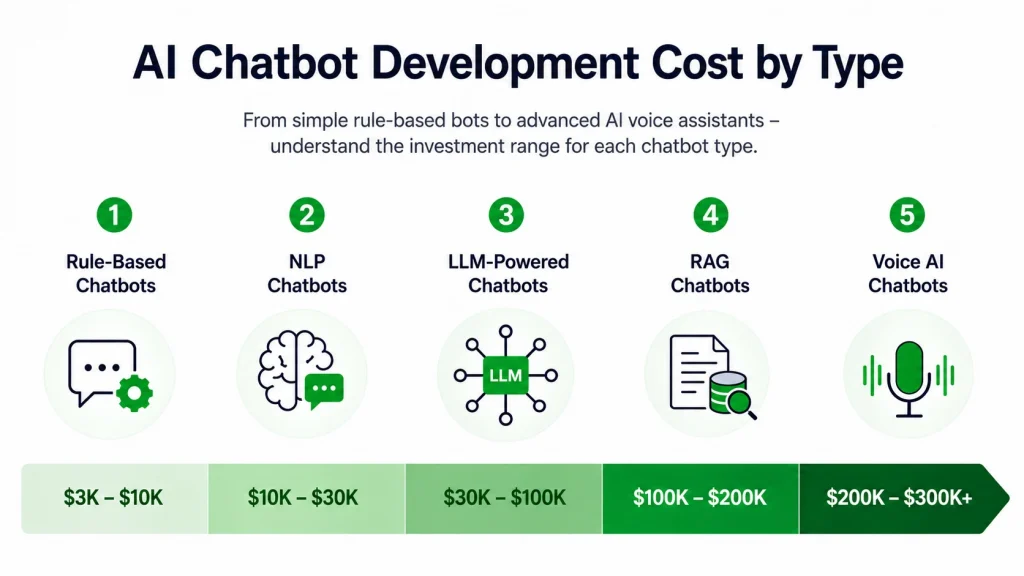
Each chatbot type serves a different use case, and the cost reflects the underlying technical complexity. A rule-based bot requires decision-tree logic. An LLM-powered chatbot requires prompt engineering, embeddings, and retrieval systems. Below is a detailed breakdown for each type.
1. Rule-based chatbots ($3,000 to $15,000)
Rule-based chatbots follow predefined scripts and decision trees. They work best for structured, predictable interactions like FAQ responses, appointment booking, and basic lead qualification. Development involves mapping conversation flows, writing response scripts, and connecting buttons or quick replies.
These bots do not understand natural language. They rely on keyword matching or menu-based navigation. The low cost makes them ideal for businesses testing chatbot adoption before committing to AI-powered solutions.
2. NLP-driven chatbots ($15,000 to $50,000)
NLP-driven chatbots use frameworks like Dialogflow, Rasa, or Microsoft Bot Framework to recognize user intent. They parse sentence structure, identify entities, and respond contextually. Training these bots requires labeled conversation data and ongoing intent refinement.
The cost increases because NLP chatbots need training datasets, entity extraction models, and fallback handling for unrecognized inputs. Businesses with varied customer queries benefit from this type, as it handles phrasing variations that rule-based bots cannot.
3. LLM-powered chatbots ($30,000 to $100,000)
LLM-powered chatbots use large language models such as GPT-4o, Claude, Gemini, or Llama 3 to generate human-like responses. They handle open-ended conversations, understand context across multiple turns, and adapt their tone based on the interaction. Learning how to create an AI app using OpenAI provides a practical starting point for understanding the build process.
Development involves prompt engineering, guardrail implementation, content moderation filters, and API integration. The higher cost reflects the complexity of managing model behavior, ensuring response accuracy, and handling edge cases where the model might generate incorrect information.
4. RAG-powered chatbots ($50,000 to $150,000)
RAG-powered chatbots combine large language models with retrieval systems that pull information from your proprietary documents, knowledge bases, or databases. They use vector databases like Pinecone, Weaviate, or pgvector to store document embeddings and retrieve relevant context before generating a response.
This architecture significantly improves response accuracy for domain-specific questions. The cost is higher because it requires document ingestion pipelines, embedding generation, retrieval logic, and prompt grounding to prevent hallucinations. Businesses in healthcare, legal, and financial services often require RAG-based artificial intelligence solutions for compliance-grade accuracy.
5. Voice and multimodal chatbots ($80,000 to $300,000+)
Voice chatbots process spoken input through speech-to-text (Whisper, Deepgram), generate responses using an LLM, and deliver audio output through text-to-speech (ElevenLabs, Amazon Polly). Multimodal chatbots extend this further by processing images, documents, or video alongside text and voice.
The cost reflects the additional complexity of audio processing pipelines, latency optimization, and accessibility compliance. These chatbots typically replace IVR systems or serve users who require hands-free interaction. Enterprise deployments in banking, insurance, and telecom commonly fall into this category.
AI Chatbot Development Cost Breakdown by Phases (SDLC)
Chatbot development cost is distributed unevenly across six phases, with core development consuming the largest share. Understanding how the budget allocates per phase helps you plan resources and avoid underfunding critical stages like testing or maintenance.
| Development Phase | Budget Share | Timeline | Key Activities |
|---|---|---|---|
| Discovery and planning | 10% – 15% | 1 – 2 weeks | Requirements gathering, use case mapping, and technology selection |
| Design and prototyping | 10% – 15% | 1 – 3 weeks | Conversation flows, wireframes, UX design, and user journey mapping |
| Core development | 40% – 50% | 4 – 12 weeks | Backend, NLP/LLM integration, API development, and database setup |
| Testing and QA | 15% – 20% | 2 – 4 weeks | Functional testing, conversation testing, load testing, and security audit |
| Deployment and launch | 5% – 10% | 1 – 2 weeks | Server setup, channel deployment, and monitoring configuration |
| Post-launch maintenance | 15% – 25% annually | Ongoing | Model retraining, bug fixes, knowledge base updates, and performance tuning |
For a $60,000 chatbot project, discovery costs approximately $6,000 to $9,000, and development costs $24,000 to $30,000. Testing accounts for $9,000 to $12,000, while annual maintenance adds $9,000 to $15,000 per year. Engaging software development consulting during the discovery phase helps define an accurate scope and avoid budget overruns in later phases.
Chatbot Pricing Models Explained
Five pricing models exist for chatbot solutions, each suited to different business needs and budget structures. The right model depends on conversation volume, customization requirements, and long-term scalability plans.
1. Fixed-cost development
Fixed-cost projects work best when the scope is clearly defined before development begins. The development company delivers an agreed set of features for a predetermined price. This model provides budget certainty but limits flexibility for mid-project changes.
Fixed-cost chatbot development typically ranges from $10,000 to $150,000. It suits businesses that have completed discovery, finalized feature requirements, and need predictable billing. Enterprise software development projects with rigid compliance requirements often prefer this model.
2. Time and material
Time-and-material pricing charges are based on actual development hours consumed. Hourly rates vary by team role and location. This model offers maximum flexibility, allowing scope adjustments as user feedback shapes the chatbot’s direction.
Costs accumulate based on hours logged, making this model ideal for iterative builds where requirements evolve. Most custom AI chatbot development projects use time and material for builds that begin with an MVP and expand based on usage data.
3. Subscription-based SaaS platforms
SaaS chatbot platforms charge monthly or annual subscription fees. Pricing tiers typically range from $50 per month for basic plans to $5,000+ per month for enterprise plans with advanced AI, analytics, and integrations.
Platforms like Intercom, Drift, Tidio, and Zendesk AI fall into this category. The monthly cost stays predictable, but customization options are limited compared to custom-built solutions. SaaS chatbots suit businesses that need quick deployment without heavy technical investment.
4. Per-resolution and usage-based pricing
Some chatbot providers charge per resolved conversation rather than a flat subscription. Per-resolution pricing ranges from $0.50 to $5.00 per successful resolution, depending on conversation complexity and the AI model used.
This model aligns cost with value delivered. Businesses only pay for conversations the chatbot successfully handles. However, costs become unpredictable during traffic spikes, making it risky for high-volume customer support operations.
5. Hybrid models
Hybrid pricing combines a base subscription fee with usage-based charges. A business might pay a $1,000 monthly base for infrastructure and support, plus per-conversation fees above a set threshold.
This model balances cost predictability with scalability. It works well for growing businesses that expect conversation volumes to increase over time but want a cost floor for budgeting purposes.
Not Sure Whether to Build or Buy a Chatbot?
Our AI consultants evaluate your use case, integration requirements, and budget constraints. Get a clear recommendation backed by hands-on experience across 1,200+ delivered projects for businesses worldwide.
AI Chatbot Development Cost by Industry
Industry-specific requirements significantly influence chatbot pricing, with healthcare and fintech commanding premium costs due to compliance overhead. Each vertical has unique data handling, integration, and accuracy requirements that shape the budget.
eCommerce chatbot costs
eCommerce chatbots handle product recommendations, order tracking, cart recovery, and customer queries. Typical costs range from $15,000 to $60,000 for a custom build with product catalog integration, payment processing, and personalized suggestions.
Space-O Technologies built eComChat, an AI-powered e-commerce search solution using OpenAI. Instead of relying on keyword matching, eComChat interprets customer intent through natural language processing and surfaces the most relevant products.
The solution delivered a 23% improvement in search speed across a catalog of 20,000 products. On-demand app development businesses in the eCommerce space frequently pair chatbots with order management and delivery tracking systems.
Healthcare chatbot costs
Healthcare chatbots require HIPAA-compliant infrastructure, encrypted data storage, and audit trails. Symptom checkers, appointment schedulers, and patient intake bots in this vertical cost $40,000 to $150,000 due to regulatory compliance and data sensitivity.
EHR/EMR integration, patient identity verification, and clinical decision support features push costs toward the higher end. Every interaction must be logged, encrypted, and retrievable for compliance audits. See our guide to chatbot solutions for healthcare for the compliance requirements behind these figures.
Fintech chatbot costs
Financial services chatbots handle balance inquiries, transaction disputes, fraud alerts, and loan applications. Costs range from $50,000 to $200,000 based on the depth of banking system integration and regulatory compliance (PCI-DSS, SOC 2).
Multi-factor authentication, real-time fraud detection, and encrypted transaction processing add layers of development complexity. These chatbots also require extensive testing to prevent errors in financial calculations or account operations. Our breakdown of AI-powered banking chatbots covers the core banking integrations, authentication layers, and fraud workflows behind those numbers.
Customer support chatbot costs
General customer support chatbots across industries typically cost $10,000 to $80,000. The range depends on ticket volume, escalation complexity, and integration with helpdesk platforms like Zendesk, Freshdesk, or ServiceNow.
Advanced support chatbots that handle multi-turn troubleshooting, access order history, and generate case summaries require more development effort. Businesses with high ticket volumes often see ROI within 3 to 6 months through reduced agent workload and faster resolution times.
Build vs. Buy: Custom Development or SaaS Platform?
The decision between building a custom AI chatbot and buying a SaaS solution depends on integration depth, long-term scalability, and budget structure. Neither option is universally better. The right choice aligns with your technical requirements and business goals.
| Criteria | Custom Development | SaaS Platform |
|---|---|---|
| Upfront cost | $10,000 – $300,000+ | $0 – $5,000/month |
| Customization | Unlimited, fully tailored | Limited to platform features |
| Integration depth | Deep integration with any system | Pre-built connectors only |
| Time to launch | 4 – 24 weeks | 1 – 5 days |
| Scalability | Scales with your architecture | Scales within platform limits |
| Data ownership | Full ownership and control | Stored on vendor infrastructure |
| Ongoing cost | 15% – 25% annually for maintenance | Recurring subscription fees |
| Vendor dependency | None | High, platform lock-in risk |
Choose custom development when:
- Your chatbot needs to integrate deeply with proprietary systems, databases, or APIs.
- Data privacy and ownership are critical for your industry (healthcare, finance, legal).
- Full control over conversation logic, AI model behavior, and user experience is required.
- Long-term cost efficiency matters more than speed to market.
Choose a SaaS platform when:
- A chatbot is needed live within days, not weeks.
- The use case is standard (FAQ, lead capture, basic support).
- Budget constraints prevent a custom build at this stage.
- Internal development resources are limited.
Businesses that start with SaaS platforms and later outgrow their limitations often transition to custom builds. Beginning with MVP development services is another viable path. It validates the chatbot concept at a lower cost before committing to full-scale custom development.
Ready to Build an AI Chatbot That Delivers Real Results?
From discovery to deployment, our chatbot developers handle the full development lifecycle. Share your requirements and receive a free consultation along with a detailed cost estimate for your project.
How to Reduce AI Chatbot Development Cost
Five proven strategies help businesses reduce chatbot development cost without compromising quality or user experience. Each strategy targets a specific cost driver identified in the sections above.
1. Start with an MVP
An MVP chatbot focuses on solving one or two high-impact use cases rather than launching with full functionality. A customer support MVP might handle only the top 10 most common queries, covering 60% to 70% of total ticket volume.
This approach reduces initial development cost by 40% to 60% compared to a full-featured build. Once the MVP proves its value through usage data and user feedback, additional features are added in iterative phases.
2. Use pre-trained AI models
Pre-trained models like GPT-4o, Claude, or Gemini provide strong language understanding out of the box. Using these models through API calls eliminates the cost of training a custom model from scratch, saving $20,000 to $80,000 in model development alone.
The trade-off is recurring API costs. However, for most businesses processing fewer than 50,000 conversations per month, API-based approaches remain more cost-effective than training and hosting custom models.
3. Outsource to an experienced team
Partnering with a specialized development team reduces costs through established workflows, reusable components, and cross-project expertise. An experienced team avoids common pitfalls that inflate budgets, such as over-engineering conversation flows or selecting the wrong AI model for the use case.
Companies that hire dedicated developers in regions with competitive rates have access to the same technical expertise. Hourly costs run 40% to 60% lower than those of North American or Western European teams.
4. Prioritize high-impact features first
Not every feature planned for the chatbot needs to ship in version one. Prioritizing features by business impact, such as order tracking, appointment booking, or lead qualification, ensures the highest-ROI capabilities launch first.
Low-impact features like advanced sentiment analysis, multi-language support, or voice input can be added in later releases. This phased approach keeps the initial budget focused and prevents scope creep.
5. Plan integrations in phases
Launching with one or two critical integrations (CRM and helpdesk, for example) keeps development scope manageable. Additional integrations with payment systems, ERP platforms, or marketing automation tools are added post-launch based on user demand and business priorities.
Each integration avoided in phase one saves $2,000 to $10,000 in development costs. Phased integration planning is especially effective when paired with time-and-material pricing models that allow scope adjustments between releases.
Common Mistakes That Increase Chatbot Development Cost
Five avoidable mistakes consistently inflate chatbot budgets, often adding 30% to 50% to the original estimate. Identifying these pitfalls before development begins saves both money and time.
1. Overscoping the initial build
Launching with every planned feature in version one is the most common budget mistake. A chatbot designed to handle 20 use cases, support 5 languages, and integrate with 8 tools will almost certainly exceed the budget. Building all of this before any user has tested the core flows delays the launch further.
Starting with 2 to 3 high-impact use cases, gathering real conversation data, and expanding based on evidence is more cost-effective. The MVP approach exists because over-scoping fails more often than under-scoping.
2. Skipping conversation design
Jumping directly into development without mapping conversation flows, fallback paths, and escalation logic creates expensive rework. Developers build features that users find confusing or incomplete, leading to redesign cycles that double the UX-related costs.
Investing 10% to 15% of the budget in conversation design before writing a single line of code reduces total project cost. Conversation maps created during this phase become the blueprint that keeps development focused and efficient.
3. Choosing the wrong AI model
Selecting an LLM for a use case that a simpler NLP model handles effectively inflates both development cost and ongoing API expenses. A chatbot that routes support tickets based on category does not need GPT-4o. Dialogflow or Rasa handles this at a fraction of the cost.
Conversely, forcing a rule-based bot to handle open-ended queries creates a poor user experience that requires a full rebuild. Matching the AI model to the actual conversation complexity is essential for budget accuracy. An AI chatbot consulting partner maps conversation complexity to the right model tier before development begins, which prevents both overspend and a full rebuild.
4. Ignoring post-launch costs
Many businesses budget only for development and treat maintenance, retraining, and API costs as afterthoughts. A chatbot that launches successfully but receives no updates for six months degrades in accuracy, loses relevance, and frustrates users.
Budgeting 15% to 25% of the initial development cost annually for maintenance ensures the chatbot stays accurate, secure, and aligned with evolving business needs. API costs, knowledge base updates, and performance monitoring all contribute to this ongoing expense.
5. Underestimating integration complexity
Connecting a chatbot to legacy CRM systems, custom ERPs, or outdated databases is significantly more expensive than integrating with modern, API-ready tools. Legacy integrations require custom middleware, data transformation layers, and extensive testing.
Assessing integration readiness during the discovery phase prevents surprise costs. If a critical system lacks a modern API, budgeting an additional $10,000 to $30,000 for middleware development avoids mid-project scope expansion.
How Space-O Technologies Builds AI Chatbots
Space-O Technologies has delivered AI-powered conversational systems for eCommerce, healthcare, and recruitment verticals since 2010. With 1,200+ clients served, 140+ in-house developers, and ISO 9001/27001 certifications, the company brings structured, security-focused delivery to every chatbot project. Its AI chatbot development solutions include architecture planning, conversation design, model selection, integration, and post-launch optimization.
eComChat: AI-powered eCommerce search
Space-O Technologies developed eComChat, an AI-powered eCommerce search solution that replaces traditional keyword-based product search. Built using OpenAI’s natural language processing models, eComChat interprets what customers actually mean when they search, not just the words they type.
The system processes queries across a catalog of 20,000 products, matching intent to relevant results. It delivered a 23% improvement in search speed compared to the previous keyword-matching system. This project demonstrates how AI-powered conversational interfaces transform e-commerce user experience beyond simple chatbot interactions.
GPT Vix: multi-model AI for recruitment
GPT Vix is an AI-driven recruitment platform that Space-O Technologies developed for HR professionals. The system combines three AI models: OpenAI’s ChatGPT for natural language processing, Whisper for video-to-text conversion, and Synthesia for text-to-video generation.
This multi-model architecture automates candidate screening, promotes unbiased hiring, and streamlines interview management. GPT Vix illustrates how chatbot-adjacent AI systems require careful model orchestration. This complexity is a key factor in the higher costs of LLM-powered and multi-model chatbot builds.
Development approach
Every chatbot project at Space-O Technologies follows a structured six-phase process: discovery, design, development, testing, deployment, and ongoing support. The team includes NLP/ML engineers, conversational designers, backend developers, and QA specialists working within Agile sprints.
Clients receive transparent project documentation, regular progress updates, and clear scope change protocols. Three engagement models are available: dedicated team, time and material, and fixed cost. Each is tailored to different project sizes and budget structures.
Exploring AI app development using OpenAI or planning a chatbot for your business? Space-O Technologies provides a free consultation to assess requirements, recommend the right architecture, and deliver a detailed cost estimate.
Frequently Asked Questions
How much would it cost to build an AI chatbot?
AI chatbot development costs typically range from $3,000 to $300,000+, depending on the chatbot’s complexity, AI model, and integration requirements. A rule-based chatbot with predefined conversation flows sits at the lower end, while an LLM-powered or RAG-based chatbot with enterprise integrations, multi-channel deployment, and custom training data falls at the higher end. Most mid-market businesses invest between $20,000 and $80,000 for a production-ready AI chatbot that can automate customer support, integrate with existing business systems, and scale as conversation volume grows.
How much does it cost to develop a ChatGPT-like chatbot?
Developing a ChatGPT-like chatbot generally costs between $50,000 and $200,000+. This budget covers integration with GPT-4o or similar large language models, conversation memory, moderation guardrails, prompt engineering, and a custom user interface. Ongoing API usage typically adds $500 to $5,000+ per month, depending on conversation volume. Building and fine-tuning a proprietary model requires a larger upfront investment but can reduce long-term inference costs for high-volume applications.
How much does it cost to develop AI?
Custom AI development typically ranges from $10,000 to $300,000+, depending on the solution being built. Basic AI integrations or simple chatbots generally cost between $10,000 and $30,000, while AI applications requiring custom model training usually range from $30,000 to $100,000. Large-scale enterprise AI platforms with multiple models, complex workflows, and advanced integrations can exceed $300,000.
What is the average cost to build a chatbot?
The average cost to build a chatbot for most businesses falls between $20,000 and $80,000. This typically includes NLP-powered or LLM-based conversational AI with standard integrations, deployment across one or two channels, analytics, and basic workflow automation. Simple rule-based chatbots may start around $3,000, while enterprise-grade AI chatbots with compliance, custom workflows, and multiple integrations frequently cost more than $100,000.
How much does chatbot maintenance cost per year?
Annual chatbot maintenance generally costs 15% to 25% of the original development investment. For example, maintaining a chatbot that cost $50,000 to build typically requires an annual budget of $7,500 to $12,500. Maintenance includes model retraining, knowledge base updates, security patches, performance monitoring, bug fixes, and ongoing optimization. Businesses using LLM APIs should also budget an additional $500 to $3,000+ per month for API usage, depending on traffic and model selection.
Is it cheaper to build a chatbot or buy a SaaS solution?
SaaS chatbot platforms usually have lower upfront costs, ranging from $50 to $5,000+ per month, making them a good choice for businesses with standard requirements and lower conversation volumes. Custom chatbot development requires a larger initial investment but offers greater flexibility, ownership, scalability, and integration capabilities. For organizations requiring enterprise-grade security, proprietary data control, or complex business workflows, a custom AI chatbot often delivers a stronger long-term return on investment within 18 to 24 months.



 All our projects are secured by NDA




 4.8
4.8