
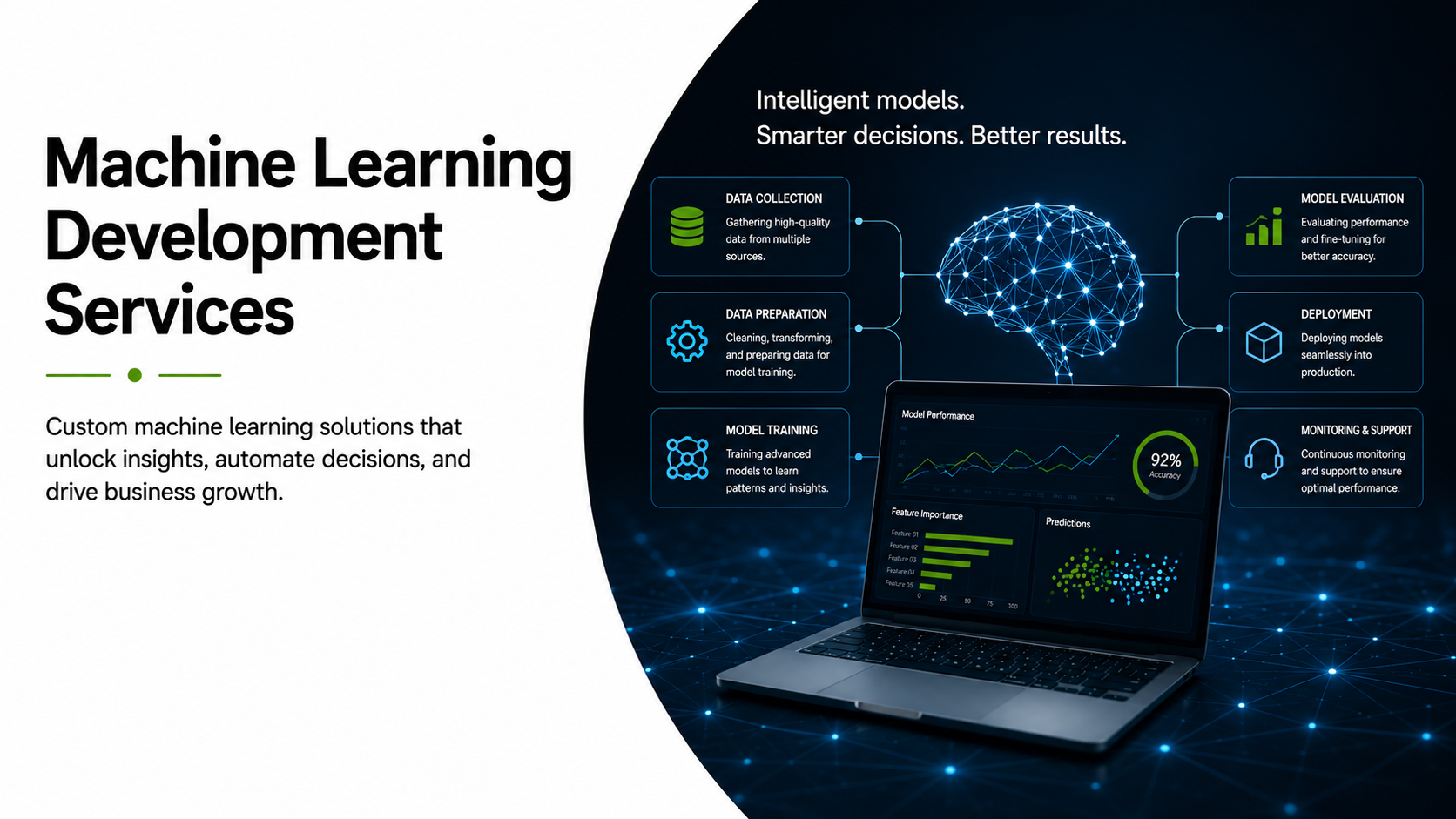
Machine Learning Development Services
Custom machine learning models help businesses automate complex decisions, forecast demand with higher accuracy, and deliver personalized experiences at scale. Space-O Technologies provides end-to-end machine learning development services covering data preparation, model training, integration, and optimization. Solutions span predictive analytics, NLP, computer vision, and recommendation systems built around your data and workflows.
Since 2010, 1,200+ clients have trusted Space-O Technologies and its 140+ in-house developers for scalable software solutions. ISO 9001 and ISO 27001 certifications back every ML project with verified quality and data security standards. A 97% client retention rate reflects ML development services that consistently translate data into business results.
Businesses that need dedicated ML talent can also hire machine learning developers from Space-O Technologies. Each ML developer brings hands-on expertise in TensorFlow, PyTorch, Scikit-Learn, and cloud ML platforms like AWS SageMaker and Azure ML. Flexible engagement options let startups and enterprises scale ML capacity without extended hiring timelines.



Dream It, We Build It




Our Comprehensive Machine Learning Services
from Strategy to Deployment
Machine learning development services build custom AI models that analyze data, recognize patterns, and automate business processes. Space-O Technologies delivers this as a comprehensive machine learning service covering consulting, model training, deployment, and optimization.
ML Consulting and Strategy
Identifying the right ML use case is the foundation of every successful project. A reliable machine learning development company starts by evaluating data assets, mapping automation opportunities, and aligning ML goals with business targets. Each engagement delivers feasibility benchmarks, architecture recommendations, and ROI projections before development begins.
Custom ML Model Development
Every business problem requires a model architecture matched to its specific data patterns, volume, and accuracy requirements. The machine learning development process spans data preparation, feature engineering, algorithm selection, hyperparameter tuning, and validation against real-world conditions. Trained models go through rigorous testing before deployment to ensure consistent performance in live environments.
Deep Learning & Neural Network Development
Complex tasks like image recognition, speech processing, and language generation require deep learning architectures beyond traditional ML algorithms. Neural networks built with CNNs, RNNs, LSTMs, and Transformer architectures train on distributed GPU clusters for maximum computational throughput. These architectures handle unstructured data at scale with higher accuracy than conventional machine learning approaches.
Transfer Learning and Model Fine-Tuning
Training a model from scratch demands large datasets, significant compute resources, and extended timelines. Transfer learning accelerates development by adapting pre-trained models like BERT, GPT, ResNet, and YOLO to your domain-specific data. Fine-tuned models achieve higher accuracy faster while reducing both development cost and training time.
Data Engineering for Machine Learning
The quality of training data determines the reliability of every ML model. Effective machine learning in software development depends on clean, well-structured datasets flowing through automated pipelines. Space-O Technologies builds ETL/ELT workflows, data lakes, and preprocessing systems that keep training data accurate, diverse, and production-ready.
ML Integration Into Existing Systems
A trained ML model delivers value only when connected to the systems your team uses daily. Comprehensive ML development services include integration into ERP, CRM, SaaS, and custom platforms through REST APIs, middleware, and serverless architectures. Integrated systems access predictions and recommendations without replacing your existing tools or workflows.
MLOps and Continuous Model Management
ML models degrade over time as data patterns shift and user behavior evolves. MLOps practices prevent this through automated CI/CD pipelines, real-time drift monitoring, version control, and scheduled retraining cycles. Governance frameworks established during development keep models accurate, auditable, and production-stable long after initial deployment.
Machine Learning as a Service (MLaaS)
Not every organization needs custom-built ML infrastructure from day one. MLaaS solutions provide access to prediction, anomaly detection, and personalization capabilities through managed cloud platforms. Space-O Technologies deploys ML workloads on AWS SageMaker, Azure ML, and Google Vertex AI with plug-and-play API access.
ML Optimization, Maintenance, and Support
Launching an ML model is only the beginning of its lifecycle. Ongoing performance tuning, bug resolution, retraining with fresh data, and infrastructure scaling ensure the model continues delivering accurate results. Being a reputed ML development company, we provide dedicated post-deployment support that ensures your ML investment compounds in value over time rather than depreciating.
Turn Your Data Into an ML-Powered Product
Every project above reached production and delivered measurable business results. Share your ML requirements to explore what custom models can solve for your operations.
Our AI and Machine Learning Development Projects
Space-O Technologies is a machine learning development company that has delivered ML-powered products across recruitment, eCommerce, on-demand delivery, and education. Each project demonstrates how custom ML models solve specific business challenges and deliver measurable outcomes.
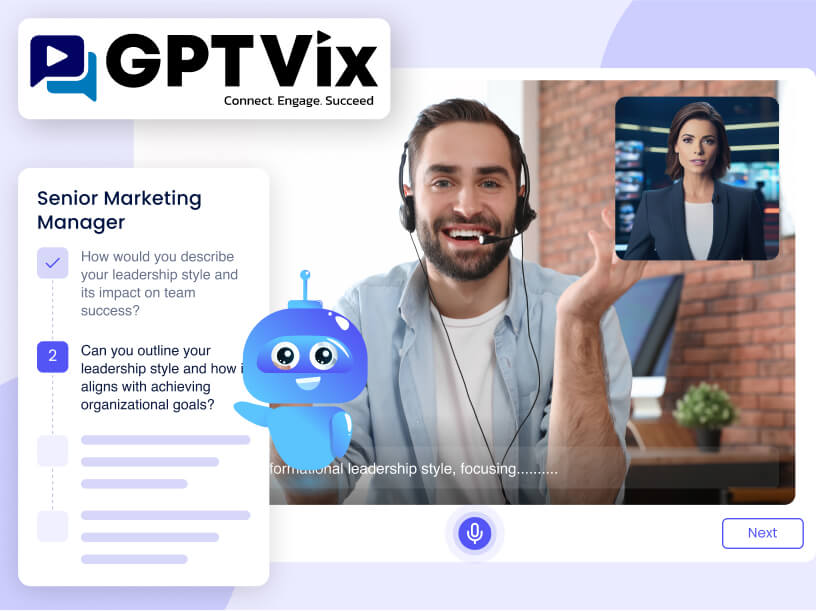
Space-O Technologies developed GPT Vix, an AI-driven recruitment platform for HR professionals. The platform uses OpenAI’s ChatGPT for natural language processing, Whisper for video-to-text conversion, and Synthesia for text-to-video generation. ML models automate candidate screening, eliminate bias from hiring decisions, and streamline interview management. These capabilities reduce manual evaluation time while improving the consistency of candidate assessments across large applicant pools.
Space-O Technologies developed eComChat, an intelligent product discovery system for online stores. The search bot uses natural language understanding to interpret buyer queries and return contextually relevant product results. ML algorithms learn from user interactions to improve recommendation accuracy over time. This conversational approach replaces traditional keyword-based filters with a shopping experience that adapts to each customer.

Glovo is a unicorn on-demand delivery app developed by Space-O Technologies with over 30 million downloads worldwide. Apple selected Glovo for its “Best of 2016” award. The platform applies machine learning for demand prediction, delivery time estimation, and personalized product recommendations across multi-category grocery and restaurant orders. TechCrunch, Financial Times, and Bloomberg have covered the application.

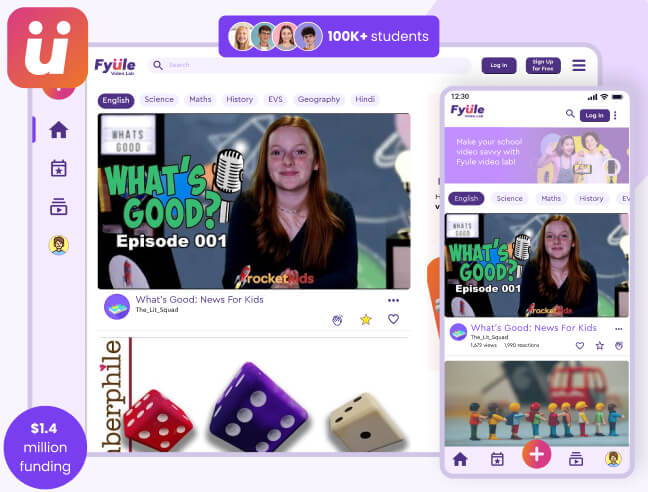
Space-O Technologies developed Fyule Video Lab, a video learning platform for students to engage with educational content. The platform secured $1.4 million in funding through an Angel syndicate backed by senior leaders from Google, Deloitte, Tata 1mg, and Axis Capital. ML-powered content recommendations and engagement analytics help learners discover relevant courses and track progress across iOS, Android, and web.
Our Software Development Capabilities & Recognition





Clients Love Space-O Technologies

Project Summary
AI System Development for Gift Search Company
Space-O Technologies has developed an AI system for a gift search company. The team has built a recommendation engine, implemented dynamic pricing, and created tools for personalized marketing campaigns.
Project Summary
AI System Development for Christian Church
Space-O Technologies developed a private AI system for a Christian church. The team built a system capable of uploading research information, allowing other church workers to query information in a natural way.
Project Summary
Mobile App Dev & UX/UI Design for Behavioral AI Company
Space-O Technologies has designed and developed a mobile app for a behavioral AI company. The team is responsible for integrating patient management features, appointment scheduling, and communication tools.
Project Summary
POC Design & Dev for AI Technology Company
Space-O Technologies developed the POC of an AI product for life coaching conversations. Their work included wireframing, app design, engineering, and branding.
Custom Machine Learning Solutions We Develop
Machine learning solution development is the process of designing, building, and deploying AI models that solve specific business problems by transforming raw data into self-learning systems. Our ML engineers develop custom machine learning solutions that bridge data science and software engineering to deliver measurable business outcomes.
Predictive Analytics Software
Accurate forecasting helps businesses reduce uncertainty in revenue planning, inventory management, and customer behavior analysis. ML models trained on historical and real-time data detect hidden patterns that traditional reporting tools miss. Predictive systems deliver actionable projections for demand, churn, pricing, and market trends.
Anomaly Detection and Fraud Prevention
Financial fraud, security breaches, and equipment failures share one common trait: they deviate from expected data patterns. ML models trained on normal behavior baselines identify these deviations in real time across transactions, network logs, and sensor feeds. Early detection reduces financial losses, prevents downtime, and strengthens compliance across regulated industries.
Natural Language Processing Solutions
Unstructured text in emails, documents, support tickets, and reviews contains business intelligence that manual review cannot scale. NLP models extract entities, classify intent, analyze sentiment, and summarize content across large datasets. These capabilities turn text-heavy workflows into structured, searchable, and actionable business data.
Computer Vision Systems
Visual data from cameras, scanners, and sensors requires automated interpretation to operate at production speed. Computer vision development services enable image classification, object detection, facial recognition, OCR, and quality inspection across manufacturing, retail, and healthcare. Real-time visual analysis reduces manual inspection costs while improving detection accuracy.
Recommendation Engine Development
Personalized recommendations increase engagement, average order value, and content consumption across digital platforms. ML algorithms analyze user behavior, purchase history, and contextual signals to surface relevant products, content, or services. Collaborative filtering and content-based models adapt in real time as user preferences evolve.
AI Chatbots and Virtual Assistants
Customer support, employee onboarding, and internal knowledge retrieval all benefit from conversational AI that operates around the clock. AI chatbot development uses neural networks for intent recognition, context retention, and multi-turn dialogue management. Trained chatbots handle routine queries autonomously while escalating complex issues to human agents.
Generative AI Solutions
Content creation, code generation, document summarization, and data synthesis tasks consume significant manual effort across departments. Generative AI development services fine-tune large language models like GPT, Llama, and Claude on domain-specific data for higher accuracy. Custom generative systems produce brand-aligned outputs at scale while maintaining quality and factual consistency.
Intelligent Process Automation
Repetitive, rule-based tasks like invoice processing, claims review, and data entry drain operational resources without adding strategic value. ML-enhanced automation goes beyond traditional RPA by handling exceptions, detecting anomalies, and making judgment-based decisions. Intelligent workflows reduce processing time and error rates across finance, insurance, and logistics operations.
AI Agent Development
Multi-step business workflows that span multiple systems require autonomous coordination beyond single-task automation. AI agent development builds autonomous agents that plan, execute, and adapt across tools like CRMs, ERPs, and communication platforms. These agents orchestrate complex processes end-to-end with minimal human intervention.
Speech Recognition and Voice AI
Audio data from call centers, medical consultations, and voice interfaces contains insights that text-based systems never capture. ML-powered speech models convert spoken language into structured text with speaker identification, emotion detection, and accent adaptation. Voice AI capabilities enable hands-free interfaces, real-time transcription, and automated call analytics at scale.
Search and Knowledge Retrieval Systems
Enterprise teams lose productive hours searching for information buried across documents, databases, and communication channels. Semantic search powered by ML understands query intent rather than matching keywords, delivering contextually relevant results. Vector databases and RAG architectures connect large language models to your proprietary knowledge base for accurate, source-grounded answers.
Data Classification and Segmentation
Raw data without structure limits every downstream analytics and marketing initiative. ML classification models automatically categorize documents, tag support tickets, score leads, and segment customers based on behavioral and demographic patterns. Automated segmentation enables targeted campaigns, personalized pricing, and resource allocation based on data-driven groupings.
Not Sure Which ML Solution Fits Your Problem?
Predictive analytics, NLP, computer vision, and recommendation systems solve fundamentally different challenges. A 30-minute consultation identifies the right ML approach matched to your data and goals.
Benefits of Machine Learning Development Services
Traditional software follows predefined rules. Machine learning in software development replaces that limitation with systems that learn from data, improve with usage, and adapt to changing conditions. Businesses partner with machine learning development companies to gain six capabilities that conventional technology cannot deliver.
Automated Decision-Making at Scale
Credit approvals, fraud flags, inventory replenishment, and lead scoring all require judgment that static rules cannot replicate accurately. ML models evaluate hundreds of variables per decision in milliseconds, maintaining consistency across millions of transactions. Businesses remove human bottlenecks from high-volume decisions without sacrificing accuracy or accountability.
Predictive Intelligence Over Backward Reporting
Standard business intelligence tools report what has already happened. ML shifts that perspective forward by forecasting customer churn, demand fluctuations, equipment failures, and revenue trends before they occur. Acting on predictions rather than reactions gives businesses a measurable head start over competitors relying on historical dashboards.
Personalization That Adapts in Real Time
Manual customer segmentation creates static groups that become outdated within weeks. ML models analyze individual behavior, purchase patterns, and contextual signals to deliver unique experiences for every user. A trusted machine learning app development company builds these adaptive systems into mobile and web platforms for seamless personalization at scale.
Unlocking Value From Unstructured Data
Over 80% of enterprise data sits in formats that traditional analytics tools cannot process, including emails, images, PDFs, audio recordings, and support transcripts. ML extracts entities, classifies sentiment, recognizes objects, and converts speech to structured data. Organizations gain insights from data assets that were previously inaccessible to any reporting system.
Continuous Self-Improvement Over Time
Conventional software delivers the same output on day one and day one thousand. ML models improve accuracy with every new data point they process, compounding performance over their lifecycle. A fraud detection model that flags 85% of threats at launch can reach 96% accuracy within months as it learns new patterns.
Intelligent Automation Beyond Rule-Based Workflows
Traditional automation handles repetitive tasks with fixed logic: if X, then Y. ML extends automation to tasks requiring judgment, like reviewing insurance claims, grading product quality, or routing support tickets by urgency. An experienced machine learning software development firm builds these capabilities into existing business systems without disrupting current operations.
Why Choose Space-O Technologies as Your Machine Learning Development Company
Most ML initiatives fail not because the model was wrong, but because the team lacked the engineering depth to take it from prototype to production. Choosing the right machine learning development company means finding a partner that covers the full lifecycle, from raw data to live, optimized systems.
Full-Cycle ML Delivery, Not Just Model Training
Many ML vendors build a trained model and hand it off, leaving integration and monitoring to your team. Complete machine learning development services cover consulting, data engineering, model training, system integration, MLOps, and post-launch support. This full-cycle approach eliminates handoff gaps between prototype and production.
Production-Proven ML Systems, Not Lab Prototypes
Over 80% of ML projects never reach production deployment. Space-O Technologies has shipped ML-powered products at scale, including GPT Vix for AI recruitment, eComChat for conversational product search, and Glovo with 30 million downloads. These are live systems handling real users and real business outcomes.
Dedicated ML Team Structure Under One Roof
ML projects require tight collaboration between data scientists, ML engineers, backend developers, and DevOps specialists. A reliable machine learning software development firm employs all these roles in-house without third-party outsourcing. A unified team of 140+ professionals eliminates communication delays and accountability gaps across the engagement.
Data Engineering as a Core Capability
Models trained on poorly structured data underperform regardless of algorithm sophistication. Effective ML development services include data infrastructure that most vendors skip, covering ETL/ELT pipelines, data lakes, and automated quality monitoring. This data-first approach ensures models train on clean, complete, and representative datasets from day one.
ML Models That Improve After Deployment
Static models lose accuracy as data patterns shift and user behavior evolves. A structured machine learning development process builds drift detection, automated retraining, and continuous monitoring into every system from the architecture stage. A 97% client retention rate confirms that delivered models keep improving after deployment.
Compliance-Ready ML for Regulated Industries
ML projects in healthcare, finance, and insurance face regulatory requirements that generic development processes cannot satisfy. Space-O Technologies holds ISO 9001 certification for repeatable quality and ISO 27001 for auditable data security. GDPR and HIPAA alignment supports ML deployments where data privacy is legally mandated.
Hire a Machine Learning Development Company That Ships to Production
Most ML vendors stop at model training and hand off the rest. Space-O Technologies owns the full lifecycle from data preparation through deployment and continuous optimization.
Machine Learning Development Process
We Follow
The machine learning development process is an iterative, systematic lifecycle for planning, building, deploying, and maintaining AI models that solve specific business problems. Structured stages span business problem definition, data collection, model training, evaluation, and continuous production monitoring.
01
Problem Definition and Scoping
Every ML initiative begins by translating business goals into concrete machine learning tasks with measurable outcomes. Successful machine learning solutions development starts with identifying success metrics, establishing a performance baseline, and evaluating feasibility, data privacy, and compliance constraints. Deliverables include a scoping document, a risk assessment, and a prioritized project roadmap.
02
Data Collection, Preparation, & Preprocessing
Raw data from databases, APIs, and internal systems must be representative of the real-world scenarios the model will face. Data engineers handle missing values, remove duplicates, filter outliers, normalize formats, and perform feature engineering to highlight important data points. Clean, well-structured data is the critical foundation of every ML system.
03
Model Selection and Training
Data scientists split prepared datasets into training, validation, and test sets before evaluating multiple algorithm candidates. Professional machine learning development services assess approaches ranging from random forests and gradient boosting to neural networks and transformer architectures. Hyperparameter tuning optimizes each model for maximum prediction accuracy on the training data.
04
Evaluation and Tuning
Trained models undergo assessment against the validation set using predefined metrics like accuracy, precision, and recall on unseen data. Models that fall below the target performance threshold return to the training stage for iterative feature engineering and architecture adjustments. This cycle continues until evaluation benchmarks consistently meet production-grade requirements.
05
Deployment and Integration
The trained model is packaged, typically via an API, so that web, mobile, and backend applications can send data and receive predictions in real time. A capable machine learning app development company integrates models through REST endpoints, middleware, and serverless architectures. Monitoring infrastructure activates at deployment to track live model performance.
06
Monitoring, Governance, and Retraining
Production models face concept drift, where real-world behaviors change and cause prediction accuracy to degrade over time. Top machine learning development companies build automated monitoring that tracks performance, data distribution shifts, and business metric alignment continuously. Periodic retraining with fresh data ensures models adapt to evolving patterns and maintain long-term relevance.
Technology Stack We Use for Machine Learning Software Development
A machine learning technology stack is the combination of programming languages, frameworks, libraries, and cloud platforms used to build, train, and deploy ML models. Space-O Technologies selects from a proven machine learning solution development stack tailored to each project’s data volume, model complexity, and deployment requirements.
Industries We Serve With Machine Learning Development Services
Space-O Technologies develops custom machine learning solutions that address industry-specific data, compliance, and operational challenges across diverse business sectors.
Healthcare and Life Sciences
Patient data holds patterns that improve diagnostics, treatment planning, and operational efficiency across clinical workflows. ML models power medical image analysis, drug discovery acceleration, patient risk prediction, and clinical NLP for automated documentation. These capabilities reduce diagnostic errors while improving patient outcomes at scale.
Banking and Financial Services
Financial transactions generate massive datasets where fraudulent patterns hide in millisecond windows. ML models automate fraud detection, credit scoring, risk assessment, and anti-money laundering compliance across millions of daily transactions. Predictive intelligence replaces reactive rule-based systems that miss sophisticated threats.
Retail and eCommerce
Customer behavior data drives every competitive advantage in modern retail environments. ML powers recommendation engines, demand forecasting, dynamic pricing, inventory optimization, and customer churn prediction across digital and physical channels. Personalized shopping experiences increase average order value and long-term customer retention.
Manufacturing
Production environments generate continuous sensor data that reveals equipment health, quality trends, and efficiency gaps. ML enables predictive maintenance, automated defect detection, supply chain optimization, and production planning based on real-time signals. Downtime decreases, and yield rates improve without expanding physical infrastructure.
Logistics and Supply Chain
Delivery networks involve thousands of variables that manual planning cannot optimize at speed. ML models handle route optimization, warehouse automation, demand prediction, fleet management, and delivery time estimation across global operations. Logistics costs decrease as prediction accuracy improves with each shipment cycle.
Insurance
Claims processing, underwriting, and fraud detection consume significant manual resources across traditional insurance operations. ML automates claims review, policyholder risk modeling, fraud identification, and premium optimization using historical and behavioral data. Processing timelines shrink from weeks to hours while accuracy rates increase.
Telecommunications
Network infrastructure generates performance data at volumes no human team can monitor manually. ML drives network optimization, customer churn prediction, service personalization, predictive maintenance, and capacity planning across distributed systems. Proactive issue resolution reduces service disruptions and improves subscriber satisfaction scores.
Automotive and Transportation
Vehicle systems and fleet operations produce continuous telemetry that reveals performance patterns invisible to manual monitoring. ML powers autonomous driving features, predictive maintenance scheduling, fleet optimization, quality control, and safety monitoring across production and operations. Maintenance costs decrease as failure prediction accuracy compounds over time.
Energy and Utilities
Energy grids and utility networks face demand variability that static models cannot forecast reliably. ML enables grid optimization, consumption forecasting, predictive maintenance for infrastructure assets, and renewable energy output modeling. Operational efficiency improves as models learn seasonal patterns, usage spikes, and equipment degradation signals.
Every Business Problem Needs a Different
ML Approach
Choosing the wrong model architecture wastes months of development time and budget. Space-O Technologies evaluates your data, constraints, and objectives before recommending a technical direction.
Frequently Asked Questions
What are machine learning development services?
Machine learning development services cover the full lifecycle of building, training, deploying, and maintaining custom AI models that solve specific business problems. These services typically include ML consulting, data engineering, model development, system integration, MLOps, and ongoing optimization. Space-O Technologies delivers each stage as a structured engagement tailored to your data infrastructure, industry requirements, and business goals.


 All our projects are secured by NDA




 4.8
4.8