
 By
Contents
- Gate every stage on evidence, with a named owner deciding to proceed, hold, or stop.
- Five chained AI steps that each look accurate still deliver noticeably lower end-to-end reliability.
- Data preparation can consume 25% to 40% of an AI build’s budget, so fund it first.
- Plan yearly maintenance at 15% to 25% of build cost before approving the production budget.
Key Takeaways
Scaling an AI proof of concept to a full product means secure, monitored production. Production must handle messy data, enforce permissions, control cost, and recover from failure. A proof of concept (PoC) proves the happy path, not daily reliability.
Your PoC impressed stakeholders, yet the launch keeps slipping. The gap is rarely the model. Data, permissions, latency, and cost usually block launch, which AI consulting services can diagnose.
This guide covers four production pillars, gated rollout, and a harden-or-rebuild rule. It also breaks down production costs for startups and small and mid-sized businesses (SMEs). Space-O Technologies delivers AI development services for teams ready to scale.
PoC Versus Pilot Versus Production: What Changes at Each Stage
A PoC asks “Can it work?”, a pilot asks “Does it help real work?”, and production asks “Will it last?” Almost every layer around the model changes between those stages. Good AI proof of concept development plans for production from day one. Some teams call the middle step a proof of value, because it tests measurable business impact.
| Area | AI proof of concept (PoC) | Pilot | Full production product |
|---|---|---|---|
| Data | Clean, limited, often hand-picked sample | Real or redacted real data from governed sources | Messy, incomplete, and changing real-world data through governed pipelines |
| Users | A few internal testers | A small, named group doing real work | Real customers or staff at full volume |
| Integration | Standalone demo or notebook | Connected to one workflow or system | Connected to workflows, customer relationship management (CRM), and enterprise resource planning (ERP) systems |
| Failure handling | A human restarts the demo | Manual fallbacks and a support contact | Fallbacks, retries, and graceful degradation |
| Security | Shared keys, open access | Role-based access and an initial security review | Access controls, audit trails, and compliance review |
| Cost | Small fixed budget | Measured cost per request at pilot volume | Usage-based spend that grows with every request |
| Monitoring | Manual spot checks | Logged requests, responses, and user feedback | Continuous tracking of accuracy, drift, latency, and cost |
| Success measure | The demo impressed stakeholders | An agreed key performance indicator (KPI) moves for pilot users | A business metric moved and stayed moved |
Production data is the biggest shock for most teams. A PoC usually runs on a tidy extract. Production data arrives with missing fields, new formats, and shifting patterns. A model tuned on clean samples can lose accuracy within weeks.
Integration is where the value is realized. An AI feature that lives outside daily tools gets ignored. Value appears when the output lands inside the CRM, ERP, ticketing tool, or app your people already use.
These gaps between stages explain why so many PoCs stall. The next section covers that.
Why AI PoCs Fail to Scale
Most AI PoCs stall for organizational and engineering reasons, not because the model failed. Gartner predicted at least 30% of generative AI projects would be abandoned after proof of concept. It names poor data quality, inadequate risk controls, escalating costs, and unclear business value as the causes.
These six causes come up again and again when a demo fails in production:
- No success criteria: The team never defined what “good enough to ship” meant, so no one could approve a go-live.
- Tech-led, not product-led: The PoC proved a model could run, but never tested whether users wanted the output.
- Clean-data assumptions: The demo relied on curated data that production pipelines cannot supply.
- Late security and compliance: Legal and security reviews start after the build, then block or reshape it.
- Unmodeled cost: Inference spend at real volume was never estimated, so the business case collapses at scale.
- No owner after the pilot: The PoC team moves on, and no one runs, funds, or improves the system.
A seventh warning sign is hardcoded shortcuts baked into PoC code, which make later scaling slow and risky. The harden-or-rebuild section below turns that warning into a decision rule. The four pillars that follow address the six causes one at a time, starting with data.
1. Fix the Data Foundation Before You Scale
Production AI needs governed data pipelines, because the clean sample that powered the PoC will not exist at scale. Data is the one layer no production AI system can skip. Quality, pipelines, governance, and drift all decide whether answers stay accurate.
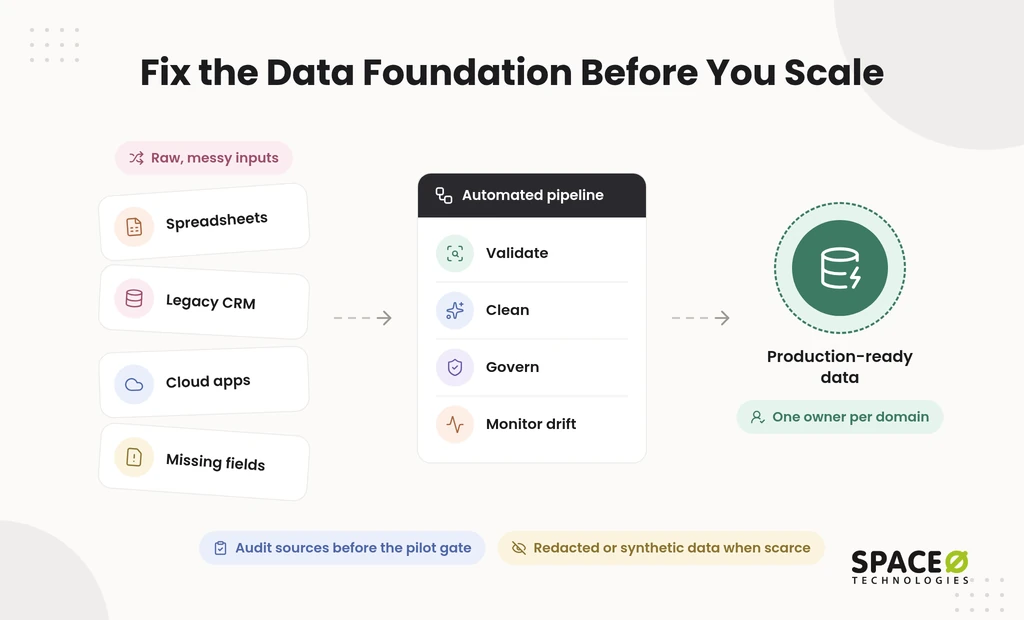
- Problem: hand-picked data: The PoC ran on a curated extract. Fix: Build automated pipelines that validate, clean, and filter live sources by metadata.
- Problem: Inconsistent master data: Customer and product records differ across systems. Fix: Apply master data management (MDM) and give each data domain one owner.
- Problem: No governance: Nobody decided who may use which data. Fix: Define access rules, lineage, and retention before the pilot starts.
- Problem: data drift: Input distributions shift after launch and edge cases multiply. Fix: Monitor input patterns and route unusual cases to human review.
- Problem: Scarce or private data: Real data is limited or sensitive. Fix: Pilot on redacted real data, and use synthetic data where real data is scarce or privacy-sensitive.
Action: Audit data sources, owners, and gaps before the pilot gate opens, the same order an AI development project roadmap follows. Clean data alone is not enough, though, because the next risk is who can reach it.
2. Lock Down Security and Permissions
Production AI must only see and do what each user is already allowed to see and do. A PoC often runs on shared keys and open access. Once real users arrive, that shortcut becomes your biggest exposure.
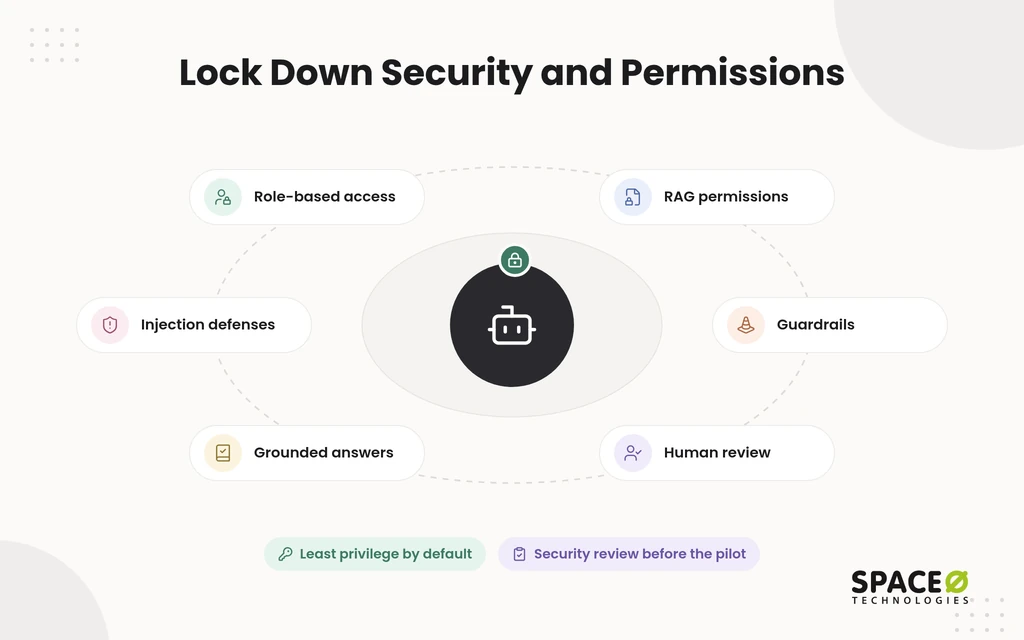
The main risks are prompt injection, sensitive data exposure, excessive permissions, and unsafe tool use. These controls belong in the design, not in a patch after launch.
- Role-based access control (RBAC): Map every AI action to an existing role, and grant least-privilege permissions only.
- Retrieval-augmented generation (RAG) permissioning: Users should only retrieve documents they are already authorized to see.
- Prompt-injection defenses: Treat user input and retrieved text as untrusted, and use layered prompt injection protection to block hidden instructions.
- Guardrails: Filter inputs and outputs for unsafe content, data leakage, and off-topic use.
- Grounding: Tie answers to approved source data so the system cites what it knows instead of guessing.
- Human-in-the-loop review: People approve high-risk decisions, such as lending, clinical, or legal outcomes, before they take effect.
What do US regulated buyers expect before go-live?
US regulated buyers expect controls, audit trails, and a recognized risk framework before launch. The National Institute of Standards and Technology (NIST) publishes an AI Risk Management Framework. It helps teams map, measure, and manage AI risks and gives them one shared vocabulary.
Healthcare workflows need HIPAA-compliant data handling. Enterprise buyers often expect security assurance reports from vendors. Every regulated system needs audit trails showing who accessed data and which model version produced each output.
Action: Run the security review before the pilot, not after the build. Once security sets the boundaries, the next pillar keeps the system fast and affordable within them.
3. Design for Reliability, Latency, and Cost
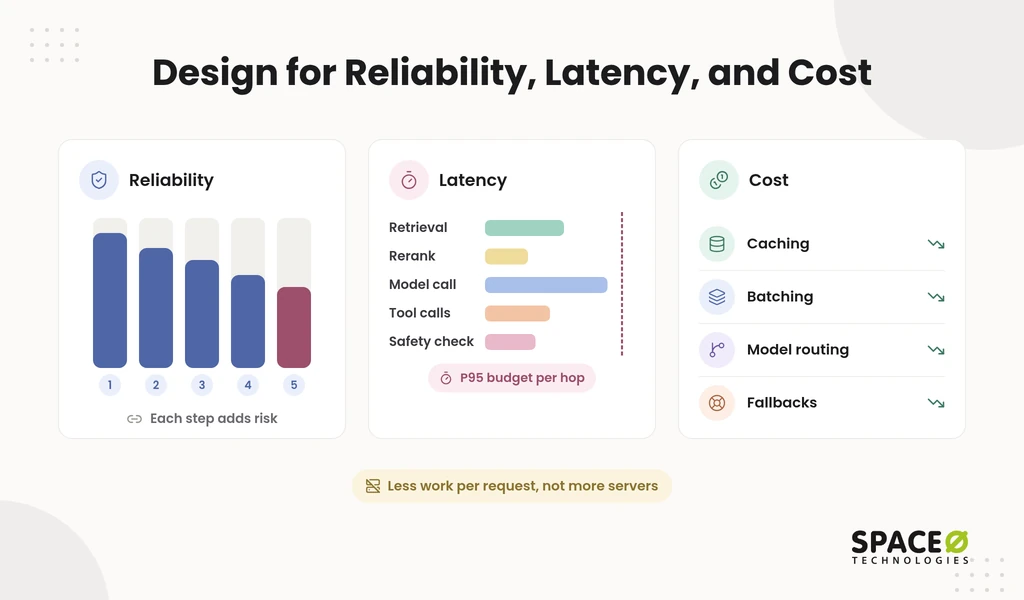
Production AI must stay reliable, fast, and affordable at volume, and more servers alone cannot deliver that. The demo ran once, for one user, on one happy path. Production runs thousands of times, and small weaknesses multiply.
Why do chained AI steps compound error?
Every step in an AI workflow multiplies the chance of failure, so accuracy erodes across a chain. Take five chained steps, each 95% accurate. The end-to-end result is 0.95 × 0.95 × 0.95 × 0.95 × 0.95, or about 77%.
That means nearly one run in four goes wrong somewhere. Shorten chains, validate outputs between steps, and use deterministic code where the logic is fixed.
Where does latency add up?
Latency in production is the sum of every hop, not the speed of the model alone. A demo calls one model once. Production adds retrieval, reranking, the model call, tool calls, and safety checks in sequence.
Set a latency budget for each hop. Measure the 95th percentile (P95), not the average, because slow outliers are what users remember.
How do you scale without just adding servers?
Scaling AI means cutting the work done per request, not throwing more servers at every request. Adding capacity without changing the design often just means spending more money faster.
- Caching: Store answers to repeated questions and reuse retrieval results.
- Batching: Group non-urgent requests to cut per-call inference cost.
- Streaming: Return partial responses so users see progress while the model works.
- Model routing: Send simple requests to smaller models, and reserve large models for hard cases.
- Fallbacks and graceful degradation: Retry, switch models, or return a safe default when a service fails.
- Decoupled services: Expose the model through application programming interfaces (APIs) or microservices so you can swap models without rewriting the app.
Action: Set reliability, latency, and cost targets per request before the build, using a layered AI agent architecture. Even an efficient design degrades without operations, which is the fourth pillar.
4. Operate the System With MLOps, Evaluation, and Drift Monitoring
Production AI needs an operations practice that treats models, prompts, and data like versioned code. Without it, every change becomes a risky manual release. Quality can also slip for weeks before anyone notices.
- MLOps or LLMOps: Machine learning and large language model operations (MLOps and LLMOps) bring DevOps discipline to AI releases. They automate retraining, testing, and deployment through continuous integration and continuous delivery (CI/CD).
- Prompt and model version control: Store prompts, model versions, and configuration in version control so every change is traceable and reversible.
- Evaluation sets: Test every release against a fixed set of real cases, including hallucination and bias checks.
- Drift monitoring: Track input data and output quality continuously, because real-world patterns shift after launch.
- Observability and root-cause tracing: Log each request end to end, and use audit logs and observability to trace weak answers to their cause.
- Health metrics: Track task completion time, user edit rates after AI suggestions, and latency.
Common MLOps tooling includes MLflow, Kubeflow, Docker, and Kubernetes. Managed options include Amazon SageMaker, Amazon Bedrock, Google Vertex AI, and Azure OpenAI Service. Many practitioners also advise a fail-fast, fail-cheap framework, so weak use cases stop early.
Action: Name the team that owns releases and alerts before limited production starts. With the four pillars in place, the remaining question is how to expand safely.
5. Roll Out Through Evidence-Based Gates
Roll out production AI in gated stages, where a named owner reviews evidence before each expansion. Many practitioners describe the path as a five-stage ladder:
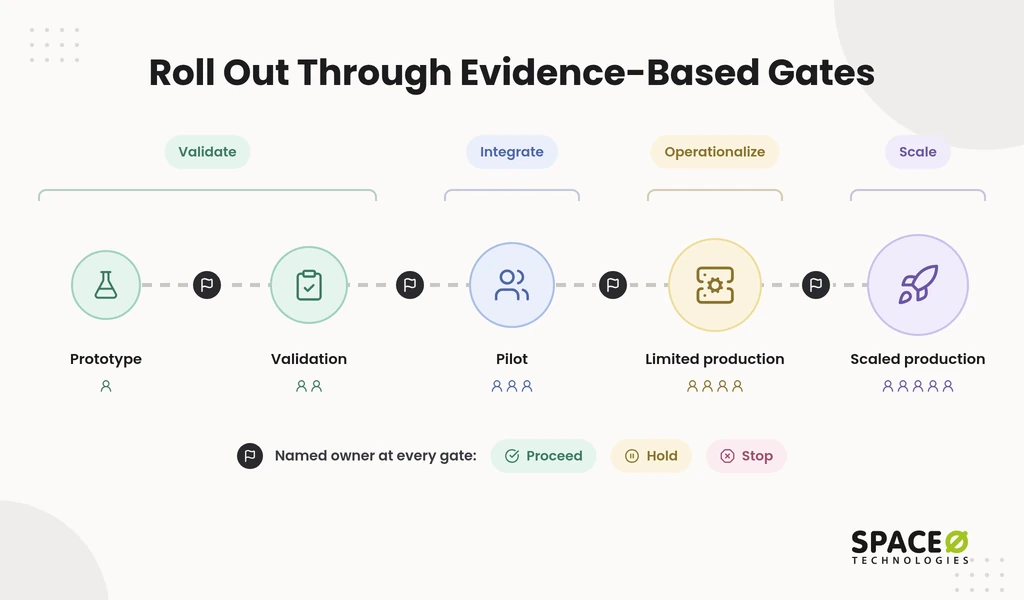
Prototype → validation → pilot → limited production → scaled production.
At each gate, a named owner reviews the evidence and decides to proceed, hold, or stop. Space-O Technologies runs this ladder as four gated phases: Validate, Integrate, Operationalize, and Scale.
| Stage | Audience | Data | Exit evidence | Gate owner | Roadmap phase |
|---|---|---|---|---|---|
| Prototype | The build team | Curated sample | Works on the happy path, with cost per request estimated | Product sponsor | Validate |
| Validation | Domain experts | Realistic or redacted real sample | Meets agreed accuracy, KPI, and stop thresholds | Product sponsor | Validate |
| Pilot | A small, named group doing real work | Live data through governed pipelines | Used inside the normal workflow, with permissions passing review | Business owner | Integrate |
| Limited production | A bounded population with real support | Full live data, monitored | Repeatable releases, working drift alerts, and on-call support | Engineering owner | Operationalize |
| Scaled production | All target users or tenants | Full volume, isolated per tenant | Usage grows while cost per outcome holds steady or falls | Product and finance owners | Scale |
Validate: prototype and validation
The Validate phase proves the use case is worth building before production spending begins.
- Goal: Confirm the AI solves a real business problem with measurable value.
- Action: Define success criteria before the PoC starts, test on a realistic data sample, and estimate cost per request.
- Exit criteria: The PoC meets its agreed accuracy and business targets, and a sponsor approves a go decision.
Integrate: pilot
The Integrate phase connects the AI to the systems and workflows where people actually work.
- Goal: Put AI output inside daily tools instead of a separate demo.
- Action: Connect to your CRM, ERP, and data warehouse, and build governed data pipelines with real access controls. Our generative AI integration services cover this step.
- Exit criteria: A pilot group uses the AI inside its normal workflow with live data, and the business owner signs off.
Operationalize: limited production
The Operationalize phase makes the AI reliable, observable, and safe to change.
- Goal: Run the system without heroics from the original PoC team.
- Action: Add MLOps or LLMOps practices, CI/CD, prompt and model versioning, monitoring, and fallbacks.
- Exit criteria: Releases are repeatable, drift alerts work, and a named team owns support.
Scale: scaled production
The Scale phase expands usage while keeping unit economics and quality under control.
- Goal: Grow adoption across users, teams, or customers profitably.
- Action: Reuse shared components for new use cases, track adoption, and manage cost per request and per user.
- Exit criteria: Usage grows while cost per outcome holds steady or falls.
Agree in advance on the metrics that would stop the project, such as unacceptable error rates or unsustainable cost. A clear stop signal protects budget as much as a clear launch signal does. Before the first gate, decide whether your PoC code can carry you forward.
Get a Gate-by-Gate Plan for Your PoC
Share your data sources, integrations, and compliance needs. Our AI engineers return a written, phase-by-phase scaling estimate with exit evidence, owners, and budget ranges for each gate.

Harden or Rebuild Your PoC? A Decision Rule
Harden your PoC when its data, permissions, and architecture can pass the gate evidence, and rebuild it when they cannot. Published advice conflicts here. One camp builds near the target cloud to avoid throwaway code; the other rewrites experimental scripts before production. Both are right under different conditions.
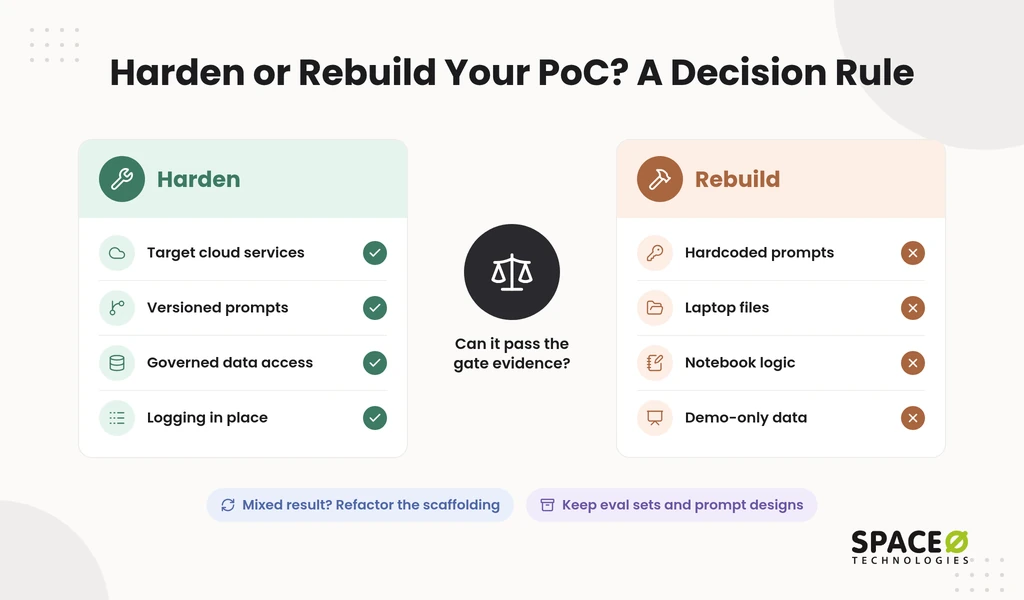
When should you harden PoC code?
Harden the PoC when it already behaves like a small production system. Look for these signals:
- Target cloud services: The PoC runs on the same cloud and managed services planned for production.
- Versioned prompts and models: Prompts and model choices live in version control, not inside the code.
- Real data access: The PoC reads from governed sources through real permissions, not exported files.
- Logging in place: Requests, responses, and errors are already captured for evaluation.
When should you rebuild PoC code?
Rebuild the PoC when its shortcuts would become production risks. These signals mean a rebuild is cheaper than patching, as when teams rebuild a no-code AI agent for production:
- Hardcoded prompts: Prompts, keys, or business rules sit directly inside the code.
- Local files: Data loads from a laptop folder or one-off spreadsheet.
- Notebook or monolith logic: The core workflow lives in an untested notebook or monolith that cannot be monitored or secured.
- Demo data: Results depend on a curated sample that production cannot reproduce.
What about a mixed result?
A mixed result usually means refactor: keep the validated logic and rebuild the scaffolding around it. Keep the evaluation sets, prompt designs, and lessons learned. Replace data access, secrets handling, and deployment.
The cheaper path is deciding this before the PoC starts. We build PoCs for startups and enterprises so the product can grow into version two without a rebuild. For customer-facing products, that decision carries extra weight.
Scaling an AI PoC Into a Customer-Facing Product (Startups and SaaS)
For startups and SaaS companies, “full product” means AI that paying customers rely on, not an internal tool. Founders face a different set of risks. Every request costs money, every tenant’s data must stay separate, and adoption decides funding. Good software development for startups prices all three risks before the first sprint.
What does the PoC → MVP → scalable product path look like?
A customer-facing AI product moves from PoC to minimum viable product (MVP) to scalable product. The PoC proves the AI can do the job. The MVP proves customers will use and pay, and the scalable product proves demand can be served profitably.
On Space-O Technologies’ published timelines for MVP development, a simple MVP takes 4 to 8 weeks. By contrast, a complex MVP with multiple integrations or custom functionality takes 3 to 4 months. Space-O Technologies built Fyule Video Lab’s MVP and then its full platform on Flutter, PHP, Laravel, and MySQL.
Which metrics matter most for an AI SaaS product?
AI SaaS products live or die on cost per request, cost per user, and adoption. Track these from the MVP onward:
- Cost per request: Know what each AI call costs, including retrieval and post-processing.
- Cost per user: Compare AI spend per user against what that user pays.
- Adoption metrics: Measure how often users trigger the AI feature and whether they keep using it.
How do you keep customer data separate?
Multi-tenant AI products must keep each customer’s data isolated at every layer. That includes storage, vector indexes, prompts, and logs. One tenant’s documents should never appear in another tenant’s answers.
RAG permissioning, covered in the security pillar, enforces this at retrieval time. Plan tenant isolation during SaaS MVP development, because retrofitting it later is costly. Isolation and every other control carry a price, which the next section breaks down.
What the Production Jump Costs: A Cost Anatomy for Startups and SMEs
The production jump costs far more than the PoC, because spend shifts from a fixed budget to usage-based, ongoing costs. Our AI development cost guide puts a focused PoC near $15,000, while enterprise platforms go beyond $500,000. AI development costs range from $25,000 to $500,000+ in 2026.
In most projects, data work, integrations, and production engineering cost more than the model itself. Treat every figure here as a planning range, not a quote.
Where does the money go?
Production AI budgets go to five areas beyond the model, and each one needs its own budget line.
- Inference: Every user request costs compute or API tokens, and volume multiplies it.
- Data pipelines: Cleaning, syncing, and governing real-world data is ongoing work.
- MLOps or LLMOps: Monitoring, evaluation, and release tooling need build time and upkeep.
- Security: Access controls, audits, and compliance reviews add engineering and process cost.
- Integration: Connecting to CRM, ERP, and other systems is often the highest one-time cost.
Which budget mistakes sink the business case?
Most overruns come from four predictable gaps, and each one has a simple fix.
| Problem | Fix |
|---|---|
| The budget is built on PoC economics. | Model cost per request at real volume before the Integrate phase. |
| Data work is underfunded. | Data preparation can consume 25% to 40% of the total project budget, so reserve that share upfront. |
| Testing and compliance are left to the end. | Budget a defined share of the project for testing, quality assurance (QA), and compliance. |
| Launch is treated as the finish line. | Plan yearly maintenance at 15% to 25% of build cost, including retraining cycles. |
How should startups and SMEs structure the budget?
Tie each payment to a gate deliverable, so spend only grows when evidence does. A basic MVP can start from $15,000, while more feature-rich MVPs can go up to $50,000 or more. On our MVP engagements, payments are milestone-based, tied to deliverables.
That structure gives startups and SMEs a fixed-cost, milestone-based path from MVP to production. Space-O Technologies offers four engagement models, and each suits a different stage:
| Engagement model | Best-fit stage | Why it fits |
|---|---|---|
| Fixed Cost | Prototype, validation, and a scoped MVP | A bounded question gets clear scope and budget. |
| Time & Material | Pilot and limited production | Scope shifts as live data and user feedback arrive. |
| Dedicated Team | Scaled production | One team owns releases, monitoring, and retraining long term. |
| Staff Augmentation | Any stage with an in-house lead | Your team keeps the roadmap and adds AI skills. |
RAG, fine-tuning, or API: which fits each PoC stage?
Choose the approach that solves your problem most cost-effectively at your stage, not the one that is trending.
| Approach | Best fit | Watch for |
|---|---|---|
| Hosted AI API | Prototype and validation for generic tasks | Token cost at volume and vendor data terms |
| RAG | Answers that depend on changing company documents | Retrieval permissions and index freshness |
| Fine-tuning | Consistent style or behavior at high volume | Training data preparation and retraining cost |
Pair any approach with model routing to control inference spend. With costs mapped, the last decision is who does the work.
How Space-O Technologies Takes AI From PoC to Production
We start from your business goal, then run the four gated phases with the most cost-effective approach. Space-O Technologies has built AI-powered custom software since 2010. We have served 1,200+ clients, developed 300+ software solutions, and report 97% client retention.
Our 140+ in-house developers start work only after we sign a non-disclosure agreement (NDA). All source code, data, and intellectual property (IP) built during a project transfer to you at completion.
In practice, the four phases run as six delivery steps within our AI development work. They cover discovery, a data quality audit, and a solution architecture that fixes scope, timeline, and budget. Next come model development, using prompt engineering, fine-tuning, or RAG setup. Then integration and QA cover functionality, performance, and security. Post-launch monitoring tracks accuracy and drift and retrains models as data changes.
Every production model ships with an evaluation suite covering accuracy, hallucination rate, bias, latency, and cost. Continuous monitoring stays in place after launch. Automation handles the volume, but a qualified human reviews and approves before any output influences a final decision.
We have also scaled products well past launch. Glovo, an on-demand delivery app built by Space-O Technologies, has passed 50M+ downloads.
Should you scale in-house or with a partner?
Scale in-house when you have spare AI, data, and platform engineers, and partner when you lack MLOps or integration depth. A partner is not the only route, even if you outsource AI development later:
- In-house team: This route works well when you already employ AI, data, and platform engineers with spare capacity.
- Staff augmentation: This route suits teams that own the roadmap but lack specific AI or MLOps skills.
- Buying an existing tool: This route often fits commodity use cases, such as generic transcription or basic chat.
Whichever route you choose, the next step is the same: name your model and your bottleneck.
Tell Us Your Model and Your Bottleneck
The fastest way to map your next gate is to name your AI type and your biggest constraint. Answer three questions:
- Say what type of AI is in your PoC: LLM/RAG, agent, predictive machine learning (ML), or computer vision.
- Name your biggest bottleneck today: cost, latency, data quality, or security.
- State which gate you are at now: validation, pilot, or limited production.
Send us those answers, and we will map the phases, risks, and costs between your PoC and launch. Share your PoC details and get a free, expert-reviewed scaling estimate.
Frequently Asked Questions
What does “proof of concept” mean?
In AI work, a proof of concept shows that an idea works on the happy path. Success here means the demo impressed stakeholders, not that it handles messy data, permissions, or cost at volume. Some teams add a middle step called a proof of value, which tests measurable business impact.
How to build AI product prototypes?
Start with a curated data sample, prove the happy path works, and estimate cost per request. Have a product sponsor approve the prototype before you invest in validation. Watch token cost at volume and vendor data terms. Keep prompts out of hardcoded logic so the prototype can grow.
What can an AI PoC prove, and what can’t it prove?
A PoC proves the idea works on clean, limited data, but not that it survives real production conditions.
What is model drift, and why does it matter after an AI product launches?
Model drift is the shift in real-world input patterns after launch, which can erode output quality over time. It matters because quality can slip for weeks before anyone notices if nothing is watching. Teams should track input data and output quality continuously, and route unusual cases to human review.
How do I know if my AI proof of concept is ready for production?
A PoC is ready for production when it meets the Validate exit criteria and shows no rewrite signals. If any rewrite signal appears, budget a refactor before the Integrate phase. Passing both tests means the system can move into a pilot with live data.
How do you measure the success of an AI PoC?
Measure PoC success against a launch threshold and a stop threshold, both set before the PoC starts. A stop threshold is an error rate or cost per request that would end the project. Stakeholder reaction to the demo is not a metric. Past the PoC, test whether a business metric moved and stayed moved.
How long does it take to scale an AI PoC to production?
The timeline depends on the AI type, data readiness, and integration depth, so scope it during the Validate phase. A data quality audit and solution architecture come before the build. Ask for a written, phase-by-phase estimate before you commit budget.
Should you build, buy, or partner to scale an AI PoC?
Build in-house if you have spare AI, data, and platform engineers. Partner when you lack MLOps or integration skills. Buy an existing tool when the use case is commodity, such as generic transcription. Whichever route you choose, keep the PoC’s evaluation sets and prompt designs.



 All our projects are secured by NDA




 4.8


