
 By
Contents
- No single control stops prompt injection, so business AI agents need layered defense built around containment.
- Scoped per-agent credentials limit the damage even when an injection succeeds.
- Approval screens should show the actual recipient, payload, and parameters, not an AI summary.
- Run a worst-case containment test before launch, then enforce behavior baselines once you have recorded data.
Key Takeaways
Prompt injection protection for business AI agents requires layered defense, built around containment. Large language models (LLMs) cannot reliably separate trusted instructions from untrusted data. Space-O Technologies has built custom software since 2010.
Your agent reads emails, web pages, and documents, then acts with real credentials. One hostile sentence in that content can steer its next tool call. Before you hire an AI agent development company, ask what a hijacked agent could do.
This guide covers one threat within your wider AI agent security best practices. It explains how injection reaches an agent and the seven control layers to use. It then compares options, sets a build order, and gives you a pass/fail test.
How Prompt Injection Reaches a Business AI Agent
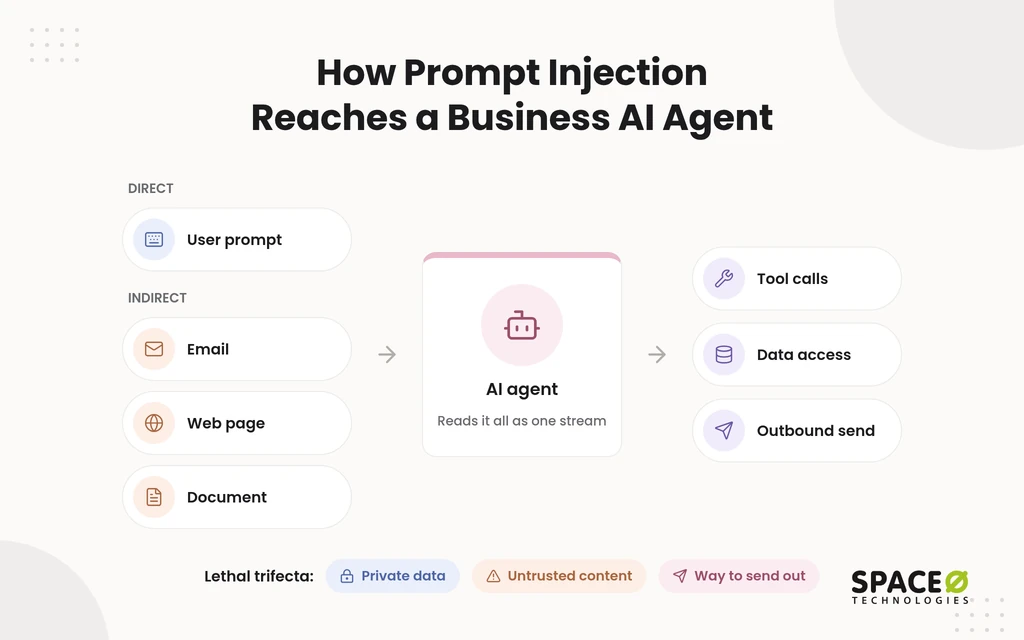
Prompt injection reaches a business AI agent through any text the model reads. A user can type it, or a tool can fetch it. The Open Worldwide Application Security Project (OWASP) ranks prompt injection as LLM01 on its list of LLM application risks. Vectra reports attack success of 50-84%, depending on configuration. LLM-powered agents with tool use raise the stakes, because they can act on what they read.
Direct and indirect injection
Direct injection comes from the person using the agent, while indirect injection arrives inside content the agent retrieves. The second type deserves more attention, because the attacker never needs access to your interface.
- Direct injection: A user types instructions that try to override the agent’s rules.
- Indirect injection: An attacker plants instructions in an email, web page, or document that the agent later reads.
Why the model cannot tell them apart
The model reads instructions and data in one stream, so no hard boundary separates them. Better prompts can lower the odds of a successful attack, but they cannot create that boundary. Prevention will never be complete, so an injection against an agent becomes a privilege-escalation event. The attacker borrows whatever access the agent already holds.
The lethal trifecta
The lethal trifecta combines access to private data, exposure to untrusted content, and a way to send data outside. An agent with all three can be steered to read something sensitive and transmit it. Removing any one of the three closes that path. The seven layers below reduce the odds of an attack and limit its damage.
1. Least Privilege and Per-Agent Identity
Least privilege limits prompt injection damage in a business AI agent. A hijacked agent can only use the access it holds.
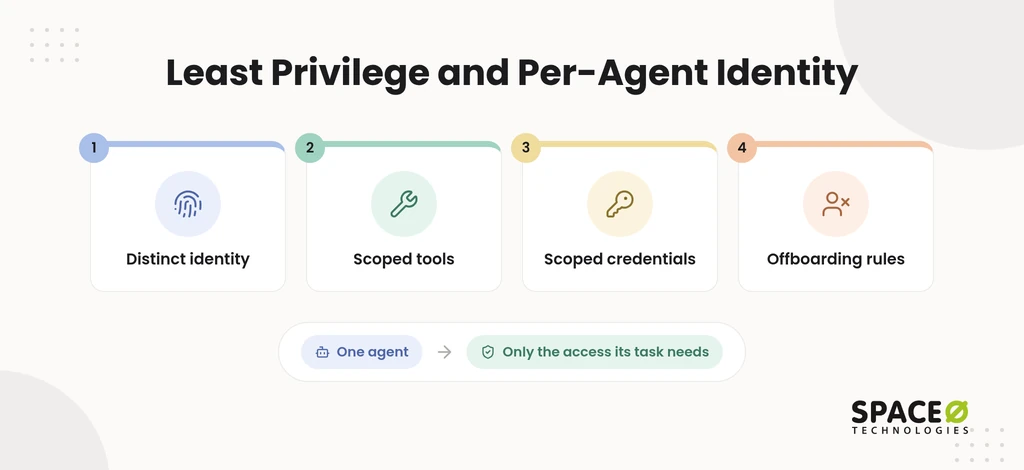
- Distinct identity: Give each agent its own non-human identity, so agents never share a credential or audit trail.
- Scoped tools: Allow only the tools and API methods that the agent’s job requires.
- Scoped credentials: Limit each credential to the systems and records the agent’s task needs.
- Offboarding rules: Revoke an agent’s access when its job changes or the agent is retired.
Access you never granted cannot be abused. Scope every agent to its task, following AI agent development best practices, before adding other controls.
2. Separate Instructions From Untrusted Data
Separate instructions from data by marking all external content as untrusted before the model reads it. This matters because your agent otherwise gives a stranger’s email the same standing as your system prompt. Treat the model as an untrusted reasoning engine, not as a security boundary.
- Input delimiting: Wrap retrieved content in clear markers that identify it as data, not instructions.
- Source labels: Tag each input by origin, so downstream rules can treat external content more strictly.
- Input sanitization: Strip hidden text such as white-on-white, zero-size, and zero-width characters.
- Encoding checks: Inspect Base64 strings and homoglyphs, which can disguise instructions from simple filters.
OWASP’s prompt injection prevention cheat sheet gives your engineers further detail. These steps lower the odds of an attack but do not guarantee separation. The next layer moves enforcement out of the model entirely.
3. Authorization Outside the Model
Enforce authorization outside the model’s reasoning loop, so injected text cannot talk its way past your permissions. A rule written only in a prompt is a request, and an attacker can argue with a request. A check in your application programming interface (API) layer simply returns a denial.
- Execution-time checks: Authorize every tool call when it runs, not when the session starts.
- API-layer authorization: Keep permission logic in your own services, where model output cannot rewrite it.
- Parameter limits: Validate amounts, recipients, and record scopes against policy before a call executes.
- Default denial: Reject any tool or action that policy does not explicitly allow.
Whichever AI agent frameworks your team selects, keep this check in code you control. The model can propose an action, but only your systems should authorize it.
4. Human Approval for High-Impact Actions
Require human approval for high-impact or irreversible actions, so a successful injection still stops at a person. Human-in-the-loop (HITL) review only works when the reviewer can see what will actually happen.
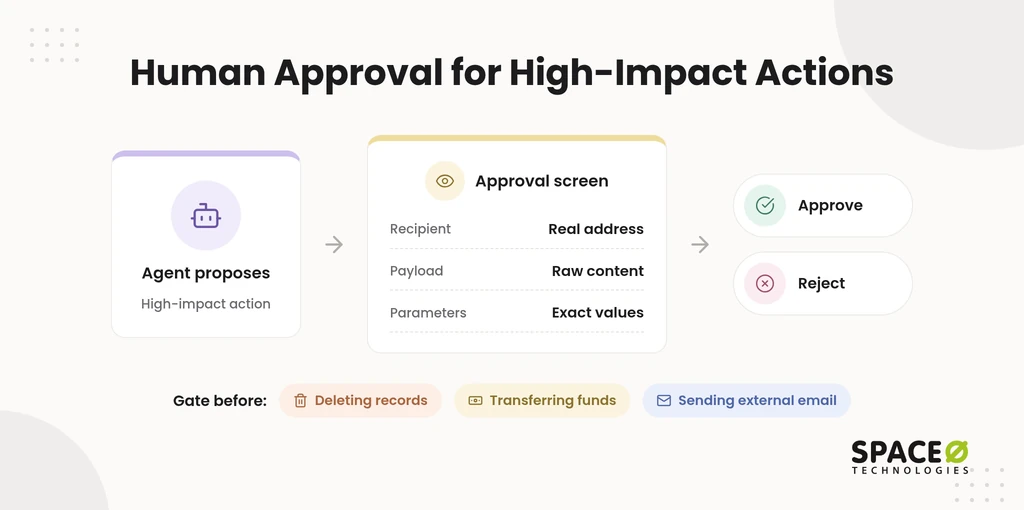
- Gated actions: Require sign-off before deleting records, transferring funds, or sending external emails.
- Raw parameters: Show the actual recipient, payload, and parameters, not an “AI recommends sending this email” summary.
- Enforced gates: Place the approval step in your application, so the model cannot skip it.
- Narrow scope: Reserve approvals for consequential actions, so reviewers stay attentive instead of approving by habit.
A manipulated summary can mislead the approver, much like an AI agent hallucinating and taking wrong actions. Show reviewers the raw action, then use the next layer to reduce how many attacks reach this point.
5. Screening With an AI Firewall, Gateway, or Classifier
A screening layer inspects inputs and tool calls for injection attempts before they reach the model or your systems. It catches common attacks and gives your team a useful signal. It works on probability, though, so a missed attack must still meet the containment layers above.
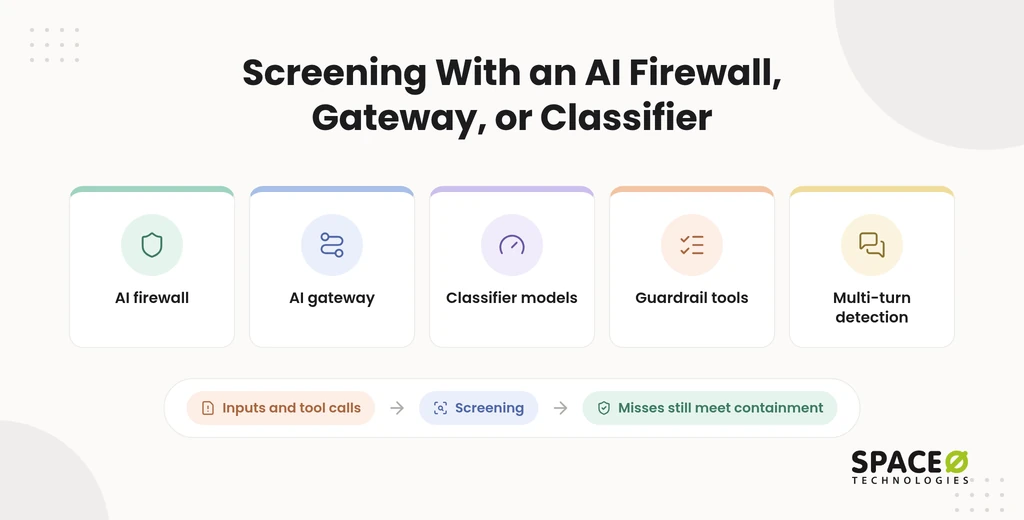
- AI firewall: Inspects prompts and retrieved content for known attack patterns.
- AI gateway: Applies screening and policy at one point between agents, models, and tools.
- Classifier models: Score text for the likelihood that it contains an injection.
- Guardrail tools: Apply defined rules to what enters and leaves the agent.
- Multi-turn detection: Looks for payloads split across several messages or documents.
A detector should never be your only control. Screening covers only what goes in, so the agent’s outputs need checking next.
6. Output Filtering and PII Redaction
Output filtering stops sensitive data from leaving through the agent’s responses and tool arguments. An injected agent may never need a forbidden tool if it can place private data in a normal reply. Check outputs as carefully as you check inputs.
- PII redaction: Mask personally identifiable information (PII) that the recipient has no reason to see.
- Credential redaction: Remove API keys, tokens, and passwords from responses and logs.
- Tool-argument checks: Inspect outbound parameters for sensitive data before a tool runs.
- Destination limits: Restrict outbound messages and requests to approved recipients and domains.
Output controls close the exfiltration path in the lethal trifecta. You still need evidence of what the agent did, which is the job of the final layer.
7. Monitoring, Audit Logs, and Red Teaming
Log every tool call and test the agent adversarially, so you can detect, investigate, and prevent repeat attacks. Without those records, your team cannot show what a compromised agent touched. Monitoring also shows whether the other six layers still hold as the agent changes. Plan for AI agent maintenance cost after launch, because monitoring never stops.
- Audit logs: Record each tool call with its agent identity, parameters, decision, and result.
- SIEM integration: Send agent events to your security information and event management (SIEM) platform.
- Anomaly alerts: Flag unusual tools, data volumes, destinations, and repeated denials for review.
- Red teaming: Attack the agent on a regular schedule and after each new tool or data source.
Together, these seven layers describe what to build. The next decision is where each one should be enforced.
Comparing Prompt Injection Protection Options
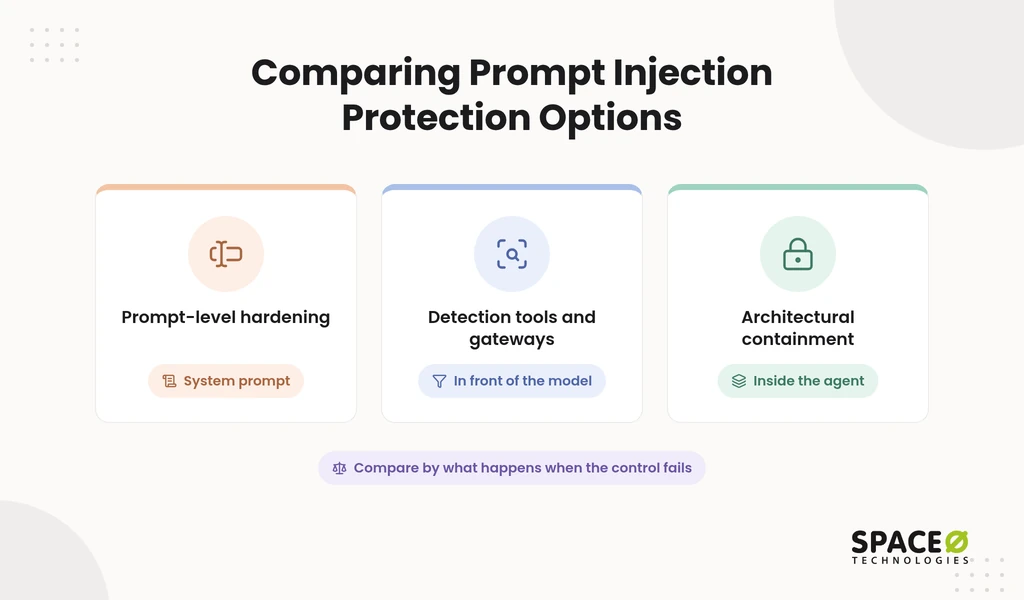
Most business agents need all three options below, because each one enforces protection in a different place. Compare them by what still happens when the control fails. This table describes categories, not a ranking of vendors.
| Option | Where enforcement lives | What it stops | What it misses |
|---|---|---|---|
| Prompt-level hardening | System prompt and input formatting | Simple override attempts and some confusion between instructions and data | Determined attacks, because the model can still follow injected text |
| Detection tools and gateways, such as AI firewalls, prompt classifiers, and inbound email filters | A layer in front of the model, tools, or inbox | Known patterns and many hidden-text techniques | Attacks that the detector fails to recognize |
| Architectural containment built into the agent | Identity, API-layer authorization, and approval gates | Unauthorized actions, even after a successful injection | Misuse within permissions you granted, which is why scopes must stay narrow |
Adopting a detection product means routing agent traffic through it and maintaining its rules. Detectors reduce probability and must be paired with structural containment. Containment built into custom software does not depend on a detector’s accuracy.
Get a Second Opinion on Agent Security
Our AI consultants review the tools, data, and approvals your agent uses before you expand its access. The review then shows which containment layers you should add first, ahead of any expansion.

In What Order Should You Build Prompt Injection Protection?
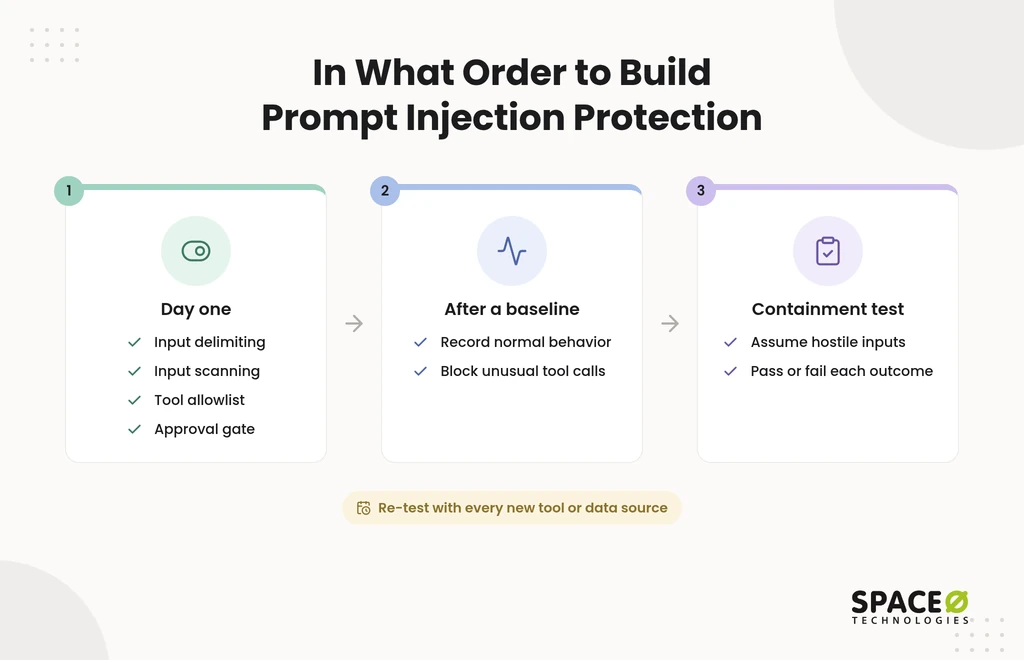
Start with controls that need no historical data, add behavior-based enforcement after recording a baseline, and test containment throughout. Most guidance lists layers without giving you a sequence. Fit the steps below into your AI agent development process rather than treating security as a final review.
What to switch on from day one
Four controls can ship with the first release, because none depends on recorded agent behavior. Your team can define each one from the agent’s intended job.
- Input delimiting: Mark all retrieved content as data.
- Input scanning: Screen inbound content and tool calls.
- Tool allowlist: Permit only the tools the agent’s job requires.
- Approval gate: Hold destructive actions until a person signs off.
What needs a recorded baseline first
Behavior-based enforcement must wait for a baseline, because you cannot flag unusual activity before defining normal activity. ARMO says recording that baseline takes 7-14 days for narrow agents. Treat this as one vendor’s claim and measure your own agent. Then use the baseline to block or escalate tool-call patterns the agent has not shown before.
How to run the pass/fail containment test
Assume an attacker controls everything the agent reads, then find the worst action it can take. The scoring below is our engineering guidance.
- List every tool, credential, and data source the agent can reach.
- Assume an attacker controls every input the agent reads.
- Write down the worst realistic outcome for each tool and tool combination.
- Mark a pass if each outcome is blocked, held for approval, or reversible and logged.
- Mark a fail if an outcome is irreversible and ungated, or lets data leave through the lethal trifecta.
- Fix each failure by removing access or adding a gate, then repeat the test.
Run the test again whenever the agent gains a tool or data source. A pass gives your team a documented limit on the damage, not a promise that attacks will stop.
Space-O Technologies runs this kind of check before any agent goes live. Pre-production validation includes prompt-injection stress tests and adversarial exercises. Agents also run in shadow mode alongside human workflows for parallel-run comparison.
How Space-O Technologies Builds Containment Into Custom AI Agents
Space-O Technologies builds protection into the agent’s software, so containment does not rest on a detector alone. Your team gets the controls inside code it owns, along with a delivery model that fits its capacity. The details below are the commitments we can state plainly.
- Human review: Automation handles the volume, but a qualified human reviews and approves before any output influences a final decision.
- Gated decisions: For a lending client, our agent only drafts an approve-or-decline recommendation with its reasoning. A human underwriter signs off on every case above the exposure threshold, keeping high-value decisions at 100% human approval.
- Built-in guardrails: Our agents ship with topic boundaries, action whitelists, escalation triggers, and kill-switches.
- Responsible AI: We apply PII masking and hallucination and bias testing, and we never train on client data.
- Compliance: Space-O Technologies holds ISO 27001 and ISO 9001 certifications and builds HIPAA-ready frameworks for healthcare AI engagements.
- Delivery capacity: Space-O Technologies has served 1,200+ clients and developed 300+ software solutions, with 140+ in-house developers. For agent work, 30+ AI engineers run 50+ AI systems live.
- Ownership: We sign a non-disclosure agreement (NDA) before starting. All source code, data, and IP transfer to you at completion.
- Engagement models: You can choose Dedicated Team, Time & Material, Fixed Cost, or Staff Augmentation.
Teams that need extra capacity can hire AI agent developers to work alongside in-house engineers.
What to confirm before scoping the work
Three facts about your agent determine how much protection it needs. Confirm them before you request an estimate, and read our AI agent development cost guide for budget drivers.
- Reach: Confirm which tools and APIs the agent can access.
- Exposure: Confirm whether the agent reads external content, such as emails, web pages, or uploaded files.
- Impact: Confirm which actions are irreversible or can send data outside your company.
Frequently Asked Questions
Why isn’t a prompt injection detector enough on its own?
A detector works on probability, so it will eventually miss an attack it fails to recognize. Prompt-level hardening has the same weakness, because the model can still follow injected text from a determined attacker. Structural containment such as scoped identity, API-layer authorization, and approval gates still limits the damage when screening fails.
What should be in place before giving an AI agent a new tool?
Scope the agent’s credential to the task, allowlist the tool, and enforce authorization in your API layer. Require approval for destructive actions, log every call, and rerun the worst-case containment test after adding it.
What do I need in place before an agent reads external email, web pages, or files?
You need to treat all external content as untrusted before the model sees it. That means delimiting retrieved content as data and labeling each input by its source before processing. It means stripping hidden text such as white-on-white or zero-width characters, and inspecting Base64 and homoglyph encodings. You also need limits on approved outbound recipients and domains, so injected instructions cannot easily send data out.
How to make AI agents secure?
Secure an AI agent by designing for containment, because no single control stops prompt injection. Give each agent its own scoped identity, enforce authorization outside the model, and require human approval for high-impact actions. Add input and output screening, then log every tool call and red team the agent regularly. Before launch, run a worst-case containment test that assumes an attacker controls every input the agent reads.
How much does prompt injection protection for a business AI agent cost?
Cost depends on how much your agent can reach. As our AI agent development services pricing notes, annual maintenance typically adds 15% to 25% of the original build cost. Three facts set the scope: which tools and APIs the agent can access, whether it reads external content, and which actions are irreversible or can send data outside your company. A detection product also means routing agent traffic through it and maintaining its rules. Containment built into custom software does not depend on a detector’s accuracy.
How long does it take to set up prompt injection protection?
Four controls can ship with the first release, because none needs recorded agent behavior. These are input delimiting, input scanning, a tool allowlist, and an approval gate for destructive actions. Behavior-based enforcement must wait for a baseline. ARMO says recording one takes 7-14 days for narrow agents. Treat that as one vendor’s claim and measure your own agent.
Can prompt injection be fully prevented in a business AI agent?
No, because the model reads instructions and data in one stream, so no hard boundary separates them. Better prompts and screening lower the odds of an attack but cannot guarantee separation. Design for containment instead. Scoped credentials, authorization outside the model, and approval gates limit the damage when an injection succeeds. Misuse within permissions you granted is still possible, so keep scopes narrow.



 All our projects are secured by NDA




 4.8


