
 By
By 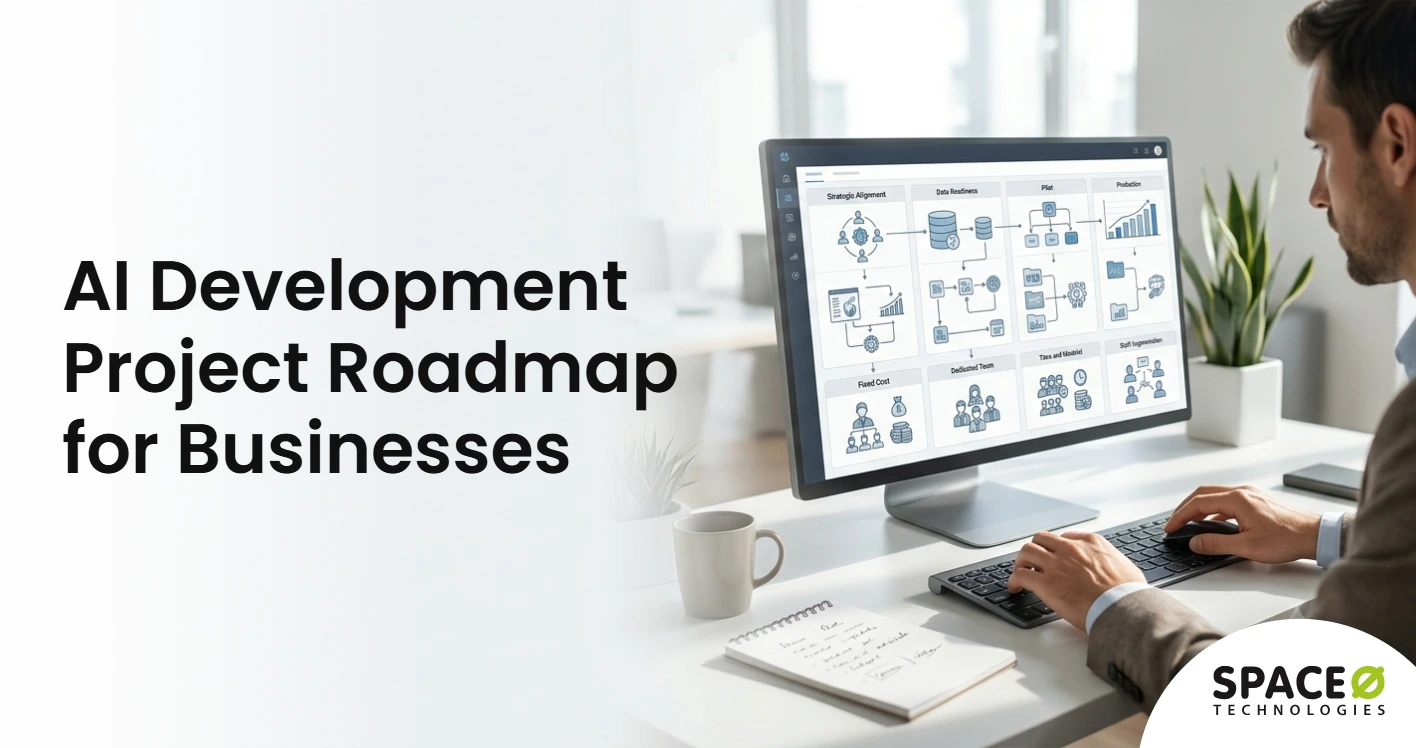
Contents
- A roadmap has four phases: alignment, data readiness, pilot, and production with monitoring.
- Start with the business problem and KPIs, then rank use cases by value against feasibility.
- Weak data stalls many projects, so audit data quality before any model training.
- Prove value in a small pilot, with human review on consequential decisions, before you scale.
- Match the engagement model to the phase: Fixed Cost for pilots, Dedicated Team for production and MLOps.
Key Takeaways
An AI development project roadmap is a phased plan tied to business goals. It moves from a defined problem to production. Four phases carry it: alignment, data readiness, pilot, and production with monitoring.
Space-O Technologies has built custom software since 2010. Our AI development services cover every phase, from discovery to monitoring. We rank use cases by value against feasibility, so quick wins come first.
Most guides agree on the phases. They rarely say who builds each one with you. This page maps every phase to a build, buy, or partner choice.
What is an AI development project roadmap?
An AI development project roadmap is a structured, phased blueprint that connects AI goals to business outcomes. It sequences the work from problem definition to production so each stage de-risks the next. It is not a technology shopping list. The point of the format is discipline. You commit to a measurable business problem first, then prioritize, build data foundations, and pilot. Only then do you deploy at scale with monitoring in place.
This phased shape is what separates AI work that reaches production from work that stalls. The McKinsey State of AI survey found that 88% of organizations use AI in at least one business function. Yet only about one-third have scaled it across the enterprise. The common failure pattern is skipping phases. Teams buy infrastructure before the use case is clear, or scale a pilot that was never evaluated. The roadmap exists to stop that.
Phase 1: Strategic Alignment and Use-Case Selection (Months 1-2)
Phase 1 starts with the business problem rather than with any particular choice of technology. Starting with the problem keeps the work anchored to outcomes instead of drifting toward available tools. By the end of the phase, you should have a short list of prioritized, high-value use cases. This is the universal first step across every credible roadmap: define what business outcome you need before choosing how to build it.
- Define the business problem and KPIs: Name measurable outcomes: hours saved, tickets deflected, or approval times cut. This lets return on investment (ROI) be judged later, rather than chasing hype or ad-hoc tech trends.
- Prioritize on a value-versus-feasibility matrix: Plot candidate use cases by business impact against technical feasibility. Target high-impact, low-complexity “quick wins” first; an invoice-processing automation or a customer-support triage model usually scores well.
- Decide the AI approach during discovery: Pick between retrieval-augmented generation (RAG), fine-tuning, or classic machine learning. Space-O Technologies defaults to RAG before fine-tuning, settling this in discovery, not after a build starts.
Are you still weighing whether to buy a platform or build custom at this stage? Our guide to generative AI platforms versus custom development walks through the speed, budget, and data-control trade-offs.
Phase 2: Data Readiness and Infrastructure (Months 2-4)
Phase 2 audits your data first, well before any model is trained on that data. It also stands up the infrastructure and governance that the use case needs at this stage. Data quality is the non-negotiable foundation; a strong use case on weak data fails.
- Audit data quality and build pipelines: First, evaluate whether the data behind your chosen use case is complete, labeled, and accessible. Then build the ingestion and processing pipelines, because most “quick wins” quietly become data projects.
- Establish governance and compliance from the start: Set data privacy, access, and ethics controls now, not at launch, and document who can use what. For US businesses, align data handling with the California Consumer Privacy Act (CCPA) where applicable.
- Provision the environment: Choose cloud infrastructure such as AWS, Microsoft Azure, or Google Cloud Platform (GCP). Size compute to the workload, with GPUs for training and CPUs for orchestration.
Data work often sets the size of the budget, so run your numbers early with an AI development cost calculator before you commit to a pilot.
Phase 3: Pilot and Proof-of-Concept Development (Months 4-6)
Phase 3 builds a small-scale pilot, proof-of-concept (PoC), or minimum viable product (MVP) to test the idea. The goal is to prove the use case delivers measurable value before you commit to scaling. You are testing one thing: does this clear the KPI you set in Phase 1?
- Build a scoped prototype: Develop a working pilot against a single high-value use case. One example is an AI chatbot grounded in company data, rather than a broad platform. Space-O Technologies has shipped production AI including GPT Vix, eComChat, and ReadGenie through exactly this build-small-first path.
- Evaluate against the KPI, with human review built in: Measure the pilot’s output quality and business impact. Put human-review checkpoints on consequential decisions such as hiring, lending, clinical, and legal, so people approve what matters. Grounding, evaluation, and human review are how a pilot becomes trustworthy, not just functional.
- Decideto go, iterate, or stop: Use the evaluation to make an honest scaling decision. A pilot that misses its KPI is a cheap lesson, not a sunk cost.
Ready to scope your pilot?
Share your use case with our engineers, and we will scope a fixed-cost MVP pilot with clear KPIs, a team plan, and a realistic timeline.

Phase 4: Production Deployment, Scaling, and Monitoring (Months 6+)
Phase 4 moves the validated AI into production and integrates it into real workflows across the business. Phase 4 also runs continuous monitoring for model drift once the system is live in production. The roadmap does not end at launch; a model that worked at deployment degrades as the world changes around it.
- Deploy and integrate: Move the model into production and connect it to the systems your people already use. Typical targets are CRM, ERP, or ServiceNow, so the AI runs inside the job, not beside it.
- Stand up MLOps/ModelOps monitoring: Instrument the model for drift detection, performance observability, and retraining triggers. This ongoing operations discipline, known as MLOps or ModelOps, is what keeps production AI reliable over time.
- Measure ROI and iterate: Compare the Phase 1 KPI against live production results and report the return. Feed the learnings from those results into the next use case on your value-versus-feasibility matrix.
To judge whether the pilot paid off, use the ROI of AI software development formula.
Who builds each phase: build, buy, or partner
The roadmap above is the settled part, while the unsettled part is who executes it. That decision about who executes it changes from one phase to the next in the roadmap. Most guides describe what a roadmap is and stop. In practice, businesses staff it three ways: build in-house, buy a platform, or partner with a full-cycle development team, and the right answer often differs by phase.
For a fixed-cost pilot, our MVP development services cover scoping through launch.
Match the engagement model to the phase
Space-O Technologies maps four engagement models to the roadmap, so each phase is staffed by the right arrangement. This avoids a one-size contract. The four models are Dedicated Team, Time and Material, Fixed Cost, and Staff Augmentation.
- Fixed Cost for a scoped pilot (Phase 3): When the MVP scope is well defined, a fixed-cost engagement is suited to this pilot phase. This arrangement caps the cost of proving that the AI use case delivers real value.
- Dedicated Team for production and MLOps (Phase 4): A production build plus ongoing drift monitoring needs a stable team that stays with the system. A Dedicated Team model fits that long arc, from the first production build through ongoing monitoring.
- Staff Augmentation when you have a team but lack a role: Use this when your engineering lead needs an AI engineering pod inside existing sprints and repositories. Vetted developers join the team and work alongside it, rather than taking over the project.
- Time and Material for evolving scope: Early discovery and iterative work have requirements that are still moving and not yet settled. Time and Material is the engagement model that suits this evolving scope during those early stages.
When you add AI engineers to an existing team, speed of onboarding matters as much as skill. Our hire AI developers service matches a client with the right AI engineer within 48 hours. Hiring runs 4 to 6 days, covering requirement analysis, developer matching, interview, NDA signing, and onboarding. Developers are aligned with the client’s tools, repositories, and workflows within the first week.
Space-O Technologies delivers the full cycle under one team, covering requirement analysis, UI/UX, agile development, QA, deployment, and maintenance. An NDA comes before every project, and full code and IP ownership transfer at handover. That matters most where this roadmap lives or dies: the pilot-to-production-to-monitoring stretch.
If you plan to outsource AI development, define a measurable problem and prepare clean data first.
Where a platform or a staffing-only partner fits
Buying an off-the-shelf platform or hiring staffing-only talent can be the right call for parts of the roadmap, and honest roadmaps say so. A generative AI platform can cover a general, low-stakes use case fast; staffing-only providers can fill a seat when you own the delivery. Space-O Technologies differs where the roadmap gets hard, offering end-to-end product ownership through discovery, design, build, and maintenance, and production AI governed with human review, rather than handing back a model with no operations plan.
Before you sign, evaluate AI development companies on production record, IP ownership, and drift monitoring.
Why many AI projects stall, and what reaches production
Statista puts the AI market at around $255 billion in 2025 and over $1,218 billion by 2030. Yet many AI projects stall short of production, and the failures cluster at the phase boundaries. Projects that skip data readiness, scale an unevaluated pilot, or ship without drift monitoring are the ones that stall.
What reaches production is a defined problem, honest prioritization, a KPI-measured pilot, and MLOps discipline after launch. Space-O Technologies runs the full cycle across 300+ solutions since 2010, not handing off at risky seams.
That full cycle shows in shipped work. Space-O Technologies has shipped 50+ AI systems to production, built by a team of 30+ AI engineers and prompt specialists. For a New Jersey recruiting agency, it took GPT Vix from requirements to a live web platform, using React.js, Node.js, AWS Lambda, OpenAI for interview-question generation, and Whisper for transcription. For a US B2B and B2C store with a 47,000+ product catalog, it built eComChat, grounding search in vector embeddings with real-time indexing, which increased revenue by 23%. ReadGenie, an iOS reading assistant built on OCR and GPT-3.5, reached 525+ downloads in its first week on the App Store.
Frequently Asked Questions
When should I build an AI solution in-house versus buy a platform or partner with a development team?
Buy an off-the-shelf generative AI platform when the use case is general and low-stakes and you need speed. Build or partner when the asset is core, data control matters, or the model needs ongoing operations. A full-cycle partner fits best from pilot to production to monitoring. Owning delivery end to end prevents stalls at the risky seams. The right answer often differs by phase rather than being one choice for the whole roadmap.
Are there hidden costs in an AI roadmap beyond the initial build?
Yes, an AI roadmap carries costs beyond the initial build. Many use cases quietly become data projects in Phase 2. Ingestion and processing pipelines must be built, and data cleaned, labeled, and made accessible. Phase 4 then adds ongoing MLOps costs for drift detection, performance monitoring, and retraining after launch.
How long does an AI development roadmap take?
This roadmap reaches production deployment at about month six. Phase 1 runs months 1-2 and Phase 2 runs months 2-4. Phase 3 runs months 4-6. Phase 4 then continues with monitoring.
Why do AI projects stall before production?
Weak data and unclear business goals cause most stalls. Teams also skip the plan for operating the model after the pilot. Phase 1 KPIs and the Phase 2 data audit address the first two causes.
Which engagement model fits each phase?
Fixed Cost fits a scoped pilot, and a Dedicated Team fits production and MLOps. Time and Material suits evolving scope. Staff Augmentation adds engineers to a team you already run.
Do people stay involved once the AI is in production?
Yes, people review and approve consequential decisions at every phase. Human-review checkpoints start in the pilot. They continue after launch alongside grounding and evaluation of model outputs.



 All our projects are secured by NDA




 4.8
4.8