
 By
Contents
- Write a pass/fail acceptance threshold on your own evaluation set before any vendor starts building.
- Audit where your data lives, how clean it is, who owns it, and which privacy rules apply.
- Budget yearly maintenance on top of the build cost, not only the initial build.
- Pay a fixed cost for the first phase, then price the full build on its results.
Key Takeaways
To outsource AI development successfully, define the problem and set metrics first. Then audit your data, vet partners, and protect your IP. Finish with a paid pilot and monitoring after launch.
Most outsourced AI projects stall for simple reasons. The goal was vague, the data was not ready, or a demo replaced proof. That is why our AI development services start with scope and data, not model choice.
This guide covers five steps, contract acceptance criteria, and year-one costs. If buying may fit better, compare custom AI vs. off-the-shelf options first. Space-O Technologies has built AI-powered custom software since 2010 for 1,200+ clients.
Step 1: Define the Business Problem, Baseline, and Success Metrics
Start with one measurable business problem and today’s baseline, not a tool you want to try. Ask a vendor for “an AI agent” and you will get one, whether or not it solves anything. A clear goal tells your partner what to build and tells you how to judge it.
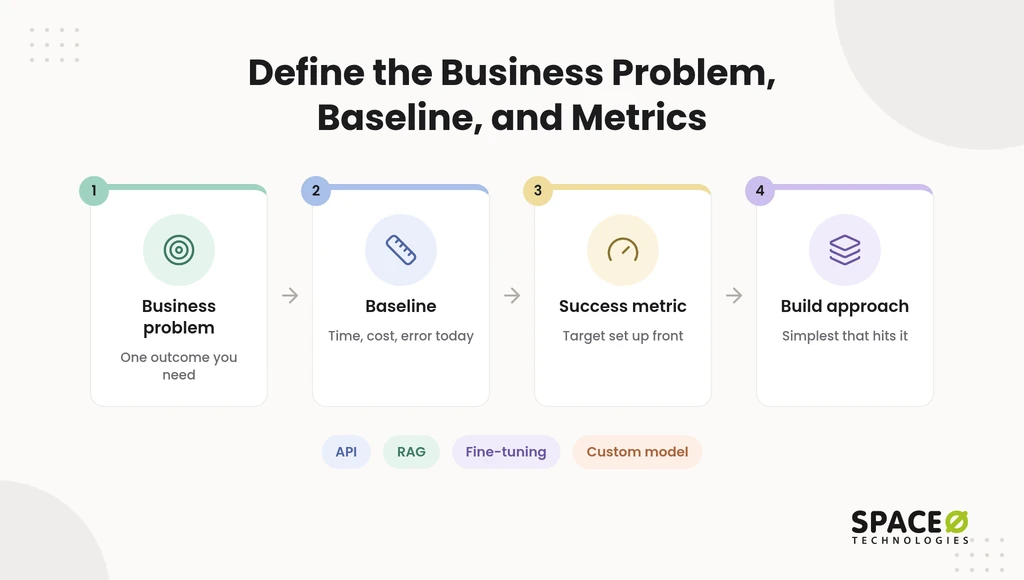
- Define the problem in business terms: Name the outcome you need, such as cutting support response time or flagging fraudulent claims. A support goal might point to AI chatbot development services judged on response time.
- Record the baseline and the workflow: Measure how the work performs today in time, cost, or error rate. Automating a broken process only makes it fail faster, so document the current process first.
- Set success metrics before the build: Decide the target accuracy, cost savings, or time saved up front. A vendor who guarantees accuracy before seeing your data is a red flag.
- Choose the build approach last: Pick the simplest approach that can hit the metric. The options are an API integration, retrieval-augmented generation (RAG), fine-tuning, or a custom model.
If the goal is still unclear, AI consulting services can rank use cases before any build starts. At Space-O Technologies, we start from your goal and then pick the technology. Once the goal is fixed, ask whether your data can support it.
Step 2: Audit and Prepare Your Data
Audit your data before you shortlist a vendor, because data readiness decides whether a model learns anything useful. Many teams shortlist vendors first and only then discover their data is scattered or unlabeled. Data preparation often takes longer than building the model itself.
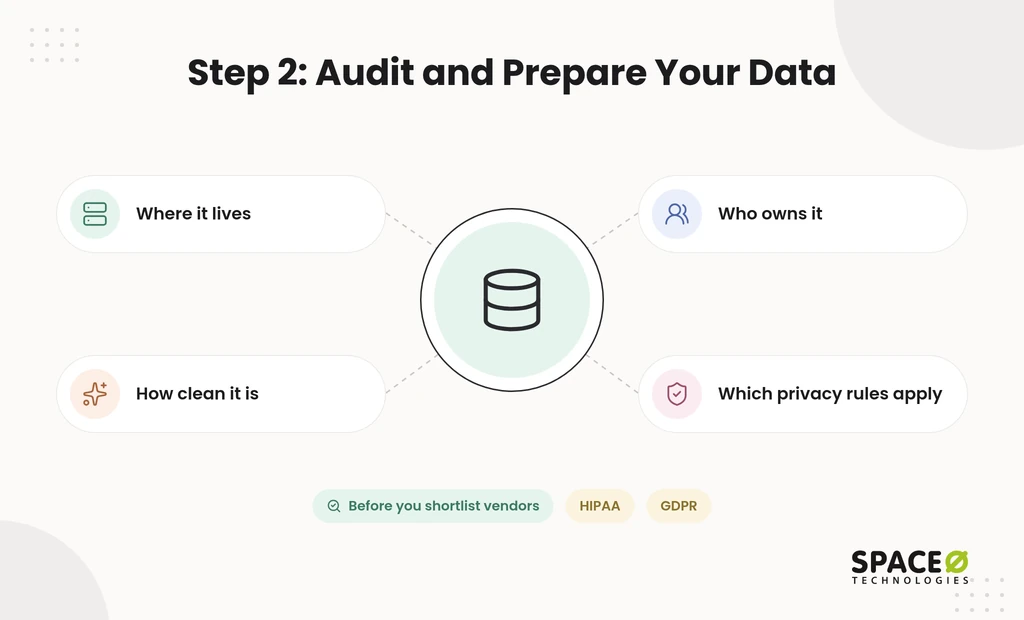
Gartner predicts that through 2026, organizations will abandon 60% of AI projects unsupported by AI-ready data. Four checks tell you where your data stands:
- Check where it lives: List every system, file store, and API that holds the data. Confirm a partner can reach it without manual exports.
- Check how clean it is: Look for gaps, duplicates, and missing labels. Fix them before a build begins, not during it.
- Check who owns it: Name an internal owner for each data source and its usage decisions. In a hybrid model, your team holds governance, and the partner builds, which keeps control where it belongs.
- Check which privacy rules apply: Flag personal, health, and financial data and the rules that cover it, such as HIPAA or GDPR. These rules shape what a vendor may see, and data privacy in AI development projects covers where data may be stored.
Clean, reachable, well-owned data is what makes a vendor shortlist worth having. The next step is finding a partner who can actually use it.
Step 3: Vet the Partner and Choose an Engagement Model
Choose a partner with shipped machine learning, natural language processing (NLP), or computer vision work, not a generic software shop. Demos make every vendor look capable, so choose an AI development partner with questions a demo cannot answer. Space-O Technologies serves startups, growing businesses, and enterprises, and reports 97% client retention.
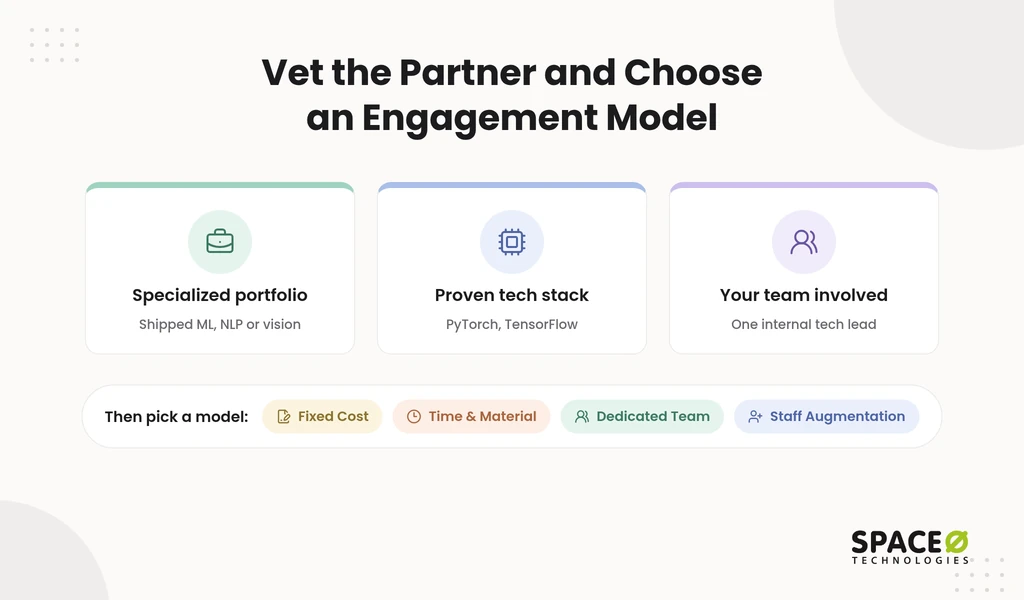
- Check the specialized portfolio: Ask for production machine learning, NLP, or computer vision projects, not general web development. Low-cost providers often lack real machine learning depth.
- Confirm the tech stack: A capable team works in proven open-source frameworks such as PyTorch and TensorFlow. They can also explain their model choices in plain terms.
- Involve your internal team early: Bring your engineers into vendor calls and share architecture documents upfront. Name one internal tech lead to oversee the partner from kickoff to handoff.
Questions to ask any AI vendor
Ask how the vendor measures quality, handles failure, and assigns ownership, and expect specific answers. A credible team answers with a method. A weak team answers with a demo.
| Question | Strong answer | Weak answer | How Space-O Technologies handles this |
|---|---|---|---|
| How do you measure quality? | An evaluation method, a labeled test set, and regression testing. | A slick user interface demo. | Every production model gets an evaluation suite for accuracy, hallucination rate, bias, latency, and cost. |
| What happens when the model is wrong in production? | Monitoring, human escalation paths, and a rollback procedure. | “We tweak the prompt.” | Continuous monitoring with human review on high-stakes outputs, as described in step 5. |
| Who owns the code, prompts, and model weights? | Your company, in writing, at completion. | The vendor keeps rights to reuse them. | All source code, data, and IP built during a project transfer to the client at completion. |
Which engagement model fits each phase
Match the engagement model to how fixed your scope is. Space-O Technologies offers four engagement models: Dedicated Team, Time & Material, Fixed Cost, and Staff Augmentation. The table also shows the in-house and hybrid options buyers weigh against outsourcing.
| Model | Best for | What your team manages |
|---|---|---|
| In-house team | Organizations treating AI as a long-term core capability. | Hiring, tooling, and retaining AI specialists. |
| Hybrid | Teams that want product control with outside build speed. | Data governance and product decisions, while the partner builds. |
| Fixed Cost | A tightly scoped pilot, proof of concept, or MVP. | A firm scope and agreed acceptance criteria. |
| Time & Material | Evolving scope and exploratory model work. | Backlog priorities and budget tracking. |
| Dedicated Team | Long-term AI products. | Product direction and roadmap. |
| Staff Augmentation | Adding AI engineers to an in-house team. | Day-to-day management of the added engineers. |
The cost section below shows how to use Fixed Cost and Time & Material in sequence. Before any build starts, though, your data and IP need protection.
Step 4: Protect Your Data and Intellectual Property
Lock down data access and IP ownership before any data leaves your systems. Once data is shared, it is hard to pull back. Contract gaps on ownership are just as hard to fix after delivery.
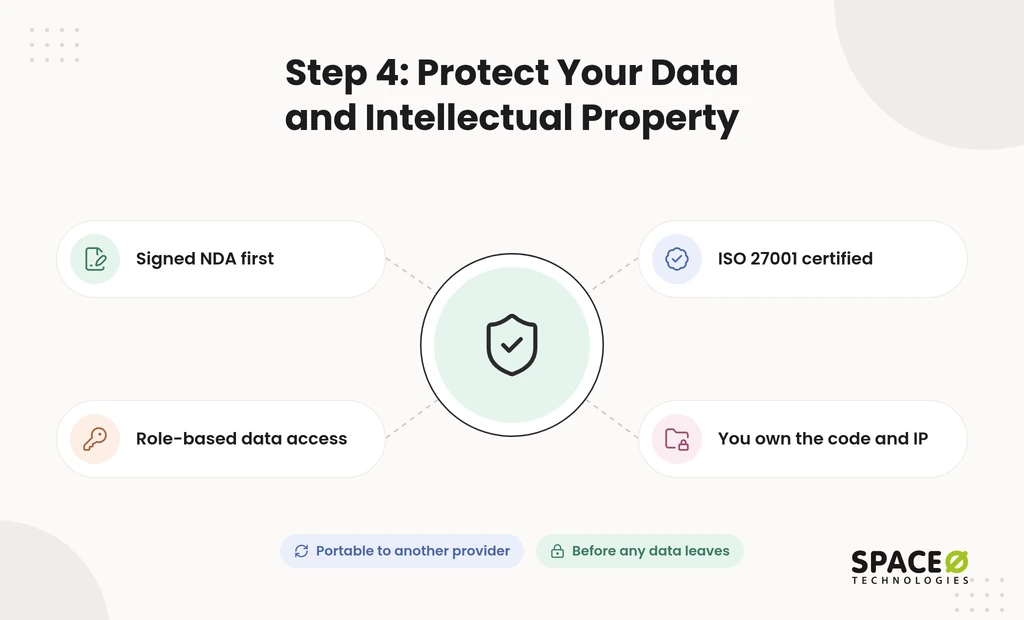
- Sign an NDA first: Get a signed non-disclosure agreement (NDA) before you share data or architecture. Space-O Technologies signs an NDA before starting a project.
- Limit access by role: Share data through encrypted access, private repositories, and role-based permissions. Give each engineer only the data their task needs.
- Ask which standards apply: Ask about ISO 27001 and how the partner handles HIPAA-compliant data. Space-O Technologies holds ISO 27001 and ISO 9001 certifications and uses HIPAA-ready frameworks for healthcare AI.
- Write ownership and portability into the contract: Assign custom code, prompts, model weights, and datasets to your company under clear AI development IP ownership and NDA terms. Confirm you can move the model to another provider, which avoids vendor lock-in.
With protection in place, you can safely test the partner on real work.
Step 5: Pilot, Test, Hand Off, and Monitor
Start with a small paid pilot, score it on real examples, and plan monitoring before launch. Demos are built to impress, while production exposes every gap. A short, paid first phase shows you which kind of partner you have.
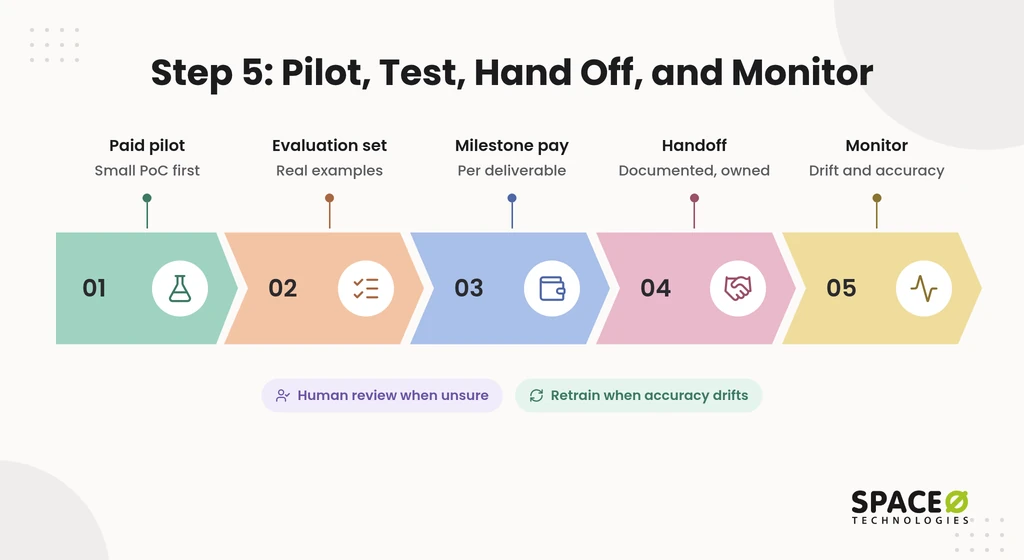
- Begin with a paid test task or pilot: A small, paid proof of concept (PoC) tests skill, communication, and fit before a full contract. Scope it as our MVP development services team scopes an MVP, with a clear go or no-go gate.
- Score against an evaluation set, not a demo: Build a set of real examples from your data with known correct answers. Without one, a team can keep tuning without knowing whether each change helps.
- Pay by milestone: Tie each payment to a completed, agreed deliverable. Avoid large lump sums upfront.
- Plan the handoff in writing: Agree how your engineers will retrain, debug, and own the system. Require documented prompts, evaluation logic, training scripts, and deployment steps.
What should you monitor after launch?
Monitor accuracy, drift, and cost continuously, because models degrade as real-world data shifts. This degradation is called model drift. The machine learning operations (MLOps) work after launch keeps it in check.
- Continuous evaluation: The same evaluation suite keeps running in production, so regressions surface before users see them.
- Drift and model updates: Models are re-evaluated after every meaningful upgrade from their providers. The choice between RAG and fine-tuning is reviewed quarterly.
- Human-in-the-loop review: Outputs below a confidence threshold route to a qualified person for review. Hiring, lending, clinical, and legal decisions get human approval before they take effect.
- Maintenance: Maintenance covers performance optimization, issue resolution, updates, and security patches.
Scope a Fixed-Cost First Phase for Your AI
Share your use case, data sources, and success metric. We will scope a fixed-cost discovery or proof of concept with milestone payments, so you judge real work first.

Acceptance Criteria and Year-One Cost: What to Agree Before You Sign
Agree in the contract what “working” means and what year one costs, before the build starts. Many contracts list deliverables but never define a pass, so disputes begin at handover. Budgets often cover the build and miss the running costs that follow.
How do you write acceptance into the contract?
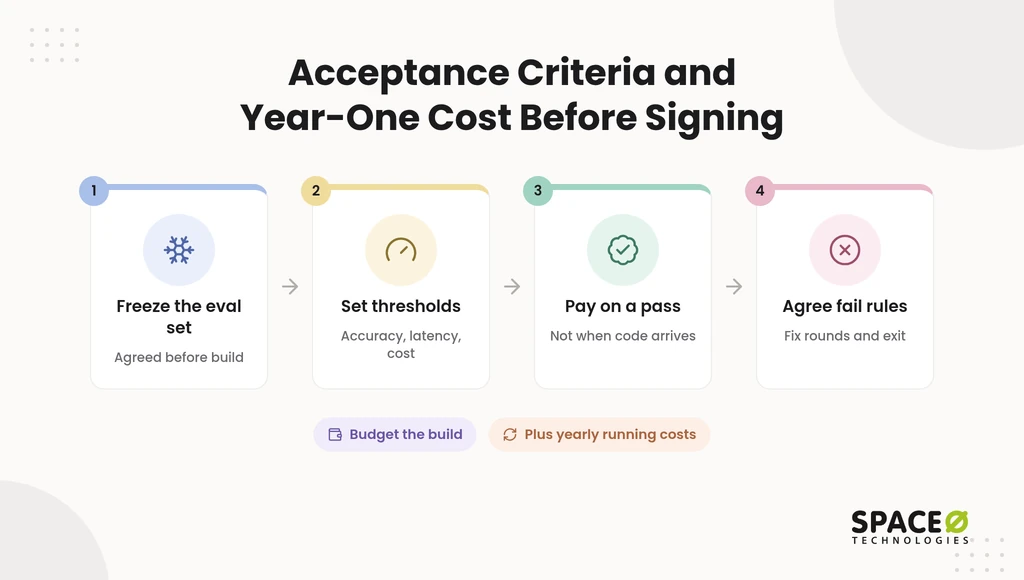
Make acceptance a pass/fail threshold on an evaluation set that both sides agree on before development. The contract then tests the result, not the effort.
- Freeze the evaluation set: Agree on the examples and correct answers before development starts. Hold back a portion the team never tunes against.
- Set a threshold for each metric: Write a minimum accuracy score plus limits for latency and cost per request.
- Tie payment to the threshold: Release each milestone payment when the build passes the test, not when code arrives.
- Agree what happens on a fail: Set the number of fix rounds allowed and the point where either side can stop.
What does outsourced AI cost in year one?
Year-one cost is the build plus the cost of running it, and running costs recur every year. The figures below come from our AI development cost guide and are Space-O Technologies planning figures, not industry averages.
| Cost item | Space-O Technologies figure (USD) |
|---|---|
| Proof of concept | Starts near $15,000 for a Space-O Technologies proof of concept, before any MVP build. |
| Basic MVP | From $15,000. |
| Feature-rich MVP | Up to $50,000 or more. |
| AI chatbots and virtual assistants | $25,000-$100,000 for customer support, FAQ automation, or internal assistance. |
| Mid-level AI application | $80,000-$200,000, built over 4 to 7 months. |
| Enterprise AI platform | Can go well past $500,000 with custom models, deep integrations, and compliance controls. |
| Data preparation | 25%-40% of the total project budget. |
| Annual maintenance | 15%-25% of the build cost every year. |
| Retraining cycles | $15,000-$60,000 per year. |
Infrastructure and API usage add to the total. For example, a $50,000 feature-rich MVP implies $7,500-$12,500 a year in maintenance, before hosting and API fees.
Why pay a fixed cost for the first phase?
A fixed-cost first phase caps your risk while the data and approach are still unknown. Guides split here: some favor time and material for exploratory AI, while others favor fixed-price milestones. You can use both in sequence.
Run discovery or a proof of concept on a Fixed Cost model with milestone payments. Then price the full build from that phase’s results. Use Fixed Cost if the scope is firm, or Time & Material if it is still moving.
This approach suits US teams that want a known first-phase cost before committing to open-ended hours.
Checklist Before Your First Vendor Call
Before any vendor call, answer two questions: what is the use case, and is your data ready? The six items below turn those questions into a working brief.
- Use case: Name one problem, one owner, and one metric with today’s baseline.
- Data readiness: Document location, cleanliness, ownership, and privacy rules for each source.
- Acceptance: Draft an evaluation set and a pass/fail threshold, using ways to test and evaluate an AI agent before launch.
- Protection: Prepare an NDA and a list of the data a vendor may access.
- Budget: Set a first-phase cap plus a yearly maintenance allowance.
- Internal team: Name a tech lead and engineers ready to join vendor calls.
With these six answers ready, a first call becomes a scoping session rather than a sales pitch.
Frequently Asked Questions
What is AI outsourcing?
AI outsourcing means hiring external vendors to plan, build, deploy, or support AI solutions instead of building in-house. Common engagement models include Fixed Cost, Time & Material, Dedicated Team, and Staff Augmentation. The right one depends on how firm your scope is.
Why outsource AI development instead of building an in-house team?
Outsourcing suits teams that want outside build speed without hiring and retaining AI specialists. An in-house team fits organizations that treat AI as a long-term core capability. A hybrid model sits between the two: the partner builds while you keep product control.
What types of AI projects are best suited for outsourcing?
Machine learning, natural language processing (NLP), and computer vision projects are good candidates. The partner must have shipped that kind of work in production. Examples include customer support chatbots judged on response time and models that flag fraudulent claims. The best fits start from one measurable business problem, a recorded baseline, and ready-to-use data.
What are the top 3 most important things in outsourced software development?
For AI projects, three things matter most. First, define one measurable business problem and its baseline before choosing a tool. Second, make sure your data is reachable, clean, owned, and cleared under the privacy rules that apply. Third, write a pass/fail acceptance threshold and IP ownership into the contract before the build starts.
Should I buy a ready-made AI platform or commission a custom build?
Buy a ready platform when your problem is common, and commission a custom build when it is specific. A ready platform is faster to adopt. A custom build gives you full control over code, model weights, and IP. Both paths still need clean, structured data to work.
How much does it cost to outsource AI development?
Cost depends on scope, data condition, and engagement model. A proof of concept starts near $15,000, and enterprise platforms go past $500,000. Space-O Technologies gives a free, expert-reviewed estimate instead of hourly rates.
Who owns the code and IP when you outsource AI development?
You should, and the contract should say so. At Space-O Technologies, all source code, data, and IP built during a project transfer to the client at completion. We also sign an NDA before the project starts.
How do you keep outsourced AI accurate after launch?
Monitor the model in production, retrain when accuracy drifts, and keep people approving high-stakes outputs. Agree on the monitoring method and retraining cadence in the contract. Route consequential decisions, such as hiring or lending, to a qualified person for review.



 All our projects are secured by NDA




 4.8


