
 By
Contents
- An AI agent proof of concept (PoC) tests multi-step workflows on your real data before you fund production.
- It delivers a working prototype, live integrations, human controls, and a decision package.
- Market ranges for agentic PoCs run 8-14 weeks and often cost $10,000-$25,000+.
- Agree on success criteria and a go, refactor, or stop scorecard before the build.
- Stopping is a valid result, and it saves the cost of a failed production build.
Key Takeaways
Many AI demos impress in meetings, then fail on real data. AI agent proof of concept development services test your idea before full production. A small project shows whether an agent can handle your multi-step workflows.
Space-O Technologies has built AI-powered custom software since 2010. Each proof of concept delivers a prototype, real integrations, and human-in-the-loop controls. We build it in your environment, backed by our AI agent development expertise.
Every proof of concept ends with a clear decision: scale, refactor, or stop. Scaling can move straight into our AI development services for production. This page covers deliverables, timeline, cost, process, and safeguards.
What Your AI Agent PoC Delivers
An AI agent PoC delivers four things: a working prototype, live integrations, human controls, and a decision package.
Most stalled AI projects share one problem. The demo looked good, but nobody could say whether it would work on real data. A PoC answers that question with evidence instead of slides.
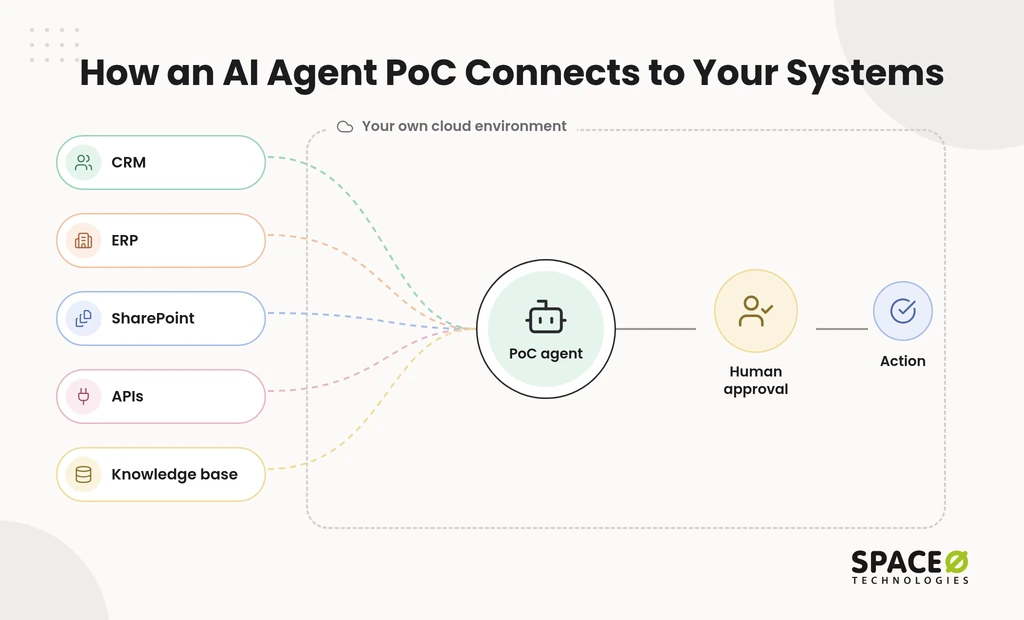
- Functional agent prototype: We build a working agent inside your own cloud or data environment, not a sandbox you cannot reuse.
- Tool and data integrations: Your agent connects to knowledge bases, SharePoint, and application programming interfaces (APIs). It also reaches customer relationship management (CRM) and enterprise resource planning (ERP) systems.
- Human-in-the-loop controls: Guardrails, permission boundaries, and approval routing send high-risk decisions to a person before anything executes.
- Validation and roadmap package: Your team gets measured results, prompt libraries, model and retrieval cost estimates, and a path from pilot to production.
Integration depth is what separates an agent PoC from a chat demo. An agent that cannot touch your CRM or ERP has not proven anything about your workflow.
Typical AI Agent PoC Timeline and Cost
Agentic multi-step PoCs typically take 8-14 weeks and often cost $10,000-$25,000+, depending on integrations and data complexity.
AI development costs vary widely with scope. Treat these market ranges as a guide, not a Space-O Technologies quote. Your scope sets your number.
For a scoped figure, ask for a free, expert-reviewed estimate based on your workflow and data.
A basic retrieval-augmented generation (RAG) demo is faster because it does less. The table shows where the extra weeks go.
| Factor | Basic RAG or static LLM demo | AI agent PoC |
|---|---|---|
| Typical timeline | 3-4 weeks | 8-14 weeks |
| What it proves | The model can answer questions over your documents | The agent can complete multi-step workflows |
| Integrations | Usually one knowledge base | CRM, ERP, SharePoint, and APIs |
| Human controls | Often none | Guardrails, permissions, and approval routing |
| Output | A demo | A validation and roadmap package |
The cost range moves most with integration count and data readiness. Our LLM integration project cost guide shows labor and data preparation drive most of the budget. Data spread across legacy systems lengthens the build.
Our AI Agent PoC Process
We run every agent PoC through four steps, and the final step can end in scale, refactor, or stop.
Teams often skip the first step and jump into building. That is how a PoC turns into an expensive experiment with no answer. Our order keeps each step tied to a business decision.
- Define the Business Problem: We pick one workflow, name the bottleneck, and agree on what success looks like before writing code.
- Assess Data & Tech Stack: We map where your data lives, how clean it is, and which systems the agent must reach.
- Build & Iterate: We build the agent, connect it to your tools, and refine prompts and retrieval against real tasks.
- Evaluate & Decide: We measure results against the agreed criteria and recommend scaling to a minimum viable product (MVP), refactoring, or stopping.
“Stop” is a valid outcome. A PoC that shows a workflow is not ready saves you the cost of a failed production build. Our AI consulting services team can help when the problem itself is not yet clear.
How do you decide whether to scale, refactor, or stop?
Agree on a four-row scorecard before the build starts, then judge the PoC against it.
- Success criteria: The workflow outcome the agent must reach, defined in business terms before any code.
- Evaluation metrics: Task completion and accuracy, measured against source data on a fixed test set.
- Human-escalation rate: The share of tasks the agent routes to a person for approval.
- Cost per task: Model, retrieval, and infrastructure cost for each completed task, compared with the current process.
Give each row a go threshold, a refactor band, and a stop line.
Have a Workflow Worth Testing First?
Share your workflow and data sources. Our team returns a free, expert-reviewed estimate for your AI agent PoC, with a realistic timeline and scope.

How Do We Keep an AI Agent PoC Safe for High-Stakes Workflows?
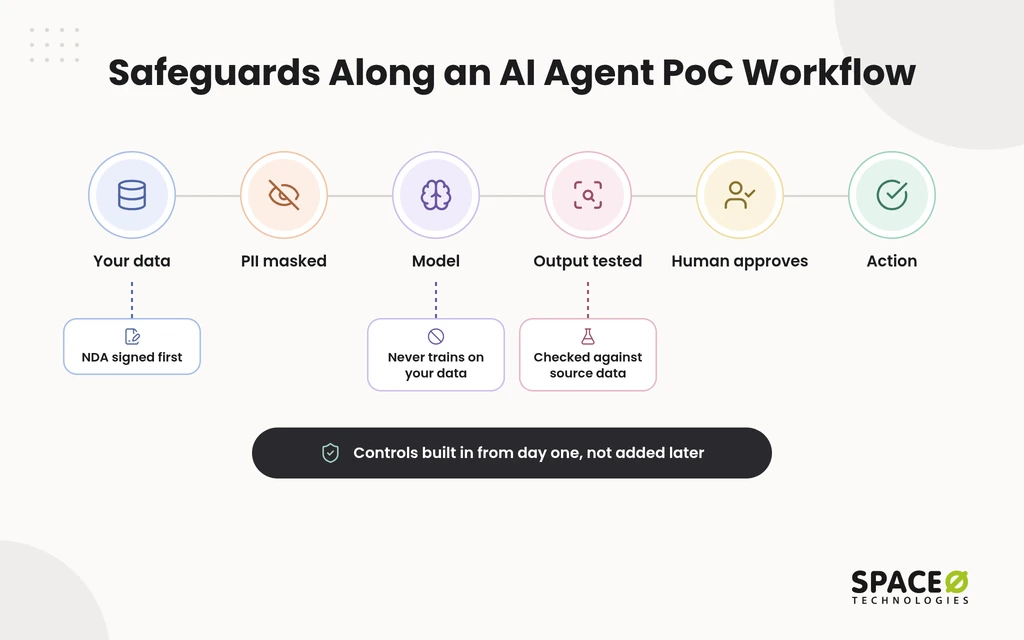
We build every PoC as if it will reach production, with human review and data protection from day one.
Regulated teams in healthcare, lending, and insurance face a specific risk. A PoC built without controls proves the agent works, but not that it works safely. Rebuilding for compliance later wastes the PoC.
- Human review checkpoints by default: People approve consequential decisions, and the agent drafts and retrieves evidence.
- No training on client data: Your data stays yours and never trains a shared model.
- PII masking: We mask personally identifiable information (PII) before it reaches the model.
- Hallucination and bias testing: We test outputs against source data before any result counts as validated.
- HIPAA-compliant builds: Healthcare workflows follow Health Insurance Portability and Accountability Act (HIPAA) requirements.
- NDA before every project: We sign a non-disclosure agreement (NDA) before any work starts.
How Does an AI Agent PoC Become a Production System?
A PoC that passes evaluation moves into an MVP build, reusing the prototype, integrations, and controls already in place.
The common failure is a PoC built on throwaway code. The team proves the idea, then starts again from zero. We avoid that by building in your environment with production-grade integrations.
- Scale to MVP: Your validated agent grows into a scoped product through our MVP development services.
- Refactor: We rework the weak part, such as retrieval or a single integration, and re-test it.
- Expand capability: We extend the agent across more workflows once the first one proves out.
Plan for ongoing costs after launch. Maintenance alone usually adds 15% to 25% of the original build cost every year, as our AI development cost guide explains.
Which Engagement Models Fit an AI Agent PoC?
Four engagement models fit an AI agent PoC: Dedicated Team, Time & Material, Fixed Cost, and Staff Augmentation.
Buyers worry about two things with a new vendor: losing control of scope and losing ownership of the work. Our terms address both.
- Fixed Cost: Suits a PoC with one workflow and clear success criteria.
- Time & Material: Suits a PoC where the data or integrations are still uncertain.
- Dedicated Team: Suits a PoC that should flow directly into a longer build.
- Staff Augmentation: Adds AI agent developers to your in-house team.
At completion, all source code, data, and intellectual property (IP) transfer to you. Payments follow milestones tied to deliverables. A team from our 140+ in-house developers builds the PoC, backed by 1,200+ clients served since 2010.
Where the AWS Marketplace Fits
AWS lists an “Agentic AI Proof-of-Concept” offering on AWS Marketplace, which buyers on AWS may see.
Buying through a marketplace listing ties the engagement to that platform’s procurement process and scope. A custom AI development engagement starts from your workflow and data instead. Both routes should still deliver a prototype, integrations, controls, and a decision package.
Before You Start: Two Questions to Answer
Every agent PoC starts with two answers: which workflow you want to automate, and where its data lives.
- Which workflow? Name one multi-step process with a clear bottleneck, not “general chat”.
- Where does the data live? List the systems involved, such as a CRM, ERP, SharePoint, or internal APIs.
Bring those two answers to a scoping call, and the PoC plan takes shape quickly.
Frequently Asked Questions
What exactly is an AI agent?
An AI agent is an autonomous software system that completes multi-step business workflows rather than only answering questions. It connects to tools such as a CRM or SharePoint, so it can act on real tasks. In higher-risk workflows, human-in-the-loop controls route consequential decisions to a person before anything executes.
How do you measure the success of an AI PoC?
Agree on success criteria before the build. Then measure task completion and accuracy against source data on a fixed test set. For agents, also track the human-escalation rate, the share of tasks routed to a person. Add the cost per task compared with the current process.
How long does an AI agent PoC take?
Agentic multi-step PoCs typically take 8-14 weeks, depending on integrations and data complexity. A basic retrieval-augmented generation (RAG) demo takes about 3-4 weeks.
How much does an AI agent PoC cost?
Agentic PoCs often cost $10,000-$25,000+ as a market range. Your scope sets your number, and a free, expert-reviewed estimate gives you a scoped figure.
What is the difference between a PoC and an MVP?
A PoC tests whether an agent can handle your workflow. An MVP is the scoped product you build once the PoC passes evaluation.
What happens after an AI agent PoC?
You choose to scale, refactor, or stop. Scaling moves into an MVP build that reuses the prototype, integrations, and controls.
Who owns the code and data from a PoC?
You do. All source code, data, and intellectual property transfer to you at completion.
Which engagement model suits an AI agent PoC?
Fixed Cost suits one workflow with clear success criteria. Time & Material suits uncertain data or integrations. Dedicated Team suits a PoC that flows into a longer build.



 All our projects are secured by NDA




 4.8


