
 By
Contents
- Move the agent off the canvas when duplicate runs, lost context, or retry storms appear.
- Small per-step errors compound, so a five-step chain finishes correctly far less often than any single step.
- Patch one failing step, but rebuild when failures come from the architecture.
- Budget for ongoing maintenance beyond the initial rebuild, and roll out in stages.
Key Takeaways
Rebuild a no-code AI agent as a production system with code-first orchestration. The large language model (LLM) reasons while deterministic code controls state, tools, and execution. Zapier and n8n both hit reliability limits at scale, but they fail differently.
Your canvas got the workflow live quickly. Customers and budgets now depend on steps your team cannot test or trace. Our guide to how AI agent development works covers the basics.
Our AI agent development services give founders and CTOs a production path for that agent. This page covers failure modes, target architecture, rebuild steps, and budget.
No-Code Agents Break in Production Because State, Governance, and Debugging Stay on the Canvas
A no-code agent struggles in production because state, governance, error handling, and debugging stay inside a visual builder. That builder works well for proving an idea. Once customers depend on every run, a no-code AI app cannot scale on that builder alone.
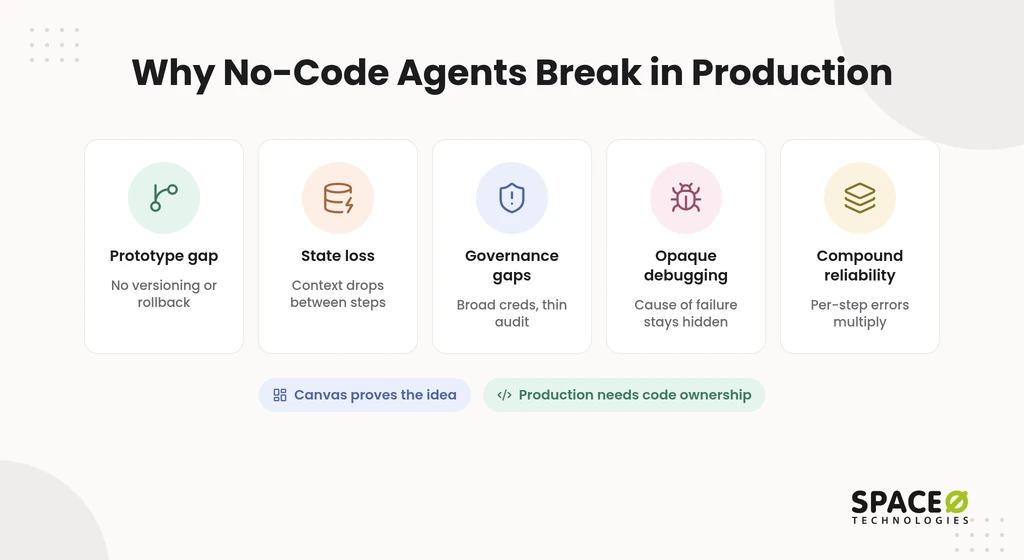
- Prototype-to-production gap: A canvas proves the idea quickly, but production needs versioning, automated tests, rollback, and clear owners.
- State loss: Context disappears between steps or workflows, so the agent repeats work or acts on stale data.
- Governance gaps: Broad credentials and missing audit logs become business risks as soon as an agent touches live data.
- Opaque debugging: A failed run rarely shows which prompt, tool call, or token spike caused the problem.
- Compound reliability: Per-step accuracy multiplies across a chain, so a five-step chain succeeds far less often than any single step.
Zapier workflows break at scale in four ways
Zapier workflows usually break through linear design, scattered state, task-based cost, and hard processing limits. Each failure has a different symptom and a different fix.
- Linear design: Zapier’s AI steps mostly sit inside linear, single-step flows without true agentic loops. An agent that must check its work and retry needs awkward workarounds. Results then drift as edge cases pile up. Moving planning and retries into code makes branching and exit conditions explicit.
- State loss across Zaps: Many disconnected Zaps share no managed state. When two act on the same record, race conditions overwrite data or trigger duplicate actions. Teams often find the damage later. Checkpointed state in PostgreSQL or Redis, plus idempotent writes, gives each change one clear owner.
- Task-cost escalation: Task-based pricing charges for activity rather than completed outcomes. An AI chain firing thousands of times a day multiplies billable tasks, so cost can outpace useful work. Code-first orchestration lets you meter each run, cache repeated work, and route simple steps to smaller models.
- Loop and array limits: Zapier sets hard limits on loops, circular references, and array processing. Large batches then need split Zaps or manual workarounds. Failures appear as missing records instead of clear errors. Code replaces those workarounds with bounded loops, queues, and explicit batch handling.
n8n agent workflows break at scale in three ways
n8n agent workflows usually break through runaway loops, self-hosting burden, and error cascades. n8n gives you more control than a linear flow, but your team must also operate more of the system.
- Runaway loops: Autonomous agent loops can keep calling the model when retry logic and token caps are missing. At volume, that burns tokens and hits rate limits, which slows other workflows. Step limits, token budgets, and backoff in code stop the run when its budget is spent.
- Self-hosting burden: Scaling self-hosted n8n means running queue mode with workers, Redis, and PostgreSQL. Your team then owns uptime, upgrades, and capacity alongside the agent. Backlogs grow when that work slips. A durable workflow engine such as Temporal or Apache Conductor builds retries and recovery into execution.
- Error cascades: One failed sub-node or unhandled tool-call exception can stall a branch or flood the logs. At low volume, someone notices and reruns it. At high volume, the failure hides among thousands of entries. Typed errors, circuit breakers, and fallbacks contain the damage at the failing step.
These limits explain why teams move to orchestration that handles state, retries, and handoffs natively. The next section shows what that system looks like.
We Rebuild Your Agent as Versioned, Tested, Observable Code
Space-O Technologies keeps what your agent does and replaces the fragile layer underneath it. You stop debugging a canvas and start running software your engineers can review. Each capability below addresses a failure mode your team may already see.
A six-layer architecture replaces the canvas
Six named layers give every production concern a clear home and a clear owner. No single framework fits every workflow. We choose after reviewing your AI agent framework options against the agent’s needs.
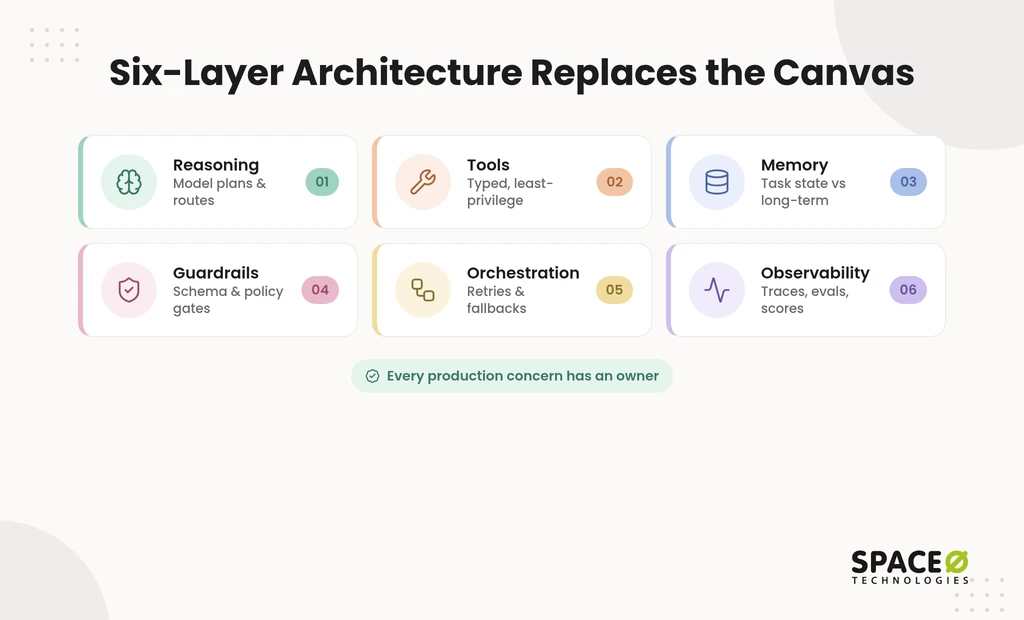
| Layer | What it owns | Typical tools |
|---|---|---|
| Reasoning (model) | Planning, decisions, and model routing by task | Your selected LLMs |
| Tools (MCP) | Single-purpose, typed, least-privilege actions | Model Context Protocol (MCP), FastAPI |
| Memory (state) | Task state, kept separate from long-term memory | PostgreSQL, Redis, Chroma or pgvector |
| Guardrails (critical) | Schema validation, policy enforcement, and confidence thresholds | Pydantic, JSON Schema |
| Orchestration (failure handling) | Control flow, retries, fallbacks, and circuit breakers | LangGraph and LangChain, CrewAI, LlamaIndex Workflows, Temporal, Apache Conductor |
| Observability (evals) | Traces, regression tests, and quality scores | Langfuse, LangSmith, Arize Phoenix, Braintrust |
Schema-validated outputs and state control keep execution deterministic
Model output must pass a strict schema before any action runs. We validate each response with JSON Schema or Pydantic, then reject or repair anything that fails. This is the “Brains vs. Hands” split: the LLM proposes the next move, and a deterministic harness carries it out.
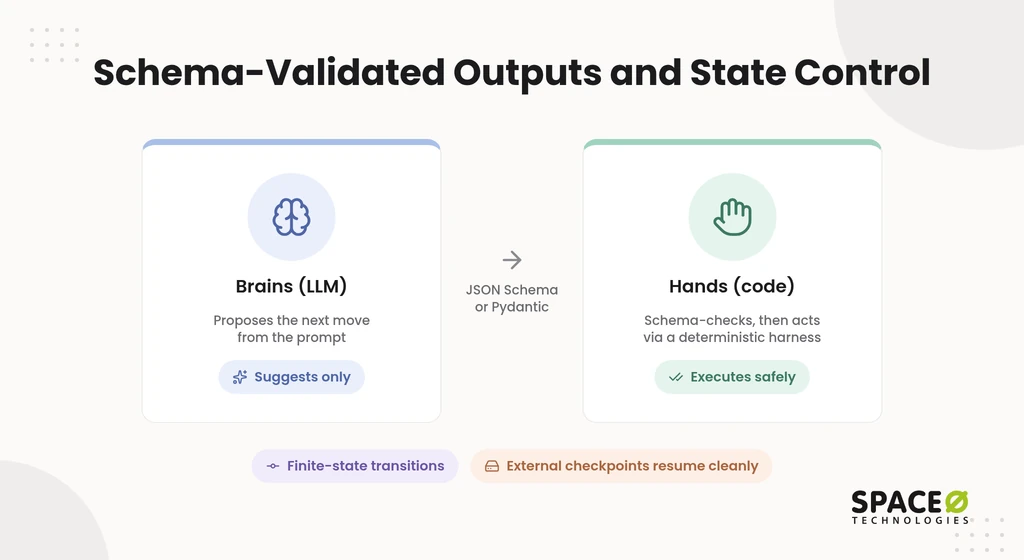
We model the workflow as a finite-state machine, so code governs each transition. Checkpoints in an external store let a failed run resume without repeating its side effects.
Trace-level observability and regression evals make failures reproducible
Every run should show its prompts, tokens, latency, and tool calls. We instrument those signals with OpenTelemetry conventions for generative AI, so your team can replay a failure instead of guessing.
Regression evals then run in continuous integration (CI), with a separate evaluator checking the generator’s work. Every model we ship sits in an evaluation suite covering accuracy, hallucination, bias, latency, and cost, with continuous monitoring.
Human-in-the-loop approvals and guardrails protect high-risk actions
People approve irreversible or high-risk actions before they run. Human-in-the-loop (HITL) gates pause the agent at those points, while confidence thresholds send uncertain cases to a reviewer. Role-based access control (RBAC) and least-privilege credentials limit what each tool can touch.
Isolation needs the same precision, and our AI agent security practices cover it further. Docker containers share the host kernel, so untrusted agent-generated code needs microVM-class isolation. A misconfigured agent also takes active actions, unlike a SaaS tool that passively leaks data.
No-code platforms and production builds differ on ownership and control
A no-code platform keeps you within its limits. A production build puts those controls in your own codebase. The table compares what each path requires.
| Area | No-code platform | Production build with Space-O Technologies |
|---|---|---|
| Code and intellectual property (IP) | Logic stays in the vendor’s canvas format. | Transfers to you at completion. |
| Engagement | Your team administers plans, limits, and add-ons. | You choose from four engagement models. |
| Human-review checkpoints | Your team configures them per workflow. | Enabled by default for high-stakes decisions. |
| Confidentiality | Platform terms apply. | Non-disclosure agreement (NDA) before every project. |
| Versioned and tested code | Versioning, testing, and rollback are often thin. | Versioned code with regression evals in CI. |
Move from Zapier or n8n when these symptoms appear
Recurring symptoms in live runs are the clearest signal that a workflow has outgrown its canvas. Use this checklist to match what you see to the engineering fix.
| Symptom | Likely cause | Fix |
|---|---|---|
| Duplicate runs | Race conditions and non-idempotent writes | Durable state and idempotent actions |
| Lost context between steps | No shared, persisted task state | Checkpoints in an external store |
| Retry storms | Unbounded retries against failing tools | Bounded retries, backoff, and circuit breakers |
| Rising per-run cost | Unmetered loops and one model for every step | Token budgets and model routing |
Not every workflow needs a rebuild. Zapier or n8n can still fit low-volume, simple flows and fast prototypes. A rebuild earns its cost when failures start reaching customers, records, or budgets.
A Six-Step Rebuild Takes Your Agent from Sandbox to Monitored Scale
A staged rebuild protects live operations while the new system proves itself. Replacing everything at once would swap one risk for another. Our broader AI agent development process shapes these six steps for a no-code starting point.
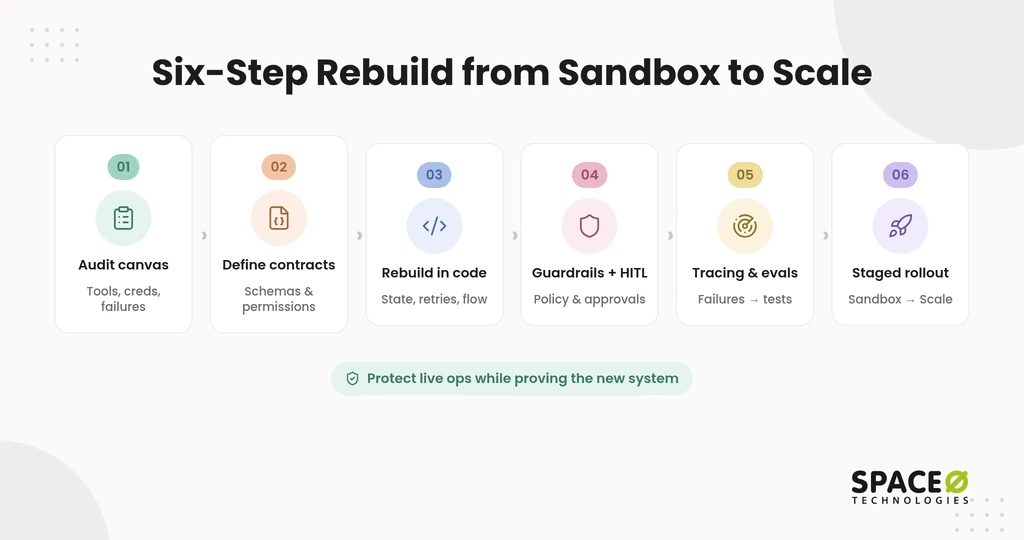
- Audit the canvas: Export the workflows, then document tools, credentials, failure points, and undocumented logic.
- Define schemas and contracts: Specify inputs, outputs, tool permissions, and success criteria for every step.
- Rebuild orchestration in code: Move control flow, state, and retries into the selected framework or workflow engine.
- Add guardrails and human review: Enforce policies, then place approval gates in front of high-risk actions.
- Add tracing and evals: Instrument each run, then turn real failures into regression tests.
- Roll out in stages: Move through Proof of Concept (Sandbox), Controlled Pilot, Governed Rollout, and Monitored Scale.
A rebuild-or-patch decision list sets the right scope
Patch a contained failure, and rebuild when the failures come from the architecture. A smaller fix is the better call when it solves the actual problem.
Patch the agent when:
- One step causes most of the failures.
- Volume stays low and predictable.
- A person reviews each consequential output.
Rebuild the agent when:
- Several checklist symptoms keep recurring.
- The agent takes actions that are hard to reverse.
- Your team cannot trace why a run failed.
- Auditors or customers need proof of what the agent did.
The cost envelope covers MVP-scope builds, not a quote
Use MVP-scope figures as a planning range, then confirm your price after scoping. A basic MVP starts from $15,000. Feature-rich MVPs run up to $50,000 or more, with milestone-based payments tied to deliverables. These figures are not a fixed rebuild price. Infrastructure, application programming interface (API) usage, and maintenance add to the total.
Annual maintenance for an AI build typically costs 15% to 25% of the original development cost every year. On a $50,000 build, that works out to $7,500-$12,500 a year. Custom models, deep integrations, and compliance controls raise the budget. Our AI agent development cost guide breaks down those drivers.
See Which Failures Justify a Full Rebuild
Share your platform, connected tools, and current failure mode. Our AI agent developers will tell you what to patch, what to rebuild, and what to leave alone. Review My Agent

With scope and budget framed, the next question is whether the team has delivered at scale.
Space-O Technologies’ Track Record Behind Your Agent Rebuild
Moving a live agent to a new partner is a trust decision. Space-O Technologies reports these figures for its work since 2010. Use them when you evaluate AI development companies.
- Clients served: 1,200+ clients worldwide.
- Solutions delivered: 300+ software solutions.
- Engineering team: 140+ in-house developers.
- Client retention: 97% client retention.
Glovo, the on-demand delivery app we built, secured $1.2 billion in funding and passed 30 million downloads. It is a consumer product rather than an agent, so treat it as evidence of building for scale. Your rebuild scope should still rest on the audit of your own workflow.
You Own the Code, the Data, and the IP, Under NDA from Day One
Leaving a platform should not mean trading one dependency for another. Space-O Technologies structures each engagement so that control stays with your business. Weigh that against your build vs. buy AI agent options before you commit.
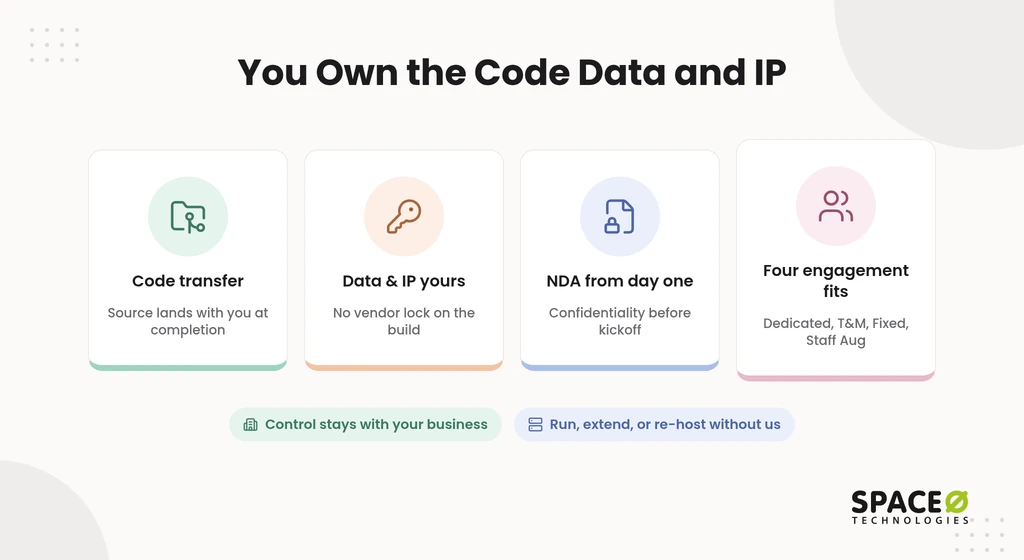
Code, data, and IP transfer to you at completion
All source code, data, and IP built during the project transfer to you at completion. We also sign an NDA before starting. Your team can then run, extend, or re-host the system without us.
Four engagement models fit your team
You can match the engagement to your scope and in-house capacity. Each model suits a different situation.
- Dedicated Team: Suits a long-term agent program with an evolving roadmap.
- Time & Material: Suits a rebuild whose scope may change after the audit.
- Fixed Cost: Suits a clearly defined scope and budget.
- Staff Augmentation: Suits an in-house team that needs added AI engineering capacity.
Regulated workflows keep human review checkpoints
Healthcare, lending, and insurance agents need stricter accuracy testing and review. Automation handles the volume, but a qualified human approves before any output influences a final decision. Our compliance posture covers ISO 27001 alignment and HIPAA-ready frameworks for healthcare AI engagements.
Ownership, flexibility, and review should be settled before the first line of code is written.
Get Your No-Code Agent Production-Ready with a Space-O Technologies Team
A useful first conversation starts with your actual failure, not a sales deck. Tell us which platform the agent runs on, which tools it touches, and where it breaks. You will get a clear view of what to fix and what it may cost. The same audit applies when you rebuild a no-code app with AI developers.
Get a free, expert-reviewed estimate for your rebuild.
Frequently Asked Questions
Is n8n considered AI automation or an AI agent framework?
n8n is a visual workflow automation platform that can run AI agent workflows, so it counts as AI automation. It is not a code-first agent framework like LangGraph, CrewAI, or LlamaIndex Workflows. In those, control lives in your own codebase. Autonomous agent loops in n8n still need explicit step limits, token caps, and backoff to stay safe at volume. Keep n8n only if your team can own its loop controls and hosting.
Is it possible to build AI agents without coding?
Yes. Visual builders such as Zapier, Make, n8n, and Flowise let you assemble a working agent without writing code, and they are well suited to proving an idea. A practical path is to build the no-code version first, then move to code when failures point to a rebuild. Failures that reach customers, records, or budgets are the clearest signal to make that move.
Can I build my own AI agent?
Yes, a founder or technical team can build an agent, either on a no-code canvas or in code. A canvas is faster to start. A code build puts the output, state, and review controls described above in a codebase your engineers can review. A code build also adds schema-validated outputs, checkpointed state, human approval gates, and regression evals. If you lack in-house AI engineering capacity, staff augmentation or a dedicated team can fill the gap.
What are the building blocks and key components of a production AI agent?
A production agent has six parts: reasoning, tools, memory, guardrails, orchestration, and observability. Tools should be typed and least-privilege, often exposed through Model Context Protocol. Memory keeps task state separate from long-term memory. Guardrails include schema validation and confidence thresholds. Orchestration handles retries and fallbacks, and observability adds traces and evals. To check a design, ask whether each production concern has a named owner in one of those layers. Then confirm that deterministic code, not the LLM, carries out each step.
How much does it cost to rebuild a no-code AI agent as a production system?
A basic MVP-scope build starts from $15,000, and a feature-rich one can reach $50,000 or more. Treat these as a planning range, not a quote. Infrastructure, API usage, and maintenance add to the total. Annual maintenance for an AI build typically costs 15% to 25% of the original development cost every year.
When should I rebuild a no-code agent instead of patching it?
Rebuild when failures come from the architecture, not from one step. Duplicate runs, lost context, and retry storms all point to a rebuild. So do actions that are hard to reverse and failed runs you cannot trace. Rebuild also fits when one failure can repeat across many runs before anyone notices. Patch when one step causes most failures and volume stays low.
Why is an n8n or Zapier AI agent workflow not reliable at scale?
Zapier and n8n both hit reliability limits at scale, but they fail differently. Zapier struggles with linear flows and hard loop limits, while n8n struggles with runaway loops and self-hosting burden. Both keep state, governance, and debugging on the canvas, so failures get harder to trace as volume grows.
Do I own the code after a no-code agent rebuild?
Yes. All source code, data, and IP built during the project transfer to you at completion. We also sign a non-disclosure agreement (NDA) before starting, so your team can run or re-host the system without us.



 All our projects are secured by NDA




 4.8


