
 By
By 
Contents
The recruitment industry is undergoing rapid digital transformation as organizations look for faster, more efficient ways to attract and hire talent. According to Grand View Research, the global recruitment software market was valued at USD 9.96 billion in 2023 and is expected to reach USD 22.67 billion by 2030. This growth highlights the increasing reliance on technology-driven hiring platforms.
This growth reflects a shift away from manual hiring processes toward centralized job portals that can manage large volumes of job listings, applications, and candidate data. A well-designed job portal helps employers streamline recruitment workflows, improves visibility for job seekers, and enables recruiters to manage the entire hiring lifecycle from a single platform.
In this job portal development guide, we cover everything you need to know to build a successful recruitment portal. With 15+ years of experience as a trusted web portal development partner, we have shared expert insights to help you understand the basics, key benefits, essential features, development process, cost considerations, and best practices for building job portal platforms. Let’s get started.
What is Job Portal Development?
Job portal development is the process of creating a digital platform that connects employers with job seekers. These platforms enable organizations to post vacancies, receive applications, and manage the entire recruitment workflow. Job seekers use these portals to search openings, submit resumes, and track application status.
Unlike generic job boards, custom job portals address industry-specific requirements. Healthcare recruitment platforms handle credential verification and compliance documentation. Technology job boards integrate coding assessments and skill testing. Staffing agencies need multi-client management with separate branding for each employer.
Modern job portals have evolved beyond simple listing websites. Today’s platforms incorporate artificial intelligence for resume parsing and candidate matching. Machine learning algorithms suggest relevant jobs to candidates and qualified applicants to recruiters. Cloud-based delivery enables access from anywhere while handling high traffic volumes during peak hiring seasons.
Now that you understand what it means to develop a web portal for recruitment, let us explore the benefits of building a custom recruitment platform.
Benefits of Job Portal Development for Recruitment Organizations
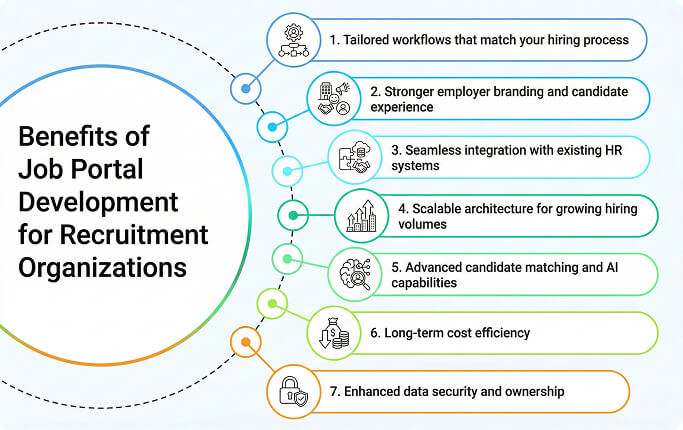
Building a custom job portal delivers advantages that off-the-shelf solutions cannot match. Organizations gain control over their recruitment technology while addressing specific operational challenges. Here are the key benefits of investing in job portal development.
1. Tailored workflows that match your hiring process
Every recruitment organization operates differently. A staffing agency has distinct processes compared to a corporate HR department. Custom job portal development creates workflows that mirror your actual recruitment practices. Your screening logic, approval chains, and communication protocols work exactly as needed.
Generic software forces workarounds and compromises. Custom solutions eliminate these inefficiencies completely. Staff productivity increases when technology supports natural work patterns. Recruiters spend less time navigating systems and more time connecting with candidates.
2. Stronger employer branding and candidate experience
Custom portals allow complete control over the user interface and brand presentation. Your job portal reflects your organization’s identity rather than a vendor’s template. Candidates associate positive experiences directly with your brand.
First impressions matter in competitive talent markets. A polished, intuitive portal signals professionalism and organizational competence. Candidates are more likely to complete applications on well-designed platforms. Poor user experience drives qualified applicants to competitor portals.
3. Seamless integration with existing HR systems
Most recruitment organizations operate multiple specialized tools. Applicant tracking systems, HR information systems, background check services, and payroll platforms all generate data. Custom job portal development connects these systems into unified workflows.
Integration eliminates manual data transfer between platforms. Recruiters enter information once and see it reflected everywhere across systems. Error rates drop significantly while overall productivity rises. Candidate information flows automatically from application to onboarding.
4. Scalable architecture for growing hiring volumes
Off-the-shelf software hits performance limits as job postings and applications increase. Custom development builds scalability into the architecture from day one. Your portal expands capacity without degradation as hiring needs grow. Learn more about how to scale a web application effectively.
Recruitment agencies serving multiple clients benefit especially from custom scalability. Centralized management with client-specific customization becomes possible without purchasing additional licenses. Seasonal hiring spikes no longer overwhelm system resources.
5. Advanced candidate matching and AI capabilities
Custom portals enable sophisticated matching algorithms tailored to your specific requirements. AI-powered resume parsing extracts relevant skills and experience automatically. Machine learning improves match quality over time based on hiring outcomes.
Generic platforms use one-size-fits-all matching logic. Custom systems understand industry-specific terminology and qualification requirements. Better matches mean faster placements and reduced time to hire.
6. Long-term cost efficiency
Initial development investment exceeds the subscription fees of commercial platforms. However, custom software eliminates ongoing per-user fees that compound annually. Organizations with high volumes often achieve break-even within two to three years.
No vendor lock-in means no price increases at renewal time. Your organization owns the software and controls its future completely. Licensing costs do not scale with team growth or transaction volumes.
7. Enhanced data security and ownership
Custom development implements security measures specific to your risk profile. You control where candidate data resides and how it is protected. Third-party vendor security decisions no longer affect your compliance.
Data ownership transfers completely to your organization. No vendor sunset decisions threaten operational continuity. Candidate privacy and GDPR compliance remain fully within your control.
Now, let us examine the core features that make a job portal effective.
Looking to Build a Smart Recruitment Platform?
Hire experienced developers from Space-O Technologies who understand recruitment workflows and candidate matching algorithms. Build software that fits your hiring process, not the other way around.

What Are the Core Features of Job Portal Software?
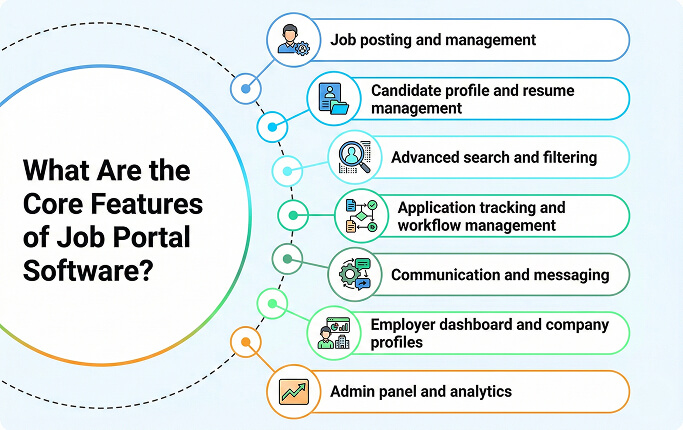
Successful job portal software combines foundational capabilities with specialized recruitment features. Understanding these components helps prioritize development investments.
1. Job posting and management
The job posting module allows employers to create, edit, and manage vacancy listings efficiently. This feature forms the foundation of any recruitment portal. Employers need intuitive tools to quickly publish opportunities.
- Rich text editor for formatting job descriptions with bullet points and headers.
- Template library for common position types to speed up posting creation.
- Scheduling options for future publication and automatic expiration dates.
- Category and location tagging for improved searchability across the portal.
- Duplicate detection to prevent accidental reposting of identical positions.
- Bulk posting tools for agencies managing multiple client vacancies.
Effective job posting features reduce the time employers spend on administrative tasks. Recruiters can focus on candidate engagement rather than data entry.
2. Candidate profile and resume management
Job seekers need comprehensive profile creation tools to showcase their qualifications. This module stores professional history, skills, education, and career preferences. A complete candidate database drives successful matching and placement.
- Multi-format resume upload supporting PDF, Word, and plain text files.
- Automatic resume parsing to extract work history and skills information.
- Profile completeness indicators encourage candidates to add more details.
- Portfolio and work sample attachments for creative and technical roles.
- Privacy controls allow candidates to hide profiles from specific employers.
- Job alert preferences based on role type, location, and salary expectations.
Comprehensive profiles improve match quality and reduce screening time. Recruiters access candidate information without requesting additional documentation.
3. Advanced search and filtering
Both employers and candidates need powerful search capabilities to find relevant matches. Search functionality directly impacts platform usability and user satisfaction. Poor search drives users to competitor platforms.
- Keyword search across job descriptions and candidate profiles.
- Multi-parameter filtering by location, experience level, and salary range.
- Boolean search operators for complex query construction.
- Saved search functionality with email notifications for new matches.
- Recent search history for quick access to frequent queries.
- Map-based location search for regional hiring initiatives.
Advanced search reduces the time users spend finding relevant opportunities or candidates. Higher engagement follows better search experiences.
4. Application tracking and workflow management
Tracking applications through the hiring pipeline requires structured workflow tools. This module manages candidate progress from initial application to final placement. Organized tracking prevents qualified candidates from falling through the cracks.
- Customizable pipeline stages reflecting your specific hiring process.
- Drag-and-drop interface for quickly moving candidates between stages.
- Automated status notifications keep candidates informed of progress.
- Interview scheduling integration with calendar applications.
- Collaborative notes and ratings from multiple interviewers.
- Bulk actions for processing multiple applications simultaneously.
Workflow management brings order to high-volume recruitment operations. Teams collaborate effectively without losing track of candidates.
5. Communication and messaging
Direct communication between employers, candidates, and recruiters happens within the platform. This module centralizes conversations and maintains a complete interaction history. Communication records support compliance and dispute resolution.
- In platform messaging between all user types with notification alerts.
- Email template library for common recruitment communications.
- Automated message sequences for application confirmations and rejections.
- Interview invitation tools with proposed time slots.
- Mass communication capabilities for job alerts and announcements.
- Message read receipts and response tracking for follow-up management.
Centralized communication prevents important messages from getting lost. Complete history supports better candidate relationship management.
6. Employer dashboard and company profiles
Employers need dedicated spaces to manage their recruitment presence. Company profiles showcase organizational culture and employment brand. Dashboards provide visibility into posting performance and application metrics.
- Company profile pages with logo, description, and culture information.
- Media galleries featuring workplace photos and employee testimonials.
- Active job listing management with performance statistics.
- Application analytics showing views, applications, and conversion rates.
- Team member access controls with role-based permissions.
- Billing and subscription management for paid posting packages.
Strong employer profiles attract more qualified applicants. Candidates research organizations before applying for open positions.
7. Admin panel and analytics
Platform administrators require comprehensive tools for portal management. The admin panel controls user accounts, content moderation, and system configuration. Analytics provide insights for continuous improvement.
- User management with verification and suspension capabilities.
- Content moderation tools for reviewing flagged postings and profiles.
- Revenue reporting for paid job posting and premium features.
- Traffic analytics showing user behavior and engagement patterns.
- System health monitoring with performance alerts.
- Configuration controls for customizing platform behavior.
Administrative tools maintain platform quality and operational efficiency. Data-driven insights guide product development decisions.
Not Sure Which Features Your Job Portal Needs?
Get expert guidance from Space-O Technologies to select features that match your hiring model, users, and growth plans.
Step-by-Step Job Portal Development Process
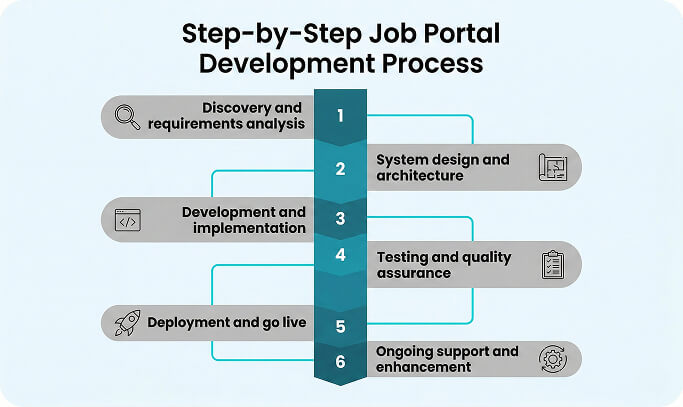
Building an effective job portal follows a structured process that balances thorough planning with iterative delivery. Understanding each phase helps set realistic expectations. Here is how custom job board software development typically progresses.
Phase 1: Discovery and requirements analysis
Timeline: 4 to 8 weeks
Discovery establishes the foundation for everything that follows. This phase documents current recruitment workflows and identifies pain points. Success criteria for the new portal will be defined during these initial weeks.
- Stakeholder interviews: Conversations with recruiters, hiring managers, and candidates reveal diverse perspectives on current challenges and future needs.
- Workflow documentation: Mapping existing recruitment processes exposes inefficiencies and integration requirements. Visual process flows clarify handoffs and decision points.
- Technical assessment: Evaluates current systems to identify integration requirements and data migration scope. Infrastructure capabilities determine deployment options.
- Competitor analysis: Reviews existing job portals to identify feature gaps and differentiation opportunities. Market research informs feature prioritization.
- Prioritization workshops: Stakeholders rank features by business value and implementation complexity. This prioritization drives development sequencing.
Discovery delivers comprehensive requirements documentation and a prioritized feature roadmap. Rushing this phase leads to costly rework later in the project.
Phase 2: System design and architecture
Timeline: 3 to 6 weeks
Design translates requirements into technical specifications. This phase defines database structure, user interfaces, and integration approaches. Architecture decisions made here impact long-term scalability.
- Architecture design: Technical architects define database structure, application layers, and infrastructure requirements. Scalability and security considerations shape foundational decisions.
- User interface design: UX designers create wireframes and prototypes that visualize system behavior. User testing validates designs before development begins.
- Integration planning: Detailed specifications define how the portal connects with ATS, HRIS, and other systems. API designs establish data exchange protocols.
- Security design: Authentication mechanisms, encryption standards, and access control models get explicitly defined. Compliance requirements drive security architecture.
Design deliverables include technical specifications, interface mockups, and integration documentation. Stakeholder approval prevents costly mid-development changes.
Phase 3: Development and implementation
Timeline: 12 to 40 weeks, depending on scope
Development transforms designs into working software. Agile methodologies deliver functionality incrementally. Early feedback enables course correction before significant investment accumulates.
- Sprint-based development: Two-week sprints deliver testable functionality at regular intervals. Product owners review progress and adjust priorities based on emerging needs.
- Continuous integration: Automated testing validates code quality with every change. Issues surface immediately rather than accumulating for later discovery.
- Environment management: Development, testing, and staging environments mirror production configuration. Environment parity prevents deployment surprises.
- Documentation creation: Technical documentation, user guides, and training materials are developed alongside the software. Documentation debt does not accumulate.
Development follows the prioritized roadmap from discovery while maintaining flexibility. Regular demonstrations keep stakeholders informed and engaged throughout the process. For detailed insights into each stage, read our comprehensive web development process guide.
Phase 4: Testing and quality assurance
Timeline: 4 to 8 weeks overlapping with development
Comprehensive testing ensures the portal meets requirements while maintaining performance standards. Quality assurance protects your investment and user experience.
- Functional testing: Test cases verify that every feature works as specified. Edge cases and error conditions receive explicit attention.
- Integration testing: End-to-end workflows validate system behavior across connected components. Data flows correctly between integrated systems.
- Performance testing: Load testing confirms system capacity under expected and peak usage. Performance bottlenecks receive attention before launch.
- Security testing: Penetration testing and vulnerability scanning identify weaknesses. Security audits verify data protection measures.
- User acceptance testing: Real users validate portal behavior in realistic scenarios. Feedback drives final refinements before launch.
Testing cannot be compressed to meet deadlines. Undiscovered defects create expensive post-launch remediation and user frustration.
Phase 5: Deployment and go live
Timeline: 2 to 4 weeks
Deployment transitions the portal from development to production use. Careful planning minimizes disruption while ensuring smooth adoption.
- Data migration: Transferring historical data from legacy systems to the new platform. Validation confirms the accuracy and completeness of migrated records.
- Training delivery: Role-based training prepares staff for new workflows. Hands-on practice builds confidence before going live.
- Cutover planning: Detailed runbooks define every step of production transition. Rollback procedures provide a safety net if issues arise.
- Go-live support: Dedicated teams provide intensive support during initial operation. Quick issue resolution maintains user confidence.
Phased rollouts reduce risk for large implementations. Starting with a single team validates processes before broader deployment.
Phase 6: Ongoing support and enhancement
Timeline: Continuous
Post-launch support ensures portal stability while enabling continuous improvement. Job portals require ongoing attention to maintain a competitive advantage.
- Bug fixes and patches: Issues discovered in production receive prompt resolution. Severity-based prioritization ensures critical problems get immediate attention.
- Performance monitoring: System health metrics identify capacity needs and degradation. Proactive intervention prevents user-facing issues.
- Enhancement development: New feature requests are added to the backlog for prioritization. The portal evolves as business needs change.
- Market updates: New recruitment trends and user expectations drive feature additions. The portal maintains relevance in a changing landscape.
Budget for ongoing support from project inception. Portals without maintenance degrade over time and eventually require replacement.
Let Our Experts Handle Your Job Portal Development
From planning to deployment, Space-O Technologies manages the entire job portal development process for you.
Technology Stack for Job Portal Development
Selecting the right technology stack impacts portal performance, scalability, and maintenance costs. Working with an experienced web development services provider ensures optimal technology selection. Here are the common technology choices for job portal development.
Frontend technologies
The frontend creates the user interface that job seekers and employers interact with daily. Modern frameworks deliver responsive, fast-loading experiences across all devices.
| Technology | Purpose | Best For |
|---|---|---|
| React.js | Component-based UI development | Complex, interactive interfaces |
| Angular | Enterprise frontend framework | Large-scale portals with many features |
| Vue.js | Progressive JavaScript framework | Rapid development with flexibility |
| Next.js | React framework with SSR | SEO focused job portals |
| Tailwind CSS | Utility first CSS framework | Consistent, maintainable styling |
Backend technologies
The backend handles business logic, data processing, and integrations. Technology selection affects development speed and long-term maintainability.
| Technology | Purpose | Best For |
|---|---|---|
| Node.js | JavaScript runtime for server | Real-time features and APIs |
| Python/Django | Full-stack web framework | Rapid development with AI integration |
| Ruby on Rails | Convention-based framework | Startups and MVPs |
| Java/Spring Boot | Enterprise application framework | High volume, mission-critical portals |
| PHP/Laravel | Web application framework | Cost-effective development |
Database technologies
Database selection impacts search performance and data management capabilities. Most job portals combine multiple database types for optimal results.
| Technology | Purpose | Best For |
|---|---|---|
| PostgreSQL | Relational database | Structured data and complex queries |
| MongoDB | Document database | Flexible schemas and rapid iteration |
| Elasticsearch | Search engine | Fast full-text search across listings |
| Redis | In-memory data store | Caching and session management |
| MySQL | Relational database | Traditional web applications |
Cloud and infrastructure
Cloud platforms provide the scalable infrastructure modern job portals require. Selection depends on budget, compliance needs, and team expertise.
| Technology | Purpose | Best For |
|---|---|---|
| AWS | Comprehensive cloud platform | Enterprise deployments with full control |
| Google Cloud | Cloud services with AI tools | ML powered matching features |
| Microsoft Azure | Enterprise cloud platform | Organizations using Microsoft stack |
| Docker | Container platform | Consistent deployment environments |
| Kubernetes | Container orchestration | High availability and auto scaling |
Now, let us examine the costs involved in building a job portal, including key factors such as platform complexity, feature requirements, integrations, scalability, and ongoing maintenance considerations.
How Much Does Custom Job Portal Development Cost?
Understanding cost components helps organizations budget accurately and make informed decisions. The cost of developing a job portal app varies based on complexity, features, and development approach. For a broader perspective on software investment, explore our detailed guide on web app development cost.
Cost by implementation scope
| Scope Level | Development Cost Range | Timeline | Features Included |
|---|---|---|---|
| Basic Job Portal | $40,000 to $80,000 | 3 to 5 months | Job posting, candidate profiles, basic search, application tracking |
| Standard Job Portal | $80,000 to $180,000 | 5 to 8 months | Basic features plus advanced search, messaging, employer dashboards, analytics |
| Advanced Job Portal | $180,000 to $350,000 | 8 to 14 months | Standard features plus AI matching, resume parsing, ATS integration, mobile apps |
| Enterprise Job Portal | $350,000 to $700,000+ | 12 to 18 months | Advanced features plus multi-tenant architecture, custom integrations, white-label capabilities |
Enterprise solutions often require B2B portal development services expertise for multi-tenant architecture and advanced integrations.
Cost breakdown by development phase
| Phase | Budget Allocation | Activities |
|---|---|---|
| Discovery and Requirements | 8% to 12% | Stakeholder interviews, workflow documentation, technical assessment |
| Design and Architecture | 10% to 15% | UI/UX design, technical architecture, integration planning |
| Development | 45% to 55% | Core feature development, integration implementation, testing |
| Quality Assurance | 15% to 20% | Functional testing, security testing, performance optimization |
| Deployment and Training | 8% to 12% | Data migration, user training, go live support |
| Project Management | 10% to 15% | Coordination, communication, risk management |
Factors that increase development costs
Several variables push costs toward higher ranges:
- Integration complexity: Each external system integration adds $10,000 to $40,000, depending on the availability of the API. Legacy systems without modern APIs require custom middleware.
- AI and machine learning: Resume parsing, candidate matching, and recommendation engines add $30,000-$80,000. Model training and optimization require specialized expertise.
- Mobile applications: Native iOS and Android apps double or triple the effort required for interface development. Cross-platform frameworks reduce but do not eliminate this cost.
- Multi-tenant architecture: White-label capabilities for agencies serving multiple clients add architectural complexity. Per tenant customization increases testing scope.
- Compliance requirements: GDPR compliance, accessibility standards, and industry regulations increase scope and testing requirements by 15% to 25%.
Ongoing cost considerations
Initial development represents only part of the total ownership cost. It is equally important to plan for ongoing expenses, including maintenance, updates, hosting, security, and feature enhancements.
- Annual maintenance: 15% to 20% of the initial development cost covers bug fixes, security patches, and minor enhancements.
- Infrastructure: Cloud hosting costs range from $300 to $3,000 per month, depending on user volume and data storage needs.
- Feature enhancements: Budget $40,000-$120,000 annually for new functionality to maintain competitive positioning.
- Support staff: Customer support and content moderation require ongoing investment as portal usage grows.
Get a Free Job Portal Development Cost Estimate
Share your requirements and receive a tailored cost estimate from Space-O Technologies. No obligation, NDA protection guaranteed.
Common Challenges in Job Portal Development and How to Overcome
Building a job portal involves more than creating job listings and application forms. Platforms must handle high traffic, complex user roles, sensitive data, and evolving recruitment workflows, which introduce several technical and operational challenges.
Challenge 1: Achieving a critical mass of users
Job portals face the classic marketplace challenge. Employers want platforms with many candidates. Job seekers want portals with many openings. Getting both sides simultaneously proves difficult.
How to overcome this challenge
- Focus on a specific niche or industry vertical before expanding broadly.
- Seed the platform with job listings from aggregation or partnerships initially.
- Offer free or discounted posting to attract early employer participation.
- Invest in content marketing to attract organic job seeker traffic.
- Build relationships with educational institutions for graduate job seekers.
Challenge 2: Resume parsing accuracy
Automated resume parsing often produces inconsistent results. Different document formats, creative layouts, and non-standard sections confuse extraction algorithms. Poor parsing creates frustration for both candidates and recruiters.
How to overcome this challenge
- Implement multiple parsing engines and select the best results for each resume.
- Allow candidates to easily review and correct parsed information.
- Build structured profile forms as an alternative to resume upload.
- Train custom parsing models on industry-specific resume formats.
- Maintain human review workflows for parsing exceptions and edge cases.
Challenge 3: Search relevance and candidate matching
Generic keyword matching produces poor results in recruitment contexts. Candidates and employers both become frustrated when the search returns irrelevant matches. Poor matching drives users to competitor platforms.
How to overcome this challenge
- Implement a semantic search that understands job and skill terminology.
- Build feedback loops that improve matching based on hiring outcomes.
- Allow users to provide explicit relevance feedback on search results.
- Consider skill taxonomy and synonyms in matching algorithms.
- Use machine learning to personalize results based on user behavior patterns.
Challenge 4: Spam and fake listings
Job portals attract fraudulent postings and fake employer accounts. Scam listings damage platform reputation and user trust. Candidates who encounter fraud are rarely tempted to return to the platform.
How to overcome this challenge
- Implement employer verification workflows before posting activation.
- Use automated detection for common scam patterns and keywords.
- Provide easy reporting mechanisms for suspicious content.
- Maintain moderation teams to review flagged content.
- Display prominently trust indicators indicating verified employer status.
Challenge 5: Integration with applicant tracking systems
Employers expect job postings and applications to sync with existing ATS platforms. Integration complexity varies widely across different systems. Failed integrations create manual work that frustrates users.
How to overcome this challenge
- Prioritize integrations with the most popular ATS platforms in your target market.
- Build robust error handling and retry mechanisms for failed syncs.
- Provide manual export options as a fallback for unsupported systems.
- Document integration setup clearly to reduce support burden.
- Proactively monitor integration health to catch issues before users report them.
Challenge 6: Mobile experience optimization
Job seekers increasingly search and apply via mobile devices. Complex application forms designed for desktops create high abandonment rates. Employers also expect mobile access for candidate review.
How to overcome this challenge
- Design mobile-first interfaces that work well on small screens.
- Simplify application flows by progressively disclosing fields.
- Enable one-click apply with stored profiles and resume.
- Optimize page load times for mobile network conditions.
- Test thoroughly across diverse device types and operating systems.
Best Practices for Successful Job Portal Development
Following proven practices dramatically increases project success rates. These guidelines represent accumulated wisdom from successful implementations. For comprehensive insights, explore our web portal development guide.
1. Clear market positioning
Start by defining a clear target audience before development begins. Niche job portals perform better than generic platforms by enabling tailored features, focused marketing, and stronger differentiation that aligns every product decision with a specific hiring problem.
2. Mobile-first experience
Mobile dominates job search behavior, making a mobile-first approach essential. Design within mobile constraints, test real-device flows early, reduce form friction, and consider PWAs to deliver fast, app-like experiences without requiring downloads.
3. Search engine visibility
Most job seekers discover opportunities through search engines, making SEO critical. Implement structured job data, create indexable job pages, optimize load speed, and avoid crawl-blocking rendering choices to ensure long-term organic traffic growth.
4. Intuitive application flows
Simple application flows significantly improve completion rates. Minimize required fields, support saved applications, enable one-click apply, optimize for mobile users, and use progress indicators to clearly communicate effort required, reducing abandonment during multi-step processes.
5. Robust analytics foundation
Implement analytics from launch to enable data-driven decisions. Track key actions across employer and candidate journeys, monitor funnel drop-offs, analyze search behavior, and support A/B testing to continuously optimize platform performance using real usage data.
6. Scalable content moderation
Job portals generate large volumes of user content that require moderation. Define policies early, combine automated screening with human review, establish escalation workflows, and build efficient moderation tools to maintain quality as the platform scales.
7. Trust and safety features
Trust is critical for job portals. Features like verified employers, fraud detection, reporting tools, and identity verification protect users, deter abuse, and strengthen platform credibility while also creating opportunities for premium verification-based monetization.
Building a successful job portal requires thoughtful planning, the right technology, and a user-first approach. With clear positioning and scalable architecture, you can create a platform that delivers long-term value.
Why Choose Space-O Technologies for End-to-End Job Portal Software Development?
A job portal is more than a listing platform. It is a complex digital ecosystem that connects employers, recruiters, and job seekers while handling sensitive data, high traffic, and continuous interactions. When built with scalability, usability, and security in mind, a job portal becomes a reliable foundation for long term recruitment success.
Space-O Technologies brings 15+ years of experience in custom software development, delivering scalable, secure job portal solutions tailored to unique hiring models. Our team understands recruitment workflows, platform scalability, and performance requirements essential for long-term success.
We follow an end-to-end development approach, covering strategy, UI/UX design, development, integrations, testing, and post-launch support. This ensures seamless functionality, optimized user experiences, and smooth platform evolution as business needs grow.
With a strong track record of 300+ successful software deliveries, Space-O Technologies focuses on building reliable, future-ready job portals. We emphasize clean architecture, security, and flexibility to support high traffic, feature expansion, and changing market demands.
Contact our consultants to discuss your job portal requirements. We provide detailed assessments, realistic cost estimates, and development roadmaps tailored to your specific situation.
FAQs on Job Portal Development
1. How much does it cost to develop a job portal?
Job portal development costs range from $40,000 for basic systems to $700,000+ for enterprise platforms. Basic portals with job posting and application tracking cost $40,000 to $80,000. Standard systems with advanced search and messaging cost $80,000 to $180,000. Advanced platforms with AI matching and mobile apps cost $180,000 to $350,000. Enterprise portals with white-label capabilities exceed $350,000 in development investment.
2. How long does it take to develop a job portal?
Development timelines range from 3 to 5 months for basic portals to 12 to 18 months for enterprise implementations. Basic job portals with core features typically take 3 to 5 months. Standard implementations requiring integrations take 5 to 8 months. Advanced projects with AI capabilities require 8 to 14 months. Enterprise deployments with multi-tenant architecture take 12 to 18 months, including phased rollouts.
3. What features are essential in a job portal?
Essential job portal features include job posting and management, candidate profile creation, advanced search and filtering, application tracking, user messaging, employer dashboards, and admin analytics. Additional valuable features include AI-powered resume parsing, candidate matching algorithms, ATS integration, mobile applications, and employer verification systems. The specific feature set depends on the target audience and competitive positioning.
4. Should I build a custom job portal or use an existing platform?
Custom development suits organizations with unique requirements that existing platforms cannot accommodate. Build custom when you need proprietary matching algorithms, deep integration with existing systems, specific branding requirements, or white-label capabilities for multiple clients. Use existing platforms for basic job board needs, limited budgets, or rapid deployment requirements. Consider long-term ownership costs when comparing options.
5. What technology stack is best for developing a job portal?
Technology stack selection depends on project requirements and team expertise. Common choices include React or Angular for frontend development with Node.js or Python for backend services. PostgreSQL handles structured data while Elasticsearch powers fast job search. AWS, Google Cloud, or Azure provide scalable infrastructure. The best stack balances development speed, long-term maintainability, and performance requirements.
6. How do you attract users to a new job portal?
User acquisition requires simultaneous employer and candidate strategies. For employers, offer free or discounted postings initially and build integrations with popular ATS platforms. For candidates, invest in SEO, content marketing, and partnerships with educational institutions. Focus on a specific niche before expanding broadly. Quality job listings attract candidates, and active candidates attract employer postings.
7. What ongoing maintenance does a job portal require?
Job portals require continuous maintenance, including bug fixes, security updates, performance monitoring, and feature enhancements. Budget 15% to 20% of initial development cost annually for maintenance. Additional ongoing costs include cloud hosting, customer support, content moderation, and marketing. Portals without adequate maintenance degrade over time and lose users to competitors who continue improving.



 All our projects are secured by NDA




 4.8
4.8