
 By
By 
Contents
AI chatbots are becoming a core part of how businesses handle customer support, sales, lead generation, and internal workflows. As conversational AI becomes more capable, businesses are looking for development partners that can build secure, scalable, and context-aware chatbot solutions.
The chatbot market is growing rapidly as businesses increase their investment in conversational AI. A Grand View Research report puts the global chatbot market at USD 11.8 billion in 2026, rising to USD 41.2 billion by 2033, at a 19.6% CAGR.
This growth has also increased demand for companies offering AI-powered chatbot development services that go beyond basic question-and-answer bots. The right development partner can help businesses integrate chatbots with knowledge bases, CRMs, APIs, business systems, and generative AI models.
In this guide, we have listed the top 10 AI chatbot development companies, evaluated based on their AI expertise, technical capabilities, industry experience, portfolio, and ability to develop AI chatbot solutions.
Quick Comparison of the Top AI Chatbot Development Companies
| Company | Clutch Rating | Hourly Rate | Min. Project | Founded Year | Location | Social Profile |
|---|---|---|---|---|---|---|
| Space-O Technologies | 4.8/5 (75 reviews) | $25–$49/hr | $25,000+ | 2010 | Mesa, AZ | |
| Itransition | 4.9/5 (42 reviews) | $25–$49/hr | $25,000+ | 1998 | Decatur, GA | |
| Scopic Software | 4.8/5 (69 reviews) | $50 – $99 / hr | $10,000+ | 2006 | Marlborough, MA | |
| EffectiveSoft | 4.9/5 (19 reviews) | $50 – $99 / hr | $25,000+ | 2003 | San Diego, CA | |
| Appinventiv | 4.6/5 (90 reviews) | $25–$49/hr | $50,000+ | 2014 | Manhattan, NY | |
| Innowise | 4.9/5 (73 reviews) | $50 – $99 / hr | $10,000+ | 2007 | Manhattan, NY | |
| Chetu | 4.3/5 (82 reviews) | Undisclosed | $10,000+ | 2000 | Clearwater, FL | |
| Master of Code Global | 4.7/5 (35 reviews) | $50 – $99 / hr | $25,000+ | 2004 | Redwood City, California | |
| Daffodil Software | 4.6/5 (88 reviews) | $25 – $49 / hr | $10,000+ | 1999 | Delaware, USA | |
| Jafton | 4.8/5 (126 reviews) | $50 – $99 / hr | $25,000+ | 2013 | Los Angeles, CA |
How We Built This List of AI Chatbot Development Companies
This list was built by verifying real chatbot development capabilities, not marketing claims. Every company listed here has shipped chatbots that businesses actually use today, not just a homepage that mentions AI. We cross-checked portfolios, client reviews on Clutch and GoodFirms, and named case studies before adding any company to this list, following the same listicle research methodology we apply across every ranked guide we publish.
- Live, working chatbots: The company has chatbots deployed and actively used by real customers, not just prototypes shown in a sales call.
- LLM and NLP expertise: Hands-on experience integrating large language models and natural language processing, not just basic keyword-matching bots.
- RAG and data grounding: Proven ability to connect a chatbot to a company’s real data through retrieval-augmented generation, so answers come from actual business information instead of generic AI responses.
- System integration: A track record of linking chatbots to CRMs, helpdesks, or databases, so the bot can complete tasks and not just answer questions.
- Conversation accuracy: Evidence that the chatbot handles multi-turn conversations, remembers context, and knows when to hand off to a human agent.
- Post-launch reliability: A process for monitoring, retraining, and fixing the chatbot after launch, since accuracy drops over time without upkeep.
In short, we prioritized companies that demonstrate real-world AI chatbot expertise over those making broad AI claims. The result is a practical, research-backed list designed to help you evaluate vendors based on proven technical capabilities, delivery experience, and long-term support. Now, let’s explore each AI chatbot development company in detail to understand its strengths, expertise, and ideal use cases.
Turn Customer Conversations Into Measurable Business Results
Get expert guidance on architecture, integrations, and timeline for your AI chatbot, whether you need a simple support bot or an enterprise-grade RAG system.

10 Best AI Chatbot Development Companies in 2026
Finding the right AI chatbot development company can be challenging with so many options available. Knowing which types of AI chatbot solution you need first makes these vendor comparisons far easier. To simplify your search, we’ve shortlisted the 10 best AI chatbot development companies in 2026 based on their expertise, proven projects, client reviews, and AI capabilities.
1. Space-O Technologies
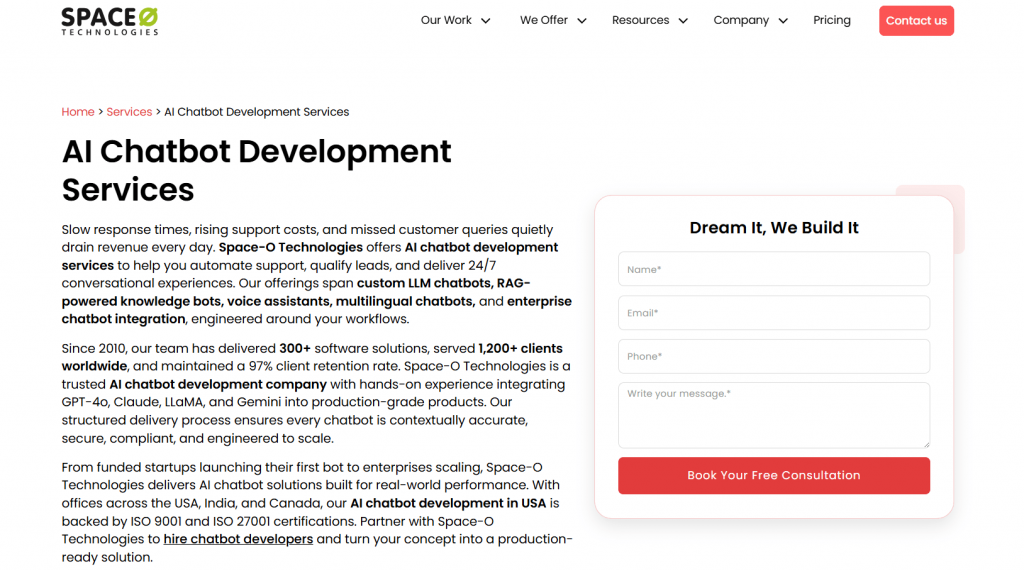
Space-O Technologies offers AI chatbot development services to build custom chatbots that connect to your CRM, ERP, and product catalog through retrieval-augmented generation (RAG). The company has delivered 300+ software solutions to 1,200+ clients worldwide, maintaining a 97% client retention rate across projects run from offices in the USA, India, and Canada.
As an AI chatbot development company, Space-O Technologies builds security and compliance into every project from day one, with GDPR, HIPAA, and SOC 2 requirements embedded into the architecture. If you’re planning to hire AI chatbot developers, the team can take your project from discovery to a working MVP in 6 to 12 weeks. Every engagement follows ISO 9001 and ISO 27001-certified development processes and includes real-time performance dashboards.
Services Offered:
- AI chatbot consulting to align every chatbot use case with clear business goals.
- Custom chatbot development covers GPT-4o, Claude, LLaMA, and Gemini integration for your business.
- RAG-powered knowledge chatbots pull answers from your live product catalogs and documentation.
- Voice bot development adds hands-free interaction through Whisper and ElevenLabs integration.
- Multilingual chatbots support 50+ languages with automatic detection and cultural localization.
- Chatbot integration connects your bot to CRMs, ERPs, and messaging platforms like WhatsApp.
- Enterprise chatbot solutions automate HR, IT helpdesk, and finance queries across departments.
Key Strengths / USP:
- Chatbots ground every response in live business data through RAG, rather than generic model output
- Hallucination control layers validate responses before they ever reach a customer
- Context memory holds conversation history and user preferences across multi-turn dialogue
- Sentiment detection adapts tone in real time and escalates frustrated users to a human agent
Industries Served: Healthcare, Retail and eCommerce, Banking and Finance, Insurance, Real Estate, Travel and Hospitality, Education, Logistics and Supply Chain, SaaS and Technology
Build an AI Chatbot Customers Actually Want to Use
Skip the trial and error. Our chatbot developers design conversation flows, select the right AI model, and integrate with your existing systems from day one.
2. Itransition
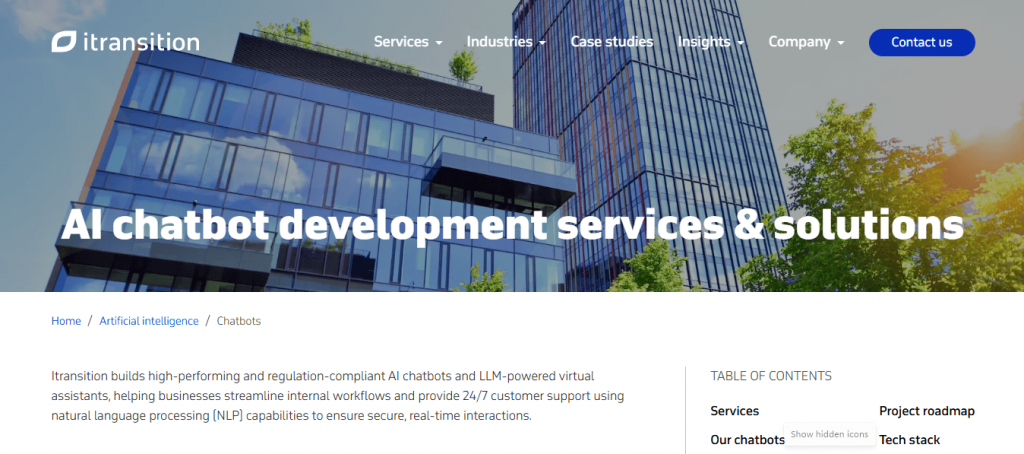
Itransition has provided IT services since 1998, running its own in-house AI/ML Center of Excellence alongside standing Microsoft and AWS partnerships. Its AI chatbots combine rule-based logic with large language models depending on the use case, rather than defaulting to one architecture regardless of what a business actually needs. As a chatbot development company, Itransition covers the full build cycle from architecture design through deployment, with ISO 9001 and ISO 27001 certification supporting work for clients ranging from startups to large enterprises.
The company’s AI chatbot development services span consulting, development, and ongoing support and maintenance. Consulting covers analysis of a client’s workflows, target audience, and current tech environment before any tooling decisions are made. Development includes chatbot architecture design, front-end and back-end build, cybersecurity feature implementation, and integration through both out-of-the-box and custom APIs.
Services Offered:
- AI chatbot architecture design lays the technical foundation before any code gets written.
- Front-end and back-end development builds the full chatbot experience from the ground up.
- Cybersecurity feature implementation protects every conversation and keeps user data secure.
- End-to-end QA and testing catch issues before your chatbot reaches real customers.
- Chatbot integration connects your bot through both custom and pre-built connectors.
- Deployment to production moves your finished chatbot live with minimal disruption.
- Ongoing support includes monitoring, feedback analysis, and regular software updates.
Industries Served: Healthcare, Retail and eCommerce, Manufacturing, Automotive, Finance, Insurance, Real Estate, Telecom, Software and Hi-Tech
3. Scopic Software
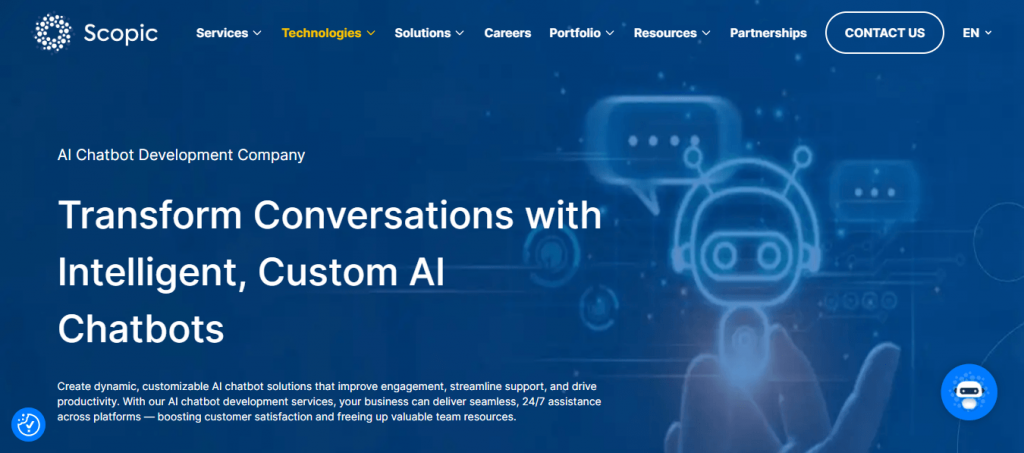
Scopic is counted among the established AI chatbot development companies backed by both AWS and Google Cloud partner status. The company builds custom AI chatbots through four core service lines: ChatGPT integration, custom AI chatbot design, AI feature enhancement, and AI strategy consulting. The chatbot types on offer range from GPT-powered conversational bots to voice assistants and custom CRM, ERP, and CMS-connected bots, built by a globally distributed team spanning the US, Europe, Latin America, and APAC.
The company frames its chatbot development service for websites around four specific outcomes: higher eCommerce engagement, reduced website support load, better cross-channel satisfaction scores, and analytics pulled directly from every conversation. Scopic’s published tech stack includes GPT-4, Claude, Gemini, LLaMA 2, LangChain, Pinecone, and FAISS.
Services Offered:
- ChatGPT integration creates more intelligent, responsive conversational experiences for your users.
- Custom AI chatbot design builds chatbots that integrate with your existing systems.
- AI feature enhancement adds capabilities like advanced analytics and multi-language support.
- AI strategy consulting identifies the highest-impact chatbot use cases for your business.
Industries Served: Customer Service, eCommerce, Healthcare & Life Science, Finance & Trading, Manufacturing & Industrial, E-Commerce & Retail
4. EffectiveSoft
EffectiveSoft’s AI chatbot development company work starts with consulting on technology selection and use case prioritization before any code gets written. The team designs conversational systems ranging from rule-based setups to advanced assistants with natural language understanding, and extends into voice-enabled options for hands-free, multimodal interaction. As one top AI chatbot development company option worth shortlisting, EffectiveSoft plans chatbot architecture for scalability and secure integration from the outset.
The company’s AI chatbot development services cover the identification of valuable chatbot use cases, recommendations on which AI technologies fit best, whether NLP pipelines, large language models, or knowledge-based architectures, and integration with CRMs, ERPs, and internal databases. Analytics and optimization use real interaction data to refine chatbot performance over time.
Services Offered:
- Consulting identifies which chatbot use cases are worth automating for your business.
- Custom conversational system design ranges from rule-based setups to advanced NLU assistants.
- Voice-enabled chatbot options extend capabilities for hands-free, multi-modal interactions.
- CRM, ERP, and database integration enable automation and real-time data access.
- Analytics and optimization use interaction data to continuously refine chatbot performance.
- Maintenance ensures your chatbot solution stays current as requirements evolve.
Industries Served: Fintech, Trading, Healthcare, Manufacturing, Retail and e-commerce, eLearning
5. Appinventiv
Appinventiv delivers enterprise-grade chatbots trained on domain-specific data, backed by 200+ dedicated data scientists and AI engineers, and 300+ AI-powered solutions delivered. Compliance is built into every chatbot from the foundation, covering GDPR, SOC 2, CCPA, HIPAA, the EU AI Act, and PCI-DSS rather than being retrofitted later. For businesses comparing a best chatbot development company shortlist, Appinventiv works with cloud-native, API-first architectures designed to handle high concurrency and multi-bot orchestration.
The company’s chatbot solution providers train NLP models directly on a client’s own data rather than generic datasets, then configure security layers and integrations to match how the business actually operates. With 1,700+ experts on staff, Appinventiv positions its chatbot practice around measurable business impact rather than feature lists alone.
Services Offered:
- Chatbot consulting uncovers the highest-impact use cases for support, sales, or operations.
- Chatbot conversation design maps intents, fallback logic, and escalation points for you.
- Chatbot architecture uses API-first frameworks built for speed, security, and scale.
- Custom chatbot development tunes NLP models on your data and configures integrations.
- Chatbot integration links your bot to CRMs, ERPs, and payment gateways securely.
- AI chatbot support includes continuous training and lifecycle maintenance after launch.
Industries Served: Banking, Healthcare, eCommerce, Travel and Hospitality, Education, Logistics and Supply Chain, Real Estate, Telecom and Media, Manufacturing, Government, Automotive, Energy and Utilities, Agriculture, Food and Beverage
6. Innowise
Innowise’s chatbot practice includes Claude Certified Architects with validated expertise in Anthropic’s ecosystem, working alongside its broader AI chatbot design, architecture, consulting, and engineering services. Among AI chatbot companies, that certification shapes how the team approaches conversation quality, fine-tuning prompts specifically for accuracy and consistency rather than treating every model the same way.
As an AI chatbot development company, Innowise builds on 16+ years of combined technical experience across its team. Global development centers running around the clock support faster iteration, and services extend beyond standard chatbots into social media-focused bots and custom AI voice assistants trained on both formal and spontaneous speech datasets.
Services Offered:
- AI chatbot design maps user journeys and wireframes conversational flows for clarity.
- AI chatbot architecture uses microservices and cloud technologies for fault tolerance.
- AI chatbot consulting recommends the best solution for your data and integration needs.
- AI chatbot engineering applies NLP algorithms, so bots adapt to diverse contexts.
- AI voice assistant customization trains assistants on diverse dialects and datasets.
- Social media-focused chatbot programming automates sales funnels and comment processing.
Industries Served: Fintech, Retail, Travel and Hospitality, Real Estate, Healthcare, Education, eCommerce
7. Chetu
Chetu is one of the AI chatbot development companies whose capabilities extend to intent recognition, speech recognition integration, conversation flow management, and multilingual support through neural machine translation. Its developers use AI tools to build custom chatbots that give businesses visibility into the customer journey through real-time data analysis, automating processes through integrations with Oracle, Amazon, Microsoft, ServiceNow, and SAP.
Chetu’s developers apply retrieval-augmented generation techniques to ground chatbot responses in a client’s own playbooks and systems, then confirm accuracy through structured testing. Among chatbot solution companies, Chetu also builds custom integrations across SMS, Facebook Messenger, WhatsApp, Slack, Amazon Echo, and major online marketplaces.
Services Offered:
- Multi-language development enables bots to engage customers across multiple languages naturally.
- Business process automation integrates with Oracle, Amazon, Microsoft, ServiceNow, and SAP systems.
- Natural language understanding chatbots interpret content using computational linguistics techniques.
- Voice bots answer questions through audio or video for a more human feel.
- Custom chatbot integrations connect your bot to SMS, Messenger, WhatsApp, and Slack.
- Chatbot maintenance and security updates keep your solution current without downtime.
Industries Served: Healthcare, Finance, Retail, Hospitality, Manufacturing, Automotive, Energy and Utilities, Agriculture, Food and Beverage
8. Master of Code Global
Master of Code Global is among the AI chatbot development companies whose process pairs conversation designers with chatbot developers who regularly fine-tune algorithms based on real user interactions and feedback. Core offerings include enterprise AI chatbot development, model fine-tuning and optimization, conversational solutions, and generative AI integration. Based in Redwood City, California, the company runs on a toolset that includes Rasa, OpenAI, Cohere, AWS Lex, Azure Cognitive Services, Vertex AI, and Dialogflow.
Chatbot integration extends across websites, mobile apps, social media channels, and internal systems like CRMs and knowledge bases. This chatbot development company in USA publishes a direct comparison between custom chatbot builds and off-the-shelf platforms so clients can weigh both paths clearly.
Services Offered:
- Enterprise chatbot development integrates AI-driven assistants into your existing systems.
- Model fine-tuning continuously improves algorithms based on real user interactions.
- Conversational solutions deliver personalized, context-aware interactions built around your brand voice.
- Generative AI integration automates content creation, engagement, and data analysis for you.
- Conversation design builds intuitive dialogue flows and bot personas that engage naturally.
- Chatbot integration fits your new chatbot into websites, apps, and internal systems.
Industries Served: Healthcare, Finance, Banking, Telecom, Insurance, Travel and Hospitality, Supply Chain and Manufacturing, eCommerce, Retail, Education, Airports and Airlines
9. Daffodil Software
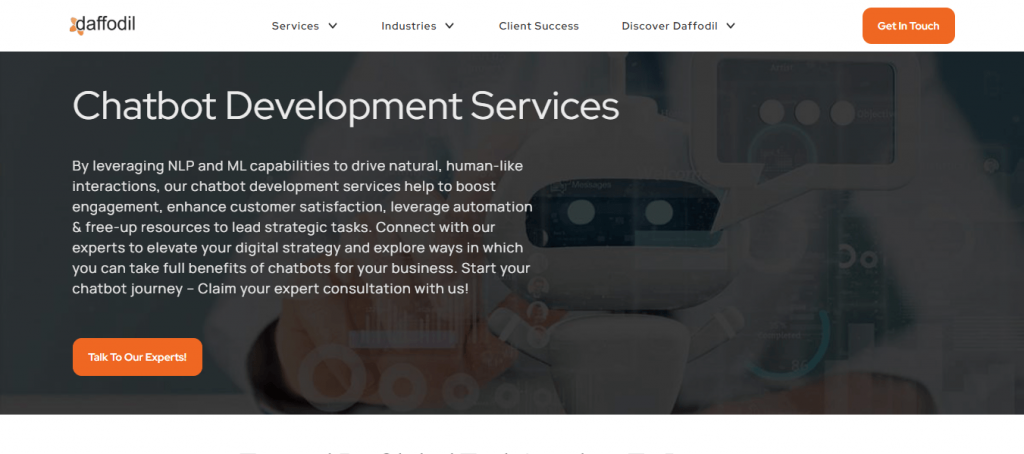
As one of the AI chatbot development companies with a global footprint, Daffodil builds across the full spectrum of chatbot types, including GPT-based, Gemini-powered, custom AI voice assistants, social media-focused, transactional, and retrieval-based bots. The company brings 25+ years of software engineering experience, running offices in Delaware, USA, London, Dubai, and Gurugram, India. Among chatbot development companies offering multilingual support, Daffodil’s bots adapt responses to local cultures and customs for more inclusive interactions.
Third-party integrations connect chatbots to CRM systems, payment gateways, and marketing automation tools, allowing for automated data flow without manual intervention, positioning Daffodil’s AI chatbot development in usa work alongside a genuinely global delivery footprint.
Services Offered:
- Custom chatbot development delivers retrieval-based or NLP-infused responses for your customers.
- Technology consulting guides you toward the right tools for seamless chatbot integration.
- AI and ML integrated chatbot development responds to complex queries in a human-like manner.
- NLP integration enables sentiment analysis, context understanding, and intent recognition for your bot.
- Third-party integrations connect your chatbot to CRMs, payment gateways, and marketing tools.
- Chatbot deployment and support ensure optimal performance through ongoing monitoring.
Industries Served: eCommerce and Retail, Healthcare, Travel, Banking, Manufacturing, Education
10. Jafton
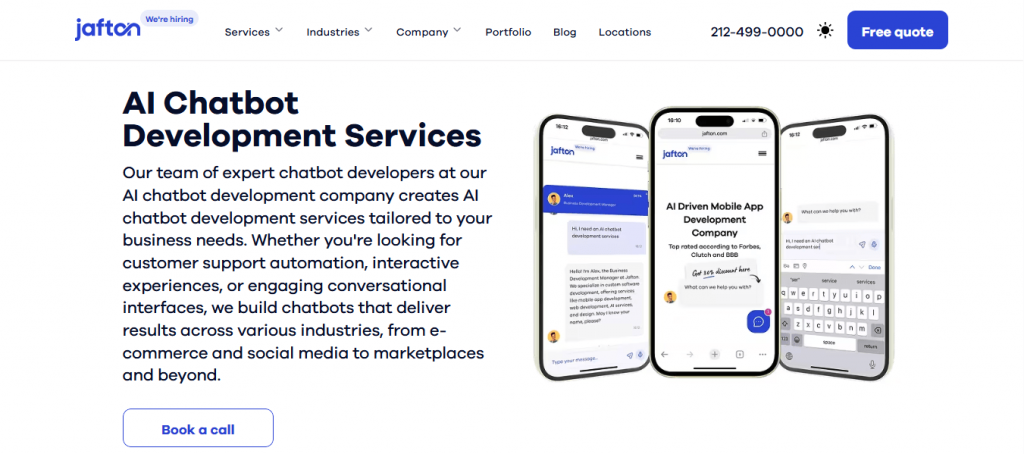
Jafton is one of the AI chatbot development companies that focuses on aligning chatbot solutions with business objectives. Before development begins, the team evaluates each client’s requirements to recommend the most suitable native or cross-platform approach. Its New York-based team of 120+ experts manages projects from discovery to long-term maintenance.
As a best AI chatbot development company candidate for businesses weighing performance against budget, Jafton’s pitch on architecture stays direct. Native development suits businesses prioritizing performance and long-term user experience, while cross-platform development suits those prioritizing budget control and faster deployment.
Services Offered:
- Planning and analysis define your chatbot’s goals, personality, and conversation flow.
- Native iOS and Android development builds a highly responsive, platform-specific chatbot.
- Hybrid development balances budget control with faster deployment and reusable code.
- Design work creates the first wireframe covering how your chatbot looks and functions.
- Development and coding build feature-rich chatbots using efficient, tested workflows.
- Testing and release ensure a bug-free chatbot backed by ongoing maintenance.
Industries Served: eCommerce, Social Media, Marketplaces, Supply Chain and Manufacturing, Retail, Education
Stop Losing Customers to Slow Response Times
Automate routine queries, qualify leads, and support customers around the clock with a chatbot built around your business data, not a generic template.
AI Chatbot Development Agency vs Conversational AI Platform
An AI chatbot development agency builds a custom virtual assistant for your business, while a conversational AI platform is a software tool you use to build and host the bot yourself. One route hands you a finished product, built by a dedicated development team. The other hands you a dashboard and expects your team to do the building.
Knowing which one you’re evaluating changes your entire budget, timeline, and staffing plan before you sign anything. The table below breaks down where the two actually differ.
| Factor | Agency | Platform |
|---|---|---|
| What you get | A custom-built chatbot, developed by a team | A software tool you configure yourself |
| Cost model | Project fee or retainer | Subscription or pay-per-message |
| Typical starting cost | $10,000 to $50,000+ | Free tier to several thousand a month |
| Technical staff needed | None, the agency handles engineering | An in-house developer or admin |
| Customization | Fully bespoke, built around your workflows | Bound by the platform’s existing architecture |
| Deployment speed | Slower, but tailored end-to-end | Faster, ready-made building blocks |
| Best fit | Complex, regulated, or highly custom builds | Standard support or lead-generation use cases |
Choose an agency if you need deep custom integrations, have no technical staff, or require strict regulatory compliance built in from scratch. Healthcare, finance, and other regulated industries usually fall here, since a generic platform rarely covers their compliance needs out of the box. Our guide to chatbot development for healthcare shows what those compliance requirements involve.
Choose a platform if you have internal staff who can manage software tools and need rapid deployment on a predictable monthly budget. Standard customer support and lead-generation use cases are typically the better fit.
AI Chatbot Development Cost in 2026
AI chatbot development costs range from $3,000 to $300,000 or more, depending on chatbot type, AI model, and integration depth. A basic rule-based bot with scripted flows sits at the low end. An enterprise-grade RAG or multimodal chatbot with deep system integration sits at the high end.
For a full breakdown by chatbot type, development phase, and industry, along with pricing models and cost-saving strategies, check out the detailed guide on AI chatbot development cost.
Get an AI Chatbot Roadmap Built Around Your Business
Share your use case, channels, and integration needs. Receive a clear architecture recommendation, cost estimate, and delivery timeline before committing to a full build.
How to Choose an AI Chatbot Development Company
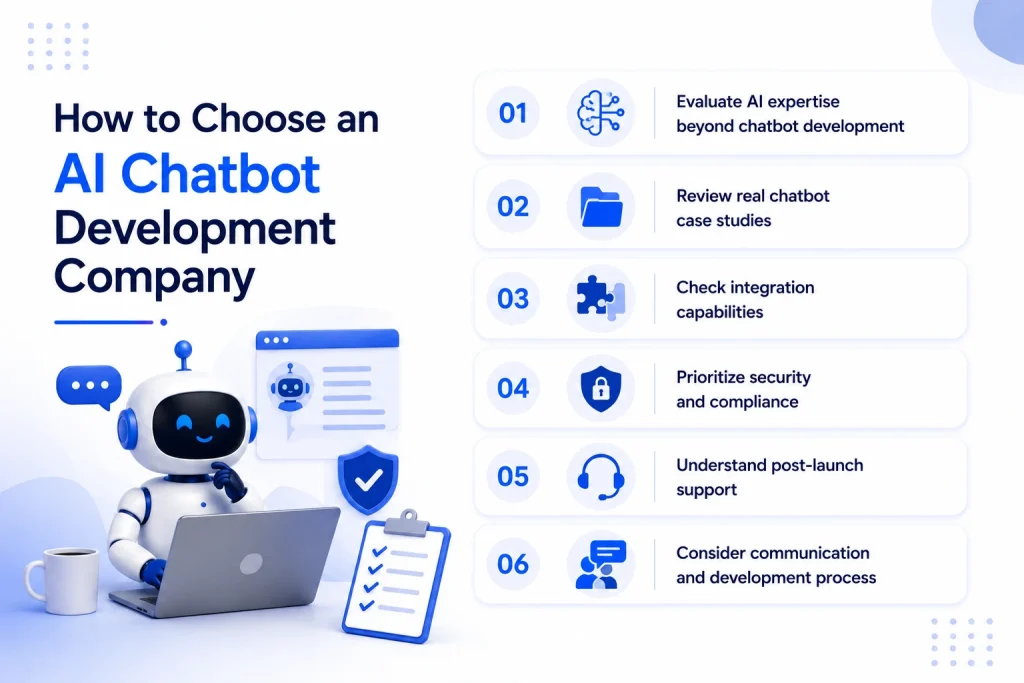
Choosing the right AI chatbot development company is about more than comparing hourly rates or portfolios. The right partner should understand your business goals, recommend the right AI approach, and build an AI chatbot that integrates with your existing systems while remaining secure, scalable, and easy to maintain. Here are the key factors to evaluate before making your decision.
1. Evaluate AI expertise beyond chatbot development
Look for a company with hands-on experience in large language models (LLMs), natural language processing (NLP), retrieval-augmented generation (RAG), and AI agent frameworks. Ask about the models they work with and how they improve chatbot accuracy over time. Some businesses engage an AI chatbot consulting company first to define requirements, then use that scope document to evaluate every vendor on equal terms.
2. Review real chatbot case studies
A strong portfolio should include chatbots that are live and solving real business problems. Review case studies, client testimonials, and measurable outcomes such as reduced support costs, higher customer satisfaction, or improved lead conversion.
3. Check integration capabilities
Your chatbot should connect seamlessly with your CRM, helpdesk, ERP, knowledge base, payment systems, or other business tools. Verify that the company has experience integrating with platforms similar to yours.
4. Prioritize security and compliance
If your chatbot handles customer or business data, security is essential. Choose a company that follows industry standards such as GDPR, HIPAA, SOC 2, or ISO 27001, depending on your compliance requirements. Vendors building AI chatbots in the banking industry face the strictest version of this review. PCI-DSS scope, core banking access, and audit logging all sit inside it.
5. Understand post-launch support
AI chatbots require continuous monitoring, prompt optimization, model updates, and performance improvements. Ensure the company offers ongoing maintenance and support after deployment instead of treating the launch as the end of the project.
6. Consider communication and development process
A transparent development process with regular updates, milestone reviews, and clear documentation reduces project risk. Ask about their delivery methodology, project management tools, and expected timelines.
By evaluating companies against these factors, you can choose an AI chatbot development partner that delivers long-term value instead of just building a chatbot that works on day one.
Questions to Ask an AI Chatbot Development Company Before Signing
Before signing a contract, ask questions that help you evaluate the company’s technical expertise, delivery process, and long-term support. The answers will reveal whether they can build a chatbot that meets your business goals rather than just delivering a basic conversational interface.
1. What AI models and technologies do you use?
Understand whether they work with leading LLMs, NLP frameworks, RAG, and AI agent technologies, and why they recommend a particular stack for your use case.
2. Can you share similar chatbot projects?
Request case studies or live examples relevant to your industry. Look for measurable outcomes such as improved customer support, higher lead conversion, or reduced operational costs.
Our guide to AI-powered ecommerce chatbots lists the retail-specific outcomes worth asking about.
3. How will the chatbot integrate with our existing systems?
Ask about experience integrating with CRMs, ERPs, helpdesks, payment gateways, and internal knowledge bases to ensure seamless workflows.
4. How do you handle security and compliance?
Verify how customer data is protected and whether the company follows standards such as GDPR, HIPAA, SOC 2, or ISO 27001, if applicable.
5. What is included after launch?
Clarify whether ongoing monitoring, prompt optimization, model updates, bug fixes, and performance improvements are part of the support plan.
6. What is the expected timeline and pricing model?
Ask how long the project will take, what factors influence the cost, and whether pricing is fixed, time and materials, or milestone-based.
7. How do you measure chatbot success?
A reliable development partner should define KPIs such as response accuracy, resolution rate, CSAT, user engagement, and escalation rate to evaluate performance after deployment.
Asking these questions before signing helps you compare vendors objectively and choose a development partner with the right technical expertise, transparent processes, and long-term commitment.
Why Businesses Choose Space-O Technologies for AI Chatbot Development
Businesses choose Space-O Technologies because it builds AI chatbots that solve real business problems, not just automate conversations. Every solution is tailored to your goals, whether you need to improve customer support, generate leads, automate workflows, or enhance employee productivity.
The team handles the complete chatbot development lifecycle, from strategy and AI model selection to development, system integration, deployment, and optimization. Chatbots are built using LLMs, NLP, and RAG, with secure development practices that support GDPR, HIPAA, and SOC 2 requirements, backed by ISO 9001 and ISO 27001-certified processes.
With experience delivering AI solutions across multiple industries, Space-O Technologies develops scalable, production-ready chatbots that continue to improve after launch. Ongoing monitoring, prompt optimization, and model updates help ensure long-term performance and business value.
Frequently Asked Questions
What is an AI chatbot?
An AI chatbot interprets what a user means and generates a response, unlike a rule-based bot that matches keywords to pre-written replies. That difference drives cost and vendor fit. AI chatbots need natural language processing, retrieval, and live data access, which takes deeper technical work. For types, architecture, and use cases, read our guide on what is an AI chatbot.
Are AI chatbots worth the investment for a small business?
Yes. For businesses handling repetitive, high-volume customer queries, AI chatbots often recover their investment within 3 to 6 months. A chatbot that resolves 40% to 60% of routine support requests can significantly reduce agent workload, improve response times, and lower operating costs, even for small support teams.
Can I build an AI chatbot without any technical staff?
Yes. An AI chatbot development company can manage the entire technical implementation, including architecture, integrations, NLP, and deployment. Your team only needs to provide business knowledge, review conversation flows, and approve chatbot responses while the development team handles the engineering.
What happens if my chatbot gives a wrong answer to a customer?
A well-designed AI chatbot includes confidence scoring, response validation, and human handoff mechanisms that reduce the risk of incorrect responses. Chatbots built with Retrieval-Augmented Generation (RAG) retrieve information from verified business documents, helping minimize hallucinations and improving answer accuracy.
Do I need a different chatbot for each messaging channel I use?
No. Modern AI chatbots can support multiple communication channels such as websites, WhatsApp, mobile apps, Slack, and Microsoft Teams from a single backend. They maintain conversation history across channels, allowing users to continue conversations without losing context.
How do I know if my chatbot is actually performing well after launch?
Monitor key performance indicators such as resolution rate, escalation rate, customer satisfaction (CSAT), conversation completion rate, and drop-off points. Ongoing analytics help identify performance issues early and ensure the chatbot continues improving as customer behavior evolves.
Can a chatbot replace my customer support team entirely?
No. AI chatbots are designed to automate repetitive, high-volume requests while escalating complex, sensitive, or exception-based issues to human agents. The most successful customer support strategies combine AI automation with human expertise to deliver faster and more accurate service.
What is the biggest reason chatbot projects fail?
The most common reason chatbot projects fail is choosing the wrong use case or launching without proper integrations. A chatbot that cannot access business systems such as CRM platforms, inventory databases, or order management software delivers limited value and struggles to improve customer experience.
Should I start with a pilot project before a full chatbot build?
Yes. Launching a proof of concept or MVP focused on one or two high-impact business processes reduces implementation risk and validates business value before expanding. Starting small often reduces initial development costs by 40% to 60% while providing valuable user feedback.
How often does a chatbot need to be updated after launch?
AI chatbots should be reviewed and updated monthly or quarterly to reflect changes in products, services, customer behavior, and business knowledge. Regular retraining, knowledge base updates, and performance monitoring help maintain response quality and prevent declining accuracy over time.
Can a chatbot support multiple languages from day one?
Yes. Most AI chatbot development companies can build multilingual support into the initial architecture, including automatic language detection and localized responses. Planning multilingual capabilities during development is generally more cost-effective than adding new languages after deployment.



 All our projects are secured by NDA




 4.8
4.8