
 By
By 
Contents
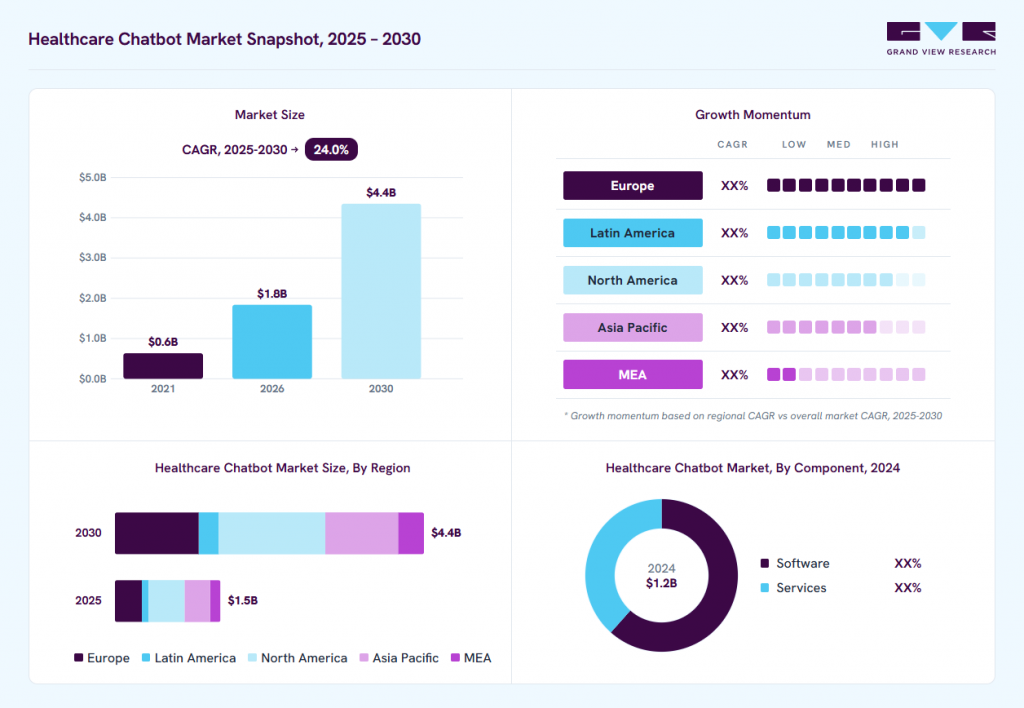
Healthcare chatbots can do more than answer patient questions. They can help patients book appointments, complete pre-visit tasks, receive medication reminders, check symptoms, and get support beyond regular office hours. According to Grand View Research, the global healthcare chatbot market was valued at $1.2 billion in 2024 and is projected to reach $4.4 billion by 2030.
If you want to develop a chatbot that simplifies these complexities, working with an experienced AI-powered chatbot development service provider can help you build a secure and reliable solution.
This guide covers the key healthcare chatbot use cases, development process, technology stack, compliance requirements, cost factors, and best practices to help you plan and build a chatbot that is ready for real-world healthcare environments.
What is Healthcare Chatbot Development?
Healthcare chatbot development is the process of building AI chatbots in healthcare designed to automate patient communication, support clinicians, and streamline medical administrative workflows.
These chatbots interact with patients and clinical staff through text or voice to handle tasks like patient scheduling, symptom triage, medication reminders, and insurance verification while strictly adhering to data privacy regulations like HIPAA.
Unlike general-purpose chatbots, healthcare chatbots operate in a regulated environment where every interaction involves Protected Health Information (PHI). This means the development process must account for clinical accuracy, data encryption, and Business Associate Agreements (BAAs) from day one.
Make Patient Support Faster With AI Chatbots
Reduce response times and automate routine patient interactions with a secure chatbot built around your healthcare workflows.

Healthcare Chatbot Development- A Step-by-Step Process from Discovery to Deployment
Healthcare chatbot development differs from retail or support builds at almost every stage. Protected health information, clinical escalation, and EHR dependencies reorder the decision sequence. The steps below cover what each stage involves and why the decision carries weight.
Step 1: Requirement discovery and use case scoping
Scoping decides what the assistant handles and, just as importantly, what it declines. Healthcare projects that rush this stage tend to expand mid-build, because clinical stakeholders surface requirements late. A written scope keeps timelines and budgets predictable from the first sprint onward.
What this step covers
- Identifying the primary user: patient, clinician, caregiver, or administrative staff
- Choosing launch use cases such as intake, triage handoff, or appointment booking
- Documenting out-of-scope scenarios and queries the assistant will refuse
- Setting baseline targets for containment rate, booking volume, and response time
Patient-facing and clinician-facing assistants need separate conversation flows, so combining both audiences forces an expensive rebuild. Undefined scope also drives feature creep, the most common cause of budget overruns in healthcare chatbot projects. Locking scope early avoids both outcomes.
Step 2: Compliance and data architecture planning
HIPAA obligations shape architecture, not hosting choices alone. Every component touching protected health information sits inside the compliance boundary, including the model, the message queue, and the analytics layer. Decisions made here determine audit readiness for the life of the product.
What this step covers
- Mapping PHI flow across interface, model, hosting, storage, and integrations
- Confirming business associate agreement coverage for each third-party service
- Defining encryption at rest, encryption in transit, and audit logging rules
- Setting consent capture, retention periods, and de-identification standards, including GDPR where relevant
Retrofitting compliance after deployment costs far more than designing for it during planning. HIPAA-eligible cloud services from AWS, Azure, and Google Cloud are not compliant by default. Configuration and BAA scope determine actual coverage for each deployment.
Step 3: Conversation design and escalation mapping
Real patients describe symptoms in vague, incomplete, and emotionally loaded language. Conversation design accounts for that reality before the ideal path gets built. Escalation logic written first gives every unmapped input a safe destination, which matters most during emergencies.
What this step covers
- Defining escalation triggers for emergency symptoms, ambiguous input, and out-of-scope requests
- Writing responses at plain health literacy level rather than clinical terminology
- Building context retention so patients avoid repeating symptoms mid-conversation
- Designing empathetic flows for mental health, post-discharge, and pain-related interactions
Escalation paths added late; transfer incomplete context to clinical staff, creating a safety risk at the handoff point. Clear AI disclosure and visible progress indicators reduce abandonment during multi-step intake, where drop-off rates run highest. Reading level influences completion just as strongly.
Step 4: AI model selection and training
Model selection in healthcare answers to compliance scope as much as raw capability. Most production builds combine rule-based logic with language models, assigning each approach to the tasks suited to it. Training data quality then decides how accurately the assistant reads clinical language.
What this step covers
- Matching approach to task: rules for booking, NLP for intake, LLMs for summarization
- Verifying BAA scope with the model provider before PHI reaches the model
- Training on clinical vocabulary, medication names, and condition-specific intents
- Adding guardrails that block diagnosis claims and unsupported medical advice
General-purpose models frequently misread symptom descriptions, drug names, and dosage phrasing without domain-specific training. Guardrails keep the assistant inside its clinical scope, blocking diagnostic language and limiting liability exposure for the provider. Both safeguards belong in the build, not the backlog.
Step 5: EHR and healthcare systems integration
Integration depth decides whether staff gain time or inherit a second inbox. Bidirectional data flow marks that difference, since the assistant needs to read patient context and write structured output back. Interoperability standards make that exchange predictable across vendors.
What this step covers
- Connecting through FHIR and HL7 APIs to EHR and practice management platforms
- Writing structured conversation output back into the patient record automatically
- Syncing scheduling, reminders, pharmacy, and billing workflows through secure APIs
- Routing SMS and email alerts through HIPAA-compliant communication providers
One-way API handoffs force staff into manual reconciliation, erasing the efficiency the assistant was meant to deliver. Notification channels deserve equal scrutiny, because unencrypted reminders can breach HIPAA even when the assistant itself stays compliant. Integration scope therefore belongs inside the compliance review.
Step 6: Clinical validation and security testing
Healthcare testing extends past functional QA into clinical accuracy and patient safety. Reviewers with clinical backgrounds carry equal weight to engineers at this stage. Test scenarios deliberately target the boundaries of the defined scope rather than the paths already known to work.
What this step covers
- Validating triage and symptom logic against published clinical guidelines
- Running deliberate safety tests on emergency, ambiguous, and boundary scenarios
- Beta testing with actual patients and clinical staff rather than internal teams
- Auditing the complete data flow independently before go-live
Escalation failures carry clinical consequences, not usability complaints alone, so emergency scenarios deserve dedicated test cases. Clinical staff also surface input patterns that developer-led testing consistently misses, particularly around slang, misspellings, and multilingual phrasing. Independent audit closes the compliance gate before launch.
Step 7: Deployment, monitoring, and continuous improvement
Launch begins measurement rather than ending development. Live usage exposes gaps that no test environment reproduces, especially around unusual phrasing and integration timing. A phased release limits exposure while those gaps get identified and closed at manageable volume.
What this step covers
- Releasing to a defined user group before opening access organization-wide
- Tracking containment rate, escalation volume, task completion, and satisfaction scores
- Retraining models using abandoned conversations and unplanned escalations
- Rerunning compliance audits as integrations, languages, and use cases expand
Abandoned chats signal broken flows, so dismissing them as edge cases hides real failures in the design. Compliance posture also degrades as integrations, languages, and use cases expand, which makes scheduled audits part of ongoing operations rather than a launch task.
At Space-O Technologies, we follow this chatbot development lifecycle for every healthcare chatbot project. From use case scoping through post-launch optimization, our team handles the clinical validation, EHR integration complexity, and compliance requirements so your internal team stays focused on patient care, not infrastructure.
Build a Chatbot That Fits Your Business
Avoid one-size-fits-all chatbot solutions with an approach aligned to your workflows, customers, and goals. Share your requirements, and we’ll recommend the right architecture.
What Are the Challenges in Healthcare Chatbot Development?
Chatbots and healthcare have a complex relationship because every technical decision directly affects patient safety. Developers must balance innovation with strict regulatory boundaries, clinical accuracy, and the sensitive nature of patient interactions. Here are the core challenges and how to solve them.
1. Patient data is a high-value target for cyberattacks
Healthcare chatbots handle highly sensitive Protected Health Information (PHI), making them prime targets for data breaches. Every data input, processing step, and output must comply with HIPAA, which heavily restricts how PHI can be shared, stored, or transmitted. Health data sells for 10x more than credit card data on the dark web, so a single breach can result in millions in penalties and permanent reputation damage.
Note: Banking chatbot solutions carry a parallel threat model under PCI-DSS. The regulations differ, but the architectural discipline required is identical.
How we solve it:
- At Space-O Technologies, we build enterprise-grade encryption, secure storage, role-based access controls, and audit logging into the architecture from day one. Compliance is not a final checklist. It is the foundation every feature is built on.
2. Generative AI hallucinations can cause real patient harm
Unlike customer service bots where a wrong answer causes mild inconvenience, errors in healthcare chatbots can lead to misdiagnosis or direct patient harm. Generative AI models are prone to hallucinations, confidently generating medical information that sounds correct but is entirely fabricated. A chatbot reassuring a patient when they actually need emergency care is not a product bug. It is a patient safety failure.
How we solve it:
- We implement multi-layered clinical validation pipelines where every chatbot response is cross-checked against verified medical knowledge bases before reaching the patient. The choice between RAG vs fine-tuning depends on your clinical accuracy requirements and data availability.
3. Legacy hospital systems make EHR integration difficult
For a healthcare chatbot to deliver real value, it needs access to patient histories, lab results, medication records, and care schedules. The problem is EHR interoperability. Most hospitals run fragmented legacy IT infrastructure where Electronic Health Records (EHR) systems were never designed to communicate with external AI tools. Connecting a chatbot to platforms like Epic or Cerner through AI EHR mobile app development requires FHIR/HL7 expertise and careful handling of data formats that vary across institutions.
How we solve it:
- Our development team has hands-on experience integrating chatbots with major EHR platforms using FHIR and HL7 standards. We handle the complexity of legacy system connectivity so your clinical workflows remain uninterrupted.
4. Chatbots lack the emotional intelligence patients need
Patients often seek medical support during their most vulnerable moments. Conversational agents struggle to provide empathy, warmth, and the human touch required during stressful health crises. They also lack the contextual understanding needed to navigate complex ethical and highly subjective medical decisions.
How we solve it:
- We design conversation flows with clinician input that recognize emotional cues in patient messages and shift tone accordingly. When the chatbot detects distress, grief, or crisis language, it immediately connects the patient to a human care provider rather than continuing an automated response.
5. Biased training data can worsen health disparities
If a chatbot is trained on unrepresentative datasets, its responses and recommendations will be biased toward specific demographics. This means certain patient groups receive less accurate guidance, potentially widening existing health disparities rather than closing them. Algorithmic bias in healthcare is not just a technical problem. It is an equity problem.
How we solve it:
- Our machine learning development team trains and fine-tunes models using diverse, clinically validated training data reviewed by medical professionals across specialties. Post-deployment, we run continuous bias audits to identify and correct demographic gaps in chatbot performance.
How Much Does Healthcare Chatbot Development Cost?
Healthcare chatbot development costs range from $15,000 for a basic rule-based FAQ bot to $350,000+ for an advanced Generative AI system with deep EHR integration, significantly higher than the general AI chatbot development cost due to compliance and clinical accuracy requirements.
The final price depends on whether you are deploying a simple rule-based system for FAQs or building a Generative AI chatbot with deep EHR/EMR integration and HIPAA compliance.
What you pay based on chatbot complexity
- Basic chatbot ($15,000 to $40,000): Rule-based systems designed for simple symptom checking, answering common patient questions, or routing inquiries to human staff. No NLP or LLM involvement. Limited to pre-defined conversation flows.
- Mid-level AI chatbot ($40,000 to $100,000): Uses Natural Language Processing (NLP) to handle patient intake, appointment scheduling, and multilingual queries. Can manage basic triage flows but does not connect to hospital databases or clinical records.
- Advanced Generative AI chatbot ($120,000 to $350,000+): Through our LLM development and RAG pipelines, every response is anchored to approved medical knowledge bases, not raw training data. Requires deep integration with Electronic Health Record (EHR) platforms like Epic or Cerner, security audits, end-to-end encryption, and strict clinical accuracy validation.
What drives the cost higher in healthcare
- HIPAA compliance: Building end-to-end encryption, secure data storage, role-based access controls (RBAC), and audit logging adds significant development time. Legal audits for regulatory sign-off increase the cost further.
- EHR/EMR integration: Connecting the chatbot to legacy systems like Epic or Cerner to pull real-time patient histories, lab results, and care plans requires FHIR/HL7 expertise and dedicated integration sprints.
- AI model complexity: Training or fine-tuning a healthcare-specific LLM demands high compute costs and domain expertise from clinicians who validate the chatbot’s clinical accuracy before deployment.
- Symptom checking and triage logic: Building medically reliable symptom checking that correctly escalates urgent cases to physicians requires clinical validation, testing against medical datasets, and ongoing monitoring post-launch.
How Long Does Healthcare Chatbot Development Take?
Developing a healthcare chatbot takes 2 to 6 months. The timeline depends on whether you are building a simple rule-based FAQ bot or an advanced AI-driven assistant with deep EHR integration, NLP training on medical terminology, and full HIPAA compliance.
How the timeline changes based on chatbot complexity
- Simple chatbot (2 to 4 weeks): Rule-based systems that handle basic FAQs like clinic hours, location info, or general health inquiries. No AI involvement, limited to pre-defined conversational flows.
- Mid-level patient support bot (2 to 4 months): Uses NLP for appointment scheduling, AI-driven symptom checking, and basic patient intake. Requires API connections to existing databases but no deep clinical system integration.
- Enterprise EHR-integrated chatbot (4 to 6+ months): Requires secure integration with Electronic Health Records (EHR) platforms like Epic or Cerner, LLM fine-tuning on clinical knowledge bases, and full regulatory compliance testing.
What each development phase looks like
- Discovery and design (2 to 3 weeks): Scoping use cases, prototyping patient-facing interfaces, and mapping conversational flows for each clinical scenario the chatbot will handle.
- Development and integration (3 to 8 weeks): Writing backend logic, connecting APIs to existing hospital databases or EHR systems, and building the core conversation engine.
- AI and NLP training (4 to 6 weeks): Training the model on specialized medical terminology, clinical intents, and domain-specific knowledge bases to ensure accurate responses.
- Security and QA (1 to 2 weeks): Ensuring strict adherence to data privacy regulations like HIPAA. This includes setting up encrypted storage, role-based access controls, and audit logging for every patient interaction.
Let AI Handle Routine Patient Queries
Free your healthcare staff from repetitive questions and administrative tasks with intelligent conversational automation. Tell us your workflow, and we’ll identify the right opportunities.
What Can Healthcare Chatbots Automate for Clinics?
Healthcare chatbots can automate routine patient interactions, reduce administrative workloads, and help clinics provide faster support. From appointment scheduling and patient FAQs to reminders and follow-ups, chatbots can handle repetitive tasks while allowing staff to focus on patient care.
- Appointment scheduling: Help patients book, reschedule, or cancel appointments based on provider availability.
- Patient inquiries: Answer common questions about services, consultation fees, clinic hours, locations, and preparation instructions.
- Appointment reminders: Send automated reminders through preferred communication channels to reduce missed appointments.
- Patient intake: Collect basic patient information, symptoms, and appointment details before a consultation.
- Prescription and medication reminders: Notify patients about medication schedules and provide approved medication-related information.
- Follow-up communication: Automate post-visit check-ins, feedback collection, and routine follow-up messages.
- Insurance and billing FAQs: Provide information about accepted insurance plans, billing procedures, payment options, and documentation requirements.
- Patient navigation: Guide patients to the appropriate department, provider, or service based on their needs.
- Basic symptom guidance: Ask predefined questions and provide general guidance on the next appropriate step, while directing patients to healthcare professionals when necessary.
- Administrative support: Reduce repetitive workload by handling frequently asked questions and routine requests around the clock.
With the right workflows and integrations, a healthcare chatbot can connect with scheduling systems, EHR/EMR platforms, CRM software, and other clinic systems to automate patient-facing processes more efficiently.
Why Do Healthcare Chatbot Implementations Fail?
Healthcare chatbot implementations fail when organizations rush to market without rigorous training, clinical validation, or meaningful integration with existing hospital workflows. The failure is rarely the technology itself. It is how the technology is deployed. This Reddit discussion among healthcare AI practitioners highlights the same pattern.
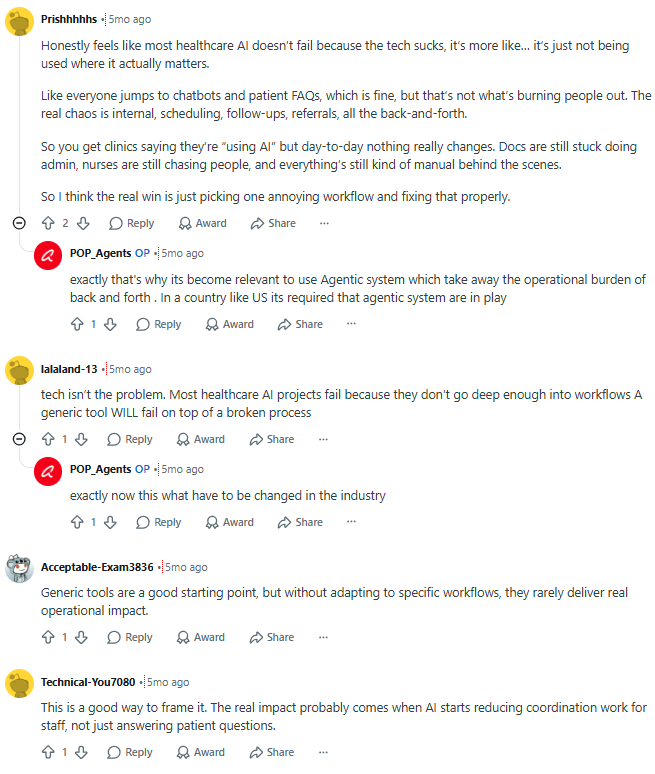
This pattern shows up repeatedly across real-world deployments. Here are the specific failure points and how to avoid them.
1. AI hallucinations create real patient safety risks
AI models rely on statistical language prediction, not clinical reasoning. They can confidently fabricate medical facts, suggest dangerous self-treatment, or miss critical diagnoses entirely. A Mass General Brigham study found that AI chatbots miss the initial diagnosis 80% of the time. In healthcare, a hallucinated response is not an inconvenience. It is a medicolegal liability.
2. Chatbots layered onto broken workflows make things worse
Many chatbots perform well in demos but fail in production because they are layered onto disconnected legacy systems. Instead of saving time, they add clicks and create friction for already burnt-out clinicians. If the chatbot cannot pull real-time data from existing Electronic Health Records (EHR), staff end up entering information twice, which accelerates clinical burnout instead of reducing it.
3. Vague goals lead to vague results
Organizations that deploy chatbots with broad objectives like “improve patient experience” face significantly higher failure rates than those with specific, measurable targets. A chatbot built to “reduce routine scheduling calls by 40%” has a clear success metric. A chatbot built to “make things better” has none.
4. Chatbots cannot handle emotionally sensitive conversations
Chatbots lack the contextual awareness needed for nuanced mental health or sensitive diagnostic conversations. Deploying them in these scenarios without strict escalation logic puts patients at risk. See the best practices section for how to build context-preserving human handoff properly.
5. Patients and staff overestimate what the chatbot can do
User overreliance is one of the most overlooked failure points. Both patients and clinical staff treat unverified chatbot output as reliable medical advice. Without clear disclaimers, confidence scoring, and mandatory human validation checkpoints, the chatbot becomes a liability rather than a tool.
6. Privacy failures trigger compliance shutdowns
If the chatbot trains on, stores, or mishandles Protected Health Information (PHI) without proper HIPAA safeguards, the result is not just a data breach. It is a full compliance and medicolegal shutdown that can cost millions in penalties and permanently damage patient trust.
At Space-O Technologies, every chatbot project starts with specific, measurable use case goals, not vague improvement targets. We build clinical validation pipelines that catch hallucinations before responses reach patients, integrate directly with your EHR to eliminate duplicate workflows, and configure human handoff triggers for every scenario the chatbot should not handle alone.
What Technologies Are Needed for Healthcare Chatbot Development?
Healthcare chatbot development combines AI, conversational technologies, secure backend systems, and healthcare integrations. The right technology stack depends on the chatbot’s use case, required integrations, data sensitivity, and deployment environment.
| Category | Technologies | Purpose |
|---|---|---|
| Programming Languages | Python, JavaScript, TypeScript | Build chatbot logic, backend services, APIs, and AI workflows |
| AI & Machine Learning | TensorFlow, PyTorch, scikit-learn | Train and deploy machine learning models for healthcare use cases |
| Large Language Models | OpenAI GPT, Google Gemini, Anthropic Claude, Llama | Generate contextual and conversational responses |
| NLP Frameworks | spaCy, NLTK, Hugging Face Transformers | Understand patient intent, entities, context, and natural language |
| Chatbot Frameworks | Rasa, Microsoft Bot Framework, Dialogflow | Build, manage, and deploy conversational workflows |
| Speech Technologies | Google Speech-to-Text, Azure Speech, Amazon Transcribe | Enable voice-based patient interactions |
| Text-to-Speech | Amazon Polly, Google Cloud Text-to-Speech, Azure Speech | Convert chatbot responses into natural-sounding speech |
| Healthcare Integration | HL7, FHIR, SMART on FHIR | Exchange healthcare data and connect with clinical systems |
| Backend Technologies | Node.js, Django, FastAPI, Laravel | Develop APIs, business logic, authentication, and integrations |
| Databases | PostgreSQL, MySQL, MongoDB, Redis | Store approved patient, appointment, conversation, and application data |
| Cloud Platforms | AWS, Microsoft Azure, Google Cloud | Host, scale, monitor, and secure chatbot applications |
| Security | OAuth 2.0, OpenID Connect, TLS, AES-256 | Protect authentication, data transmission, and stored sensitive information |
| Vector Databases | Pinecone, Weaviate, Milvus, pgvector | Store and retrieve embeddings for knowledge-based chatbot responses |
| AI Orchestration | LangChain, LlamaIndex | Connect LLMs with healthcare data, tools, APIs, and knowledge bases |
| Analytics & Monitoring | OpenTelemetry, Grafana, Datadog | Monitor performance, errors, usage, and chatbot interactions |
For healthcare applications, technology selection should also account for applicable privacy, security, interoperability, and regulatory requirements. Integrating the chatbot with existing EHR/EMR, appointment, CRM, and patient-management systems can further automate clinic workflows.
Retail builds run a lighter stack, since no PHI or interoperability layer applies. Our guide to AI chatbots for ecommerce shows how that changes tooling and cost.
What Are Real-World Healthcare Chatbot Examples?
Healthcare chatbots already run in production across hospitals, national health services, insurers, and consumer health apps. The examples below are grouped by function, so you can see what each system actually does rather than how it is marketed.
| Chatbot | Category | Primary Function | Verified Scale or Status |
|---|---|---|---|
| Ada Health | Symptom assessment | Adaptive symptom questions plus triage guidance | 13M users, 32M assessments |
| Buoy Health | Symptom assessment | Care-level navigation from symptoms and history | Care uncertainty cut 34% to 21% |
| Wysa | Mental health | CBT-based support and clinical intake screening | 300,000+ NHS therapy referrals |
| Woebot | Mental health | CBT check-ins, consumer app now retired | Shut down June 30, 2025 |
| Florence | Chronic care | Long-running text check-ins and readings | Generated Health clinical service |
| Sensely | Triage and chronic care | Avatar-led triage across voice, text, visual | Acquired by Mediktor, 2024 |
What separates the chatbots that last from the ones that quietly disappear is rarely conversation quality. The ones still running connect to real systems, whether that means a curated medical knowledge base, an EHR, or connected monitoring devices. The ones that shut down usually had strong research behind them but never resolved the regulatory pathway or the business model. Settle your use case and integrations before the conversation design.
Ready to Make Healthcare Support Faster and Smarter?
Automate patient questions, appointment requests, and routine support while giving your staff more time to focus on patient care.
What Are the Best Practices for Healthcare Chatbot Development?
Building a healthcare chatbot that works in production requires clinical safety guardrails, compliant data handling, and a conversational experience designed for patients who may be anxious or unwell.
1. Treat data anonymization as seriously as encryption
Beyond the encryption and BAA requirements covered in the HIPAA section, one practice most teams overlook is data anonymization during model training. Use data masking and de-identification techniques whenever processing conversation logs. Never train AI models on raw PHI.
2. Hardcode clinical triage logic instead of relying on AI-generated assessments
Do not let the LLM decide whether a symptom is urgent. Hardcode triage thresholds and red-flag symptom triggers like chest pain, difficulty breathing, or suicidal ideation that override generative outputs and immediately route users to emergency services. Every interaction should display a clear disclaimer that the chatbot provides educational or administrative support, not a medical diagnosis.
3. Build a human handoff that preserves full conversation context
When the chatbot transfers a patient to a human agent, the agent must receive the full transcript so the patient never repeats symptoms, insurance details, or personal information. A human-in-the-loop escalation path without context continuity is not a handoff. It is a restart.
4. Design conversational UX for patients, not for demos
Use plain language instead of medical jargon. Build empathetic flows that acknowledge patient anxiety. Ensure the chatbot is compatible with screen readers and supports multilingual interfaces to serve diverse patient populations equitably.
5. Monitor, audit, and retrain continuously after launch
Audit conversation logs weekly for clinical accuracy and bias. Update medical knowledge bases quarterly with the latest guidelines. Track performance analytics including satisfaction scores, dropped conversations, routing accuracy, and escalation frequency.
How Space-O Technologies Helps in Healthcare Chatbot Development
Space-O Technologies helps healthcare organizations build AI-powered chatbots that automate patient interactions, streamline administrative workflows, and improve response times. Our team develops chatbot solutions tailored to clinics, hospitals, healthcare providers, and digital health businesses.
We help with chatbot strategy, conversational AI development, system integration, and deployment. Our solutions can integrate with EHR/EMR systems, appointment platforms, CRM software, and healthcare APIs while incorporating features such as patient FAQs, appointment scheduling, reminders, intake, and automated follow-ups.
From selecting the right AI technologies to testing, deployment, and ongoing optimization, we focus on building secure, scalable, and user-friendly healthcare chatbot solutions. If you are planning to build or enhance a healthcare chatbot, hire AI chatbot developers with experience in AI-driven conversational solutions.
Frequently Asked Questions
What types of AI chatbots work best in healthcare?
Healthcare deployments typically use rule-based, retrieval-based, and generative chatbots, often combined in one build. Rule-based flows handle booking and refills, retrieval answers policy questions from verified content, and generative models summarize. Understanding the different types of AI chatbots helps clarify which fits each clinic workflow.
How do you prevent AI hallucinations in healthcare chatbots?
Healthcare chatbots avoid hallucinations when responses stay grounded in approved clinical content rather than open model generation. Retrieval pulls answers from a verified knowledge base, while guardrails block diagnostic phrasing. Anything outside that content routes to a human instead.
Rule-based vs NLP vs LLM chatbots: which is best for healthcare?
No single approach suits every healthcare use case, and most production builds combine all three. Rule-based logic handles booking and refills predictably, NLP interprets free-text symptoms, and LLMs summarize behind retrieval grounding. Scoping decides the mix.
How do you integrate chatbots with EHR/EMR systems?
Chatbots connect to EHR and EMR platforms through FHIR and HL7 APIs. Bidirectional data flow matters more than the connection itself, since structured output needs to write back into the record automatically. One-way handoffs create manual reconciliation work.
What compliance rules apply beyond HIPAA?
Several regulations apply alongside HIPAA, depending on patient location and data type. GDPR covers EU patients, PIPEDA covers Canada, and 42 CFR Part 2 protects substance use records. ADA and WCAG standards govern interface accessibility.
How do you design safe handoffs to human agents?
Safe handoffs start with escalation conditions defined before any conversation flow gets written. Full conversation history transfers with the patient, so nobody repeats their symptoms to staff. Emergency triggers route immediately with clear instructions displayed.
What metrics should you track after chatbot launch?
Containment rate, escalation volume, and task completion form the core measurement set. Operational measures like no-show reduction connect chatbot activity to clinic performance. Abandoned conversations expose broken flows faster than satisfaction surveys do.
How do you support multiple languages and low health literacy?
Plain language and professional clinical translation matter more than the number of languages supported. Responses at a sixth- to eighth-grade reading level improve completion across every patient group. Voice input and screen reader support widen access further.
Why do healthcare chatbot pilots fail after deployment?
Most healthcare chatbot pilots fail for planning reasons rather than technical ones. Generic triage logic, escalation paths added late, and fragmented BAA coverage account for the majority. Each costs little to prevent and plenty to fix.
How do you maintain and govern a chatbot long-term?
Long-term governance needs a clinical owner working alongside the technical owner. Monthly review of escalations and abandoned conversations identifies flows needing revision. Space-O Technologies repeats compliance audits whenever integrations or use cases expand.
Can healthcare chatbots be used for diagnosis?
Healthcare chatbots should not diagnose patients, and well-built systems block diagnostic language outright. Symptom tools gather structured information and route patients toward appropriate care. Regulators treat diagnostic claims as a medical device function requiring separate approval.
How do you choose a healthcare chatbot development partner?
Look for demonstrated healthcare delivery, HIPAA architecture experience, and EHR integration work rather than general chatbot portfolios. Ask how escalation paths and BAA coverage get handled during scoping. Comparing AI chatbot development companies on compliance track record narrows the shortlist quickly.



 All our projects are secured by NDA




 4.8
4.8