
 By
By 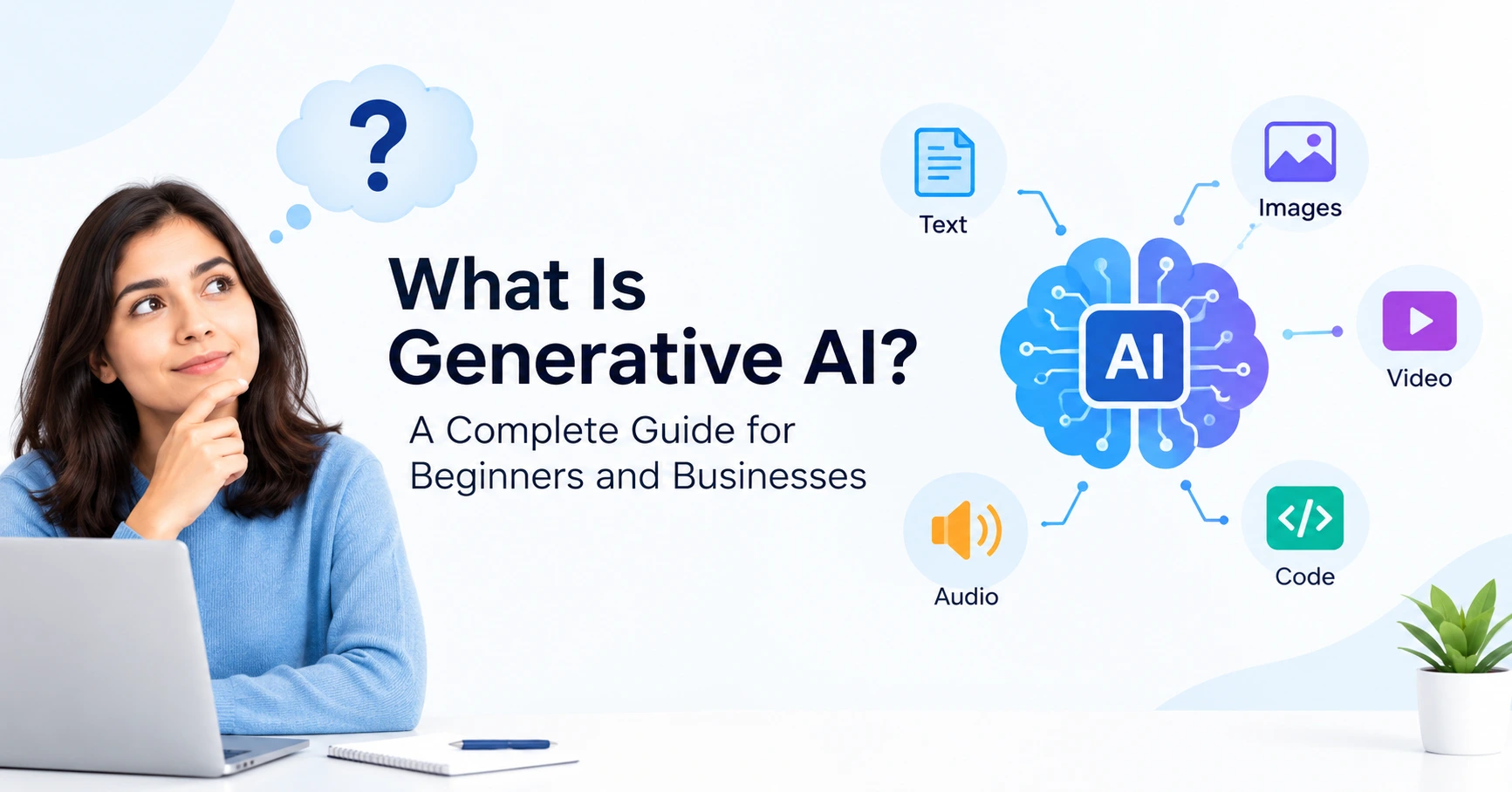
Contents
Generative AI is changing how people write, design, code, and complete everyday tasks. Unlike traditional AI that mainly analyzes existing information, generative AI creates new text, images, audio, video, and code from learned patterns.
So, what is generative AI, and how does it actually work? This guide explains the technology in simple terms, from how AI models learn patterns to how prompts produce new content. You will also discover its common types, capabilities, real-world examples, benefits, and limitations.
You will also learn how businesses use generative AI across industries and what it takes to choose the right model. We will cover emerging developments, including multimodal AI and AI agents, to help you understand where the technology is heading.
Space-O Technologies has been developing software solutions since 2010, including AI-powered applications for businesses. Our practical experience helps connect generative AI concepts with real-world development and implementation needs. If you are exploring a custom solution, GenAI development services can help turn a specific business use case into a working AI application.
What is Generative AI?
Generative AI is a type of artificial intelligence that creates new content from patterns learned from existing data. It can generate text, images, audio, video, and code based on user prompts. Unlike traditional AI, which mainly analyzes, classifies, or predicts information, generative AI produces new outputs.
For example, you can ask a generative AI tool to write a poem about autumn. It creates a new poem based on patterns learned during training rather than retrieving an existing one. This ability to generate original content makes generative AI useful across creative, business, and technical tasks.
How does generative AI actually work?
Generative AI works by learning patterns from large datasets and using them to create new content. The process typically involves five stages.
- Data collection and training: Developers train AI models on large datasets, such as text, images, audio, or code. The quality and diversity of this data influence the model’s performance.
- Model training and pattern learning: The model uses machine learning to identify patterns and relationships within the training data. It adjusts its parameters to learn language, context, visual features, and other patterns.
- Prompt or user input: After training, users provide prompts, instructions, or other inputs. Clear and specific prompts generally help produce more relevant results.
- Content generation: The model uses learned patterns to generate new content based on the input. Depending on the model, it can create text, images, audio, video, or code.
- Output refinement: The generated output may be reviewed, filtered, edited, or regenerated to improve quality and safety. Foundation models, including large language models, power many generative AI applications.
Together, these steps allow generative AI to turn user instructions into useful, original outputs. The exact process varies depending on the model and type of content being generated.
What Can Generative AI Create?
Generative AI can create text, images, video, audio, music, code, synthetic data, and 3D content. Each content type relies on a model trained specifically for that format, though many tools now combine several formats together.
- Text: Generative AI writes articles, emails, summaries, and conversational replies. Marketing teams can draft product descriptions quickly. Writers can brainstorm headlines or restructure paragraphs, while support teams create clear responses.
- Images: AI tools generate photorealistic or artistic images from text descriptions. Designers can create logos, while businesses use AI to remove backgrounds, adjust lighting, or create visuals.
- Video: Newer models create short video clips from text prompts or images. Filmmakers can test concepts, while marketing teams create product demos for social media.
- Audio: Generative AI produces realistic speech, sound effects, and voice clones. Podcasters and publishers use it for narration, while accessibility tools use generated speech to read content aloud.
- Music: AI models compose melodies, backing tracks, and full songs in different styles. Creators use them for background music, while musicians use them for songwriting inspiration.
- Code: Developers use generative AI to write, complete, explain, or debug code. It handles repetitive tasks and helps developers work with unfamiliar programming languages.
- Synthetic data: Companies generate artificial datasets that mimic real-world patterns. This supports AI training, testing, and simulations without exposing sensitive information.
- 3D content: Generative AI can create 3D models and environments for games, simulations, and design. Architects and product designers use these models to explore concepts before physical production.
This wide range of output shows why generative AI applies across so many industries. A single underlying technique adapts to text, visuals, sound, and structured data alike. Businesses increasingly combine several of these formats within one connected workflow.
Turn a Generative AI Idea Into a Working Solution
Have a specific AI use case in mind? Our team can help you assess the idea, choose the right approach, and build it.

Types of Generative AI Models
Generative AI models fall into several categories, each suited to specific tasks and content types. Understanding these categories helps clarify how different tools achieve different results.
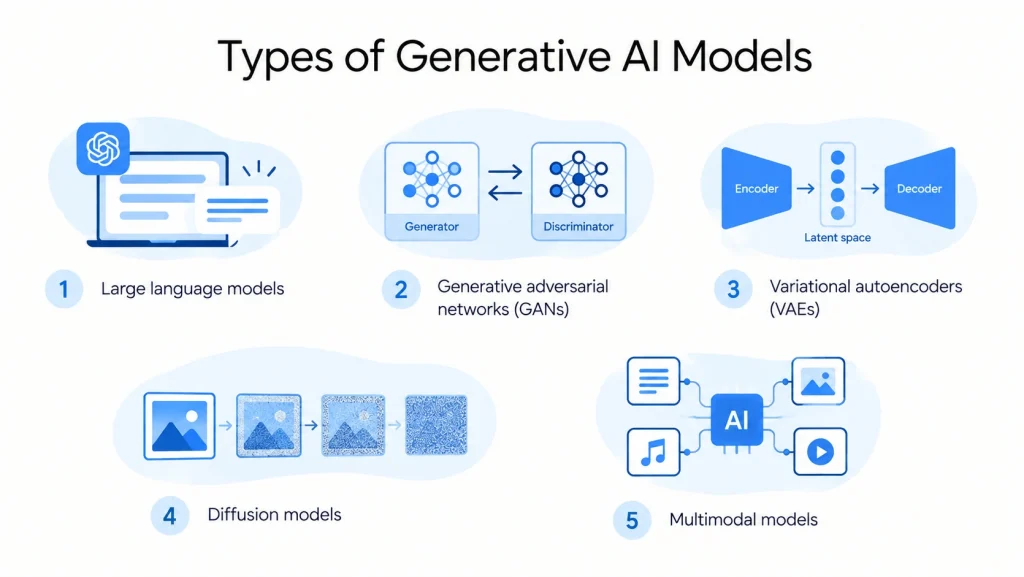
1. Large language models
Large language models specialize in understanding and generating human language. They power chatbots, writing assistants, and translation tools used by millions of people daily. These models learn from enormous collections of text, giving them broad general knowledge. They can answer questions, summarize documents, and hold natural conversations.
2. Generative adversarial networks (GANs)
Generative adversarial networks, often called GANs, use two competing neural networks. One network generates content, while the other evaluates how realistic it looks. This competition pushes the output toward higher quality over time. GANs are common in image and face generation, as well as photo enhancement tools.
3. Variational autoencoders (VAEs)
Variational autoencoders compress data into a simplified form and then reconstruct it. This process allows the model to generate new variations of the original data. They are often used in image generation and anomaly detection tasks. Their structure also makes them useful for compressing and reconstructing complex datasets.
4. Diffusion models
Diffusion models start with random noise and gradually refine it into a clear output. Many popular image generation tools rely on this approach today. The gradual refinement process often produces highly detailed and realistic results. Researchers continue improving diffusion techniques for faster, sharper output.
5. Multimodal models
Multimodal models can process and generate more than one type of content at once. A single model might accept an image and text together, then produce a written description. These models represent a growing trend toward more flexible, general-purpose AI systems. Many newer consumer tools now default to this multimodal approach.
Each model type suits different needs, so companies often combine several approaches. A single product, such as an AI design tool, might use diffusion models for images and a language model for captions. Choosing the right combination depends heavily on the specific business problem being solved.
Generative AI vs Traditional AI
Generative AI creates new content, while traditional AI analyzes, classifies, or predicts using existing data. Traditional AI powers fraud detection, recommendations, and spam filters, while generative AI creates reports, images, code, and other content.
Predictive AI, a common form of traditional AI, forecasts outcomes such as sales or customer churn. Generative AI focuses on producing new content rather than predicting future outcomes.
| Factor | Traditional AI | Generative AI |
|---|---|---|
| Primary purpose | Analyze and predict | Create new content |
| Type of output | Labels, scores, decisions | Text, images, audio, code |
| Learning approach | Pattern recognition | Pattern generation |
| User interaction | Often automated, background | Often prompt-based, interactive |
| Typical applications | Fraud detection, recommendations | Content creation, chatbots |
| Examples | Spam filters, credit scoring | ChatGPT, image generators |
Both approaches use machine learning but serve different purposes. For example, an ecommerce platform can use traditional AI for fraud detection and generative AI for product descriptions.
Generative AI vs Machine Learning
Generative AI is a specialized branch of machine learning focused on producing new content. Machine learning is the broader field that teaches computers to learn from data without explicit programming for every rule.
Machine learning includes many techniques beyond generation, such as classification and clustering. A machine learning model might sort emails into categories or predict housing prices. Generative AI narrows this broad field toward one specific goal, which is creating original output. Every generative model still relies on core machine learning principles underneath.
Every generative AI system uses machine learning techniques underneath. However, not every machine learning system is generative. A model that predicts tomorrow’s weather is not generative, since it forecasts rather than creates content. This relationship makes generative AI a subset within the larger machine learning landscape, rather than a separate, unrelated field.
Understanding this hierarchy helps avoid confusion in business conversations. When someone mentions machine learning, they may mean a broad category of techniques. When someone mentions generative AI, they specifically mean tools that produce new content.
Generative AI vs Agentic AI
Generative AI creates content in response to a prompt, while agentic AI plans and carries out multi-step tasks on its own. The two concepts often get confused, since agentic systems usually rely on generative models underneath.
A generative AI tool waits for a person to ask a question or give an instruction. It then produces one response, such as a paragraph, image, or block of code. Agentic AI goes further by breaking a goal into steps and completing them with limited supervision. It might research a topic, draft a document, and schedule a follow-up task without repeated prompting.
Agentic AI still depends on generative models to write text or generate content along the way. The difference lies in autonomy, since agents make decisions about what to do next. Businesses exploring this shift should read up on the latest generative AI trends, since agentic capability is one of the fastest-moving areas in the field right now.
How Is Generative AI Used?
Businesses use generative AI across customer service, marketing, software development, healthcare, and many other functions. Its flexibility allows nearly every department to find a practical application, often within existing workflows.
1. Customer service
Support teams use generative AI chatbots to answer common questions instantly. These systems can draft responses, summarize conversations, and suggest next steps for agents. This reduces wait times and frees staff for complex issues. Many companies report faster resolution times after adding these tools.
2. Marketing and sales
Marketing teams generate ad copy, social media posts, and email campaigns faster than before. Sales teams use it to draft personalized outreach messages at scale. This helps smaller teams produce more content without sacrificing quality. Campaign managers also use it to test multiple message variations quickly.
Sales leaders increasingly look at generative AI for sales to shorten deal cycles and personalize outreach. It helps reps draft follow-up emails, summarize call notes, and prepare proposals faster. This lets sales teams spend more time actually talking with prospects instead of writing.
3. Software development
Developers use generative AI to write boilerplate code and suggest fixes for bugs. This speeds up repetitive work and lets engineers focus on complex logic. Many coding assistants now integrate directly into popular software development tools. Teams report shorter development cycles for routine feature updates.
4. Healthcare
Healthcare providers use generative AI to summarize patient notes and draft documentation. Researchers also use it to explore potential drug compounds faster. Administrative staff use it to simplify scheduling and insurance paperwork. Human experts still review every clinical decision for safety and accuracy.
The role of generative AI in the healthcare industry continues to expand beyond documentation and research support. Hospitals use it to draft discharge summaries and simplify patient communication materials. Strict privacy rules mean every output still needs review before reaching a patient record.
5. Banking and finance
Financial firms use generative AI to draft reports, summarize market research, and answer customer questions. It also helps detect unusual patterns when combined with traditional analytics tools. Advisors use it to prepare personalized client summaries more quickly. Compliance teams review outputs carefully given the sensitivity of financial data.
Banks exploring generative AI in banking often start with internal use cases before facing customers directly. Common examples include summarizing loan applications and drafting responses to routine account questions. Regulatory review remains a critical step before any customer-facing rollout.
6. Insurance
Insurers use generative AI to summarize claims, draft policy explanations, and assist customer support. This shortens the time between filing a claim and receiving a response. Agents use it to answer common coverage questions consistently. Underwriters still make the final coverage decisions based on their own judgment.
Adoption of generative AI in insurance has grown fastest around claims processing and policy summaries. Carriers use it to translate dense policy language into plain, customer-friendly explanations. This reduces confusion and cuts down on repeat calls to support teams.
7. Manufacturing
Manufacturers use generative AI to design product variations and simulate performance before production. Engineers explore many design options quickly instead of testing each one physically. This shortens product development cycles and reduces material waste. Quality teams also use generated simulations to predict potential failures early.
Interest in generative AI for manufacturing businesses is rising as factories look to cut design and testing time. Plants use it to generate maintenance reports and predict equipment issues before they cause downtime. This proactive approach helps reduce costly, unplanned production stoppages.
8. Retail
Retailers generate product descriptions, personalized recommendations, and marketing visuals at scale. Some stores use AI-generated images to show products in different settings. This helps smaller brands compete with larger retailers on content volume. Customer service teams also use it to answer sizing or shipping questions instantly.
Store chains studying generative AI in retail often start with product catalog automation and visual merchandising. It helps teams generate seasonal campaign visuals without a full photo shoot. This cuts production costs while keeping content fresh across every season.
8. Ecommerce
Online stores use generative AI to write product listings and personalize the shopping experience. Chatbots answer questions about sizing, returns, and order status around the clock. Merchandisers use it to generate variations of product images for different marketplaces. This keeps listings consistent across channels without extra manual work.
Applying generative AI in online ecommerce also helps smaller online sellers compete with bigger platforms. It speeds up catalog creation, product photography edits, and customer support responses. This lets lean teams manage larger inventories without hiring extra staff.
9. Education
Educators use generative AI to create practice questions, lesson plans, and study guides. Students use it to get explanations in simpler language when concepts feel confusing. Tutors use it to generate customized practice material for different skill levels. Teachers still guide learning and verify the accuracy of generated material.
10. Legal services
Law firms use generative AI to draft contracts, summarize case files, and review documents. This speeds up research that once took hours of manual reading. Paralegals use it to prepare first drafts of routine agreements. Attorneys still review every document carefully before it reaches a client.
11. Human resources
HR teams use generative AI to draft job descriptions, interview questions, and onboarding material. It also helps summarize employee feedback collected through surveys. Recruiters use it to screen resumes faster and highlight relevant candidates. Managers still make final hiring and policy decisions themselves.
12. Content creation
Writers, designers, and video creators use generative AI as a starting point for their work. It helps generate drafts, outlines, or visual concepts quickly. Social media managers use it to repurpose one idea across multiple formats. Human creativity still shapes the final, polished output in every case.
Build a Generative AI Solution Around Your Needs
Move beyond experimenting with AI tools. Get development support to create a solution aligned with your data, workflows, and business goals.
What Are the Benefits of Generative AI?
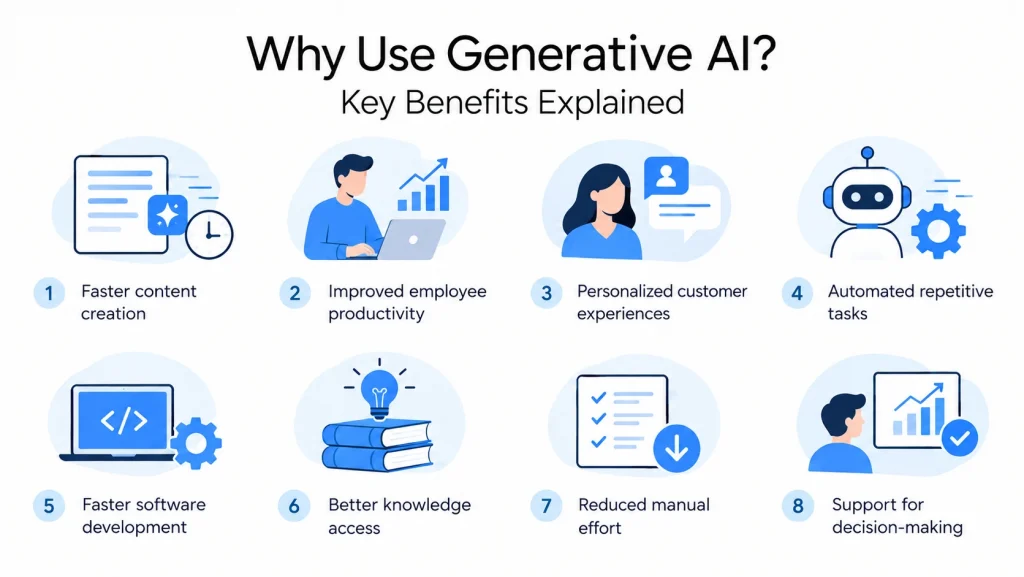
Generative AI offers practical benefits, including faster content creation and improved productivity across teams. These advantages explain why adoption has grown so quickly across industries of every size.
1. Faster content creation
Teams produce drafts, images, and reports in minutes instead of hours. This speed helps businesses respond to trends and customer needs more quickly. Smaller teams can now produce content volumes once reserved for larger companies.
2. Improved employee productivity
Staff spend less time on repetitive writing or design tasks. This frees hours each week for strategic thinking and creative problem-solving. Employees often report less burnout when routine tasks get automated.
3. Personalized customer experiences
Businesses tailor messages and recommendations to individual users at scale. Personalization once required large teams, but AI now handles much of this work. Customers respond well to communication that feels relevant to their needs.
4. Automated repetitive tasks
Generative AI handles routine drafting, freeing people for strategic work. This applies to writing, coding, and even basic design tasks. Automation reduces the mental fatigue that comes from repetitive manual work.
5. Faster software development
Developers write and debug code more quickly with AI assistance. This helps companies ship new features and fixes faster than before. Faster development cycles often translate into a stronger competitive position.
6. Better knowledge access
Employees get quick summaries of complex documents or research. This helps teams make informed decisions without reading lengthy reports in full. Knowledge that once sat buried in documents becomes easier to find and use.
7. Reduced manual effort
Teams spend less time on formatting, editing, and first drafts. This shifts human effort toward reviewing and improving quality instead. Reduced manual effort also lowers the risk of simple, careless errors.
8. Support for decision-making
Leaders get clear summaries that help them decide faster. Generative AI can compile data from multiple sources into a single overview. This supports better decisions without requiring hours of manual research.
These benefits do not eliminate the need for human judgment. Instead, generative AI removes friction from early stages of work, so people can focus on refinement and strategy. Companies that combine AI speed with human oversight tend to see the strongest results.
Bring Your Generative AI Use Case to Life
From initial planning to development, build a custom AI solution around the problem you want to solve.
Key Challenges of Generative AI and How to Address Them
Generative AI offers significant benefits, but businesses must address key challenges before implementation. The right safeguards can improve accuracy, security, and responsible AI adoption.
1. Hallucinations and inaccurate outputs
Generative AI can produce confident but incorrect information, including false facts or sources. These errors can affect decisions when outputs are used without proper verification.
How to address it:
- Verify important outputs against trusted sources.
- Use retrieval-augmented generation (RAG) for reliable information.
- Add human review for critical content and decisions.
2. Bias in AI outputs
AI models can reproduce biases found in their training data, leading to unfair or inconsistent results. These issues can become more serious when AI supports sensitive business decisions.
How to address it:
- Use diverse and representative training data.
- Test outputs across different user groups and scenarios.
- Monitor model results regularly for biased patterns.
3. Data privacy and security
Sharing sensitive information with AI systems can create privacy and security risks. Poor data handling can expose confidential business or customer information.
How to address it:
- Create clear policies for handling sensitive AI inputs.
- Use secure, enterprise-grade AI platforms.
- Restrict access based on user roles and data sensitivity.
4. Copyright and intellectual property
AI-generated content can raise concerns around ownership, licensing, and copyrighted material. Businesses need to understand these considerations before using generated content commercially.
How to address it:
- Review AI-generated content before commercial use.
- Check applicable copyright and licensing requirements.
- Keep records of AI-generated assets and their sources where needed.
5. High implementation and computing costs
Developing and running generative AI systems can require substantial computing resources and investment. Costs can increase with model size, usage volume, and infrastructure requirements.
How to address it:
- Start with focused use cases that offer measurable value.
- Choose smaller models when they meet performance requirements.
- Optimize infrastructure based on actual usage and workload.
Managing these challenges requires more than selecting an AI model. Businesses also need clear policies, human oversight, security controls, and ongoing monitoring. A structured implementation approach can help organizations use generative AI effectively while reducing its potential risks.
Responsibilities of Developers Using Generative AI
Developers play an important role in building reliable and secure generative AI applications. Their responsibilities go beyond writing code and include choosing suitable models, protecting data, testing outputs, and monitoring performance. Working with a generative AI consulting company also helps teams address technical and deployment challenges effectively.
Developers should focus on the following responsibilities when building generative AI systems:
- Choose the right AI model: Select a model based on accuracy, cost, performance, data requirements, and the intended use case.
- Protect sensitive data: Apply access controls, encryption, and secure data practices when handling business or customer information.
- Validate AI outputs: Test responses for accuracy, relevance, bias, and harmful or unexpected content before deployment.
- Prevent security risks: Add safeguards against prompt injection, data leakage, unauthorized access, and other AI-specific threats.
- Build reliable AI workflows: Use techniques such as RAG, structured prompts, validation layers, and fallback mechanisms to improve output quality.
- Monitor performance: Track accuracy, response quality, latency, usage, and costs after deployment to identify issues early.
- Maintain human oversight: Keep human review in workflows where incorrect or unsafe outputs could have serious consequences.
Responsible development does not end when a generative AI application goes live. Developers must continuously test, monitor, and improve the system as models, data, user needs, and security risks change.
Real-World Examples of Generative AI
Generative AI is already used in popular tools for creating content, writing code, and completing business tasks. These examples show how generative AI works in practical, everyday applications.
- ChatGPT: Generates text, answers questions, summarizes documents, and assists with coding.
- Google Gemini: Generates and analyzes text, images, code, and other content.
- Claude: Helps users analyze documents, write content, summarize information, and generate code.
- Midjourney: Creates detailed images and artwork from natural language prompts.
- DALL-E: Generates custom images and illustrations based on text descriptions.
- Sora: Generates video content from text and other creative inputs.
- GitHub Copilot: Generates code suggestions, completes code, and helps developers solve programming tasks.
- Microsoft Copilot: Generates workplace content, summarizes information, and assists with everyday productivity tasks.
These tools demonstrate how generative AI can support both creative and technical workflows. Businesses can also build custom applications around these capabilities for specific operational needs.
Turn a Business Problem Into an AI Opportunity
Have a process that takes too much time? Explore how generative AI could help solve it with a practical development strategy.
How Businesses Can Use Generative AI
Businesses can adopt generative AI by identifying a clear problem, choosing the right model, and testing carefully. Following a structured process reduces risk and improves the chance of long-term success.
- Identify a suitable business problem: Start with a specific, measurable challenge, such as slow customer response times.
- Evaluate available data: Check whether existing data is clean, relevant, and sufficient for the task.
- Select an appropriate model: Choose a model type based on the content format needed, such as text or images.
- Design the AI workflow: Map out how the model fits into existing processes and tools.
- Integrate the model with existing systems: Connect the AI tool to relevant software, such as a customer relationship platform.
- Test output quality and security: Run pilot tests to check accuracy, tone, and safety before wider use.
- Deploy with human oversight: Launch the tool with clear review steps built into daily workflows.
- Monitor and improve performance: Track results over time and adjust prompts, data, or processes as needed.
Step five often proves the hardest part, since connecting AI output to existing software takes real engineering work. Teams without in-house resources often turn to specialized generative AI integration services to connect models with CRMs, support desks, or internal databases. This ensures generated content flows into daily tools instead of sitting disconnected from the rest of the workflow.
This step-by-step approach helps teams avoid rushing into adoption without a clear plan. Skipping early steps, such as evaluating data quality, often leads to disappointing results later. Companies that test thoroughly tend to see more reliable, long-term results from generative AI.
Smaller companies can start with a single, low-risk use case before expanding further. This allows a team to build internal knowledge without overwhelming existing workflows. Once early results prove valuable, expanding to additional departments becomes far easier.
How to Choose the Right Generative AI Model
Choosing a generative AI model depends on your use case, data, performance needs, and budget. Evaluate these factors before selecting a model for your application.
- Define your use case: Identify the tasks the model needs to perform, such as content generation, coding, document analysis, or customer support.
- Compare model capabilities: Check whether the model supports the required inputs, outputs, context length, and multimodal capabilities.
- Evaluate accuracy: Test the model with real business data to assess response quality, consistency, and relevance.
- Consider cost: Compare API pricing, token usage, infrastructure costs, and expected usage volume.
- Check speed and scalability: Evaluate response times and whether the model can handle your expected workload.
- Review security and privacy: Check data handling, compliance requirements, access controls, and deployment options.
- Test before deployment: Run a proof of concept and compare shortlisted models against the same evaluation criteria.
Businesses that need help with model evaluation and AI strategy can also explore top generative AI consulting companies. Their expertise can help organizations assess technical requirements, compare suitable models, and plan an effective implementation approach.
Once you have selected the right model, working with the leading generative AI development companies can help turn the selected technology into a production-ready application.
The right model should balance performance, cost, security, and scalability for your specific requirements. A structured evaluation can help you select a model that fits both current needs and future growth.
Have a Use Case? Let’s Explore the Right AI Approach
Discuss your requirements and identify suitable models, technologies, and development strategies for your generative AI application.
What Will Be the Future of Generative AI?
Generative AI will likely move beyond content creation toward more autonomous and context-aware systems. Future developments may make AI more capable, efficient, personalized, and independent.
- More autonomous AI agents: AI may plan and complete complex, multi-step tasks with minimal human intervention.
- Advanced multimodal AI: Future models may combine text, images, audio, and video to understand complex situations.
- Smaller and more efficient models: AI models may become smaller, faster, and easier to run on personal devices or private servers.
- More personalized AI: AI may adapt its responses and workflows to individual users, preferences, and contexts.
- Greater AI autonomy: AI systems may manage entire workflows while following predefined rules and safeguards.
- More reliable AI outputs: Future models may produce more accurate and consistent results through improved training and evaluation.
These developments could expand generative AI into more complex personal and business applications. Human oversight and responsible AI practices will remain important as these capabilities evolve.
Conclusion
Generative AI creates original text, images, audio, and code by learning patterns from large datasets. It works through training, prompting, and refinement, powered by models like large language models and diffusion models. Businesses across healthcare, finance, retail, and education already use it to save time and improve output quality.
Like any powerful tool, generative AI comes with real limitations, including bias and occasional inaccuracies. Success depends on pairing the technology with careful human review and clear governance. As multimodal systems and AI agents mature, generative AI will likely become even more integrated into daily work across every industry.
If you want to apply generative AI to your business, start with one clear, well-defined problem. Evaluate your data, test carefully, and measure results before expanding further. Businesses can also hire generative AI developers to build, integrate, and optimize custom AI solutions around their specific requirements.
Frequently Asked Questions
What is generative AI in simple terms?
Generative AI is technology that creates new content, such as text or images, based on learned patterns. It studies existing examples and then produces something original in response to a request.
What is an example of generative AI?
A chatbot that writes original responses to your questions is a common generative AI example. Image generators that turn text descriptions into pictures are another familiar example.
How does generative AI work?
It learns patterns from training data, then generates new content based on a user’s prompt. The process moves from data collection through training, prompting, generation, and refinement.
What Are Large Language Models?
Large language models (LLMs) are AI models trained on large amounts of text data. They understand and generate human-like text for tasks such as answering questions, summarizing content, translating languages, and writing code.
What Is Multimodal Generative AI?
Multimodal generative AI can process and generate different types of content, including text, images, audio, video, and code. It combines multiple data types to understand complex inputs and create richer AI-generated outputs.
Is ChatGPT generative AI?
Yes, ChatGPT is a generative AI tool built on a large language model. It generates original text responses rather than retrieving pre-written answers.
What are the main types of generative AI?
Main types include large language models, GANs, variational autoencoders, diffusion models, and multimodal models. Each type suits different content formats and business needs.
What can generative AI create?
It can create text, images, video, audio, music, code, synthetic data, and 3D content. Many modern tools combine several of these formats within one product.
What is the difference between AI and generative AI?
AI is the broad field of intelligent systems, while generative AI focuses specifically on creating new content. Traditional AI often analyzes or predicts instead of generating something new.
What is the difference between generative AI and machine learning?
Machine learning is the broader technique, and generative AI is a specialized application within it. Every generative model relies on machine learning, but not every machine learning model generates content.
What is the difference between generative AI and predictive AI?
Predictive AI forecasts outcomes, such as sales figures or churn risk, from existing data. Generative AI instead creates new content, such as text or images, rather than a prediction.
What is agentic AI vs generative AI?
Generative AI produces content in response to a single prompt from a user. Agentic AI plans and completes multi-step tasks with less direct supervision, often using generative models along the way.
What is the main focus of generative AI models?
The main focus is learning patterns from training data and using them to create new, original content. This applies across formats, including text, images, audio, video, and code.
What is the responsibility of developers using generative AI?
Developers are responsible for output accuracy, fairness, safety, and protecting user data and privacy. They should also build monitoring and review steps before releasing any AI feature to users.
Is generative AI safe to use?
It can be safe with proper oversight, fact-checking, and clear data privacy practices in place. Businesses should avoid entering sensitive information into public tools without safeguards.
Do I need technical skills to use generative AI?
Most consumer tools require no coding knowledge at all. Anyone can type a prompt and receive a useful response within seconds. Technical skills become more useful when building custom integrations or automated workflows.



 All our projects are secured by NDA




 4.8
4.8