
 By
By 
Contents
Every insurance claim starts with paperwork, but the work rarely ends there. Adjusters review documents, underwriters assess policy details, and service teams answer questions across multiple systems. Generative AI in insurance can help bring these workflows together, reducing the manual effort behind everyday insurance operations.
Yet adopting GenAI is not as simple as adding an AI assistant to an existing process. Insurers must determine which workflows are suitable, protect sensitive customer data, maintain accuracy, and meet regulatory requirements. The business case also needs to be clear before moving from an AI pilot to production.
This is where the right GenAI use case can make a difference. Generative AI can support claims processing, underwriting, policy analysis, customer service, fraud investigation, and other document-heavy workflows. Insurers can use GenAI software development services to build these capabilities around their specific processes and existing technology stack.
In this guide, we explore the key generative AI use cases in insurance, their business benefits, and the challenges involved. You will also learn how to identify suitable processes and approach implementation, from selecting an AI use case to integrating it into your insurance operations.
Generative AI in Insurance: Market Size and Adoption Trends
The insurance GenAI market is expanding as insurers move from experimentation toward practical business applications. Recent industry research shows strong market growth alongside rising adoption across insurers.
- The global generative AI in insurance market reached $1.39 billion in 2025 and is projected to reach $4.83 billion by 2030, growing at a 28.5% CAGR.
- Celent’s 2025 global survey found that 48% of insurers had GenAI applications in production, signaling a shift beyond pilots and proof-of-concept projects.
- EIOPA found that 65% of European insurance undertakings were already using GenAI, while another 23% planned to adopt it within three years.
These figures show that GenAI adoption is progressing alongside market growth. However, insurers are taking a measured approach, with many still validating use cases before scaling them across core operations. EIOPA reported that 64% of identified GenAI use cases remained in the proof-of-concept or experimentation stage.
What is Generative AI in Insurance?
Generative AI in insurance is a technology that reads, summarizes, and generates text, images, and documents from unstructured data like emails, policy wordings, and claim photos. It uses large AI models to understand patterns and context within this information and generate new content based on a given prompt.
In simple terms, generative AI is a technology that can understand insurance-related information and generate human-like content from it. Unlike traditional AI systems that mainly analyze data or make predictions, it can generate new text, summaries, responses, and other content based on the information it receives.
Readers unfamiliar with the core concept can start with our explainer on what is generative AI.
How does generative AI work in insurance?
Generative AI works in insurance by processing unstructured information such as policy documents, emails, claim forms, notes, and images. It understands the context within this information and generates relevant outputs, helping insurers handle document-heavy processes more efficiently.
- Underwriting: Generative AI reads underwriting guidelines and submission documents, extracts relevant details, and creates concise risk summaries.
- Claims processing: It extracts information from First Notice of Loss (FNOL) documents, reviews claim notes and damage photos, and compares details with policy rules.
- Customer service: It understands customer questions and generates responses about policies, claims, and coverage while supporting multilingual conversations.
- Fraud detection: It analyzes text-heavy claim files and emails to identify inconsistencies and unusual patterns that may require further investigation.
For these workflows, generative AI can connect with an insurer’s internal data and existing systems to retrieve relevant information before generating an output. Human oversight, secure data connections, and validation remain important to manage inaccurate or biased outputs.
Reduce Manual Work Across Insurance Operations
Our team builds GenAI solutions that automate document-heavy insurance workflows, helping claims, underwriting, and service teams reduce repetitive work and respond faster.

Types of generative AI used in insurance
Generative AI in insurance combines different technologies to handle text, images, enterprise data, and complex workflows. Each technology serves a different purpose, from generating content to retrieving trusted information and automating multi-step tasks.
- Large language models (LLMs): Understand and generate human-like text for policy summaries, document drafting, customer queries, and internal knowledge tasks.
- Multimodal AI models: Process text, images, and other data types together. Insurers can use them to interpret claim photos alongside written reports and supporting documents.
- Retrieval-augmented generation (RAG): Connects generative AI models with internal knowledge sources, such as policy documents, underwriting guidelines, and enterprise databases, to provide context-specific responses.
- Fine-tuned AI models: Adapt foundation models to specialized insurance data, terminology, and workflows for more domain-specific outputs.
- Agentic AI: Enables AI agents to coordinate multiple steps in a workflow, such as gathering information, routing documents, checking exceptions, and initiating follow-up actions.
These technologies can also work together within a single insurance solution. For example, a multimodal model can process claim images, RAG can retrieve the relevant policy terms, and an AI agent can coordinate the next steps.
Top Generative AI Use Cases in Insurance
Generative AI is helping insurers handle information-heavy processes across claims, underwriting, customer service, and compliance. These generative AI use cases in insurance show where the technology can support employees, automate repetitive work, and improve customer interactions.
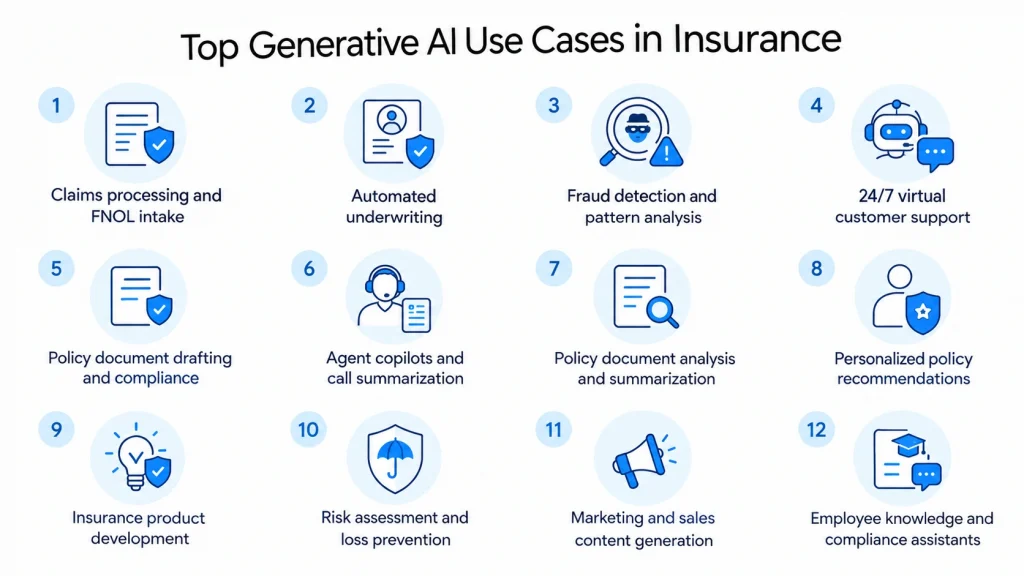
1. Claims processing and FNOL intake
Claims teams deal with forms, emails, medical records, images, and previous claim documents. Reviewing all this information manually can slow down claims and increase administrative work.
Generative AI can extract important details, summarize claims, classify cases, and route them to the right teams. It can turn a First Notice of Loss (FNOL) submission into a concise summary containing incident details, claimant information, damage, and relevant policy information. This mirrors how generative AI in healthcare already helps providers summarize medical records and case files.
This helps claims professionals start with organized information instead of reviewing every document from scratch. Complex claims can still be escalated to adjusters for detailed assessment and approval.
2. Automated underwriting
Underwriters review applications, policy histories, property details, inspection reports, and third-party information before assessing risk. Much of this work involves finding relevant information across lengthy and unstructured documents.
For insurers exploring gen AI in insurance, underwriting can be a valuable area for automation. Generative AI can extract risk factors, identify missing information, compare details with underwriting guidelines, and prepare risk summaries.
Underwriters can then spend less time gathering information and more time evaluating complex risks. The final underwriting decision can remain with qualified professionals.
Make Underwriting Faster With AI-Powered Workflows
Our GenAI team helps insurers automate document analysis, extract risk factors, and prepare summaries while keeping final underwriting decisions with your experts.
3. Fraud detection and pattern analysis
Fraud investigators often examine claim notes, payment records, customer information, emails, and historical claims to find suspicious activity. Important clues may be scattered across multiple documents and systems.
Generative AI can analyze this unstructured information and surface inconsistencies, unusual relationships, or patterns that require further investigation. It can also summarize the information behind a potential fraud case, a capability that mirrors how generative AI in financial services already strengthens fraud detection across banks and payment providers.
GenAI should complement traditional fraud detection models rather than replace them. Investigators can use its findings as additional context when reviewing suspicious claims.
4. 24/7 virtual customer support
Customers frequently need answers about coverage, deductibles, policy terms, claims, and routine service requests. Waiting for an agent can create frustration, particularly outside regular business hours.
Generative AI can power insurance-specific virtual assistants that understand customer questions and generate responses using approved policy and customer information. For example, an assistant can explain relevant coverage terms or provide an update on a claim. This approach builds on lessons from generative AI in ecommerce, where always-on assistants already handle high volumes of customer queries.
Connecting the assistant to trusted insurance data is important for improving response accuracy. Complex or sensitive requests can be transferred to human representatives when needed.
5. Policy document drafting and compliance
Insurance teams create endorsements, renewal communications, loss run reports, regulatory summaries, and other documents regularly. Preparing these documents manually can consume significant employee time.
Generative AI can use approved information and predefined requirements to create initial drafts. It can also summarize regulatory requirements and help employees identify information that needs attention.
Because insurance documents can have legal and regulatory implications, generated content should go through human review. Audit trails, access controls, and compliance checks should also be built into the workflow.
6. Agent copilots and call summarization
Agents often search for product information while speaking with customers. They also spend time documenting calls, updating records, and preparing follow-up communications.
An AI copilot can retrieve relevant product information, suggest responses, recommend next actions, and summarize conversations automatically. After a call, it can turn the discussion into structured notes and draft follow-up messages.
These AI applications in insurance can reduce administrative work without removing agents from customer interactions. Agents can review AI-generated information and remain responsible for the final response.
7. Policy document analysis and summarization
Insurance policies can contain lengthy clauses, exclusions, deductibles, coverage limits, and conditions. Finding specific information within these documents can require significant manual effort.
Generative AI can extract key policy details and create concise summaries for employees. It can also help compare policy versions and identify changes in coverage, exclusions, or other important clauses.
For example, an employee could ask the system to compare two versions of a policy and highlight the major differences. This makes complex policy information easier to review while keeping the original documents available for verification.
8. Personalized policy recommendations
Customers may have coverage gaps that are difficult to identify during standard interactions. Their existing policies, customer information, and changing needs may also sit across different systems.
Generative AI for insurance can analyze this information to identify potentially relevant policies, riders, or add-ons. It can then generate personalized explanations for why a particular coverage option may be relevant, much like generative AI in retail powers personalized product recommendations for shoppers.
For insurers, this can support more targeted cross-selling and upselling. For customers, personalized recommendations can make insurance options easier to understand and evaluate.
9. Insurance product development
Developing a new insurance product requires research into customer needs, market trends, emerging risks, and feedback from existing products. Teams must then turn these insights into product concepts, policy wording, and supporting documentation.
Generative AI can analyze customer feedback, market research, and emerging-risk information to identify recurring themes and potential opportunities. It can also support product ideation and generate initial drafts of policy wording and product documents.
Product teams can use these outputs as a starting point for review and refinement. This can reduce time spent on research and initial documentation while keeping product decisions with experienced professionals.
10. Risk assessment and loss prevention
Insurers collect risk information through inspection reports, historical records, property details, and other sources. Turning these inputs into clear risk assessments can require considerable analysis.
Generative AI can combine this information and create concise risk summaries. It can also support scenario analysis by showing how different conditions could affect potential losses and generating recommendations for risk mitigation. This use case parallels how generative AI for manufacturing supports predictive maintenance and inspection-based risk analysis.
For example, insurers can use GenAI to summarize property risks and suggest preventive measures. This allows insurers and policyholders to focus on reducing potential losses rather than only responding after they occur.
11. Marketing and sales content generation
Insurance marketing teams create emails, campaigns, product descriptions, sales proposals, and customer communications for different audiences. Producing personalized content across multiple channels can become time-consuming.
Generative AI can adapt messaging based on customer segments, products, channels, and languages. It can create initial versions of campaigns, sales proposals, product content, and personalized customer communications, similar to how GenAI for sales helps teams draft outreach and proposals faster.
Marketing teams can then review and refine the generated content before publishing it. This approach helps insurers produce more relevant communication at scale while maintaining consistent messaging.
12. Employee knowledge and compliance assistants
Insurance employees regularly search for underwriting guidelines, standard operating procedures, product documents, regulatory requirements, and internal policies. Finding the right information across multiple sources can slow down everyday decisions.
An internal GenAI assistant can retrieve information from approved company sources and provide concise answers with relevant context. An underwriter could use it to check a guideline, while a service employee could quickly find the correct procedure for a customer request.
These generative AI insurance use cases can reduce information-search time and support more consistent decision-making. For gen AI in the insurance industry, controlled data sources and appropriate access permissions are essential for reliable internal assistants.
The value of generative AI in insurance extends beyond customer chatbots and content generation. The strongest opportunities often involve document-heavy workflows, repetitive tasks, and processes that require employees to search through large amounts of information.
Let’s Build Secure GenAI Around Your Insurance Workflows
Space-O Technologies helps insurers build secure GenAI solutions with controlled data access, system integrations, and human oversight for sensitive insurance processes.
What are the Benefits of Generative AI in Insurance?
Gen AI in insurance delivers measurable value across cost, speed, and customer experience. Carriers see gains across nearly every department they run. The returns stay consistent and easy to track. Here’s how each benefit plays out in practice.
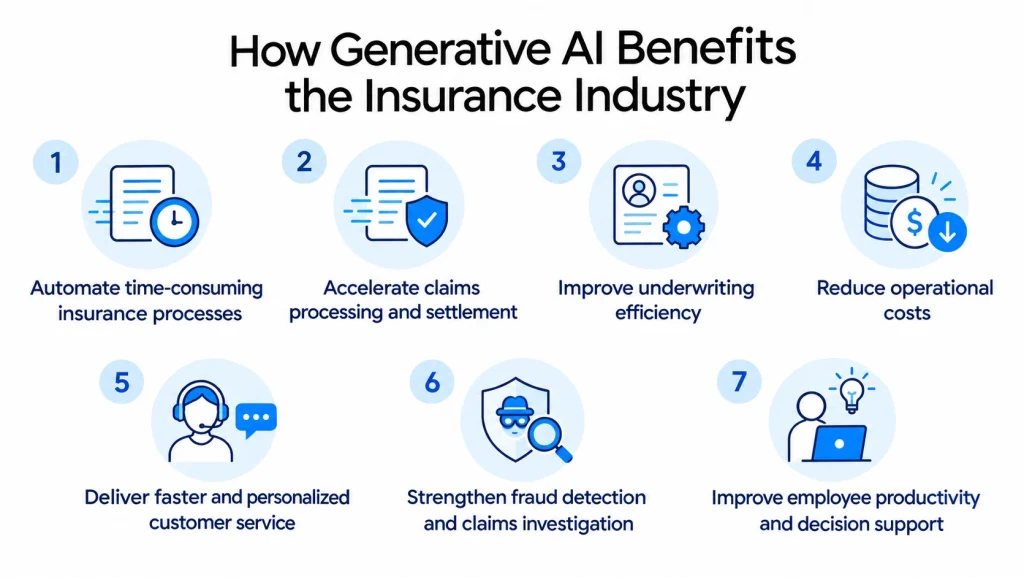
1. Automate time-consuming insurance processes
Generative AI insurance tools remove hours of repetitive administrative work from employees’ plates. They automate document extraction, claim summaries, policy analysis, email drafting, and report generation. Tasks that once needed manual review now take seconds. Staff spend more time on judgment-based work instead.
2. Accelerate claims processing and settlement
Generative AI for insurance speeds up claims from first notice to final settlement. It handles FNOL intake, document review, claim summarization, and information retrieval almost instantly. Adjusters no longer sort through scattered files manually. Straightforward claims settle faster, and policyholders wait less.
3. Improve underwriting efficiency
Underwriting ranks among the strongest generative AI use cases in insurance today. It reviews applications, policy histories, risk documents, and third-party data within moments. The system flags missing information automatically. This shortens the quote-to-bind cycle considerably.
4. Reduce operational costs
AI applications in insurance help carriers control operational costs across multiple departments. Automation reduces administrative workloads, manual data entry, and repetitive work. Teams handle higher volumes without adding headcount. Lower costs per policy or claim strengthen margins over time.
5. Deliver faster and personalized customer service
Gen AI in the insurance industry is reshaping how carriers support customers daily. It powers 24/7 assistants that answer policy questions and share claim-status updates. Multilingual capabilities serve diverse customers without extra language specialists. Customers get personalized answers immediately, instead of waiting on hold.
6. Strengthen fraud detection and claims investigation
Fraud detection stands out among the most valuable generative AI insurance use cases. It analyzes claim notes, payment records, and historical information for inconsistencies. The system flags suspicious activity and drafts investigator summaries. This sharpens existing fraud models without replacing them.
7. Improve employee productivity and decision support
Generative AI in insurance also strengthens productivity through copilots and internal assistants. Agent copilots retrieve information, summarize calls, and draft responses in real time. Internal assistants give staff instant access to compliance and policy guidelines. New employees ramp up faster as a result.
These benefits show why insurers keep expanding this technology across their operations. Each addresses a specific, measurable pain point. Together, they justify moving past pilots into full deployment.
Turn Insurance Use Cases Into Working Solutions
Space-O Technologies builds generative AI tools around your claims, underwriting, and customer service workflows, so results show up fast.
How to Implement Generative AI in Insurance
Implementing generative AI in insurance starts with auditing your data and testing low-risk internal workflows first. Successful adoption means moving beyond high-level ideas into structured, step-by-step execution. Here’s exactly how to get generative AI insurance projects off the ground.
Step 1: Identify high-value insurance use cases
Start by pinpointing where manual effort runs highest across your operations. Claims, underwriting, and customer service typically offer the fastest, most measurable wins. Working with GenAI consulting services can help insurers prioritize the right opportunity instead of guessing. Pick one or two generative AI use cases in insurance instead of transforming everything at once.
- Map your bottlenecks: Find the workflows where staff spend the most time on repetitive, manual tasks.
- Set measurable goals: Define what success looks like in speed, accuracy, or cost before you start.
- Prioritize low-risk areas: Choose internal use cases first, since customer-facing tools carry higher compliance stakes.
Step 2: Assess data and technology readiness
Clean, well-organized data determines whether gen AI in insurance actually performs as expected. Poor data quality is the single biggest reason generative AI insurance pilots fail early. Insurers unsure where to start often review generative AI consulting companies that specialize in data readiness assessments.
- Audit your data: Find out exactly where your company stores files, claims, and policy records.
- Remove duplicates and errors: Clear out old, inaccurate, or conflicting records before training any model.
- Secure your storage: Set up strict access rules that protect client privacy and meet legal standards.
Step 3: Choose the right AI models and architecture
Matching the right model to the right task drives every strong generative AI use case in insurance. A language model suits drafting and summarization, while multimodal models handle image-based claims work. Retrieval-augmented generation connects the AI to your own policy documents, so its answers stay grounded in your company’s actual rules rather than generic assumptions. Comparing established generative AI development agencies can help insurers choose the right technology partner for this step.
Step 4: Start with internal workflows before customer-facing tools
Generative AI for insurance delivers the safest early wins through internal, employee-facing use cases. Testing internally first builds confidence before the technology reaches a policyholder directly.
- Summarize documents: Let AI read long emails, chat logs, or medical reports to save staff hours.
- Assist employees: Give agents and adjusters AI co-pilots to draft notes and locate policy details quickly.
- Test slowly and deliberately: Learn exactly how the system behaves internally before it talks to customers.
Step 5: Integrate GenAI with existing systems
AI applications in insurance only create value once connected to the systems teams already use daily. Disconnected tools rarely survive past the pilot stage. Working with a dedicated generative AI integration company helps insurers connect new AI models to legacy platforms without disrupting daily operations.
- Connect legacy software: Link modern AI models to older, established policy and claims databases.
- Add search enhancement: Connect company handbooks to a secure database, so AI answers reflect only your own rules.
Step 6: Establish security and governance
Strong governance keeps gen AI in the insurance industry safe, compliant, and genuinely trustworthy. Governance built in from day one prevents far bigger problems down the line.
- Create an AI council: Form a team that reviews new tools for safety, fairness, and accuracy.
- Guard against hallucinations: Use safeguards that catch AI-generated errors before they reach a customer.
- Keep humans in control: Require expert approval on final decisions in underwriting and claims payouts.
Step 7: Test, measure, and scale
Run a controlled pilot before expanding generative AI insurance use cases company-wide. Track processing speed, accuracy, and cost savings throughout the trial period. Expand only after the pilot proves clear, repeatable value across real workflows.
This sequence turns generative AI in insurance from a concept into a working, compliant system. Skipping data readiness or governance remains the most common reason pilots stall. Carriers that follow this order build lasting momentum instead of one-off experiments.
What are the Challenges of Generative AI in Insurance?
Generative AI in insurance introduces real risks that carriers must manage carefully. These challenges don’t rule out adoption, but they do demand careful planning. Understanding both the risk and the fix helps insurers move forward with confidence.
Data privacy and security
Insurance data includes sensitive personal and medical details that demand strict protection. Feeding this information into generative AI systems without safeguards creates serious exposure risk.
How to address this challenge:
- Use approved, secure platforms: Avoid public AI tools for any sensitive claims or policyholder data.
- Encrypt data at every stage: Protect information both in storage and during active processing.
- Limit access by role: Give employees access only to the data their specific job requires.
Accuracy and AI hallucinations
Generative AI can produce confident-sounding but incorrect information in regulated decisions. This risk grows more serious in underwriting, claims denials, or customer-facing communications.
How to address this challenge:
- Ground outputs in verified data: Use retrieval-augmented generation to base answers on real company documents.
- Add human review checkpoints: Require staff to verify AI-generated content before it reaches customers.
- Monitor outputs continuously: Track error rates and flag patterns that signal recurring accuracy problems.
Regulatory compliance
State and federal insurance regulators expect explainable, auditable AI decisions at every step. Requirements keep evolving as generative AI use cases in insurance continue expanding across the industry.
How to address this challenge:
- Track regulatory changes closely: Assign a compliance owner to monitor evolving state and federal AI rules.
- Document every AI decision: Keep clear records showing how and why a system reached its output.
- Build compliance into design: Involve legal and compliance teams from the earliest planning stages.
Bias and fairness
Models trained on historical data can inherit past biases, leading to unfair outcomes. This becomes especially risky in pricing, underwriting, and coverage decisions that affect real customers.
How to address this challenge:
- Audit training data regularly: Check for patterns that could unfairly disadvantage specific customer groups.
- Test outputs for fairness: Run periodic checks comparing decisions across different demographic segments.
- Involve diverse review teams: Include varied perspectives when evaluating AI behavior and outcomes.
Human oversight and customer trust
Removing people entirely from AI-driven decisions risks eroding customer trust during a claim. Insurance remains a relationship-driven business, especially in moments of genuine customer need.
How to address this challenge:
- Keep humans in final decisions: Require expert sign-off on underwriting approvals and claim payouts.
- Be transparent with customers: Let policyholders know when they’re interacting with an AI system.
- Offer an easy human handoff: Give customers a clear path to a live representative whenever needed.
None of these challenges are reasons to avoid generative AI in insurance altogether. They’re reasons to build the right governance and oversight from day one. Carriers who address these risks early tend to scale faster and with fewer costly setbacks.
Avoid The Risks Slowing Other Insurers Down
Space-O Technologies handles data privacy, bias, and compliance from day one, so your generative AI project stays audit-ready.
What is the Future of Generative AI in Insurance?
These shifts align with current generative AI trends shaping enterprise adoption more broadly. Generative AI in insurance is moving toward autonomous workflows and hyper-personalized policy management. Artificial intelligence is shifting from a side experiment into a core, CEO-level strategy.
- Autonomous AI agents: By 2030, agentic AI will handle claims routing, document verification, and policy administration with minimal human input.
- Embedded intelligence: Generative AI will move out of standalone tools and integrate directly into core policy, CRM, and claims systems.
- Hyper-personalization at scale: Real-time data from wearables, telematics, and IoT devices will let insurers price and customize coverage dynamically.
- AI-powered co-pilots: Underwriters, agents, and adjusters will rely on AI to draft communications, summarize contracts, and speed up decisions.
These trends show that generative AI in insurance is becoming a permanent fixture, not a passing pilot. Carriers building strong data and governance foundations now will adopt these advances with far less friction.
How Space-O Technologies Delivers Generative AI Solutions for Insurance
Space-O Technologies has built custom AI solutions for businesses since 2010. Our team designs generative AI systems tailored to specific insurance workflows, not generic, off-the-shelf tools. Whether you need faster claims processing, smarter underwriting support, or a customer-facing virtual assistant, we build it around your existing systems.
Our engineers handle everything from data readiness assessments to model selection, integration, and ongoing support. We prioritize security and governance from the first conversation, never as an afterthought. This approach helps insurance carriers, agencies, and insurtech companies move past pilots into working, compliant solutions.
We work closely with your compliance, IT, and operations teams at every stage of the project. This collaboration ensures the final solution fits your data, your regulations, and your daily workflows. If you’re ready to explore generative AI for your insurance business, our GenAI developers for hire can help you get started.
Frequently Asked Questions
What is generative AI in insurance?
Generative AI in insurance uses advanced AI models to understand insurance data and generate new content. It can process information from policy documents, claims, emails, images, and customer records to create summaries, responses, documents, and other outputs.
How is generative AI being used in insurance?
Generative AI is being used across claims processing, underwriting, fraud investigation, customer service, policy analysis, and agent assistance. Insurers also use it for document drafting, personalized recommendations, product development, marketing, and employee knowledge support.
What are the most common generative AI use cases in insurance?
The most common generative AI use cases in insurance include claims processing, underwriting, fraud investigation, customer support, policy analysis, and agent assistance. Insurers also use it for document drafting, personalized recommendations, product development, marketing, and employee knowledge support.
How much does it cost to implement generative AI in insurance?
A generative AI solution for insurance typically costs $30,000 to $300,000+, depending on its scope and complexity. A basic AI assistant may cost less, while solutions involving claims, underwriting, enterprise data, and multiple system integrations can require significantly higher investment. The final cost depends on AI models, data preparation, security requirements, integrations, customization, and ongoing maintenance.
How can generative AI improve insurance claims processing?
Generative AI can extract information from claim forms, emails, images, and supporting documents. It can summarize claims, organize relevant details, classify cases, and route them to the appropriate teams. This reduces manual document review and helps claims professionals process information faster.
Can generative AI help insurance companies detect fraud?
Yes, generative AI can support fraud detection by analyzing claim notes, emails, customer information, and historical records. It can identify inconsistencies, summarize suspicious cases, and surface patterns for investigators. It works best alongside traditional fraud detection models and human review.
How can insurers use generative AI for underwriting?
Insurers can use generative AI to review applications, policy histories, inspection reports, and underwriting guidelines. It can extract risk factors, identify missing information, compare details with guidelines, and generate risk summaries. Underwriters can then use these insights to support their final decisions.
What types of data can generative AI process in insurance?
Generative AI can process text, documents, images, emails, claim forms, policy documents, customer records, and other unstructured insurance data. Multimodal AI can also analyze different data types together, such as claim photos and written reports.
How can generative AI personalize insurance customer experiences?
Generative AI can analyze customer information, existing coverage, and interaction history to generate personalized responses and recommendations. It can help explain policy terms, suggest relevant coverage options, and provide tailored support across customer interactions.
Is generative AI safe for handling sensitive insurance data?
Generative AI can be used with sensitive insurance data when appropriate security, access controls, encryption, data governance, and human oversight are implemented. Insurers should also use controlled data sources and validate AI outputs to reduce privacy, security, and accuracy risks.



 All our projects are secured by NDA




 4.8
4.8