
 By
By 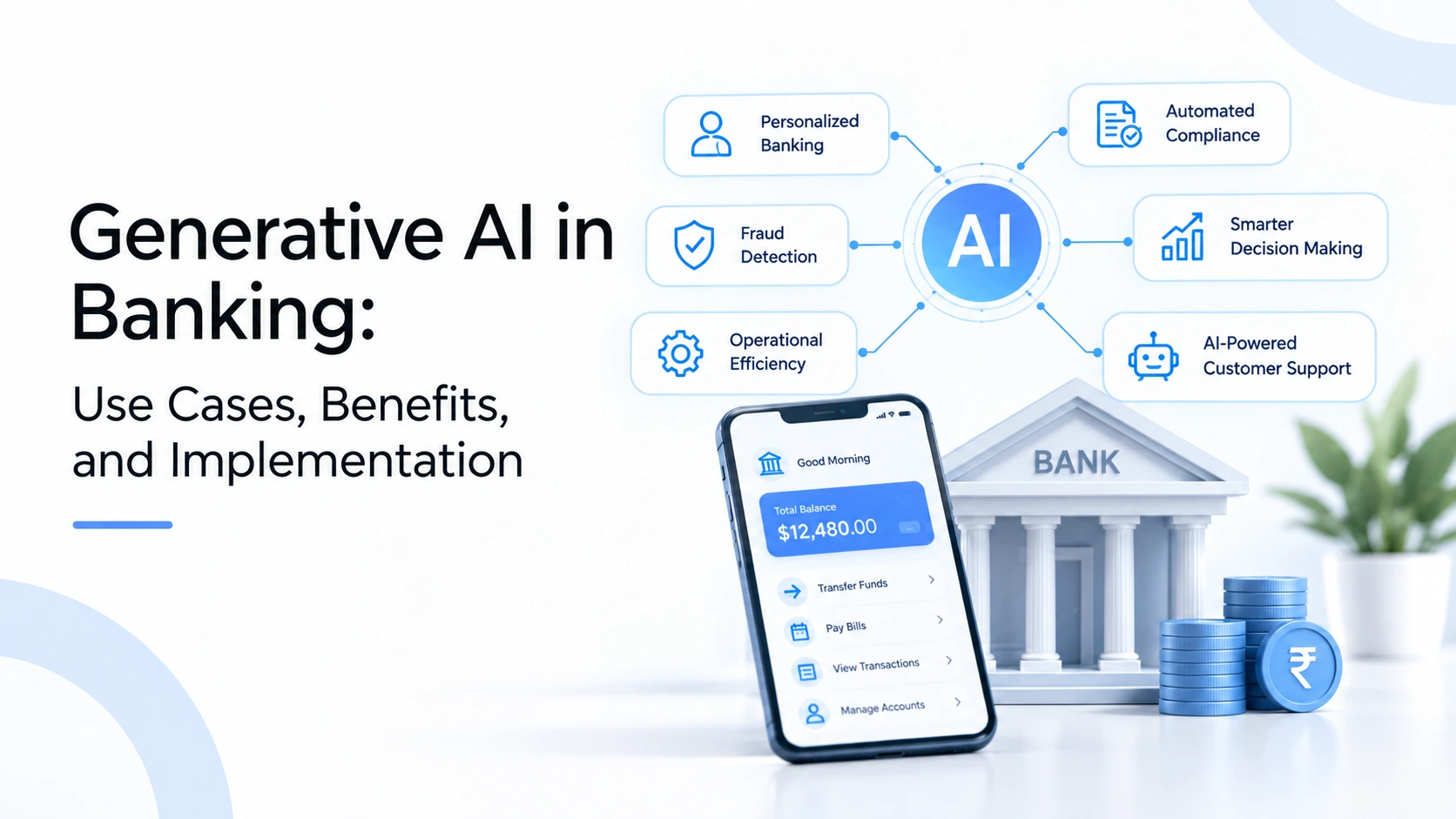
Contents
Banking teams still spend hours handling work that requires searching, reviewing, and interpreting large volumes of data. Customers wait for answers to simple questions, compliance teams review transaction narratives manually, and loan officers work through scattered documents to assess risk. Generative AI in banking can reduce this manual workload by bringing these processes together and helping teams work with banking data more efficiently.
But adding GenAI to banking workflows is not as simple as deploying a chatbot. Banks must protect sensitive customer data, maintain regulatory compliance, validate AI outputs, and integrate new capabilities with legacy core banking systems. These requirements make security, accuracy, governance, and implementation strategy critical to any GenAI initiative.
With the right approach to gen AI in banking, financial institutions can apply generative AI across customer onboarding, credit risk assessment, fraud detection, compliance, document processing, and other data-heavy workflows. For banks moving beyond experimentation, a GenAI software development company can help turn high-value use cases into production-ready solutions.
In this guide, we explore the key generative AI use cases in banking, their benefits and challenges, security considerations, and implementation strategies. You’ll also learn how banks can move from an initial GenAI pilot to a reliable production-ready solution.
Generative AI in Banking: Market Size and Adoption Trends
The generative AI banking market is growing quickly, but production adoption still lags behind the hype. Recent industry research shows a clear gap between interest and actual, measurable results.
- Precedence Research estimates the global generative AI in banking and finance market at $1.68 billion in 2025, reaching $26.34 billion by 2035 at a 31.72% CAGR.
- BCG reports that only 5 to 10% of banks use generative AI effectively in daily operations, even though most have already launched a pilot.
- According to the American Bankers Association, 64% of financial institutions implementing GenAI prioritize improving customer experience, followed by customer service (58%) and internal productivity (55%).
These figures tell a consistent story. Interest in generative AI for banking is high, but most institutions haven’t moved past the pilot stage. The banks pulling ahead aren’t the ones with the most advanced models. They’re the ones solving integration, governance, and data readiness before scaling anything.
What is Generative AI in Banking?
Generative AI in banking uses AI models to create, summarize, and analyze financial information. Banks use it to automate tasks, improve customer service, detect fraud, personalize financial guidance, and support employees. Unlike traditional AI, GenAI can generate new content based on the data and context it receives. Our overview of generative AI fundamentals covers how the technology works more broadly.
How does generative AI work in banking?
Generative AI works in banking through three key steps: data ingestion, pattern recognition, and content generation. Banks provide secure AI models with financial data; the models identify relevant patterns and context, and then generate useful outputs from that information.
- Data ingestion: Banks provide financial documents, emails, loan applications, transaction histories, and other relevant data to secure AI models.
- Pattern recognition: The AI processes language and financial relationships to identify relevant information and context within the data.
- Content generation: The model uses this context to generate outputs such as credit summaries, regulatory updates, and customer service responses.
This process allows banks to turn large volumes of financial information into useful outputs while reducing manual work across banking operations.
Build Secure GenAI Solutions For Your Bank
We help banks turn high-value GenAI use cases into secure, production-ready solutions that fit existing systems, compliance needs, and workflows.

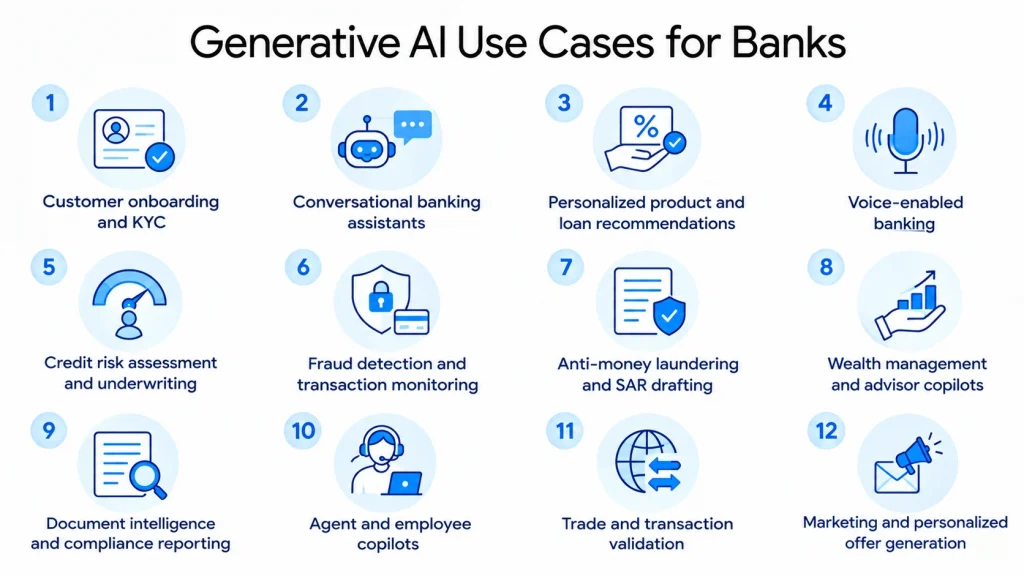
Top 12 Generative AI Use Cases in Banking
Generative AI supports different workflows depending on where they sit in a bank’s operations. Front office teams handle customers directly, middle office teams manage risk and compliance, and back office teams keep everything running behind the scenes. Here’s where generative AI delivers the clearest results across all three.
1. Customer onboarding and KYC
Opening a new account traditionally means manual document checks, repeated data entry, and slow verification. Generative AI can extract data from passports, utility bills, and ID documents automatically, then verify it against supporting records, much like generative AI in healthcare already helps providers extract and verify data from patient records.
Airwallex reported a 50% reduction in false-positive KYC alerts after deploying a generative AI copilot for its compliance team, which also cut unnecessary manual reviews significantly. Faster, more accurate onboarding means fewer drop-offs and quicker account activation for genuine customers.
2. Conversational banking assistants
Customers expect instant answers about balances, transactions, and account questions at any hour. Generative AI powers chatbots that understand natural language and respond with context-aware, accurate information, an approach that builds on lessons from generative AI in ecommerce, where always-on assistants already handle high volumes of customer queries.
Wells Fargo’s assistant, Fargo, processed over 245 million interactions in 2024 using a privacy layer that keeps personal data from ever reaching the underlying model. Complex or sensitive requests still route to a human representative when needed.
3. Personalized product and loan recommendations
Generic product offers rarely match what a specific customer actually needs. Generative AI analyzes spending patterns, credit behavior, and life stage indicators to recommend relevant loans, cards, or investment products, much like generative AI in retail powers personalized product recommendations for shoppers.
This approach replaces one-size-fits-all marketing with recommendations that feel genuinely useful to the customer. Banks also use it to generate personalized messaging that explains why a specific offer fits.
4. Voice-enabled banking
Voice interfaces let customers check balances, receive fraud alerts, and complete simple transactions hands-free. Generative AI powers the natural-language understanding behind these voice assistants, making interactions feel conversational rather than scripted.
It reduces support costs while improving accessibility for customers who prefer voice over typing. Voice biometrics layered on top also strengthens security during these interactions.
5. Credit risk assessment and underwriting
Underwriters traditionally spend hours reviewing applications, income documents, and third-party data before reaching a decision. Generative AI extracts risk factors, flags missing information, and prepares concise summaries for review.
This lets underwriters spend less time gathering data and more time evaluating genuinely complex applications. The final credit decision still rests with qualified underwriting staff.
6. Fraud detection and transaction monitoring
Fraud patterns shift constantly, and reviewing every flagged transaction manually can’t keep pace. Generative AI analyzes patterns across millions of transactions simultaneously, surfacing anomalies that traditional rule-based systems might miss.
Mastercard’s Decision Intelligence Pro platform reported a 20 to 300% boost in fraud detection accuracy, along with over 85% fewer false positives. Fewer false positives also means fewer legitimate transactions get blocked, which improves the customer experience.
7. Anti-money laundering and SAR drafting
Compliance teams investigating suspicious activity often face a backlog of alerts that outpaces their capacity to file reports. Generative AI reads flagged transaction data an investigator has already reviewed, then drafts the regulatory narrative explaining why the activity looked suspicious.
This is one of the clearest examples of why secure generative AI solutions for banking matter, since every draft still requires mandatory human sign-off before filing. No regulator accepts a fully automated suspicious activity report, regardless of how accurate the drafting model is.
8. Wealth management and advisor copilots
Financial advisors often need answers about proprietary products, fund structures, or research that a general-purpose model was never trained on. Retrieval-augmented generation grounds every response in a firm’s actual documentation, reducing the risk of confident but incorrect answers.
Morgan Stanley’s advisor assistant indexes roughly 350,000 research documents and is used by over 98% of its advisor teams. A research lookup that once took 30 minutes now takes seconds, with every answer citing its source document.
9. Document intelligence and compliance reporting
Banks generate enormous volumes of loan documents, regulatory filings, and internal reports that traditionally require manual review. Generative AI reads unstructured documents, extracts key details, and drafts summaries far faster than a human reviewer working alone.
Citigroup gave roughly 140,000 employees access to internal tools that summarize and compare documents, cutting one account opening review from 60 minutes to 15. Every generated summary still passes through human review before it informs a final decision.
10. Agent and employee copilots
Bank employees regularly search across policies, product guides, and compliance requirements to answer routine questions. An internal generative AI assistant retrieves this information instantly and provides concise, sourced answers.
New employees ramp up faster when they can ask questions instead of digging through manuals themselves. This use case mirrors how generative AI in insurance already supports claims and underwriting staff with similar internal copilots.
11. Trade and transaction validation
Validating trades and transactions traditionally means cross-referencing multiple systems and market data sources manually. Generative AI ingests transaction data, applies predictive models, and flags anomalies in real time against live market conditions, a pattern that parallels how generative AI for manufacturing supports predictive maintenance through similar anomaly detection.
This reduces the manual bottlenecks that slow down settlement and increase operational risk. Faster validation also means fewer errors reach downstream systems before anyone catches them.
12. Marketing and personalized offer generation
Producing compliant, personalized marketing content across many customer segments takes significant time from small marketing teams. Generative AI drafts multiple variations of a single offer, each tailored to a specific audience and pre-checked against fair lending requirements, similar to how generative AI for sales helps teams draft outreach and proposals faster.
Banks using this kind of personalization report meaningfully stronger revenue growth compared to peers who still rely on generic messaging. Marketing teams review and refine every draft before it reaches customers.
The value of generative AI in banking extends well beyond customer-facing chatbots. The strongest opportunities usually involve document-heavy workflows, repetitive analysis, and processes that require staff to search through large amounts of information quickly.
Move Your Banking GenAI Pilot Into Production
We help banking teams overcome integration, governance, and security challenges while building GenAI solutions ready for real-world use.
What are the Benefits of Generative AI in Banking?
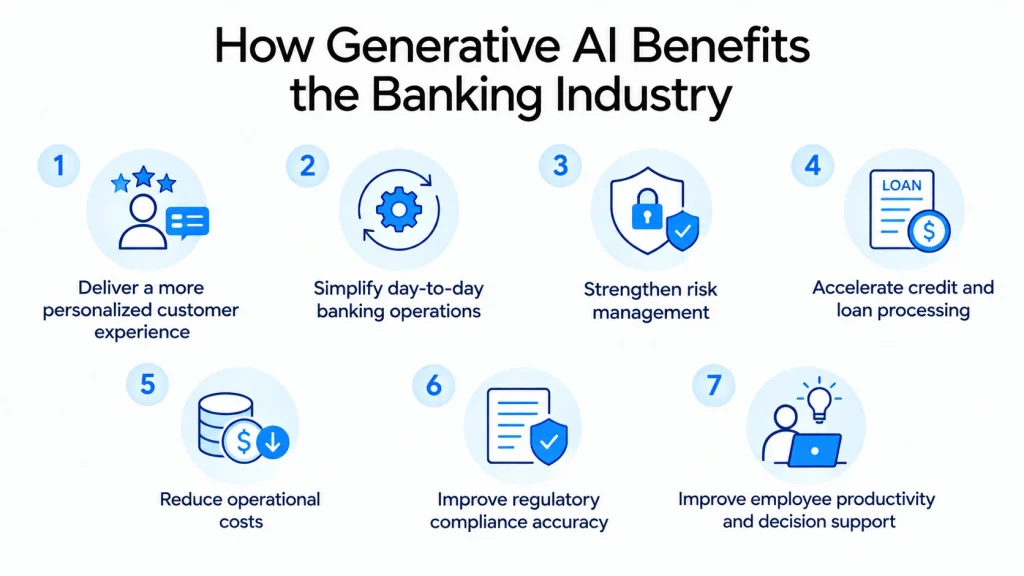
Generative AI for banking delivers measurable value across cost, speed, and customer experience. Institutions see gains across nearly every department they run. Here’s how each benefit plays out in practice.
1. Deliver a more personalized customer experience
Generative AI banking tools analyze customer behavior to generate tailored product recommendations and communications. Customers get advice and offers that reflect their actual financial situation, not a generic template. This builds stronger loyalty and improves engagement across every channel. Marketing and service teams both benefit from content that feels genuinely relevant.
2. Simplify day-to-day banking operations
Automating document processing, data entry, and compliance checks removes significant manual workload. Tasks that once required an employee’s full attention now happen automatically in the background. This reduces bottlenecks across onboarding, lending, and servicing workflows. Staff spend more time on decisions that genuinely need human judgment.
3. Strengthen risk management
Generative AI analyzes market trends, customer portfolios, and macroeconomic indicators to support more accurate risk assessments. This helps institutions spot potential issues before they escalate into losses. Credit, fraud, and market risk all benefit from faster, more consistent analysis. Risk teams gain earlier visibility into problems that used to surface too late.
4. Accelerate credit and loan processing
Generative AI use cases in financial services increasingly center on faster, more accurate credit decisions. Reviewing spending patterns and financial history through AI shortens the path from application to approval considerably. This benefits both the bank’s efficiency and the customer’s experience. Faster decisions also reduce the chance that a strong applicant walks away to a competitor.
5. Reduce operational costs
Automating document processing, transaction monitoring, and routine customer support cuts the need for extensive manual effort. Teams handle higher volumes without proportionally increasing headcount. Fewer errors also mean fewer expensive corrections down the line. Lower costs per transaction strengthen margins across the institution over time.
6. Improve regulatory compliance accuracy
Generative AI drafts compliance summaries and monitors transactions for irregularities more consistently than manual review alone. This reduces the risk of human error in reporting and documentation. Compliance officers still validate every output, but they start from an organized draft instead of a blank page. Consistent documentation also makes regulatory audits considerably smoother.
7. Improve employee productivity and decision support
Agent copilots and internal assistants retrieve information, summarize documents, and draft responses in real time. Staff spend less time searching for answers and more time applying their expertise. New employees also ramp up faster with instant access to policies and procedures. Better-supported teams ultimately deliver a stronger experience to every customer they serve.
These benefits explain why banks keep expanding their investment in this technology. Each one addresses a specific, measurable pain point institutions face daily. Together, they build a strong case for moving past pilots into full production.
Is Generative AI Secure for Banking? What to Look for in a Solution
Generative AI can be secure for banking when it’s built with the right architecture from the start. Security in this context means more than encryption. It means customer data never reaches a model in a form that could expose personal information, model decisions stay explainable, and every sensitive output gets human review before it matters.
A genuinely secure generative AI solution for banking includes several specific safeguards:
- PII protection by design: Customer data should be stripped or tokenized before it reaches the underlying model, the same approach Wells Fargo uses across 245 million assistant interactions.
- Grounded, retrieval-based responses: Retrieval-augmented generation keeps answers tied to verified internal documents instead of the model’s general training data, reducing hallucination risk in high-stakes decisions.
- Model risk validation readiness: Solutions should support documentation, testing, and independent challenge processes that regulators expect, not just accurate outputs.
- Full audit trails: Every generated output should be traceable to its source data and reviewed by a named human before it affects a customer or a regulatory filing.
- Role-based access controls: Employees should only reach the data their specific role requires, limiting exposure if any single account is compromised.
Solve Complex Banking Workflows With GenAI
We help banks automate document-heavy processes, improve customer support, and strengthen operations with GenAI built around their systems.
How to Implement Generative AI in Banking
Implementing generative AI in banking starts with a focused pilot and clean, well-governed data. Successful adoption means moving beyond high-level ideas into structured, step-by-step execution. Here’s exactly how to get a generative AI banking project off the ground.
Step 1: Identify high-value banking use cases
Start by pinpointing where manual effort runs highest across your operations. Customer service, document processing, and fraud detection typically offer the fastest, most measurable wins. Pick one or two generative AI use cases in banking instead of transforming everything at once.
- Find the workflows where staff spend the most time on repetitive, manual tasks.
- Define what success looks like in speed, accuracy, or cost before you start.
- Choose internal use cases first, since customer-facing and credit decisions carry higher regulatory stakes.
Working with a generative AI consulting company helps banks prioritize the right opportunity instead of guessing. Pick one or two generative AI use cases in banking instead of transforming everything at once.
Step 2: Assess data and technology readiness
Clean, well-organized data determines whether gen AI in banking actually performs as expected. Poor data quality remains the single biggest reason generative AI banking pilots fail early.
- Find out exactly where your institution stores customer records, transactions, and documents.
- Clear out old, inaccurate, or conflicting records before training any model.
- Set up strict access rules that protect customer privacy and meet regulatory standards.
Step 3: Choose the right AI models and architecture
Matching the right model to the right task drives every strong generative AI use case in banking. A language model suits drafting and summarization, while retrieval-augmented generation grounds answers in your bank’s own policies and research. Comparing established generative AI companies can help institutions choose the right technology partner for this step.
Step 4: Build security and privacy into the architecture
Security cannot be added after a model is already built. Strip or tokenize personal data before it reaches the model, and design retrieval systems that ground every answer in verified sources. This is the step where the secure generative AI solutions for banking mentioned earlier actually get built, not just described.
Step 5: Start with internal workflows before customer-facing tools
Generative AI for banking delivers the safest early wins through internal, employee-facing use cases. Testing internally first builds confidence before the technology reaches a customer directly.
- Let AI read long reports, emails, or filings to save staff hours.
- Give service and compliance staff AI copilots to draft responses and locate policy details quickly.
- Learn exactly how the system behaves internally before it talks to customers.
Step 6: Integrate GenAI with legacy core systems
AI applications in banking only create value once connected to the systems teams already use daily. Disconnected tools rarely survive past the pilot stage. Working with a GenAI integration company helps banks connect new AI models to core banking platforms without disrupting daily operations.
Step 7: Establish governance and model risk validation
Strong governance keeps generative AI in banking safe, compliant, and genuinely trustworthy. Form a team that reviews new tools for safety, fairness, and accuracy before deployment. Require expert approval on every decision that touches credit, compliance, or customer funds. Document how each model reaches its output, since regulators will eventually ask.
Step 8: Test, measure, and scale
Run a controlled pilot before expanding generative AI banking use cases institution-wide. Track processing speed, accuracy, and cost savings throughout the trial period. Expand only after the pilot proves clear, repeatable value across real workflows.
This sequence turns generative AI in banking from a concept into a working, compliant system. Skipping data readiness or governance remains the most common reason pilots stall before reaching production. Institutions that follow this order build lasting momentum instead of one-off experiments.
Build GenAI Around Your Banking Workflows
Our team develops secure GenAI solutions for document processing, fraud detection, customer service, and other banking workflows.
What are the Challenges of Generative AI in Banking?
Generative AI in banking introduces real risks that institutions must manage carefully. These challenges don’t rule out adoption, but they do demand careful planning. Understanding both the risk and the fix helps banks move forward with confidence.
Model risk validation and regulatory compliance
Regulators expect explainable, documented, and independently validated AI decisions. In April 2026, the OCC, Federal Reserve, and FDIC issued Bulletin 2026-13, replacing the prior SR 11-7 framework with a single interagency standard. Most off-the-shelf generative AI tools were never built to meet this bar.
How to address this challenge:
- Document every model decision: Keep clear records showing how and why a system reached its output.
- Build validation into the roadmap: Plan for independent challenge and testing before deployment, not after.
- Assign a compliance owner: Give one person clear responsibility for tracking evolving regulatory requirements.
Data privacy and security
Customer financial data demands strict protection under laws like the Gramm-Leach-Bliley Act and various state privacy rules. Feeding this information into generative AI systems without safeguards creates serious exposure risk.
How to address this challenge:
- Strip PII before it reaches the model: Use tokenization so sensitive data never touches the underlying language model directly.
- Encrypt data at every stage: Protect information both in storage and during active processing.
- Limit access by role: Give employees access only to the data their specific job genuinely requires.
Accuracy and hallucination in high-stakes decisions
Generative AI can produce confident-sounding but incorrect information in regulated decisions. This risk grows more serious in credit decisions, compliance filings, or customer-facing financial advice.
How to address this challenge:
- Ground outputs in verified data: Use retrieval-augmented generation to base answers on real, current source documents.
- Add human review checkpoints: Require staff to verify AI-generated content before it reaches a customer or a regulator.
- Monitor outputs continuously: Track error rates and flag patterns that signal recurring accuracy problems.
Bias and fairness in lending decisions
Models trained on historical data can inherit past biases, leading to unfair credit or lending outcomes. This becomes especially risky given fair lending laws that prohibit targeting based on protected characteristics.
How to address this challenge:
- Audit training data regularly: Check for patterns that could unfairly disadvantage specific customer groups.
- Test outputs for fairness: Run periodic checks comparing decisions across different demographic segments.
- Build compliance into targeting logic: Ensure personalized offers never rely on protected characteristics as inputs.
Legacy core system integration
Many banks still run on decades-old core banking platforms that weren’t designed for modern AI integration. Research from Backbase found that 63% of banks report real difficulty connecting chatbots to their legacy core systems.
How to address this challenge:
- Map integration points early: Identify exactly where new AI tools need to connect to legacy platforms.
- Use middleware where needed: Bridge older systems and modern AI tools without a full infrastructure overhaul.
- Pilot before full rollout: Test integration on a small scale before connecting every core system.
Auditability of AI-generated compliance narratives
Regulators require banks to explain every step of a model’s reasoning behind a compliance decision. A language model isn’t inherently auditable unless its output is specifically structured to preserve that reasoning chain.
How to address this challenge:
- Choose explainable AI tools: Prioritize systems that show their reasoning, not just a final answer.
- Maintain detailed audit trails: Log every input, output, and human approval tied to each decision.
- Require mandatory human sign-off: Never let a suspicious activity report or compliance filing go out fully automated.
None of these challenges are reasons to avoid generative AI in banking altogether. They’re reasons to build the right governance and oversight from day one. Institutions that address these risks early tend to scale faster and with fewer costly setbacks.
Turn Banking GenAI Ideas Into Working Solutions
Our GenAI team helps you select practical use cases, integrate AI with existing systems, and build secure solutions for daily banking operations.
Build, Buy, or Partner: Choosing the Right Approach
The right approach depends on your data sensitivity, governance capacity, and available talent. Most banks don’t need to build every generative AI capability from scratch, but a few factors should guide the decision.
Build works best for institutions with a large internal engineering team and highly proprietary data that’s hard to replicate elsewhere.
Buy works best for standardized, commodity processes where every bank faces roughly the same problem and a proven off-the-shelf tool exists.
Partner works best when the real challenge is legacy core integration, regulatory governance, or a mid-market institution without a dedicated machine learning team.
For many banks, partnering becomes the practical choice when implementation challenges extend beyond the AI model itself. Legacy infrastructure, compliance documentation, data governance, and long-term system ownership can make building internally more complex and time-consuming.
Working with experienced generative AI consulting companies can help banks address these challenges while moving from experimentation to production faster. A proven consulting partner can also bring established governance practices and implementation experience from other regulated institutions.
How Space-O Technologies Delivers Generative AI Solutions for Banking
Space-O Technologies has been building custom AI solutions for businesses since 2010. Our team develops generative AI systems around specific banking workflows instead of relying on generic, off-the-shelf tools. Whether you need faster document processing, smarter fraud detection, or a secure customer-facing assistant, we build solutions around your existing systems and requirements.
Our engineers manage the full development process, from data readiness assessment and model selection to system integration and ongoing support. We also bring expertise in financial software development to build solutions that align with banking operations and requirements. Security, data protection, and governance remain part of the development process from the start. This approach helps banks, credit unions, and fintech companies move beyond GenAI pilots toward secure and production-ready solutions.
We also work closely with your compliance, IT, and risk teams throughout the project. This collaboration ensures the solution aligns with your data, regulatory requirements, and day-to-day banking workflows. If you’re ready to explore generative AI for your banking business, our GenAI developers for hire can help you plan and build the right solution.
Frequently Asked Questions
What is generative AI in banking?
Generative AI in banking uses advanced AI models to understand banking data and generate new content. It can process information from applications, transactions, documents, and customer records to create summaries, responses, and reports.
How is generative AI being used in banking?
Generative AI is being used across customer service, credit risk assessment, fraud detection, compliance reporting, and wealth management. Banks also use it for document processing, personalized recommendations, and employee support tools.
How to use generative AI in banking?
Start by identifying one or two high-value use cases, such as document processing or customer service, where manual effort runs highest. Assess your data readiness, build security into the architecture from the start, and pilot the solution internally before any customer-facing rollout.
What are the most common generative AI use cases in banking?
The most common generative AI use cases in banking include customer onboarding, conversational assistants, fraud detection, credit risk assessment, and compliance reporting. Banks also use it for wealth management support, employee copilots, and personalized marketing.
Is generative AI secure for banking applications?
Generative AI can be secure for banking when it’s built with proper data protection, retrieval-grounded responses, and full audit trails. Institutions should also require human sign-off on any output tied to credit, compliance, or customer funds.
How can generative AI help detect fraud in banking?
Generative AI analyzes patterns across large volumes of transactions to surface anomalies that traditional rule-based systems might miss. It also drafts investigation summaries that help fraud teams act on suspicious activity faster.
How much does it cost to implement generative AI in banking?
A generative AI solution for banking typically costs $30,000 to $300,000 or more, depending on its scope and complexity. Solutions involving compliance, multiple system integrations, and enterprise-scale data require a higher investment than a single internal assistant.
What is the future of generative AI in banking?
Generative AI in banking will move toward autonomous workflows, embedded intelligence, real-time personalized advice, and conversational banking. AI agents will handle more multi-step tasks while integrating with core banking, CRM, and compliance systems. These shifts follow the same generative AI trends and developments playing out across other regulated industries.



 All our projects are secured by NDA




 4.8
4.8