
 By
By 
Contents
Online shoppers expect more than a large product catalog. They want relevant recommendations, detailed product information, instant answers, and experiences tailored to their preferences. Meeting these expectations at scale is difficult when teams still rely on manual content creation, customer support, and merchandising processes. Generative AI in ecommerce helps businesses automate these activities while creating more personalized shopping experiences.
As ecommerce journeys become more personalized, businesses need faster ways to manage content, customer interactions, and product discovery. Generative AI can support these processes by analyzing business data, generating content, assisting shoppers, and helping teams make faster decisions. This makes GenAI a practical technology for improving both customer experiences and ecommerce operations.
Space-O Technologies has been building custom software solutions since 2010 and provides generative AI development services to help businesses integrate GenAI into their applications and workflows. Our solutions can support use cases across product discovery, content generation, customer engagement, and ecommerce operations.
In this guide, you will explore the key generative AI in ecommerce use cases, real-world examples, and their business impact. You will also learn where GenAI fits into the ecommerce journey, what data and technologies are required, and how businesses can implement these solutions effectively.
Generative AI in Ecommerce: Key Statistics and Market Trends
Generative AI is changing how shoppers discover, evaluate, and purchase products online. Recent research shows that AI is moving beyond content generation and becoming part of the ecommerce buying journey.
- 23% of consumers use generative AI to discover products. In the U.S., 53% of consumers who use AI for search also use it for shopping. 85% say AI gives them a better shopping experience. McKinsey & Company
- AI-referred shoppers are converting at higher rates. Shopify found that these visitors had nearly 50% higher conversion rates than organic search visitors. Their orders also had a 14% higher average order value. Shopify Enterprise
- 89% of brands are appearing in AI search citations. However, only 14% of marketers track their AI search visibility. This shows the growing need for ecommerce brands to optimize content for AI search. GoodFirms AI SEO Statistics 2026
These numbers show that generative AI is becoming more than a content creation tool. It is changing how shoppers discover products, compare options, and make purchase decisions. But what exactly does generative AI mean in an ecommerce context? Let’s explore how this technology works and where it fits into the online shopping journey.
What is Generative AI in Ecommerce?
Generative AI in ecommerce uses AI to create content, understand customer intent, and deliver personalized interactions. Unlike traditional rule-based systems, it can generate dynamic responses and experiences based on real-time context. It helps businesses automate content creation, improve product discovery, personalize shopping journeys, and enhance customer support. Our guide to generative AI fundamentals covers the broader concept in more depth.
How Generative AI Is Changing Ecommerce
Generative AI is moving ecommerce beyond rule-based automation toward more intelligent, personalized experiences. It can understand customer intent, product data, and business context to create more adaptive shopping journeys. These capabilities can also be built into modern ecommerce website development to support smarter digital experiences.
This shift is changing how ecommerce businesses approach:
- Content creation: Generate product descriptions, marketing copy, and other content faster.
- Product discovery: Understand natural-language queries and surface relevant products through AI-powered ecommerce experiences, as demonstrated by eComChat.
- Customer interactions: Provide contextual answers and support across customer touchpoints.
- Personalization: Tailor recommendations, offers, and experiences to individual shoppers.
- Decision-making: Turn ecommerce data into insights that support faster business decisions.
These capabilities extend beyond ecommerce, with generative AI in the sales process helping teams personalize outreach, qualify leads, and automate customer interactions.
Ready to Build Smarter Ecommerce Experiences?
Turn GenAI use cases into practical ecommerce solutions that improve personalization, product discovery, customer support, and conversions.

Top 15 Generative AI Use Cases in Ecommerce
Generative AI in ecommerce is changing how businesses personalize shopping experiences, create product content, support customers, and manage large product catalogs. From AI shopping assistants to automated product descriptions, generative AI for ecommerce can improve both customer-facing experiences and internal operations.
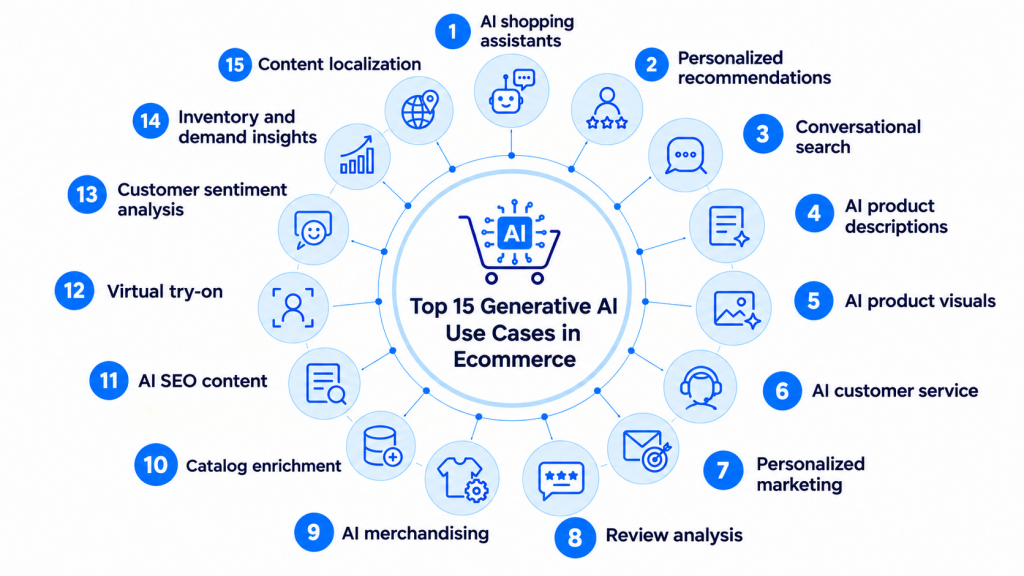
These generative AI use cases in ecommerce combine large language models (LLMs), natural language processing (NLP), computer vision, recommendation engines, and ecommerce data to create more intelligent shopping experiences.
1. AI shopping assistants
AI shopping assistants are one of the leading generative AI use cases in ecommerce. They use LLMs to help customers discover, compare, and select products through natural language conversations.
Instead of navigating filters and categories, shoppers can describe what they need and receive contextual recommendations. For example, Amazon’s Rufus helps shoppers research products, compare options, answer questions, and make purchasing decisions.
For businesses implementing generative AI for ecommerce, these assistants can support product discovery, gift recommendations, product research, and purchase decisions.
2. Personalized product recommendations
Generative AI for ecommerce can make product recommendations more contextual by combining browsing history, purchase history, preferences, product attributes, and conversational intent.
For example, instead of simply showing “customers also bought” products, an AI system can understand that a shopper wants lightweight running shoes for long-distance training and recommend suitable products with an explanation.
This enables personalized cross-selling, upselling, product bundling, and alternative product recommendations, helping improve conversion rates and average order value.
3. Conversational ecommerce search
Generative AI can transform traditional keyword-based ecommerce search into semantic and conversational search.
A shopper can search for “a comfortable office chair for long working hours under $300” instead of entering specific keywords. An LLM can interpret the intent, identify relevant attributes, and retrieve products that match the request.
When connected with product catalogs, vector databases, search engines, and inventory data, conversational search makes product discovery faster and more intuitive.
4. AI-generated product descriptions
Generating product content manually becomes difficult when an ecommerce store has thousands of SKUs. Generative AI in ecommerce can convert structured product attributes into descriptions, product highlights, bullet points, FAQs, and other content.
It can use information such as product features, dimensions, materials, specifications, and use cases to create consistent descriptions at scale.
Ecommerce teams can also generate SEO titles and meta descriptions while maintaining their brand voice. Human review remains important to prevent inaccurate product claims or AI hallucinations.
5. AI-generated product images and visual content
Generative AI can help retailers create and modify product visuals without producing every asset through a traditional photoshoot.
Businesses can generate lifestyle images, backgrounds, product variations, promotional creatives, and social media visuals from existing product assets.
For example, a furniture retailer could show the same sofa in different room settings. A fashion retailer could generate campaign visuals for different seasons. Product accuracy and brand consistency should be reviewed before publishing.
6. AI customer service
Generative AI-powered customer service agents can answer common questions about products, orders, shipping, returns, refunds, payments, and policies.
Unlike basic AI chatbots that rely on predefined responses, LLM-powered agents can understand conversational questions and generate context-aware answers. To understand how these systems differ from traditional chatbots, explore our guide on what is an AI chatbot.
When connected to CRM, order management, inventory, and knowledge bases, generative AI for ecommerce can provide more personalized support and escalate complex issues to human agents with relevant conversation context. Banks and payment providers apply the same conversational approach to answer account and transaction questions, a use case covered in our guide to generative AI in banking.
7. Personalized marketing campaigns
Generative AI allows ecommerce marketers to create personalized content across email, SMS, push notifications, social media, and advertising campaigns.
For example, an ecommerce brand can generate different messages for first-time visitors, returning customers, loyal customers, or shoppers who abandoned their carts.
AI can generate campaign copy, subject lines, product recommendations, promotional messages, and creative variations while marketers maintain control over brand voice and approvals.
8. AI-powered product review analysis
Customer reviews contain valuable information about product quality, usability, sizing, features, and common problems. Generative AI can analyze thousands of reviews and turn them into concise insights.
It can identify recurring themes, summarize positive and negative feedback, detect common complaints, and generate AI-powered review summaries for shoppers.
These capabilities demonstrate how generative AI in retail and ecommerce can benefit both customers and businesses. Shoppers get faster access to useful feedback, while retailers gain insights for improving products and customer experience.
9. AI-powered merchandising
Generative AI can support ecommerce merchandising by helping teams create product collections, bundles, seasonal assortments, and personalized storefront experiences.
A merchandiser could prompt an AI system to create a “Back-to-School Essentials” collection based on product attributes, customer behavior, inventory, and seasonal demand.
AI can also explain why certain products should be grouped together, while human merchandisers retain control over final selections.
10. Product catalog enrichment
Large ecommerce catalogs often contain incomplete or inconsistent product information. Generative AI for ecommerce can enrich product data by generating missing descriptions, attributes, FAQs, category content, and product highlights from structured information.
When integrated with a Product Information Management (PIM) system, GenAI can help maintain consistent product information across websites, marketplaces, mobile apps, and other sales channels.
This is particularly valuable for retailers managing thousands or millions of SKUs.
11. AI-generated SEO content
Generative AI can accelerate the creation of ecommerce SEO content, including category pages, buying guides, FAQs, product comparisons, meta descriptions, and supporting content.
The goal should not be simply to produce keyword-heavy content. AI should use search intent, product attributes, customer questions, semantic entities, and structured product information to create useful content.
This makes Generative AI in Ecommerce relevant not only to shopping experiences but also to organic search visibility and content operations.
12. Virtual try-on and AI product visualization
Generative AI combined with computer vision can create more immersive shopping experiences.
Fashion and beauty brands can use virtual try-on to help customers visualize clothing, accessories, or makeup. Furniture retailers can help shoppers visualize products within their homes.
These experiences give customers more information before purchasing and can reduce uncertainty around product fit, appearance, and compatibility.
13. AI-powered customer feedback and sentiment analysis
Beyond product reviews, GenAI can analyze surveys, support conversations, social media comments, feedback forms, and customer messages to identify customer sentiment and emerging trends.
For example, an ecommerce company could discover that customers consistently praise a product’s quality but complain about its packaging.
These insights show another important application of AI in ecommerce, helping teams improve product development, marketing messaging, customer support, and overall customer experience. Insurers apply the same text-analysis approach to claim notes and correspondence, one of several generative AI use cases in insurance used to flag inconsistencies for review.
14. AI-assisted inventory and demand insights
Generative AI can make inventory and demand data easier for ecommerce teams to understand and act on.
Instead of manually reviewing dashboards, managers can ask questions such as, “Which products have declining demand?” or “Which categories may face inventory shortages next month?”
GenAI can summarize information from inventory management systems, sales data, forecasting models, and ERP platforms and explain important trends in natural language.
It works best as an intelligent layer over existing forecasting and analytics systems, rather than replacing specialized forecasting models. Manufacturers face similar challenges with demand forecasting and production planning across the supply chain. See how generative AI is applied in manufacturing to address these challenges.
15. AI-powered content localization
Generative AI can help ecommerce businesses adapt product and marketing content for different languages and markets.
It can localize product descriptions, FAQs, advertisements, emails, support responses, and promotional content while maintaining a consistent brand voice.
For global brands, generative AI for ecommerce can reduce the time required to launch localized storefronts and campaigns. Human review remains important for regulated products, cultural nuances, and high-value markets.
Find Where GenAI Can Impact Your Ecommerce Business
Get expert guidance on applying generative AI across product discovery, personalization, customer support, content, and other ecommerce workflows.
Why Ecommerce Businesses Are Adopting Generative AI
The value of generative AI in ecommerce goes beyond automating repetitive tasks. It helps businesses turn customer, product, and behavioral data into more relevant shopping experiences and faster business decisions.
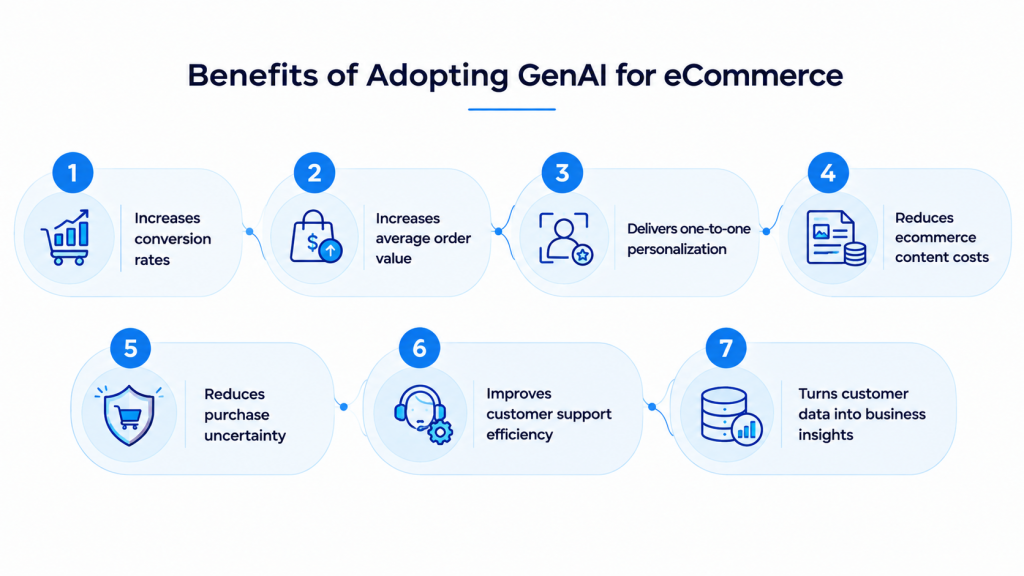
1. Increases conversion rates
Generative AI for ecommerce can understand natural-language shopping intent and recommend relevant products. AI shopping assistants and conversational search reduce discovery friction, helping customers find suitable products and move toward purchase faster.
2. Increases average order value
GenAI can identify relevant cross-sell, upsell, and bundling opportunities based on customer context. For example, a camera shopper could receive recommendations for compatible lenses, memory cards, and accessories.
3. Delivers one-to-one personalization
Instead of relying only on broad customer segments, GenAI can generate recommendations, product explanations, and marketing messages based on individual preferences and real-time intent. This creates more relevant shopping experiences across different customer touchpoints. Healthcare organizations apply the same logic to a higher-stakes context, where generative AI in healthcare tailors treatment plans and patient communication to each individual’s profile.
4. Reduces ecommerce content costs
GenAI can turn structured product data into product descriptions, FAQs, buying guides, comparison content, ad copy, and email campaigns. This allows ecommerce teams to manage large catalogs and produce content faster without manually creating every asset.
5. Reduces purchase uncertainty
Customers often need more information before committing to an online purchase. GenAI can answer product questions, summarize reviews, compare alternatives, and explain technical specifications in simple language, helping customers make more confident decisions.
6. Improves customer support efficiency
AI agents can handle repetitive questions about orders, shipping, returns, refunds, products, and policies. When connected to CRM and order management systems, they can provide contextual responses and escalate complex issues to human agents.
7. Turns customer data into business insights
Generative AI in e-commerce can analyze reviews, support conversations, surveys, and behavioral data at scale. These insights help teams identify customer needs, product issues, merchandising opportunities, and experience gaps faster.
Together, these benefits make generative AI in ecommerce a strategic capability rather than simply another automation tool.
Turn Ecommerce AI Ideas Into a Working Solution
We help ecommerce businesses prioritize the right use cases and turn them into production-ready solutions.
How to Implement Generative AI in Ecommerce
Implementing generative AI in ecommerce requires the right use case, quality data, suitable AI models, and integration with existing systems. Follow these six phases to build and scale an effective AI solution.
1. Identify the right use case
Find areas where generative AI for ecommerce can solve a clear business problem. Prioritize opportunities such as AI shopping assistants, personalized recommendations, customer support, or automated product content.
Generative AI consulting and strategy services can help evaluate use cases, technical feasibility, and potential ROI before development.
2. Prepare e-commerce data
Prepare data from your product catalog, PIM, CRM, customer reviews, inventory, and order systems. Clean outdated or inconsistent information and define appropriate access controls.
For customer-facing applications, RAG can connect LLMs with current business data to generate more accurate responses.
3. Choose the right AI stack
Select the AI model and technologies according to your use case. Your stack may include LLMs, multimodal models, vector databases, RAG, AI agents, and APIs.
Consider accuracy, scalability, response time, data privacy, integration requirements, and cost.
4. Integrate with ecommerce systems
Connect GenAI with your ecommerce platform, PIM, CRM, ERP, inventory, search, and customer support systems.
Generative AI integration services can help connect LLMs, RAG pipelines, and AI agents with existing APIs and business workflows, turning AI into a functional part of your ecommerce ecosystem.
5. Test and add guardrails
Test the AI with real customer scenarios and evaluate accuracy, relevance, hallucinations, latency, and personalization. Add guardrails for privacy, security, brand guidelines, product claims, and access permissions.
Human review should remain in workflows where inaccurate AI output could significantly affect customers or the business.
6. Launch, measure, and scale
Start with a controlled rollout and track KPIs such as conversion rate, AOV, customer satisfaction, support resolution time, and content production efficiency.
Use these results to improve the system and gradually expand into additional generative AI use cases in ecommerce.
Now that we have covered how to implement GenAI in ecommerce, let’s look at the challenges and risks associated with its adoption and how businesses can address them effectively.
If you are comparing potential technology partners, explore our list of top generative AI development agencies to evaluate leading providers.
Plan Your Ecommerce GenAI Implementation
Get a practical implementation roadmap covering AI use cases, data requirements, architecture, integrations, security, and scalability for your ecommerce platform.
Practical Challenges of Implementing Generative AI in Ecommerce
Generative AI can improve ecommerce experiences, but scaling it across real-world operations brings several challenges. Businesses need to address data, infrastructure, integration, governance, and ROI before expanding AI across the customer journey.
1. Maintaining real-time product accuracy
Ecommerce information changes constantly across prices, inventory, promotions, and product specifications. AI systems using outdated information can provide answers that conflict with the actual storefront.
How to address it:
- Connect GenAI applications with real-time product and inventory data.
- Use RAG to retrieve current information before generating responses.
- Set validation rules for prices, availability, and product specifications.
2. Managing complex product catalogs
Large catalogs often contain missing attributes, duplicate listings, inconsistent names, and incomplete descriptions. Poor product data can limit the quality of AI-generated recommendations and responses.
How to address it:
- Standardize product attributes across the catalog.
- Use AI to identify missing, duplicate, or inconsistent product information.
- Maintain a centralized product information source for AI applications.
3. Handling peak traffic and AI costs
Ecommerce platforms can experience sudden traffic increases during sales, holidays, and product launches. Generative AI workloads can increase infrastructure and API costs while creating performance challenges.
How to address it:
- Use scalable cloud infrastructure and model-routing strategies.
- Cache frequently requested AI responses where appropriate.
- Monitor token usage, API costs, latency, and workload patterns.
- Use smaller models for simple tasks and advanced models for complex requests.
4. Integrating fragmented ecommerce systems
Customer and product information often exists across ecommerce platforms, PIMs, CRMs, ERPs, inventory systems, and order management tools. Connecting these systems can make GenAI implementation technically complex.
How to address it:
- Define which systems provide authoritative data for each use case.
- Use APIs and middleware to connect existing ecommerce systems.
- Build reusable integration layers instead of creating isolated AI workflows.
- Test data synchronization across every connected system.
5. Proving business value and ROI
GenAI projects can become expensive if businesses measure activity instead of outcomes. Ecommerce teams need to know whether AI is actually improving customer and business performance.
How to address it:
- Define KPIs before launching each GenAI use case.
- Track metrics such as conversion rate, AOV, support resolution time, and content production time.
- Start with high-impact use cases that have measurable outcomes.
- Compare AI-assisted performance against existing processes before scaling.
The challenges of generative AI in ecommerce are manageable with the right implementation strategy. Businesses should start with focused use cases, reliable data, scalable architecture, and clear performance metrics. If you need help defining your AI strategy, explore our list of top GenAI consulting firms to compare experienced providers. This approach reduces implementation risks while creating a stronger foundation for expanding AI across the ecommerce journey.
Make Your Ecommerce GenAI Project Production-Ready
Our AI specialists help you address data, integration, scalability, and ROI challenges before they affect your ecommerce operations.
Real-World Examples of Generative AI in E-Commerce
Leading ecommerce and retail brands are already using generative AI across product discovery, shopping assistance, content creation, and personalization. These real-world examples show how generative AI for ecommerce is being applied beyond experimentation.
1. Amazon: AI-powered shopping assistant
Amazon’s Rufus, now renamed Alexa for Shopping, is a generative and agentic AI shopping assistant. It can answer product questions, compare products, provide personalized recommendations, track prices, and help customers complete shopping tasks. Amazon says the assistant uses product catalog information, customer reviews, community Q&As, and other web information to support its responses.
GenAI use case: Conversational commerce, product discovery, personalized recommendations, and shopping assistance.
2. Sephora: personalized beauty shopping in ChatGPT
Sephora launched its app in ChatGPT to help customers discover beauty products through conversational advice and personalized recommendations. Customers can ask questions such as finding a foundation for dry skin, with recommendations informed by their preferences and, when linked, their Beauty Insider profile.
This is a strong example of generative AI in ecommerce moving product discovery into conversational AI platforms.
GenAI use case: Personalized recommendations, conversational shopping, and AI-powered product discovery.
3. Shopify: AI for ecommerce store management
Shopify uses Shopify Magic and Sidekick to help merchants manage and grow their ecommerce stores. Sidekick can generate product descriptions, blog content, images, marketing materials, and reports while also helping merchants analyze data and complete store-management tasks using natural language.
This demonstrates how generative AI for ecommerce can support merchants behind the storefront, not just shoppers.
GenAI use case: Product content generation, AI image generation, marketing, analytics, and ecommerce automation.
4. eBay: Generative AI for product listings
eBay uses generative AI to simplify product listing creation for sellers. Its Magical Listing tool can analyze information provided by sellers and generate product descriptions and other listing details. eBay has also expanded AI tools for social content and image-based listing creation.
The example shows how GenAI can reduce the manual effort involved in managing large ecommerce catalogs.
GenAI use case: Product description generation, catalog enrichment, listing creation, and seller productivity.
5. Walmart: GenAI shopping assistant
Walmart has developed Sparky, a generative AI shopping assistant that helps customers discover and compare products, build shopping lists, plan for occasions, and receive personalized recommendations. Walmart says Sparky synthesizes product data and customer reviews to provide helpful shopping responses.
Walmart has also integrated AI into search to understand broader shopping missions, such as finding everything needed for a themed birthday party instead of requiring customers to search for individual products.
GenAI use case: AI shopping assistants, conversational search, product recommendations, and personalized shopping.
These examples demonstrate that generative AI use cases in ecommerce extend across the entire shopping ecosystem. Amazon and Walmart focus heavily on AI-assisted shopping, Sephora brings personalized product discovery into conversational AI, while Shopify and eBay use GenAI to improve ecommerce operations and content creation.
Together, they show how generative AI ecommerce is evolving from isolated content-generation tools into connected experiences spanning discovery, recommendations, search, merchandising, content, and purchasing.
Emerging Trends Shaping Generative AI in Ecommerce
These shifts sit inside a wider set of generative AI trends and developments reshaping how businesses build and deploy AI. Generative AI in ecommerce is moving beyond customer-facing applications. The next phase will reshape how products are discovered, transactions happen, and ecommerce systems interact.
- AI-native storefronts: Ecommerce brands will build experiences designed for AI agents as well as human shoppers. Product data will need to be structured for easier AI discovery and recommendations.
- Agentic checkout: AI agents will increasingly handle product research, comparison, payment, and order placement. This could reduce the need for customers to navigate traditional ecommerce journeys.
- AI visibility as a growth channel: Brands will optimize product information for AI systems that influence product discovery and purchasing decisions. This creates a new optimization layer beyond traditional SEO.
- Digital twins for ecommerce: Retailers can use virtual models of products, stores, and supply chains to simulate scenarios before making real-world changes. GenAI can help teams analyze these scenarios and make faster decisions.
- AI commerce protocols: Emerging commerce standards will help AI agents interact with product catalogs, inventory, checkout, and payment systems. This could make AI-driven shopping more seamless across platforms.
The future of generative AI in ecommerce will create an AI-driven commerce layer connecting products, customers, transactions, and business systems.
Ready to Build GenAI for Your Ecommerce Business?
Share your ecommerce requirements with our GenAI team and get guidance on the right use cases, architecture, integrations, and development approach for your project.
Conclusion
Generative AI is changing how ecommerce businesses attract, engage, and serve customers. From smarter product discovery to AI-driven content, support, and business insights, its impact now extends across the entire ecommerce journey.
However, successful adoption requires more than choosing an AI model. Businesses need reliable data, connected systems, clear use cases, and measurable goals to turn generative AI for ecommerce into real business value.
As AI agents, AI-native storefronts, and autonomous commerce continue to evolve, ecommerce businesses need the right technical expertise to turn these opportunities into production-ready solutions. Space-O Technologies helps businesses build and integrate generative AI solutions tailored to their products, workflows, and customer experiences.
If you are planning your next AI-powered ecommerce solution, hire generative AI developers to accelerate development with specialized GenAI expertise.
Frequently Asked Questions
What is generative AI in ecommerce?
Generative AI in ecommerce is the use of AI models that create product content, answer shopper questions, and generate insights from store data. Retailers apply it to catalogs, marketing, search, support, and analytics.
How is generative AI used in ecommerce?
Generative AI is used to write listings, enrich attributes, draft campaigns, power conversational search, resolve support tickets, and analyze reviews. Each use case runs on product and customer data through an AI layer.
What are the best generative AI use cases in ecommerce?
The best use cases are product description generation, attribute enrichment, conversational search, and AI customer support. These deliver measurable savings and conversion gains with proven technology.
How does generative AI improve ecommerce personalization?
Generative AI improves personalization by producing individual-level messaging and recommendations explained in context. Segment rules give way to content that reflects each shopper’s behavior.
Can generative AI create product descriptions?
Yes, generative AI creates product descriptions from specifications, materials, and brand guidelines. Human review keeps accuracy and tone consistent across the catalog.
Can GenAI power an ecommerce chatbot?
Yes, GenAI powers ecommerce chatbots that answer product, order, and policy questions from live store data. RAG keeps replies grounded rather than invented.
How much does it cost to build a generative AI ecommerce solution?
A focused generative AI ecommerce solution typically starts around $30,000 to $60,000 and scales with integrations and catalog size. Model usage, data preparation, and security requirements shape the final estimate.
What data is required for ecommerce GenAI?
Ecommerce GenAI requires structured product data, customer profiles, order history, inventory, pricing, policies, and brand guidelines. Accuracy and freshness matter more than volume.
Can generative AI integrate with Shopify and other ecommerce platforms?
Yes, generative AI integrates with Shopify, Magento, BigCommerce, and custom platforms through their APIs. Custom storefronts may need an additional connection layer.
Will generative AI replace ecommerce employees?
No, generative AI shifts ecommerce employees from repetitive production to review, strategy, and exception handling. Teams produce more with the same headcount.



 All our projects are secured by NDA




 4.8
4.8