
 By
By 
Contents
- AI chatbots in ecommerce act as virtual shopping assistants that simulate human conversation using NLP, machine learning, and LLMs to help customers discover products, get support, and complete purchases.
- Key use cases include personalized product recommendations, cart abandonment recovery, order tracking, returns handling, upselling, and 24/7 support automation.
- Ecommerce brands using chatbots report higher conversion rates, increased average order value, and reduced support costs.
- The results come from chatbots integrated with product catalogs, CRM systems, and order management platforms.
Key Takeaways
Your ecommerce store is open 24/7. Your support team is not. That gap between when customers shop and when someone is available to help them is where revenue quietly disappears. Sizing questions at midnight. Shipping queries on weekends. Return policy confusion during a flash sale. Every unanswered question at the moment of purchase is a sale lost to a competitor who answered faster.
AI chatbots for ecommerce closes that gap. It sits inside your store, answers product questions in real time, recovers abandoned carts, handles returns, and guides customers to checkout, all without adding headcount. According to McKinsey, 65% of companies are already using AI regularly, and ecommerce is leading adoption. Online retailers across every category are deploying chatbots to engage shoppers at every stage of the buying journey.
At Space-O Technologies, we build AI chatbot solutions for ecommerce businesses that need more than a basic FAQ widget. We combine NLP, generative AI, and catalog integrations to create conversational experiences that help shoppers find products, get instant answers, and complete purchases. As an AI chatbot development company, we turn these strategies into scalable chatbot experiences designed to improve engagement and drive revenue around the clock.
What Is an AI Chatbot in Ecommerce?
An ecommerce AI chatbot is an automated software tool that uses artificial intelligence and natural language processing (NLP) to communicate with online shoppers. It connects with product catalogs, inventory, order data, and other store systems to answer questions, recommend products, track orders, process returns, and assist with checkout in real time.
Unlike traditional rule-based bots that follow predefined scripts, AI-powered chatbots understand customer intent and respond to natural language. For example, when a shopper says, “I need a birthday gift for my mom who likes gardening, under $50,” the chatbot can understand the occasion, interests, and budget to recommend relevant products.
Core functions of AI chatbot for e-commerce
- Product discovery: Recommends products based on shopper preferences, needs, budget, and purchase intent.
- Order support: Provides order status, delivery updates, shipping information, and return policy details.
- Sales sssistance: Guides shoppers through product comparisons, upselling, cross-selling, and checkout.
- Cart recovery: Re-engages shoppers who leave items in their carts and can send personalized reminders or offers.
- 24/7 customer support: Answers common questions instantly without requiring a human agent.
- Returns and exchanges: Helps customers initiate returns, check eligibility, and understand refund timelines.
How does an e-commerce AI chatbot work?
- Understands the request: NLP identifies the shopper’s intent and key details such as product type, budget, size, or occasion.
- Retrieves relevant data: The chatbot accesses product catalogs, inventory, order information, or other connected systems.
- Generates a response: AI uses the available data and conversation context to provide a relevant answer or recommendation.
- Takes action: Depending on its integrations, the chatbot can update carts, track orders, initiate returns, or assist with checkout.
- Escalates when needed: Complex requests are transferred to a human agent along with the conversation context.
Want to understand AI chatbots in more detail? This AI chatbot guide covers their core concepts, capabilities, and applications.
Turn Missed Customer Questions Into More Sales
Shoppers leave when answers take too long. Give them instant responses that remove buying hesitation and keep them moving toward checkout.

What Types of Chatbots Are Used in Ecommerce?
Classifying by technology alone (rule-based vs. AI) does not help a store owner decide what to buy. It is more useful to understand chatbot types for ecommerce by what they actually do in your store.
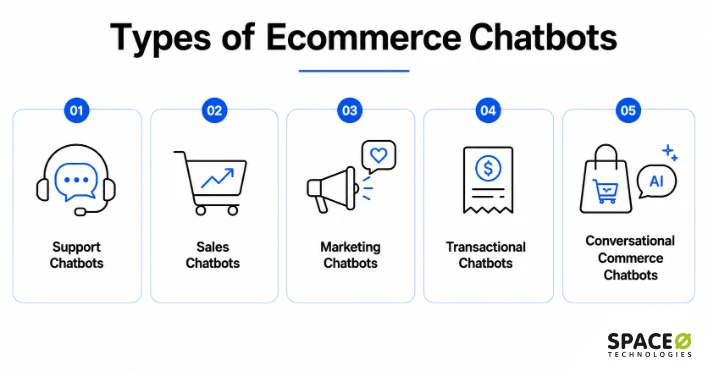
1. Support chatbots
Handle customer service queries: order status, return policies, shipping timelines, sizing questions. A well-configured support bot resolves 60 to 80% of incoming queries without human involvement, freeing your team for complex issues like disputes and damaged shipments. Best for stores where support ticket volume is the primary cost.
2. Sales chatbots
Actively drive revenue through product discovery, recommendations, upselling, and checkout assistance. They understand shopping intent (“I need running shoes for trail running under $120”) and guide customers to the right products. A support bot answers questions. A sales bot closes deals. Best for stores with large catalogs or complex product selection.
3. Marketing chatbots
Run on WhatsApp, Instagram DM, TikTok, and Messenger to collect emails, send promotions, recover abandoned carts, and drive repeat purchases. A customer comments “Want this!” on an Instagram post, and the bot automatically DMs a product link with a discount code. Best for D2C brands with strong social presence.
4. Transactional chatbots
Execute specific commercial actions: checkout completion, payment processing, returns, exchanges, subscription management. A customer says “Cancel my order,” and the bot actually cancels it, confirms the refund timeline, and sends confirmation. Best for stores with high order volumes and complex post-purchase workflows.
5. Conversational commerce chatbots (agentic)
The most advanced category. A customer can discover a product, ask sizing questions, compare options, add to cart, apply a discount code, and complete checkout without leaving the chat. These use generative AI with RAG architecture to ground every response in real product data. Best for brands investing in a full conversational shopping experience.
Choosing the right chatbot depends on your ecommerce goals, customer journey, and level of automation. For a broader look at chatbot capabilities and use cases, explore our guide to types of AI chatbots.
How Are Ecommerce Businesses Using AI Chatbots?
Here are the use cases where ecommerce bots deliver the most measurable results across every stage of the buying journey.
1. Product discovery and recommendations
A customer describes what they need: “I’m looking for a waterproof jacket for hiking in fall, budget around $150.” The chatbot searches the catalog, applies filters, returns personalized product recommendations with images and pricing, and asks follow-up questions to narrow results. This mirrors what an in-store salesperson does, and it keeps customers engaged who would otherwise bounce from filter-heavy category pages.
2. Cart abandonment recovery
Every abandoned checkout drains revenue. Chatbots step in with exit-intent messages, reminder notifications via WhatsApp or SMS, and the chatbot applies discount codes automatically for high-value carts. A chatbot reaches the customer in seconds. A follow-up email reaches them hours later when they have moved on. For AI-powered ecommerce solutions, cart recovery is consistently the highest-ROI use case.
3. Customer support automation
“Where is my order?” “What is your return policy?” “Do you ship to Canada?” These queries make up 60 to 80% of support volume. The best AI chatbots for ecommerce customer service handle them instantly, so human agents focus on complex cases that need judgment.
4. Upselling and cross-selling
A customer adds a laptop to their cart. The chatbot suggests a compatible bag, mouse, and screen protector based on purchase patterns and current promotions. AI chatbots for selling ecommerce products thrive here because contextual recommendations (not random pushes) directly lift average order value.
5. Returns, refunds, and exchanges
Chatbots automate the entire return flow: identify the order, present options, generate a shipping label, confirm the refund timeline, and suggest an exchange if the issue is sizing. A fast, painless return process builds trust. That customer comes back.
6. Order tracking and proactive updates
Chatbots manage orders end-to-end: status checks, delivery estimates, delay notifications. The smarter approach goes beyond reactive queries into proactive sales engagement: shipping confirmations, delivery alerts, and personalized reorder suggestions sent before the customer asks.
7. Data collection and feedback
Every conversation generates zero-party data: preferences, product feedback, NPS scores, review requests. This data feeds personalization, marketing segmentation, and product development. Often more valuable than the support automation itself.
8. Multilingual and omnichannel support
AI chatbots for ecommerce sites work across websites, apps, WhatsApp, Instagram, Messenger, and SMS with session continuity. A customer who asks about sizing on Instagram and later visits the website should not start over.
These use cases show how AI chatbots can support customers throughout the ecommerce journey, from product discovery to post-purchase service. Choosing the right applications can help businesses improve customer experience, increase conversions, and reduce support workloads.
AI chatbot applications extend beyond ecommerce, as explained in our guide to custom healthcare chatbot development.
Build an AI Chatbot That Recovers Lost Sales
Abandoned carts and unanswered questions cost revenue. Build a chatbot that engages shoppers, resolves objections, and drives more completed purchases.
What Are the Benefits of AI Chatbots for Ecommerce?
AI chatbots help ecommerce businesses automate customer interactions, improve shopping experiences, and drive more conversions. They also reduce support workloads while providing faster, personalized assistance at scale.
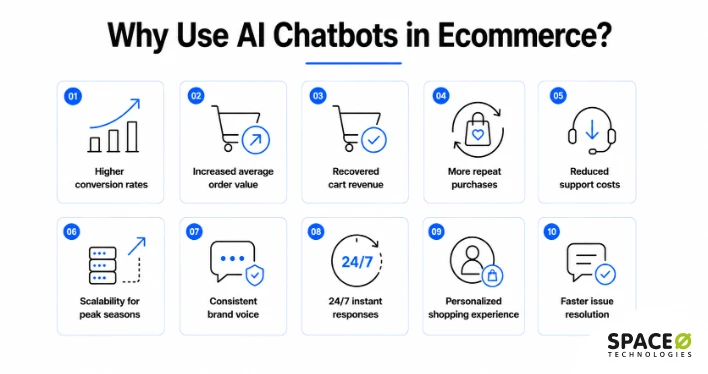
1. Higher conversion rates
Chatbots answer questions at the moment of purchase consideration, reducing the gap between “interested” and “purchased.” AI chatbots for ecommerce websites directly reduce bounce rates and abandoned checkouts. A customer deciding between two jacket sizes gets an instant answer instead of leaving your store to Google a sizing chart on a competitor’s site.
2. Increased average order value
Contextual upselling during checkout, based on actual purchase patterns rather than random products, lifts AOV measurably. A chatbot that suggests a matching belt after someone adds a pair of jeans is helpful. A chatbot that pushes unrelated products on every page is noise. The difference between the two shows up directly in revenue per session.
3. Recovered cart revenue
Every recovered cart is revenue that would otherwise be lost. Proactive intervention through exit-intent messages and targeted discounts converts abandoners back into buyers. Even small recovery rates compound fast. A store losing $300K/month to abandoned carts only needs to recover 5% to add $15K/month, $180K/year from one chatbot feature.
4. More repeat purchases
Post-purchase engagement (replenishment reminders, loyalty nudges, personalized offers) turns one-time buyers into repeat customers. An ecommerce business chatbot that remembers past purchases and suggests restocks at the right time drives lifetime value. A skincare brand reminding a customer that their moisturizer runs out in two weeks, with a one-tap reorder, is the kind of experience that builds loyalty competitors cannot replicate.
5. Reduced support costs
Automating routine queries drops cost per interaction significantly. Customer engagement improves because human agents handle only the cases that need judgment. The cost difference between a chatbot interaction and a human-handled ticket is not marginal. At scale, support cost savings alone often cover the entire chatbot investment within the first year.
6. Scalability for peak seasons
Black Friday. Holiday sales. Flash promotions. Scalability is where chatbots outperform human teams. Ten thousand simultaneous conversations handled the same way as ten. No seasonal hiring, no two-week training ramp, no quality drop when temporary staff handles unfamiliar products.
7. Consistent brand voice
Every interaction follows the same tone, accuracy, and policy guidelines. No variation from training gaps or bad days. A customer asking about your return policy at 3 AM gets the same accurate answer as someone asking at 3 PM. For brands selling across multiple channels and markets, this consistency protects both the customer experience and your compliance exposure. The same requirement applies to banking AI chatbots, where every response must follow regulatory scripts and audit rules.
8. 24/7 instant responses
Customers shopping at midnight get the same service quality as those shopping at noon. For global stores serving customers across time zones, this is not a feature. It is a basic expectation. The stores that still show “We’ll respond within 24 hours” outside business hours are losing sales to competitors who respond in seconds.
9. Personalized shopping experience
Recommendations based on browsing history, purchase patterns, and stated preferences make the shopping experience feel curated. Customer satisfaction [CSAT] improves when interactions feel relevant rather than generic. A returning customer who bought running shoes last month should not see the same homepage experience as a first-time visitor browsing home decor.
10. Faster issue resolution
Order tracking in two seconds. Return initiation in thirty seconds. Routine tasks resolve orders of magnitude faster through chat than through traditional support channels. Speed matters because every minute a customer spends waiting for an answer is a minute they could spend completing a purchase or browsing a competitor.
Give Shoppers Instant Help Before They Leave
Develop an AI chatbot that provides real-time assistance, reduces purchase friction, and keeps customers engaged throughout their shopping journey.
What Results Are Real Ecommerce Brands Seeing?
The best ecommerce chatbots are backed by real numbers, not marketing claims.
- Sephora: Their Virtual Artist chatbot has facilitated over 200 million virtual shade trials since launch, with 8.5 million unique users. The chatbot runs product quizzes, recommends shades based on skin tone through AR, and books in-store appointments via Facebook Messenger. Sephora’s e-commerce sales grew from $580 million to over $3 billion between 2016 and 2022, with AI-driven personalization playing a central role.
- Domino’s: Customers order through chatbots on Facebook Messenger and voice assistants, with the full menu available inside the conversation. Domino’s reported that over 85% of U.S. retail sales in 2024 came through digital channels, with chatbot and voice ordering playing a key role in that shift.
- H&M: Their chatbot asks about style preferences, occasion, and budget to recommend outfits from the catalog. It replicates the in-store stylist experience online, helping customers navigate a catalog of thousands of products.
- Levi’s: A virtual stylist chatbot helps shoppers navigate fit options (slim, relaxed, tapered) and provides size recommendations based on body measurements and past purchase data.
Still Evaluating Whether a Chatbot Makes Sense for Your Store?
Our team at Space-O Technologies runs a free discovery session where we analyze your support data, checkout funnel, and product catalog to identify the highest-ROI chatbot use case for your specific business.
What Features Should You Look for in an Ecommerce Chatbot?
Choosing the right AI chatbot platform for ecommerce starts with knowing which features matter. Here are the 10 that separate useful chatbots from frustrating ones.
| Feature | What to Look For | Why It Matters |
|---|---|---|
| NLP & Intent Recognition | Ability to understand natural-language shopping queries and customer intent | Helps customers find relevant products even when they use different phrasing |
| Product Catalog Integration | Real-time access to product pricing, inventory, variants, and availability | Prevents inaccurate recommendations and improves customer trust |
| Cart & Checkout Interaction | Ability to add products to cart, apply discounts, recommend add-ons, and assist during checkout | Reduces friction and increases conversion rates |
| CRM & Customer Data Sync | Integration with customer profiles, purchase history, browsing behavior, and segmentation data | Enables personalized recommendations and support |
| Omnichannel Deployment | Support for website chat, WhatsApp, Instagram, Messenger, SMS, and mobile apps | Provides a seamless experience across customer touchpoints |
| Human Handoff with Full Context | Smooth escalation to live agents with conversation history and intent data | Eliminates the need for customers to repeat information |
| Analytics & Revenue Attribution | Reporting on chatbot interactions, conversions, sales influence, AOV, and cart recovery | Helps measure chatbot ROI and business impact |
| Multilingual Support | Ability to communicate naturally in multiple languages | Improves customer experience for global audiences |
| Customizable Brand Voice | Options to customize tone, messaging style, and responses | Ensures conversations align with brand identity |
| Security & Data Privacy | Encryption, access controls, data retention policies, GDPR, CCPA, and PCI-DSS compliance | Protects customer data and supports regulatory compliance |
-
Pro Tip: Revenue attribution is the feature most stores overlook. If you cannot track which sales your chatbot influenced, you cannot prove ROI. Confirm this capability before you commit to any platform.
What Are the Top AI Chatbots for Ecommerce Websites?
Choosing the best chatbot for ecommerce depends on your goal, platform, and budget. Here is a reference across different use cases and store sizes.
| Platform | Best For | Key Strength |
|---|---|---|
| Tidio | Small-to-mid-sized eCommerce stores | Easy setup with Lyro AI agent |
| Gorgias | Shopify-native customer support and order management | Deep Shopify and Magento integration |
| Intercom | Scaling customer support and sales across channels | Fin AI agent and multi-channel support |
| ManyChat | Social commerce on Instagram, WhatsApp, and TikTok | Social channel automation |
| ChatBot (LiveChat) | No-code AI chatbot development | Easy-to-use AI chatbot builder |
| Ada | Enterprise-level multilingual customer support | Supports 50+ languages with low-code implementation |
| Drift (Salesloft) | B2B eCommerce lead generation | Pipeline generation and account-based marketing (ABM) |
| HubSpot Chatbot | CRM-integrated chat and lead capture | Native HubSpot CRM synchronization |
| Certainly | Conversational product discovery | AI-powered shopping assistant |
| Tolstoy | Video commerce and AI shopping experiences | Shoppable videos combined with AI chat assistance |
The best ecommerce chatbot is the one that fits your store’s goals, customer journey, and existing technology stack. Compare each platform based on its automation capabilities, integrations, scalability, and total cost before making a decision. Want to build a chatbot tailored to your ecommerce workflows? Check out our list of top AI chatbot development companies.
Convert More Store Visitors Into Paying Customers
Develop an AI chatbot that engages visitors, personalizes recommendations, and guides shoppers from their first question to checkout.
How Do You Integrate an AI Chatbot Into Your Ecommerce Store?
Integrating an AI chatbot into your ecommerce store involves connecting it with your website, product catalog, customer data, and business systems. A well-planned integration helps the chatbot deliver accurate responses, personalized recommendations, and seamless support across the customer journey.
Step 1: Define your primary goal
Support ticket reduction? Conversion boost? Cart recovery? The goal determines everything else: which chatbot type you need, which platform fits, and how you measure success. A store drowning in “Where is my order?” tickets needs a different chatbot than one losing revenue to checkout abandonment. Trying to solve both equally from day one usually means solving neither well.
Step 2: Choose your platform based on store type
Match the chatbot to your ecommerce infrastructure. A Shopify store with 500 SKUs has different needs than a custom headless platform with 50,000 SKUs across multiple warehouses. The integration path, API availability, and plugin ecosystem vary by platform, so this decision shapes everything that follows.
Step 3: Connect to your ecommerce platform
The wrong integration approach creates maintenance headaches that outlast the initial build.
- Shopify: Install through the App Store (Tidio, Gorgias, ChatBot have native apps). For custom builds, use the Storefront API and Admin API for catalog, cart, checkout, and order data.
- WooCommerce: WordPress plugin integration for SaaS chatbots. REST API for custom builds needing access to products, orders, and customer data.
- Magento / Adobe Commerce: Extension marketplace for pre-built integrations. GraphQL API for headless or custom builds.
- BigCommerce: App marketplace for SaaS tools. Catalyst storefront support and REST/GraphQL APIs for custom implementations.
- Custom platforms: Direct API integration with product catalog, OMS, payment gateway, and CRM. Expect to build a middleware layer if systems use different data formats.
Step 4: Build your knowledge base
Feed the chatbot product data, shipping policies, return policies, sizing guides, FAQ content, and promotion rules. This is the single biggest factor in chatbot quality. A chatbot with incomplete product data will recommend out-of-stock items, quote outdated shipping times, or give wrong return windows. Every wrong answer costs trust and potentially a customer.
Update cadence matters too. If your catalog changes weekly but the chatbot knowledge base updates monthly, the gap creates problems.
Step 5: Design conversation flows for shopping
Design flows for product discovery, cart building, objection handling, checkout completion, and post-purchase engagement. Not just support routing. Most stores design chatbot flows like support ticket queues, which misses the revenue opportunity. A customer asking “What’s the difference between these two jackets?” is a buying signal, not a support ticket. Design accordingly.
Step 6: Test across devices, channels, and edge cases
Test on mobile (where most ecommerce traffic comes from), desktop, and every messaging channel. What happens when a product goes out of stock mid-conversation? When the customer switches languages? When payment fails? When someone asks something the chatbot was never trained for?
Every untested scenario is a broken experience waiting to happen in production. The brands that test 50 edge cases before launch avoid the firefighting that comes from testing zero.
Step 7: Launch, monitor, and optimize
Track containment rate, fallback frequency, conversion rate, and customer satisfaction from day one. Identify the top 10 failed intents each week and retrain. Expand flows based on what customers actually ask, not what you assumed they would ask.
The first version of any chatbot is never the best. Monthly optimization based on real interaction data is what separates chatbots that drive revenue from chatbots that collect dust.
A successful ecommerce chatbot integration is an ongoing process, not a one-time setup. Monitor real conversations, improve responses, and refine workflows regularly to keep the chatbot accurate, useful, and aligned with business goals.
How to Choose the Right Ecommerce Chatbot Platform
The right ecommerce chatbot platform should match your store’s goals, technology stack, customer needs, and budget. Evaluate its integrations, AI capabilities, scalability, and automation features before making your choice.
1. Match to your store size
- Small stores (0-1M): Tidio, ManyChat, HubSpot free tier. Low cost, fast setup.
- Mid-market (1M-20M): Gorgias, Intercom, ChatBot. Stronger integrations and AI.
- Enterprise ($20M+): Ada, Certainly, or custom-built. Full control and deep integrations.
Best AI chatbots for small ecommerce stores prioritize ease and low cost. Enterprise AI chatbot solutions for ecommerce needs prioritize customization and compliance.
2. Check platform integration
A Shopify store should pick a chatbot with native Shopify integration. Forcing a generic tool to work with platform-specific checkout flows creates maintenance headaches.
3. Evaluate AI capability
Rule-based is cheaper but limited. NLP handles more complexity. Generative AI with RAG delivers the most natural conversations but needs guardrails. Match AI level to use case complexity.
4. Assess channel coverage
Web-only misses customers on WhatsApp, Instagram, or Messenger. If your audience lives on social channels, native support is essential.
5. Understand pricing models
- Per-conversation: Good for low volume, expensive at scale
- Per-seat: Good for teams, irrelevant for fully automated bots
- Flat monthly: Predictable, best for growing stores
- Usage-based: Scales with traffic, works with predictable patterns
6. Build vs. buy
Buy (SaaS): Faster launch, lower upfront cost, limited customization. Build (custom): Full control, deep integration, higher upfront investment, needs an AI development partner.
Start SaaS to validate. Go custom when SaaS hits its ceiling.
How Much Does It Cost to Build or Deploy an Ecommerce Chatbot?
SaaS platforms range from free to $2,500+/month. Custom builds range from $15,000 to $300,000+.
SaaS platform costs
| Tier | Monthly Cost | What You Get |
|---|---|---|
| Free / Starter | $0 to $29/mo | Basic chat, FAQ automation, limited conversations |
| Mid-Tier | $50 to $150/mo | AI responses, multi-channel support, CRM integration |
| Enterprise | $500 to $2,500+/mo | Custom AI, advanced analytics, compliance features |
Custom build costs
| Complexity | Estimated Cost | Timeline |
|---|---|---|
| Basic (FAQ + Product Search) | $15,000 to $40,000 | 2 to 4 months |
| Mid-Level (Catalog + Cart Recovery + Multi-Channel) | $40,000 to $120,000 | 4 to 8 months |
| Advanced (GenAI + RAG + Agentic + Omnichannel) | $120,000 to $300,000+ | 8 to 14 months |
The right approach depends on your budget, ecommerce platform, integration needs, and expected chatbot usage. For a detailed breakdown of development costs, see our guide on how much it costs to develop an AI chatbot. Start with a SaaS platform for quick validation, or invest in a custom solution when you need greater control, scalability, and deeper integrations.
Losing Revenue to Abandoned Carts and Unanswered Questions?
We build ecommerce chatbots that recover lost sales, automate support, and drive conversions. We start with a free analysis of your checkout funnel and support data to identify where a chatbot delivers the fastest ROI.
Partner with Space-O Technologies to Develop AI Chatbots for Ecommerce
Space-O Technologies builds ecommerce AI chatbots around revenue-focused use cases such as product discovery, personalized recommendations, cart recovery, and automated customer support. Our team connects chatbots with product catalogs, CRMs, ecommerce platforms, and order systems to deliver relevant, real-time interactions.
Our AI chatbot consulting services help define the right chatbot strategy, use cases, integrations, and conversation flows for your ecommerce business. We align each solution with your customer journey and business goals before moving into development.
We combine conversational AI, RAG, APIs, and ecommerce integrations to create chatbots that understand customer intent and guide shoppers toward the right actions. If you need a chatbot tailored to your store, you can hire dedicated chatbot developers to design, integrate, and optimize the solution around your business goals.
Frequently Asked Questions
How often does an ecommerce chatbot need to be updated or retrained?
At minimum, monthly. Product catalogs change, promotions rotate, shipping policies shift seasonally, and customer language evolves. The chatbot’s knowledge base and intent models need to reflect these changes. Stores that update quarterly or less frequently see accuracy degrade and customer complaints increase. The best practice is weekly reviews of failed intents and monthly knowledge base refreshes.
Will customers be annoyed by a chatbot instead of a human agent?
Some will, especially for complex or emotionally charged issues like billing disputes or damaged high-value orders. The key is transparency and easy escalation. Let customers know they are chatting with a bot, make the handoff to a human agent seamless, and never trap someone in a chatbot loop with no exit. For routine queries such as order status, sizing, and return policy, most customers prefer the speed of a bot over waiting in a support queue.
Can I use the same chatbot for my website and social channels like WhatsApp and Instagram?
Yes, if the platform supports omnichannel deployment with a centralized conversation engine. Tidio, Intercom, ManyChat, and custom-built solutions all offer multi-channel support. The important part is session continuity. A customer who starts a conversation on Instagram and later visits your website should not have to repeat themselves. Not every platform handles this well, so test cross-channel handoff before committing.
What happens when a chatbot gives the wrong answer to a customer?
It depends on the severity. A wrong product suggestion is a missed sale. A wrong shipping estimate creates a disappointed customer. A wrong refund amount creates a financial and legal issue. Every chatbot needs a feedback mechanism where wrong answers get flagged, logged, and corrected in the training data. RAG-grounded chatbots reduce this risk by pulling from verified data sources, but no system is perfect. Build a review process for flagged interactions and treat every wrong answer as a training opportunity.
Is it better to build a chatbot in-house or hire a development partner?
In-house works if your team has NLP, API integration, and conversation design experience plus the bandwidth to maintain the system long-term. Most ecommerce teams do not have all three. A development partner brings domain expertise, faster time-to-launch, and proven architecture patterns. The trade-off is cost and dependency. A practical middle ground is to start with a SaaS platform for validation, then engage a development partner for a custom build once you have proven the use case and understand your specific requirements.
Can a chatbot handle product returns and refunds automatically?
Modern transactional chatbots can manage the entire return flow by identifying the order, presenting options, generating shipping labels, confirming refund timelines, and suggesting exchanges. They integrate with order management systems and payment gateways to execute actions rather than simply describe them.
How do ecommerce chatbots handle product recommendations?
They use contextual relevance to make recommendations. A chatbot suggesting a phone case for the exact phone a customer just bought feels helpful, while random product promotions can feel intrusive. The best ecommerce chatbots trigger recommendations based on signals such as cart contents, browsing history, stated preferences, and complementary product logic.
How do I know if my chatbot is actually working or just annoying customers?
Track four metrics: containment rate, which measures conversations resolved without escalation; CSAT score after chatbot interactions; fallback rate, which shows how often the bot fails to understand; and escalation reasons, which reveal why conversations are handed to human agents. If containment is below 50%, fallback is above 20%, or CSAT drops after chatbot deployment, the chatbot needs improvement.



 All our projects are secured by NDA




 4.8
4.8