
 By
Contents
- Specialist agents sharing one environment solve complex tasks that overload a single agent.
- An orchestrator splits goals, a checker reviews output, and results merge into one answer.
- Multi-agent systems add cost, latency, and cascading-error risk, so test a single agent first.
- Business deployments need per-agent permissions, audit trails, and human approval for high-stakes decisions.
Key Takeaways
Imagine asking one AI to research, decide, write, and verify at once. It loses focus as the task grows. Teams now split that work among several agents.
A multi-agent system (MAS) is a team of specialized AI agents sharing one environment. They communicate, split subtasks, and solve problems that one agent cannot. Space-O Technologies builds these teams through its AI agent development services.
This guide explains how these systems work, where they fit, and where they fail. You will also see how multi-agent AI systems work in business. Finally, a go/no-go test shows when one agent is enough.
How Multi-Agent Systems Work
Multi-agent systems split one goal among specialist agents that share context, check each other, and merge results.
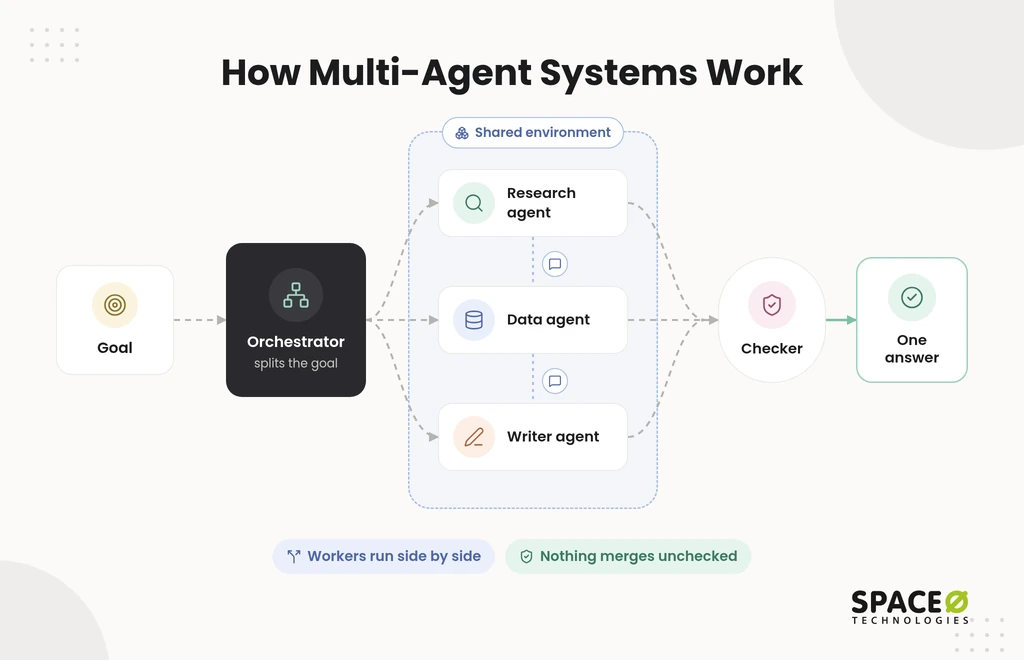
Ask one agent to research, decide, write, and verify, and it loses focus as the task grows. Splitting the work through agentic workflow automation gives each step a clear owner. A typical run looks like this:
- Goal intake: An orchestrator, also called a supervisor or manager agent, receives the goal and breaks it into subtasks.
- Delegation: Each subtask goes to a worker agent with its own role, instructions, and tools.
- Communication: Agents pass results through messages, handoffs, or shared memory inside a shared environment.
- Parallel execution: Independent subtasks run at the same time, so the team finishes faster than one agent working step by step.
- Verification: A checker, critic, or compliance agent reviews another agent’s output before it moves forward.
- Compilation: The orchestrator merges the approved results into one answer or one completed action.
Core Components of a Multi-Agent System
Every multi-agent system rests on three elements: the agents, the environment they share, and the way they interact.
Google Cloud’s explainer uses the same three-part frame. When one element is weak, the whole team underperforms.
- Agents: Autonomous units, often driven by a large language model (LLM), each holding a role, instructions, and tools.
- Environment: The shared space agents observe and change, such as a workspace, a database, or a business application.
- Interaction mechanisms: The rules and channels behind the communication step described above.
What characteristics define a multi-agent system?
A multi-agent system shows five traits: autonomy, specialization, coordination, interoperability, and scalability.
- Autonomy: Each agent decides how to complete its own subtask without step-by-step human instruction.
- Specialization: Each agent focuses on one job, such as research, drafting, or compliance review.
- Coordination: Agents sequence, share, and combine their work so outputs fit together.
- Interoperability: Model Context Protocol (MCP) links agents to tools and data. The agent-to-agent protocol (A2A) links agents to each other.
- Scalability: Teams add a new agent for a new task instead of overloading one agent.
Common Architecture Patterns
Multi-agent systems follow six common patterns, from a central supervisor to fully peer-to-peer coordination.
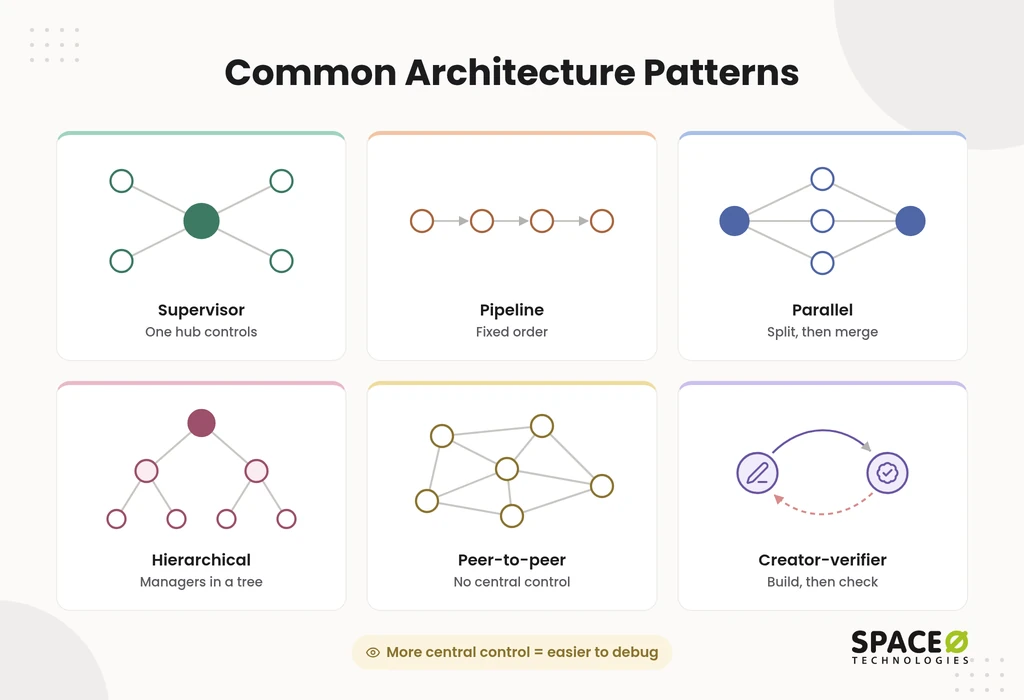
The pattern decides who holds control. Control sets how far AI agents make decisions autonomously and how easy the system is to debug.
- Supervisor: One orchestrator assigns every subtask and collects every result.
- Pipeline (sequential): Agents work in a fixed order, such as extract, draft, check, and send.
- Parallel: A manager slices the work across sub-agents running at once, then merges their outputs.
- Hierarchical: Agents sit in a tree, with managers above sub-managers and workers below.
- Decentralized (peer-to-peer): Agents share information with neighboring agents and coordinate without any central controller.
- Creator-verifier: One agent builds an output, and a second agent checks it before release.
Popular Frameworks for Building Multi-Agent Systems
LangGraph, AutoGen, and CrewAI are the three frameworks most often named for building multi-agent systems.
Your framework choice shapes how agents hold state and hand off work. Here is how the three differ:
- LangGraph: Models agent work as a stateful graph, with explicit steps and transitions between them.
- CrewAI: Organizes agents by role and delegates tasks across that crew.
- AutoGen: Coordinates agents through conversational, multi-agent dialogue.
Mastra and the OpenAI Agents SDK are further options teams evaluate. Most connect to tools through MCP, so MCP server development often follows the framework choice. The right choice depends on your business problem, not on a framework’s popularity.
Multi-Agent Versus Single-Agent Systems
A single agent fits focused tasks. A multi-agent system fits parallel steps, many tools, or independent review.
Choosing wrong in either direction costs money, so a small AI agent proof of concept helps first. Too few agents overload one context. Too many adds hand-offs nobody needed.
| Factor | Single-agent system | Multi-agent system |
|---|---|---|
| Context size | Works when the task fits one context window | Splits large context across specialist agents |
| Number of tools | A small set of related tools | Many tools, grouped by agent role |
| Parallel work | Runs steps one after another | Runs independent subtasks at the same time |
| Decision checkpoints and verification | The agent checks its own work | A separate checker or compliance agent reviews work |
| Failure impact | One failure stops the task | Errors can cascade between agents unless checks catch them |
| Permission scope per agent | One agent holds every permission | Each agent gets only the access its role needs |
| Review gates and auditability | One trace to audit | More hand-offs to log, but each step is reviewable |
| Build and run cost | Lower token use and simpler to build | Higher token use, latency, and build effort |
How Do Multi-Agent AI Systems Work in Business?
In business, a multi-agent system acts on core systems. It escalates to a human when confidence is low.
Most business workflows cross several systems and several approval steps. These include customer relationship management (CRM), enterprise resource planning (ERP), databases, and ticketing tools. One agent juggling all of them loses track. A team of agents gives each system and each decision its own owner.
What does a multi-agent workflow look like in a business?
A business workflow typically runs as a numbered chain, with each agent owning one step and one system.
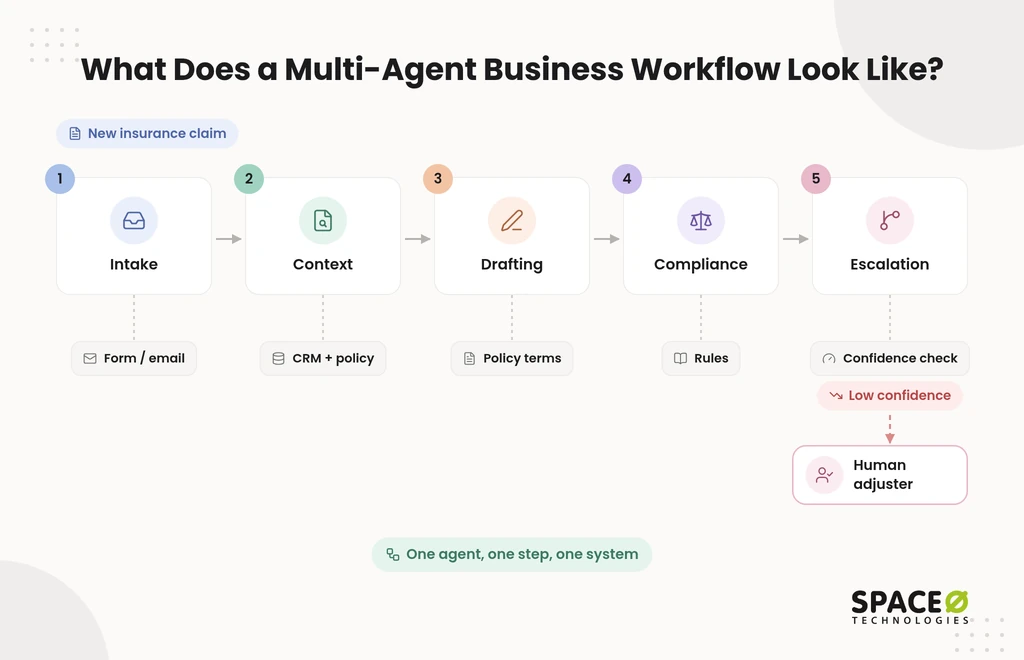
Take insurance claims intake, where slow triage delays payouts and frustrates policyholders. This chain is illustrative, not a client project:
- Intake agent: Classifies the claim type and intent from the submitted form or email.
- Context agent: Pulls policy terms and customer history from the CRM and policy system.
- Drafting agent: Proposes a coverage response based on the policy terms and claim details.
- Compliance agent: Checks the draft against rules and flags missing documents.
- Escalation agent: Routes the case to a human adjuster whenever confidence falls below a set threshold.
Each agent depends on clean access to those systems. Reliable API integration services often decide whether a chain like this works in production.
What are the four layers of a production multi-agent system?
A production multi-agent system has four layers: agents, orchestration, memory and context, and observability and governance.
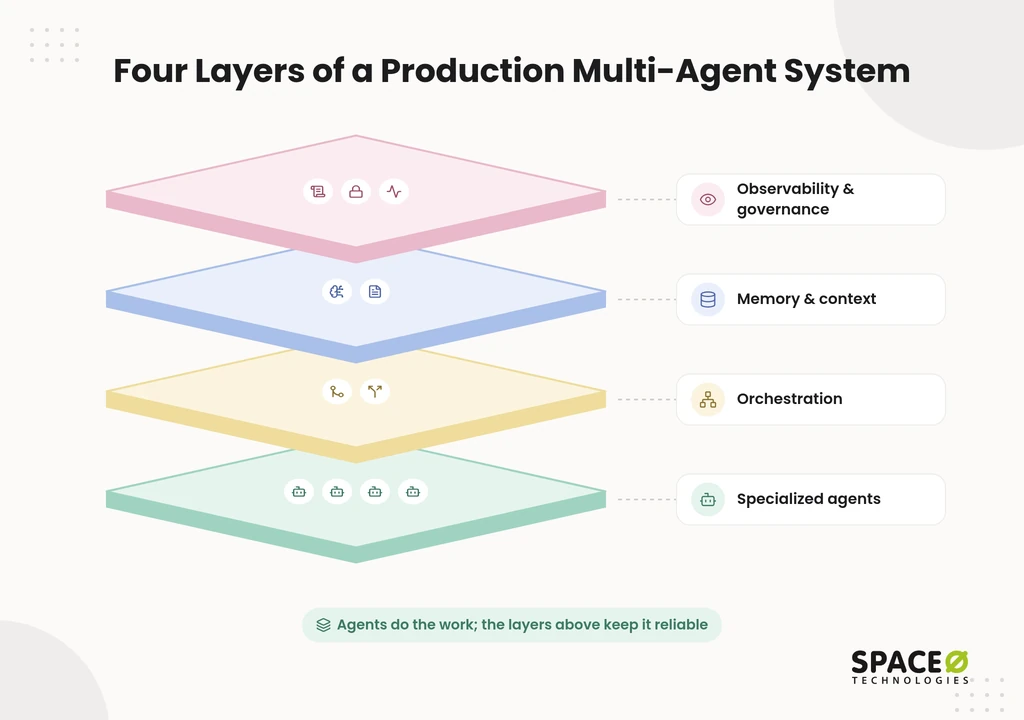
- Specialized agents: The workers, each scoped to one role and one set of tools.
- Orchestration layer: The logic that assigns tasks, orders hand-offs, and resolves conflicts.
- Memory and context layer: The shared store that gives each agent only what it needs, which limits context rot.
- Observability and governance layer: The logs, traces, and policies that show what each agent did and why.
How do teams keep business agents safe and governed?
Teams govern business agents with per-agent permissions, review gates, audit trails, and human approval for consequential decisions.
- Permission limits: Role-based access for AI agents keeps a read-only context agent from ever writing to the CRM.
- Review gates: A compliance or checker agent must approve before any external action runs.
- Audit trails: Every hand-off and tool call is logged, so reviewers can trace a decision back to its agent.
- Human-in-the-loop: People approve high-stakes outputs, such as claim denials, credit decisions, or clinical notes.
- Control model: Central orchestration is simpler to audit and govern. Weigh that against its single-point risk.
At Space-O Technologies, agents handle the volume, but a qualified human approves the high-stakes outputs. Examples include claim denials, credit decisions, and clinical notes, all reviewed before they influence a final decision.
When to Use a Multi-Agent System, and When Not To
Use a multi-agent system only when the task is read-heavy, splits cleanly, and outgrows one agent; otherwise keep one agent.
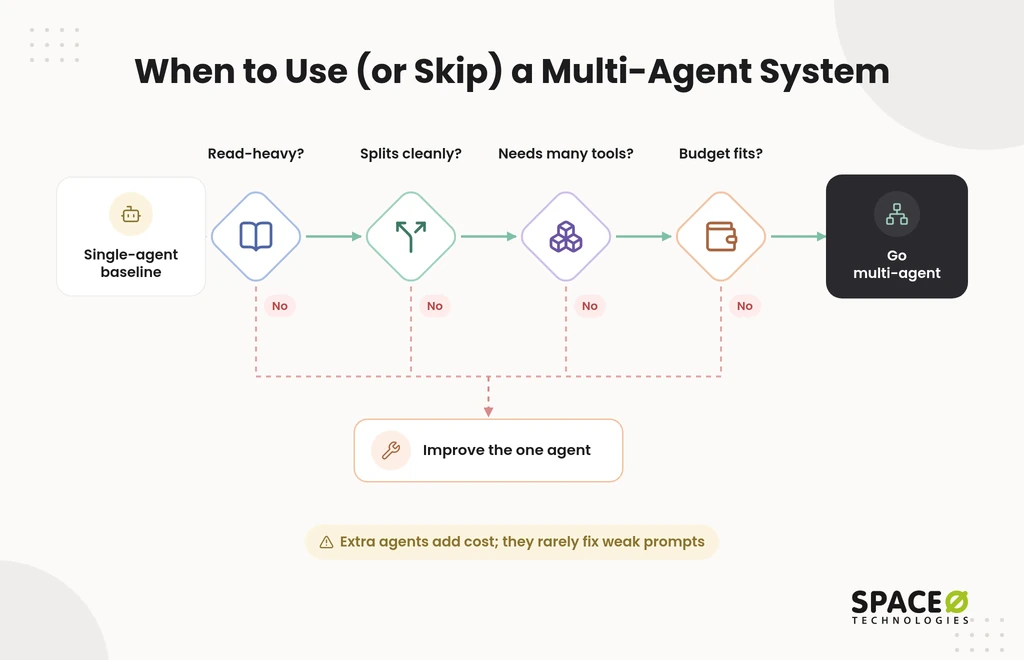
Teams often add agents to fix a quality problem. Extra agents rarely fix weak prompts or bad data, and they always add cost. Run this go/no-go test before you commit to enterprise AI agent development:
- Baseline first: Measure how often one well-built agent completes the task. A video analysis by Shaw Talebi finds multi-agent gains fade once a single agent already succeeds at a reasonable rate.
- Read versus write: Read-heavy, parallelizable work such as research suits several agents. Write-heavy, state-dependent work, where each step changes shared state, suits one agent.
- Decomposability: The goal must split into subtasks that do not need constant back-and-forth between agents.
- Context and tools: GitHub recommends multi-agent designs for parallel work, specialized tools, large context, or multiple decision checkpoints.
- Budget check: Cost grows faster than agent count. Phil Schmid (philschmid.de) puts multi-agent token use near 15x a chat, against roughly 4x for one agent.
Verdict: Go multi-agent when checks 2-4 pass and the single-agent baseline sits below the threshold. Otherwise, improve the single agent first.
Benefits of a Multi-Agent System
The main benefits are specialization, parallel speed, scalability, modularity, and fault tolerance.
These gains matter most when one agent has become a bottleneck as enterprises move manual processes to AI agents. In a PwC survey of 308 US executives, nearly two-thirds (66%) of those adopting AI agents report increased productivity.
- Specialization: Each agent gets narrow instructions and tools, which makes its behavior easier to test.
- Parallel speed: Shorter total completion time, from the parallel execution described above.
- Scalability: Capacity grows agent by agent, not by rewriting one large prompt.
- Modularity: Your team can update or replace one agent without rebuilding the others.
- Fault tolerance: Well-designed systems isolate a failed agent so the rest can retry or reroute the work.
Not Sure One Agent Or Several?
Our team runs the go/no-go test on your workflow, compares single-agent and multi-agent results, and recommends the design that fits your goals and budget.

Challenges and Risks
Multi-agent systems trade simplicity for capability, adding cost, latency, coordination overhead, and new failure modes.
Most failures come from the spaces between agents, not from any single agent.
- Cost and latency: Every hand-off adds model calls, tokens, and waiting time.
- Coordination complexity: Agents can duplicate work or wait on each other without clear ownership rules.
- Cascading errors: One agent’s mistake becomes the next agent’s input and spreads downstream.
- Conflicting writes: Agents working in parallel can overwrite each other’s files or shared state.
- Single point of failure: Under centralized control, an orchestrator outage stops the whole team.
- Harder debugging: Tracing a bad output means reading every hand-off, so AI agent audit logs matter.
- Security and governance: Gartner flags governance, observability, and a wider security attack surface as agent counts grow.
Real-World Examples of Multi-Agent Systems
Businesses use multi-agent systems where work spans research, software, logistics, and physical operations.
Interest is climbing fast, in line with wider agentic AI trends. Gartner reported a sharp rise in multi-agent system inquiries from Q1 2024 to Q2 2025. It also predicts 40% of enterprise apps will feature task-specific AI agents by 2026, up from less than 5% in 2025.
- Research and reporting: A researcher gathers sources, a writer drafts, and an editor reviews. A reviewer sends weak drafts back for revision.
- Software development: NVIDIA describes bug triage in which agents work in sequence, run in parallel, or ask other agents for help.
- Logistics and supply chain: Separate agents track inventory, forecast demand, and plan routes, then reconcile their plans.
- Robotics: Robots act as agents in one physical environment, coordinating movement so they avoid collisions and share tasks.
How Teams Put Multi-Agent Systems Into Production
Teams reach production when every agent ships with evaluation, monitoring, permission limits, and a human approval point.
Many agent projects stall between a convincing demo and a system the business trusts. Space-O Technologies has built AI-powered custom software since 2010. Here is what your team gets when we build one:
- Evaluation: We wrap every production model in an evaluation suite covering accuracy, hallucination rate, bias checks, latency, and cost. Continuous monitoring runs after launch.
- Compliance: Our team holds ISO 27001 and ISO 9001 certifications and builds HIPAA-ready frameworks for healthcare AI engagements.
- Ownership: We sign a non-disclosure agreement (NDA) before every project. All code, data, and intellectual property (IP) transfer to you at completion.
- Engagement models: Choose from four: Dedicated Team, Time & Material, Fixed Cost, and Staff Augmentation.
- Track record: We have served 1,200+ clients, delivered 300+ software solutions, and maintained 97% client retention with 140+ in-house developers.
Our team builds the agents, orchestration, and integrations. If you are still deciding between one agent and several, our AI consulting services can run the go/no-go test with you first.
After launch, agents need model updates, tool changes, and monitoring, which our software maintenance services cover.
Related Terms
These related terms help you read multi-agent designs and vendor proposals accurately.
- AI agent: One autonomous program that plans and takes actions toward a goal using tools.
- Single-agent system: One agent handling an entire task, with no hand-offs to other agents.
- Human-in-the-loop: A design in which a person reviews or approves an agent’s output, as in human-in-the-loop approval, before it takes effect.
Frequently Asked Questions
What is a multi-agent system in AI?
A multi-agent system is a group of autonomous, specialized AI agents that share an environment. They communicate and coordinate to solve tasks that are too complex for a single agent.
How do multi-agent systems work?
An orchestrator receives a goal and splits it into subtasks. Worker agents complete those subtasks, often in parallel. A checker agent reviews the results, and the orchestrator merges them into one answer.
How do multi-agent systems communicate?
Agents communicate through messages, task handoffs, and shared memory inside a shared environment. A central orchestrator can route this traffic. In peer-to-peer designs, agents exchange information directly with neighboring agents.
What do I need in place before building a multi-agent system?
You need a measured single-agent baseline and a goal that splits into independent subtasks. Agents also need clean access to the systems they use. Add per-agent permissions, monitoring, and a human approval point for high-stakes outputs. If one agent already succeeds at a high rate, improve it first.
What is the difference between a single-agent and a multi-agent system?
A single agent handles a whole task alone, which suits focused work. A multi-agent system divides the task among specialized agents. It suits parallel steps, many tools, or independent review, but it costs more and adds latency.
What are examples of multi-agent systems?
Common examples include research teams with a researcher, writer, and editor, and bug triage in software development. Others include logistics planning across inventory, demand, and routes, and robots that share a physical space.
Which frameworks build multi-agent systems?
LangGraph, AutoGen, and CrewAI are the most common choices. LangGraph models work as a stateful graph, CrewAI organizes agents by role, and AutoGen uses conversational dialogue between agents. Mastra and the OpenAI Agents SDK are further options.
What are the risks of multi-agent systems?
The main risks are higher cost and latency, coordination problems, and cascading errors between agents. Parallel agents can overwrite shared state. Centralized control adds a single point of failure.



 All our projects are secured by NDA




 4.8


