
 By
Contents
- Architecture: Model Context Protocol (MCP) turns N × M custom integrations into N + M components.
- Build: Define capabilities, choose a transport layer, and set up OAuth authentication with your identity provider.
- Security: Treat every server as untrusted by default, then add allow-lists, isolation, and a live inventory.
- Governance: Require human approval for any tool call that deletes or overwrites data.
- Fit: Choose a custom server, a gateway, or a platform-native option based on systems and ownership.
Key Takeaways
An enterprise Model Context Protocol (MCP) server links artificial intelligence (AI) agents to business systems. Most enterprises run several AI pilots, and each needs its own wiring. That wiring drives cost, delay, and security gaps.
This guide explains enterprise MCP server development, from architecture to security. Space-O Technologies has built AI-powered custom software since 2010. We build enterprise MCP servers under a non-disclosure agreement (NDA).
You will see how servers, gateways, and identity providers fit together. You will also get a risk-to-control table for security reviews. For the agent side, read our AI agent architecture for enterprise systems guide.
How does MCP architecture work in an enterprise?
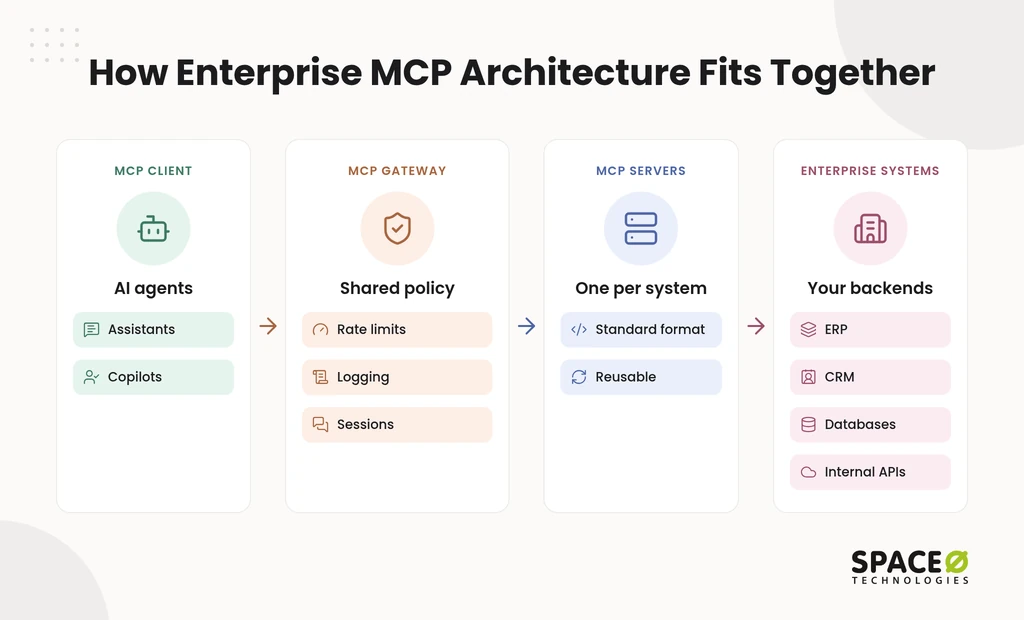
MCP uses a client-server model: AI agents act as MCP clients, and backend connectors act as MCP servers.
Most enterprises run several AI pilots, and each one needs its own path into business systems. That point-to-point wiring is where cost, delay, and security gaps pile up. Read why enterprise AI agent pilots fail for the same reason.
Gartner predicts over 40% of agentic AI projects will be canceled by the end of 2027. MCP standardizes the connection, so any compliant agent can use any compliant server.
- MCP client: The AI agent or assistant that requests data and actions on a user’s behalf.
- MCP server: The connector that exposes one backend system’s data and actions in a standard format.
- Enterprise system: An enterprise resource planning (ERP) or customer relationship management (CRM) platform. It can also be a database or internal application programming interface (API).
Why does MCP turn N × M integrations into N + M?
MCP replaces one custom integration per agent-system pair with one client per agent and one server per system.
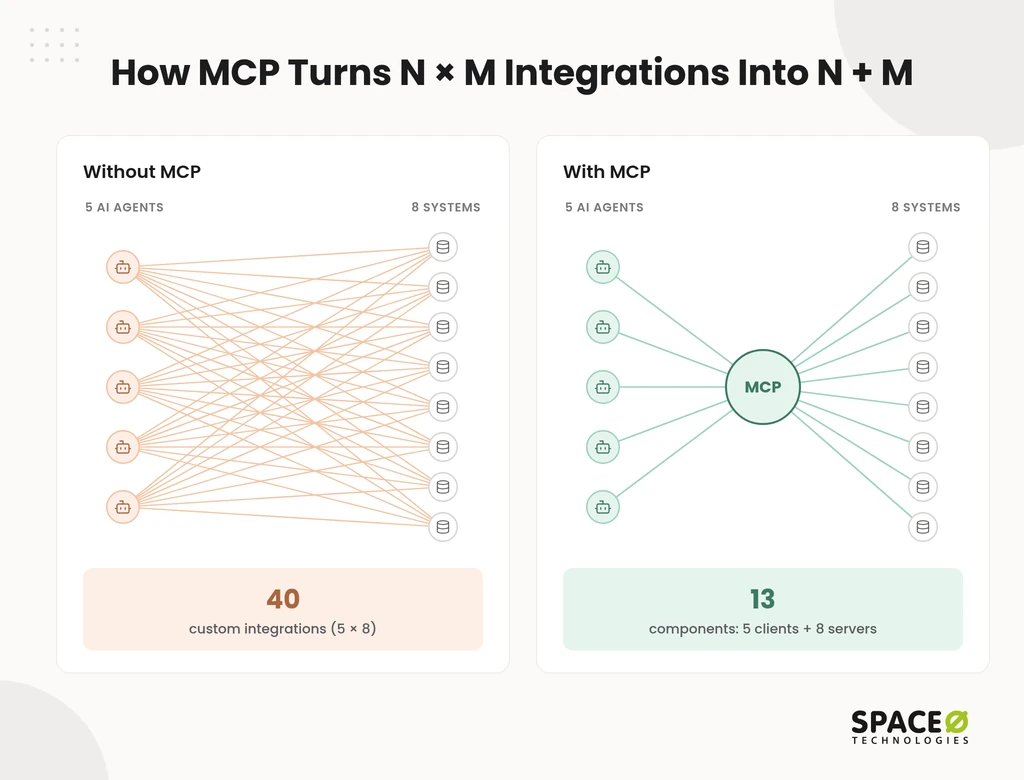
Without a standard, N agents and M systems need N × M custom integrations. With MCP, the same estate needs N + M components. For example, 5 agents and 8 systems drop from 40 integrations to 13. Your team maintains fewer connectors across ERP integration projects, and each new agent reuses existing servers.
What does an enterprise MCP gateway add?
An enterprise MCP gateway sits in front of your MCP servers and enforces shared policy across all of them.
Once several teams run their own servers, controls start to drift between them. A gateway centralizes three functions:
- Rate-limiting: Caps how often agents call each server, which protects backend systems from runaway loops.
- Centralized logging: Records every request in one place for security review and audits.
- Stateful multi-turn sessions: Keeps context across a multi-step agent conversation instead of handling each call in isolation.
What are the key steps in MCP server development?
MCP server development follows three core build steps: define capabilities, choose the transport layer, and set up authentication.
Each step shapes what your security team will later need to approve.
- Define capabilities: Decide which tools, resources, and prompts the server exposes.
- Choose the transport layer: Pick how clients and the server exchange messages.
- Set up authentication: Connect the server to your identity provider through OAuth.
What capabilities does an MCP server expose?
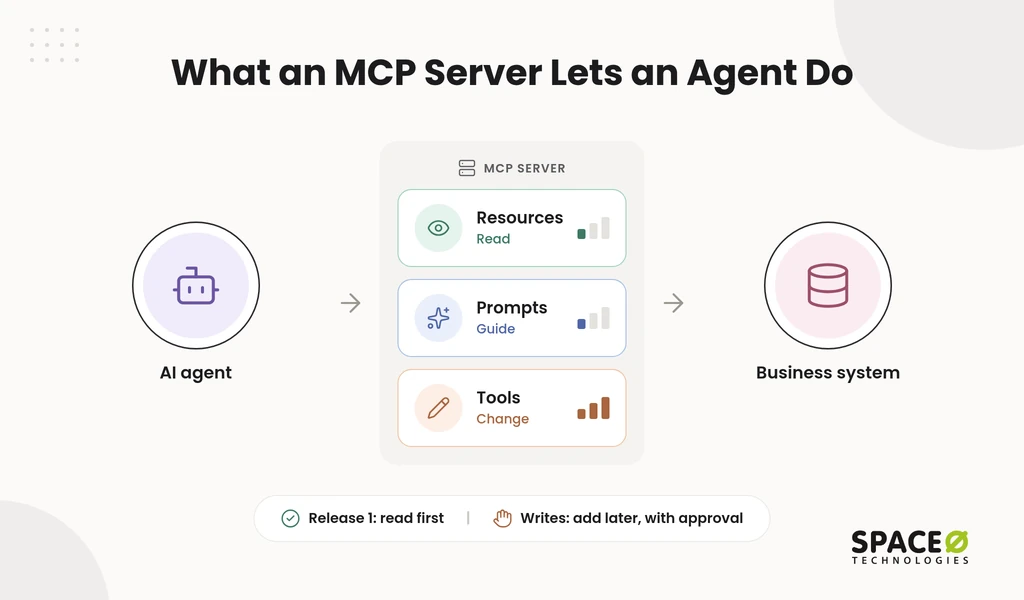
An MCP server exposes three capabilities: Tools, Resources, and Prompts.
The business question is simple: what should an agent see, and what should it change?
- Tools: Actions the agent can call, such as creating a ticket or updating a record built through our CRM development services.
- Resources: Data the agent can retrieve for context, such as files, records, or query results.
- Prompts: Reusable, prewritten instructions that guide the agent through a defined task.
Start with Resources where you can. Read access carries less risk than write access.
Which transport layer should an MCP server use?
Remote enterprise MCP servers typically use Server-Sent Events (SSE) or persistent socket connections for transport.
The choice affects how long-running agent sessions behave across your network. Persistent connections suit stateful, multi-step sessions that stream results back to the agent.
The MCP specification evolves, so we confirm the current transport options at kickoff. That way your server is never built on a method the standard has since replaced.
How should an MCP server authenticate users and agents?
Enterprise MCP servers should authenticate through OAuth discovery flows against your existing identity provider.
Shared service keys are a common source of credential exposure. OAuth lets each request carry a scoped, revocable token tied to a real user. Your identity provider stays the single source of truth for who can do what.
ServiceNow is a worked example of this pattern. Its MCP builds pair an OAuth registry with scoped tool execution. Each tool runs only within the permissions the token grants.
How do you secure and govern enterprise MCP servers?
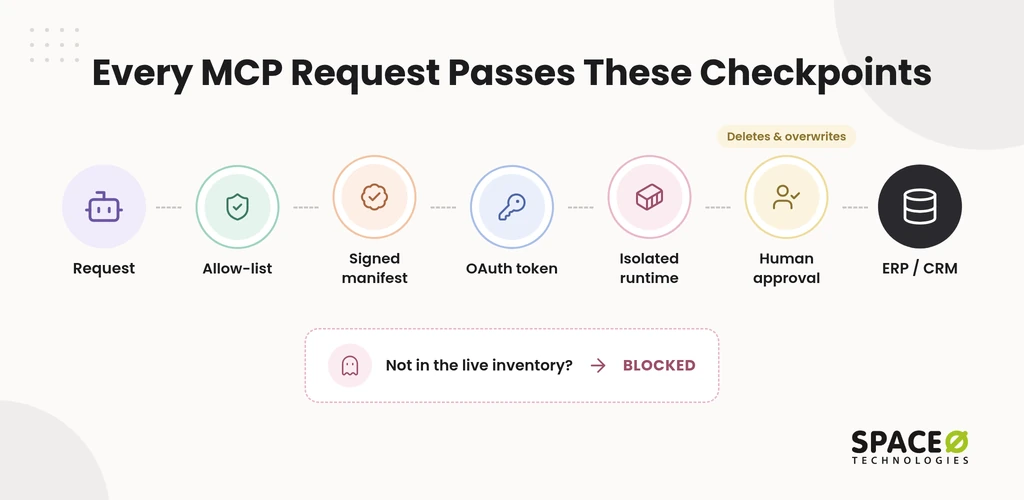
Secure enterprise MCP servers by treating each one as untrusted by default, then adding controls before you grant access.
An MCP server can read records and trigger actions. One weak server can become a path into core systems. Four practices cover the risks most enterprise security reviews raise. For governance planning, see our AI consulting services.
What does “untrusted by default” mean for MCP servers?
Untrusted by default means no MCP server gets access until its identity and permissions are verified.
- Signed manifests: Confirm that a server’s code and declared capabilities come from a known publisher and are unaltered.
- Allow-lists: Permit only approved servers and approved tools, and block everything else.
This matters most for third-party servers your team did not build.
Where should enterprise MCP servers run?
Run MCP servers in isolated environments: enclaves, trusted execution environments (TEEs), containers, or your own virtual private cloud (VPC).
Isolation limits the damage if a server is compromised. A breached container should not be able to reach your ERP, CRM, or file stores. Match the isolation level to the sensitivity of the data each server touches.
How do you find shadow IT MCP servers?
Find shadow IT MCP servers by keeping a live inventory of every server your teams run or connect.
Employees can connect MCP servers to approved AI tools without telling IT. Those servers can hold credentials that nobody reviews. An inventory records each server’s owner, data access, and approval status. Anything missing from the inventory stays blocked by the allow-list.
When should a human approve an MCP tool call?
A human should approve any MCP tool call that deletes, overwrites, or otherwise cannot be undone.
An agent that misreads a request should not be able to wipe records on its own. Human-in-the-loop review puts a person between the agent’s proposal and the action.
Our guide on AI agent hallucination and taking wrong actions explains why. Space-O Technologies applies the same rule in production AI, where people approve consequential decisions.
Which control covers each MCP risk?
Each of the four common MCP risks maps to one primary control. Security reviewers can use this table as a quick reference.
| Risk | Control |
|---|---|
| Untrusted servers | Signed manifests and allow-lists |
| Credential exposure | OAuth through your identity provider, with scoped, revocable tokens |
| Shadow IT | Live server inventory enforced by the allow-list |
| Destructive tools | Human-in-the-loop approval before the action runs |
Map These Controls to Your Stack
Our engineers can review your identity provider and backend systems. We will show which controls your first MCP server needs.

Which MCP build approach fits your enterprise?
Most enterprises choose between a custom MCP server, gateway-fronted servers, or a platform-native option such as ServiceNow.
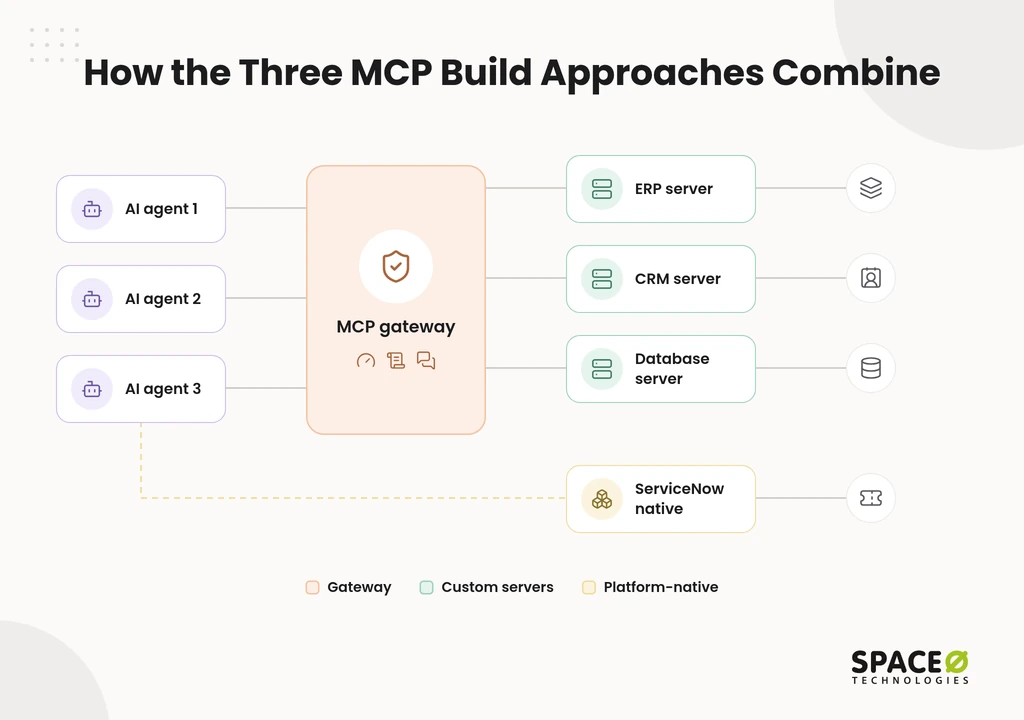
The right choice depends on how many systems you connect and who must own the result.
| Approach | Integration breadth | Security controls | Code and intellectual property (IP) ownership | What adoption requires |
|---|---|---|---|---|
| Custom MCP server | Any ERP, CRM, database, or internal API you choose | Built to your policy: OAuth, allow-lists, isolation, and human approval | Your organization, when the contract transfers it | An engineering team to build, host, and maintain each server |
| Gateway-fronted MCP servers | Many servers behind one control point | Shared rate-limiting, centralized logging, and session handling | Servers are yours; the gateway is licensed or self-hosted | Gateway setup, administrators, and a clear policy owner |
| Platform-native (ServiceNow) | Data and workflows inside the platform | Platform OAuth registry and scoped tool execution | Configuration lives inside the platform | Platform licensing and administrators, plus separate work for systems outside it |
These approaches combine well. You can run custom servers behind a gateway, alongside a platform-native ServiceNow connection. Budget platform work early, starting with ServiceNow implementation cost.
How does Space-O Technologies build enterprise MCP servers?
Space-O Technologies fits enterprises connecting MCP servers to ServiceNow, ERP, and CRM, with human review on high-stakes actions.
The hard part of MCP is rarely the protocol. It is the systems behind it. We already build and run the systems your MCP servers connect to.
- ServiceNow: Our team delivers ServiceNow integration services alongside implementation, migration, managed services, and support.
- ERP, CRM, and internal APIs: We connect existing tools through API integration services and build the systems behind them.
- AI agents: The MCP clients come from our AI agent development practice.
- Responsible AI defaults: No training on client data, personally identifiable information (PII) masking, and human review for high-stakes decisions.
We have served 1,200+ clients and developed 300+ software solutions. Our 140+ in-house developers work from offices that include Mesa, Arizona.
Which engagement models fit an MCP build?
Four engagement models cover an MCP build: Dedicated Team, Time & Material, Fixed Cost, and Staff Augmentation.
MCP scope often grows once the first server proves its value. Pick the model that matches where you are.
- Fixed Cost: Suits a first server with a defined system and tool list.
- Time & Material: Suits discovery-heavy work where capabilities are still being mapped.
- Dedicated Team: Suits a multi-server program built over several releases.
- Staff Augmentation: Adds specialists to your in-house team. You can hire AI agent developers who join your sprints.
What should you share before scoping your MCP server?
Share your backend systems, programming language, and identity provider, and we can scope your first MCP server.
- Backend system: Which ERP, CRM, database, or internal API the first server should reach.
- Programming language: The language your team will maintain the server in after handover.
- Identity provider: The system that OAuth will authenticate against.
- Destructive actions: Which tool calls must wait for human approval.
- Hosting: Container, enclave, TEE, or VPC requirements from your security team.
Get Your First MCP Server Scoped
Send us those five answers and our engineers will return a scoped plan. You get a clear first-server scope before any build begins.
Frequently Asked Questions
Can I use MCP with existing tools and applications?
Yes, an MCP server connects to your existing tools and applications without replacing them. It can expose data and actions from an ERP, CRM, database, or internal API. Platform-native options also exist, such as ServiceNow, which pairs an OAuth registry with scoped tool execution. Systems outside a platform need separate server work.
Can an MCP server be limited to read-only access?
Yes, an MCP server can be limited to read-only access. A server can expose only Resources, which let an agent retrieve data for context but not change it. Read access carries less risk than write access, so starting with Resources is a sensible first release. You can add Tools that create or update records later. Require human approval for any call that deletes or overwrites data.
What should security teams have approved before an MCP server goes live?
Security teams should approve the exposed capabilities, the transport layer, and the OAuth connection before launch. They should also approve the server’s place on the allow-list and its entry in the live inventory. Finally, they should define which tool calls must wait for human approval. Anything not inventoried and approved should stay blocked.
How do I connect a new AI agent when my MCP servers already exist?
Add one MCP client for the new agent and point it at the servers you already run. You do not build new integrations. In an estate of 5 agents and 8 systems, that means 13 components rather than 40 custom integrations. Scope the agent’s access through OAuth tokens and your allow-list so it sees only the tools and resources it needs.
What services and use cases can benefit from MCP?
Any workflow where an agent needs business data or must act in a backend system can benefit. Examples include creating a ticket, updating a CRM record, or retrieving files, records, and query results for context. ServiceNow is a worked example of the pattern, and ERP, CRM, database, and internal API connections follow the same model.
How does human approval work for MCP tool calls?
A person reviews and approves any consequential output or irreversible action before it takes effect. The model drafts a recommendation and retrieves evidence. A human signs off on every decision above a set risk threshold. MCP tool calls that delete or overwrite data follow the same rule.



 All our projects are secured by NDA




 4.8


