
 By
Contents
- Enterprise AI agents handle variable, exception-heavy steps that break rule-based automation, while workflows handle the predictable steps.
- Start with one workflow that runs often, varies in its inputs, follows written rules, and has API access.
- Role-based access, audit trails, and human approval gates keep agents safe when they take high-risk actions in your systems.
- Budget for build and run, because yearly maintenance adds a predictable share of the build cost.
Key Takeaways
Enterprise AI agent development replaces manual workflows with agents that act inside your systems. These agents plan multi-step work, use tools, and make decisions within set limits. They go beyond robotic process automation (RPA) scripts and prompt-driven assistants.
Operations and IT leaders often start with scripts, bots, or packaged tools. Those tools break when inputs vary, such as free-text emails or scanned documents. Our AI consulting services team helps you pick the first workflow worth automating.
We connect agents to customer relationship management (CRM) and enterprise resource planning (ERP) systems. Our ERP integration services handle the system side of each build. This guide covers readiness, build steps, governance, partner choice, and cost.
AI Agents vs. Traditional Automation vs. Off-the-Shelf Tools
AI agents take the variable, exception-heavy steps that break rule-based automation, while workflows keep the predictable ones.
Your operations team probably runs scripts, bots, or packaged tools already. Traditional automation executes fixed sequences on structured data. It fails when inputs vary, such as free-text emails or scanned documents. Agents read those inputs and reason with a large language model (LLM). They then act through tools and application programming interfaces (APIs).
Rule-based workflows stay best for repeatability, governance, and auditability. That is why production systems are hybrid. A workflow engine owns state, approvals, exceptions, and audit trails. Agents act only at the steps where judgment adds value.
Agents sit on top of your systems of record, not in place of them. They work inside Salesforce, SAP, or ServiceNow as policy-aware users with scoped permissions. Our ServiceNow integration services cover the ticketing side of that connection.
| Criterion | Traditional automation (RPA, rule-based) | Off-the-shelf AI tools | Custom enterprise AI agents |
|---|---|---|---|
| Handles unstructured data and exceptions | No; fails when inputs vary | Partly, within the vendor’s templates | Yes; reasons over documents, emails, and free text |
| Fit to your workflows | Exact, but only for fixed sequences | Generic; your process adapts to the tool | Built around your mapped process and rules |
| Connects to existing systems through APIs | Through scripted steps or connectors | Through the vendor’s connector list | Through APIs and MCP to your CRM, ERP, and ticketing |
| Human-review checkpoints | Added as manual hand-offs | Depends on vendor features | Designed into every high-risk step |
| Code and IP ownership | Tied to the platform license | Vendor owns the product; you license it | Fully transferable to you under a custom contract |
| Engagement model | Platform license plus configuration | Vendor subscription or license | Dedicated Team, Time & Material, Fixed Cost, or Staff Augmentation |
Which Manual Workflows Should You Replace First?
Start with one scoped workflow that runs often, varies in its inputs, follows written rules, and touches API-ready systems.
Many agent projects fail before any code is written. The team picks a process nobody has documented. Automating a broken process makes the same failures happen faster and at a larger scale.
A process audit prevents that. We map every step and mark each one as a rule or judgment. Rule steps become deterministic code. Judgment steps become agent candidates.
The four-point readiness test:
- Volume: The workflow runs daily or weekly, so each saved hour repeats.
- Variability: Inputs arrive as emails, PDFs, or free text that scripts cannot parse reliably.
- Written rules: Standard operating procedures (SOPs) or policy documents define the right outcome.
- Access: Every system the workflow touches exposes an API or a supported connector.
A workflow that passes all four is a strong first candidate, and it helps to pick the first use case for an AI agent with that test. One that fails two or more needs process work first.
How Enterprise AI Agent Development Works, Step by Step
Space-O Technologies takes one manual workflow from audit to production in seven steps.
Pilots stall when teams jump straight from demo to deployment. Each step below closes one of those gaps.
- Map the manual workflow. We document every step and mark judgment versus rules. Our team runs this audit with your process owners.
- Define outcomes and boundaries. Your team agrees on what the agent may do alone and what needs approval. We also list what it must never touch.
- Ground the agent in your data and SOPs. We use retrieval-augmented generation (RAG) over your policies and records. Each answer traces back to a source your team can check.
- Integrate with your systems. We connect through API integration services or the Model Context Protocol (MCP) to your CRM, ERP, and ticketing tools.
- Add human review and audit logging. High-risk or irreversible actions wait at an approval gate. Every tool call and decision lands in an audit log.
- Evaluate on real cases before launch. We replay real historical cases through the agent. Your team sets the pass thresholds before go-live.
- Pilot, scale, and maintain. We launch with one team, then widen scope as error logs hold steady. Ongoing software maintenance services keep models, prompts, and integrations current.
Enterprise AI Agent Use Cases That Replace Manual Work
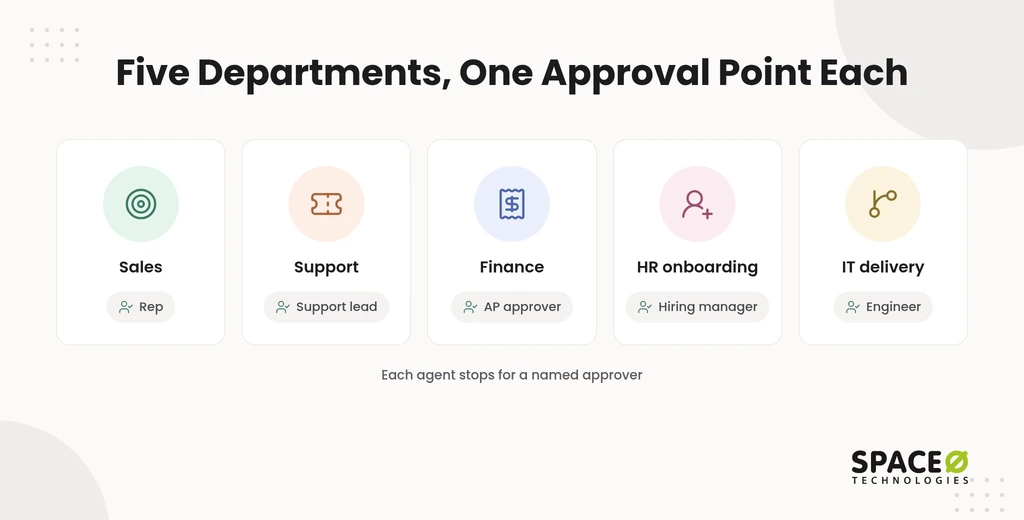
The strongest early use cases combine high volume, variable inputs, and a clear point where a person approves.
Adoption is moving fast. Gartner expects a growing share of enterprise applications to include task-specific agents by the end of 2026. That is a sharp rise from a year earlier, per the same Gartner forecast.
- Sales and lead handling: Reps research every inbound lead by hand before calling. The agent researches the account, updates the CRM record, and drafts a follow-up. A rep approves before any email goes out.
- Customer support triage: Agents sort and route tickets manually all day. The AI agent classifies each ticket, pulls account history, and drafts a reply. A support lead approves replies that change an order or account.
- Finance and invoice processing: Accounts payable (AP) clerks match invoices to purchase orders (POs) by hand. The agent extracts invoice fields and checks them against the PO in your ERP. Variances above your tolerance go to a named approver.
- Employee onboarding: HR coordinates accounts, equipment, and training across separate tools. The agent opens tickets in your IT service management (ITSM) and human resources information system (HRIS) platforms. The hiring manager approves any elevated access.
- IT and software delivery: Engineers lose hours triaging failed builds. The agent reads continuous integration and continuous delivery (CI/CD) logs and links failures to recent commits. An engineer reviews its proposed fix before merging.
Governance, Security, and Human Review for Enterprise AI Agents
Every agent we ship runs with role-based access and audit trails, human review, privacy controls, and tested outputs.
An agent with broad access and no logs is a compliance problem in waiting. These controls are part of every Space-O Technologies build.
- Role-based access: Each agent runs under its own scoped role. On Salesforce, data access follows its permissions and sharing models.
- Audit trails: Every input, tool call, decision, and approval is logged for later review.
- Human review: A qualified person approves before any agent output shapes a consequential decision, through human-in-the-loop approval gates.
- Privacy: We mask personally identifiable information (PII) and never train models on client data.
- Testing: Every production model runs inside an evaluation suite with continuous monitoring. It covers accuracy, hallucination rate, bias checks, latency, and cost.
- Compliance posture: We hold ISO 27001 and ISO 9001 certifications. Healthcare AI engagements use Health Insurance Portability and Accountability Act (HIPAA)-ready frameworks.
Finance and healthcare outputs get stricter accuracy testing because errors there carry higher stakes.
How to Choose an Enterprise AI Agent Development Partner
An AI agent development partner for enterprises designs, builds, and governs multi-agent systems inside your ERP, CRM, and ITSM platforms.
Every vendor now claims agent expertise. Weigh orchestration depth, security and compliance controls, and integration experience over marketing claims.
What four tests separate a production partner from a chatbot vendor?
Four tests separate a production partner from a chatbot vendor: orchestration, governance, integration, and an honest buy-versus-build answer.
- Multi-Agent Orchestration: Ask to see agents handing off work with shared state. Orchestration depth is what separates agents from rule-based scripts and chatbots.
- Governance & Security: Look for role-based access and audit trails, privacy controls, and guardrails. Human review should be documented, not promised.
- Integration Depth: Ask for proven connections to ERP, CRM, ITSM, and HRIS platforms. Integration depth with existing enterprise systems is often the primary driver of time to value.
- Buy vs. Build (80/20): Many enterprises take an 80/20 buy-vs.-build approach: purchase the platform, build only differentiated workflows. A credible partner tells you when a platform already covers most of the job.
What routes do enterprises choose from, and what does each require?
Enterprises choose among global consultancies and integrators, specialist engineering partners, and native agent platforms.
Each route asks something different of your team. The table describes each option by what adopting it requires.
| Option | Route | Known for | What adopting it requires |
|---|---|---|---|
| Deloitte | Global consultancy and integrator | Multi-year, multi-department AI programs | Program-level scoping and sponsorship across several departments |
| Accenture | Global consultancy and integrator | Multi-year, multi-department AI programs | Program-level scoping and sponsorship across several departments |
| N-iX | Specialist engineering partner | Large-scale enterprise integration and a “Pragmatic AI” approach | A multi-team engagement scoped to integration-heavy work |
| ScienceSoft | Specialist engineering partner | Regulated industries such as healthcare and banking; long-standing IT consulting | Consulting-led scoping across its enterprise software domains |
| Itransition | Specialist engineering partner | Layering copilots onto existing software such as SAP or Salesforce | An existing SAP or Salesforce estate and a platform implementation scope |
| BairesDev | Specialist engineering partner | Substantial engineering capacity from nearshore Latin American talent | Managing nearshore capacity alongside your own process owners |
| GrowExx | Specialist engineering partner | Multi-agent systems inside existing ERP, CRM, and core platforms; ISO 27001 marker | Direct access to your core platforms for in-place builds |
| Salesforce Agentforce | Native platform | Agents inside Salesforce, with Actions that reach external systems | A Salesforce estate, admin setup of permissions and sharing models, and platform licensing |
| Google’s Gemini Enterprise Agent Platform | Native platform | Building agents inside a Google estate | A Google Cloud estate and in-house admins to configure it |
| Microsoft Copilot Studio | Native platform | Building agents inside a Microsoft estate | A Microsoft estate and in-house admins to configure it |
| Space-O Technologies | Specialist engineering partner | One scoped workflow from audit to production agent, with AI, ERP, CRM, and ServiceNow under one team | A process owner for the target workflow and a paid discovery phase |
Where does Space-O Technologies fit?
Space-O Technologies fits operations and IT leaders who want one scoped workflow in production with human review built in.
You get custom AI agent development, ERP and CRM integration, and ServiceNow work from one team. The codebase transfers fully to you. Work starts as a milestone-paid MVP, then scales.
- Since 2010: We have built AI-powered custom software for 1,200+ clients.
- Delivery volume: Our 140+ in-house developers have shipped 300+ software solutions.
- Retention: We report 97% client retention.
- Scale proof: Glovo, an on-demand delivery app we built, passed 50M+ downloads.
- Locations: We have offices in Mesa (Arizona), Brampton (Ontario), and Ahmedabad (India).
Have a Manual Workflow in Mind?
Tell us which process slows your team down, and we will map it, scope one agent, and share a free, expert-reviewed estimate for your first rollout.

Pilot to Production: What Enterprise AI Agents Cost, Who Owns Them, and What Can Fail
A first agent starts as a proof of concept near $15,000, and maintenance adds 15%-25% of build cost yearly.
Most budgets cover the build and miss the run costs. This section covers both, plus ownership terms and failure risk.
What does an enterprise AI agent cost to build and run?
Build cost depends on scope, while run cost adds a predictable yearly share on top.
A basic MVP can start from $15,000, while more feature-rich MVPs can go up to $50,000 or more. Maintenance follows the 15% to 25% yearly range in our AI development cost guide.
| Stage | Verified range | What it covers |
|---|---|---|
| Proof of concept | Starts near $15,000 | One workflow tested on real cases |
| Basic MVP | From $15,000 | MVP scope, not a fixed price for every agent |
| Feature-rich MVP | Up to $50,000+ | More integrations, review flows, and reporting |
| Broader AI development | $25,000-$500,000+ in 2026 | Range across AI project tiers |
| Enterprise AI platform | Well past $500,000 | Custom models, deep integrations, and compliance controls |
| Annual maintenance | 15%-25% of original build cost | Monitoring, updates, and fixes each year |
| Retraining cycles | $15,000-$60,000 per year | Keeping models accurate as data shifts |
Your full budget also includes cloud infrastructure and model or API usage fees. Our MVP development services page explains how MVP scope is set.
How are payments structured, and who owns the result?
You pay in milestones tied to deliverables, and you own everything we build.
We sign a non-disclosure agreement (NDA) before every project starts. All source code, data, and intellectual property (IP) transfer to you at completion. Engagements start with a paid discovery or proof-of-concept phase on one workflow. A milestone-paid MVP follows, then scale-up on any of the four engagement models, including a team of dedicated AI agent developers.
What can fail between pilot and production?
Agentic projects fail mainly on scope, process quality, and missing controls, not on model capability.
Gartner predicts that a large share of agentic AI projects will be canceled by the end of 2027. The common reasons enterprise AI agent pilots fail are predictable:
- Undocumented processes: The agent inherits every flaw of the manual workflow.
- Full autonomy too early: High-risk actions run without an approval gate.
- Legacy-integration friction: Older systems lack the APIs the agent needs.
- No evaluation baseline: Nobody can prove the agent beats the manual process.
The audit, approval gates, and evaluation suite described on this page target each cause directly.
What Should You Know Before Your First Scoping Call?
Four answers scope your first enterprise AI agent: the workflow, the systems, the industry, and build versus buy.
- What manual workflow? Name the process and roughly how often it runs.
- What systems does it touch? List the CRM, ERP, ticketing, and databases involved.
- Which industry? Regulated data changes the controls and testing needed.
- Build or buy a platform? Tell us if you already run Salesforce, Google, or Microsoft tools.
Frequently Asked Questions
Is AI going to replace ERP systems?
No. Agents layer on top of your systems of record and do not replace them. In platforms such as Salesforce, SAP, or ServiceNow, an agent acts like a policy-aware user limited to scoped permissions. The ERP still owns the data. The agent takes variable steps, such as matching invoices to purchase orders.
What can you get an AI agent to do?
An enterprise AI agent can finish multi-step work across your systems. It can research a lead and update the CRM record. It can classify a support ticket and draft a reply. It can extract invoice fields and check them against a purchase order. It can read build logs and link failures to commits. Each task ends at a point where a person approves.
What are the top AI agent development companies?
The options fall into three routes. Global consultancies include Deloitte and Accenture. Specialist engineering partners include N-iX, ScienceSoft, Itransition, BairesDev, GrowExx, and Space-O Technologies. Native platforms include Salesforce Agentforce, Google’s Gemini Enterprise Agent Platform, and Microsoft Copilot Studio. This is a route comparison, not a ranking. Verified pricing is not published for most of them, and Itransition sells by quote.
How much does it cost to build an enterprise AI agent?
A proof of concept starts near $15,000. A basic MVP can start from $15,000, and feature-rich MVPs can reach $50,000 or more. Yearly maintenance adds 15% to 25% of the original build cost.
Which manual workflows should you replace with AI agents first?
Start with one workflow that runs often, varies in its inputs, follows written rules, and touches API-ready systems. Lead handling, support triage, invoice matching, employee onboarding, and failed-build triage fit best.
How do AI agents differ from robotic process automation?
RPA runs fixed sequences on structured data and fails when inputs vary. Agents read free text and documents, reason over them, and act through APIs. Production systems pair both.
Who owns the code and data of an enterprise AI agent?
You do. All source code, data, and intellectual property transfer to you at completion. We sign a non-disclosure agreement before every project starts.
How do you keep an AI agent safe in production?
Use role-based access, audit logs, and human approval gates for high-risk actions. Mask personally identifiable information and run an evaluation suite with continuous monitoring.



 All our projects are secured by NDA




 4.8


