
 By
Contents
- Scale only after retention holds without your push, and no customer needs a custom hack.
- Refactor when the data model is sound; rebuild with the MVP as the specification when it is not.
- Move model calls to background workers, cache repeated answers, and route simple requests to smaller models.
- Budget for AI maintenance as a yearly cost, not a one-time build line.
Key Takeaways
To scale an AI MVP into a product, build a reliable, cost-controlled production system. Prove retention first, then fix the data model. Last, control token cost, latency, and security.
Your minimum viable product (MVP) answered one question: does this idea work? A production product answers a harder one: will it hold up at a defensible cost? If our MVP development services built your first version, this is the next stage.
Space-O Technologies has built AI-powered custom software since 2010 for 1,200+ clients. This guide covers a readiness test, five steps, and a US-dollar cost model. It also shows when an AI product development company is worth hiring.
Is Your AI MVP Ready to Scale?
Your AI MVP is ready to scale once usage holds without you pushing it. Scaling before demand is proven puts a startup at real risk. Scaling a product nobody has committed to only multiplies the cost of being wrong.
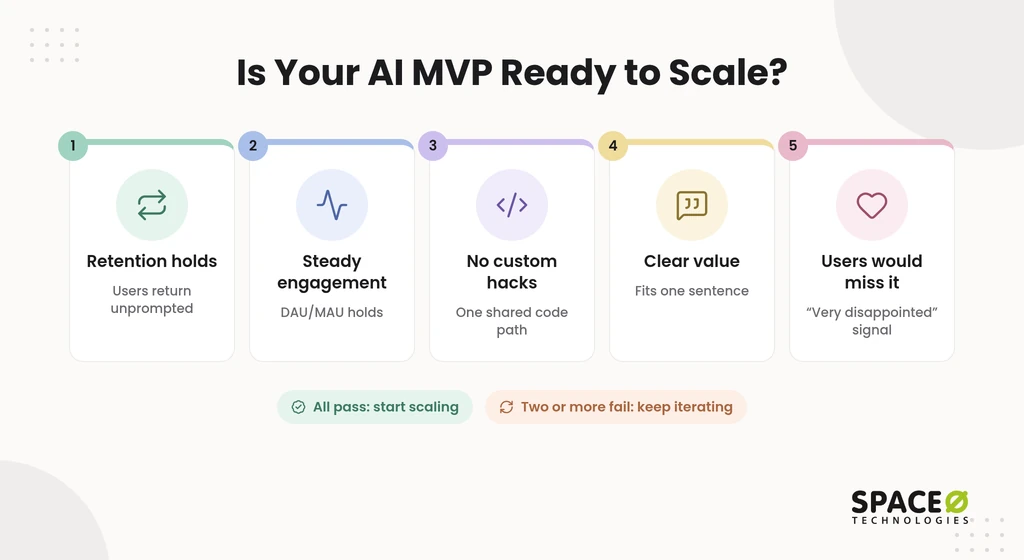
Run these five checks before you write production code. Together, they confirm product-market fit.
- Retention holds on its own: Users keep returning in day-1, day-7, and day-30 cohorts without founder outreach or discounts.
- Engagement is steady: Track your daily-to-monthly active user (DAU/MAU) ratio and confirm it holds as cohorts mature.
- No custom hacks per customer: Every paying account runs on the same code path, with no one-off prompts, scripts, or manual fixes.
- Value fits one sentence: You can explain what the product does, and for whom, in one sentence.
- The “very disappointed” signal is strong: Most active users say they would be “very disappointed” to lose the product.
If two or more checks fail, keep iterating and track your AI MVP development cost meanwhile. If they pass, the comparison below shows what has to change.
AI MVP vs Scaled AI Product: What Changes
Nearly every layer changes when an AI MVP becomes a product, from the data model to cost control. Use this comparison to find the layers still in prototype mode. It echoes the split in AI development vs. software development.
| Area | AI MVP | Scaled AI product |
|---|---|---|
| Goal | Prove the idea works | Hold up daily at a cost you can defend |
| Architecture | One codebase on one machine | Decoupled UI, application logic, and AI inference layers in containers |
| Data model | Single-tenant schema shaped by the demo | Multi-tenant schema with role-based access control (RBAC) |
| Model choice | One frontier model through OpenAI or Anthropic APIs | Tiered routing across frontier models, small language models (SLMs), and fine-tuned open-source models |
| Request handling | Synchronous large language model (LLM) calls that block the interface | Asynchronous workers, queues, and semantic caching |
| Cost control | Token spend checked at month end | Cost per inference tracked live per feature, with token caps |
| Quality | Spot checks by the founder | Golden-dataset evals, hallucination tracking, and human review |
| Operations | Manual onboarding, billing, and fixes | Automated onboarding and billing, CI/CD, and named on-call owners |
| Data protection | Loose handling of test data | Personally identifiable information (PII) masking and no training on customer data |
Each row maps to one of the five steps that follow.
Step 1. Cut Scope and Retire Manual Workarounds
Start by cutting features your retained users ignore and automating the manual work behind the scenes. AI coding tools make it easy to add features, so many MVPs reach this stage carrying extras. Every extra feature becomes code you must refactor, test, and pay to run.
- Act as an editor: AI makes it dangerously easy to add features, so remove any feature that retained users do not touch.
- Automate onboarding and billing: Manual steps that work at ten customers become someone’s whole job at a hundred.
- Lock behavior in regression tests: Capture current behavior in tests first, so refactoring cannot silently break what already works.
A smaller, tested MVP gives Step 2 less code to judge, which is core software product development discipline.
Step 2. Decide Refactor or Rebuild by the Data Model
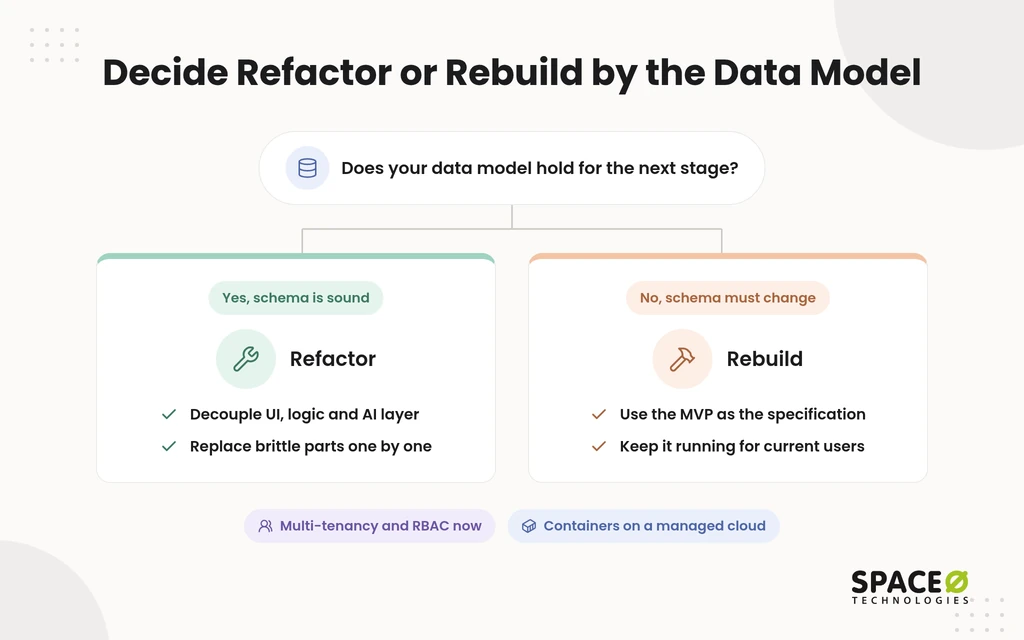
Decide whether to refactor or rebuild by testing your data model, not your code quality. Founders often judge an MVP by how messy its code looks. That is the wrong test, and it leads to needless rewrites or endless patches.
Check whether your schema is sound
If the shape of your data must change for the next stage, rebuild with the MVP as the specification. If the schema is sound, refactor, even when the code is ugly. Ugly code with the right data model scales; beautiful code with the wrong one does not.
- Refactor when the schema holds: Decouple the user interface, application logic, and AI inference layer so each scales and deploys independently.
- Isolate brittle components: Replace hacky API wrappers and prototype scripts with typed, tested modules, one high-risk component at a time.
- Rebuild when the schema breaks: Keep the MVP running for current users and treat it as the working specification for the new build.
Build multi-tenancy and RBAC in now
Add multi-tenancy and role-based access control before you scale, because retrofitting them later amounts to a rewrite. “We’ll add multi-tenancy in phase two” is often the most expensive sentence in a scaling plan. Added later, tenancy means rewriting the application while paying customers use it.
- Tenant isolation: Tag every record, vector index, and cached answer with a tenant ID, so no customer’s data reaches another’s prompts.
- Permissions model: Define roles and permissions once in the data layer instead of scattering checks through prompt code.
Move to containerized cloud infrastructure
Run the refactored product in containers on a managed cloud so it can handle real traffic. A prototype on one machine cannot absorb a traffic spike.
- Containerize with Docker: Package your application and its dependencies so it runs identically in development, staging, and production.
- Deploy on a managed cloud: Use Amazon Web Services (AWS), Microsoft Azure, or Google Cloud Platform (GCP) for elastic compute and autoscaling.
- Plan horizontal scaling early: Add capacity by adding instances, and design for it before demand strains the system.
The same horizontal patterns apply when you scale a web application beyond one server. With the data model settled and the infrastructure elastic, the AI layer comes next.
Step 3. Re-Architect the AI Layer for Load and Cost
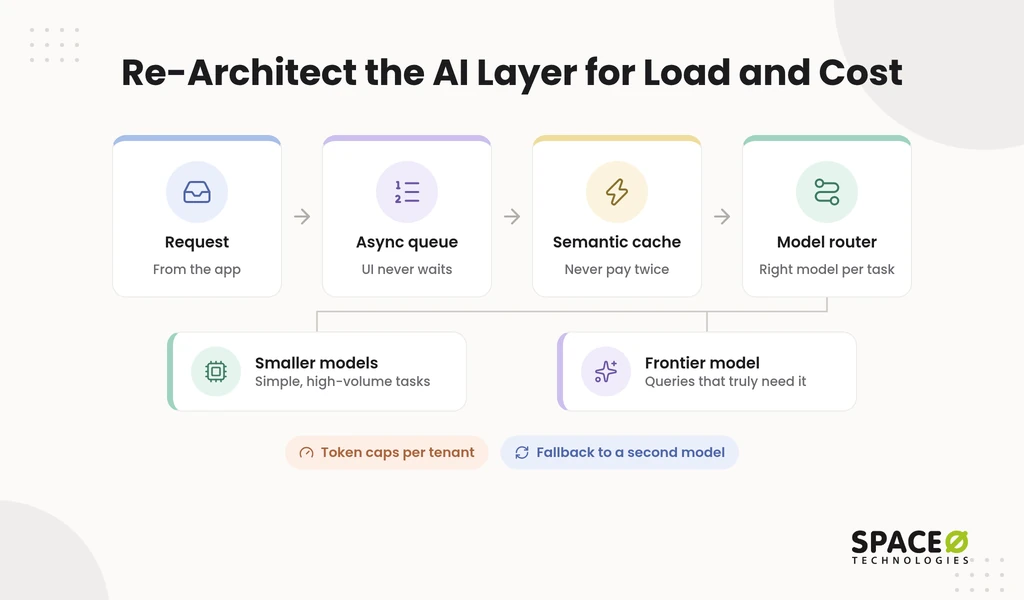
Make the AI layer non-blocking, cache what repeats, and right-size models once usage data proves the need. The model that impressed investors in a demo often bankrupts the product at scale. Unit economics, not demo quality, decide whether the product survives.
Move LLM calls to asynchronous workers
Send slow LLM calls to background queues so the interface never waits on them. Missing asynchronous support is a core red flag in production AI systems. Queueing and batching tasks is what lets a product absorb large request volumes.
- Queue heavy jobs: Run document processing, long generations, and batch scoring on a job queue, for example, Celery with Redis.
- Stream or notify: Stream partial output, or notify users when a job finishes, instead of holding a request open.
- Remove hardcoded defaults: Move model names, timeouts, and limits into configuration so you can change them without a deploy.
Add semantic caching and token caps
Cache answers to similar queries and cap tokens per request, user, and tenant. Without caps, one heavy account or a looping prompt can drain a monthly budget.
- Semantic caching: Serve stored responses to semantically similar queries so you never pay twice for one answer.
- Token and rate caps: Set per-tenant limits on input tokens, output tokens, and requests, with alerts before each limit.
- Fallback routing: Route traffic to a secondary model when the primary fails, so uptime does not depend on one provider.
Knowing your LLM integration cost shows where token spend adds up.
Right-size models after API validation
Stay on OpenAI or Anthropic APIs while you validate, then move suitable tasks to smaller models. A common sequence is to start with existing AI services, then build custom after market validation. Your usage logs then show which tasks a cheaper model can handle.
- Tiered routing: Send simple requests to SLMs and reserve frontier models for the queries that genuinely need them.
- Fine-tuned open-source models: Fine-tune an open-source model on your labeled data when one high-volume task dominates spend.
- Model abstraction layer: Call models through one internal interface, so switching providers becomes a configuration change.
Before you fine-tune, check whether Retrieval-Augmented Generation (RAG) on your own data closes the accuracy gap more cheaply. The model path table after Step 5 summarizes when to switch.
Step 4. Instrument Observability, Evals, and Human Review
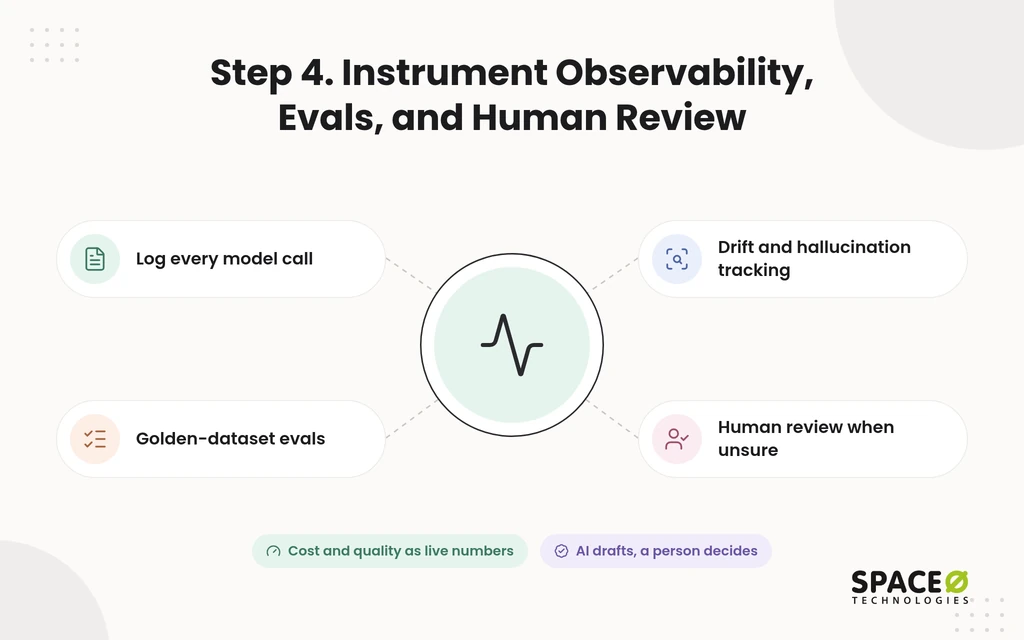
Log every AI call, score outputs against a golden dataset, and route uncertain outputs to a person. An AI MVP introduces uncertainty at the core. In production, the data pipeline, serving infrastructure, and monitoring layer are the product, and the model is one component.
Measure cost and quality on every call
Capture the same fields on every model call so cost and quality become live numbers.
- Standardize event capture: Log input tokens, output tokens, latency, model, tenant, and error rate for every call.
- Run golden-dataset evals: Score outputs against a fixed set of reviewed answers whenever a prompt or model changes.
- Track drift and hallucination rate: Monitor live output quality, because model updates and new user behavior both shift results.
- Use LLMOps tooling: Tools such as LangSmith or Langfuse can trace prompts, scores, and spend in one place.
The same checks apply when you evaluate an AI agent before launch. At Space-O Technologies, every production model runs inside an evaluation suite with continuous monitoring. The suite covers accuracy, hallucination rate, bias checks, latency, and cost.
Keep people on uncertain and consequential outputs
Route low-confidence outputs to a review queue, and have people approve every consequential decision. A confident-sounding wrong answer with no correction path erodes trust faster than a slow one.
- Confidence thresholds: Send outputs below a set confidence score to human review instead of straight to the user.
- Human-in-the-loop approvals: People approve hiring, lending, clinical, and legal outcomes; the AI drafts, and a person decides.
- User feedback loop: Let users flag and correct outputs, then feed that signal into evals and future fine-tuning.
Good AI MVPs generate training data, not just test features. Automation handles the volume, but a qualified human reviews and approves before any output influences a final decision. Once quality is measurable, security and operations decide whether larger customers can buy.
Step 5. Harden Security, Compliance, and Operations
Give security, compliance, and operations their own gate before you sell to larger customers. A prototype can be loose with data, but a product cannot. For regulated data, this gate decides whether you ship at all.
Protect customer data and meet US regulations
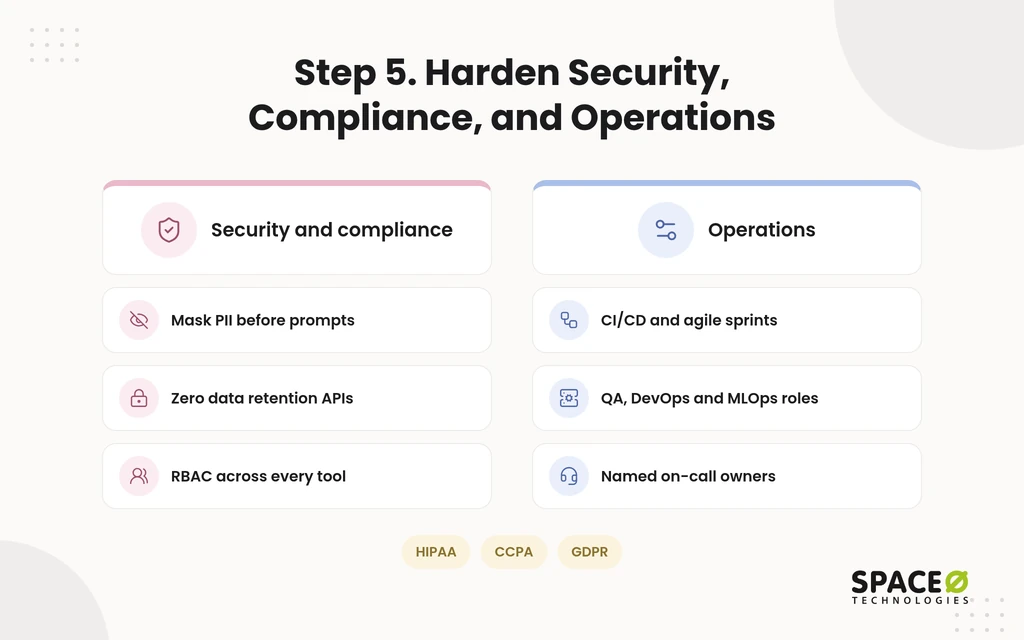
Mask personally identifiable information at capture and keep customer data out of third-party model training.
- PII masking: Strip or mask PII before any prompt leaves your system, and log what was masked.
- No training on customer data: Choose enterprise API tiers with zero data retention, so customer data never trains a third-party model.
- Access control: Enforce the RBAC model from Step 2 across APIs, dashboards, and admin tools.
Match the rules your data lives under. Health data falls under the Health Insurance Portability and Accountability Act (HIPAA). California consumer data falls under the California Consumer Privacy Act (CCPA).
Enterprise buyers often ask for formal security and compliance evidence. EU users bring the General Data Protection Regulation (GDPR).
High-stakes outputs in finance or healthcare also need stricter accuracy testing and often human review.
Scale the team and operations
Formalize delivery and add specialist roles before the founder becomes the bottleneck. The person who fixed every issue by hand cannot remain the on-call system.
- Adopt CI/CD and agile sprints: Ship small, tested increments through continuous integration and continuous delivery (CI/CD).
- Add specialist roles: Bring in quality assurance (QA), DevOps, and machine learning operations (MLOps) skills as volume grows.
- Name support and on-call owners: Give support and incident response clear owners, with runbooks for model outages and cost spikes.
If you need that capacity inside your sprints quickly, outside engineers can join your repositories, tools, and governance.
Add AI Engineers to Your Scaling Sprints
Bring vetted backend, DevOps, and MLOps engineers into your repositories through a Dedicated Team or Staff Augmentation, and keep full code and IP ownership at handover.

Which Model Path Fits Your Stage?
Stay on third-party APIs until usage data shows a cheaper path, and rebuild only when the data model fails. Use this table when a cost review or a new enterprise deal forces the decision.
| Path | Choose when | Switch when | Risk |
|---|---|---|---|
| Stay on OpenAI or Anthropic APIs | You are still validating demand and request volume is modest | Token spend grows faster than revenue per user | Pricing, rate limits, and retention terms you do not control |
| Route to SLMs or fine-tuned open-source models | Logs show high-volume, repetitive tasks a smaller model handles at target accuracy | Evals show accuracy falling below your quality bar | You own hosting, evals, and retraining costs |
| Rebuild with the MVP as the specification | The data model cannot support multi-tenancy or the next feature set | The new build passes your regression tests and evals | Running two systems during the migration |
Whichever path you choose mirrors custom AI development vs off-the-shelf choices, and the roadmap below sets the order and timing.
Phased Scaling Roadmap: When Each Step Happens
Scaling runs in three phases: stabilize, optimize unit economics, then grow. Use the table to sequence the five steps, then compare it with an AI development project roadmap for wider planning.
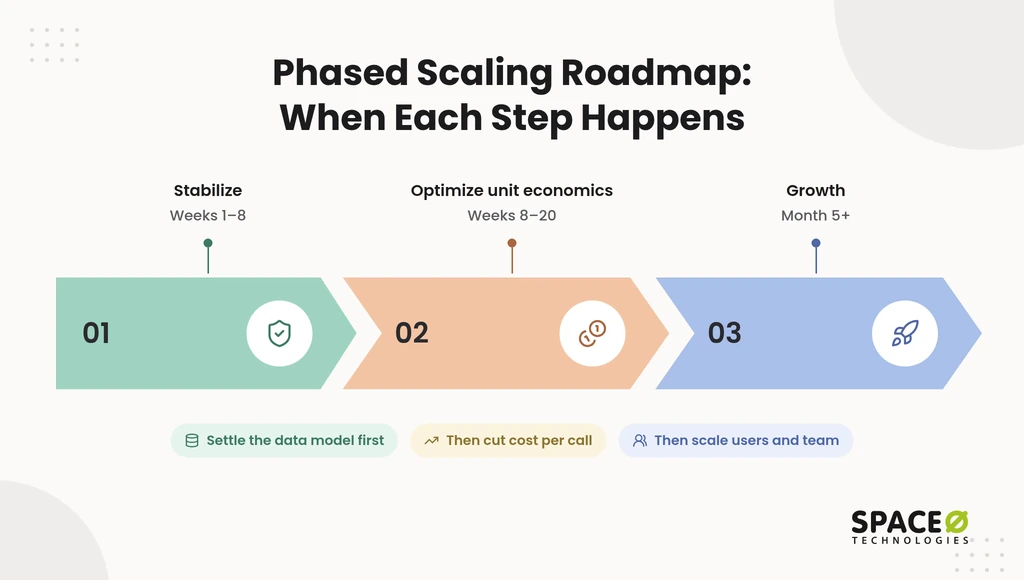
| Phase | Timeframe | Focus |
|---|---|---|
| Stabilize | Weeks 1-8 | Cut scope, settle the data model, refactor high-risk components, add observability, regression tests, and fallbacks |
| Optimize unit economics | Weeks 8-20 | Model routing, semantic caching, data pipelines, automated evals |
| Growth | Month 5+ | Staged rollout, cohort retention tracking, security and compliance hardening, team scaling |
GPT Vix shows what a Stabilize-phase fix looks like. Speech-to-text delays held up its candidate-screening workflow. Space-O Technologies moved that processing onto AWS Lambda to fix it.
Timing matters, but so does the budget behind each phase.
What Scaling an AI MVP Costs in US Dollars
Plan the scaling budget as a build cost plus a yearly run cost, because both grow with users. Few guides attach dollar figures to scaling. Cost planning starts before the first line of production code.
Build and run cost ranges
Use Space-O Technologies’ published ranges to size each line of your plan. Overall, AI development cost ranges from $25,000 to $500,000+ in 2026.
| Cost line | Typical range | Notes |
|---|---|---|
| MVP starting point | A basic MVP from $15,000; feature-rich MVPs up to $50,000+ | Payments are milestone-based, tied to deliverables |
| Proof of concept | Starts near $15,000 | Validates one use case before a full build |
| AI chatbot or virtual assistant | $25,000-$100,000 | Customer support, FAQ automation, internal assistance |
| Basic AI feature | $40,000 to $100,000 over 2 to 4 months | Added to an existing product |
| Mid-level AI application | $80,000 to $200,000 over 4 to 7 months | A full product with AI at the core |
| Enterprise AI platform | Well past $500,000 | Custom models, deep integrations, and compliance controls |
| Data preparation | 25% to 40% of the total project budget | The single largest cost driver in an AI build |
| Annual maintenance | 15% to 25% of the original build cost | Recurring every year the product runs |
| Retraining cycles | US $15,000 to US $60,000 per year | Scales with data volume and model change |
| API fees | Can pass $50,000 a month at heavy production traffic | Shifts with model mix, prompt length, and caching |
Our AI development cost breakdown puts yearly maintenance at 15% to 25% of build cost. On an $80,000 mid-level build, that means $12,000 to $20,000 a year. Data preparation at 25% to 40% of budget would account for $20,000 to $32,000 of that build.
Unit economics: cost per conversation against revenue
Your cost per inference must stay well below what each user pays, or growth deepens losses. Divide your monthly API fees by monthly conversations to get your cost per conversation. Multiply that by monthly conversations per user, then compare the result with your monthly price per user.
If that gap narrows as usage grows, apply the Step 3 levers before you add customers.
Once the numbers are clear, the last decision is who does the work.
When to Bring in a Partner
Bring in a partner when scaling needs machine learning, DevOps, and security skills you cannot hire quickly. Most scaling teams weigh four paths. Each one is described below by what adopting it requires.
| Option | What it requires | Engagement/pricing | Best-fit signal |
|---|---|---|---|
| In-house build | Hiring and retaining machine learning, DevOps, and full-stack specialists before work starts | Full salary plus overhead | You have long-term, continuous AI work and time to hire |
| No-code builders (e.g., Bubble, Glide) | Accepting platform limits on custom AI logic and data control | Subscription | Early validation tests, not production AI at scale |
| Specialist agency or product partner | Scoping the work and choosing an engagement model | Varies by vendor | You want one team from refactor through maintenance |
| Space-O Technologies | Requirement analysis and idea validation before build; NDA before kickoff | Fixed Cost, Time & Material, Dedicated Team, or Staff Augmentation; scoped ranges via a free, expert-reviewed estimate | Full-cycle ownership from MVP through scale, with grounding, evaluation, and human review |
Space-O Technologies reports 97% client retention, with 140+ in-house developers and 300+ software solutions delivered. Our teams work from Mesa (Arizona, USA), Brampton (Ontario, Canada), and Ahmedabad (India).
We sign an NDA before kickoff on every scaling engagement, so confidentiality is covered from day one. At completion, all source code, data, and IP transfer to you, so you own the work. For how we add AI to custom and legacy systems without replacing them, see our guide to AI integration with legacy applications.
What to send us for a scoped estimate
Send three details, and our engineers can scope your scaling work.
- Your stack and model mix: List your framework, cloud provider, and the models you call today.
- Your volume and spend: Share monthly requests, active users, and current token spend.
- Your biggest bottleneck: Name the issue that hurts most, whether cost, latency, quality, or a stalled enterprise deal.
Request your free, expert-reviewed scaling estimate and get a phased plan for your AI MVP.
Frequently Asked Questions
What is MVP in AI development?
An AI minimum viable product (MVP) is a first working version built to answer one question: does this idea work? It typically runs one frontier model through OpenAI or Anthropic APIs. It uses a single-tenant schema shaped by the demo and relies on founder spot checks for quality. A production product must then answer a harder question: will it hold up every day?
How to scale an AI application?
Confirm that retention holds without your push, then work in order. Cut scope, settle the data model, move LLM calls to asynchronous workers, add evals and review, then harden security. Teams typically stabilize in weeks 1 to 8 and optimize unit economics in weeks 8 to 20. Growth then follows from month 5 onward.
Which AI is best for MVP?
No single model is best. While you validate, the practical choice is a frontier model through the OpenAI or Anthropic APIs. Once usage logs show which tasks a cheaper model can handle, move them to smaller or fine-tuned open-source models. Keep a model abstraction layer in place so the first choice is not permanent.
Should I rewrite my AI MVP from scratch to scale it?
No. Refactor and modularize the risky parts, because a rewrite discards validated learning and restarts the risk clock. Decouple the UI, application logic, and AI layer, then lock current behavior in regression tests. Rebuild one brittle component at a time.
How do I cut the cost of running an AI product at scale?
Route simpler requests to smaller models, then add semantic caching so you never pay twice for one query. Track input tokens, output tokens, and latency on every call. That makes cost a live number you manage, not a month-end surprise.
When is my MVP ready to scale into a production product?
Scale once you have proven product-market fit. That means stable retention and a strong “very disappointed to lose it” signal. Validate demand first, then re-architect in steps on that base.
Can an AI product be scaled while staying HIPAA-compliant?
Yes. HIPAA-compliant delivery builds in PII scrubbing, role-based access control, encryption, and human review of clinical decisions from the start. Space-O Technologies works under an NDA with full code and IP transfer at handover.
How much does it cost to maintain an AI product after it scales?
Annual maintenance is a recurring cost, sized as a share of the original build. Plan it as a yearly line item alongside cloud hosting and model usage.



 All our projects are secured by NDA




 4.8


