
 By
Contents
- Focused LLM integrations cost $10,000-$80,000; core-product builds run $100,000-$500,000+.
- Engineering labor, not the model, takes the largest share of the build budget.
- Reserve a yearly share of the original build cost for maintenance, on top of token fees.
- Self-hosting a model pays off only at high, steady volume, around 50M+ tokens monthly.
Key Takeaways
Your LLM integration project cost can start at $5,000-$15,000 for a basic API build. Core-product and multi-system builds cost far more. Recurring token, hosting, and maintenance fees add to the total.
Teams that budget only the build get surprised after launch. Per-token fees, hosting, and upkeep grow as usage grows. Our guide to AI integration cost covers the wider picture for software you already run.
This guide prices LLM integration by tier and shows where the money goes. It itemizes 2026 U.S. running costs and ends with a year-one budget formula. Space-O Technologies has built AI-powered custom software since 2010.
How Much Does an LLM Integration Project Cost?
Total cost equals a one-time build plus a recurring run cost, and your scope sets both. A thin API wrapper, a retrieval-augmented generation (RAG) assistant, and a multi-agent workflow sit in very different bands. Compliance needs and the number of systems you connect move the number further.
The build cost covers the stages of AI integration in software development: discovery, data preparation, engineering, testing, and deployment. The run cost covers per-token API fees, hosting, the vector database, observability, and annual maintenance. Both halves belong in the same budget conversation.
Notice that credible ranges never close at the top. A “+” on the upper figure marks the start of a long tail, not a cap. Enterprise builds with many integrations and strict governance can run well past it.
The next section breaks that range into four tiers you can match to your own project.
Cost Breakdown by Project Scale
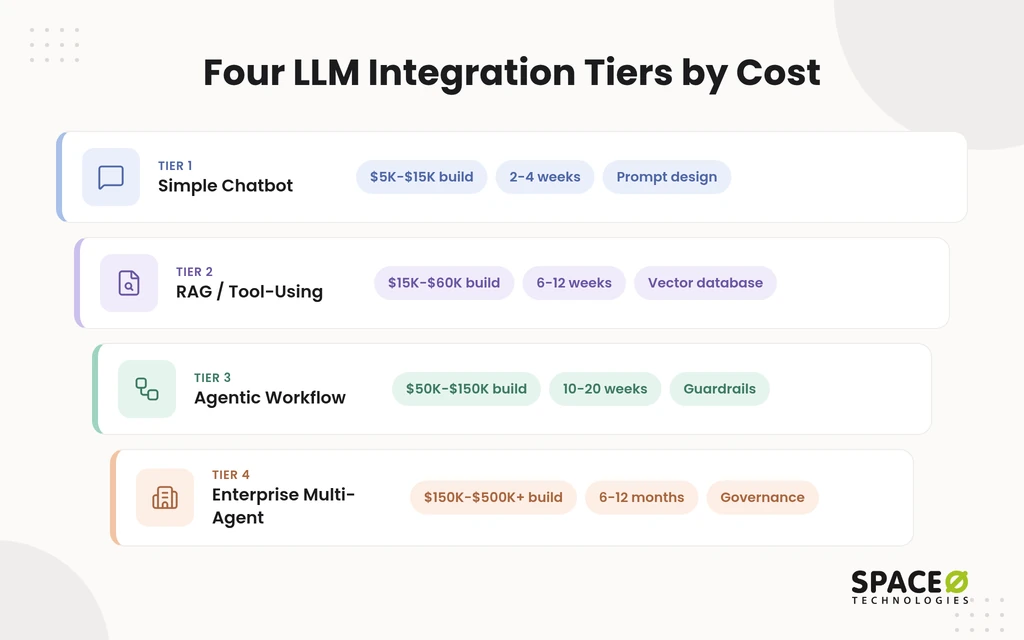
Four tiers cover almost every LLM integration, and each adds data work, retrieval, orchestration, and governance to the one below. Pick the tier that matches your architecture, then adjust for compliance and integration depth.
| Tier | What it includes | U.S. build cost (USD) | Typical timeline | Key expenses |
|---|---|---|---|---|
| Simple chatbot | A prompt-driven assistant on a commercial API such as OpenAI, Anthropic, or Google Gemini. It has light custom logic and no private-data retrieval. | $5,000-$15,000 | 2-4 weeks | Prompt design, interface wiring, basic testing. |
| RAG / tool-using integration | Retrieval-augmented generation grounded in your own documents, connected to one or two internal tools. | $15,000-$60,000 | 6-12 weeks | Data preparation, embeddings, vector database, retrieval tuning. |
| Agentic workflow | A model that plans, calls tools, and completes multi-step tasks, with evaluation and human review on consequential actions. | $50,000-$150,000 | 10-20 weeks | Orchestration, tool integrations, evaluation suite, guardrails. |
| Enterprise multi-agent system | Multiple coordinated agents across systems, with compliance, monitoring, and role-based access built in. | $150,000-$500,000+ | 6 to 12 months | Multi-system integration, security review, audit logging, governance. |
The RAG tier is the most common first production build. It answers questions from your own content without the expense of training a model. Many mid-market projects land between $40,000 and $150,000, where RAG meets agent workflows.
The agentic tier is where costs start to compound. Each tool the model can call needs its own connector, permissions, and failure handling. Enterprise systems coordinate several agents and add role-based access across departments. Our AI agent development company work follows this pattern.
Fine-tuning sits across tiers rather than in one. Training a model on your own data adds labeling, training runs, and retraining cycles. That work pushes a build toward the agentic or enterprise band.
Knowing your tier gives you a range. Knowing where that range goes tells you where to save.
See What Your LLM Build Will Cost
Tell us your use case, data sources, and monthly volume. Our engineers then return an itemized build and running-cost estimate within a few days.

Where the Money Goes
Labor and data preparation move an LLM integration budget more than model choice does. In most projects, data work, integrations, and production engineering cost more than the model itself. The shares below overlap, since data preparation and testing are mostly engineering time.
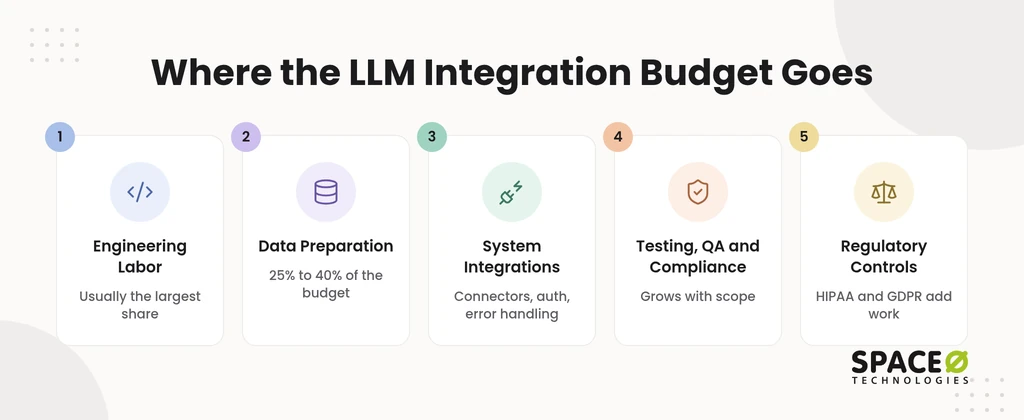
- Engineering labor is usually the largest share of total project cost, though estimates vary by source.
- Data preparation can consume 25% to 40% of the total project budget, according to our AI development cost guide. It is a major cost driver in any AI build.
- System integrations add connectors, authentication, and error handling for every CRM, ERP, or database the model touches.
- Testing, QA, and compliance take a meaningful share of the budget, and the cost grows with scope.
- Regulatory controls raise the floor for Health Insurance Portability and Accountability Act (HIPAA) builds. Other compliance frameworks add further cost.
Compliance adds work you cannot see in a demo. A HIPAA-compliant build needs encryption at rest and in transit, access controls, and audit logs. If you serve users in Europe, the General Data Protection Regulation (GDPR) adds data-handling rules on top.
Once the build ships, a second set of costs begins.
Ongoing Operational Costs
Beyond the one-time build, you pay every month for tokens and infrastructure, and every year for maintenance. These costs are a common source of AI software development budget overruns because they scale with usage, not scope. Budget them separately from the build.
How much do LLM API tokens cost per million?
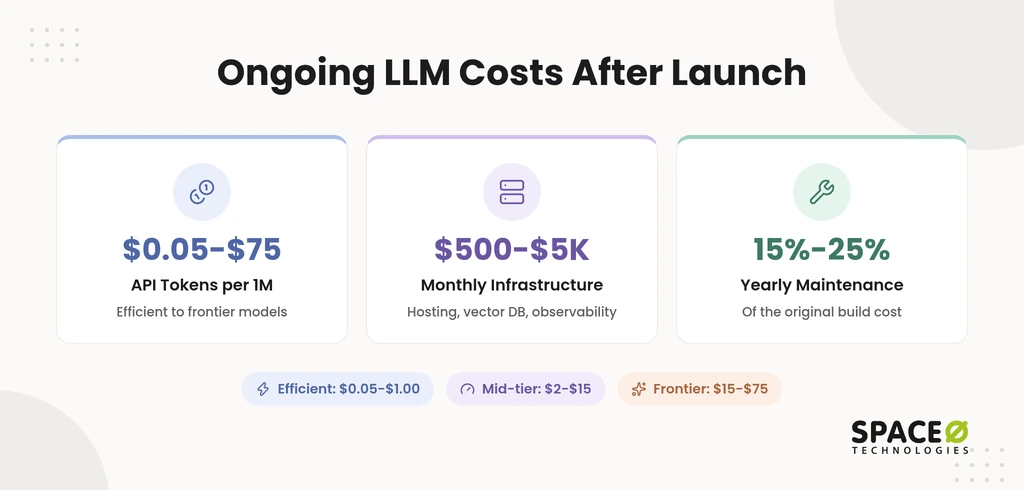
Token pricing falls into three bands, and the gap between low-cost and frontier models is large. Output tokens typically cost several times more than input tokens. Output-heavy features, such as long summaries, cost more than their input volume suggests.
- Efficient / open-weight models (Llama, Mistral) cost $0.05-$1.00 per 1M tokens and are often self-hostable.
- Mid-tier models cost roughly $2-$15 per 1M tokens and balance capability with price.
- Frontier models cost $15-$75 per 1M tokens and deliver the highest reasoning quality at the highest spend.
Prompt caching, batch processing, and model routing can cut token spend substantially once a workload is live. Rates change often, so confirm them on the provider’s own pricing page. Machine learning consulting helps match each task to the right model band before you commit.
Monthly infrastructure costs
Budget US $500 to US $5,000 monthly for data infrastructure on a typical integration. That line covers hosting, a vector database such as Pinecone or pgvector, logging, and observability tools. Observability, one of the MLOps capabilities that keep models reliable, tracks latency, cost, and answer quality per request.
GPU workloads, low-latency responses, and hybrid or on-premises hosting raise both build and monthly costs. Plan for those choices early, because changing hosting after launch means rework.
What maintenance adds each year
Annual maintenance for an AI build typically costs 15% to 25% of the original development cost every year. It covers prompt tuning, model version updates, evaluation upkeep, and security patches. Provider model updates alone can force prompt and test changes. That is why AI agent maintenance cost after launch needs its own budget line.
If you fine-tune a model, plan US $15,000 to US $60,000 per year on retraining cycles. Regulated teams should also reserve for audits, which can cost US $10,000 to US $40,000 each year, depending on scope.
Token fees raise one obvious question: would running your own model be less expensive?
API vs. Self-Hosting Break-Even
Self-hosting an open-weight model pays off only at high, steady volume, around 50M+ tokens per month. A break-even analysis of on-premises LLM deployment places the threshold at roughly 50 million tokens a month. Below that, hosted API pricing usually wins.
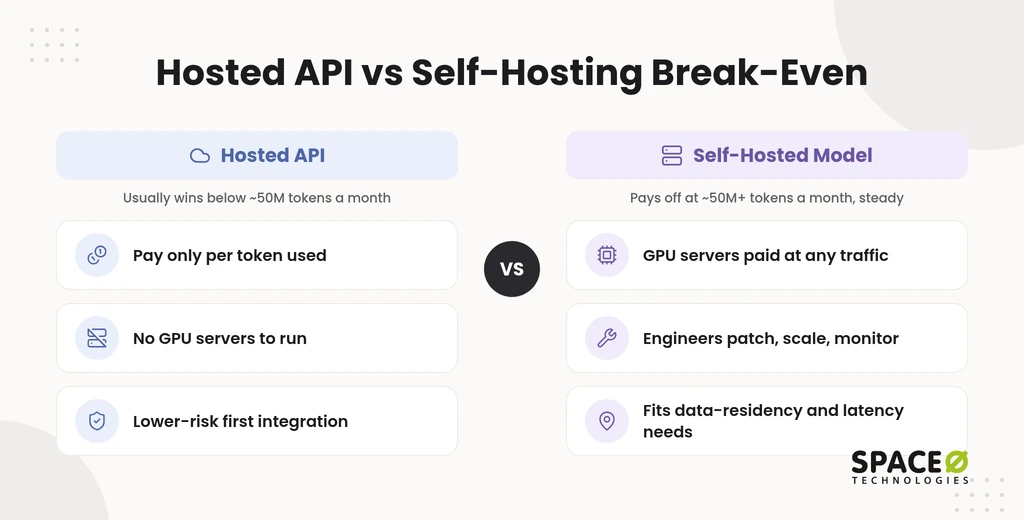
A self-hosted deployment trades API fees for hardware, operations, and security burden rather than removing cost. You pay for GPU servers whether traffic is high or low. You also need engineers to patch, scale, and monitor the model.
Self-hosting still makes sense in a few situations, and the open-source LLM vs proprietary API choice turns on them. Strict data-residency rules, predictable high volume, or tight latency targets can justify it. For most first integrations, a hosted API with good routing is the lower-risk start.
Volume is only part of the cost story. The other part is how often a model gets the answer right.
Cost per Successful Output
A lower-priced model can cost more per useful answer once retries and human review are counted. Per-token price measures inputs, not results. A model that fails formatting or hallucinates forces re-runs and manual fixes.
Measure it this way. Cost per successful output equals total spend on calls, retries, and review, divided by outputs that pass. A mid-tier model that passes on the first attempt can beat a low-cost model that needs three tries. Agent workflows magnify this, because AI agent loops that burn LLM costs pay for tokens on every step.
We wrap every production model in an evaluation suite. It covers accuracy, hallucination rate, bias checks, latency, and cost. Continuous monitoring stays in place after launch. Confidence scoring routes any output below an acceptable threshold to a human-review checkpoint, so people approve consequential decisions.
With the technical costs mapped, the next lever is how you buy the work.
Cost by Engagement Model
The same LLM integration can cost very differently depending on how you choose to buy the work. The right model depends on how fixed or fluid your project scope actually is.
| Engagement model | Best for | Typical cost band | When to choose it |
|---|---|---|---|
| Fixed Cost | A well-defined MVP or PoC | $10K-$150K for chatbot builds | Scope is clear, and you want a predictable price |
| Time & Material | Evolving scope, iterative RAG build | Billed by time used | Requirements will change as you learn from data |
| Dedicated Team | Ongoing, multi-phase integration | Billed monthly for the team | You need sustained capacity across several releases |
| Staff Augmentation | Filling a specific AI engineering gap | Billed per engineer | Your in-house team leads and needs vetted developers |
The fixed-cost band comes from our AI chatbot development cost guide. Fixed cost suits teams that have finished discovery and locked their requirements. Time and materials are billed on hours logged. It suits builds that start as a minimum viable product (MVP) and expand on usage data.
A fixed-cost MVP gives startups a predictable path to a fundable product. A dedicated team or staff augmentation suits CTOs scaling an in-house AI pod. Payments run on milestones tied to deliverables, so spend tracks visible progress.
Engagement models shape how you pay. Use cases shape what you pay for.
Cost by Use Case
The three use cases teams ask about most each sit in a predictable cost band. These map to the questions buyers raise again and again when they start scoping.
- Customer-support chatbot: A support integration grounded in your help documents, with retrieval so answers stay accurate. The same chatbot guide puts these builds at $10,000 to $80,000, with a payback that depends on ticket volume.
- Internal document / RAG search: Search grounded in your own documents, catalog, or knowledge base through RAG-based AI application development. A larger RAG-powered build with real-time indexing runs $50,000 to $150,000 over 10 to 20 weeks. eComChat follows this approach, grounding search across its product catalog with real-time indexing as products change.
- Automated data extraction: An integration that pulls structured fields from documents or messages, with human review on anything consequential. ReadGenie, Space-O Technologies’ iOS app, pairs OCR with GPT-3.5 for text extraction.
We build these with grounding, evaluation, and human review by default, shipped in products like GPT Vix, eComChat, and ReadGenie. That way, the model’s output is checked before it reaches a customer or a decision.
Which Tier Fits Your Team?
Match the tier to your team’s situation, not to the most impressive demo. Founders, regulated teams, and enterprises face different risks, so their budgets weigh different lines.
- Startup founders usually need a scoped MVP that proves value to users and investors. A basic MVP development project starts at $15,000, and a feature-rich MVP runs up to $50,000+, on a fixed-cost model.
- Regulated teams in healthcare, fintech, lending, and insurance need a RAG or agentic integration. Human-review checkpoints should cover every high-stakes output. Itemize compliance separately, including annual audits and encryption.
- Enterprises need multi-system integration across CRM, ERP, and legacy applications. Budget for role-based access, audit logging, and documented IP transfer, usually through a dedicated team.
The common thread is visibility. Each buyer should see compliance, integration, and running costs as separate lines, not buried in one total.
Year-One Budget Example
Year-one cost equals the build, plus twelve months of running cost, plus a maintenance reserve. Many estimates show the build only. This formula puts the first year’s full bill on one page.
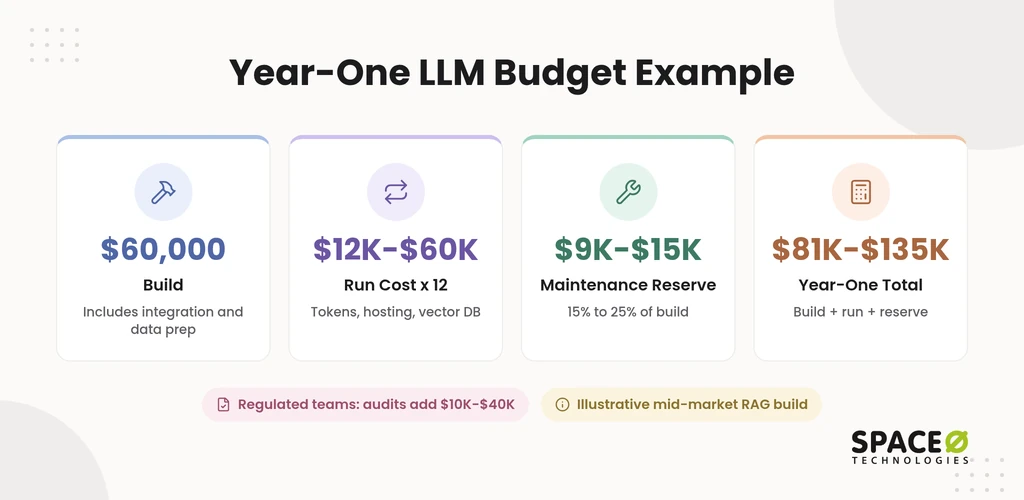
Year-one total = build + (12 × monthly run cost) + maintenance reserve + audits (if regulated). The build line includes integration and data preparation.
The example below uses a mid-market RAG integration, a build type a generative AI development cost estimate also prices. Rows marked “illustrative” are assumptions drawn from the tier ranges above, not a quote.
| Line item | Basis | Year-one amount (USD) |
|---|---|---|
| Build, including integration | Illustrative, within the $10,000-$80,000 focused band | $60,000 |
| Data preparation (inside the build) | 25% to 40% of project budget | $15,000-$24,000 |
| Monthly run cost × 12 | Illustrative $1,000-$5,000 a month for tokens, hosting, vector database, and observability | $12,000-$60,000 |
| Maintenance reserve | 15% to 25% of build | $9,000-$15,000 |
| Year-one total | Build + run + reserve | $81,000-$135,000 |
| Compliance audit (regulated teams only) | US $10,000-$40,000 annually | Adds $10,000-$40,000 |
The run-cost row swings most, because token volume drives it. Change the monthly figure first when you adapt this to your own traffic. A regulated build with an audit lands at $91,000-$175,000 in year one.
Get Your Itemized LLM Integration Estimate Now
Share your use case, hosting choice, and monthly volume. Our engineers return a year-one budget that separates build, running, and maintenance costs for your scope.
How Space-O Technologies Prices LLM Integration
We price from your scope, data, and volume, then match the engagement model that keeps spend predictable. Space-O Technologies has served 1,200+ clients since 2010 with 140+ in-house developers. Every estimate separates build cost from running cost.
We sign an NDA before every project starts. Under AI development IP ownership and NDA terms, source code, data, and IP built for you transfer at completion. That ownership holds across Dedicated Team, Time & Material, Fixed Cost, and Staff Augmentation engagements.
Clients stay with us, and Space-O Technologies reports 97% client retention. Poppy Gifting, a San Francisco startup, rated its AI gift-search build 5.0 on Clutch. Clear pricing is part of why teams come back for version two.
Questions to Scope Your Estimate
Three answers turn a range into a quote: your use case, your hosting choice, and your monthly volume. Have these ready before you request an estimate.
- What is the use case? Name the workflow, the data it draws on, and the systems it must connect to.
- Will you call a hosted API or self-host a model? Your answer depends on data-residency rules, latency targets, and expected volume.
- What monthly volume do you expect? Estimate requests per month and average length, since tokens drive the run cost.
Add any HIPAA requirements and your preferred engagement model, and the estimate tightens further. Share your answers with our team and get a scoped, itemized LLM integration estimate.
Frequently Asked Questions
How much does it cost to build an AI system?
U.S. build cost depends on the tier. A simple chatbot costs $5,000-$15,000, and a RAG or tool-using integration costs $15,000-$60,000. An agentic workflow costs $50,000-$150,000, and an enterprise multi-agent system costs $150,000-$500,000+. Timelines run from 2-4 weeks for a simple chatbot to 6-12 months for an enterprise system.
How much does the LLM API cost?
Per 1M tokens, efficient or open-weight models run about $0.05-$1.00, mid-tier models roughly $2-$15, and frontier models $15-$75. Your bill depends more on what a feature generates than reads, since output costs more. Rates change often, so confirm them on the provider’s pricing page before committing.
What are LLM integrations?
An LLM integration connects a large language model to your own software, data, or workflows. Common forms include a thin API wrapper, a retrieval-augmented generation (RAG) assistant grounded in your documents, and a multi-agent workflow. Your scope, including which form you choose, sets both the build cost and the run cost.
How do I estimate LLM API token costs for a production system?
Estimate your monthly requests and their average length, then price that volume against your chosen model band. Weight the estimate toward output tokens, which carry the premium rate. Then add retries and human review by dividing total spend by the outputs that pass.
What data work is required before an LLM integration can be built?
Your data must be cleaned, structured, and grounded for retrieval-augmented generation first. Data preparation can consume 25% to 40% of the total project budget. It is a major cost driver in any AI build.
How long does an LLM integration take?
Timelines follow the tier. A simple chatbot takes 2-4 weeks, and a RAG or tool-using integration takes 6-12 weeks. An agentic workflow takes 10-20 weeks, and an enterprise multi-agent system takes 6 to 12 months.
How much does LLM maintenance cost each year?
Plan on 15% to 25% of the original build cost each year. That covers prompt tuning, model version updates, evaluation upkeep, and security patches. Fine-tuned models add US $15,000 to US $60,000 a year for retraining.
Is self-hosting an LLM cheaper than using an API?
Only at high, steady volume. Self-hosting tends to pay off at around 50M+ tokens per month. Below that, hosted API pricing usually costs less.



 All our projects are secured by NDA




 4.8


