
 By
Contents
- A narrow first agent runs in days, while a production agent takes weeks to months.
- Enterprise agents typically need 4-6 weeks for a proof of concept and 3-6 months for production.
- Integrations, evaluation, data quality, approvals, and system access drive the schedule more than the model does.
- Published ranges disagree because each one measures a different finish line, so match estimates before comparing.
Key Takeaways
Wondering how long it takes to build an AI agent? Builds range from minutes for a simple prototype to several months for a production system. A custom build with an AI agent development company usually lands between those two ends.
Scope, integrations, and testing decide where your build lands in that range. Anyreach reports 4-6 weeks for an enterprise proof of concept (PoC). It reports 3-6 months for full production.
This guide breaks timelines down by scope, phase, and engagement model. It also explains why published ranges disagree. Schedule and AI agent development cost follow the same drivers.
AI Agent Build Timeline by Scope
A narrow first agent runs in days, while a production agent with several integrations takes weeks to months. Most leaders get one number and plan around it. The tier you are actually buying matters more than the number. Published sources give these ranges, from the simplest build to the most complex:
- First working agent (2-5 days): One well-scoped workflow, running on real tasks. Most teams add another 1-3 weeks of production hardening before wider use.
- Focused pilot (3-5 weeks): A contained pilot on live data with a limited group of users. Most of the budget goes to integration and testing, not the model.
- Single-workflow agent (4-8 weeks): One business workflow with its own tools, checks, and owners, built for daily use. This range fits a single-workflow build.
- Production agent (12-20 weeks, or 2-4 months): The 12-20 week end fits 3-5 integrations, memory, and monitoring. The 2-4 month end assumes 5-10 integrations, write actions, approvals, and security review. Orbilon puts a narrow agent near two months and a broad one at four or more.
- Multi-agent system (3-6 weeks to 6-12 months): A multi-agent system has several agents that hand work to each other across systems. A first connected version takes about 3-6 weeks. Viston reports 6-12 months for a full multi-agent system.
| Tier | Typical timeline | What is included | What stretches it |
|---|---|---|---|
| First working agent | 2-5 days | One workflow, real tasks, basic tool calling | Unclear task boundaries |
| Focused pilot | 3-5 weeks | Live data, limited users, first integrations | Slow access to systems and test data |
| Single-workflow agent | 4-8 weeks | Workflow-specific tools, evaluation, owners | Edge cases found late in testing |
| Production agent | 12-20 weeks or 2-4 months | 3-10 integrations, write actions, approvals, monitoring | Security review and approval design |
| Multi-agent system | 3-6 weeks (first version) to 6-12 months | Agent hand-offs, shared memory, orchestration | Coordination failures between agents |
Why Published Timelines Disagree
Published AI agent timelines disagree because each one measures a different finish line, not because one is wrong. Leaders compare a “two weeks” claim with a “six months” claim and lose trust in both. The spread makes sense once you know what each source counts as done.
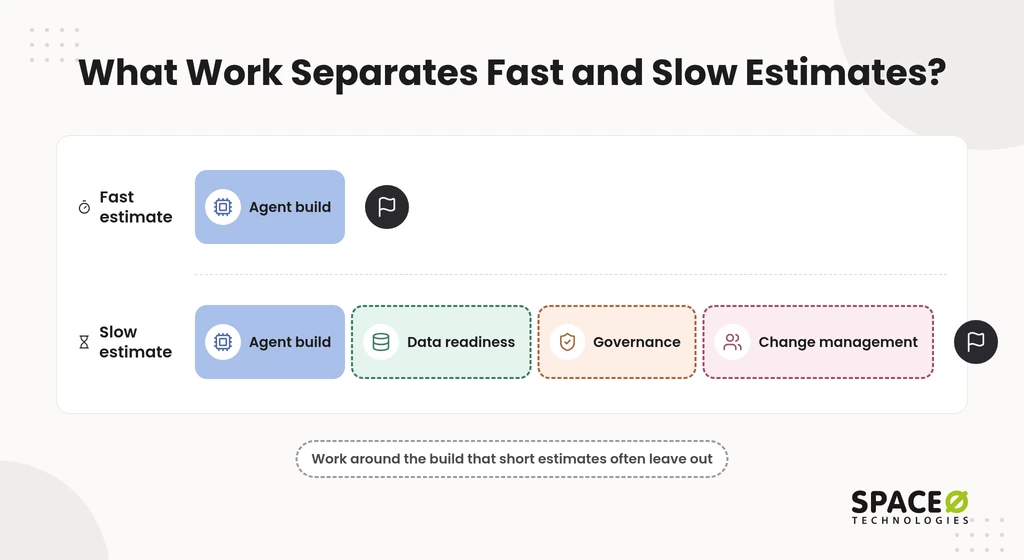
What work separates a fast estimate from a slow one?
Most of the gap is work that happens around the build, not the build itself. Viston reports that most deployment time goes to data readiness, governance, and change management. A short estimate usually leaves that work out. A long estimate usually includes it.
Which four finish lines do the published ranges measure?
Each published range fits one of four definitions, and each definition has a clear exit gate. Match an estimate to its row before you compare it with another.
| Finish line | Stated assumptions | Exit gate | Published ranges that fit |
|---|---|---|---|
| First working agent | One workflow, mostly read-only actions, sample data, informal review | Agent completes real tasks end to end | 2-5 days |
| Hardened single agent | Same workflow plus an evaluation set, guardrails, and logging | Passes the evaluation set and runs under monitoring | 1-3 added weeks; 4-8 weeks |
| Integrated production agent | 3-5 or 5-10 integrations, write actions, human approvals, security review | Security review passed; live with approvals on write actions | 12-20 weeks; 2-4 months; 12-16+ weeks across CRM, ERP, and email |
| Enterprise multi-system agent | Many systems, a data readiness program, governance, change management | Staged rollout complete, with ongoing monitoring | 3-6 months to production; 3-5 months mid-complexity and 6-12 months multi-agent |
How should you read the next estimate you receive?
Ask three questions before you accept any AI agent timeline. First, which exit gate does the date end at? Second, how many systems does the agent touch, and can it write to them? Third, who owns data readiness and governance, and is that work inside the estimate?
Watch the labels too. Vegavid describes a 4-6 month figure as a proof of concept. Elsewhere, that figure has been repeated as a production timeline. A PoC range quoted as production understates the real schedule.
Space-O Technologies publishes its own delivery ranges. An AI agent proof of concept takes 4 to 8 weeks. A basic AI feature takes 2 to 4 months. A mid-level AI app takes 4 to 7 months. A RAG-powered chatbot takes 10 to 20 weeks.
Four Build Phases and What Each Takes
AI Handbook splits a single agent build into four phases that together run about 6-15 weeks. Teams that skip a phase usually pay for it later in rework. Each phase below has its duration and its main risk.
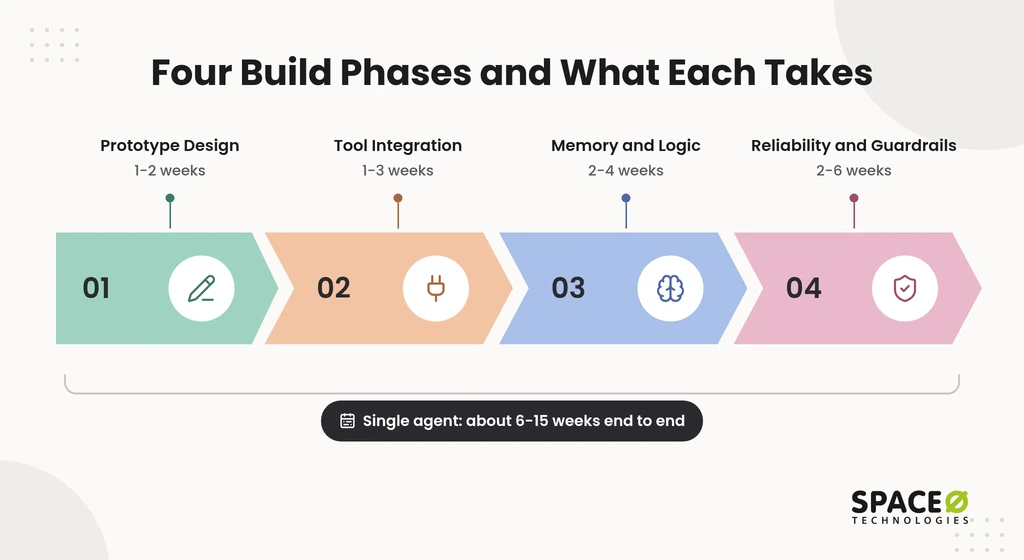
- Prototype Design (1-2 weeks): Pick a first use case for an AI agent, then define its inputs and correct outputs. Main risk: a scope too broad to test.
- Tool Integration (1-3 weeks): Connect the agent to systems through tool calling, also called function calling, and API integration. LangGraph, CrewAI, the OpenAI Agents SDK, and the Claude Agent SDK are common frameworks. Main risk: credentials and API limits that nobody planned for.
- Memory and Logic (2-4 weeks): Add persistent memory, multi-step reasoning, and rules for when to stop or escalate. Main risk: the agent loses context on long tasks.
- Reliability and Guardrails (2-6 weeks): Build the evaluation set, add guardrails, and fix failures until results hold steady. Main risk: this phase gets cut to hit a date.
AI Agent Development Timeline for Enterprise Teams
An enterprise AI agent moves through five phases, and integration scope sets most of the schedule. Enterprise leaders face more systems, more approvers, and stricter reviews than a single-team pilot. Microsoft’s Agent Development Lifecycle names five phases: Discovery, Experimentation, Build, Deploy, and Operational steady state. It gives no durations.
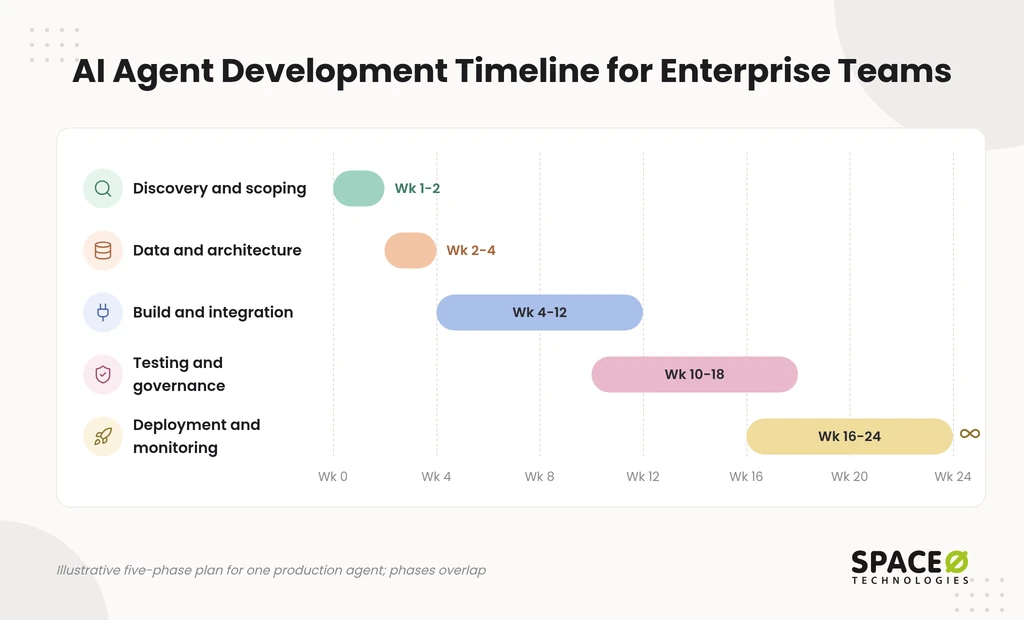
The plan below follows that five-phase shape. Its week labels are an illustrative schedule for one production agent. They fit inside the 4-6 week PoC and 3-6 month production window reported by Anyreach. They are not a measured benchmark.
Phase 1: Discovery and scoping (weeks 1-2)
Discovery takes 1-2 weeks and ends with a scoped use case, key performance indicators (KPIs), and autonomy boundaries. Without this, teams build an agent nobody can sign off on. AI consulting services often cover this step.
- Use case: one workflow with a named business owner.
- KPIs: baseline numbers the agent must beat.
- Boundaries: which actions the agent may take alone and which need approval.
Phase 2: Data and architecture (weeks 2-4)
Data and architecture work takes about two weeks and decides how the agent finds and trusts information. Poor data readiness is a frequent reason this phase runs over.
- Data readiness: sources mapped, cleaned, and access-approved.
- Grounding: retrieval-augmented generation (RAG) over company data, or another approach chosen by cost and accuracy.
- Tool access: connection pattern set, including Model Context Protocol (MCP) where it fits.
- Microsoft guidance: ground the agent on real-world data sets rather than synthetic ones.
Phase 3: Build and integration (weeks 4-12)
Build and integration is the longest phase, because every connected system adds credentials, edge cases, and test data. A PoC on one system often sits at the start of this window.
- Tool calling: LLM-powered agents read and write through approved APIs.
- Systems: enterprise resource planning (ERP), customer relationship management (CRM), and ServiceNow, as scope requires.
- Memory: persistent memory for multi-step and multi-day tasks.
- Human-in-the-loop: approval steps on consequential actions.
Phase 4: Testing and governance (weeks 10-18)
Testing and governance overlaps the build and ends when the agent passes its evaluation set and security review. LangChain frames this as a Build → Test → Deploy → Monitor loop, not a single pass.
- Evaluation set: real cases scored for accuracy and failure modes.
- Guardrails: limits on actions, data exposure, and output types.
- Security review: permissions, logging, and audit trails checked.
- Governance: named owners for changes after launch.
Phase 5: Deployment and monitoring (weeks 16-24, then ongoing)
Deployment is staged, starting in shadow mode before the agent gets live permissions. TechWize recommends shadow mode, so teams see real outputs before they carry real consequences.
- Shadow mode: the agent runs alongside people without acting.
- Staged rollout: permissions expand one user group at a time.
- Monitoring and logging: every action traced and reviewable.
- AgentOps: ongoing tuning as data, tools, and policies change.
How does integration scope set the enterprise schedule?
Integration scope sets the schedule: the more systems the agent touches and writes to, the longer the build. BinaryBrill reports that a narrow agent inside one tool takes far less time. It reports 12-16 weeks or more for agents that read and write across a CRM, ERP, and email.
No source gives a fixed duration per system type, so treat each estate on its own terms. An ERP, CRM, and ServiceNow estate each brings its own access model and test environment. Our API integration services team scopes each connection before the build starts.
What changes when the agent handles regulated data?
A regulated workflow adds a security and compliance review gate before the agent can act on live data. High-stakes outputs in finance or healthcare need stricter accuracy testing and often human review. That review belongs in Phases 4 and 5, not after launch.
For HIPAA-compliant healthcare and fintech workflows, plan the compliance review into your schedule from Phase 1. Space-O Technologies holds ISO 27001 certification and builds HIPAA-ready frameworks for healthcare AI engagements.
What Drives the Timeline
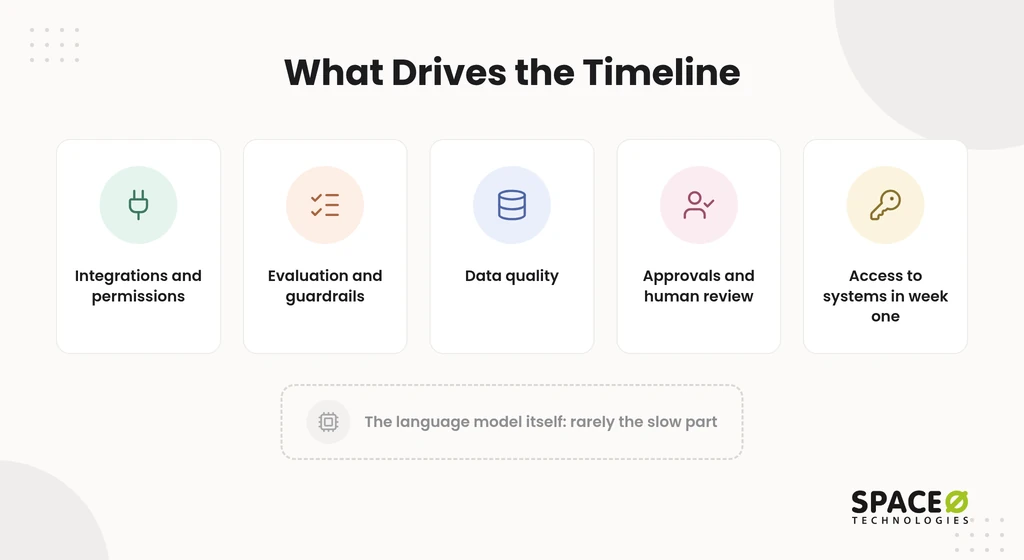
Integrations, evaluation, data quality, approvals, and system access drive AI agent timelines; the language model rarely does. Published sources agree that the delays sit outside the model. BinaryBrill puts it directly: the build itself is rarely the slow part.
Integrations and permissions
Every system the agent connects to adds weeks, and write access adds more than read access. Each connection needs credentials, a test environment, and error handling. Write actions also need approval rules, rollback plans, and role-based access for AI agents.
Evaluation and guardrails
An agent is ready when it passes an evaluation set, not when the demo works. Building that set takes real cases and expert scoring. Guardrails then need testing against the failures the set exposes.
Data quality
Clean data shortens the schedule more than any tool choice does. Anyreach reports that companies with clean data repositories can cut data preparation time substantially. Scattered or unlabeled data pushes everything after Phase 2 back.
Approvals and human review
Each human approval point needs design, testing, and a named reviewer, so it adds time. Human-in-the-loop steps protect consequential decisions. They also need clear rules on what gets escalated and who responds.
Access to systems in week one
A team that grants system access in week one saves the most time. Waiting for credentials, sandboxes, or security sign-off stalls the build before it starts. Arrange access during discovery, not after it.
Build Timeline by Engagement Model
Who builds your agent changes how fast you reach a PoC and how much scope control you keep. The three main routes are an in-house team, an enterprise agent platform, and a development partner. Each one trades speed against control differently.
When is an off-the-shelf product faster?
An off-the-shelf product is sometimes the fastest route. It works well when the task matches what the product already does. It falls short when you need custom integrations or write actions in your own systems. It also falls short when the product hides the compliance controls you need.
An in-house team keeps full control but needs agent, integration, and evaluation skills on staff. An enterprise platform speeds setup inside its own ecosystem but ties you to its tools and plan limits. A partner brings a ready team, and agents rarely ship alone. They sit inside Node.js services, React.js review screens, and existing APIs.
How do partner engagement models compare on speed?
Space-O Technologies offers four engagement models, and each one affects the timeline differently.
| Engagement model | Scope control | Flexibility | Speed to PoC |
|---|---|---|---|
| Dedicated Team | You set priorities sprint by sprint | High; the team adapts as scope shifts | Fast once the team is in place |
| Time & Material | You adjust scope as evaluation results arrive | High; you pay for work done | Fast; work starts on the known scope |
| Fixed Cost | Scope is locked up front | Low; changes need a change request | Fast when the use case is already clear |
| Staff Augmentation | Your leads keep control of the process | High within your own process | Depends on your team’s readiness |
Dedicated developers are matched to your project in 48 to 72 hours and onboarded within days.
How does Space-O Technologies run agent builds?
We start from the business goal, then pick the technology that reaches it. Space-O Technologies has built AI-powered custom software since 2010 and has developed 300+ software solutions. Our 140+ in-house developers include specialists you can hire as AI agent developers.
Every model we put into production is wrapped in an evaluation suite. It covers accuracy, hallucination rate, bias checks, latency, and cost, with continuous monitoring in place. People approve consequential decisions. We sign a non-disclosure agreement (NDA) before every project. All source code, data, and intellectual property (IP) transfer to you at completion.
What to Bring for an Estimate
A tight timeline estimate needs five details about your workflow. Without them, any estimate is a guess dressed as a date. Bring these to the first conversation:
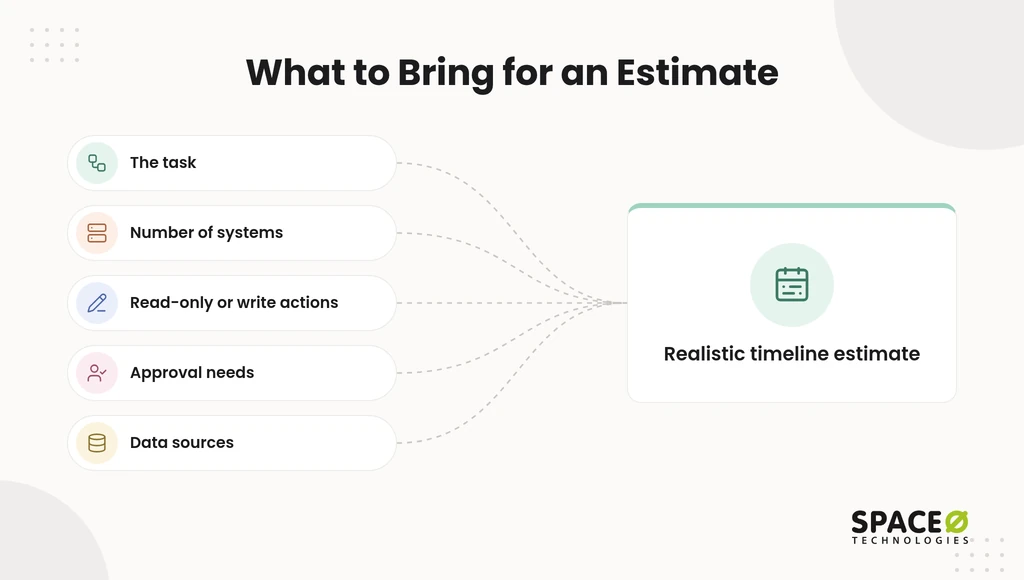
- The task: the workflow the agent will run, with its start and end.
- Number of systems: every tool, database, and platform the agent must reach.
- Read-only or write actions: whether the agent only reads data or also changes records.
- Approval needs: which decisions need a person to sign off.
- Data sources: where the information lives and how clean it is.
Need a Realistic Timeline for Your Agent?
Tell us about your workflow, systems, and approval needs. Space-O Technologies returns an expert-reviewed timeline estimate that separates proof of concept from full production scope.

Frequently Asked Questions
How long does it take to build an AI agent?
A basic agent takes 2-5 days, while a production agent takes 12-20 weeks or 2-4 months. Multi-agent systems run 3-6 weeks for a first version and 6-12 months for a full build. Scope, integrations, and testing set the range.
How long does an enterprise AI agent take to build?
Anyreach reports 4-6 weeks for an enterprise proof of concept and 3-6 months for full production. Our illustrative plan runs five phases across roughly 24 weeks, then ongoing monitoring.
What factors affect AI agent development time?
Integrations, evaluation and guardrails, data quality, approvals, and system access drive the schedule. The language model rarely does. Write access to other systems adds more time than read access.
How do you create an AI agent?
Follow four build phases in order: prototype design, tool integration, memory and logic, and reliability and guardrails. Budget roughly 6-15 weeks for a single agent. Move to the next phase only when the current one meets its exit condition.
How do you train an AI agent?
An agent improves through evaluation and iterative fixes rather than a separate training step. Grounding it on real company data, for example through retrieval-augmented generation (RAG), also improves accuracy. Plan extra time for the reliability and guardrails phase.
What should be the first step when building an AI agent?
Scope one workflow with a named business owner, which takes about 1-2 weeks in the enterprise plan. Request system access, credentials, and sandboxes in the same week. Access delays stall the build before it starts.
How do I use an AI agent once it is built?
Treat launch as the start of Phase 5, not the end of the project. Widen permissions to the next user group only after shadow-mode outputs hold steady. AgentOps tuning then continues as data, tools, and policies change.
Why do AI agent timelines vary so much between sources?
Each published range measures a different finish line, from a first working agent to a staged enterprise rollout. A short estimate usually leaves out data readiness, governance, and change management. Match an estimate to its exit gate before comparing it.



 All our projects are secured by NDA




 4.8


