
 By
By 
Contents
AI agent development cost ranges from $10,000 for a rule-based assistant to $500,000 for an enterprise system. Most mid-market builds settle between $80,000 and $250,000 once integrations and compliance work are included.
Ask three vendors to price the same agent and the quotes will rarely align with each other. That happens because each one is quietly pricing a different system behind the same written brief. One assumes your data is ready, while another budgets three weeks to clean it first.
The variable that actually moves your budget is not the feature list or the model you choose. It is whether the agent recommends an action or executes that action inside a live system. That single distinction routinely separates a $40,000 project from one costing well past $250,000.
These decisions now face the same scrutiny as any other major system investment. Gartner projects that 33% of enterprise applications will contain agentic AI by 2028, up from under 1% in 2024.
Adoption has already moved well past isolated pilots inside most large organizations. McKinsey reports that 23% of organizations now use agent-based AI, with a further 39% still experimenting. That experimenting 39% is exactly where most unresolved spending decisions currently sit today.
As an AI agent development company, Space-O Technologies has scoped these builds since 2010 across more than 1,200 clients. Every figure in this AI agent development cost breakdown reflects current market rates, including the operational spend most proposals leave out.
Note: All prices in this guide are in US dollars. The ranges reflect Space-O Technologies’ evaluation of AI agent projects across different complexity levels. Your actual cost will depend on project scope and integrations.
What Is an AI Agent?
An AI agent is an autonomous software system powered by artificial intelligence that perceives its environment, makes decisions, and executes multi-step actions to reach a specific goal. A basic chatbot only replies with text, while an agent plans its own steps, calls external tools, and works through complex tasks without supervision.
The difference sits in autonomy. A traditional automation workflow follows a fixed script written by a developer. An agent decides its own sequence at runtime, adapts when a step fails, and keeps working until the objective closes out or the agent hits a defined stop condition.
Key components of an AI agent
- Reasoning model: A large language model such as GPT-4, Claude, or Llama interprets the goal, weighs options, and produces the next decision.
- Planning layer: A planner decomposes one broad objective into ordered subtasks and re-plans when a subtask returns an unexpected result.
- Memory: Short-term memory holds the current task state. Long-term memory, usually a vector store like Pinecone or Weaviate, carries knowledge across sessions.
- Tool layer: APIs, functions, databases, and applications give the agent its reach into real systems. Frameworks such as LangChain, CrewAI, and AutoGen handle the orchestration.
Our guide, AI agent development explained, covers how these components work together in more depth.
How an AI agent works
- Goal intake: A user or upstream system hands the agent an objective, for example, “audit these 40 URLs and flag the ones missing schema markup.”
- Plan formation: The agent maps the objective to a sequence of steps and selects the tools each step requires.
- Tool execution: The agent calls an API, queries a database, or runs a function, then captures the output.
- Self-evaluation: The agent checks the output against the goal, retries or reroutes on failure, and advances to the next step.
- Completion: The agent returns the finished result once every subtask closes.
Every component above adds to the build cost, and the number of steps an agent handles drives the engineering time behind it. The next section breaks down what a custom AI agent costs and which factors move that number most.
Build Your AI Agent With an Experienced Development Team
Space-O Technologies has delivered AI solutions since 2010. Tell us what you need automated and get a clear development quote.

How Much Does Custom AI Agent Development Cost?
The cost of developing an AI agent ranges from $10,000 to $250,000, with enterprise builds exceeding $500,000. The quoted build price, however, represents only one of the three cost layers you need to plan against.
Treating a proposal figure as the total AI development cost is the most common budgeting error. Planning against all three layers from the beginning prevents the uncomfortable conversation in year two.
- Build: The one-time engineering spend running from discovery through to production deployment and handover.
- Run: Recurring token, infrastructure, and storage costs that scale directly with adoption and usage volume.
- Maintain: Retraining, model migration, monitoring, and compliance renewal across the working life of the agent.
For a mid-complexity agent handling moderate volume, run and maintain costs commonly add $40,000 to $120,000 annually. Across a three-year horizon, operational spend frequently exceeds the original build price by a meaningful margin.
The remaining sections break each of these layers down so your business case survives internal scrutiny.
Know What Your AI Agent Will Actually Cost
Share your workflow and target outcome. Our AI team returns a scoped cost range, timeline, and recommended agent tier within two business days.
AI Agent Development Cost by Agent Type
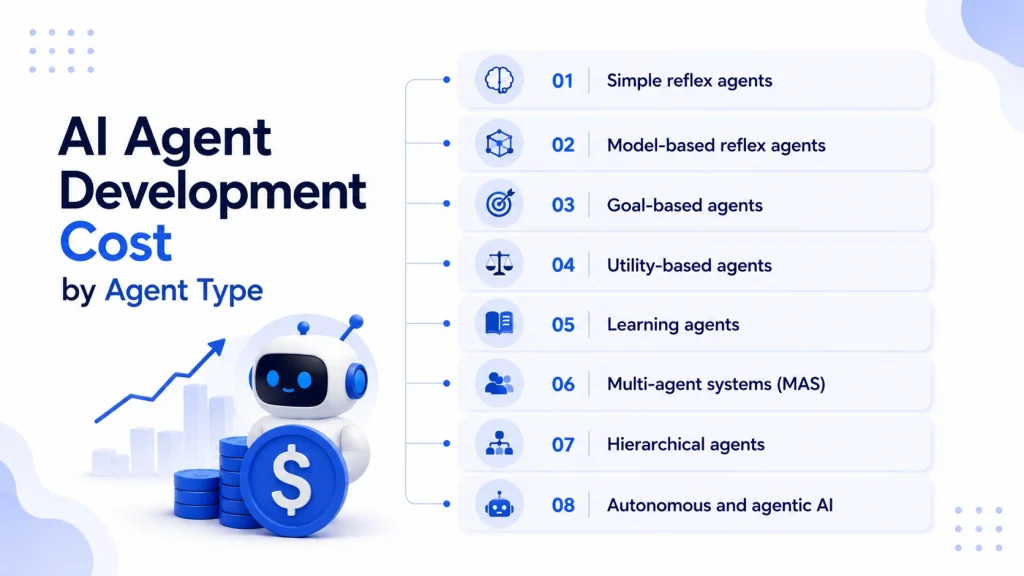
Agent classification matters because the architecture actually drives the final price. The types below are ordered by autonomy, running from the simplest through to the most complex.
1. Simple reflex agents
Simple reflex agents act on fixed if-then rules using only the input currently in front of them. They hold no memory of past events, which keeps both build and testing effort genuinely low.
This category splits into two cost tiers that buyers should price separately during scoping. Deterministic rule engines handle FAQ routing cheaply, while stateless LLM agents interpret natural language instead.
| Pros | Cons |
|---|---|
| Fastest option to build and deploy | Breaks on any unanticipated input |
| Completely transparent and easy to debug | Cannot learn from past interactions |
| Lowest infrastructure and running costs | Rule count becomes unmanageable at scale |
| Predictable behaviour in every scenario | Unsuitable for dynamic environments |
Cost: $15,000 to $40,000 for rule-based, $40,000 to $100,000 for stateless LLM. Timeline: 4 to 14 weeks.
2. Model-based reflex agents
Model-based reflex agents maintain internal state to track parts of the environment they cannot directly observe. That stored context lets them handle multi-turn conversations and conditions that change over time.
Two implementations sit here at very different price points. Session memory suits onboarding assistants, while retrieval-augmented generation uses core generative AI development services capabilities.
| Pros | Cons |
|---|---|
| Maintains context across multi-step flows | Memory management adds engineering complexity |
| Answers grounded in current company data | Response quality depends on source data quality |
| Reduces hallucination compared with base models | Cannot plan toward longer-term objectives |
| Content updates without retraining the model | Storage costs grow with volume and queries |
Cost: $40,000 to $80,000 for session memory, $100,000 to $300,000 for RAG. Timeline: 10 to 24 weeks.
3. Goal-based agents
Goal-based agents plan by looking at future states before committing to any action. They evaluate a sequence of steps against an explicit target rather than reacting to input.
Applications include resource scheduling, diagnostic support, and treatment planning across healthcare and operational settings.
| Pros | Cons |
|---|---|
| Adapts well to complex, changing environments | Requires substantial computational resources |
| Evaluates multiple alternatives before acting | Significantly harder to build and validate |
| Can anticipate outcomes rather than react | Performance drops under high uncertainty |
| Strong fit for planning-heavy workflows | Longer development and testing cycles |
Cost: $40,000 to $150,000. Timeline: 12 to 20 weeks.
4. Utility-based agents
Utility-based agents choose whichever action delivers the best overall outcome when several paths reach the goal. Safety, cost, and speed all get weighed inside a single scored decision.
Pricing engines, logistics optimization, and recommendation systems commonly rely on this architectural pattern.
| Pros | Cons |
|---|---|
| Makes nuanced trade-offs between competing goals | Extensive calculation required for each decision |
| Maintains performance under uncertain conditions | Poor scoring criteria produce flawed decisions |
| Adapts decisions as business priorities shift | Slower response times than simpler agents |
| Well suited to optimization problems | Requires advanced mathematical modeling |
Cost: $80,000 to $200,000. Timeline: 14 to 24 weeks.
5. Learning agents
Learning agents improve their performance over time by learning from feedback and experience. They combine supervised, unsupervised, and reinforcement approaches inside a single operating system.
Recommendation engines and adaptive support systems benefit most from this continuous improvement capability.
| Pros | Cons |
|---|---|
| Improves automatically without manual reprogramming | Poor training data degrades performance over time |
| Adapts to shifting customer preferences | Requires careful monitoring for bias |
| Handles genuinely dynamic operating conditions | Long initial training period before value appears |
| Reduces long-term manual tuning effort | Highest ongoing monitoring cost of any type |
Cost: $100,000 to $300,000. Timeline: 20 to 32 weeks.
6. Multi-agent systems (MAS)
Multi-agent systems put several autonomous agents into a shared environment to cooperate or compete. Each agent holds a defined role, which allows genuinely complex workflows to be decomposed cleanly.
Testing is the hidden expense here, because agent interactions produce emergent behaviour that resists prediction.
| Pros | Cons |
|---|---|
| Solves problems too complex for single agents | Emergent behaviour is difficult to test fully |
| New agents can be added without redesign | Coordination overhead grows with agent count |
| Each agent stays specialized and maintainable | Requires powerful infrastructure and orchestration |
| Adapts to new information without human input | Highest debugging complexity of any architecture |
Cost: $150,000 to $500,000. Timeline: 16 to 28 weeks.
7. Hierarchical agents
Hierarchical agents split tasks into layered levels, separating high-level planning from low-level execution. Upper layers decompose objectives and delegate the resulting subtasks downward through the structure.
Manufacturing robotics, logistics coordination, and large autonomous systems commonly adopt this layered approach.
| Pros | Cons |
|---|---|
| Assigns each task to the best-suited agent | Training a full hierarchy is complex |
| Scales cleanly across large coordinated systems | Top-level failure can disrupt everything below |
| Separates planning from execution efficiently | Low-level agents struggle with novel situations |
| Enables targeted optimization at each layer | Requires significant architectural planning upfront |
Cost: $100,000 to $400,000. Timeline: 20 to 32 weeks.
8. Autonomous and agentic AI
Autonomous agents are modern LLM-driven systems built to run multi-step workflows with limited human intervention. They search, query databases, execute code, and reason about whatever results come back.
Most production enterprise agents sit here, which makes this the most commonly commissioned category. Multi-tool agents handle a defined workflow, while enterprise systems span entire business processes.
| Pros | Cons |
|---|---|
| Completes real work rather than answering questions | Guardrail design is essential and time-consuming |
| Handles ambiguous inputs across multiple steps | Each tool integration adds build and test time |
| Delivers the clearest measurable business return | Compliance infrastructure carries standalone cost |
| Automates complete processes at enterprise scale | Requires dedicated governance and monitoring |
Cost: $80,000 to $180,000 for multi-tool, $300,000 to $800,000+ for enterprise. Timeline: 12 to 40+ weeks.
Ready to Start Your AI Agent Development Project Today
Talk to our AI engineers about your workflow, integrations, and timeline. You get a development plan and cost estimate free.
AI Agent Development Cost Breakdown by Phase
Understanding how to make an AI agent starts with knowing what each build phase actually produces. Cost accumulates stage by stage rather than arriving as a single lump sum at the end. For a closer look at what happens inside each stage, see our full breakdown of the AI agent development lifecycle.
This AI agent development cost breakdown shows where the budget goes across the eight delivery phases. Teams asking how to make an AI agent usually underestimate the two phases that precede development entirely.
1. Discovery, scoping, and feasibility
The real purpose of this phase is deciding what should not be built at all. Teams define the target workflow, the success metrics, and the riskiest technical assumption in the project.
Deliverables include a requirements document, architecture outline, data audit, and interface wireframes. Skipping this stage is the most reliable way to overspend during the phases that follow.
Cost: $5,000 to $15,000. Duration: 2 to 4 weeks.
2. Data collection, cleaning, and labeling
Cost at this stage depends almost entirely on the current state of your existing data. Structured and accessible data moves quickly, while scattered documents and inconsistent records do not.
Work covers source identification, cleaning, labeling, deduplication, and preparation for any applicable compliance requirements. Poor data quality routinely adds 20% to 40% to the total cost of the project.
Cost: $10,000 to $70,000. Duration: 3 to 10 weeks.
3. Model selection and fine-tuning
Teams choose between proprietary model APIs and self-hosted open-source alternatives at this point. Most projects fine-tune a pre-trained model rather than training anything from scratch.
Selection weighs reasoning quality, token pricing, latency, and any data residency requirements that apply. Regulated data almost always forces additional validation work into the schedule.
Cost: $15,000 to $100,000. Duration: 3 to 8 weeks.
4. Agent architecture and development
This phase is the core build where engineers construct the reasoning loop and memory layer. Tool interfaces, business logic, and decision routing are all implemented and connected during this stage.
AI agent development frameworks such as LangGraph, LlamaIndex, and CrewAI meaningfully reduce the engineering effort required here. Building these primitives from scratch adds weeks of work without adding any real differentiation.
Cost: $20,000 to $200,000. Duration: 6 to 16 weeks.
5. Integration and workflow orchestration
Each connected system requires authentication, data mapping, error handling, and its own dedicated testing cycle. Complex or legacy integrations commonly consume two to four weeks each on their own.
Orchestration determines how multiple agents coordinate with one another inside the production environment. Centralized, decentralized, hierarchical, and federated patterns each carry noticeably different engineering costs.
Cost: $20,000 to $50,000. Duration: 4 to 12 weeks.
6. Testing, evaluation, and red teaming
Agent testing differs fundamentally from traditional software QA in both method and objective. You are validating behaviour and judgement here, rather than simply confirming that code paths execute.
A production evaluation suite covers unit tests, integration tests, trajectory evaluation, regression tests, and adversarial inputs. This work typically adds 15% to 25% to the overall development timeline.
Cost: $5,000 to $50,000. Duration: 3 to 8 weeks.
7. Deployment and monitoring setup
Deployment covers containerization, cloud configuration, CI/CD pipelines, and full observability instrumentation before launch. Monitoring dashboards are configured ahead of go-live rather than retrofitted afterwards.
Getting this stage right prevents runaway infrastructure spend once real production traffic starts arriving.
Cost: $10,000 to $30,000. Duration: 2 to 5 weeks.
8. Maintenance, retraining, and scaling
Annual maintenance typically runs between 15% and 25% of the original build cost. Fast-growing systems with rising usage regularly exceed that range within the first year.
Work includes model retraining, prompt refinement, feature additions, performance tuning, and ongoing compliance updates.
Cost: $10,000 to $50,000+ annually. Duration: Ongoing.
Get Your Custom AI Agent Built by Certified Experts
ISO 9001 and ISO 27001 certified delivery, 1,200+ clients served, and 97% client retention. Send your requirements for a scoped proposal.
AI Agent Development Cost by Industry
Industry changes the cost of an agent through three distinct and compounding levers. Compliance burden, integration difficulty, and accuracy tolerance all move the final figure in the same direction.
Healthcare and life sciences
Healthcare agents must handle protected health information correctly from the very first day of operation. That requirement means data isolation, access controls, audit trails, and formal validation documentation throughout.
EHR integrations are notoriously slow and frequently add six to twelve weeks to the schedule. Clinical accuracy requirements also demand considerably heavier testing than typical enterprise software projects.
Cost: $100,000 to $400,000.
Financial services and fintech
Financial agents face the heaviest combination of regulation, real-time data requirements, and explainability standards. Every decision the agent makes must be logged, traceable, and defensible under external audit.
Compliance infrastructure alone frequently represents a substantial share of the total project budget here.
Cost: $120,000 to $500,000+.
Retail and eCommerce
Retail agents prioritize scale and personalization rather than navigating heavy regulatory complexity. Catalog integration and real-time inventory access are usually the main engineering challenges to solve.
This vertical typically offers the fastest payback period because transaction volume is naturally high. Our guide to the AI agent for eCommerce breaks down these retail workflows.
Cost: $50,000 to $200,000.
Manufacturing and supply chain
Manufacturing agents often interface with operational technology never designed for software integration at all. Edge deployment adds infrastructure cost but is frequently mandatory for latency or security reasons.
Cost: $80,000 to $300,000.
Logistics and transportation
Logistics agents coordinate routing, capacity, and exception handling across several independent parties simultaneously. Cost is driven mainly by third-party data feeds and real-time processing requirements.
Cost: $70,000 to $250,000.
Professional and legal services
These agents work with dense documents where accuracy expectations are unusually high. Knowledge retrieval quality matters considerably more than raw model reasoning capability in this context.
Multi-source retrieval and citation traceability are the primary cost drivers across these engagements.
Cost: $60,000 to $250,000.
Across all verticals, the compliance premium is the single most underestimated line item. Budget for it during scoping rather than discovering it midway through the build. Real estate brokerages face this premium through fair housing rules, as our guide to AI solutions for real estate explains.
Start Your AI Agent Development With a Free Consultation
Book a 30-minute call with our AI team. Discuss your use case, get a cost range, and decide your next step.
AI Agent Pricing by Business Function
Most buyers scope their project by the job to be done rather than by architecture. The table below maps typical cost directly to the business function the agent supports.
| Business function | Build cost | Monthly run cost | Timeline |
|---|---|---|---|
| Customer support | $40,000 to $120,000 | $2,500 to $5,000 | 8 to 16 weeks |
| Sales qualification | $70,000 to $180,000 | $3,000 to $6,000 | 12 to 20 weeks |
| Marketing operations | $60,000 to $150,000 | $2,500 to $5,500 | 10 to 18 weeks |
| HR onboarding | $50,000 to $100,000 | $2,000 to $5,000 | 10 to 16 weeks |
| Finance and accounts payable | $20,000 to $60,000 | $2,000 to $4,500 | 8 to 14 weeks |
| Legal document review | $100,000 to $200,000 | $3,000 to $10,000 | 16 to 24 weeks |
| Data analysis and reporting | $80,000 to $180,000 | $3,000 to $7,000 | 12 to 20 weeks |
| IT helpdesk | $40,000 to $110,000 | $2,000 to $4,500 | 8 to 16 weeks |
| Procurement | $60,000 to $140,000 | $2,500 to $5,500 | 12 to 18 weeks |
| Logistics coordination | $70,000 to $150,000 | $3,000 to $6,500 | 12 to 20 weeks |
These figures assume a single function rather than an agent spanning several departments at once. Cross-functional agents cost more than the sum of their parts, because each added function multiplies integration and testing work. Scope one function first, prove the return, then expand from a working foundation. Our guide to use cases of AI agents helps identify which function to automate first.
What Affects AI Agent Development Cost?
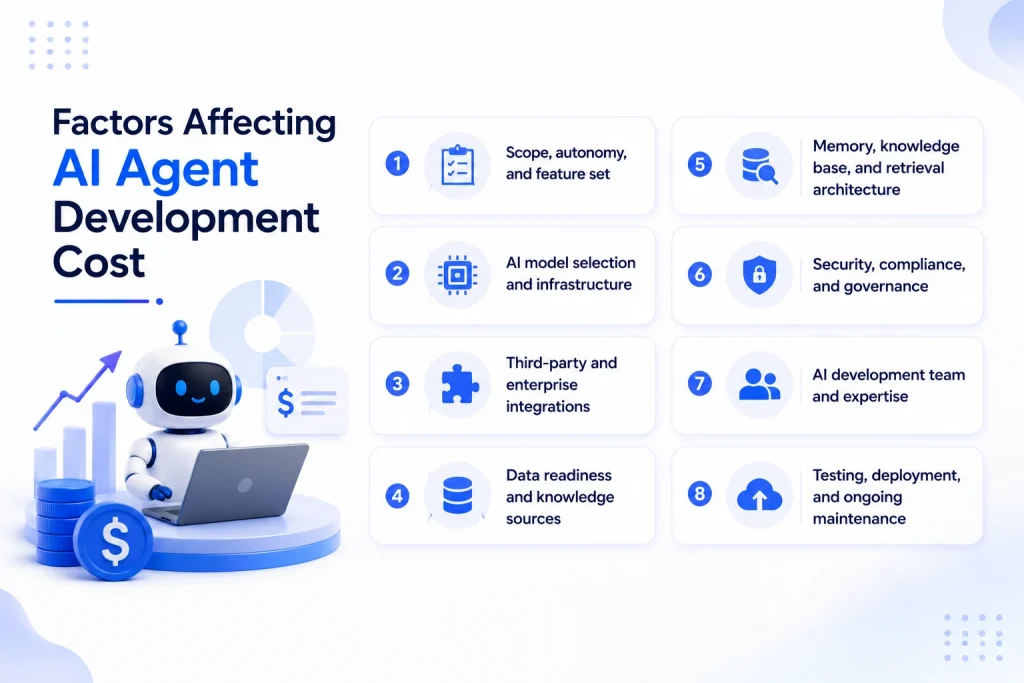
The cost to build an AI agent depends on much more than its core functionality. Factors such as the agent’s complexity, AI model, data quality, integrations, security requirements, and the expertise of your development team all influence the final investment. Understanding these variables helps you estimate your budget more accurately and prioritize features that deliver the highest business value.
Scope, autonomy, and feature set
The scope of your AI agent is the single biggest cost driver. A task-specific AI agent that automates one workflow requires significantly less effort than an autonomous agent capable of reasoning, planning, and executing complex business processes. Additional capabilities such as voice interactions, image recognition, document processing, multilingual support, and human handoff further increase development effort, testing requirements, and infrastructure costs.
AI model selection and infrastructure
Your choice of AI model directly affects both development and long-term operational costs. Proprietary large language models provide strong reasoning capabilities and enterprise support but involve ongoing API fees, while open-source models reduce licensing costs at the expense of additional infrastructure and maintenance. Beyond the model itself, cloud hosting, GPU resources, storage, monitoring, and autoscaling all contribute to the overall AI agent development cost.
Third-party and enterprise integrations
Most AI agents need to integrate with existing business applications such as CRMs, ERPs, customer support platforms, payment systems, and internal databases. While standard APIs simplify implementation, legacy systems often require custom connectors, authentication mechanisms, and data transformation, increasing development time and complexity. The greater the number of integrations, the higher the overall project cost.
Data readiness and knowledge sources
High-quality, well-structured data can significantly reduce AI agent development costs. Organizations with clean, API-accessible data can accelerate implementation, while businesses relying on scattered documents, spreadsheets, or inconsistent records must invest additional time in data cleaning, organization, and pipeline development. Since AI agents depend heavily on reliable data, investing in data readiness early often lowers both development time and future maintenance costs.
Memory, knowledge base, and retrieval architecture
Enterprise AI agents typically require Retrieval-Augmented Generation (RAG), vector databases, and long-term memory to provide accurate, context-aware responses. Building this architecture involves document indexing, embedding generation, retrieval optimization, and secure storage. As the volume of business knowledge grows, additional effort is required to maintain fast, accurate, and scalable retrieval, making this an important contributor to the overall development budget.
Our guide to AI agent system architecture explains how memory fits alongside reasoning, tools, and orchestration.
Security, compliance, and governance
Security and compliance requirements can substantially increase AI agent development costs, especially for industries such as healthcare, finance, and legal services. Features such as data encryption, role-based access control, audit logging, secure authentication, and compliance with regulations like GDPR, HIPAA, or SOC 2 require additional engineering and testing. Although these measures increase the initial investment, they are essential for protecting sensitive information and ensuring regulatory compliance.
AI development team and expertise
The experience and composition of your AI development team play a major role in project cost and quality. A production-ready AI agent often requires AI engineers, backend developers, frontend developers, data engineers, MLOps specialists, QA engineers, and solution architects. While highly experienced professionals typically command higher rates, they reduce project risks, minimize rework, and deliver scalable solutions that lower the total cost of ownership.
Vendors who follow best practices for AI agent development, including documented architecture reasoning, verified framework experience, and evaluation-driven scoping, consistently deliver more reliable agents per dollar spent than generalist shops.
Testing, deployment, and ongoing maintenance
Building an AI agent is only the beginning. Comprehensive testing is required to validate prompts, measure accuracy, identify hallucinations, evaluate edge cases, and ensure reliable performance before deployment. After launch, organizations must continue investing in model updates, infrastructure monitoring, performance optimization, bug fixes, and feature enhancements to keep the AI agent secure, accurate, and aligned with evolving business requirements.
Developing an AI agent is a strategic investment, and understanding the factors that influence cost helps you plan your budget more effectively. By defining a clear project scope, preparing high-quality data, selecting the right AI technologies, and partnering with an experienced AI development team, you can optimize your AI agent development cost while building a scalable solution that delivers long-term business value.
Hidden and Ongoing Costs of Running an AI Agent
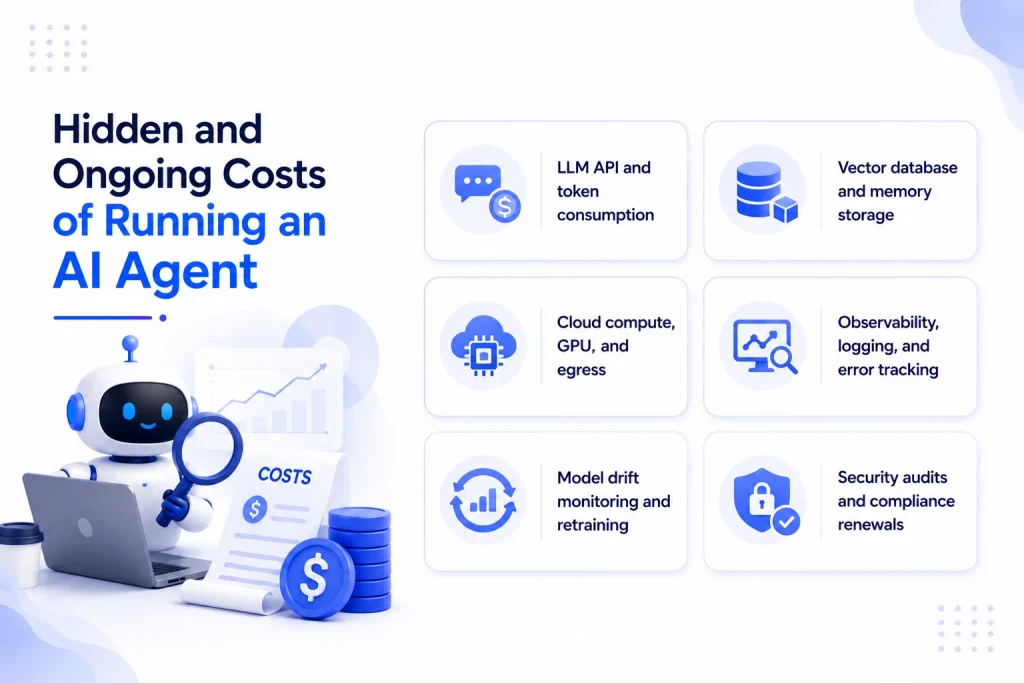
Build cost is clearly visible in the proposal document you receive from any vendor. Operating cost is what actually determines the real three-year total for the system.
LLM API and token consumption
Token spend scales in direct proportion to adoption, which creates an uncomfortable dynamic for budgets. Low volume feels genuinely cheap, and high volume very quickly does not.
Prompt optimization, response caching, and context trimming all meaningfully reduce this recurring line item.
Vector database and memory storage
Managed vector services bill on stored volume, query frequency, and sustained throughput requirements. Storage for embeddings, logs, and session history compounds steadily across the life of the agent.
Cloud compute, GPU, and egress
Compute, storage, network egress, and load balancing all contribute to the monthly infrastructure bill. Auto-scaling and correctly sized instances prevent the most common form of cloud overspend.
Observability, logging, and error tracking
Production agents need interaction-level logging, error tracking, and analytics dashboards from the first day. Without this instrumentation, diagnosing any production failure becomes expensive guesswork for your team.
Model drift monitoring and retraining
Underlying data changes over time, and model accuracy degrades quietly alongside it. Retraining cycles require fresh labeling, tuning, validation, and occasionally an expansion of your infrastructure.
Security audits and compliance renewals
Penetration testing, certification maintenance, and data processing agreements all recur on an annual basis. These belong in the operating budget rather than the original project budget.
For a mid-complexity agent at moderate volume, budget $40,000 to $120,000 annually beyond the build. Building this into the business case at the start avoids a difficult conversation after launch.
AI Agent Pricing Models and How Each Affects Your Budget
How you pay matters nearly as much as what you pay across a three-year horizon. Each model has a volume threshold where it quietly stops being the cheaper choice.
| Pricing model | How it works | Typical range | Best fit | Where it breaks down |
|---|---|---|---|---|
| Per-seat subscription | Fixed fee per user monthly | $20 to $500 per user | Internal productivity tools | Large headcount, light usage |
| Per-conversation or per-task | Charge per interaction | $0.02 to $1.50 per interaction | Variable or seasonal volume | High-volume customer support |
| Tiered subscription | Volume bands with caps | $500 to $5,000 monthly | Predictable mid-market volume | Growth past the top tier |
| Custom build plus hosting | One-time build, monthly infrastructure | $15,000 to $200,000+ build | Unique workflows, IP ownership | Low volume, standard use cases |
Usage-based pricing transfers the budget risk from the vendor directly onto your organization. Cost rises precisely when adoption succeeds, which is the worst possible moment for a budget surprise.
If you choose a usage model, negotiate volume ceilings and overage terms before signing anything. If you expect real scale, custom development with fixed hosting becomes cheaper faster than most buyers anticipate.
Build vs. Buy vs. Hybrid: Which Costs Less for You
The correct answer depends almost entirely on how templatable your target workflow genuinely is.
When an off-the-shelf platform is the cheaper choice
Choose a platform when your use case is standard, volume is modest, and speed matters most. Tier-one support deflection and basic FAQ handling both fit this profile extremely well. Our guide to AI agents for customer support compares the leading platforms for this scenario.
Platform pricing is predictable, and deployment usually takes days rather than several months of engineering.
When custom development pays for itself
Custom development wins under four fairly specific conditions that are worth testing honestly. Your workflow cannot be templated, or you need deep integration with proprietary internal systems.
The other two conditions are operating under real regulatory constraints or requiring full IP ownership. At scale, custom builds also win on unit economics because there is no per-task markup.
When a hybrid path makes sense
Start on a platform to validate the use case, then migrate to custom afterwards. By then you understand the real requirements and have proven the return internally.
This route suits growth-stage companies that need evidence before committing significant capital to a build.
ROI of AI Agent Development
Any investment in AI development services needs a business case modeling return, not just cost. The three scenarios below illustrate how return builds at different organizational scales.
Customer support agent ROI scenario
A mid-market company builds a support agent for $120,000 as a first deployment. It resolves 60% of tier-one tickets previously handled by three staff costing $210,000 annually.
Annual savings reach roughly $126,000 against approximately $45,000 in ongoing operating costs. The net first-year position is a modest loss, turning to around $81,000 profit annually afterwards.
Payback in this scenario lands somewhere close to month fourteen after production deployment.
Document processing agent ROI scenario
A professional services firm invests $90,000 in an agent supporting document review work. It reduces review time per document by roughly 55% across a team of six analysts.
Recovered capacity is worth approximately $135,000 annually against $30,000 in operating costs. Payback in this scenario occurs somewhere near month ten after go-live.
Sales qualification agent ROI scenario
A B2B company builds a lead qualification agent at a total cost of $150,000. Faster response times and consistent scoring together lift qualified pipeline conversion measurably. Our guide to the AI agent for sales covers the qualification workflows behind this scenario.
Where an agent grows revenue rather than reducing cost, payback depends on deal size and volume. Model this scenario conservatively, because revenue attribution is much harder to defend internally.
Across all three scenarios, most enterprise agents reach positive return within eight to eighteen months. Beyond direct savings, the business case usually includes error reduction and round-the-clock availability.
Consistent auditable decisions and volume scalability without added headcount also belong in that calculation.
How to Reduce AI Agent Development Cost Without Cutting Quality
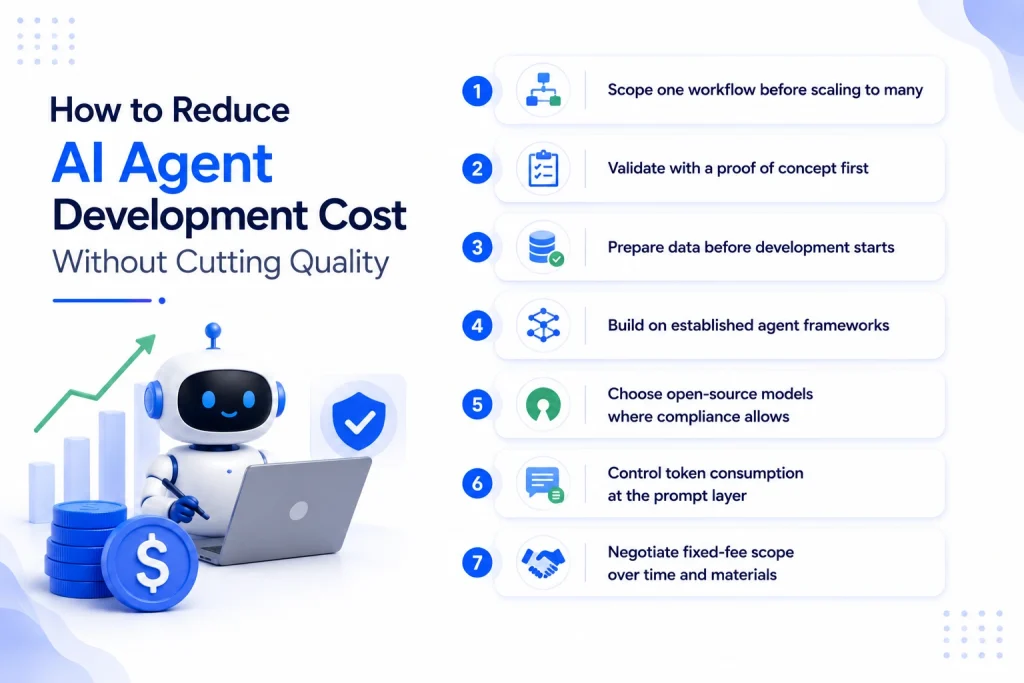
Cost control on agent projects is about correct sequencing rather than cutting any corners. The seven tactics below are ordered by where they apply across the project lifecycle.
1. Scope one workflow before scaling to many
A single well-defined workflow costs a fraction of an open-ended organizational mandate. Phased delivery of this kind commonly reduces upfront spend by 40% to 60%. Deliver one function well, then fund the next expansion from proven results.
2. Validate with a proof of concept first
A four- to six-week proof of concept tests the riskiest assumption at low cost. It also produces the operational data needed to build an accurate full-project estimate. Nothing else converts a speculative number into evidence this cheaply or this quickly.
3. Prepare data before development starts
Cleaning data during an active build is significantly more expensive than doing it beforehand. Poor data quality routinely adds 20% to 40% to the total project cost. Sequencing this correctly protects both the project budget and the delivery timeline.
4. Build on established agent frameworks
Frameworks provide memory management, tool calling, and orchestration logic straight out of the box. Reimplementing these primitives internally adds weeks of work without creating any real differentiation. Reserve your custom engineering for the logic that actually distinguishes your own product.
5. Choose open-source models where compliance allows
Open-source models eliminate per-token API fees across the life of the system. At high interaction volume, this can reduce ongoing model spend quite substantially. Weigh that saving against the infrastructure and operational expertise self-hosting demands from you.
6. Control token consumption at the prompt layer
Prompt optimization, context trimming, and response caching all reduce recurring monthly spend. Real-time token tracking prevents the kind of surprise that damages internal credibility. Set consumption alerts before launch rather than diagnosing an unexpected bill afterwards.
7. Negotiate fixed-fee scope over time and materials
Time and materials engagements have a reliable tendency to expand beyond the original scope. A fixed-fee contract transfers that scope risk away from you and onto the vendor. Vendors confident in their own process are usually willing to price this way.
How to Get an Accurate AI Agent Development Cost Estimate
Getting an accurate AI agent development cost estimate depends almost entirely on the quality of your brief. Vague briefs produce wide quotes, while precise briefs produce quotes you can actually compare.
What to prepare before requesting a quote
Bring the following seven items to any scoping conversation with a prospective development partner.
- The exact workflow you want automated, described as a clear sequence of steps.
- Every system the agent must read from and write to during operation.
- The current state of your data, including format, volume, and general accessibility.
- Expected interaction volume both at launch and again at the twelve-month mark.
- Any regulatory requirements applying to the data the agent will handle.
- Whether the agent should recommend actions or execute them without human approval.
- Your definition of success, expressed as a metric you can measure afterwards.
10 questions to ask any AI agent development vendor
These questions turn a rough AI agent development cost estimate into a number you can defend. Each one surfaces a gap that commonly causes budget overruns later in delivery.
- Is this a fixed-fee or time and materials engagement, and what falls outside scope?
- Who owns the resulting code, prompts, fine-tuned models, and any training data produced?
- How do you handle base model deprecation or a major version change mid-contract?
- What does your evaluation framework cover, and can you share an example suite?
- What is the projected twelve-month operating cost once the agent goes live?
- Have you built agents in our industry, and can we speak with a reference?
- What does knowledge transfer look like if we bring maintenance in-house afterwards?
- How do you handle failure modes and escalation to a human operator?
- What happens to this estimate if our data needs more preparation than expected?
- Which parts of this build could a proof of concept de-risk first?
Red flags in an AI agent proposal
Be cautious of any quote delivered without a proper audit of your data first. A single total figure with no phase breakdown is another consistent warning sign.
Silence on ongoing operating costs usually means the vendor has not modeled it either. Watch also for a vendor who agrees to every requirement without pushing back on scope.
Productive scoping conversations involve genuine disagreement about what should and should not be built.
How Space-O Technologies Approaches AI Agent Development Pricing
Space-O Technologies has built AI and software products since 2010 for more than 1,200 clients worldwide. Estimates come from a scoped discovery process rather than a rate card, because every project differs.
- Named AI delivery experience: Space-O Technologies built GPT Vix, an AI recruitment platform using ChatGPT, Whisper, and Synthesia.
- Measured outcomes rather than claims: The eComChat project delivered a 23% improvement in search speed for eCommerce.
- Scale and continuity: A team of 140+ in-house developers supports long-lifecycle work, backed by 97% client retention.
- Certified processes: ISO 9001 and ISO 27001 certification cover quality management and information security for regulated deployments.
- Flexible engagement: Hire AI agent developers on fixed-cost, time and materials, dedicated team, or staff augmentation models.
- Proof of concept first: Complex agent programmes begin with a scoped proof of concept before full budget commitment.
Every engagement begins by identifying the riskiest technical assumption inside your target workflow. Testing that assumption before committing the full budget is what keeps AI agent development cost predictable. If you are still evaluating development partners, our full comparison of the top AI agent development companies covers verified profiles, production track records, and a checklist for shortlisting the right vendor.
Frequently Asked Questions
How much does it cost to build an AI agent in 2026?
Building an AI agent typically costs between $15,000 and $500,000, depending on its autonomy, integrations, and compliance requirements. Rule-based assistants sit at the lower end of this range, while production-ready autonomous AI agents generally cost between $80,000 and $180,000. Enterprise-grade multi-agent systems with regulatory requirements often exceed $300,000 before ongoing operating costs. The biggest cost factor is whether the AI agent simply recommends actions or executes them independently.
How much does custom AI agent development cost compared to a prebuilt platform?
Custom AI agent development generally costs between $40,000 and $250,000 upfront, while prebuilt AI platforms often start at around $50 per month. Prebuilt platforms reduce initial investment and accelerate deployment but offer limited customization and can create vendor lock-in. Custom AI agents require a larger upfront investment but provide full ownership of the codebase, prompts, workflows, and architecture while offering better long-term scalability and ROI.
How long does it take to build an AI agent?
A proof of concept typically takes 4 to 6 weeks, while an MVP requires around 6 to 10 weeks. Production-ready AI agents generally take 12 to 20 weeks, whereas enterprise multi-agent systems with compliance requirements may require 24 to 40 weeks. Data preparation is one of the biggest factors affecting project timelines, often adding 20% to 40% to both schedule and development cost.
How much does it cost to build an AI system for an enterprise?
Enterprise AI systems generally cost between $300,000 and $800,000 to build. Pricing depends on compliance requirements, governance, integration complexity, and the number of enterprise platforms involved. These systems commonly integrate with ERP, CRM, and proprietary business platforms while supporting organization-wide workflows. Annual maintenance typically costs 15% to 25% of the original development investment.
What does an AI agent cost to run each month after launch?
Monthly operating costs range from approximately $500 for simple AI agents to over $10,000 for enterprise deployments. Ongoing expenses include LLM token usage, cloud infrastructure, vector databases, monitoring, and observability tools. Most mid-sized organizations should budget between $40,000 and $120,000 annually for operating costs. Prompt optimization and response caching remain the most effective ways to reduce recurring expenses.
Why do AI agent quotes vary so widely between vendors?
AI agent development quotes differ because vendors often estimate different project scopes based on the same requirements. Some assume clean, production-ready data, while others include data preparation and validation. Differences in autonomy, integrations, expected traffic, and deployment architecture also significantly affect pricing. The most accurate quotes come from clearly defined requirements with documented integrations, data readiness, and expected usage volumes.
How much does a customer service AI agent cost?
Customer service AI agents generally cost between $40,000 and $120,000 to build, with monthly operating expenses ranging from $2,500 to $5,000. Basic FAQ and ticket deflection bots sit at the lower end, while AI agents capable of checking order status, processing refunds, and integrating with CRM platforms require higher investment due to additional integrations and security controls.
How much does an agentic AI implementation cost?
Agentic AI implementations typically cost between $50,000 and $200,000 for a single production deployment. Enterprise-wide implementations involving multiple coordinated AI agents often exceed $500,000. Additional costs reflect planning capabilities, tool orchestration, long-term memory, safety guardrails, and extensive testing needed to validate autonomous decision-making.
What does AI agent fine-tuning cost?
AI agent fine-tuning costs range from approximately $5,000 for prompt optimization to around $50,000 for domain-specific model tuning. Many organizations achieve production-quality performance using prompt engineering and retrieval-augmented generation (RAG) without full model fine-tuning. Fine-tuning becomes valuable when working with proprietary datasets or highly specialized business workflows.
How much does each system integration add to the cost?
Standard API integrations typically add between $1,800 and $4,300 per integration, while legacy system integrations generally cost between $4,000 and $8,500 each. Costs vary based on authentication methods, API quality, data formats, and documentation. Complex integrations can also extend project timelines by two to four weeks.
Is it cheaper to outsource AI agent development or build in-house?
Outsourcing AI agent development is generally more cost-effective for an organization’s first deployment. Building an in-house AI engineering team often requires $400,000 to $700,000 during the first year before any production system is delivered. As organizations expand to multiple AI agents over time, maintaining an internal team can become more economical.
What is the typical payback period for an AI agent?
Most enterprise AI agents achieve a positive return on investment within 8 to 18 months after deployment. AI agents that automate customer support, document processing, or repetitive workflows generally deliver the fastest payback. Revenue-focused AI agents often require longer evaluation periods because measuring direct business impact is more complex.



 All our projects are secured by NDA




 4.8
4.8