
 By
By 
Contents
Real estate teams are moving beyond chatbots and basic automation. AI agents for real estate can qualify leads, analyze properties, and manage multi-step workflows with minimal human input. They help agents, brokerages, and property managers handle repetitive tasks while keeping people involved in important decisions.
AI adoption is already becoming part of everyday real estate work. The National Association of REALTORS® Survey found that 20% of REALTORS® use AI daily, while 22% use it weekly and 27% use it a few times a month. The survey also found that 46% of respondents use AI-generated content for tasks such as listing descriptions.
The next step is moving from standalone AI tools to agents that can execute connected workflows. McKinsey identifies maintenance, leasing and renewals, investing and asset management, and construction as areas where agentic AI can automate multi-step work across real estate operations.
Building these systems requires more than selecting an AI model. An AI agent development company designs, integrates, and deploys agents for specific real estate workflows, from lead qualification and property analysis to follow-ups and document processing.
This guide explores AI agent use cases in real estate, their benefits, implementation considerations, and the key steps to get started. You’ll also learn where these systems can create value and what to consider before deploying them.
Top Use Cases of AI Agents for Real Estate
AI agents support real estate work across lead generation, property analysis, marketing, and property management. Matching the right use case to your specific workflow matters more than adopting every available tool at once.
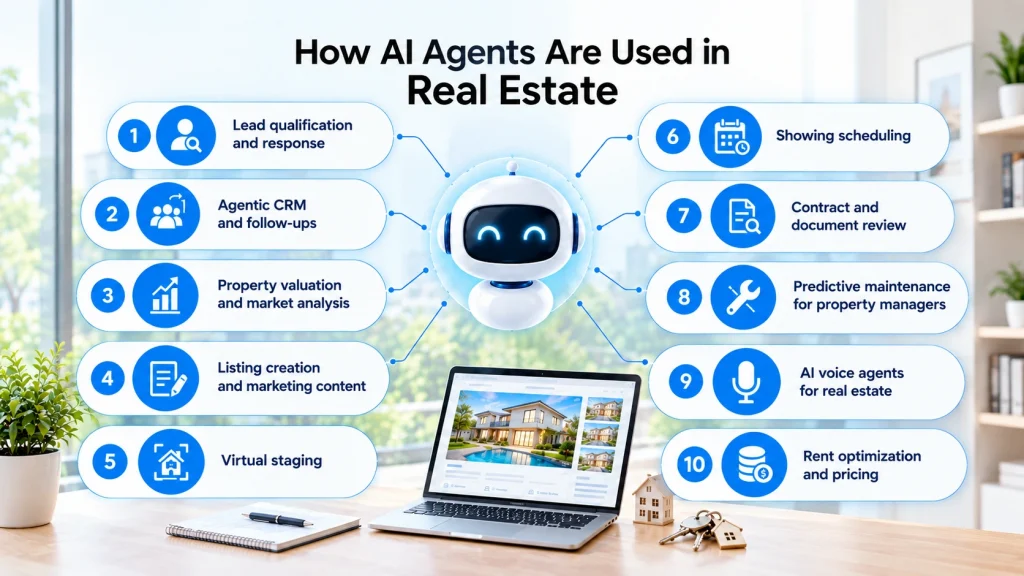
1. Lead qualification and response
Lead response ranks among the clearest use cases, since the workflow is time-sensitive and highly repetitive. When an inquiry arrives, someone must qualify intent, collect budget details, and schedule a next step fast.
An AI agent can handle this the moment an inquiry arrives, day or night. The agent captures preferences, checks calendar availability, and updates the CRM automatically. Serious prospects get routed to a human agent immediately, while lower-priority leads stay in a nurture sequence. A weekend inquiry about a listing, for example, gets a full response before Monday morning instead of sitting untouched.
2. Agentic CRM and follow-ups
Agentic CRMs proactively identify high-potential sellers and automate follow-up sequences, rather than waiting for manual data entry. These systems are projected to reach roughly 89 percent adoption among top-performing agents in 2026.
The stated goal behind this shift is straightforward. Proactive follow-up and lead prioritization can lift conversion rates significantly. Administrative workload drops too, freeing agents for actual client relationships and negotiations. A homeowner visiting a listing page three times in one week, for instance, gets flagged automatically for outreach.
3. Property valuation and market analysis
AI agents pull property-level data, comparable sales, and market trends to support faster, more accurate valuations. Tools built on standards like the Model Context Protocol now connect agents directly to production data sources.
One notable example connects an agent to over 140 data endpoints, covering valuations, rental estimates, and multi-year forecasts. Smaller brokerages gain access to analytics that once required a dedicated data science team. A two-person team can now pull the same flood risk and tax history data a large institutional buyer relies on.
4. Listing creation and marketing content
Marketing remains one of the most widely adopted use cases among everyday agents. Writing listing descriptions, generating social posts, and drafting email campaigns all consume real time every single week.
An AI agent can draft a full listing package from a property’s basic details and photos. Consistent, on-brand messaging goes out across multiple channels without an agent rewriting the same information three or four separate times. A single new listing can generate a description, social captions, and an email blurb within minutes of upload.
5. Virtual staging
Virtual staging uses AI to furnish and style empty or outdated rooms in listing photos. Virtual staging replaces the cost and scheduling hassle of physical staging for a vacant property.
Agents working with a tight marketing budget benefit the most from this particular use case. A single set of photos can be styled for several different buyer profiles without touching the physical property at all. An empty living room might get staged as both a minimalist space and a warm family layout from one photo.
6. Showing scheduling
Scheduling agents coordinate showings directly with buyers, sellers, and other agents without manual back-and-forth. Automated scheduling removes one of the most repetitive tasks in a typical agent’s week.
The agent checks availability across multiple calendars, confirms a time slot, and sends reminders automatically. Rescheduling gets handled the same way, without pulling a human agent into every small logistics change. A buyer’s agent and a seller’s agent can settle on a showing time without a single direct phone call.
7. Contract and document review
AI agents can summarize contracts, flag unusual clauses, and track key deadlines across an active transaction. Delays often happen simply because someone has to locate a document or confirm a date buried in a long agreement.
An agent monitoring a transaction can flag an approaching deadline automatically. Fewer contingency dates get missed as a result, avoiding a closing derailed at the last minute. An inspection contingency due in three days can trigger a reminder well before it becomes a last-minute scramble.
8. Predictive maintenance for property managers
Property managers use AI agents to flag maintenance needs before they become expensive emergencies. The agent analyzes patterns in past maintenance requests, equipment age, and seasonal factors.
The approach works similarly to predictive maintenance in manufacturing, applied to buildings instead of machinery. Catching a failing system early usually costs far less than an emergency repair after a full breakdown. An aging water heater flagged for replacement in the off-season avoids a costly emergency call during a holiday weekend.
9. AI voice agents for real estate
AI voice agents handle inbound and outbound calls for lead qualification, appointment scheduling, follow-ups, and routine customer inquiries. They can communicate with prospects in real time while transferring complex conversations to human agents.
A voice agent can answer calls 24/7, ask qualifying questions, capture property preferences, and schedule property viewings. It can also follow up with leads who have gone quiet or confirm appointments automatically. For example, a prospect calling about a property after business hours can receive immediate answers and schedule a showing without waiting for an agent.
10. Rent optimization and pricing
AI agents can analyze market conditions, comparable properties, occupancy rates, and historical data to support rental pricing decisions. Property managers can use these insights to review pricing as local conditions change.
An agent can monitor relevant market signals and alert property managers when a unit appears underpriced or overpriced. It can also compare nearby listings and track changes in demand over time. For a portfolio with hundreds of units, automated monitoring provides a faster way to identify properties that may need a pricing review.
These use cases show where AI agents can fit into real estate workflows. If you’re planning a custom solution, compare AI agent development companies based on their expertise and development experience.
Build AI Agents for Your Real Estate Workflow
Automate lead qualification, follow-ups, scheduling, and property workflows with a custom AI agent built around your business.

How AI Agents Benefit Real Estate Businesses
AI agents help real estate businesses automate repetitive tasks, respond to leads faster, and manage complex workflows with less manual effort. They also improve operational efficiency by supporting property analysis, follow-ups, scheduling, document processing, and customer communication.
- Faster lead response: Inquiries get answered immediately, at any hour, instead of waiting for the next available agent.
- Higher conversion rates: Consistent follow-up and lead prioritization help more inquiries turn into actual closed deals.
- Reduced administrative work: Automated scheduling and CRM updates free up hours agents previously spent on manual entry.
- More consistent marketing: Listings and campaigns go out with consistent quality, regardless of how busy an agent’s week gets.
- Better data-driven decisions: Agents surface market trends and valuation insights that manual spreadsheet review often misses.
Real estate teams save up to 16 hours weekly through automation, based on estimates covering listings and admin work. Results vary considerably depending on how well a team integrates these tools into daily habits.
Teams seeing the strongest results tend to pick one or two use cases first, rather than automating everything at once. A brokerage that nails lead response before touching valuation tools usually gets further than one spreading effort too thin.
AI Agent Risks and Compliance Considerations in Real Estate
AI agents for real estate introduce risks involving fair housing, data privacy, accuracy, and human oversight. These risks need attention before an agent handles decisions or communications that affect buyers, sellers, tenants, or property owners.
- Fair housing violations: An AI agent trained on biased historical data may produce recommendations that unintentionally steer buyers or tenants based on protected characteristics.
- Inaccurate valuations: Outdated, incomplete, or unreliable property data can lead to misleading valuations or market recommendations.
- Data privacy concerns: Real estate agents handle financial records, contact details, property information, and other sensitive data that require appropriate access controls and security measures.
- Over-automation of sensitive conversations: Financial hardship, negotiations, disputes, and other complex situations often require human judgment rather than fully automated responses.
- Regulatory uncertainty: AI-related requirements continue to evolve, while real estate rules can vary across states and local jurisdictions.
These risks highlight the need for careful vendor evaluation, human oversight, access controls, and regular testing. Fair housing requires particular attention because AI agents can reproduce patterns found in historical data and create unintended bias. Our guide to AI agent development best practices covers practical approaches for building guardrails, testing agent behavior, and maintaining human oversight.
Popular AI Agent Tools for Real Estate
Several categories of tools currently lead adoption among real estate professionals, each suited to a different part of the workflow. Tool choice should follow your specific bottleneck, rather than whichever platform gets the most attention online.
- Property data and valuation: Platforms like HouseCanary and CoreLogic connect agents to verified valuation and market data.
- Lead qualification and scoring: Tools such as Offrs and Revaluate focus specifically on predictive lead targeting.
- Multi-agent coordination platforms: Systems like Lofty AOS run several specialized agents together, covering lead prioritization, engagement, and homeowner communication.
- Listing content generation: General-purpose tools and specialized platforms both handle drafting listing descriptions and marketing copy.
- Market visualization: Tools focused on geographic and trend visualization help agents present data clearly to clients.
Start with one workflow where automation can remove a clear bottleneck, then evaluate integration support, data quality, security, and pricing. Once you define the workflow, choosing the right AI agent frameworks becomes an important part of the development process.
Turn Repetitive Real Estate Tasks Into AI Workflows
Tell us where your team spends the most time, and we’ll design an AI agent around that workflow.
How to Get Started with AI Agents in Your Real Estate Business
Start with one repetitive workflow, test a focused AI agent, measure the results, and expand after the pilot proves its value. This approach gives your team time to identify workflow gaps, refine human oversight, and build confidence before introducing more AI agents.
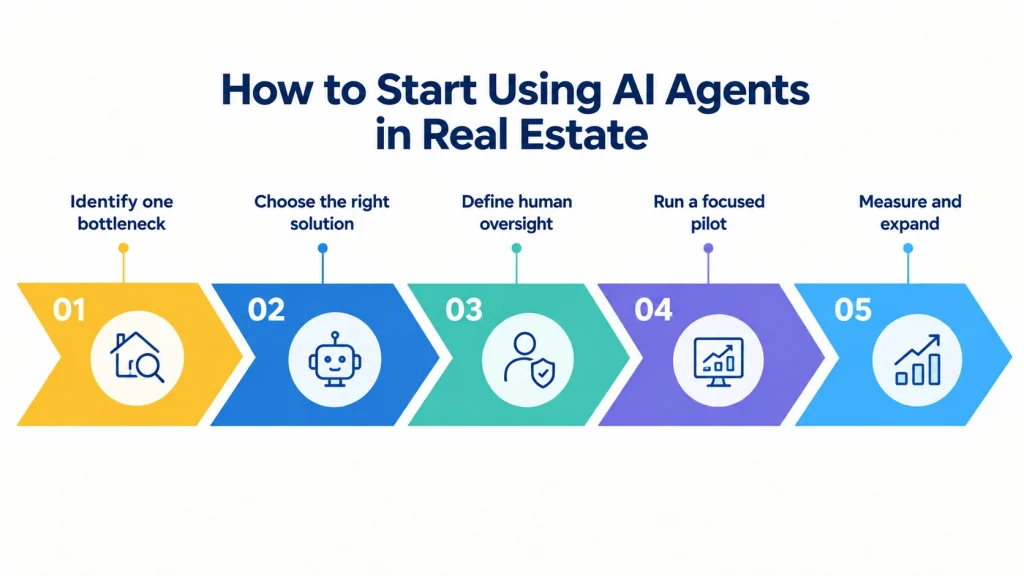
A practical starting sequence looks like this:
- Identify one bottleneck: Choose a repetitive task that consumes significant time, such as lead response, follow-ups, or listing creation.
- Choose the right solution: Select an AI agent designed for that workflow and check its CRM, calendar, property data, and other required integrations.
- Define human oversight: Set clear rules for when the agent should escalate a conversation or decision to a human.
- Run a focused pilot: Test the agent with a limited workflow and track response time, conversion rates, accuracy, and client feedback.
- Measure and expand: Review the results with the people who use the system daily, then extend the agent to additional workflows once the pilot delivers consistent results.
This approach follows the broader AI agent development process while keeping implementation practical for real estate teams. Before expanding beyond the initial workflow, review the pilot results, integration requirements, data security needs, and ongoing maintenance effort. You should also account for model usage, integrations, testing, monitoring, and future workflow changes when planning the budget. Our guide to AI agent development cost breaks down the factors that influence the overall investment.
Why Real Estate Businesses Choose Space-O Technologies for AI Agent Development
Space-O Technologies builds AI agents for real estate workflows, including lead qualification, property analysis, showing coordination, and customer follow-ups. Our AI agent developers integrate agents with CRMs, property platforms, APIs, and other business systems. Each solution is designed around the specific tasks, data, and decisions involved in your workflow.
Our experience in real estate app development gives us a broader understanding of property technology and its workflows. This allows us to build AI agents that work within existing applications rather than operating as disconnected tools. We can also connect agents with property listings, scheduling systems, customer portals, and internal databases.
From workflow planning and architecture to development, integration, testing, and deployment, we handle the complete software development process. We focus on secure, scalable AI agent solutions that fit your business processes and support measurable operational improvements. Our team can also refine and expand agents as your workflows and business requirements evolve.
Ready to Put AI Agents Into Your Workflow?
Build agents that handle repetitive tasks while keeping your team involved in decisions that require human judgment.
Frequently Asked Questions
What are AI agents in real estate?
AI agents in real estate handle multi-step tasks like lead qualification, scheduling, and valuation with limited human input. Unlike a simple chatbot, an agent reasons through a workflow and takes action toward completing it. Most agencies start with one narrow use case before expanding further.
How are real estate agents actually using AI in 2026?
Most agents use AI for lead response, listing creation, and CRM automation as their primary starting points. Adoption has grown quickly, with the vast majority of brokerage leaders reporting active daily use across their teams. Marketing content generation remains the single most widely adopted use case overall.
Are AI voice agents replacing human real estate agents?
No, AI voice agents handle initial qualification and after-hours coverage, not full client relationships. Complex negotiations and sensitive conversations still require a human agent’s judgment and experience. Voice agents work best as a first responder, not a full replacement for an agent.
What are the compliance risks of using AI agents in real estate?
The biggest risks involve fair housing violations and algorithmic bias in lead scoring or valuation models. Regular bias audits and legal review help catch these issues before they cause real regulatory or reputational harm. Data privacy also deserves close attention, given the financial detail agents often handle.
How much time can AI agents actually save a real estate business?
Industry estimates suggest real estate teams can save up to 16 hours per week through automation. Actual results depend heavily on how well a team integrates the tools into daily habits and workflows. Teams tracking time saved during a pilot get a much clearer picture than those adopting a tool blindly.
What is the difference between agentic AI and generative AI in real estate?
Generative AI responds to a single prompt, such as drafting one listing description. Agentic AI coordinates multi-step workflows, such as full lead intake or tenant onboarding, with far less ongoing human prompting. Many real estate tools now combine both capabilities in a single product.
Do small brokerages benefit from AI agents as much as large ones?
Yes, smaller brokerages often see a proportionally larger benefit, since agents let a small team cover more ground. Access to institutional-grade data and analytics has also become far more affordable for smaller operators recently. A two-person team can now compete on responsiveness with a much larger competitor.
How do I choose the right AI agent tool for my real estate business?
Start by identifying your single biggest workflow bottleneck, then choose a tool built specifically for that task. Testing a tool against your own market and lead volume matters more than relying on a generic comparison chart. A short trial period usually reveals more than any vendor’s sales pitch.



 All our projects are secured by NDA




 4.8
4.8