
 By

Contents
- The standalone agentic AI market is about $7B to $8.5B in 2026. Gartner counts $201.9B in related spending.
- Most enterprises have tried agents, but only a minority to a slim majority run them in production.
- Many early agentic projects face cancellation or restructuring, driven by runtime cost, integration, and unclear returns.
- Budget a recurring share of the build cost each year to keep an agent running.
Key Takeaways
The standalone agentic AI market size in 2026 is roughly $7B–$8.5B. Gartner puts related agentic AI enterprise spending at $201.9B for the same year. Agents have moved from pilots to core operational deployment, but production use still lags.
The harder problem for chief technology officers (CTOs) and founders is conflicting adoption data. Depending on the definition, most enterprises have adopted or tested agents. As an AI agent development company, Space-O Technologies sees that gap from the build side.
This guide sorts 2026 figures by horizon and definition, and names each source. It covers adoption by function, returns, barriers, and post-launch running costs. Weighing AI development services for an agent project? Start with production and cost.
Market Size and Financial Projections
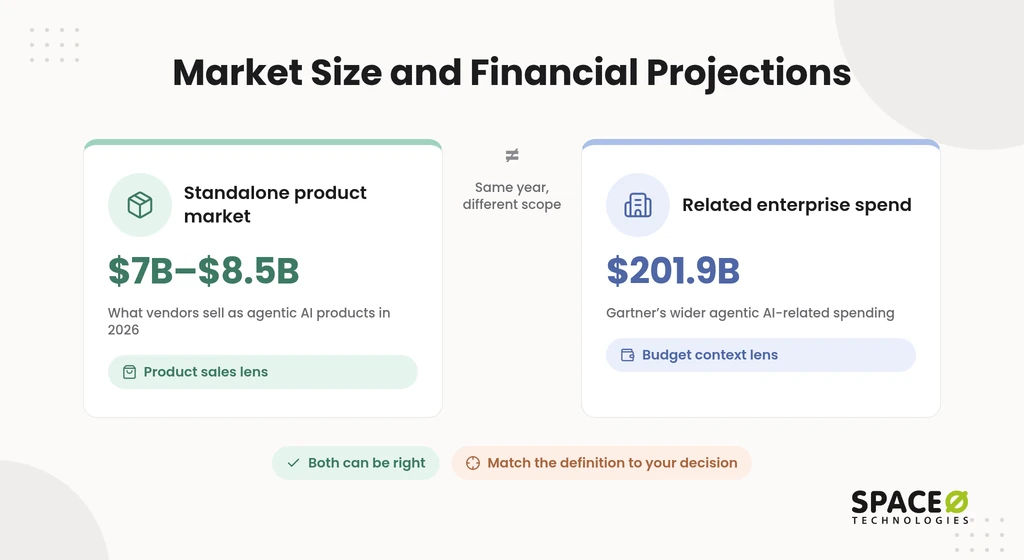
The agentic AI market is forecast to grow about 30 times by 2035, but each figure measures something different. Budget owners see $7B in one report and $201.9B in another. Both can be right, because they count different things.
| Horizon | Figure | Source | What it measures |
|---|---|---|---|
| 2026 | $7B–$8.5B, with rapid compound annual growth | Market research estimates | Standalone agentic AI market |
| 2026 | $514.5B, growing year over year | 2026 AI statistics roundups | Global AI market, of which agentic AI is a slice |
| 2030 | $35B–$45B | Market research estimates | Standalone agentic AI market |
| 2034 | $236B, from a $5.4B 2024 base | World Economic Forum | Standalone agentic AI market |
| 2035 | $231B–$263B | Cervicorn Consulting ($231.83B) and other forecasts | Standalone agentic AI market |
Gartner frames the market through spending and disruption instead of product sales:
- Related enterprise spending: Gartner estimates $201.9B of agentic AI-related enterprise spending in 2026.
- Software spend at risk: Gartner says $234B of enterprise application software spend is at risk from agentic AI by 2030.
- Business purchasing: Gartner expects AI agents to intermediate $15T of business-to-business (B2B) spending by 2028.
How the numbers reconcile: The $7B–$8.5B range sizes agentic AI sold as a standalone market. Gartner’s $201.9B covers wider agentic AI-related enterprise spending, so it works better as budget context. Market size shows where money goes. Adoption data shows how much reaches production, which shapes today’s agentic AI trends.
Enterprise Adoption and Production Status
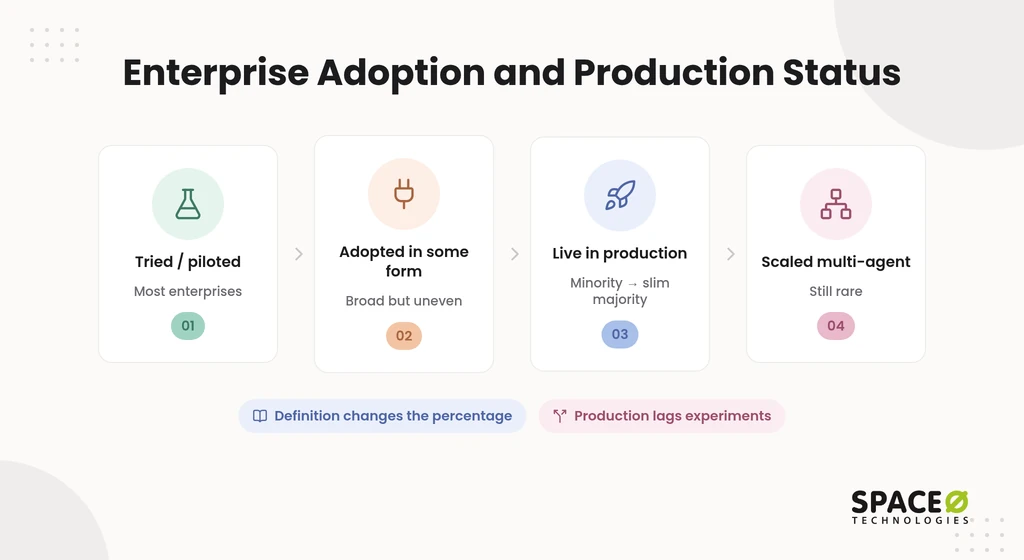
Nearly every enterprise has tried AI agents, but production use trails far behind, and multi-agent scale is rare. If you benchmark your rollout against “adoption,” you first need to know which rung a source is counting. The ladder below puts the 2026 figures in order.
| Rung | Share of enterprises (2026) | What it counts |
|---|---|---|
| Use AI in at least one business function | A large majority | Any AI use, agent or not |
| Experimented with or deployed agents | 88%-97% | Pilots, tests, and live agents |
| Adopted agents in some form | 79% | Agents in use in some form (prefactor.tech roundup) |
| Agents in production for specific workflows | Varies widely by source | Sources report very different shares, depending on how each defines “production” |
| Scaled multi-agent systems | A small share | Coordinated agents working across workflows |
Two forward-looking figures sit beside the ladder:
- Agent volume: Statista forecasts more than 2.2B active enterprise agents by 2030, up from 28.6M in 2025.
- Intent to scale: Most executives plan to scale agentic AI within two years, well ahead of current production rates.
Why adoption figures disagree
Sources disagree because they define “adoption” and “production” differently. The Prefactor Tech Roundup’s 79% counts agents in use, while the higher ranges also count experiments. The two production ranges likely reflect how strictly each source defines a live deployment.
Before you compare your own rollout, match the definition, not just the percentage. Many pilots stall when scaling an AI proof of concept into a full product. The next section breaks adoption down by function, where the numbers become more useful for planning.
AI Agent Adoption Statistics 2026: By Business Function, Productivity Gains, and ROI
AI agent adoption statistics 2026 show IT operations and customer service leading, with payback now measured in months. Leaders deciding where to start need function-level data, not market totals.
Which business functions lead agent adoption
Information technology (IT) operations and customer service lead agent adoption, while legal and compliance trail. The gap follows how much review each function needs before an agent can act.
- IT operations: A majority of enterprises use agents here, the highest rate by function.
- Customer service: A majority of enterprises use agents in support workflows.
- Legal and compliance: Only a minority of enterprises use agents, the lowest of the three functions.
- Microsoft 365: Microsoft reports active agents up 15x year over year, and 18x in large enterprises.
- Marketing agencies: Most agencies use generative AI, and a large share use agentic AI.
How much time agents save each week
Reported time savings run from 5.9 to 7.2 hours a week. McKinsey reports 6.4 hours, while Slack and Microsoft Copilot users report slightly fewer. The studies use different designs, so treat the range as a benchmark, not a promise.
What ROI and payback look like in 2026
Reported return on investment (ROI) averages 3.5x within 12-18 months, but a meaningful share of programs never pays back. Payback has shortened sharply since the last reporting period.
| Metric | 2026 figure | Earlier figure |
|---|---|---|
| Average return | 3.5x within 12-18 months | Not reported |
| Share with positive ROI in year one | A minority | Not reported |
| Average payback period | 6.7 months | 11.4 months |
| Programs that never reach payback | 19% | 34% |
The improving payback is real. Some programs never recover their cost, so model the ROI of AI software development first. The barriers below explain where that money goes.
Key Drivers and Challenges
Productivity gains and faster payback drive adoption, while runtime cost, integration, and weak governance stall pilots. Your board sees the return figures. Your engineers see the integration and control work behind them.
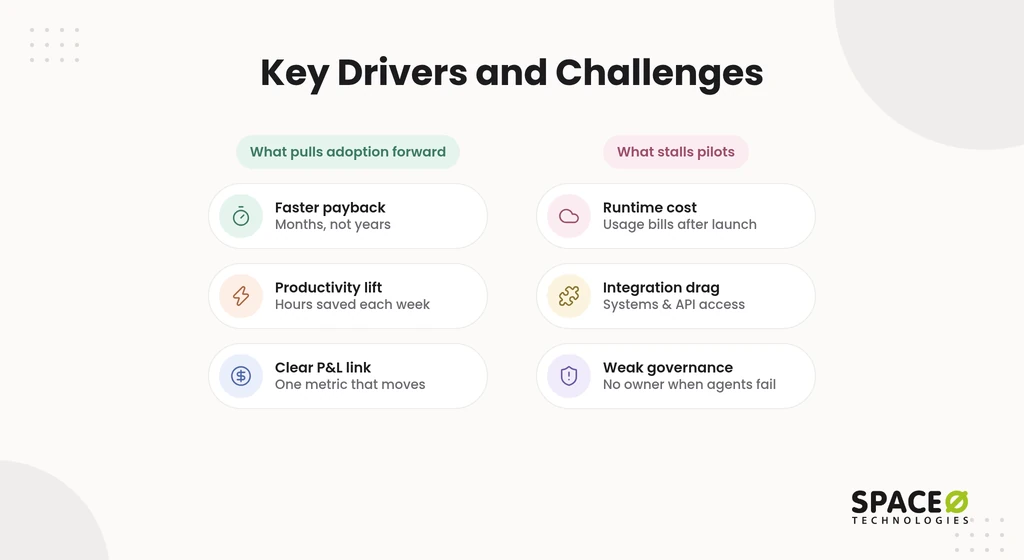
- Cancellation risk: Many early agentic AI projects face cancellation or restructuring because of runtime cost, integration complexity, and unclear ROI.
- Governance gap: Few enterprises rate their AI governance as strong.
- Identity and access: Agents need their own identities and application programming interface (API) access controls before they touch production systems.
- Failure ownership: Practitioners on Reddit’s r/AI_Agents describe pilots stalling when no one owns what happens after an agent fails.
Each barrier maps to a step that is easy to skip in a pilot. Our guide to the AI agent development process shows where governance, access, and failure handling fit before launch.
Buy, build in-house, or work with a custom-build partner
The right path depends on how deeply the agent must integrate with your systems and who should own the code. Each route solves a different version of the production gap.
| Option | Integration with existing systems | Code and intellectual property (IP) ownership | Engagement flexibility | Fits when |
|---|---|---|---|---|
| Off-the-shelf agent tool | Limited to the vendor’s connectors and API access | Product stays with the vendor; your team configures it | Set by the vendor’s plans | The workflow is standard, and the connectors cover your systems |
| In-house capacity | Full control, if the team has agent and integration skills | Owned by your company | Bound by hiring timelines and headcount | You already have AI engineers and time to fill gaps |
| Custom-build partner | Built around your systems, data, and controls | At Space-O Technologies, code and IP transfer to the client at completion | Dedicated Team, Time & Material, Fixed Cost, or Staff Augmentation at Space-O Technologies | You need deep integration and governance without a long hiring cycle |
If you choose the partner route, compare how each enterprise AI software development company handles integration, review, and ownership terms.
Need Engineers to Take Your Agent Live?
Our AI agent developers join your sprints, connect agents to your existing systems through governed API access, and build human review into every high-stakes workflow. Hire Agent Developers

What It Costs to Keep Agents in Production
Running an agent carries a yearly cost on top of the build. Our AI development cost guide treats it as a recurring annual share of the original build cost. Runtime cost is also a named cause of cancellations.
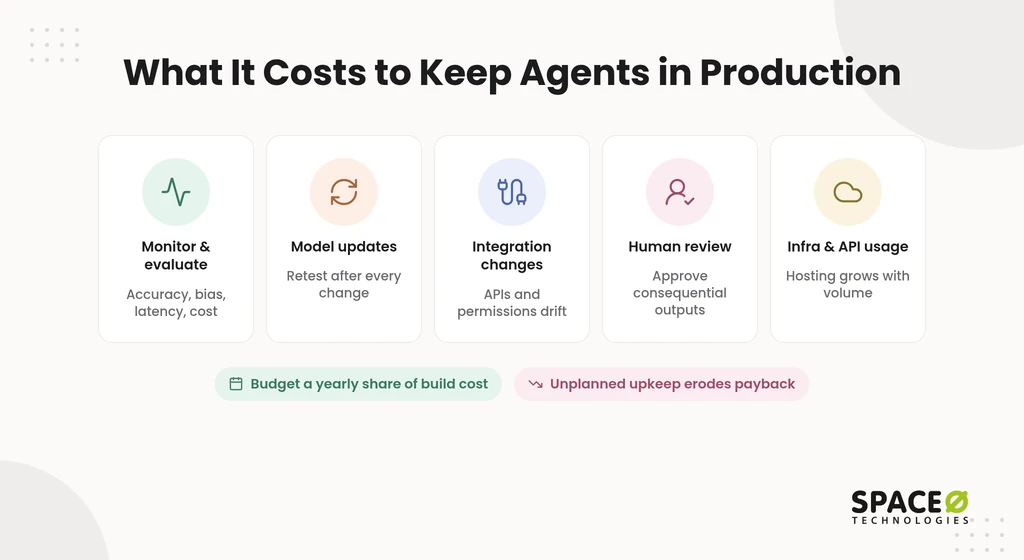
Agents keep costing money after launch, and unplanned running costs erode the returns that justified the build. A program can reach payback and still slip into the group that never recovers its cost. The difference is often whether the team budgeted for life after launch.
What yearly maintenance covers in practice
Annual maintenance covers the work that keeps an agent accurate, connected, and safe once real users depend on it. Infrastructure and API usage add to the total on top of maintenance.
| Cost area | Why it continues after launch |
|---|---|
| Monitoring and evaluation | Accuracy, hallucination rate, bias, latency, and cost need continuous checks. |
| Model updates | Models change, and outputs must be retested after each update. |
| Integration changes | Connected systems and APIs change their versions and permissions. |
| Governance and human review | People must keep approving consequential decisions. |
| Infrastructure and API usage | Hosting and model usage fees grow with volume. |
Annual upkeep scales with the size of the build, so a $300,000 system carries a proportionally larger yearly maintenance bill than a $100,000 one. Treat any figure for your own project as a planning estimate, not a quote.
Keep this separate from build-phase costs, which cover work before launch, such as data preparation. Data preparation can consume a substantial share of the total project budget, so plan for it separately. For build-side ranges, see our breakdown of AI agent development cost.
How a build partner designs controls and human review into production agents
A build partner earns its cost by designing controls in from day one, not by bolting them on after a pilot. Automation handles the volume, but a qualified human reviews and approves before any output influences a final decision.
Space-O Technologies has built AI-powered custom software since 2010 and has served 1,200+ clients. It has developed 300+ software solutions with 140+ in-house developers and reports 97% client retention. It signs a non-disclosure agreement (NDA) before every project, and all code and IP transfer to you at completion.
How to Read These Numbers
Read every 2026 agentic AI figure as a range tied to a definition, a source, and a date. Many statistics circulate through roundups that repeat earlier studies. Ranges stay as ranges here because each end often comes from a different source.
| Figure | Source | Reading note |
|---|---|---|
| $201.9B, $234B, and $15T | Gartner | Analyst estimates of related spending, not product sales. |
| $231B–$263B by 2035 | Cervicorn Consulting ($231.83B) and other forecasts | The upper end comes from other firms. |
| 2.2B agents by 2030 | Statista | A forecast, not a current count. |
| Annual maintenance cost | Space-O Technologies | A first-party build figure. |
When two sources disagree, use the one whose definition matches your decision. Pair them with AI software development trends for context. Then narrow by sector, as the next section shows.
Agentic AI Adoption by Industry: Where to Narrow Next
Adoption patterns shift by industry, mainly with how much review a wrong output would need. Few 2026 sources break adoption out by sector, so treat these as starting points.
- Finance: Lending, payments, and accounting outputs are high-stakes, so they need stricter accuracy testing and human review.
- Healthcare: Clinical and patient-facing outputs also need stricter accuracy testing and often human review.
- Software and IT teams: IT operations leads adoption by function, which makes it a natural first workflow for technology firms.
In every sector, agents depend on the systems they connect to, so plan for AI integration with legacy applications early. The questions below cover what leaders ask most once they start sizing a rollout.
Frequently Asked Questions
How big is the agentic AI market in 2026?
The standalone agentic AI market is roughly $7B to $8.5B in 2026. Gartner counts wider related enterprise spending at $201.9B, so the two figures measure different things.
How fast is the agentic AI market growing?
Forecasts reach $35B to $45B by 2030 and $231B to $263B by 2035. That is about 30 times growth, though each figure comes from a different research firm.
What share of enterprises run AI agents in production?
Only a minority to a slim majority of enterprises run agents in production. Counts rise sharply when pilots and experiments are included, so check each source’s definition.
Which business functions lead AI agent adoption?
IT operations and customer service lead, while legal and compliance trail. Functions that need heavy review before an agent can act adopt more slowly.
How many AI agents will enterprises run by 2030?
Statista forecasts more than 2.2 billion active enterprise agents by 2030, up from 28.6 million in 2025. Treat it as a forecast, not a current count.
Why do agentic AI projects get canceled?
Runtime cost, integration complexity, and unclear returns are the main causes. Weak governance and unowned failures also stall pilots.
How much does it cost to keep an AI agent running?
Budget a recurring share of the original build cost every year, not a one-time spend. That covers monitoring, model updates, integration changes, and human review, with infrastructure and API usage on top.
Are agentic AI market forecasts evidence that an agent project will pay back?
No. A market forecast describes expected industry revenue, not the return on your own project. Even when average payback shortens, some programs never reach it. Judge your project against a measured baseline and total operating cost.



 All our projects are secured by NDA




 4.8


