
 By
Contents
- Pre-built models win on speed and upfront cost, and suit standard tasks like chat or summarization.
- Custom models win on accuracy, data control, and ownership, but cost more and ship slower.
- Custom only beats API pricing when monthly API spend exceeds the custom model’s all-in monthly cost.
- Most production teams choose a hybrid, grounding or fine-tuning a model on their own data.
Key Takeaways
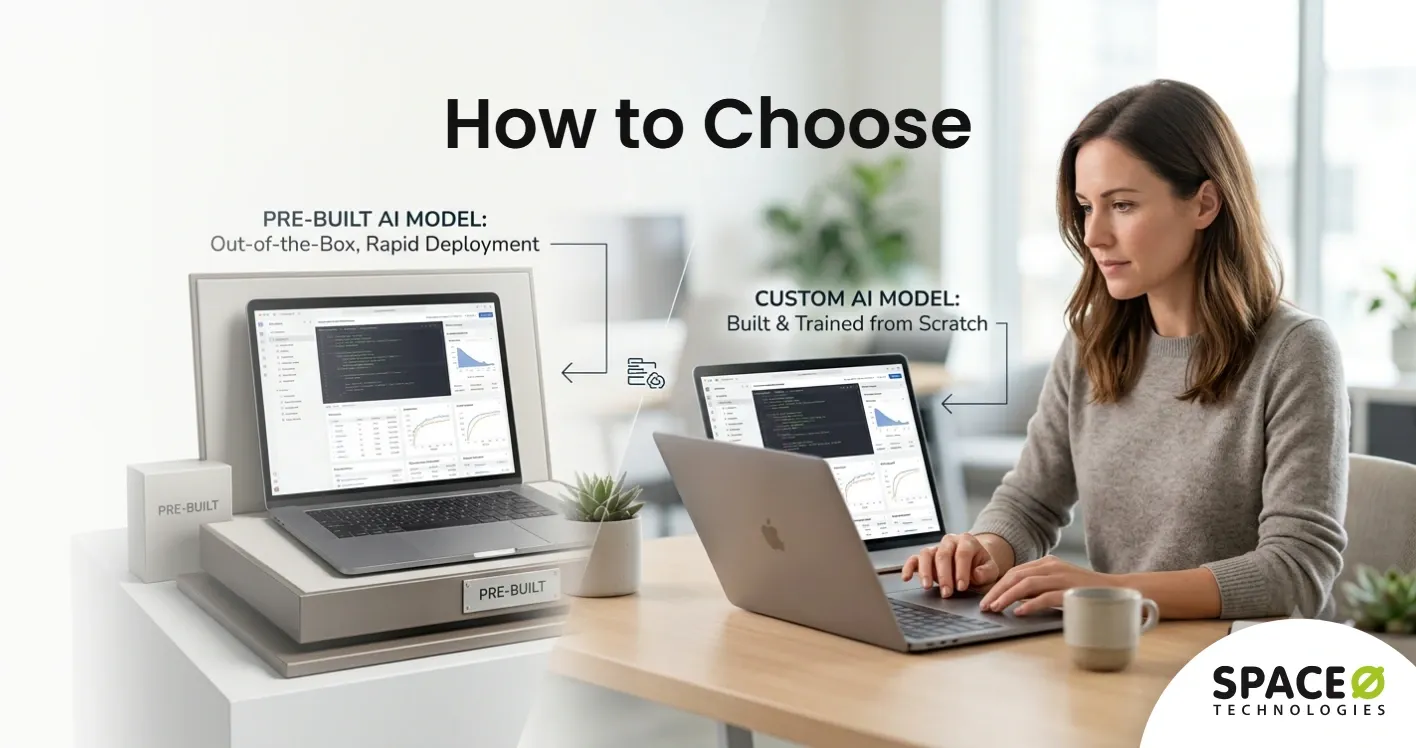
Choosing between pre-built and custom AI models decides your budget and launch date. Pre-built models are vendor-hosted and accessed through an API or subscription. Custom models are built or fine-tuned on your own proprietary data.
The right choice depends on budget, timeline, data privacy, and task complexity. Many teams overspend on custom builds or outgrow a generic API. Most land on a hybrid that grounds a model in their own data.
Space-O Technologies has built AI products since 2010 through its AI development services. The build-versus-buy call also depends on how much of the stack you want to own. This page weighs pre-built, custom, and hybrid paths so you can decide before you spend.
Pre-Built (Off-the-Shelf) AI Models
Pre-built AI models are ready-made, general-purpose models from third-party vendors, accessed through an application programming interface (API) or subscription. Practitioner guides, such as Tobias Zwingmann’s newsletter, call this AI-as-a-Service because you pay per use. The main vendors are OpenAI, Google, Microsoft, and Anthropic.
If your team needs an AI feature live this quarter, this is usually where you start.
- Fast deployment: Integrate a hosted API in hours or days, not months. A minimum viable product (MVP) reaches users on a startup timeline.
- Low upfront cost: Subscription or pay-as-you-go pricing replaces a large capital build. You pay per token or per seat.
- Managed infrastructure: The vendor handles training, scaling, and uptime. There is no model pipeline to maintain.
- Limited customization: You configure prompts and settings but cannot change core model behavior for niche tasks.
- Data-privacy risk: Sensitive data goes to third-party servers, which creates privacy and compliance risk for health or financial records.
- Vendor lock-in: Your product depends on the vendor’s pricing, model updates, and roadmap.
- Usage costs that scale: Per-token bills grow with volume, which matters for high-volume, repetitive work.
The well-known options are OpenAI’s GPT-4, Anthropic’s Claude, and Google’s Gemini. Pre-built AI also comes embedded in business tools such as Salesforce, Power BI, Microsoft Copilot, and AI Builder. Together, they cover a large share of everyday needs out of the box.
Custom AI Models
Custom AI models are built or fine-tuned on an organization’s proprietary data for its own workflows. This often means custom LLM development and fine-tuning on an open-weight base model like Llama or Mistral. You get higher accuracy and control, but you pay more and ship slower.
If your advantage lives in data no vendor can see, a generic model will not capture it.
- Higher accuracy on your data: Training on proprietary data gives higher accuracy on domain-specific tasks than a general-purpose model.
- Data control and ownership: Data stays in your systems. This supports HIPAA-compliant (Health Insurance Portability and Accountability Act) delivery in regulated industries.
- Competitive advantage: A model tuned on data only you hold becomes a proprietary asset rivals cannot copy.
- Legacy-system integration: The model is built around your customer relationship management (CRM), enterprise resource planning (ERP), and internal systems.
- High upfront investment: Custom work needs machine learning (ML) engineers, compute, and build time before it pays back.
- Maintenance and model drift: Accuracy degrades as real-world data shifts, so models need monitoring and retraining.
- Slower time-to-market: Expect weeks to months rather than days to reach production.
We ship this category in production. GPT Vix handles generative candidate screening, eComChat powers ecommerce search, and ReadGenie is a third example. Each is grounded in company data and wrapped in evaluation and human review. People approve consequential decisions.
Are open-weight models like Llama and Mistral pre-built or custom?
An open-weight model is pre-built when you use it as released. It becomes custom once you train or fine-tune it on your data. Running Llama or Mistral unchanged, through a hosted API or on your own servers, is still a pre-built model.
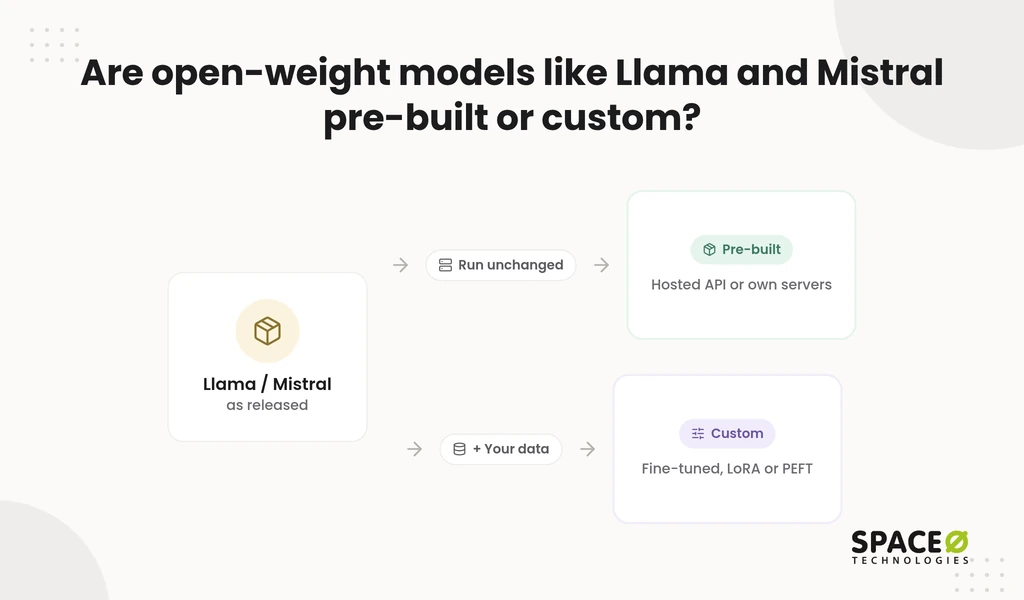
Fine-tuning it on your proprietary data makes it custom. That includes lighter methods such as low-rank adaptation (LoRA) and parameter-efficient fine-tuning (PEFT). Comparison guides file these models in both buckets, so this page applies one rule throughout.
Pre-Built vs Custom AI Models: Quick Comparison
Pre-built wins on speed and upfront cost, and custom wins on accuracy, control, and ownership. Retrieval-augmented generation (RAG) and fine-tuning sit between them. Use this table to weigh all three paths across the factors that decide most projects.
| Factor | Pre-built (API or SaaS) | Fine-tuned or RAG | Custom build |
|---|---|---|---|
| Customization | Configuration only; logic is fixed | Grounded in your documents or tuned on your examples | Full control over model behavior |
| Time to production | Hours to days | Faster than custom; RAG needs no training pipeline | Weeks to months |
| Upfront cost | Low; subscription or pay-as-you-go | Moderate | High; engineering build |
| Total cost including maintenance | Usage fees that rise with volume | Usage fees plus index or tuning upkeep | Build plus annual maintenance as a share of build cost |
| Data control and ownership | Data travels to vendor servers; vendor owns the model | Source data stays under your control | Data stays in internal systems; you own code and IP |
| Accuracy on your data | General-purpose; weaker on niche tasks | Higher, grounded in your own content | Highest on domain-specific tasks |
| Governance and human review | Vendor policies plus your own review layer | You add evaluation and review checkpoints | You design evaluation, audit, and review end to end |
| Scalability | Vendor-managed | Vendor scales the model; you scale retrieval | You own scaling |
| Competitive edge | Shared with every other subscriber | Partly proprietary through your data | Proprietary, tied to your data |
| Vendor lock-in | High | Medium | Low |
| Who maintains it | The vendor | Shared: vendor model, your data pipeline | Your team or your development partner |
Hybrid and Middle Path: RAG, Fine-Tuning, or Off-the-Shelf?
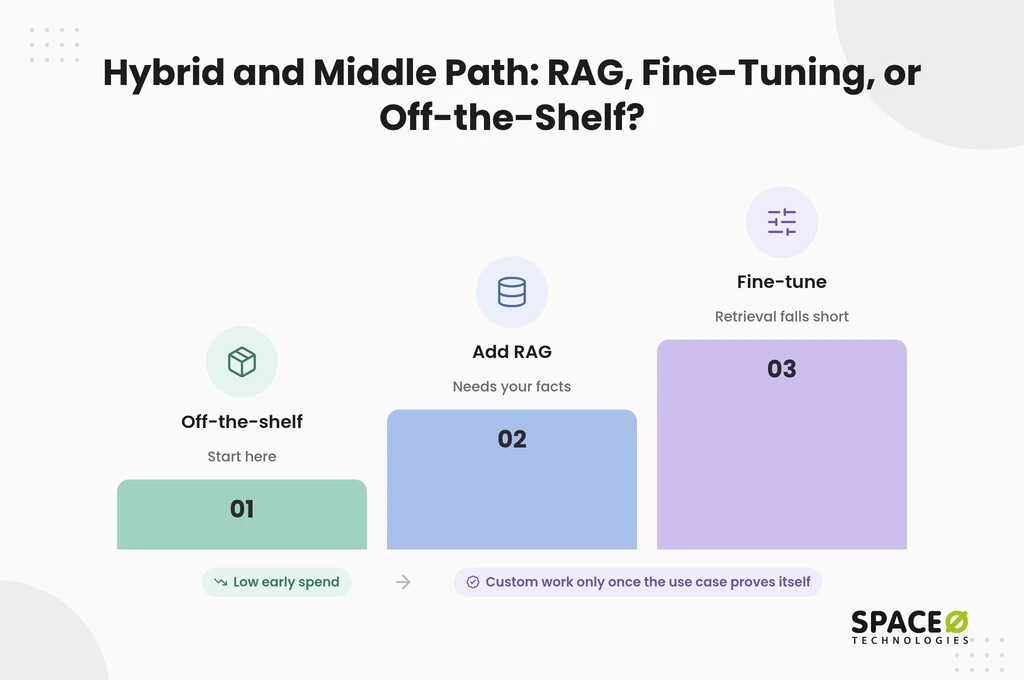
Start off-the-shelf, add RAG on your own data next, and fine-tune only when retrieval falls short. This phased path keeps early spend low. It also defers custom work until the use case proves itself.
When is off-the-shelf enough?
Off-the-shelf is enough when the task is standard, the data is not sensitive, and speed beats differentiation. Pick a hosted GPT-4, Claude, or Gemini API. This is the right first build for an MVP, a prototype, or a team without ML staff.
When should you add RAG before you fine-tune?
Add RAG when the model needs your facts, not a new skill. RAG grounds a pre-built model in your own documents at query time, with no training pipeline. Your source data stays under your control, and deployment stays fast.
The gain is measurable. On GPT Vix, RAG grounding over the product knowledge base sharply cut the unsupported-answer (hallucination) rate. We tested it on a held-out evaluation set, and human graders scored answers against source documents, with faithfulness measured via the RAGAS framework.
When should you fine-tune an open-weight model?
Fine-tune when your language, formats, or decision logic leave a gap that retrieval cannot close. Fine-tune an open-weight base model for specialized domains. Fine-tuning also fits HIPAA-compliant work where data must stay in-house.
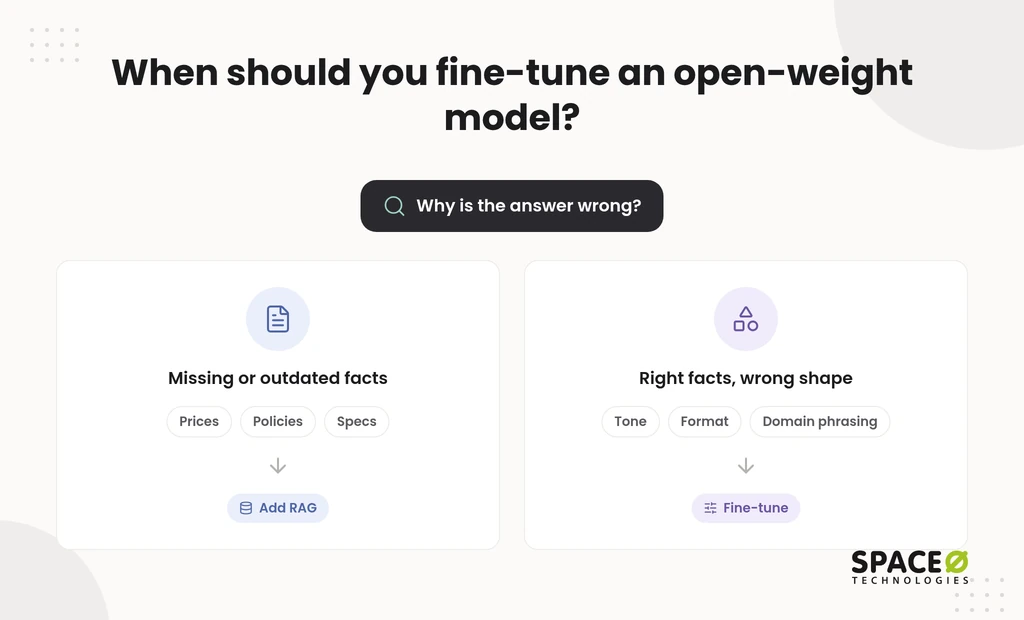
Our discovery rule is simple. Use fine-tuning for behavior, such as a fixed response format the base model keeps drifting from. Do not use it to teach facts that change every release, because re-indexing handles those faster than retraining.
A worked example: how eComChat was routed
eComChat shows how discovery routes a real use case to retrieval rather than a model built from scratch. Space-O Technologies built eComChat for a US B2B and B2C store with 47,000+ products. Discovery began with search behavior analysis, data mapping, and an AI feasibility assessment.
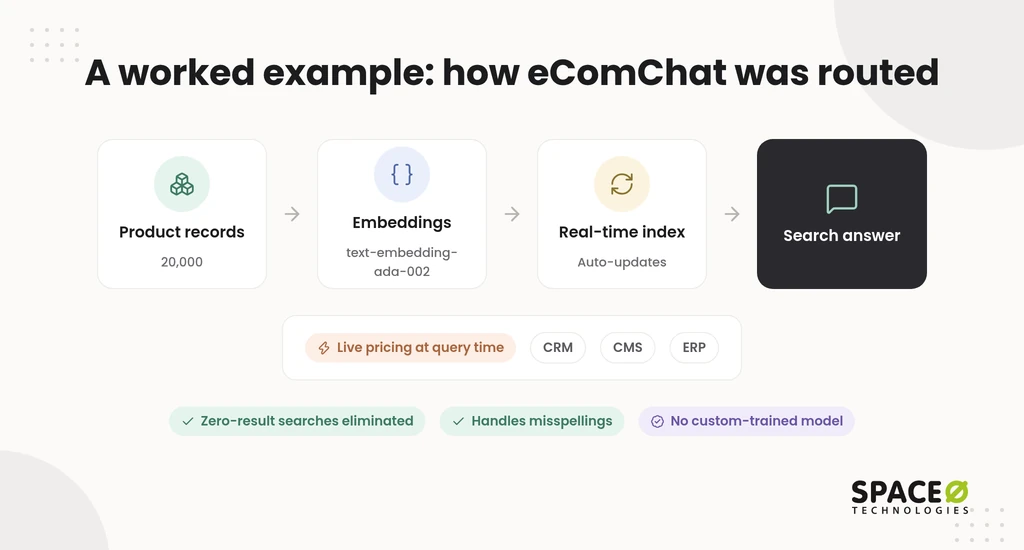
The data shaped the path. The catalog changes constantly, and prices live in the client’s CRM, content management system (CMS), and ERP systems. So the build grounded OpenAI technology in the store’s own data. It converted 20,000 product records into text-embedding-ada-002 vectors.
A real-time index updates automatically whenever products are added or changed. Pricing is pulled live at query time.
The outcome: eComChat increased store search speed and eliminated zero-result searches. It also handles semantic queries and misspelled terms, without a custom-trained model.
Get a clear RAG-or-fine-tune recommendation for your own use case: talk through your project with our AI engineering team.
What Does Each Path Cost, and Where Is the Break-Even?
Pre-built costs less upfront, and custom costs less per task only at high volume, after you count its all-in cost. Most comparisons say custom is “cheaper at scale” but give no numbers. Here is how to run them.
What does each path cost upfront?
A pre-built AI platform can start around $50 a month, while custom development generally runs $40,000 to $250,000 upfront. Those figures come from the AI agent development cost guide. Fine-tuning sits between the two. It ranges from about $5,000 for prompt optimization to around $50,000 for domain-specific model tuning.
For broader builds, custom AI development at Space-O Technologies typically runs $10,000 to $300,000+. A basic AI chatbot or API integration starts at $10,000 to $30,000. A mid-complexity solution with custom model training runs $30,000 to $100,000. Enterprise AI platforms with multiple modules and complex data pipelines reach $100,000 to $300,000 or more.
What does a custom model cost after launch?
Maintenance alone typically costs a meaningful share of the original build every year. Your full budget also includes cloud infrastructure, model or API usage fees, and monitoring for model drift.
Take a $100,000 build as an illustration. Per our AI development cost guide, maintenance adds $15,000-$25,000 a year. Over three years, the build costs $145,000-$175,000 before infrastructure.
When does a custom model beat an API on cost?
A custom model beats per-token pricing only when your monthly API bill exceeds the custom model’s all-in monthly cost. Divide the three-year custom total by 36 months. In the example above, that comes to about $4,000-$4,900 a month, plus infrastructure.
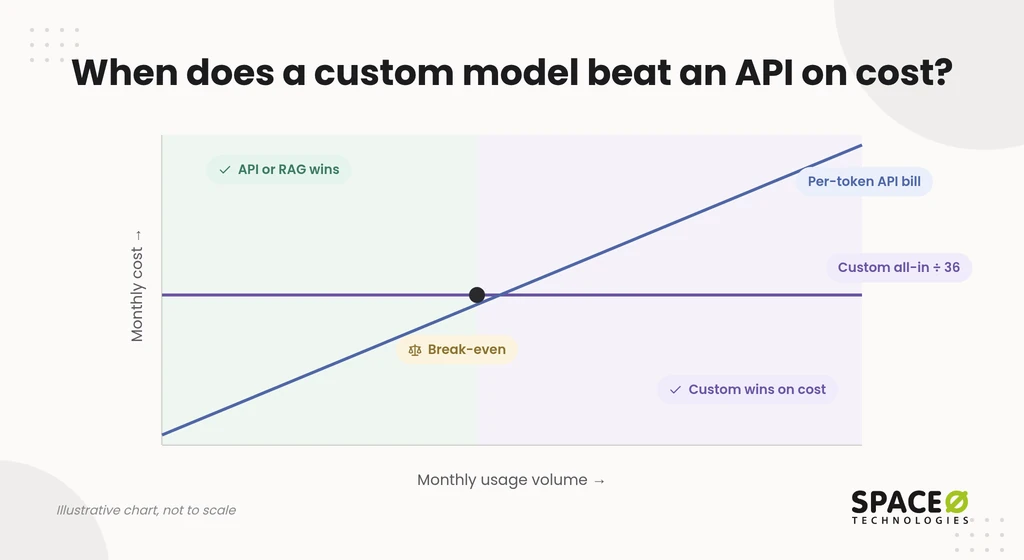
If your projected API spend sits below that line, pre-built or RAG wins on cost. Custom can still be justified on data control or accuracy, but not on savings.
At low volume, APIs often win outright, because you pay only for the tokens you use.
Run the break-even test on the full cost of ownership, not the build quote. Add infrastructure and API usage, using the bands in our LLM integration project cost guide. Then add maintenance, which typically costs 15% to 25% of the build every year.
Compare Pre-Built, RAG, and Custom for Your Project
Our AI engineers review your data, budget, and timeline, then recommend the path with the lowest total cost of ownership. Start with a free review.

Which Should You Choose?
Choose pre-built for speed and standard tasks, and custom for proprietary data and regulation. Choose hybrid for most production work. Match the path to the business problem, not the hype.
Choose pre-built if:
- You need a feature live this quarter for an MVP or prototype.
- The task is standard, such as summarization, chat, or translation.
- You have limited ML engineering capacity in-house.
Choose custom if:
- Your edge depends on proprietary data that public models cannot access.
- You work in a regulated industry like healthcare, fintech, or insurance. Examples include electronic health records, telemedicine, payments, lending, and claims.
- The AI capability itself differentiates your product.
Choose hybrid (RAG or a fine-tuned open-weight model) if you want production accuracy and data control without a from-scratch build.
This maps to the readers we serve. A founder may be launching a first product. An SME may be replacing spreadsheets. An enterprise may be putting AI into a real workflow.
How Space-O Technologies Helps
Space-O Technologies takes teams from MVP through production AI under one full-cycle team. Grounding, evaluation, and human review come by default. Choosing the path is half the work. Shipping it safely is the other half.
Our 140+ in-house developers have shipped 300+ software solutions since 2010. One of those builds, Glovo, passed 50M+ downloads.
Whether you choose a fine-tuned model or a custom build, the work runs on ISO 27001 alignment and HIPAA-ready frameworks for healthcare. It adds human review wherever a decision is high-stakes. Payments follow milestones against deliverables, from $15,000 for a basic MVP to $50,000+ for feature-rich ones. That payment runs under a Dedicated Team, Time & Material, Fixed Cost, or Staff Augmentation model.
Frequently Asked Questions
How can I create a custom AI model?
Start with discovery: analyze the use case, map your data, and run an AI feasibility assessment. Then choose the lightest path that works. That means a hosted model first and RAG for your own facts. Fine-tune an open-weight base model only if retrieval leaves a gap. Wrap the result in evaluation and human review, then plan monitoring and retraining because accuracy degrades as real-world data shifts.
How do I keep data private when using an AI model in a regulated industry?
Pre-built AI models send data to external servers, which is a risk when processing protected health or financial records. To keep data private, use a custom or fine-tuned open-weight model where data never leaves your internal systems. This supports HIPAA-compliant and GDPR obligations. Add human-review checkpoints for consequential decisions in hiring, lending, clinical, and legal workflows so people approve the outcomes.
How long does it take to deploy a pre-built AI model compared with a custom one?
A hosted pre-built API integrates in hours or days, because the vendor handles training, scaling, and uptime. A custom or fine-tuned model takes weeks to months. It is trained on your proprietary data and needs specialized engineering and ongoing maintenance. If a feature has to reach users this quarter, start pre-built.
Should I add RAG or fine-tune the model first?
Diagnose the failure before you pick the fix. If the model’s wrong answers come from missing or outdated facts, retrieval is the fix. Refresh the index as prices, policies, or product specs change. If the answers contain the right facts in the wrong shape, that is a behavior gap. Tone, format, and domain phrasing are typical examples of that gap, and fine-tuning is the fix. Retrieval is also the cheaper experiment, since fine-tuning runs from about $5,000 to around $50,000. Measure retrieval on a held-out evaluation set before committing that budget (see the cost section above).
Which option fits an MVP or a first AI product?
Pre-built fits an MVP, a prototype, and standard tasks such as summarization, chat, and translation. It suits teams without ML staff. It reaches users on a startup timeline and replaces a large capital build. Pricing stays predictable through a subscription or pay-as-you-go model instead. Move to RAG or a fine-tuned open-weight model once the workflow outgrows a hosted API. That happens when it needs more accuracy or more data control than a hosted API gives.
Do we own the code and the model if the build is custom?
Yes. Full code and IP ownership transfer at handover under NDA, with four engagement models to fit each stage. With a pre-built model, the vendor owns the system, and you rent access. That is the ownership trade-off in the comparison table above.



 All our projects are secured by NDA




 4.8


