
 By

Contents
- Custom LLM development adapts a base model to your data, workflows, and terminology.
- Start with RAG when knowledge changes, and fine-tune when behavior must change.
- Our five-step process ends in monitored production, with evaluation against a baseline.
- Choose the approach during discovery, then scope cost around data, method, and integrations.
Key Takeaways
Your generic model sounds fluent but misses your product names and policies. Fixing that takes more than a better prompt. Many LLM pilots stall before they reach real users.
Custom LLM development and fine-tuning services adapt a base model to your data. Space-O Technologies builds them within our AI development services. We have 50+ AI systems live in production.
This guide covers our five-step process and the methods we use. It also compares retrieval-augmented generation (RAG), fine-tuning, and hybrid approaches. You will also see cost ranges, security controls, and engagement models.
What do custom LLM development and fine-tuning services include?
A full engagement covers data preparation, model selection, training, evaluation, and deployment, delivered as one system you own. Generic models stumble on your product names, internal policies, and regulated workflows. Their answers sound fluent but miss what your business actually means.
Fine-tuning closes that gap by further training a pre-trained model on a task-specific dataset. The model learns your vocabulary, tone, and response formats.
Custom LLM development goes wider. It wraps the model in retrieval, integrations, monitoring, and access controls. This work connects the model to the software your team already uses. Teams weighing a packaged tool can compare custom AI development vs. off-the-shelf first.
How does the custom LLM development process work?
Our custom LLM development process runs in five steps, from data audit to monitored production. Stalled LLM projects usually skip a step, most often evaluation. Each step below produces a defined output before the next one begins.
- Data Curation & Preprocessing: We clean, deduplicate, and label your documents, tickets, or transcripts, and mask personally identifiable information (PII).
- Base Model Selection: We compare Llama 3, Mistral, Phi-3, Gemma, DeepSeek, GPT-4o, and Claude against your cost, privacy, and latency limits.
- Fine-Tuning & Optimization: We train with the method the task needs, from parameter-efficient adapters to preference alignment.
- Evaluation Against Baseline: We score the tuned model against the untouched base model on held-out data, including hallucination and bias checks.
- Deployment & MLOps: We deploy on AWS SageMaker, Azure Machine Learning, or Google Vertex AI. Machine learning operations (MLOps) monitoring watches for drift.
Before training, the cleaned dataset is divided into training, validation, and test sets. Most of the data goes to training, with smaller shares held for validation and test. The test set stays untouched until step 4, so the baseline comparison stays honest.
Forecasting or scoring models that run beside the LLM come from our machine learning development services.
Which fine-tuning methods fit which business problem?
The right method depends on what must change in the model: format, terminology, tone, or judgment. Full fine-tuning updates every weight. For most business use cases, that compute cost buys little extra. Lighter methods usually do the job.
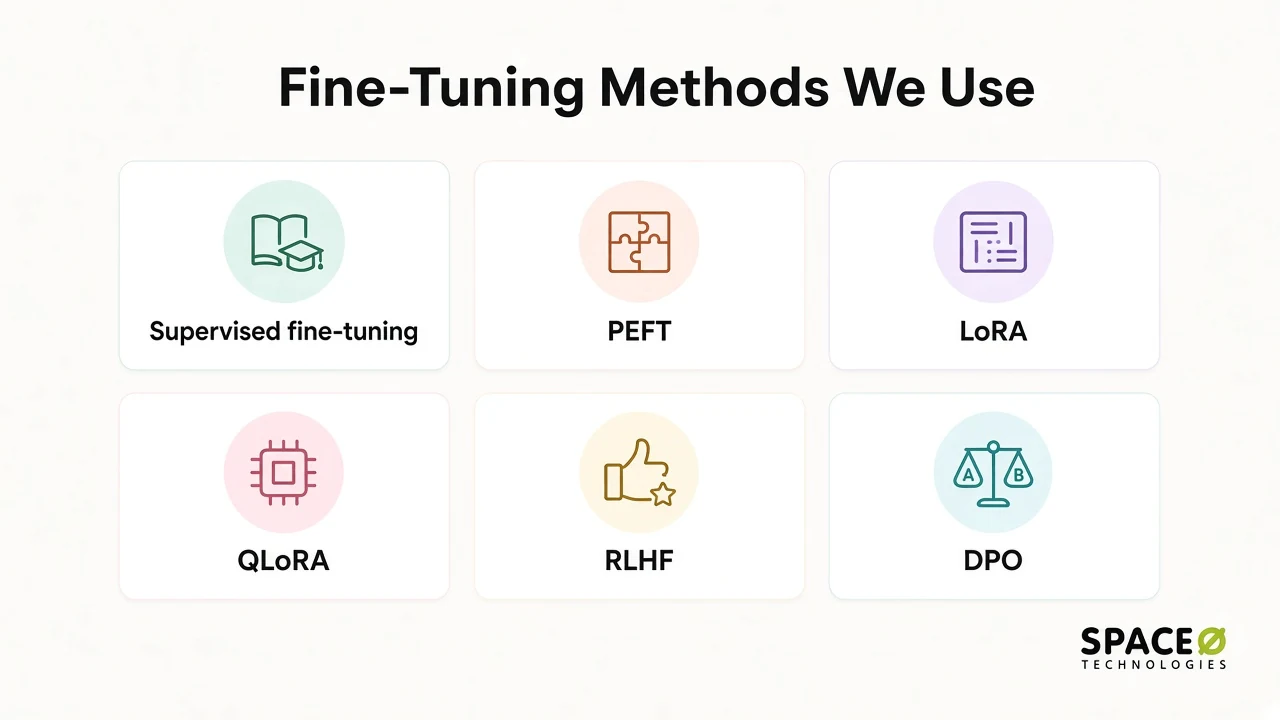
| Method | What it does | When we use it |
|---|---|---|
| Supervised fine-tuning (SFT) | Trains on labeled input and output pairs | Teaching task formats and domain terminology |
| Parameter-efficient fine-tuning (PEFT) | Trains a small set of added parameters while base weights stay frozen | Most business projects, at lower compute cost |
| Low-Rank Adaptation (LoRA) | A PEFT method that adds small low-rank matrices to the model | Swapping lightweight adapters per task |
| Quantized LoRA (QLoRA) | Applies LoRA to a quantized base model | Larger models on limited graphics processing unit (GPU) memory |
| Reinforcement learning from human feedback (RLHF) | Aligns outputs to human ratings | Tone, safety, and policy adherence |
| Direct preference optimization (DPO) | Aligns to preferred over rejected answers without a separate reward model | Preference tuning with a simpler pipeline |
Fine-tuning on curated domain data improves domain accuracy and helps reduce hallucinations. It works best for behavior the model must repeat: format, voice, and terminology.
RAG vs. Fine-Tuning vs. Hybrid: Which Do You Actually Need?
Start with RAG when knowledge changes, fine-tune when behavior must change, and combine both when you need each. Many buyers ask for fine-tuning when their real problem is stale or missing knowledge. Facts trained into a model go out of date. Updating them means retraining every release cycle.
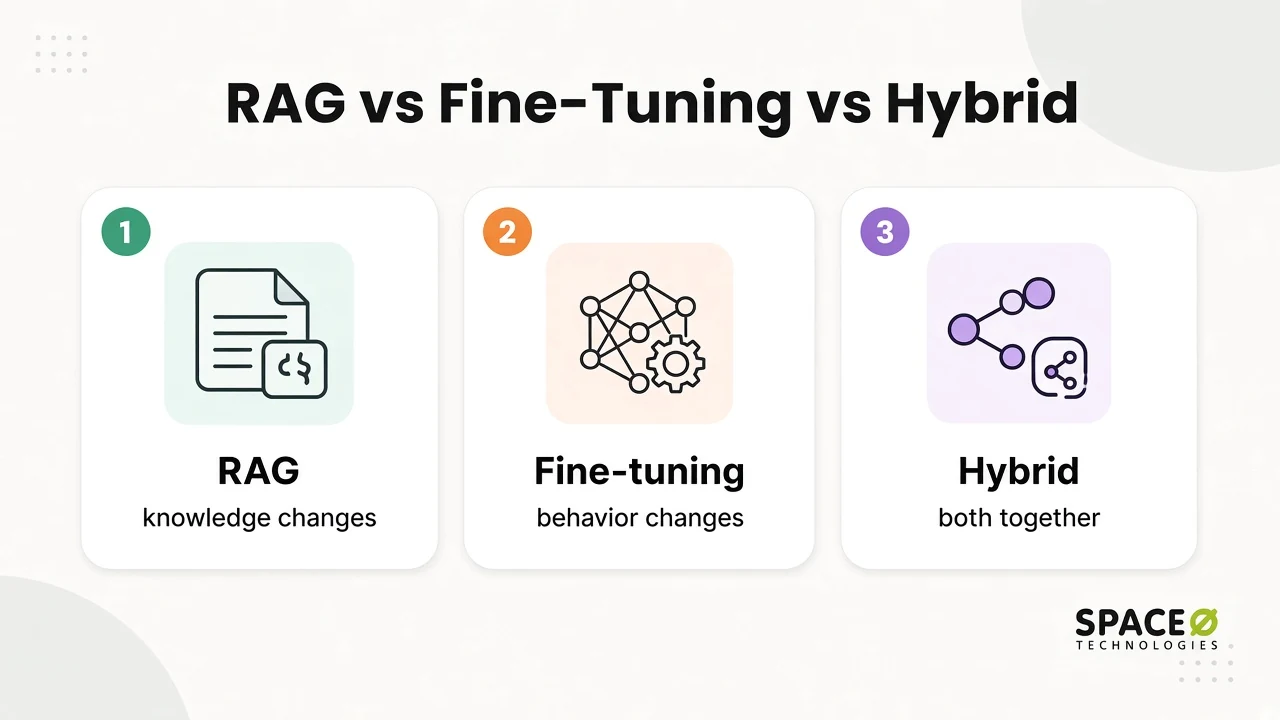
| Decision axis | RAG | Fine-tuning | Hybrid |
|---|---|---|---|
| Use case | Answers drawn from documents, manuals, and knowledge bases | Fixed formats, brand voice, and domain terminology | Grounded answers delivered in a strict format or voice |
| Data freshness | Updated by re-indexing documents | Frozen at training time until you retrain | Facts stay fresh, while behavior stays tuned |
| Cost | Lower upfront, with ongoing retrieval infrastructure | Higher upfront for data prep and training runs | Targeted tuning keeps training spend narrow |
| Accuracy | Answers trace to a specific source document | Consistent behavior, but facts can drift out of date | Traceable facts plus consistent behavior |
| Latency | A retrieval step adds time per query | No retrieval step at inference | Retrieval step remains, so it is tuned for speed |
For many teams, a hybrid of prompt engineering, RAG, and targeted fine-tuning beats full fine-tuning on cost. It also beats training a model from scratch.
What does a RAG-first decision rule look like?
Our discovery rule is RAG first, and fine-tuning only if RAG falls short. Frequently changing source content, such as equipment manuals, belongs in retrieval. Buyers fear an assistant citing the wrong document revision.
Retrieval lets every answer trace to a specific document version. Updates come from re-indexing, not retraining.
Fine-tuning comes later, for a narrower need such as a fixed response format. It enforces that format without teaching facts that change every release.
How do we pick the approach during discovery?
We start from your business goal and recommend whichever approach solves it most cost-effectively. Discovery maps your data sources, update frequency, and the failure your users fear most. That answer drives the choice, not a default toward the larger build.
We review the choice every quarter as your data and model providers change.
Teams still shaping their roadmap can begin with AI consulting services before committing to a build.
Not Sure Between RAG And Fine-Tuning?
Our engineers review your data and use case in discovery. You receive a free, expert-reviewed estimate with a clear recommendation.

Why choose Space-O Technologies for production LLM work?
Space-O Technologies builds LLM systems for production, with grounding, evaluation, and human review in place before launch. Many pilots impress in demos, then fail on real data, real users, or an audit. Gartner explains why generative AI projects stall after the proof of concept. Production work needs controls designed in, not bolted on.
- Production track record: Space-O Technologies reports 50+ AI systems live in production, built by 30+ AI engineers.
- Responsible AI by default: We apply PII masking, plus hallucination and bias testing, before release.
- Human review where it matters: The model drafts and retrieves evidence. People approve consequential decisions.
- Shipped proof: GPT Vix, our AI recruitment software, runs as production AI.
- Delivery history: We have served 1,200+ clients since 2010, with 140+ in-house developers. Space-O Technologies reports 97% client retention.
Tuned models also power features delivered through our generative AI development services, such as summaries and smart search.
How do you keep fine-tuning data secure and compliant?
Your data stays under a non-disclosure agreement (NDA), and you own the code, data, and intellectual property (IP) at completion. Regulated teams cannot hand patient, payment, or customer records to an unvetted vendor. Fine-tuning data is often your most sensitive asset.
- NDA first: Space-O Technologies signs an NDA before any project starts.
- Full ownership: All source code, data, and IP built during the project transfer to you at completion.
- Regulated data: We deliver Health Insurance Portability and Accountability Act (HIPAA)-compliant work for healthcare data.
- Privacy law: Our work is General Data Protection Regulation (GDPR)-compliant where European user data is involved.
McKinsey’s State of AI research tracks how organizations manage AI-related risks.
How much do custom LLM development and fine-tuning services cost?
Cost follows scope: data volume, tuning method, integrations, and compliance controls set the range. Budgets break when a quote ignores integration, evaluation, and monitoring work. We scope all of it upfront.
AI chatbots and virtual assistants typically cost $25,000-$100,000. That range covers customer support, frequently asked questions (FAQ) automation, and internal assistance. An enterprise AI platform can cost significantly more once custom models, multiple integrations, advanced security, compliance controls, and monitoring are added.
For LLM builds specifically, a proof of concept costs $15,000-$40,000over 4-8 weeks. A generative AI application runs $100,000-$300,000. A RAG-powered chatbot costs $50,000-$150,000 over 10-20 weeks. Our LLM integration project cost guide explains the bands.
Two line items catch teams off guard. Data preparation takes 25% to 40% of the total project budget. AI maintenance runs 15% to 25% of build cost per year, as covered in our AI development cost guide.
Which engagement model fits an LLM project?
Space-O Technologies offers four engagement models, so you can match the contract to how settled your scope is.
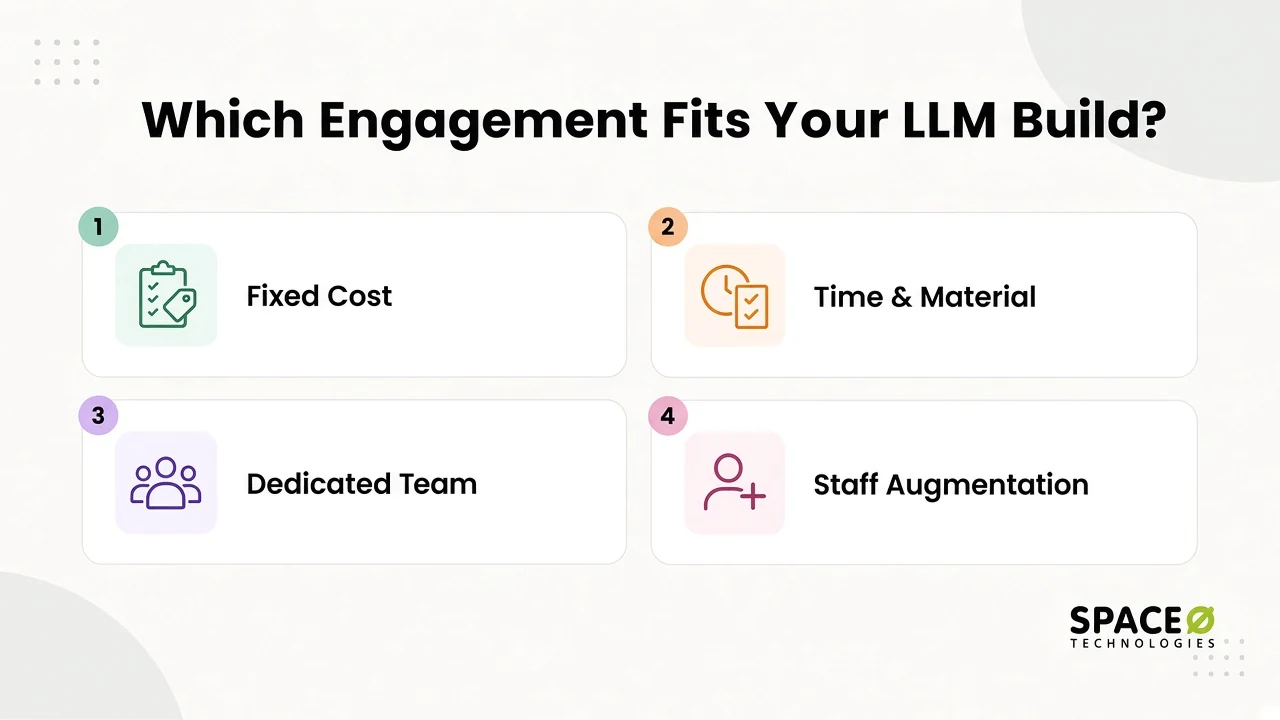
- Fixed Cost: This model suits a defined pilot with a clear dataset and success metric.
- Time & Material: This model suits discovery-heavy work, where the RAG or fine-tuning choice is still open.
- Dedicated Team: This model suits a long-term LLM product with ongoing retraining and new features.
- Staff Augmentation: This model suits teams that only need capacity. You can hire AI developers to join your sprints.
Frequently Asked Questions
How to create a dataset for LLM fine-tuning?
Build the dataset in four moves: collect, clean, label, and split. Collect your documents, tickets, or transcripts, then deduplicate them and mask personally identifiable information (PII). Divide the cleaned data into training, validation, and test sets. Hold the test set back so the baseline comparison stays honest.
Who needs a custom LLM instead of a generic model?
Teams whose generic model stumbles on product names, internal policies, or regulated workflows need a custom LLM. Generic answers can sound fluent yet miss what the business means. Teams whose main problem is stale or missing knowledge may need retrieval instead of a tuned model.
What is the difference between RAG and fine-tuning?
RAG supplies fresh knowledge at query time, while fine-tuning changes how the model behaves. RAG updates by re-indexing documents. Fine-tuning stays frozen until you retrain. Many projects combine both.
How much do custom LLM development services cost?
Cost follows scope, and a proof of concept costs $15,000-$40,000. A RAG-powered chatbot costs $50,000-$150,000. A generative AI application runs $100,000-$300,000. Data volume, integrations, and compliance controls move the range.
How long does a custom LLM project take?
A proof of concept takes 4-8 weeks, and a RAG-powered chatbot takes 10-20 weeks. Timelines grow with data preparation, integrations, and evaluation. Skipping evaluation is the most common reason projects stall.
How do you keep fine-tuning data secure?
Your data stays under an NDA, and you own the code, data, and IP at completion. We mask PII during data preparation. People approve consequential decisions before they take effect.



 All our projects are secured by NDA




 4.8


