
 By
By 
Contents
Generative AI in healthcare is moving from experimentation to real-world adoption, with half of US healthcare leaders reporting implementation. More than 80% say their organizations have already deployed their first GenAI use cases to end users, according to McKinsey’s 2026 research. Before exploring healthcare applications, readers can learn about generative AI and how the technology works.
That adoption signals a clear shift: healthcare organizations are moving from testing GenAI to applying it in real workflows. Yet healthcare industry demands more than simply adding an AI model to an existing process. Solutions must deliver useful outputs while protecting patient data, maintaining accuracy, and fitting clinical and administrative workflows.
The opportunity is broad, from summarizing clinical information and assisting documentation to supporting patients and automating administrative work. Organizations can address these needs through generative AI development solutions designed around specific workflows, data requirements, and compliance needs. The challenge is identifying use cases where GenAI can create meaningful value without introducing unnecessary risk.
Let’s find out top generative AI use cases in healthcare, their business and operational benefits, and the challenges organizations face during implementation. We also cover the key considerations for turning these use cases into practical, secure, and scalable healthcare solutions.
What is the Market Outlook for Generative AI in Healthcare?
The Generative AI in healthcare market is expanding rapidly as providers adopt AI for clinical and administrative workflows. Grand View Research estimates the global market at $2.9 billion in 2025, rising to $3.8 billion in 2026 and reaching $28.2 billion by 2033, at a 33.3% CAGR.
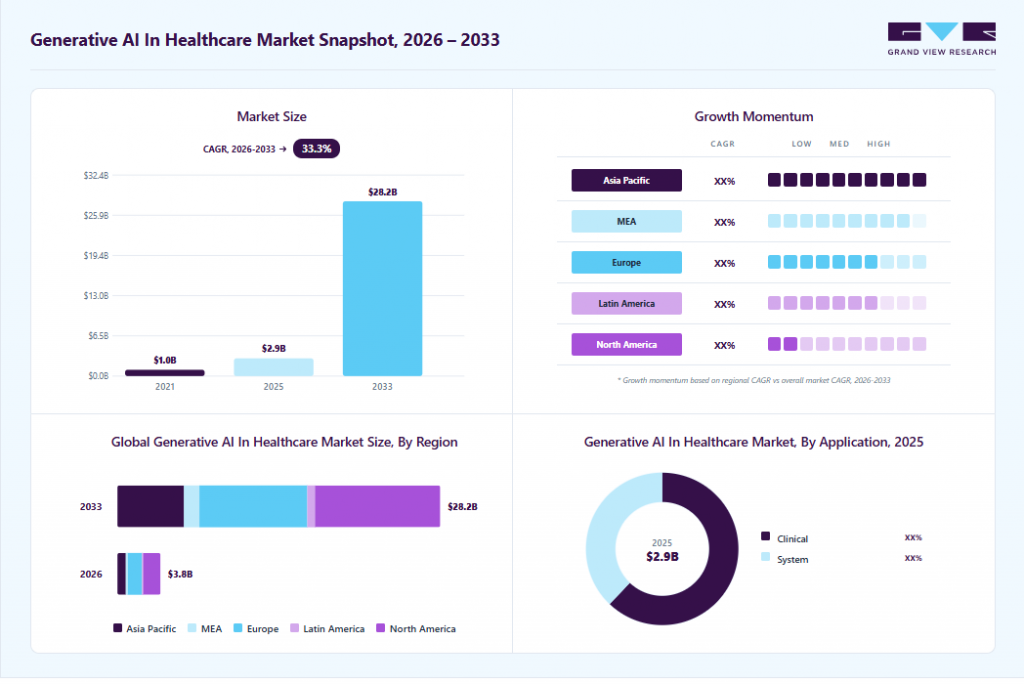
This growth reflects increasing demand for AI-powered solutions that can handle complex medical data, support clinical decisions, and improve healthcare operations. Clinical applications accounted for 62.1% of the market in 2025, while North America held the largest regional share at 41.0%.
Build AI That Understands Your Healthcare Workflow
We combine healthcare domain expertise with GenAI engineering to build solutions grounded in your data, processes, and operational requirements.

What Are the Top 15 Generative AI Use Cases in Healthcare?
The applications of generative AI in healthcare below span clinical care, hospital operations, research, and patient support. Some focus on saving clinicians time, while others improve access and accuracy. These applications show how GenAI can improve healthcare workflows, while generative AI solutions for sales apply similar capabilities to customer-facing and revenue teams.
Each use case below includes a clear example of how teams apply generative AI for healthcare today. Together, they show just how broad this technology’s reach has become across medicine.
1. AI-powered clinical documentation
Ambient AI tools listen to patient visits and draft the clinical note automatically. Physicians spend hours each day writing notes, and this burden fuels burnout. Generative models transcribe the conversation and structure it into a proper format. The doctor then reviews the draft and makes any needed edits.
Health systems and academic hospitals already run tools like Nuance DAX Copilot (now integrated into the Microsoft Dragon Copilot platform) and Abridge. Early users report saving one to two hours of documentation time daily. The global generative AI for clinical documentation market was valued at $0.79 billion in 2025 and is projected to reach $10.50 billion by 2034, according to Fortune Business Insights. This growth reflects increasing demand for AI tools that can reduce documentation workloads and streamline clinical workflows. Fewer hours spent on paperwork can give clinicians more time to focus on patient care.
Note quality also improves, since ambient tools rarely miss small details clinicians might skip. Many physicians describe these tools as the most impactful technology they have adopted in years. Health systems now treat ambient documentation as a standard part of their technology stack.
- Business benefit: Cuts documentation costs and eases clinician burnout tied to paperwork.
- Operational benefit: Frees hours in a physician’s day for direct patient care.
2. Drug discovery and molecule design
Generative AI designs and tests new drug candidates faster than traditional lab methods. Pharmaceutical researchers once spent years screening compounds by hand. AI models now simulate how a molecule will behave inside the human body. This computational step happens before a single physical trial begins.
Insilico Medicine used its generative Pharma AI platform to design INS018_055, a drug candidate for idiopathic pulmonary fibrosis. The molecule reached Phase 2 clinical trials and later reported positive efficacy results. The global generative AI in drug discovery market was valued at $260.56 million in 2025 and is projected to reach $2.72 billion by 2035, growing at a 26.45% CAGR. This growth highlights GenAI’s potential to accelerate drug discovery and reduce development costs.
Researchers can now explore thousands of molecular variations in the time older methods needed for dozens. Wider exploration increases the odds of finding a compound that actually works. Investment in this area keeps growing as early results prove genuinely promising.
- Business benefit: Shortens R&D timelines and lowers the cost of reaching market.
- Operational benefit: Lets research teams screen far more candidates in less time.
3. Medical image report drafting
Generative AI drafts narrative reports from X-rays, CT scans, and MRIs for radiologist review. Older AI tools in radiology mostly flagged abnormalities without writing anything. Multimodal models can now read an image and write a structured summary. Radiologists then verify the draft and finalize the report.
The approach helps most with routine scans that show no major findings. Radiologists can then focus their attention on complex or unusual cases. Several vendors already offer cleared solutions for automated report drafting. The AI in medical imaging market is currently valued at $1.75 billion and is projected to reach $8.56 billion by 2030, growing at a 30% CAGR through 2035. This rapid growth highlights the increasing role of AI in medical imaging and clinical workflows.
Hospitals adopting this technology often see shorter turnaround times for imaging results. Radiology departments handling high volumes benefit the most from this kind of support. The technology works best as an assistant, never as a replacement for expert judgment.
- Business benefit: Increases radiology throughput without adding headcount.
- Operational benefit: Shortens the time between a scan and a finalized report.
4. Patient communication and plain-language education
Generative AI translates dense medical language into simple, patient-friendly explanations. Lab results, discharge instructions, and imaging reports often confuse everyday readers. AI models can rewrite this content at any reading level a patient needs. The tool preserves medical accuracy while removing unnecessary jargon.
Some hospital portals, including Epic’s MyChart, already let patients ask questions about their own records. The system answers using approved, accurate medical language. Clear answers build patient confidence and reduce unnecessary calls to the clinic. Better communication also helps people follow their care plans correctly.
Patients who understand their instructions are more likely to take medications as prescribed. Family members also benefit when discharge notes explain next steps in plain terms. This use case delivers value with relatively simple technology and a fast rollout.
- Business benefit: Reduces call center volume and improves patient satisfaction scores.
- Operational benefit: Cuts staff time spent answering routine record questions.
5. AI chatbots and virtual health assistants
Virtual assistants handle scheduling, symptom checks, and medication reminders around the clock. Front desk staff often struggle with high call volumes and repetitive questions. A generative chatbot can triage symptoms and guide patients toward the right care. The same tool can confirm appointments and send helpful reminders.
Virtual assistants like these reduce pressure on front-office teams and call centers. Patients get faster answers, even outside normal clinic hours. Many systems escalate complex questions to a human staff member automatically. Keeping a person in the loop keeps care both efficient and safe.
Smaller clinics benefit especially, since they rarely have staff available at all hours. Larger networks use these assistants to manage seasonal spikes in patient inquiries. Either way, the result is faster access without adding headcount.
- Business benefit: Expands appointment capacity without expanding front-office staff.
- Operational benefit: Handles routine scheduling and triage outside business hours.
6. Personalized treatment plan generation
Generative AI drafts treatment recommendations based on a patient’s full medical history. The model reviews genetics, lifestyle factors, lab results, and past diagnoses together. Then it suggests options that a physician can review and adjust. The process supports the doctor rather than replacing clinical judgment.
Oncology teams already use similar tools to rank treatment options by likely outcome. Ranked options help physicians navigate complex, fast-changing therapy choices. Patients benefit from care that reflects their unique health profile. Personalized plans often lead to better outcomes and fewer side effects.
The approach works best when paired with strong data infrastructure across departments. Fragmented records limit how well a model can personalize its recommendations. Businesses investing in unified patient data see the strongest results from this use case.
- Business benefit: Improves outcomes and reduces costly readmissions or treatment reversals.
- Operational benefit: Speeds up how quickly a physician drafts a first treatment plan.
7. Prior authorization and claims automation
Generative AI drafts prior authorization requests and insurance claims from clinical records. This process normally requires staff to gather documents and match payer rules manually. AI tools can pull relevant details and assemble a complete request in minutes. Staff then review the draft before it goes to the insurer.
The shift can cut approval turnaround time significantly for busy clinics. Fewer errors also mean fewer denied claims and delayed payments. Hospitals processing thousands of requests each month see major time savings. Patients benefit through faster access to approved treatments.
Insurers benefit too, since cleaner submissions reduce back-and-forth communication with providers. Efficiency gains like these matter most for organizations under real financial pressure. Many revenue cycle teams now treat this as a top priority for automation.
- Business benefit: Reduces denied claims and speeds up revenue collection.
- Operational benefit: Cuts the manual hours staff spends assembling authorizations.
This is the same workflow that generative AI for insurance automates on the payer side, verifying coverage and drafting settlement communications.
8. Medical coding assistance
Generative AI suggests billing codes directly from a physician’s clinical notes. Medical coders normally read each note and assign the correct diagnosis and procedure codes. AI models can now read the same note and propose accurate codes instantly. The tool also explains why it chose each code.
Coders review these suggestions rather than starting from a blank page. The approach improves coding speed and reduces costly billing errors. Organizations using this technology report noticeable productivity gains. Cleaner coding also means fewer disputes with insurance companies.
Consistent coding accuracy also protects businesses during compliance audits and reviews. Coders often describe the tool as a helpful assistant rather than a threat to their role. Framing it this way helps teams adopt the technology with far less resistance.
- Business benefit: Lowers billing disputes and protects revenue during payer audits.
- Operational benefit: Speeds up coder throughput on high patient volumes.
9. Synthetic medical data generation
Generative AI creates realistic but artificial patient data for research and training. Real medical records carry strict privacy rules that limit how teams can share them. Synthetic data mimics the patterns of real records without exposing any actual patient. Researchers can then train models freely without privacy concerns.
Synthetic data helps most with rare diseases where real records are scarce. Teams can simulate patient populations and study disease patterns safely. Synthetic datasets also support model testing before a tool reaches real patients. The method addresses one of healthcare’s biggest data challenges.
Academic researchers increasingly rely on synthetic data to collaborate across institutions. Sharing artificial datasets avoids the legal complexity of moving real patient information. Flexibility like this accelerates research that would otherwise stall on privacy paperwork.
- Business benefit: Reduces legal and compliance exposure tied to sharing real patient data.
- Operational benefit: Gives research teams usable data without waiting on privacy approvals.
Banks apply the same technique to train fraud-detection models on synthetic transaction data, a pattern behind many generative AI banking solutions.
10. Medical research and literature summarization
Generative AI reads and condenses large volumes of medical research for busy clinicians. Researchers publish millions of new medical papers every year across every specialty. No physician or researcher can realistically keep pace with that volume. AI tools now summarize studies and highlight the findings that matter most.
Clinicians use these summaries to stay current on new treatments and guidelines. Pharmaceutical teams use similar tools for regulatory and competitive research. The capability saves enormous time across nearly every research role. Faster access to evidence supports better, more informed decisions.
Some tools can even answer specific clinical questions by pulling from multiple studies at once. A task like this once took hours and now takes minutes. Research teams increasingly treat this capability as essential infrastructure.
- Business benefit: Keeps clinical and regulatory teams current without added headcount.
- Operational benefit: Cuts the hours spent manually reviewing new medical literature.
11. Medical training and simulation
Generative AI builds realistic patient scenarios for medical students and clinical trainees. Traditional training relies on fixed case studies that never change or adapt. AI-generated simulations can adjust in real time based on a trainee’s decisions. Real-time adaptation creates a far more challenging and realistic learning experience.
Some universities already use these tools to simulate rare or complex conditions. Trainees practice difficult scenarios without putting a real patient at risk. Simulation builds stronger clinical skills before those skills matter most. Better-trained clinicians often lead to safer, more confident patient care.
Simulation also helps standardize training across different hospitals and teaching programs. Every trainee can practice the same challenging scenario under consistent conditions. Consistency like this improves overall training quality across an entire medical program.
- Business benefit: Reduces the cost of building and updating training programs.
- Operational benefit: Standardizes how trainees practice rare or high-risk scenarios.
12. Clinical trial matching
Generative AI matches patients to clinical trials by scanning records against eligibility criteria. Staff usually spend hours comparing charts against lengthy trial requirements by hand to lengthy requirement lists. AI models can compare one patient against hundreds of active trials instantly. The tool then explains why a match makes sense.
A large share of clinical trials miss their enrollment deadlines every year. The generative The AI in clinical trials market was valued at $1.20 billion in 2023 and is projected to reach $2.75 billion by 2030, growing at a 12.5% CAGR. Faster matching helps researchers fill trials and helps patients find new options. Academic medical centers already use this approach to speed up recruitment. Better matching benefits both scientific progress and individual patient outcomes.
Patients with rare conditions gain the most from this capability. Manual matching often misses opportunities simply due to the sheer volume of active trials. Automated matching closes that gap and connects more patients with promising research.
- Business benefit: Improves trial enrollment rates and protects research investment.
- Operational benefit: Cuts the manual work of screening charts against trial criteria.
13. Mental health support chatbots
Generative AI powers conversational tools that offer support between therapy sessions. A shortage of licensed therapists leaves many people without timely access to care. AI-driven chatbots can offer coping exercises, guided journaling, and check-ins. Such tools support, rather than replace, a licensed mental health professional.
Platforms in this space now include safety features that detect crisis situations. Staff escalate serious cases to a human professional immediately. Research suggests these tools can ease mild anxiety and improve session engagement. Wider access to support can make a meaningful difference for many people.
The use case demands especially careful design, given the sensitivity of the topic. Developers building these tools work closely with clinicians to set safe boundaries. Done well, the technology extends care to people who might otherwise go without support.
- Business benefit: Extends care access without hiring additional licensed therapists.
- Operational benefit: Provides support between sessions without adding clinician workload.
14. Remote patient monitoring and risk alerts
Generative AI turns continuous vitals and wearable data into clear risk summaries. Devices now track heart rate, oxygen levels, and activity around the clock. Raw data alone means little without context or interpretation. AI models can spot early warning signs and summarize them for a care team.
Early alerts help identify patients heading toward a health crisis sooner. Care teams can intervene before a condition becomes an emergency. Chronic disease management benefits especially from this kind of ongoing insight. Earlier action often means better outcomes and fewer hospital readmissions.
Patients managing conditions like heart disease or diabetes gain daily reassurance from this monitoring. Care teams also save time by reviewing summaries instead of raw data streams. Saved time lets nurses focus attention on the patients who need it most.
- Business benefit: Reduces costly hospital readmissions for chronic disease patients.
- Operational benefit: Lets nurses focus on high-risk patients instead of raw data review.
15. Pharmacovigilance and adverse event reporting
Generative AI drafts safety narratives from adverse event reports for faster regulatory review. Drug safety teams must document and report side effects with strict accuracy. The process traditionally involves manually reviewing case details and writing formal narratives. AI tools now draft these reports directly from structured and unstructured data.
Safety specialists then review and finalize each narrative before submission. Faster drafting speeds up reporting timelines without weakening regulatory oversight. Pharmaceutical companies handling large volumes of reports see the biggest gains. Faster reporting supports quicker action when a safety concern emerges.
Regulators benefit too, since consistent formatting makes reports easier to review. Consistency like this reduces back-and-forth requests for clarification during submission. Faster, cleaner reporting ultimately protects patients by catching safety signals sooner.
- Business benefit: Reduces regulatory risk and speeds up safety-related decisions.
- Operational benefit: Cuts the manual hours spent drafting adverse event narratives.
7 Key Benefits of Generative AI in Healthcare
Generative AI in healthcare delivers measurable gains across time, cost, accuracy, and patient access. Each one builds directly on the applications of generative AI in healthcare covered above. Some improve what happens inside a hospital, while gen AI in healthcare also reshapes what patients experience directly. The seven benefits below summarize the biggest wins healthcare organizations report today using generative AI for healthcare.
1. Saves clinicians time on documentation
Generative AI saves clinicians hours each week by automating documentation and note-taking. Ambient tools draft clinical notes directly from patient visits. Physicians spend far less time on paperwork and more time with patients. Reduced administrative load also eases the burnout tied to constant charting.
2. Speeds up drug discovery and research
Generative AI shortens drug discovery timelines from years down to a fraction of that time. AI models simulate how a molecule behaves before physical trials begin. Researchers explore thousands of compounds instead of dozens. Faster discovery also lowers the enormous cost of bringing a drug to market.
3. Reduces billing and coding errors
Generative AI reduces billing errors through more accurate, consistent medical coding. AI tools suggest codes directly from clinical notes and explain their reasoning. Coders review these suggestions instead of starting from a blank page. Cleaner coding means fewer disputes with insurance companies.
4. Improves patient understanding and communication
Generative AI improves patient understanding through clear, jargon-free communication. AI tools rewrite lab results and discharge instructions in plain language. Patients follow their care plans more accurately as a result. Clearer communication also reduces unnecessary calls to the clinic, similar to how generative AI solutions for ecommerce improve customer interactions across digital buying journeys.
5. Expands access to care
Generative AI expands access to care through round-the-clock virtual assistance. Chatbots handle scheduling, triage, and medication reminders outside business hours. Smaller clinics gain support they could never staff around the clock. Patients get faster answers no matter when they reach out.
6. Personalizes treatment plans
Generative AI personalizes treatment by analyzing each patient’s full health profile. Models review genetics, lifestyle, and history together to draft recommendations. Physicians then adjust these drafts based on their own clinical judgment. Personalized plans often lead to better outcomes and fewer side effects.
7. Strengthens data privacy protections
Generative AI protects patient privacy through realistic, synthetic training data. Synthetic datasets mimic real records without exposing an actual patient. Researchers train and test models freely without added legal exposure. Data like this addresses one of healthcare’s biggest ongoing challenges.
Together, these benefits compound as more departments adopt generative AI. A hospital using it for both documentation and coding sees savings multiply across teams. Organizations that start with one strong benefit in mind often expand naturally from there.
Generative AI in Healthcare: Key Adoption Challenges and Solutions
The generative AI use cases in healthcare are expanding across clinical, administrative, and patient-facing workflows. However, moving from individual generative AI for healthcare applications to organization-wide deployment introduces challenges around data, clinical reliability, system integration, governance, and adoption.
1. Keeping AI outputs grounded in patient context
A healthcare GenAI model can generate a medically plausible response without having enough context about a patient’s history, medications, or current condition. This makes hallucination more concerning than in general business applications.
Solution: Connect models to verified clinical data through retrieval-augmented generation (RAG), structured medical knowledge bases, and approved data sources. Define when human review is mandatory before an AI-generated output reaches clinicians or patients.
2. Protecting data across AI workflows
Gen AI in healthcare can involve sensitive information from EHRs, clinical notes, diagnostic reports, and patient communications. Sending this data across models, APIs, and third-party services can create additional privacy and security risks.
Solution: Apply encryption, role-based access, data minimization, audit logging, and strong API controls. Organizations should also define exactly what data each AI workflow can access and retain.
3. Making GenAI work with fragmented healthcare systems
Many generative AI in healthcare use cases depend on information spread across EHRs, laboratory systems, imaging platforms, billing software, and other applications. Even a capable model delivers limited value if it cannot access the right information at the right time.
Solution: Build an interoperability layer using secure APIs and healthcare data standards such as HL7 and FHIR. This allows GenAI applications to exchange relevant information without replacing existing systems.
4. Maintaining clinical accountability
A GenAI system may summarize records, draft clinical notes, or support decision-making, but responsibility still rests with qualified healthcare professionals. Unclear roles can make organizations hesitant to deploy AI in high-impact workflows.
Solution: Define clear human-in-the-loop checkpoints. Establish approval rules, escalation paths, audit trails, and monitoring processes based on the risk level of each application.
5. Moving beyond pilots to measurable outcomes
Many organizations can demonstrate individual generative AI use cases in healthcare, but proving sustained value at scale is harder. A successful pilot does not automatically justify organization-wide deployment, which is why generative AI consulting companies can help organizations assess scalability, risks, and expected ROI.
Solution: Select use cases with measurable outcomes from the start. Track metrics such as documentation time, administrative workload, response times, clinician adoption, error rates, and operational costs before expanding the deployment.
6. Keeping healthcare AI useful as workflows change
Healthcare processes, clinical guidelines, data sources, and organizational policies change continuously. A GenAI application that works well today can produce weaker results when its underlying information or workflow changes.
Solution: Treat the AI system as an ongoing product rather than a one-time deployment. Establish processes for model evaluation, knowledge updates, prompt changes, performance monitoring, and periodic security reviews.
How to Implement Generative AI in Healthcare
Generative AI in healthcare is transforming the industry, from accelerating drug discovery to automating documentation and patient interactions. The next challenge is turning promising generative AI use cases into solutions that deliver measurable value.
Most healthcare organizations understand why they need AI, but generative AI consulting services can help define the right use cases, strategy, and implementation approach. Successful teams start with a clear clinical or operational need, test AI against measurable goals, and scale only after proving its value.
Here are standard steps to help you move from a generative AI concept to a production-ready healthcare solution without unnecessary experimentation.
1. Define the healthcare use case
Every successful generative AI healthcare deployment starts with one clearly defined problem. Look at clinical documentation, patient support, medical research, report drafting, or administrative automation. Choose a problem narrow enough to solve well, rather than broad enough to solve poorly.
Nail down the expected outcomes, users, data needs, and success metrics before writing a line of code. Vague goals produce vague results, no matter how advanced the model.
2. Prepare and secure healthcare data
Generative AI is only as strong as the data behind it. Gather and organize the clinical records, medical literature, or patient information your use case actually needs. Messy, incomplete data undermines even the best-designed model.
Lock down privacy, security, and compliance controls before any of this data touches a training pipeline. Fixing a data breach costs far more than preventing one.
3. Choose the right AI model and technology stack
The right model depends on your use case, not the other way around. Weigh your data, accuracy needs, and deployment environment before choosing a foundation model. You might use an existing model as-is, fine-tune it, or build with retrieval-augmented generation.
Your stack also needs to talk to EHRs, healthcare APIs, medical databases, and whatever systems your team already runs. Experienced generative AI development companies can connect the right models with EHRs, healthcare APIs, medical databases, and existing systems.
4. Build with healthcare security and compliance from day one
Patient data demands protection at every stage of development, not just at launch. Build in encryption, access controls, audit trails, and strong data governance from the start. Bolting security on later almost always costs more and covers less.
Map the solution against applicable healthcare regulations and define how AI-generated outputs can enter clinical workflows. Clear boundaries help organizations use generative AI in healthcare without compromising patient safety or compliance.
5. Validate outputs with real human oversight
No generative AI system belongs near a patient until humans have tested it hard. Run the system through real-world healthcare scenarios before anything reaches production. Check accuracy, hallucination rate, bias, response quality, and how it handles sensitive medical questions.
Keep healthcare professionals in the validation loop, and require human review anywhere a wrong answer could affect patient care. Trust gets built through scrutiny, not assumption.
6. Integrate, deploy, and monitor relentlessly
Deployment is the beginning of the work, not the end. Integrate the generative AI solution into the workflows clinicians and patients already use. Track performance, security, response quality, and user feedback from the start.
Watch closely for model drift, inaccurate responses, and new risks as real-world use uncovers them. Continuous monitoring turns a one-time launch into a solution that keeps earning trust.
A well-planned implementation can take generative AI healthcare from experimentation to measurable business and clinical impact. The strongest solutions combine capable AI models with secure data, healthcare expertise, human oversight, and continuous improvement.
What is the Future of Generative AI in Healthcare?
Healthcare’s trajectory tracks closely with emerging generative AI trends across the broader technology landscape. The future of generative AI in healthcare will move beyond content generation toward intelligent systems that understand complex medical information and support broader healthcare workflows.
AI agents will manage complex workflows
AI agents could handle multi-step tasks such as coordinating records, routing requests, and updating healthcare systems. Human professionals can continue supervising decisions that require clinical expertise.
Multimodal AI will connect medical data
Future generative AI for healthcare will combine text, medical images, audio, lab results, and patient data. This can give healthcare professionals a more complete view of each patient’s condition.
Digital twins will support personalized care
Generative AI could help create digital representations of patients, organs, or biological processes. These simulations may support treatment planning, medical research, and personalized medicine.
Specialized healthcare models will grow
Healthcare organizations may increasingly adopt smaller AI models designed for specific domains, a trend also reflected in generative AI solutions for manufacturing. These models can offer greater control, lower costs, and better performance for specialized generative AI use cases in healthcare.
AI will become more proactive
Future systems could identify important patterns and surface relevant information before clinicians or patients request it. This could make healthcare AI more proactive, much like generative AI solutions for retail can anticipate customer needs while keeping human oversight at the center.
As these technologies mature, the focus will shift from what AI can generate to how reliably it can improve healthcare outcomes.
How Space-O Technologies Builds Generative AI Solutions for Healthcare
Space-O Technologies combines Generative AI expertise with healthcare software development experience to build AI solutions for real-world healthcare workflows. Our approach focuses on creating practical applications that improve efficiency, support better decision-making, and enhance patient experiences.
Our generative AI development team works across the full development lifecycle, from identifying high-value use cases and preparing healthcare data to model integration, testing, deployment, and ongoing optimization. This helps organizations move from GenAI concepts to secure, production-ready solutions.
With healthcare software solutions delivered since 2010, Space-O Technologies understands the workflows, systems, and technical requirements that shape modern healthcare applications. This domain experience helps us develop GenAI solutions that fit clinical, administrative, and patient-facing environments.
We combine AI, cloud, mobile, web, and backend engineering expertise to build next-generation healthcare platforms that are secure, scalable, and ready for real-world use. Our team integrates generative AI into existing systems to automate repetitive processes, improve patient experiences, and support smarter decision-making.
Whether you need to enhance an existing healthcare application or build a new AI-powered platform, we deliver solutions with strong security, seamless interoperability, intuitive usability, and long-term scalability at the core.
Frequently Asked Questions
What is generative AI in healthcare?
Generative AI in healthcare uses advanced AI models to create new content from medical and patient data. It can generate clinical notes, medical summaries, images, treatment recommendations, and drug candidates. Unlike traditional AI, which primarily predicts, classifies, or detects patterns, generative AI produces new outputs to support healthcare professionals, researchers, and patients.
What is the difference between generative AI and predictive AI in healthcare?
Generative AI creates new content from healthcare data, while predictive AI forecasts likely outcomes. For example, GenAI can draft a clinical note, while predictive AI can estimate a patient’s readmission risk.
Can generative AI work with EHR data?
Yes, generative AI can work with EHR data when it has secure access to relevant patient information. Retrieval-based approaches can provide verified records to the model without requiring continuous model retraining.
Can generative AI process medical images?
Yes, multimodal generative AI models can process medical images alongside clinical text and other healthcare data. This capability can support tasks such as medical report drafting and combining imaging findings with patient information.
How does RAG improve generative AI in healthcare?
RAG improves generative AI by retrieving relevant information from trusted healthcare sources before generating an answer. This helps ground responses in patient records, medical guidelines, clinical knowledge, or organizational data.
Does generative AI require training a model from scratch?
No, most healthcare organizations can use existing foundation models instead of building one from scratch. Depending on the use case, teams can use RAG, fine-tuning, or controlled prompting to adapt an existing model.
How do healthcare organizations measure generative AI performance?
Healthcare organizations measure performance using metrics such as factual accuracy, hallucination rates, response quality, time saved, error rates, clinician adoption, and workflow outcomes. The appropriate metrics depend on the AI application’s purpose and risk level.
Can generative AI support high-risk clinical decisions?
Generative AI can support high-risk clinical workflows, but it should not make critical decisions without qualified human oversight. These applications require rigorous validation, defined approval checkpoints, and clear accountability.
What should healthcare organizations consider before adopting generative AI?
Organizations should evaluate the use case, data quality, security, interoperability, clinical risk, human oversight, and expected outcomes before adoption. A focused workflow with measurable results is usually a stronger starting point than organization-wide deployment.



 All our projects are secured by NDA




 4.8
4.8