
 By
By 
Contents
Every time a customer orders food, groceries, or a package through an app, they expect it at their doorstep within minutes. That expectation has turned on-demand delivery into one of the fastest-growing digital markets worldwide. Businesses that build an on-demand delivery app through professional on-demand app development services are positioning themselves at the center of this shift.
The numbers confirm the opportunity. According to a report by Fortune Business Insights, the global delivery-as-a-service market was valued at USD 597.12 billion in 2025. It is projected to grow from USD 656.66 billion in 2026 to USD 1,415.19 billion by 2034, at a CAGR of 10.10%. This growth spans food, grocery, courier, and pharmacy verticals.
However, knowing how to make a delivery app that scales requires more than just coding. It involves selecting the right business model, defining core features, and choosing the right mobile app development partner for real-time operations.
This guide covers every step to develop on demand delivery app solutions from scratch. You will learn about app types, must-have features, technology choices, cost factors, and monetization strategies. We have also included real examples and lessons from building Glovo, a $1.2B-funded delivery platform with 30M+ downloads.
What Is an On-Demand Delivery App?
An on-demand delivery app is a mobile or digital platform that connects customers, delivery drivers, and merchants in real time. From food delivery app development to grocery and courier platforms, it enables users to order products and receive them at their doorstep within minutes or hours.
These delivery platforms typically operate through three connected interfaces. A customer app for placing orders, a driver app for accepting and fulfilling deliveries, and an admin panel for managing the entire operation. Some platforms also include a merchant app and a dispatcher panel.
On-demand delivery apps serve multiple industries. Food delivery, grocery delivery, courier and parcel services, pharmacy delivery, and multi-category marketplaces all use this model. Some platforms even share logistics frameworks with ride-sharing apps like Uber. Apps like Glovo, DoorDash, and Instacart are well-known examples of this approach.
The core value of an on-demand delivery app lies in speed, convenience, and operational efficiency. Customers get fast fulfillment. Drivers get flexible earning opportunities. Merchants get a digital sales channel without building their own logistics. Understanding this value chain is the first step when you plan to make on demand delivery app solutions.
How Does an On-Demand Delivery App Work?
Understanding the workflow is essential before you develop on demand delivery app solutions. An on-demand delivery app follows a three-sided workflow. It connects customers, delivery drivers, and administrators through a real-time delivery platform. Each side has a specific role in the order lifecycle.
Here is how each side works from order placement to delivery confirmation.
Customer-side workflow
The customer interacts with the on-demand delivery app to browse, order, and track deliveries. The app calculates the ETA based on distance, driver availability, and current demand.
- Browse available merchants, product categories, and menus
- Select items, choose a delivery address, and place an order
- Receive push notifications for order confirmation, driver assignment, pickup status, and delivery confirmation
- Use live tracking to monitor the driver’s location in real time
- Leave ratings and reviews after delivery
- View order history and reorder with saved preferences
Delivery driver side workflow
The driver receives an order assignment through the driver app. Each assignment includes the pickup location, drop-off address, and order details. Drivers can accept or decline based on availability and delivery radius.
- Accept or decline incoming delivery requests based on proximity and schedule
- Navigate to the merchant for pickup using the maps integration
- Follow route optimization suggestions for the fastest delivery path
- Share real-time tracking via GPS so customers can follow the delivery
- Capture delivery proof through a photo, signature, or in-app confirmation
Admin side workflow
The admin panel gives operators full control over the delivery platform. Admins manage order management, driver allocation, merchant onboarding, and payment processing from a centralized dashboard.
- Monitor all live orders and track delivery status in real time
- Handle refunds, manage surge pricing, and resolve disputes
- Use the dispatcher panel for manual intervention when automated dispatch fails
- Reassign high-priority orders when drivers are unavailable
- Access analytics dashboards for tracking operational efficiency
- Track metrics like average delivery time, driver utilization, customer retention, and order volume
All three sides work together in a continuous loop. The customer places an order, the system dispatches it to the nearest driver, and the admin monitors the entire operation. This connected workflow is what makes an on-demand delivery app function as a single, efficient delivery platform.
Types of On-Demand Delivery Apps
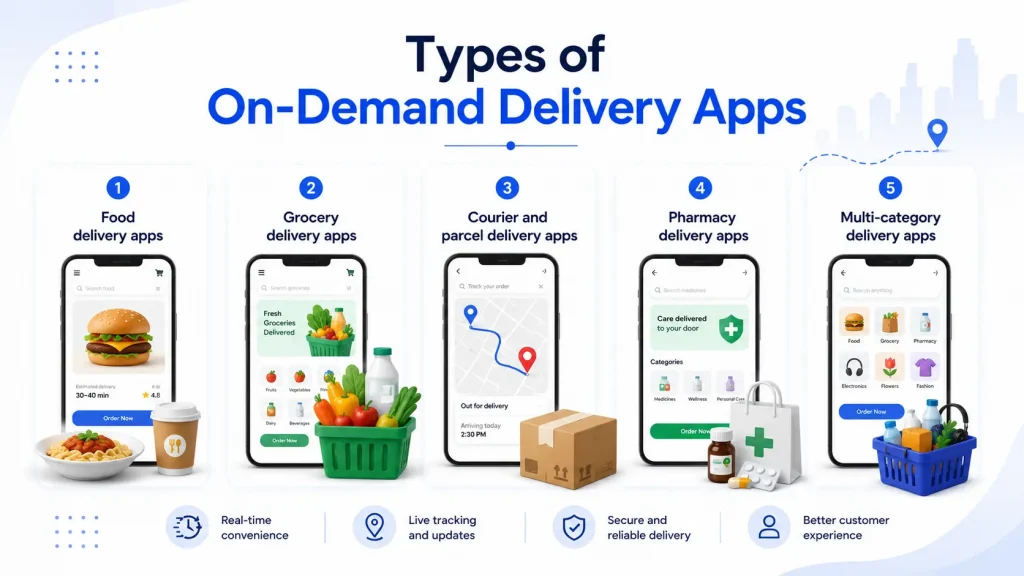
Before you make on demand delivery app, you need to identify which delivery category fits your business model. Each type serves a specific market with different operational requirements.
Here are the five primary types of on-demand delivery apps.
1. Food delivery apps
Food delivery apps connect restaurants, cloud kitchens, and food vendors with customers. Businesses that develop a food delivery app need platforms that handle order placement, payment processing, and dispatch through a single interface.
The customer browses menus, places an order, and tracks delivery in real time. The driver picks up from the restaurant and delivers to the customer’s location. Popular examples include DoorDash, Uber Eats, and Glovo.
Food delivery mobile app development requires features like menu management, order scheduling, estimated delivery time, and restaurant-specific ratings. Multi-vendor support is essential for marketplace-style food delivery platforms. Learn more in our detailed guide on how to develop a food delivery app.
2. Grocery delivery apps
Grocery delivery apps allow customers to order daily essentials and household items from nearby stores. The app assigns a personal shopper or delivery courier to fulfill the order.
These apps need inventory sync with store systems to show real-time product availability. Features like item substitution preferences, delivery time slots, and minimum order thresholds are standard. Instacart and Blinkit are leading examples.
3. Courier and parcel delivery apps
Courier apps handle same-day or on-demand parcel delivery between two locations. Customers specify pickup and drop-off addresses, and the platform assigns a nearby courier for fast fulfillment.
These platforms require strong logistics capabilities. Route optimization, real-time tracking, delivery proof with photo or signature, and multi-stop support are core features. Courier apps serve both individual users and businesses with B2B delivery needs.
4. Pharmacy delivery apps
Pharmacy delivery apps connect customers with licensed pharmacies for prescription and over-the-counter medication delivery. These platforms require compliance with healthcare regulations and secure handling of sensitive data.
Key features include prescription upload, age and identity verification, authorization workflows, and temperature-sensitive handling notifications. Security and compliance are critical in this category.
5. Multi-category delivery apps
Multi-category delivery apps combine food, grocery, pharmacy, courier, and other verticals into a single delivery platform. Glovo is a strong example of this model, offering everything from restaurant meals to electronics delivery.
This approach maximizes the delivery radius and driver utilization. A single fleet handles orders across categories. Building a multi-category app requires a more complex admin panel, merchant app, and order management system. However, it delivers the highest marketplace potential and customer retention.
Choosing the right delivery type depends on your target market, logistics capacity, and long-term growth plan. Start with a single category if you want a faster time to market and lower upfront costs. If your goal is to maximize fleet utilization and customer retention, a multi-category model offers the strongest foundation for scaling across verticals.
Not Sure Which Delivery App Type Fits Best?
Our team analyzes your market, audience, and revenue goals to recommend the right delivery model. Get a free consultation today.

How to Build an On-Demand Delivery App in 9 Steps
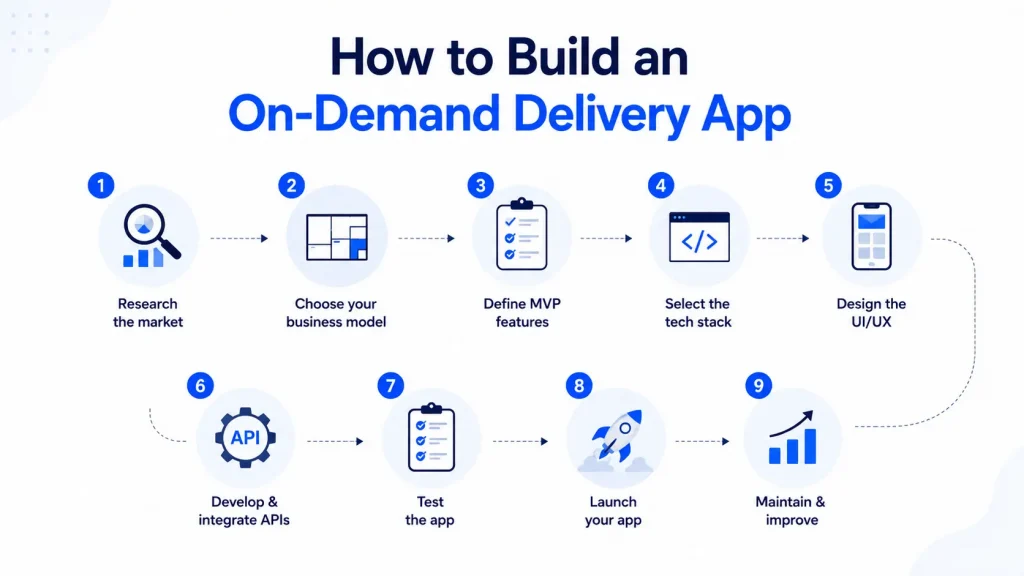
This section explains how to build a delivery app from concept to launch. Follow these steps to make on demand delivery app solutions that are production-ready and scalable.
Step 1: Conduct market research and competitor analysis
Start by studying your target market before you create on demand delivery app solutions. Identify existing competitors, their feature sets, pricing models, and user reviews. Analyze where existing platforms fall short and where your app can fill gaps.
Define your target audience clearly. Are you building for urban millennials ordering food or for businesses needing B2B courier logistics? The audience determines everything from feature scope to marketing strategy.
Research local regulations for your delivery vertical. Food delivery, pharmacy delivery, and courier services each have specific licensing, compliance, and authorization requirements. Engaging software development consulting services at this stage helps validate feasibility before committing to development.
Step 2: Define your business model
Choose between the aggregator, dedicated, hyperlocal, or subscription-based model based on your research. Each model has different infrastructure, cost, and logistics requirements.
The aggregator model is the fastest to launch but offers less operational control. The dedicated model gives full brand ownership but requires a higher investment. Hyperlocal works best in dense urban areas with high order frequency.
Your business model also determines your revenue strategy. Map out primary and secondary income streams early, including delivery commissions, subscription fees, and merchant advertising.
Step 3: Identify core features and create an MVP scope
List all features across the customer app, driver app, merchant app, and admin panel. Then prioritize ruthlessly. Your MVP should include only the features essential for the core order-to-delivery workflow. Our MVP development services help startups define this scope efficiently.
A lean MVP typically includes user registration, product browsing, order placement, payment processing, real-time tracking, push notifications, driver assignment, and basic admin controls.
Avoid feature bloat in version one. Features like promo codes, loyalty programs, multi-language support, and advanced analytics can be added in later iterations. When you create delivery app MVPs with a focused scope, you get to market faster and allow real user feedback to guide future development.
Step 4: Select the right technology stack
Your technology stack directly affects app performance, scalability, and long-term maintenance costs. Choose technologies that support real-time operations, high concurrency, and geographic scaling.
For the frontend, React Native or Flutter enables cross-platform mobile app development from a single codebase. For native performance, use Swift for iOS and Kotlin for Android.
On the backend, Node.js handles real-time WebSocket connections efficiently. Python with Django is strong for data-heavy operations. PostgreSQL or MongoDB handles database needs depending on your data structure.
Cloud hosting on AWS, Google Cloud, or Microsoft Azure provides the scalability and performance your platform needs during peak load.
Step 5: Design the UI/UX
The user experience determines whether customers complete orders or abandon them mid-flow. Design each app interface (customer, driver, merchant) for its specific usage context.
The customer app needs fast browsing, minimal checkout steps, and clear order status updates. The driver app needs one-handed operation with large buttons, clear navigation, and quick order acceptance.
Create wireframes and interactive prototypes before development begins. Test the UX with real users from your target audience. Identify and fix friction points in the ordering and delivery workflow before writing code.
Step 6: Develop the app and integrate APIs
This is where you develop on demand delivery app functionality through agile methodology with 2-week sprint cycles. Each sprint delivers a functional feature set that can be tested independently.
Build the backend first. Set up APIs for user authentication, order management, payment gateway integration, GPS tracking, and push notification services. Use RESTful APIs or GraphQL for efficient data exchange between the frontend and backend.
Frontend development happens in parallel. Connect the customer app, driver app, and merchant app to the backend APIs. Integrate third-party services for maps integration (Google Maps, Mapbox), payment processing (Stripe, PayPal), and notification delivery (Firebase, OneSignal).
Step 7: Perform testing and quality assurance
Testing validates that every feature works correctly under real-world conditions. Skipping this step leads to failure points in production that damage user trust.
Run functional testing on every user flow, from registration to delivery confirmation. Performance testing ensures the app handles peak load without crashing. Security testing checks for vulnerabilities in authentication, authorization, payment processing, and data storage.
Test real-time tracking accuracy across different devices, network conditions, and GPS environments. Verify that push notifications arrive reliably for order status updates. Conduct beta testing with a small user group before the full launch.
Step 8: Deploy and launch
Deployment moves the app from the development environment to production. This includes server setup, database configuration, SSL certification, and cloud hosting configuration.
Submit the customer and driver apps for app store submission on both the Apple App Store and the Google Play Store. Follow each platform’s guidelines for review approval. Prepare marketing assets, screenshots, and app descriptions before submission.
Plan a soft launch in a limited geographic area before a full rollout. This lets you identify operational issues, test driver supply and demand balance, and refine logistics workflows with real orders.
Step 9: Plan post-launch maintenance and updates
Post-launch support is not optional. Your delivery platform will need continuous monitoring, bug fixes, and feature updates to stay competitive and reliable. Professional mobile app maintenance services ensure long-term platform stability.
Set up automated monitoring for server uptime, API response times, and error rates. Collect user feedback through in-app surveys, ratings, and support chat transcripts.
Plan feature updates on a regular release cycle. Add advanced features like promo codes, multi-language support, AI-driven recommendations, and advanced analytics based on user behavior data. Regular maintenance ensures production readiness and long-term platform stability.
Ready to Turn Your Delivery App Idea Into Reality?
From market research to launch and maintenance, we handle every step. Share your requirements and get a detailed project estimate.
Must-Have Features of an On-Demand Delivery App
The feature set determines whether your delivery app can handle real-world operations at scale. When you build on demand delivery app solutions, you need to plan features for four distinct user roles.
Here is what each panel requires.
1. Customer app features
The customer app is the primary interface for order placement and tracking. It must be fast, intuitive, and reliable.
- User registration and profile management: Allow sign-up through email, phone number, or social accounts. Include saved addresses, payment methods, and order preferences for quick reordering.
- Product and merchant browsing: Display nearby merchants, product catalogs, pricing, and estimated delivery times. Include search, filters, and category-based navigation for faster discovery.
- Order placement and scheduling: Support both instant and scheduled deliveries. Include options for special instructions, item customization, and quantity adjustments before checkout.
- Multi-payment support: Integrate multiple payment gateways like Stripe, PayPal, and local options. Support credit cards, debit cards, digital wallets, and cash on delivery for maximum flexibility.
- Real-time tracking and ETA: Show live driver location on a map after order dispatch. Display the estimated time of arrival updated dynamically based on traffic and route conditions.
- Push notifications and order status updates: Send automated alerts for order confirmation, driver assignment, pickup, in-transit status, and delivery completion.
- In-app messaging and support chat: Enable direct communication between the customer and driver. Include a support chat channel for order issues, refunds, and general inquiries.
- Ratings, reviews, and order history: Let customers rate drivers and merchants after each delivery. Maintain a full order history with reorder capability.
- Promo codes and loyalty rewards: Support discount codes, referral bonuses, and loyalty point systems. These features drive customer acquisition and retention.
2. Delivery driver app features
The driver app must be built for on-the-go usage. It should minimize friction during pickup and drop-off while providing clear navigation and earnings visibility.
- Driver registration and profile management: Include document upload for verification (license, vehicle registration, insurance). Support profile editing and availability status toggling.
- Order assignment and acceptance: Display incoming delivery requests with pickup location, drop-off address, item details, and estimated payout. Drivers can accept or decline assignments based on their availability.
- GPS tracking and maps integration: Provide turn-by-turn navigation using Google Maps or Mapbox API. Display the optimal route with real-time traffic updates for route optimization.
- Delivery proof capture: Allow drivers to upload a photo, collect a digital signature, or record in-app confirmation as delivery proof. This protects both the driver and the customer.
- Earnings dashboard: Show daily, weekly, and monthly earnings with a breakdown per delivery. Include pending payouts, tips received, and bonus incentives.
- Location sharing and availability management: Let drivers share their real-time location during active deliveries. Allow toggling between online, offline, and busy statuses.
- Order notifications: Send push notifications for new order assignments, pickup reminders, and delivery confirmations.
3. Merchant app features
The merchant app enables restaurants, stores, and service providers to manage their catalog, incoming orders, and fulfillment operations.
- Merchant onboarding and profile setup: Include business details, operating hours, service area, tax information, and bank account setup for payouts.
- Menu and catalog management: Allow merchants to add, edit, or remove products. Support pricing updates, item availability toggling, and category organization.
- Order acceptance and preparation tracking: Display incoming orders with a timer for acceptance. Include a status flow (received, preparing, ready for pickup) to keep drivers and customers informed.
- Promotion management: Let merchants create and manage their own promo codes, discounts, and featured listing campaigns.
- Sales analytics and reporting: Provide dashboards showing order volume, revenue, average order value, and customer feedback. These insights help merchants optimize their offerings.
3. Admin panel features
The admin panel is the command center for the entire delivery platform. It manages all operational, financial, and user-facing functions.
- Dashboard and analytics: Display real-time metrics for active orders, completed deliveries, revenue, average delivery time, and driver utilization. Custom dashboards help track KPIs tied to operational efficiency.
- Order management and dispatch: Monitor all orders from placement to completion. The dispatcher panel allows manual reassignment of orders when automated dispatch encounters issues.
- User management: Manage customer accounts, driver profiles, and merchant accounts. Include options for verification, suspension, and role-based access control.
- Payment processing and settlement: Track all financial transactions. Handle commission calculations, driver payouts, merchant settlements, and refunds from a single interface.
- Surge pricing and dynamic pricing controls: Configure pricing rules based on demand, time of day, weather conditions, or delivery distance. Automated surge pricing balances supply and demand during peak load.
- Content and notification management: Manage push notification campaigns, promotional banners, and in-app content. Schedule communications for new feature launches or seasonal promotions.
- Fraud detection and dispute resolution: Monitor for suspicious activity, duplicate accounts, or payment fraud. Include a structured workflow for handling customer complaints and driver disputes.
Need a Feature Roadmap for Your Delivery App?
Our team defines the right MVP scope based on your business model. Avoid feature bloat and launch faster with a focused plan.
Top On-Demand Delivery App Examples
Space-O Technologies has developed on-demand delivery apps across food, alcohol, courier, and fleet management verticals. These projects offer real use cases for anyone planning to create a delivery app for commercial launch.
1. Glovo: Multi-category on-demand delivery app
Space-O Technologies developed Glovo, a multi-category on-demand delivery app headquartered in Spain. The marketplace connects users with restaurants and stores for food, groceries, pharmacy, and courier delivery through a single delivery platform. We built six core systems, including the customer app, driver app, merchant portal, admin dashboard, real-time tracking and dispatch system, and payment gateway integration.
- Secured $1.2 billion in funding and crossed 100 million downloads worldwide
- Selected by Apple for its “Best of 2016” award
- Operates across 20+ countries, 1,500+ cities, and 240,000+ partner stores
- Uses live tracking, in-app messaging, automated ETA calculations, and push notifications from order confirmation to delivery confirmation
- Tech stack: Swift, Kotlin, React, Node.js, Ruby on Rails, PostgreSQL, Stripe, PayPal, Google Maps API
2. Bevy: On-demand alcohol delivery app
We developed Bevy, a London-based on-demand delivery app that fulfills alcohol orders within 30 minutes. The customer app integrates with EPOS inventories from local stores to display real-time product availability. GPS tracking enables real-time tracking of the delivery driver from dispatch to drop-off within a defined delivery radius.
- Delivers alcohol, snacks, and tobacco from 5 pm to 5 am using couriers on motorbikes
- Flat £5 delivery fee with tight delivery radius management
- Stripe handles all in-app payment processing
- Earned coverage from TechCrunch, The Guardian, The Huffington Post, and Yahoo Finance
- Launched in Kensington and Chelsea, expanded to Westminster
- Tech stack: iOS (Swift), Android, Stripe, GPS tracking, EPOS inventory integration
3. Jabrool: On-demand package delivery app
Space-O Technologies developed Jabrool, an on-demand courier delivery app for Saudi Arabia. The logistics platform connects parcel senders with delivery drivers for same-day and urgent package delivery. The driver app shows pickup and drop-off details, GPS navigation, and ETA for each assignment.
- Supports package size selection (small, medium, large) with Budget and Express delivery tiers
- Automated pricing based on distance and package type
- Features include live tracking, in-app chat, multi-payment support, and full order management
- Drivers confirm delivery using unique verification codes
- Tech stack: iOS, Android (native development)
4. GelatoGoes: Delivery management software
We developed GelatoGoes, a delivery management software for door-to-door operations across New York and New Jersey. The admin panel handles fleet management, order scheduling, dispatch automation, and analytics dashboards for improved operational efficiency. The driver app includes route optimization and order status updates.
- Store panel supports automated dispatch to nearby available drivers
- Real-time order management and fleet tracking across multiple delivery zones
- Monetizes through tiered subscriptions (basic up to $5,000, premium up to $20,000)
- Tech stack: React.js, Node.js, Flutter, MySQL
5. Lacy: eCommerce liquor delivery app
Space-O Technologies developed Lacy, an eCommerce alcohol delivery app for a US-based client. The marketplace platform lets customers browse, order, and receive alcohol from local stores on both iOS and Android. Stripe handles secure payment processing with multi-card support.
- Category browsing with voice search and re-ordering from order history
- In-store pickup, gift delivery, and product requests via barcode scanning
- Referral and rewards wallet system to drive customer retention
- Expanding into on-demand delivery with a 60-minute fulfillment window
- Tech stack: iOS, Android, Stripe
Each of these projects solved a different delivery challenge. Glovo scaled across 20+ countries with multi-category operations. Bevy handled niche compliance for alcohol delivery. Jabrool built flexible courier logistics. GelatoGoes’ automated fleet dispatch. Lacy drove retention through rewards. The common thread is a scalable architecture, real-time operations, and a focus on the end user at every stage of the delivery workflow.
Top 7 Benefits of Building an On-Demand Delivery App
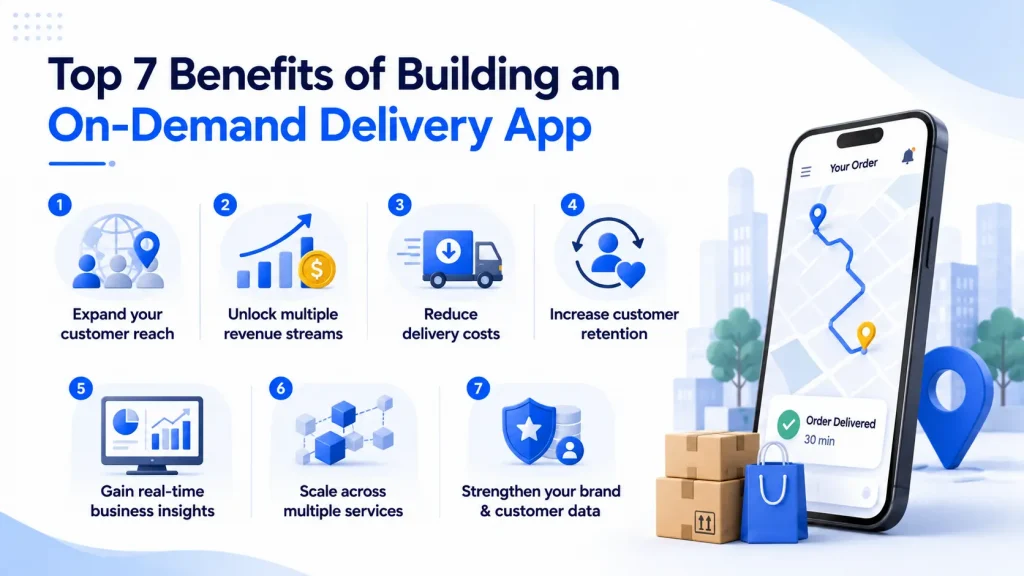
Investing in on-demand delivery app development offers measurable business advantages. Whether you are a startup or an established enterprise, here is why companies make on demand delivery app solutions and what a custom delivery platform can deliver.
1. Serve customers beyond your physical storefront
A restaurant or store without a delivery app depends entirely on foot traffic. A delivery platform removes that ceiling. Merchants can reach customers across a wider delivery radius without opening new locations. Glovo expanded from a single city in Spain to 20+ countries using the same app infrastructure.
2. Stack multiple revenue streams into one platform
Third-party aggregators take 15-30% commissions and control your customer data. When you own the delivery platform, you capture delivery commissions, subscription fees, surge pricing margins, in-app advertising revenue, and premium vendor listing fees. Each stream compounds as your order volume grows.
3. Cut delivery costs with automated dispatch and route optimization
Manual coordination between drivers, stores, and customers does not scale. Automated dispatch assigns the nearest available driver instantly. Route optimization reduces fuel costs and delivery times across the fleet. These operational efficiency gains lower your cost per delivery as order volume increases.
4. Turn one-time buyers into repeat customers
Generic marketplaces treat your customers as their customers. A custom delivery app lets you build direct relationships through order history, saved preferences, promo codes, push notifications, and loyalty rewards. Subscription models like DashPass and Instacart+ prove that delivery subscriptions drive 2-3x higher order frequency and stronger customer retention.
5. Make real-time decisions with live operational data
Delivery operations generate data at every stage. Admin dashboards show live metrics on driver utilization, average delivery time, peak demand windows, and drop-off success rates. This is not a monthly report. It is real-time tracking of your entire operation, enabling same-day adjustments to staffing, pricing, and logistics.
6. Scale from one vertical to many without rebuilding
Companies that develop on demand delivery app solutions with modular architecture can expand across verticals. A food delivery platform can add grocery, pharmacy, and courier services using the same driver network, admin panel, and payment infrastructure. Glovo, Uber Eats, and DoorDash all followed this exact pattern to maximize fleet utilization.
7. Own your customer data and brand experience
Relying on third-party aggregators means you never see who your customers are, what they reorder, or when they churn. A custom delivery platform gives you full ownership of customer data, purchase behavior, and communication channels. That data drives smarter marketing, better retention strategies, and a brand experience you fully control.
The bottom line is clear. Building your own delivery platform is not just about offering delivery. It is about owning the entire value chain, from customer acquisition and order fulfillment to data, retention, and revenue. Businesses that invest early in scalable, well-architected delivery apps gain compounding advantages that third-party aggregator dependence can never match.
What are the Business Models for an On-Demand Delivery App
Choosing the right business model determines how your delivery platform operates, generates revenue, and scales. Before you build on-demand delivery app features, decide which model aligns with your market. Here are the four primary models used in on-demand delivery app development.
Aggregator model
The aggregator model connects multiple merchants (restaurants, stores, pharmacies) with customers through a single marketplace. The platform does not own inventory or employ drivers directly. Instead, it earns a commission on each transaction.
This model works well for food delivery and multi-vendor marketplaces. Uber Eats and DoorDash operate as aggregators. The trade-off is lower operational control, since delivery quality depends on individual merchants and independent couriers.
Dedicated delivery model
In this model, a single business decides to make delivery app solutions exclusively for its own products. The company manages the entire fulfillment chain, from order placement to delivery confirmation.
This approach suits restaurant chains, grocery retailers, and pharmacy brands that want full control over the customer experience. Domino’s and Pizza Hut are examples. The trade-off is a higher operational cost for fleet management and logistics.
Hyperlocal delivery model
The hyperlocal model focuses on deliveries within a tight delivery radius, usually under 5-10 kilometers. It connects customers with nearby stores and assigns the nearest available courier for fast fulfillment.
Blinkit (formerly Grofers) and Zepto use this model for 10-minute grocery delivery. Speed is the core differentiator. The trade-off is limited geographic coverage and the need for dense merchant and driver networks.
Subscription-based model
This model offers customers unlimited or discounted deliveries for a recurring monthly or annual fee. DashPass (DoorDash), Instacart+ (Instacart), and Uber One are examples.
Subscriptions drive customer retention and predictable recurring revenue. The trade-off is reduced per-order revenue. If you are building a delivery app, this model works best when combined with an aggregator or hyperlocal approach to ensure high order frequency.
Technology Stack for On-Demand Delivery App Development
Choosing the right technology stack is critical when you make on demand delivery app platform for production use. The stack must support real-time operations, high concurrency, geographic scaling, and secure payment processing.
Here is a breakdown by technology layer.
Frontend technologies
The frontend is what customers, drivers, and merchants interact with directly. It must be responsive, fast-loading, and smooth across devices.
- React Native is a popular choice for cross-platform on-demand delivery app development. Our React Native app development services allow a single codebase for both iOS and Android, reducing development time and cost.
- Flutter offers high-performance UI rendering with a single codebase. It is well-suited for apps that require complex animations and custom design elements.
- For native development, Swift (iOS) and Kotlin (Android) deliver the best device-specific performance. You can hire iOS developers for apps that require deep hardware integration, like a camera for delivery proof.
Backend technologies
The backend manages business logic, data processing, API routing, and real-time communication between all app users.
- Node.js excels at handling real-time WebSockets connections. Our Node.js development services make it a strong choice for delivery platforms that require live tracking, instant order status updates, and in-app messaging.
- Python with Django is a solid option for backend services that involve data analytics, machine learning-based dispatching, and complex business logic.
- Ruby on Rails provides rapid development with a convention-over-configuration approach. It is suitable for MVPs and early-stage platforms that prioritize speed to market.
Database management
The database stores all user data, order records, merchant catalogs, and transaction histories.
- PostgreSQL is a relational database ideal for structured data like orders, payments, and user profiles. It supports complex queries, transactions, and geolocation functions.
- MongoDB is a NoSQL database suited for unstructured or semi-structured data. It works well for product catalogs, driver activity logs, and real-time data streams.
- Redis serves as an in-memory cache layer for frequently accessed data. It speeds up operations like session management, order status lookups, and live driver location updates.
Cloud and hosting platforms
Cloud hosting ensures your delivery platform can scale during traffic spikes and maintain high availability across regions.
- AWS (Amazon Web Services) provides a comprehensive suite of services, including EC2, S3, Lambda, and RDS. It is the most widely used cloud platform for production-grade delivery apps.
- Google Cloud offers strong integration with Google Maps APIs and machine learning services. It is a natural fit for delivery platforms that rely heavily on maps integration and AI-driven features.
- Microsoft Azure is preferred by enterprise clients with existing Microsoft infrastructure. It offers robust compliance, security, and global data center coverage.
Real-time tracking and maps APIs
Live tracking is the backbone of any on-demand delivery app. It connects GPS tracking on the driver’s device to the customer’s order tracking screen.
- Google Maps Platform provides geocoding, directions, distance matrix, and places APIs. It is the industry standard for map integration in delivery app development.
- Mapbox is a flexible alternative with customizable map styles and competitive pricing for high-volume API calls.
- WebSockets enable persistent, bidirectional communication between the client and server. This technology powers real-time tracking, instant order status updates, and live ETA recalculations.
Payment gateway integrations
Secure payment processing is essential for every transaction on your delivery platform. Integrate multiple gateways to support diverse customer preferences.
- Stripe supports credit cards, debit cards, digital wallets, and local payment methods across 40+ countries. It offers robust APIs, developer documentation, and built-in fraud detection.
- PayPal adds brand trust and provides an alternative for customers who prefer not to enter card details. It supports one-click checkout for faster order placement.
- For regional markets, integrate local payment gateways that support bank transfers, UPI, or mobile money based on your target geography.
Push notification services
Push notifications keep customers, drivers, and merchants informed at every stage of the order lifecycle.
- Firebase Cloud Messaging (FCM) is the standard for Android push notifications. It also supports iOS and web platforms.
- Apple Push Notification Service (APNs) is required for native iOS notifications.
- OneSignal is a cross-platform notification service that supports segmentation, scheduling, and analytics for targeted messaging.
How Much Does It Cost to Build an On-Demand Delivery App?
The total cost to build a custom on-demand delivery app generally ranges from $30,000 to $300,000+. Cost is one of the most common questions when businesses plan to develop on demand delivery app solutions. The total investment depends on app complexity, feature set, platform choice, and development team location. For a broader perspective, read our guide on app development cost breakdown.
Here is a cost breakdown by app complexity level.
Cost by app complexity
- Basic MVP ($30,000 – $60,000): A basic delivery app with core features for one platform (iOS or Android). Includes user registration, product browsing, order placement, payment processing, real-time tracking, and a basic admin panel. Best for validating your delivery concept with real users before scaling.
- Mid-level app ($60,000 – $120,000): A feature-rich delivery app for both iOS and Android platforms. Includes all MVP features plus a merchant app, driver earnings dashboard, order scheduling, promo codes, ratings and reviews, in-app messaging, and detailed admin analytics. Suitable for funded startups ready for market launch.
- Enterprise-grade platform ($120,000 – $300,000+): A fully scalable, multi-category delivery platform with advanced features. Includes AI-driven dispatching, route optimization, microservices architecture, multi-vendor support, subscription management, advanced fraud detection, and multi-region deployment. Built for high-volume operations and rapid geographic expansion.
Key factors affecting app development cost
- Number of platforms: Building for both iOS and Android app development costs more than a single platform. Cross-platform frameworks like React Native or Flutter reduce this gap by sharing code across platforms.
- Feature complexity: Advanced features like real-time tracking, route optimization, AI-powered dispatch, and multi-payment support require more development effort than basic CRUD functionality.
- Design requirements: Custom UI/UX design with unique animations and branded experiences costs more than template-based approaches. However, investing in the user experience pays off through higher conversion rates and customer retention.
- Third-party integrations: Payment gateways, maps APIs, push notification services, and analytics tools add integration costs. Each API has its own pricing model based on usage volume.
- Development team location: Hourly rates vary significantly by region. North American developers charge $100-$200/hour. Eastern European teams range from $40-$80/hour. South Asian development companies typically charge $25-$50/hour, offering the best cost-to-quality ratio for delivery app development.
- Ongoing maintenance: Post-launch maintenance typically costs 15-20% of the initial development budget annually. This covers bug fixes, security patches, server monitoring, and feature updates.
Challenges in On-Demand Delivery App Development
Every delivery platform faces operational and technical challenges. When you build an on-demand delivery app platform, identifying these failure points early helps you plan solutions before they affect users.
Real-time tracking accuracy
GPS tracking accuracy varies across devices, network conditions, and environments. Indoor locations, dense urban areas, and low-connectivity zones can cause location drift.
- Solution. Use a combination of GPS, Wi-Fi positioning, and cell tower triangulation. Implement server-side location smoothing to filter erratic data points. Test tracking across multiple devices and geographies before launch.
Handling peak load and scalability
Traffic spikes during lunch hours, weekends, and promotional campaigns can overwhelm servers. Slow app response or downtime during peak load directly impacts revenue and customer trust.
- Solution. Design your backend with a microservices architecture that allows independent scaling of specific services. Use auto-scaling on AWS, Google Cloud, or Microsoft Azure. Implement load balancing and CDN caching for static assets. Performance testing under simulated peak conditions should be part of every release cycle.
Driver allocation and route optimization
Assigning the right driver to each order is critical for delivery speed and cost control. Poor allocation leads to longer wait times, higher fuel costs, and lower driver satisfaction.
- Solution. Build intelligent dispatch algorithms that factor in driver proximity, current workload, traffic conditions, and order priority. Integrate route optimization APIs to calculate the fastest delivery path. For complex multi-stop scenarios, consider AI-powered dispatching that learns from historical delivery data.
Payment security and fraud prevention
Handling financial transactions introduces risks, including payment fraud, chargebacks, and unauthorized access. Compliance with PCI DSS standards is mandatory for any platform that processes card payments.
- Solution. Use PCI-compliant payment gateways like Stripe or PayPal that handle card data on their servers. Implement tokenization so sensitive payment information never touches your backend. Add multi-factor authentication for account access and transaction verification. Monitor for suspicious patterns like repeated failed payments or unusual order volumes from single accounts.
Multi-location and multi-vendor scaling
Expanding to new cities or adding new merchant categories introduces complexity. Each new market has different regulations, delivery logistics, merchant expectations, and customer behaviors.
- Solution. Design the platform architecture for multi-tenancy from the start. Use configurable delivery zones, pricing rules, and compliance settings per region. Build a standardized merchant onboarding workflow that scales without requiring custom development for each new market. A modular admin panel helps operational teams manage multiple cities independently.
How to Monetize an On-Demand Delivery App
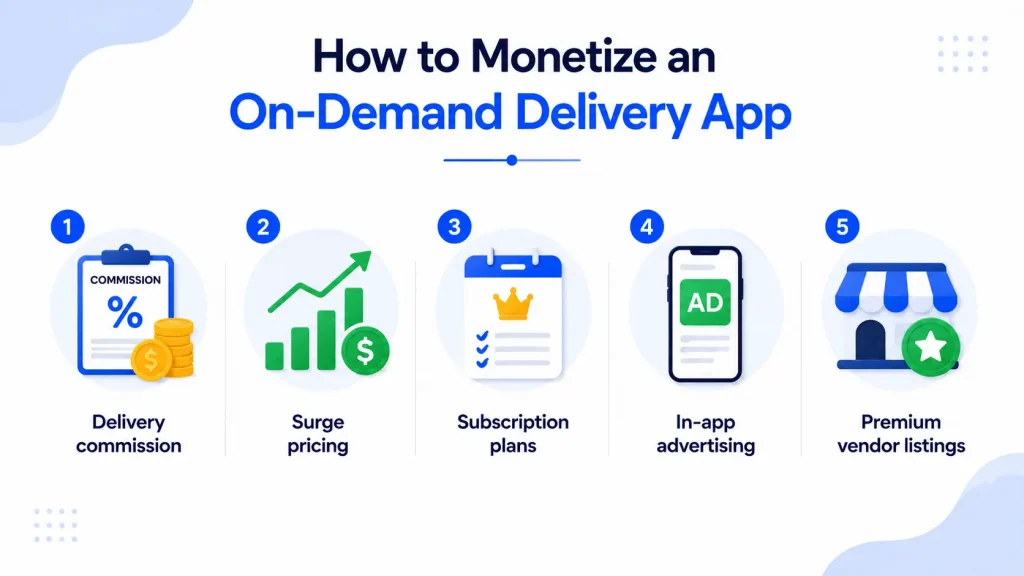
When you develop on demand delivery app platform, planning monetization from day one is critical. A sustainable delivery platform needs diversified revenue streams. Here are the most effective monetization strategies used by successful on-demand delivery apps.
Delivery commission
Charge merchants a percentage commission on each order processed through the platform. This is the primary revenue model for aggregator-style delivery platforms.
Industry standard commission rates range from 15% to 30% depending on the market, delivery category, and negotiated SLA with merchants. In on-demand food delivery app development, platforms typically charge higher commissions than grocery or courier services.
Surge pricing
Apply dynamic pricing during periods of high demand, low driver availability, or adverse weather conditions. Surge pricing balances supply and demand while increasing revenue during peak load.
The trade-off is customer perception. Transparent communication about why prices are higher builds trust. Show the estimated cost clearly before the customer confirms the order.
Subscription plans
Offer customers unlimited or discounted deliveries for a monthly or annual fee. DashPass (DoorDash), Uber One (Uber Eats), and Instacart+ are successful examples.
Subscriptions increase customer retention and create predictable recurring revenue. They also incentivize higher order frequency since delivery costs are already covered by the subscription.
In-app advertising
Allow merchants to pay for promoted listings, featured banners, or priority placement in search results. This creates a secondary revenue stream without affecting the delivery commission model.
Advertising revenue grows as your marketplace expands. More merchants competing for visibility mean higher ad spend per merchant.
Premium vendor listings
Offer merchants a premium tier with added benefits. These can include priority customer support, enhanced analytics, dedicated account management, and higher search ranking.
Premium listings work well for established merchants who see the platform as a primary sales channel and want to maximize their visibility and order volume.
Why Choose Space-O Technologies for On-Demand Delivery App Development
Space-O Technologies has been building custom delivery platforms since 2010. We developed Glovo, a multi-category on-demand delivery app that secured $1.2 billion in funding, earned Apple’s “Best of 2016” award, and crossed 100+ million downloads worldwide. We bring that same level of product thinking, technical depth, and operational understanding to every on-demand delivery app development project.
Have a look at our portfolio of on-demand delivery apps to see how we turn complex delivery concepts into scalable digital products.
UpMaid: On-Demand House Cleaning App
A two-sided cleaning marketplace where hosts post jobs with task checklists and nearby contractors apply or negotiate price in real time. Delivered as a host app, a contractor app, and a web admin panel with Airbnb calendar sync.
Learn More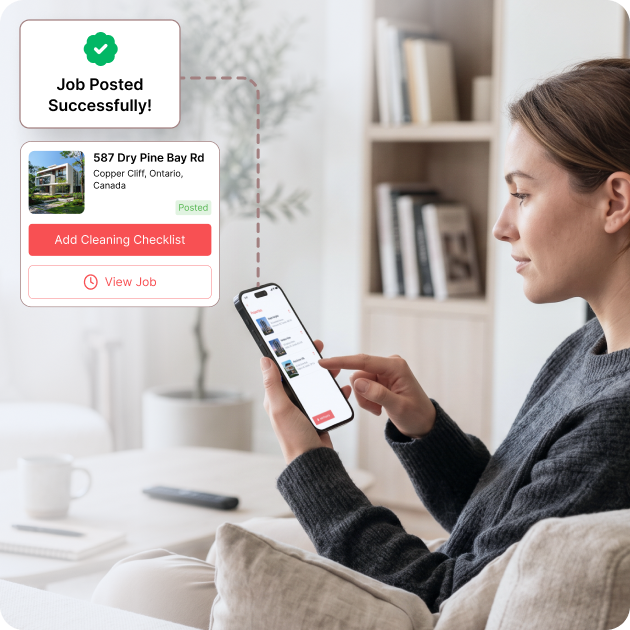
Marijuana: On-Demand Weed Delivery App
An on-demand cannabis delivery platform serving 2K+ customers across 500+ listed dispensaries in Arizona. Three connected applications handle MMJ card verification, biometric app lock, real-time driver tracking, and multi-mode payments on iOS and Android.
Learn More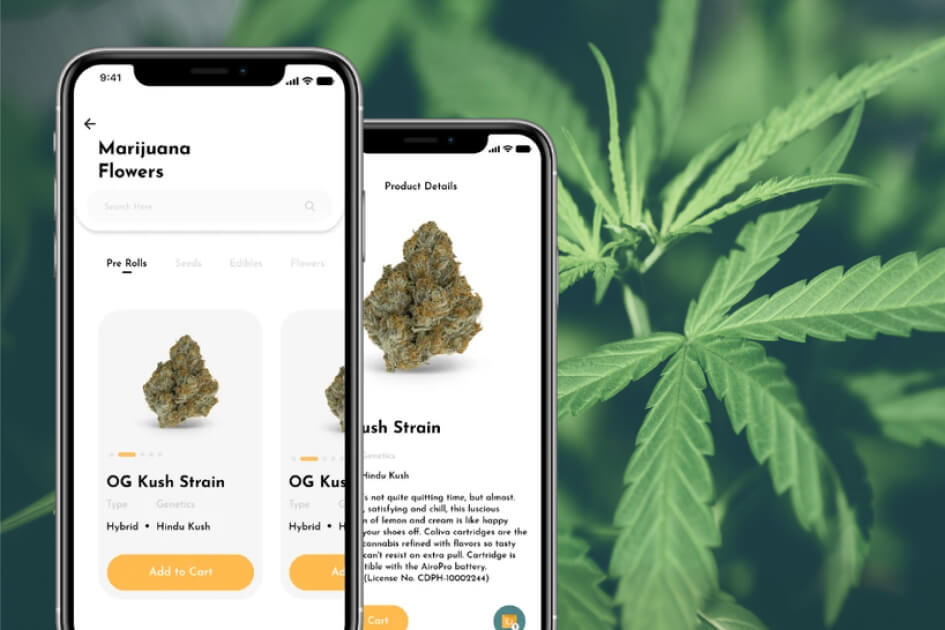
Jopla: Italian Service Marketplace Platform
Italy’s service marketplace connecting clients with professionals across 20+ sectors. Our team reverse-engineered its Kotlin Multiplatform codebase, then shipped map-based provider discovery and a rebuilt ratings system on a Node.js, GraphQL, and MongoDB Atlas backend.
Learn More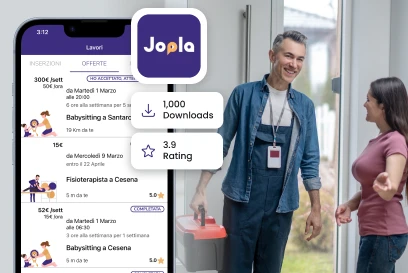
This experience gives us practical expertise in building scalable delivery platforms, from real-time tracking and dispatch to multi-vendor operations. We bring proven product thinking and technical expertise to every on-demand delivery app development project.
Frequently Asked Questions
What is an on-demand delivery app?
An on-demand delivery app is a digital platform that connects customers, businesses, and delivery drivers to fulfill orders in real time. It enables customers to browse products or services, place orders, make secure payments, and track deliveries from pickup to doorstep. Businesses use these apps for food delivery, grocery delivery, pharmacy delivery, courier services, and other on-demand business models.
How does an on-demand delivery app work?
An on-demand delivery app follows a simple workflow. Customers place an order through the app, the platform automatically assigns it to the nearest available delivery partner, and the driver fulfills the order while customers track its status in real time. The admin panel manages orders, drivers, payments, and platform operations.
What features should an on-demand delivery app include?
A complete on-demand delivery solution includes separate apps or panels for customers, drivers, merchants, and administrators. Essential customer features include registration, order placement, live order tracking, secure payments, reviews, and notifications. Driver apps require GPS navigation, route optimization, earnings tracking, and proof of delivery. Merchant and admin panels should support order management, inventory control, dispatch, analytics, promotions, and reporting.
How do you build an on-demand delivery app?
Building an on-demand delivery app involves market research, defining your business model, selecting MVP features, designing the UI/UX, choosing the right technology stack, developing the application, testing it thoroughly, launching it on app stores, and continuously improving it based on customer feedback. Partnering with an experienced on-demand delivery app development company can accelerate the development process and reduce project risks.
What is the best tech stack for an on-demand delivery app?
The ideal technology stack depends on your business requirements. React Native and Flutter are popular choices for cross-platform development, while Swift and Kotlin are preferred for native iOS and Android apps. Node.js, Python, or Java power the backend, PostgreSQL or MongoDB handle data storage, and AWS, Google Cloud, or Microsoft Azure provide scalable cloud infrastructure. Google Maps API and secure payment gateways such as Stripe or PayPal complete the core technology stack.
How much does it cost to develop an on-demand delivery app?
The cost of developing an on-demand delivery app typically ranges from $30,000 to over $300,000, depending on the number of platforms, features, third-party integrations, and overall project complexity. A basic MVP generally costs between $30,000 and $60,000, while enterprise-grade solutions with advanced features require a higher investment.
Why is GPS tracking important in delivery apps?
GPS tracking enables real-time order visibility, accurate delivery estimates, intelligent driver assignment, and route optimization. It improves customer satisfaction by allowing users to track their orders live while helping businesses reduce delivery delays and improve operational efficiency.
How do payment gateways work in delivery apps?
Payment gateways securely process online transactions between customers, merchants, and the delivery platform. They encrypt payment information, authorize transactions, and support multiple payment methods such as credit cards, debit cards, digital wallets, UPI, and cash on delivery. Using trusted payment providers ensures secure and reliable payment processing.
How can you scale an on-demand delivery platform?
Scaling an on-demand delivery platform requires cloud infrastructure, microservices architecture, automated dispatch systems, and modular APIs. Businesses can further support growth by expanding into multiple cities, implementing AI-powered route optimization, adding vendor management, and using analytics to improve operational efficiency.
Which industries can benefit from on-demand delivery app development?
On-demand delivery apps are widely used across industries such as food and restaurant delivery, grocery delivery, pharmacy and healthcare, courier and logistics, retail and eCommerce, flower and gift delivery, pet supplies, laundry services, and multi-service marketplaces. Businesses across these industries use custom delivery apps to improve customer experience and streamline operations.
Should you build your own delivery app or use third-party platforms?
Building your own delivery app gives your business complete control over branding, customer data, pricing, and revenue while eliminating ongoing marketplace commission fees. Although third-party platforms help businesses launch quickly, investing in a custom on-demand delivery platform offers greater flexibility, scalability, and long-term profitability.



 All our projects are secured by NDA




 4.8
4.8