
 By
By 
Contents
Reducing software development costs is one of the most pressing priorities for companies today. Organizations struggle with budget overruns, lengthy timelines, and diminished project value. Yet smart strategies and modern tools offer proven pathways to significant savings.
According to Statista, the global software market revenue is projected to reach US$780.93bn by 2026. But revenue growth has not solved the cost problem; most enterprises continue to waste resources through poor planning, bloated processes, and legacy technology. For any software development company looking to stay competitive, reducing costs without sacrificing quality is no longer optional.
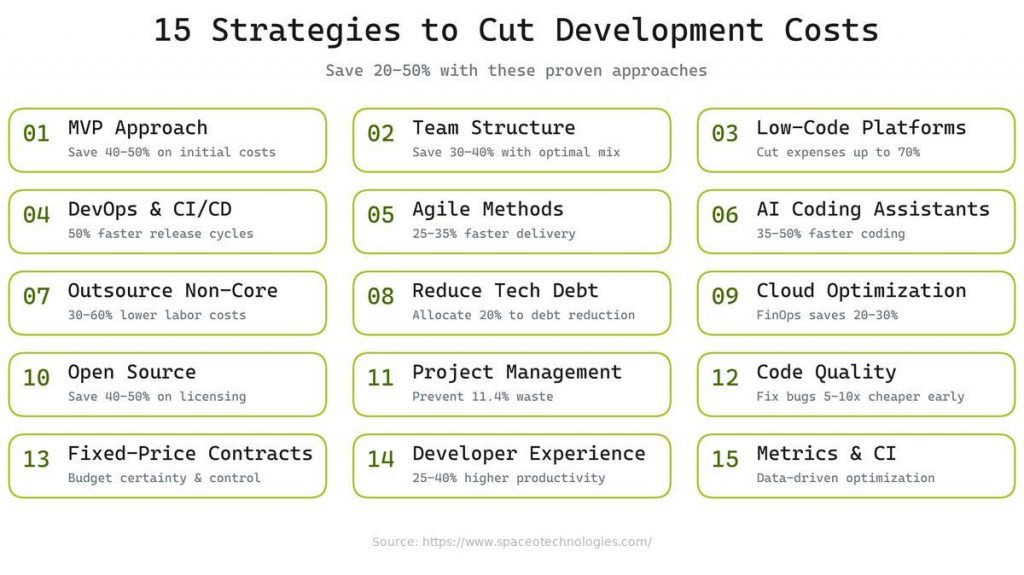
This comprehensive guide reveals 15 actionable strategies that help companies minimize expenses while maintaining high standards. Whether you’re leading a startup, managing mid-market operations, or overseeing enterprise initiatives, these approaches deliver measurable results. You’ll discover cost optimization frameworks, emerging technologies, team composition strategies, and proven methodologies that successful companies use today.
By implementing these strategies systematically, your organization can unlock significant savings while accelerating delivery and improving outcomes.
Strategy 1: Embrace the MVP Approach
Building a Minimum Viable Product (MVP) is one of the most effective cost reduction strategies available. An MVP includes only essential features required for the initial market launch. This approach reduces initial development expenses by 40-50% compared to feature-rich alternatives.
Rather than investing heavily in comprehensive feature sets, focus on solving core customer problems. Gather real-world feedback from actual users. Use that feedback to guide subsequent development iterations. This validation-driven approach prevents expensive mistakes and wasted effort. Teams build only what users genuinely need and value. Market feedback drives all future investment decisions.
MVP development accelerates time to market significantly. Faster launches generate revenue sooner. Revenue subsidizes ongoing development and feature expansion. This virtuous cycle transforms cost structures fundamentally. Startups and enterprises alike benefit from MVP thinking.
Strategy 2: Optimize Your Team Structure
Team composition directly impacts software development costs and productivity outcomes. Organizations often overhire expensive senior developers for tasks junior developers can handle. Conversely, insufficient senior leadership creates quality issues and rework. The key is balancing expertise with cost efficiency.
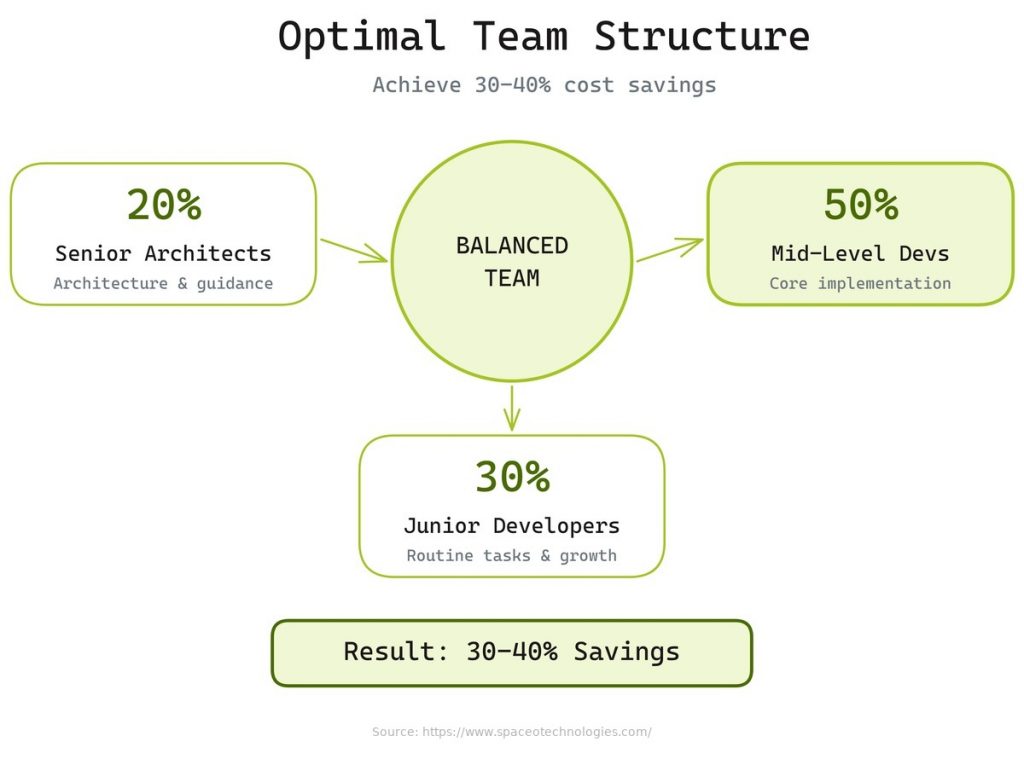
A high-performing team typically combines 20% senior architects, 50% mid-level developers, and 30% junior developers. This mix optimizes costs while maintaining quality. Senior developers provide architectural guidance and handle complex problems. Mid-level developers execute most implementation work efficiently. Junior developers handle routine tasks while developing their skills. This structure reduces labor costs while preserving code quality.
Consider staff augmentation strategies for specific skill gaps. Hire offshore or nearshore developers for non-critical components. Maintain core teams onshore for architectural decisions. This hybrid approach balances cost and control effectively. Many enterprises achieve 30-40% cost savings through strategic team composition.
Build High-Performance Teams That Deliver More, Cost Less
Optimize team structure, skills, and locations to maximize productivity while minimizing expenses across projects.

Strategy 3: Leverage Low-Code and No-Code Platforms
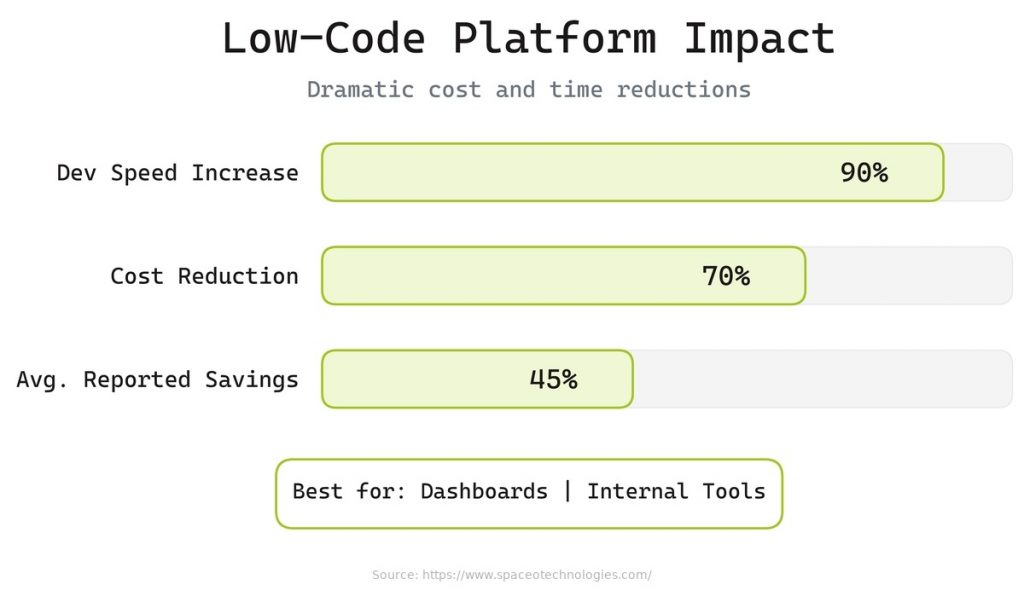
Low-code platforms dramatically reduce development time and costs for suitable use cases. Organizations can cut development expenses by up to 70% using these tools. Application development accelerates by 90% compared to traditional coding approaches.
Low-code platforms work exceptionally well for dashboards, internal tools, and data management systems. They’re less suitable for highly customized applications or systems requiring deep integrations. Evaluate each project individually to determine appropriate technology choices. Teams with low-code expertise can deliver rapid results at minimal cost.
No-code platforms extend accessibility to business users without technical backgrounds. Citizen developers can build solutions independently, freeing professional developers for complex work. This democratization of development dramatically reduces bottlenecks and costs. Organizations adopting low-code strategies report 45% average cost reductions. Gartner predicts 70% of new applications will use low-code development by 2025.
Strategy 4: Invest in DevOps and Automation
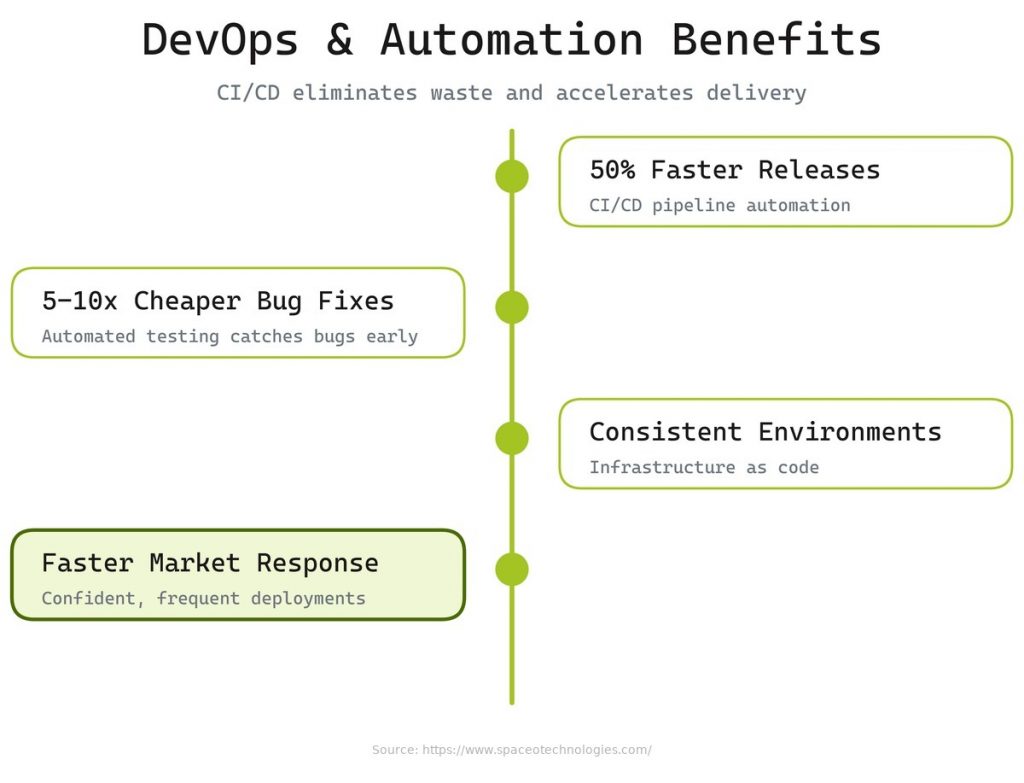
DevOps practices and continuous integration/continuous deployment pipelines eliminate significant waste. Automation reduces manual testing expenses, deployment time, and human error. Organizations implementing CI/CD report 50% faster release cycles. Automation frameworks ensure consistent quality while reducing defects.
Automated testing catches bugs early when fixes cost far less. Manual testing is expensive, slow, and prone to oversights. Infrastructure automation eliminates manual configuration work. Configuration management tools ensure consistency across environments. These practices compound, delivering exponential returns over time.
DevOps adoption transforms development culture and economics. Teams collaborate more effectively. Feedback cycles shorten dramatically. Problems surface and get resolved quickly. Deployment confidence increases, enabling more frequent releases. Organizations can respond faster to customer needs and market changes. The cumulative cost benefits are substantial.
Strategy 5: Implement Agile Methodologies
Agile development reduces waste and improves cost efficiency compared to waterfall approaches. Agile teams work in short iterations with frequent feedback cycles. Issues surface early before becoming expensive problems. Scope creep gets managed through structured sprint planning and prioritization.
Agile frameworks like Scrum provide built-in governance mechanisms. Daily standups maintain alignment. Sprint reviews validate work with stakeholders. Retrospectives drive continuous process improvements. This disciplined approach prevents many common cost drivers. Teams stay focused on the highest-value work. Changing requirements get accommodated without massive disruption.
Organizations using Agile methodologies report 25-35% faster delivery cycles. Quality metrics typically improve while costs decline. Customer satisfaction increases because feedback shapes development priorities. The combination of speed, quality, and cost efficiency makes Agile fundamental to modern development.
Strategy 6: Utilize Artificial Intelligence and Coding Assistants
AI-powered coding assistants like GitHub Copilot represent a paradigm shift in development productivity. These tools use machine learning to suggest code, reducing typing time significantly. Developers report 35-50% faster code completion. Quality often improves because AI suggests proven patterns and best practices.
AI tools reduce bugs and security vulnerabilities by leveraging collective knowledge from millions of projects. Code review processes accelerate because suggested code follows established standards. Developers spend less time on routine tasks and more on complex problem-solving. This productivity multiplication reduces project timelines and costs.
84% of developers now use or plan to use AI tools in their development process. This widespread adoption reflects genuine productivity gains and cost benefits. Organizations investing in AI-assisted development gain competitive advantages. Expect continued evolution and improved capabilities throughout 2025 and beyond.
Strategy 7: Outsource Non-Core Development Activities
Outsourcing allows organizations to access specialized expertise without maintaining permanent staff. Offshore software development reduces labor costs by 30-60% compared to onshore rates. Nearshore options balance cost savings with timezone proximity and cultural alignment.
Choose outsourcing carefully for non-critical components, maintenance work, and specialized domains. Maintain core architectural work in-house to preserve strategic control. Establish clear contracts specifying deliverables, quality standards, and timelines. Regular communication and monitoring ensure quality. Many organizations successfully combine in-house and outsourced teams.
India, Eastern Europe, and Latin America offer cost-effective development resources. Time zone differences enable 24-hour development cycles. Quality standards have improved dramatically in recent years. Many outsourcing partners now match or exceed onshore quality levels. This strategy works particularly well for projects with well-defined requirements.
Strategy 8: Reduce Technical Debt Systematically
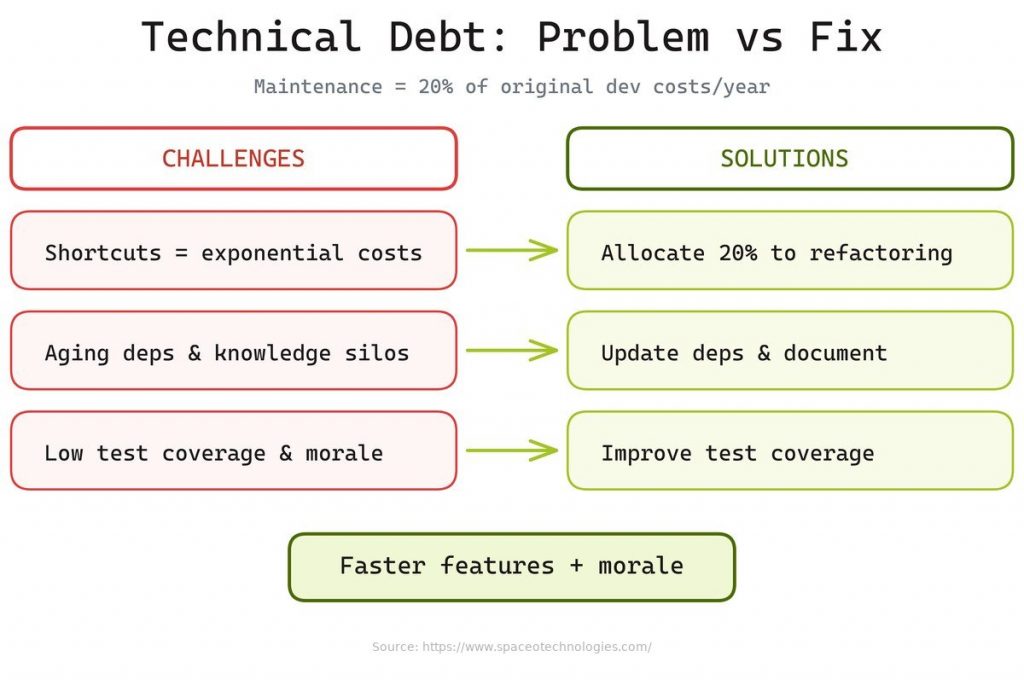
Technical debt accumulates when teams prioritize speed over long-term sustainability. Shortcuts seem cost-effective initially, but create exponential costs later. McKinsey research shows maintenance typically represents 20% of original development costs annually. High technical debt increases this significantly.
Allocate 20% of development capacity to reducing technical debt consistently. Refactor problematic code systematically. Update aging dependencies and libraries. Improve test coverage in critical areas. Document complex systems to reduce knowledge silos. This disciplined approach prevents debt from spiraling.
Organizations with low technical debt achieve faster feature development. Code quality improves. Team morale increases because developers enjoy working with clean code. Long-term project velocity accelerates. The cumulative savings far exceed the investment in debt reduction. Treat technical debt reduction as a strategic priority, not a luxury.
Strategy 9: Optimize Cloud Infrastructure Costs
Cloud platforms offer tremendous flexibility but require careful cost management. Many organizations waste thousands monthly through inefficient resource allocation. Implement cloud cost optimization frameworks systematically. Monitor usage patterns. Right-size instances to match actual demand. Reserved instances reduce costs for baseline workloads.
Implement auto-scaling to ensure you pay only for needed capacity. Eliminate unused resources and zombie instances consuming dollars silently. Choose appropriate storage classes based on access patterns. Use serverless architectures for variable workloads. Content delivery networks reduce bandwidth costs.
FinOps practices bring financial discipline to cloud spending. Track costs by project and team. Set budgets and alerts. Use chargeback models to encourage cost awareness. Regular optimization reviews identify savings opportunities. Organizations implementing FinOps achieve 20-30% cost reductions.
Strategy 10: Adopt Open Source Software Solutions
Open source software eliminates licensing costs while providing enterprise-grade functionality. Thousands of mature, well-maintained projects serve virtually every need. Organizations avoid vendor lock-in and licensing complexities. Community support provides knowledge and resources freely.
Evaluate open source carefully for security and maintenance status. Active projects with large communities provide better long-term support. Commercial support options exist for critical components. Many organizations successfully build products entirely on open source foundations.
Open source adoption reduces software licensing expenses significantly. Total cost of ownership declines when licensing costs disappear. The freedom to modify and adapt code provides additional benefits. Many enterprises save 40-50% on software costs through strategic open source adoption.
Let’s Build Software That Works for Your Business
Tell us where you are in your journey, and we’ll match you with the right development solution.
Strategy 11: Implement Effective Project Management Practices
Poor project management wastes enormous resources through rework, scope creep, and misalignment. Project Management Institute research shows that poor project management wastes 11.4% of investment. Clear requirements prevent expensive misunderstandings. Scope management prevents uncontrolled expansion. Risk management identifies issues early.
Use project management tools to improve visibility and coordination. Track tasks, timelines, and dependencies systematically. Maintain clear communication across all stakeholders. Monitor budgets and spending continuously. Document decisions and rationales. Regular status reviews identify problems quickly. These practices seem basic but deliver remarkable results.
Organizations with mature project management practices complete projects on budget, on time, and with higher quality. Costs decline because rework and delays decrease. Teams work more efficiently. Stakeholder satisfaction improves. Investment in proper project management delivers exceptional returns.
Strategy 12: Prioritize Code Quality and Testing
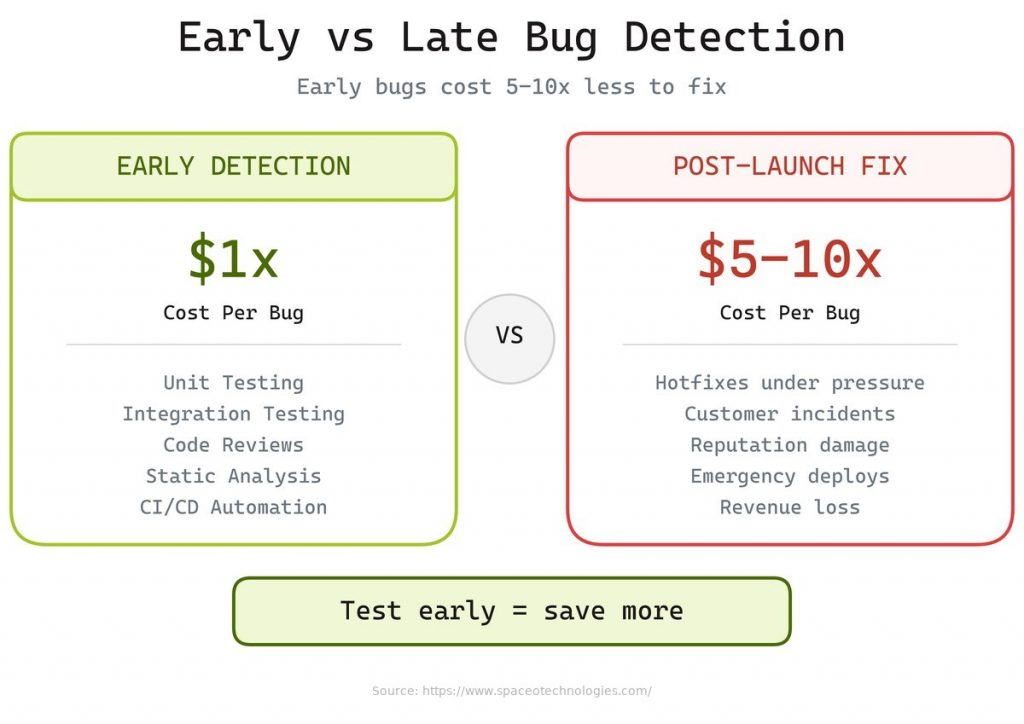
Early bug detection reduces costs dramatically. Bugs discovered during development cost 5-10 times less to fix than defects found after launch. Comprehensive testing throughout development prevents expensive problems. Quality assurance isn’t a cost center; it’s a cost saver.
Implement unit testing, integration testing, and end-to-end testing systematically. Automate testing to improve speed and consistency. Code reviews catch issues before they reach production. Static analysis tools identify problems automatically. These practices prevent expensive production incidents.
Organizations prioritizing quality report fewer defects, faster delivery, and higher customer satisfaction. The cost savings from prevented incidents far exceed testing investments. Quality is not optional; it’s essential to cost efficiency.
Strategy 13: Use Fixed-Price Contracts Strategically
Outsourcing agreements structure cost management differently. Time-and-materials contracts offer flexibility but invite cost overruns. Fixed-price contracts incentivize efficiency. Vendors completing work quickly capture better margins.
Fixed-price contracts work best with well-defined requirements and clear deliverables. Ensure specifications are detailed and comprehensive. Build contingency reserves for unexpected issues. Clear change request processes manage scope changes. When structured properly, fixed-price contracts provide budget certainty and cost control.
Strategy 14: Invest in Developer Experience and Tooling
Happy, productive developers deliver better results faster. Tools that eliminate friction accelerate work. Modern IDEs, debugging tools, and monitoring platforms enhance productivity. Developers should spend minimal time on non-coding tasks.
Invest in development infrastructure that reduces friction. Provide developers with powerful hardware. Eliminate slow builds and deployment processes. Streamline development environment setup. These investments pay dividends through increased velocity. Happy developers produce better code and stay longer.
Organizations prioritizing developer experience report 25-40% higher productivity. Attrition decreases because developers enjoy their environment. Code quality improves. Customer satisfaction increases. The modest investment in tools and experience yields substantial returns.
Strategy 15: Establish Metrics and Continuous Improvement
What gets measured gets managed. Without clear metrics, cost reduction remains theoretical. Establish baseline measurements. Track deployment frequency, lead time for changes, change failure rate, and mean time to recovery. These DORA metrics reveal development efficiency.
Monitor defect rates and resolution times. Track project burn-down and budget utilization. Measure customer satisfaction and feature adoption. Regular analysis of metrics identifies improvement opportunities. Organizations using metrics make data-driven decisions. Continuous improvement becomes systematic rather than sporadic.
Set improvement targets. Review progress regularly. Celebrate successes. Learn from failures. Iterate quickly. This disciplined approach compounds improvements over time. Small, consistent gains transform organizational capabilities.
Turn Your Software Vision Into a Deployed Product
Space-O Technologies helps startups and enterprises build, launch, and scale software — with 180+ engineers ready to move.
Partner With Space-O Technologies for Cost-Effective Software Development
As a trusted enterprise software development company, Space-O Technologies builds robust, scalable solutions that deliver real business value without unnecessary overhead. We take the time to understand your goals, target users, and operational challenges, then recommend the most cost-effective approach tailored to your needs. The result is not just functional software, but sustainable digital assets built for long-term growth.
Our team combines 14+ years of technical expertise with practical business insight to ensure every feature, integration, and architectural decision contributes to measurable ROI. By leveraging modern frameworks, cloud-native infrastructure, and agile delivery models, we streamline development cycles and minimize waste. This structured yet flexible approach helps control costs while maintaining high standards of performance, security, and scalability.
From initial discovery and estimation to deployment and ongoing support, we prioritize transparency, accountability, and consistent communication. You receive clear timelines, well-defined milestones, and complete visibility into progress and budgeting. With a commitment to quality engineering and long-term partnership, we help you maximize your technology investment and achieve sustainable competitive advantage.
Frequently Asked Questions
How much can we realistically save on development costs?
Organizations can typically reduce software development costs by 20% to 50%, depending on their current processes and level of implementation discipline. Companies with inefficient workflows or outdated development practices often achieve the largest improvements.
Quick wins may appear within the first few months, while more comprehensive cost optimization initiatives generally take 12 to 18 months to fully realize. Setting realistic expectations and focusing on systematic improvements helps organizations achieve sustainable savings.
How long does cost reduction take?
Initial improvements in development efficiency can often be seen within 30 to 60 days by implementing quick wins such as workflow optimization or improved collaboration practices.
More significant results typically appear within six months, while long-term transformation initiatives may take 12 to 18 months. Consistency and disciplined execution are more important than speed when building sustainable cost management practices.
Will cost reduction hurt quality?
No. In most cases, effective cost reduction strategies actually improve product quality. Practices such as automation, better testing processes, and streamlined development workflows help teams deliver higher-quality software.
Reducing defects, improving code review processes, and eliminating inefficient development steps simultaneously lower costs and increase product reliability. Quality and efficiency typically reinforce each other rather than conflict.
Which strategies should we implement first?
Organizations should begin with quick-win strategies that deliver visible results quickly. These often include adopting an MVP-first development approach, optimizing team structure, and implementing DevOps practices to streamline deployments and collaboration.
After early improvements, teams can move toward longer-term initiatives such as reducing technical debt, improving architecture decisions, and implementing broader organizational process improvements. Prioritization should depend on the company’s existing challenges and development maturity.
How do we maintain cost discipline long-term?
Maintaining cost discipline requires establishing clear performance metrics and reviewing them regularly. Teams should monitor development efficiency, quality indicators, and project delivery timelines to ensure continuous improvement.
Organizations should also celebrate successful improvements, learn from setbacks, and create a culture that values efficiency alongside innovation. Aligning team incentives with both cost and quality goals helps sustain long-term results.
Can small companies benefit from these strategies?
Yes, cost optimization strategies work particularly well for startups and small companies. Approaches such as MVP development, low-code platforms, and outsourcing allow smaller teams to build products efficiently with limited budgets.
Team optimization and process improvements benefit organizations of all sizes. These strategies scale effectively from small startup teams to large enterprises, making them widely applicable across different business environments.



 All our projects are secured by NDA




 4.8
4.8