
 By
Contents
- Choose onshore when your AI touches regulated data or needs daily live work on model behavior.
- Offshore fits AI work with a fixed, documented scope, such as data labeling or pipeline tuning.
- Compare total project cost, including data preparation and maintenance, not hourly rates alone.
- A hybrid team keeps architecture and human review onshore while sending repeatable execution offshore.
Key Takeaways
Choosing an onshore or offshore AI development company comes down to four factors. Those are budget, complexity, data sensitivity, and how closely you collaborate. Onshore costs more, while offshore costs less but adds time-zone friction.
AI projects behave differently from standard software outsourcing. A mislabeled dataset or weak retrieval step fails later, in production. This guide compares onshore, offshore, nearshore, and hybrid delivery for machine learning and LLM projects.
Space-O Technologies has built AI-powered custom software since 2010. Our AI development services pair onshore-facing strategy with efficient execution. Many clients begin with an AI consulting phase to map data rules first.
Onshore vs Offshore AI Development at a Glance
Onshore buys proximity and control, offshore buys cost efficiency, and nearshore and hybrid sit between them. The table compares the four models on the factors that decide most AI projects. Use it to build a shortlist before you outsource AI development, then read the trade-offs behind each row.
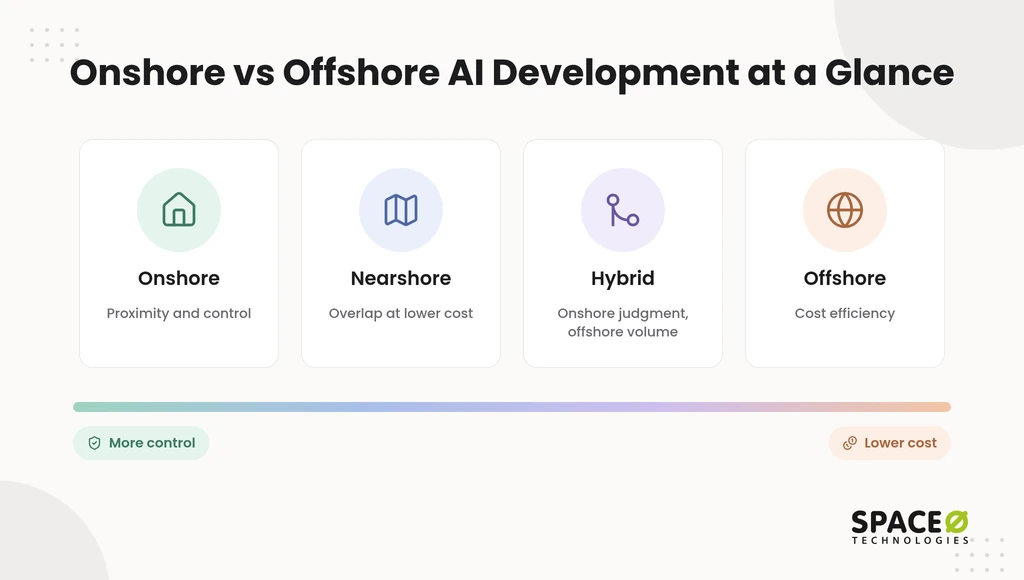
| Factor | Onshore | Offshore | Nearshore | Hybrid |
|---|---|---|---|---|
| Cost | Highest | Lowest labor cost | Moderate savings | Most of the offshore savings |
| Collaboration | Real-time, same time zone | Async, with overnight handoffs | Strong working-day overlap | Real-time on design, async on execution |
| Compliance and IP | Simplest for HIPAA, CCPA, and regulated data | Needs cross-border data and IP controls | Depends on country and contract | Sensitive data stays under onshore control |
| Talent pool | Smaller local pool for senior AI roles | Broad global pool | Regional pool | Draws on both |
| Best for | Regulated data, frequent pivots, high-judgment model work | Well-defined scope and fixed specs | Teams that need overlap at lower cost | Production AI that mixes design and volume work |
The cost row shows where the budget goes. The collaboration and compliance rows show where the risk sits, and for AI work the risk usually matters more.
Onshore AI Development
Onshore AI development puts your team in your own country and trades higher cost for real-time collaboration and simpler compliance. For a US company, that means a team on US working hours under US law. It fits AI work where people must stay close to consequential decisions and where regulated data cannot leave the country.
Advantages of an onshore AI development company
The main advantages are live collaboration, easier compliance, and tighter IP control.
- Seamless Communication: Same-time-zone overlap lets you resolve unexpected model behavior in a live working session.
- Real-Time Collaboration: Shared language and context shorten requirement gathering for AI projects full of edge cases.
- Compliance and Security: HIPAA-compliant training data and auditable lending decisions are simpler to manage under one jurisdiction.
- IP Control: Domestic contracts and enforcement make model and data ownership easier to protect.
Disadvantages of an onshore AI development company
The trade-offs are a higher price and a smaller pool of senior AI talent.
- Higher Cost: Onshore is the most expensive model, and the premium buys proximity rather than extra output.
- Smaller Talent Pool: Engineers who design retrieval-augmented generation (RAG) pipelines and run model evaluation are scarce locally.
- Costly Scaling: High-volume work like data labeling becomes expensive fast when it all runs onshore.
For those scarce roles, many teams hire AI developers with production experience rather than run a long local search. Onshore earns its premium on judgment work: architecture, evaluation, and human-review checkpoints. The next question is how much of your project is that kind of work.
Offshore AI Development
Offshore AI development uses a distant-country team to trade same-day collaboration for lower cost. It also opens a broad global talent pool. It works best when your AI project has a well-defined, documented scope that survives an overnight handoff. Many companies run it as an offshore development center (ODC), a dedicated team that works as an extension of their own engineers. If you want that setup, our offshore software development services explain how the engagement runs.
Advantages of an offshore AI development company
The main advantages are cost efficiency, talent access, and round-the-clock progress.
- Cost Efficiency: Lower labor cost is the largest single lever on an AI build budget.
- Global Talent Access: A broad pool covers data engineering, ML implementation, and model integration skills.
- Follow-the-Sun Workflow: Your team writes specs during the day, and the offshore team builds or tests overnight.
- Scalable Capacity: Volume work like data labeling and pipeline tuning scales without onshore hiring cycles.
Disadvantages of an offshore AI development company
The trade-offs are time-zone friction, management overhead, and cross-border data risk.
- Time-Zone Friction: A question asked at the end of your day can wait until the next morning for an answer.
- Management Overhead: Offshore work needs tight documentation and someone on your side who reviews quality closely.
- Literal Interpretation: Ambiguous requirements get built exactly as written, and rework can eat the savings.
- Data and IP Exposure: Sending proprietary training data or model IP across borders raises questions many regulated projects cannot accept.
The constraint on offshore work is rarely skill. It is how much live judgment a task needs. The benefits of outsourcing AI development shrink when tasks depend on real-time decisions about model behavior.
Nearshore AI Development: The Middle Option
Nearshore AI development uses a team in a nearby country with close working-day overlap. For US companies, that means Canada or Latin America. Costs sit below onshore and above the lowest offshore options. You keep most of onshore’s real-time collaboration while still cutting domestic overhead.
The catch is the delivery model, not the map. Staffing-only nearshore providers hand you developers. You still own discovery, design, QA, and long-term maintenance yourself. An AI development partner takes on that ownership, which leads directly to the hybrid model.
The Hybrid Model: Onshore Strategy, Offshore Execution
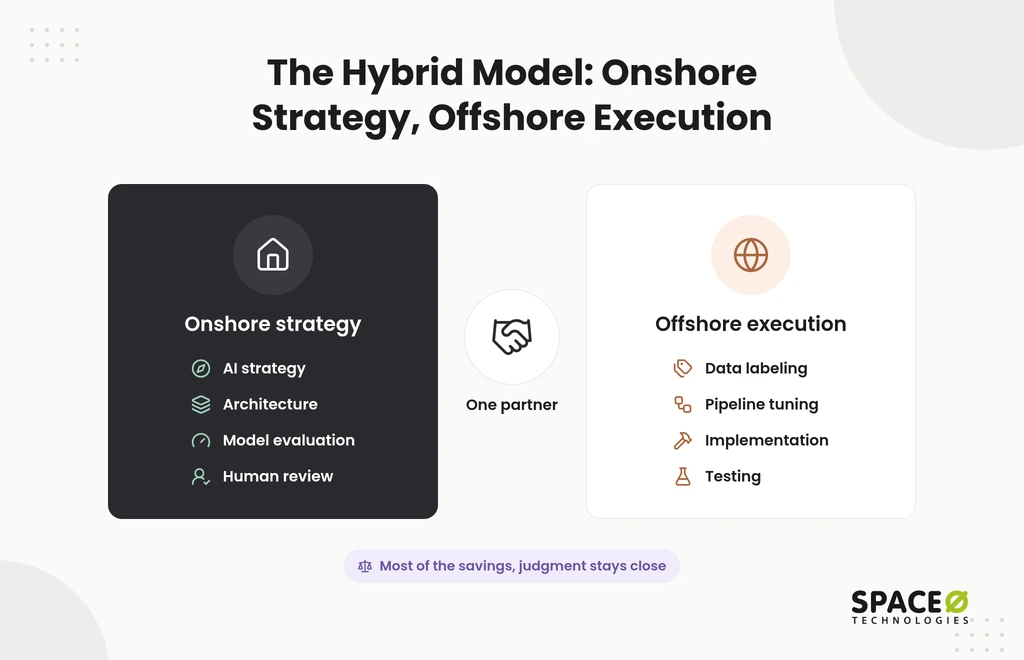
The hybrid model keeps AI strategy, architecture, and human review onshore while sending well-scoped labeling and implementation offshore. It captures most of the savings without shipping the judgment abroad. Many teams settle on it because it resolves the trade-off instead of picking a side.
Total cost of ownership is why hybrid beats a pure cost play. A discount that looks like half on paper often shrinks after rework, coordination, and review. With AI, the erosion runs deeper, because data and retrieval errors surface late. Fixing them means unwinding work that already shipped.
How Space-O Technologies delivers the blend under one team
Space-O Technologies runs the hybrid model as one partner, so you never manage the split yourself. Full-cycle ownership stays under one team. It covers requirements analysis, UI/UX, agile development, QA, deployment, and maintenance. Offices in the USA, Canada, and India keep strategy close to the client and execution efficient across time zones.
For AI work, that means production systems built with grounding, evaluation, and human review by default. We decide RAG design during discovery and run model evaluation before launch. People approve hiring, lending, clinical, and legal decisions. Shipped AI products include GPT Vix, an AI recruitment platform for a US hiring agency.
Whatever location you choose, confirm these contract terms with any provider.
| What to confirm | Why it matters | Space-O Technologies |
|---|---|---|
| Code and IP ownership | Your model and data are your asset | All source code, data, and IP transfer to the client at completion. |
| NDA timing | Protects training data and model design from discovery onward | An NDA is signed before every project starts. |
| Engagement models | Matches the contract to how certain the scope is | Dedicated Team, Time & Material, Fixed Cost, and Staff Augmentation. |
| Office locations | Sets time-zone overlap and jurisdiction | Mesa (Arizona, USA), Brampton (Ontario, Canada), and Ahmedabad (India). |
| Team depth | Reduces reliance on outside contractors | 140+ in-house developers. |
| Payment terms | Ties spend to delivered work | Milestone-based payments tied to deliverables on MVP builds. |
Our Fixed Cost model suits US startups and SMEs that want a defined-scope AI build. It includes client-owned IP and an NDA before kickoff. Enterprises that need ongoing capacity can use the other engagement models to stand up a dedicated AI team. This differs from staffing-only providers, which hand you developers and leave discovery, design, QA, and ownership on your plate.
Which Should You Choose?
Decide one project at a time, not as a permanent company policy. Most AI development project roadmaps contain work that fits different models. Use these rules to sort each project.
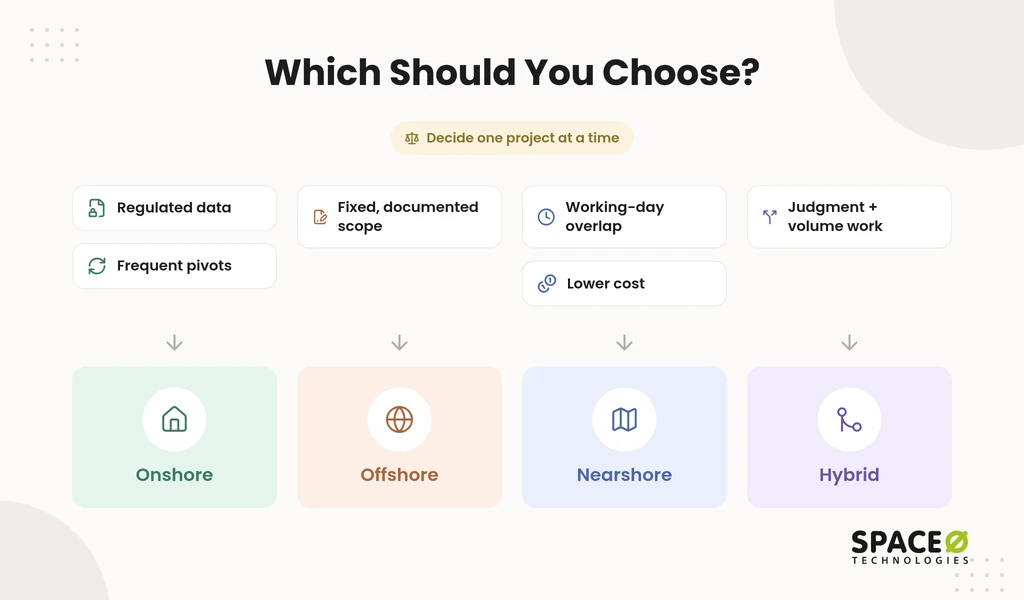
- Choose onshore if your AI touches regulated data, such as HIPAA health records or lending decisions.
- Choose onshore if requirements will pivot often or the work needs live sessions on model behavior.
- Choose offshore if the scope is well defined, such as data labeling or pipeline tuning against fixed specs.
- Choose nearshore if you need working-day overlap but want lower cost than a fully onshore team.
- Choose hybrid if the project mixes high-judgment AI design with high-volume, repeatable execution.
Most production AI projects contain both kinds of work. That makes the decision less about geography and more about cost, which the next section breaks down.
Get a Delivery Plan Built Around Your Data Rules
Tell us your AI use case, data sensitivity, and budget. Our consultants recommend an onshore, offshore, or hybrid mix and return a free, expert-reviewed estimate.

What Onshore and Offshore AI Development Cost
Onshore AI talent costs more, offshore can cut labor costs, and project scope sets the real budget. For a US buyer, the gap shows up best as a multiple rather than an exact rate. AI talent in the U.S. or Europe generally costs noticeably more than it does in many offshore markets.
Offshore delivery can cut development costs, though the real savings depend on scope and coordination. The market is large: Statista projects US$618.36 billion in worldwide IT outsourcing revenue for 2026.
Space-O Technologies prices AI software development services by scope, not by the hour. A basic MVP starts at $15,000, and a feature-rich MVP runs up to $50,000 or more. An enterprise AI platform with custom models, deep integrations, and compliance controls can go well past $500,000. Those figures cover the build, and the next section covers the cost lines a location decision does not touch.
What Location Does Not Change in AI Project Cost
The hourly rate is one line in an AI budget, and data, upkeep, and run costs often decide the total. Location changes what you pay per build hour. It does not change how much data work, cloud usage, or maintenance your AI needs. In most projects, data work, integrations, and production engineering cost more than the model itself.
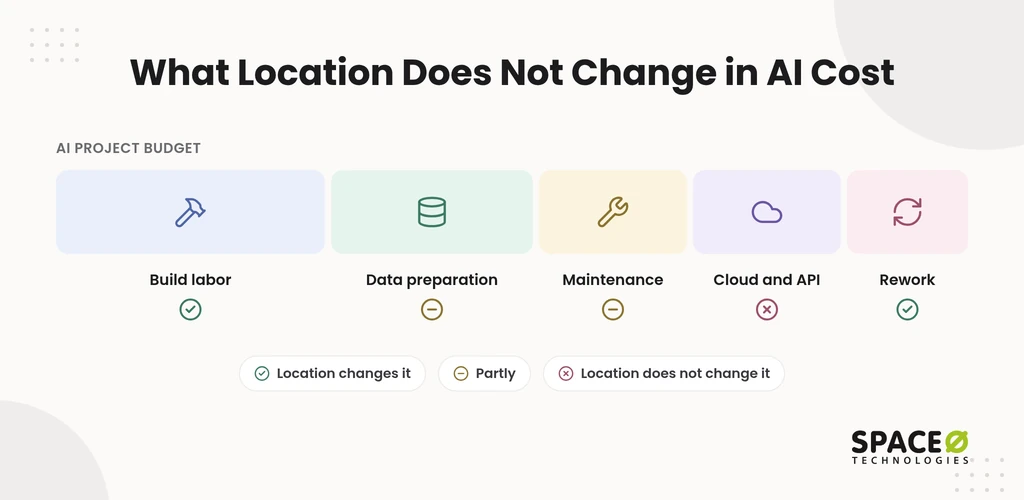
Data preparation can consume 25% to 40% of the total project budget, according to our AI development cost guide. Annual maintenance adds 15% to 25% of the build cost. Infrastructure and API usage sit on top of both.
| Cost line | Does location change it? | What to ask for in the quote |
|---|---|---|
| Build labor | Yes, it is the main lever | Hours by role and by location. |
| Data preparation | Partly, because labeling can go offshore, but data decisions need judgment | A separate line for cleaning, labeling, and validation. |
| Annual maintenance | Partly, because monitoring can be shared, but retraining needs model owners | A monitoring and retraining plan with yearly cost. |
| Cloud infrastructure and API usage | No, because providers bill by usage | Projected monthly hosting and model API fees. |
| Rework | Yes, it rises with ambiguity and distance | How spec changes and failed evaluations are handled. |
A team that trims data preparation to hit a low rate is not removing that cost. It is moving the cost to production, where a wrong answer reaches real users before anyone catches it.
eComChat shows the alternative. Space-O Technologies built this semantic search bot for a US eCommerce store. The work started with search behavior analysis, data mapping, and an AI feasibility assessment before any production code. Real-time indexing updates whenever products change, so retrieval stays in step with the live catalog.
GPU workloads, low-latency responses, and hybrid or on-premises hosting raise both build and monthly costs.
The lesson is simple. Whichever location you choose, price data readiness and evaluation explicitly in every quote.
How AI Is Changing the Onshore vs Offshore Decision
AI is shifting this decision from cost arbitrage to capability. Automation is absorbing the routine coding that the low-cost offshore model was built on. In Deloitte’s 2024 global outsourcing survey, 83% of surveyed executives said they use AI in outsourced services.
Three shifts follow from that change:
- AI-Augmented Offshore: AI coding tools let smaller offshore teams cover routine implementation faster.
- Lean Onshore Squads: Smaller onshore teams can keep architecture and review in-house with AI support.
- Rebalanced Sourcing: The same survey notes insourcing and global in-house centers regaining momentum.
As routine implementation gets cheaper everywhere, the deciding question changes. It stops being “which country is cheaper per hour” and becomes “who can own the AI capability end to end.” That favors partners who treat governance and evaluation as the core of AI software development.
How to Vet an Onshore or Offshore AI Development Company
Vet any provider on production AI evidence, controls, and contract terms, not on location alone. A low rate means little if the team has only shipped demos. Use these checks before you sign.
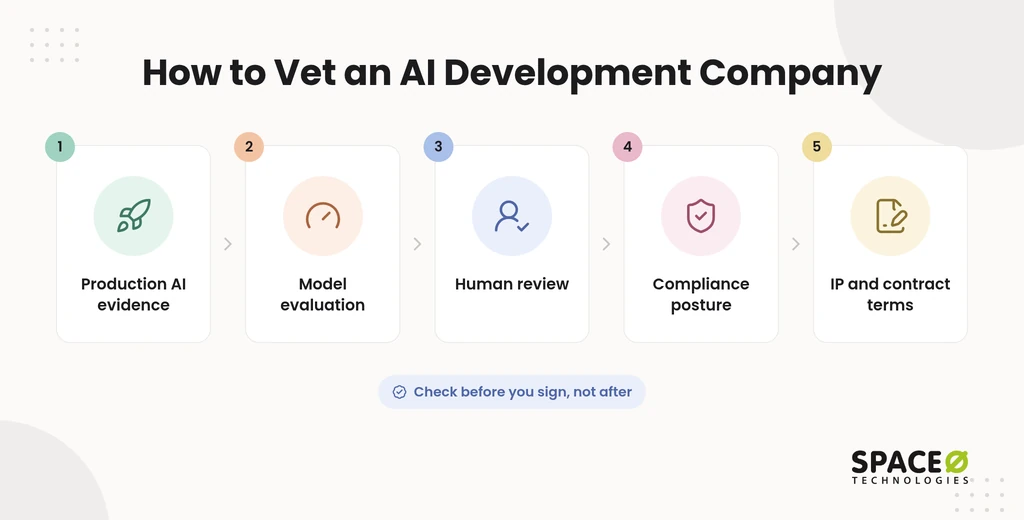
- Ask for AI systems running in production, not prototypes or slide decks.
- Ask how models are evaluated for accuracy, hallucination rate, bias, latency, and cost.
- Ask where human review sits before an output influences a final decision.
- Confirm the provider’s compliance posture for your data, including HIPAA, GDPR, or CCPA scope.
- Confirm IP transfer, NDA timing, and the engagement model in the contract itself.
At Space-O Technologies, every model we put into production is wrapped in an evaluation suite. It covers accuracy, hallucination rate, bias checks, latency, and cost, with continuous monitoring in place. Automation handles the volume, but a qualified human approves before any output influences a final decision. Our compliance posture covers ISO 27001 certification and HIPAA-ready frameworks for healthcare AI engagements.
If you want a clear answer for your own project, talk to our AI development team. You get a recommended delivery mix and a free, expert-reviewed estimate.
Frequently Asked Questions
What does “onshore” mean?
Onshore means your development team is based in your own country. For a US company, that is a team working US hours under US law. It is the most expensive model, but you get real-time collaboration and an easier time controlling compliance, IP, and sensitive data.
How much cheaper is offshore AI development than onshore?
Offshore rates run below onshore rates, but the gap depends on country, role, and scope. Coordination, rework, and review shrink the paper savings, so compare total project cost.
Is offshore AI development safe for HIPAA or financial data?
Regulated AI work, such as HIPAA-covered health data and lending or financial decisions, generally stays onshore. Keeping training data domestic and decisions auditable under one jurisdiction is far simpler. Offshore introduces cross-border data-security and intellectual-property questions that many compliance regimes will not accept. If your AI touches sensitive data, weigh compliance ahead of cost in the decision.
What is a hybrid or blended AI development model?
A hybrid model keeps strategy, architecture, model evaluation, and human review onshore. It sends well-scoped, repeatable work like data labeling and pipeline tuning offshore.
Does the time-zone gap always hurt offshore AI projects?
Not if the scope is well-defined and documented. A large time-zone gap creates async delays on ambiguous, fast-changing work. But teams can turn it into a “follow-the-sun” advantage, handing tasks across zones for round-the-clock progress. That works when the specification is unambiguous. The gap hurts most on AI tasks that need live decisions about model behavior.
Why does AI change the onshore-vs-offshore decision at all?
AI is shifting the onshore versus offshore choice from cost toward capability. Automation is absorbing routine coding, so judgment-heavy work matters more.
How do I choose between an onshore and an offshore AI development company?
Choose by project, based on budget, complexity, data sensitivity, and how closely you need to collaborate. Pick onshore if your AI touches regulated data or needs live sessions on model behavior. Pick offshore if the scope is well defined and documented, such as data labeling or pipeline tuning. If the project mixes both kinds of work, a hybrid team fits best. Compare total project cost, not hourly rates alone.
What is nearshore AI development?
Nearshore AI development uses a team in a nearby country with close working-day overlap. For US companies, that usually means Canada or Latin America. It costs less than onshore and keeps most real-time collaboration.



 All our projects are secured by NDA




 4.8


