
 By
Contents
- An AI development partner multiplies a CTO’s engineering capacity with engineers and governed AI agents.
- AI adoption runs in three phases: productivity, AI-powered products and agents, then AI-native reimagination.
- AI output is non-deterministic, so it requires logging, evaluation suites, and human code review before production.
- Put code, fine-tuned weights, prompts, and data ownership in the contract before any work starts.
Key Takeaways
An AI development partner for a CTO acts as a force multiplier. It pairs external engineers with AI agents and governance. Your team ships production AI through our AI development services without growing headcount.
Your AI roadmap probably grows faster than you can hire. Coding agents write more code, so the bottleneck moves to review and design. The wrong partner leaves you with a polished demo, not production software.
This page covers what a partner delivers, how an engagement runs, and how to judge proof. If agents come first, scope the work with our AI agent development team. Book a free consultation to get an expert-reviewed estimate for your build.
AI Roadmaps Outpace Hiring, and Demos Stall Before Production
Most CTOs already have an AI roadmap and too few engineers to deliver it. The risks below appear before the first release, not after it. Each one shapes the kind of partner you need.
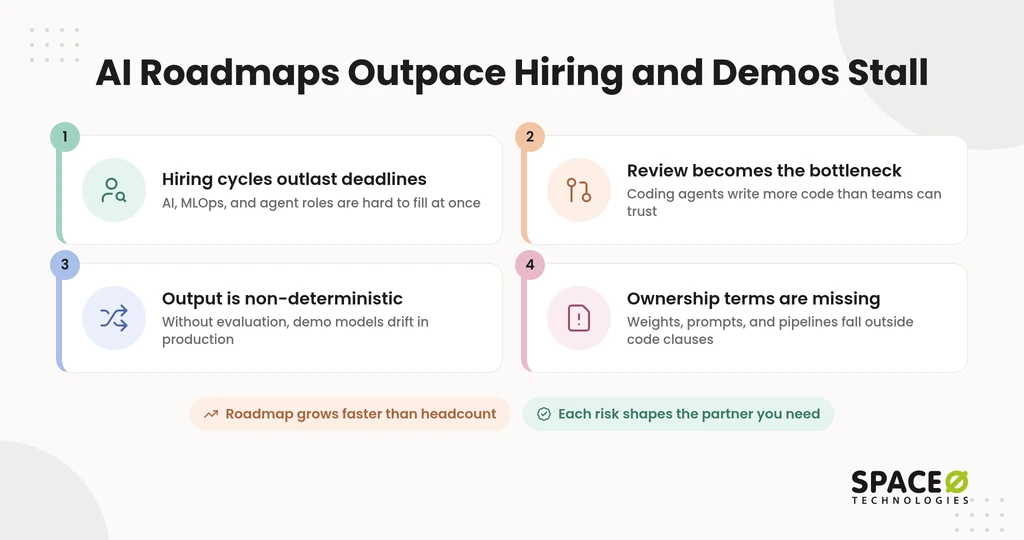
Hiring cycles outlast the deadlines they serve
A full hiring cycle can outlast the deadline it was meant to meet. AI engineers, machine learning operations (MLOps) specialists, and agent developers are hard to hire all at once. That is why many teams weigh the benefits of outsourcing AI development instead of hiring everything in-house. Your board still expects the release on schedule.
Coding agents move the bottleneck to code review
AI coding agents shift the engineering bottleneck from writing code to code review and system design. Engineers spend more time selecting the right AI for each task, reviewing outputs, and connecting agents to data sources. A team without review capacity ships more code than it can trust.
Non-deterministic output needs logging and evaluation
AI output is non-deterministic so the same request can return slightly different results each time. Without evaluation loops, a model that passed a demo can drift in production unnoticed.
Missing ownership terms create risk after launch
Contracts that skip IP and data ownership create risk long after launch. Fine-tuned weights, prompts, and data pipelines often fall outside standard code clauses. Gartner explains why generative AI projects stall after the proof of concept. Set production terms before the pilot starts.
Each of these risks has a matching capability, covered next.
What Your AI Development Partner Delivers to Engineering Teams
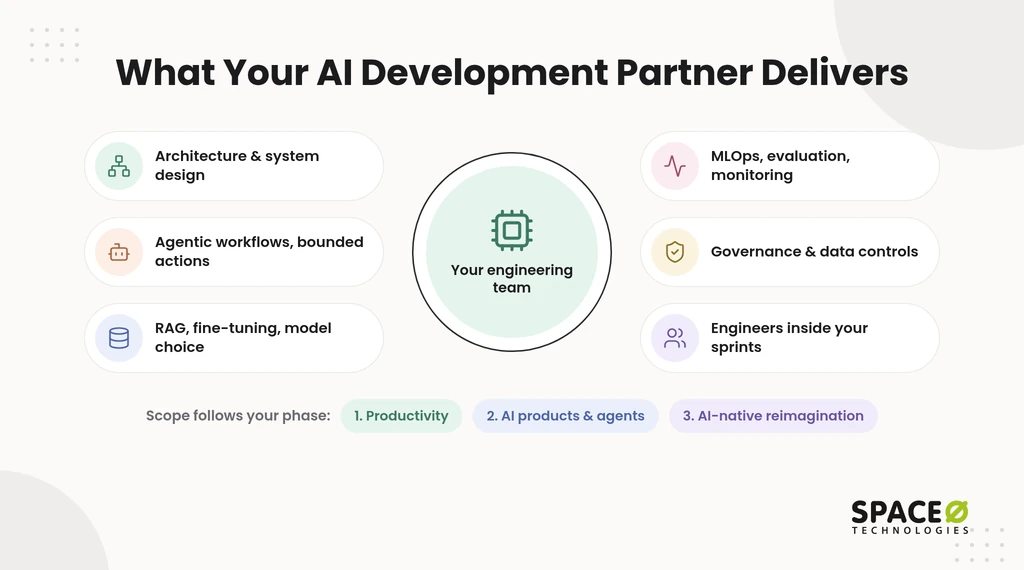
Space-O Technologies designs, builds, integrates, and runs AI inside your existing systems, under your technical direction. We work as an external extension of your engineering team. Each capability below closes a gap from the previous section.
Scope that follows the three phases of AI adoption
We scope partner work in three phases, and the scope should match the phase you are in.
- Productivity: Engineers use AI coding agents to speed up daily work.
- AI-powered products and agents: Teams add AI assistants and agents to the products customers use.
- AI-native reimagination: Teams re-architect existing products around AI-native capabilities.
Your phase decides which steps of an agentic AI transformation roadmap apply first. A staged AI roadmap for CTOs sets nine adoption levels and names daily team use as the first milestone. For wider adoption data, see McKinsey’s State of AI survey.
Architecture and system design for agentic systems
We define how models, data, and services connect before any agent writes code. That work covers retrieval layers, vector databases, application programming interface (API) gateways, and event pipelines. We also move legacy systems toward scalable, API-driven, AI-ready architectures. We choose orchestration frameworks such as LangChain, CrewAI, and LangGraph per workflow, not by default.
Agentic and multi-agent workflows with bounded actions
We build AI agents that take bounded actions inside your tools, with permissions and audit logs. Multi-agent systems split roles such as coding, testing, quality assurance (QA), and site reliability engineering (SRE). Agents connect to your internal packages, APIs, and enterprise data rather than generating isolated, generic code. Guardrails and human-in-the-loop checkpoints stay on for high-stakes actions, such as claims denials or pricing changes.
RAG, fine-tuning, and model choice made problem-first
We ask about your business problem first and pick the model last. Retrieval-augmented generation (RAG) grounds answers in your own documents without retraining. Fine-tuning adapts a model to a narrow task when prompting and retrieval fall short. Hosted models from OpenAI, Claude, or Amazon Bedrock give the fastest start, with usage costs to track. We stay model-agnostic and recommend whichever option solves the problem most cost-effectively.
MLOps, evaluation, and monitoring in production
Every model we put into production is wrapped in an evaluation suite, with continuous monitoring in place. The suite covers accuracy, hallucination rate, bias checks, latency, and cost. MLOps practices add versioning, rollback, and evaluation gates before each release. Dashboards then track model drift, cost per token, and inference latency against agreed thresholds.
Governance, security, and data controls by default
We build governance into every release instead of adding it after launch.
- No training on client data: We never train models on your data.
- PII masking: We mask personally identifiable information (PII) before prompts reach a model.
- Hallucination and bias testing: We test outputs against source documents and across user groups before release.
- Human review for high-stakes decisions: Automation handles the volume, but a qualified human approves before any output influences a final decision.
- Framework mapping: We map these controls to the AI Risk Management Framework from the National Institute of Standards and Technology (NIST).
Engineering capacity inside your sprints
Vetted engineers join your sprints, tools, and code review process from the first week. Space-O Technologies handles screening, onboarding, and replacements, so you carry no hiring overhead. Our 140+ in-house developers cover AI, mobile, web, backend, full-stack, and ServiceNow work. When the gap is a single skill, you can hire AI agent developers instead of a full team.
Add Vetted AI Engineers to Your Next Sprint
Tell us your roadmap gaps and sprint cadence. Our AI engineers recommend the right team shape and send a free, expert-reviewed estimate for your build.

Coding agents and platforms your partner works alongside
AI tools and platforms complement a partner, but none of them owns delivery. Roundups from Elephas and Faros AI group these tools by category. The table describes each tool in the terms those sources use.
| Tool | Category | What it does, per the sources | What your team still owns |
|---|---|---|---|
| GitHub Copilot, Cursor, Amazon Q Developer, Claude | Code development tools | These tools generate and suggest code directly inside the developer’s workflow, according to the roundups. | Your team still owns code review, merge decisions, and repository access when these tools generate code. |
| Aider | Command-line coding agent | Handles serious multi-file refactors from the command line. | Refactor scope and review of each change. |
| RooCode | Reliability-first coding agent | Handles big, multi-file changes. | Review of each change set. |
| Devin (Cognition) | Autonomous software engineer | Plans, writes, tests, and ships production code on its own. | Pull request review and production approval. |
| Lovable | Vibe coding app builder | Builds apps from natural-language descriptions. | Architecture, security review, and scaling past the prototype. |
| Emergent | Autonomous app builder | Plans front-end and back-end tasks, configures infrastructure, and iterates. | Architecture, security review, and scaling past the prototype. |
| CTO.ai | Developer control plane | It runs continuous integration and delivery (CI/CD) workflows in Slack, using hybrid-cloud, fine-tuned private LLMs. These models support code review and DORA metrics for the continuous integration and delivery workflows. | Pipeline policy and model hosting choices. |
| cto AI Business (cto.new) | Multi-agent platform | A Team Lead orchestrates specialist Members. | Task scope and output review. |
| AWS Startup Advisor | Virtual CTO assistant | AWS Startup Advisor is described as a “CTO on my shoulder” for architecture, infrastructure, and security. The description also covers cost and scaling decisions, so it works as a virtual CTO assistant. | Final architecture and cost decisions. |
| Snyk AI | Security scanning | Finds and fixes security problems in code. | Triage and approval of each fix. |
Generated code still needs checks for security flaws, outdated libraries, and end-of-life dependencies. Closing that gap between generated code and production code is the partner’s job, and the steps below show how.
How an AI Development Partnership Runs in Five Steps
A partnership runs in five steps, from problem-first discovery to monitored production. Each step has an owner and an exit check. A skipped step usually returns later as rework.
- Problem-first discovery: We name the metric to move and the manual step that blocks it. Our AI consulting services map use cases, data readiness, and architecture before any code.
- Engagement model: You choose fixed cost, time and materials, dedicated team, or staff augmentation from the table below.
- Architecture and data preparation: We design the system and prepare your data, often the largest single cost driver.
- Build under review: Engineers and agents work inside your sprints, with code review and evaluation gates on every merge.
- Launch and maintenance: We monitor drift and cost, then handle model updates, provider API changes, and security patches.
Engagement models matched to the job
Match the model to the job: validate an idea, ship a feature, sustain a product, or fill a skill gap.
| Your situation | Engagement model | Who owns delivery | IP and handover terms | Typical scope and timeline (USD) | When to bring it in-house |
|---|---|---|---|---|---|
| Validate an AI use case | Fixed-cost proof of concept or MVP | Space-O Technologies, against a fixed scope | Full code and IP ownership from day one | Proof of concept $15,000-40,000 (4-8 weeks); AI MVP from $20,000-40,000 | When the use case is proven and the roadmap extends past one release |
| Ship a scoped AI feature | Time and material | Your product owner sets priorities; Space-O Technologies builds | Full code and IP ownership from day one | Basic AI feature: $40,000-100,000 | When the feature becomes core to your product and changes weekly |
| Build a long-term AI product | Dedicated team | Space-O Technologies team, run against your roadmap with a dedicated project manager | Full code and IP ownership from day one | Monthly billing; 160 hours per full-time developer; one-month minimum | When you can hire and retain the roles the dedicated team fills |
| Fill an AI or ServiceNow skill gap inside existing sprints | Staff augmentation | Your engineering leads; Space-O Technologies handles vetting, onboarding, and replacements | Full code and IP ownership from day one | Matched in 48-72 hours, onboarded within days; one-month or 25-hour minimum | When the skill is needed permanently rather than per project |
The ranges come from our guide to the cost to develop an AI solution. Across project tiers, AI development cost ranges from $25,000 to $500,000+. Data preparation takes 25% to 40% of the total project budget. Yearly AI maintenance adds 15% to 25% of build cost, plus cloud and model usage fees.
At handover, Space-O Technologies transfers all source code, data, and IP to you. We do not retain, reuse, or share project assets or client data afterward. With the model chosen, the next question is what proof backs the partner.
Production Proof CTOs Can Check Before Signing
Production experience shows up as live systems, monitoring, and support terms, not slide decks. A demo shows that a model can answer once. Production shows it keeps answering correctly with real users, real data, and real costs.
50+ AI systems in production, built by 30+ AI engineers
Space-O Technologies reports 50+ AI systems in production, built by 30+ AI engineers. Each system runs with the evaluation and monitoring described above. Ask every partner for the same evidence: running systems you can discuss with a reference client.
OpenAI Select Partner and AWS Partner standing
We are an OpenAI Select Partner and an AWS Partner, and our team includes Claude Certified Architects. These credentials matter when your stack spans more than one model provider. They let us compare providers for your case instead of defaulting to one, backed by our generative AI expertise.
Delivery record and client retention
We have delivered 300+ software solutions and report 97% client retention. Our 4.8 rating on Clutch covers quality, schedule, cost, and willingness to refer.
Compliance posture for regulated engineering work
Our compliance posture covers ISO 27001 and ISO 9001 certifications and HIPAA-ready frameworks for healthcare AI engagements. Work runs under a non-disclosure agreement (NDA) signed before the project starts.
Proof shows a partner can deliver. The next section shows where that partner fits beside other options.
Why CTOs Choose an Engineering Partner Over Tools Alone
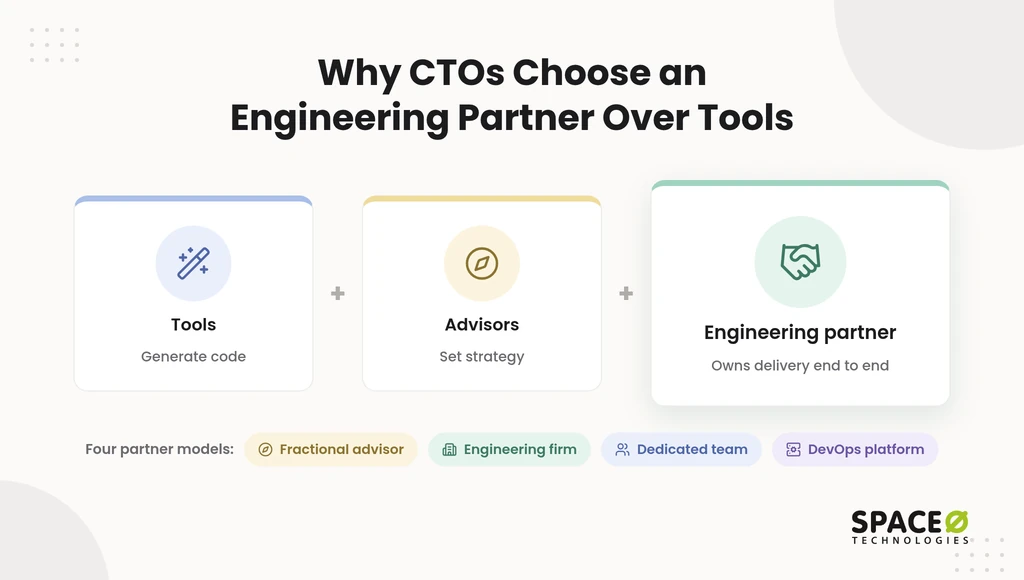
Tools generate code, advisors set strategy, and an engineering partner owns delivery end to end. Many CTOs combine all three. The comparison below shows where each one fits.
Four partner models solve different problems
CTOs typically choose among four partner models: fractional advisors, AI engineering firms, dedicated or augmented teams, and DevOps platforms. Picking the wrong one leaves a gap in either strategy or delivery. If you are weighing a firm against a solo hire, compare an AI development company vs. a freelancer first.
- Fractional CTO or AI advisor: A part-time executive who combines technical leadership with business acumen to set AI strategy.
- AI engineering agency or consultancy: An external firm that runs discovery, design, build, and maintenance as one accountable team.
- Dedicated team or staff augmentation: External engineers who join your sprints under your technical leadership.
- AI DevOps and workflow platforms: Software that automates development and operations (DevOps) pipelines without building your product.
| Partner model | Who owns end-to-end delivery | Production AI proof of concept request | Code, IP, and data ownership | Governance built in | Engagement flexibility |
|---|---|---|---|---|---|
| Fractional CTO / AI advisor | Advises only; your team or another vendor builds | Systems they helped ship in prior roles | Mostly strategy documents, not code | Sets policy; implementation sits elsewhere | Part-time retainer |
| AI engineering agency or consultancy | Owns discovery, design, build, and maintenance | Live systems and reference clients | Must be assigned to you in the contract | Should ship with every release | Varies by firm: fixed cost, time and material, or dedicated team |
| Dedicated team/staff augmentation | Your leads own delivery; the vendor supplies engineers | Engineers’ shipped AI work | Typically yours under contract | Follows your existing policies | Scales by headcount |
| AI DevOps and workflow platforms | Automates pipelines; does not build your product | Platform uptime and integrations | Platform terms apply; review data handling | Platform-level controls only | Subscription |
Space-O Technologies works in the second and third models. We are not a fractional CTO service or a DevOps platform.
Six checks that separate production partners from demo builders
Look for a partner that proves production work, assigns you ownership in the contract, and states its data policy plainly. Vendor pitches often sound alike, and these six checks separate them quickly.
- Problem-first diagnosis: Ask what they would measure in week one, and expect a business metric rather than a model name.
- Live production systems: Ask for running systems you can discuss with a reference client.
- Ownership terms: Confirm the contract assigns code, fine-tuned weights, prompts, and pipelines to you, while you keep product strategy and data.
- Model-agnostic advice: Ask which models they would rule out for your case, and why.
- Data policy: Request a written policy that bars training on client data.
- Drift and update support: Ask who retests and redeploys when a provider changes a model.
One accountable partner across software, AI, and ServiceNow
CTOs get one partner for software, mobile, web, software as a service (SaaS), AI, ERP, CRM, and ServiceNow work. ERP means enterprise resource planning, and CRM means customer relationship management. A dedicated project manager sends you daily updates. You coordinate fewer vendors as AI work reaches more of your systems.
Even with the right partner, one layer needs explicit ownership, and it is covered next.
Agent Governance Is the Layer Tools and Advisors Leave Open
The gap no tool or advisor closes alone is who reviews, approves, and answers for agent output in production. Coding agents raise output, and advisors write policy. A partner runs the review loop between them, with named reviewers and checkpoints drawn from AI governance and compliance consulting practice.
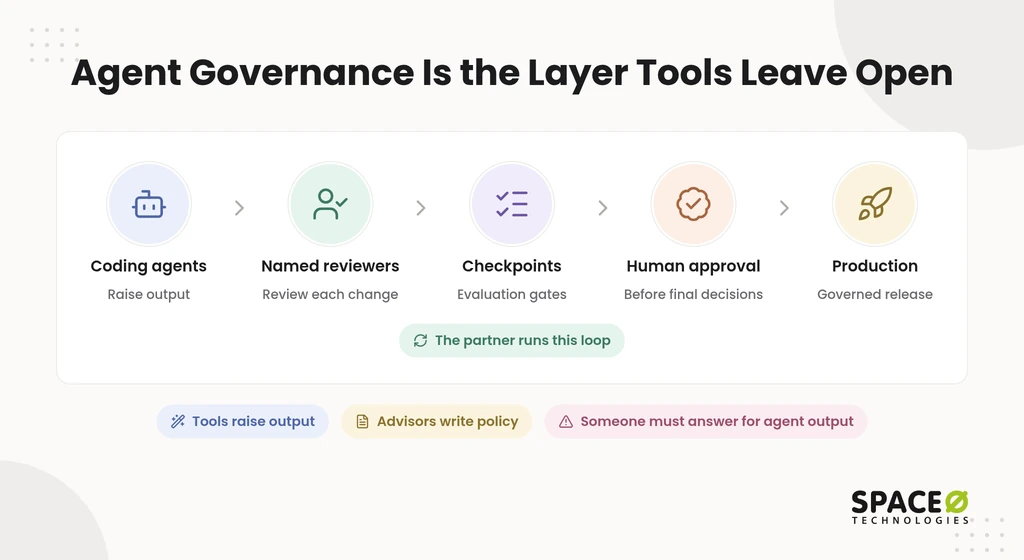
At Space-O Technologies, automation handles the volume of agent work. A qualified person approves every consequential output before it influences a final decision.
Scope Your AI Partnership Before You Commit
A short scoping review tells you which engagement model fits before you sign anything.
Get Your AI Build Scoped Before You Sign
Share your use case, systems, and data. Our AI engineers review the scope and flag delivery risks early, so you can compare engagement models before you sign.
Tell us your stack, the first workflow you want to automate, and your compliance scope. Our AI engineers will recommend an engagement model and flag risks early. Talk to our AI engineers for your free, expert-reviewed estimate.
Frequently Asked Questions
When should a CTO choose time and material over a fixed-cost proof of concept?
Choose time and material when you are shipping a scoped AI feature. Your product owner sets priorities while the partner builds.
What’s the difference between AI-assisted and AI-native development?
AI-assisted development matches the first adoption phase, productivity, where engineers use AI coding agents to make daily work faster. AI-native development matches the third phase, where teams rebuild existing products around AI-native capabilities. A second phase sits between them, in which AI assistants and agents are added to customer-facing products.
How much does an AI development partner cost?
AI development cost ranges from $25,000 to $500,000+ across project tiers. Data preparation takes 25% to 40% of the budget. Yearly maintenance adds 15% to 25% of build cost.
What is an AI development partner for a CTO?
An AI development partner is an external team that designs, builds, integrates, and maintains AI inside your existing systems. It works to your roadmap, adds engineering capacity without permanent hires, and builds in security, data privacy, and governance.
How is an AI development partner different from an AI consultant?
An AI consultant advises on strategy, while an AI development partner also builds, ships, and maintains the system. A partner that does both can carry advisory findings straight into the build.
Who should own the code and IP an AI development partner builds?
You should, and the contract should say so before work starts. Ask who owns the source code, data, fine-tuned model weights, and documentation at handover. Space-O Technologies gives clients full code and IP ownership from day one.
Which engagement models do AI development partners offer?
Four engagement models are common: fixed cost, time and material, dedicated team, and staff augmentation. Fixed cost suits a scoped proof of concept, time and material evolving features, dedicated teams long-term products.
How should an AI development partner protect your data?
A partner should never train models on your data, and it should mask personally identifiable information (PII). Ask for hallucination and bias testing before release, and human review for high-stakes decisions. Space-O Technologies works this way by default, under an NDA.



 All our projects are secured by NDA




 4.8


