
 By
Contents
- An AI development company with MLOps capabilities builds custom models and runs them in production.
- Six MLOps capabilities matter: CI/CD, drift monitoring, versioning, cloud deployment, governance, and LLMOps.
- Ask every vendor who runs the model after launch and who owns the code.
- Budget yearly upkeep on top of the build cost, not as an afterthought.
Key Takeaways
Many AI models work in a demo and fail in production. Nobody owns deployment, monitoring, or retraining once the pilot ends. An AI development company with MLOps capabilities builds the model and keeps it running.
Space-O Technologies has built AI-powered custom software since 2010. We have served 1,200+ clients and delivered 300+ software solutions. Our AI development services cover model building and its operation.
This guide explains the six MLOps (Machine Learning Operations) capabilities to expect. It also shows how to compare vendors and what yearly upkeep costs. Use it to shortlist a partner that can build and run your model.
Space-O Technologies: AI development and MLOps under one team
Space-O Technologies: Builds custom AI models and runs them in production on Amazon Web Services (AWS), Azure, and Google Cloud.
We remove that ownership gap with one team that both builds the model and operates it.
We fit companies that want AI built into their custom software products. One team runs that work from MVP (minimum viable product) to production.
- Since 2010: We have built AI-powered custom software since 2010.
- 1,200+ clients: We have served clients across startups, SMEs, and enterprises.
- 300+ software solutions: We have developed and delivered these solutions.
- 140+ in-house developers: Your project is staffed by our own engineers.
- Three offices: We have offices in Mesa (Arizona), Brampton (Ontario), and Ahmedabad (India).
Our machine learning development services cover the model build itself.
MLOps capabilities Space-O Technologies delivers
We deliver six MLOps capabilities, and each one keeps a model accurate after launch. Models degrade quietly when real-world data changes. These capabilities catch that decline early, and ship fixes safely.
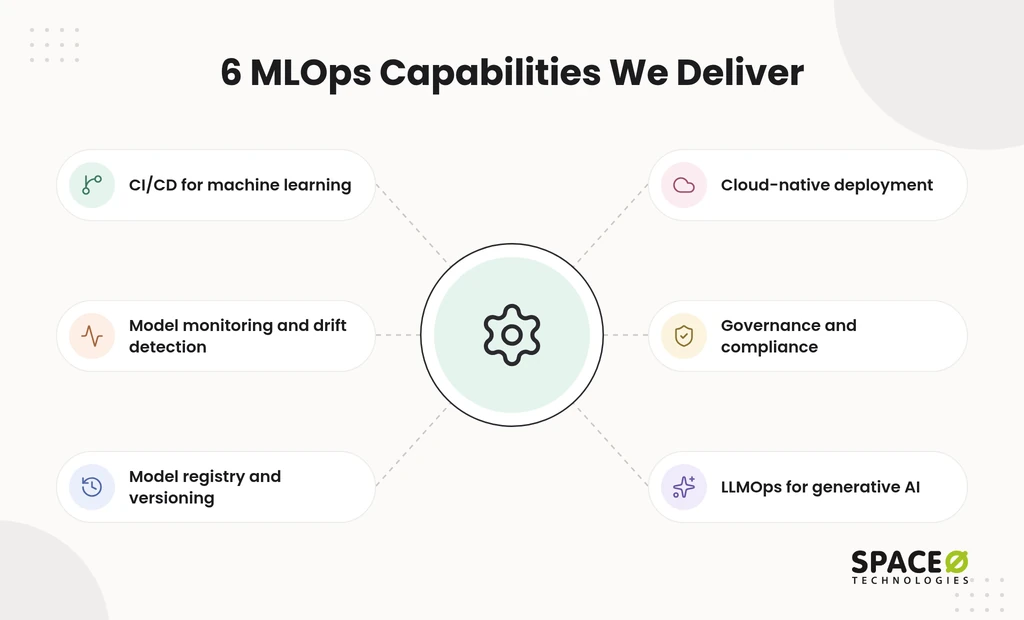
1. CI/CD for Machine Learning
We automate testing, training, and deployment so every model release follows the same checked path. Manual releases break when one person forgets a step. Our pipelines add continuous training (CT) to standard CI/CD.
- Code, data, and model checks: Every change runs validation before it ships.
- Automated retraining jobs: New data can trigger a training run without manual setup.
- Release gates: A model ships only after it passes accuracy and performance tests.
2. Model Monitoring & Drift Detection
We watch live predictions for data drift and concept drift, then alert your team or trigger retraining. A model trained on last year’s data can lose accuracy without throwing a single error. Monitoring makes that decline visible.
- Data drift: You get an alert when incoming inputs move away from the training data.
- Concept drift: You get an alert when the link between inputs and outcomes changes.
- Retraining triggers: Set thresholds start a retraining run or a human review.
- Performance dashboards: Accuracy, latency, and error rates appear in one view.
3. Model Registry & Versioning
We version every model, dataset, and configuration in a registry, so you can trace or roll back any release. Without versioning, nobody can say which model made a given prediction. That becomes a real problem during audits and incidents.
- Model lineage: Each version links to its training data and code.
- Rollback: A faulty release returns to the last good version.
- Approval records: Each promotion records who approved it and when.
4. Cloud-Native Deployment
We deploy models on AWS, Azure, or Google Cloud, using the environment your team already runs. Moving to a new cloud for one model adds cost and risk. We work inside your existing account and tooling instead.
- Containerized serving: Docker and Kubernetes keep environments consistent from test to production.
- Autoscaling: Inference capacity follows demand, so you avoid paying for idle servers.
5. Governance & Compliance
We build access control, audit trails, and regulatory mapping into the pipeline from the start. Regulated teams must show who changed a model and why—adding that later is slow and expensive.
- Role-based access control (RBAC): Only approved people can change or promote models.
- Audit trails: Training runs, approvals, and deployments are all logged.
- Regulatory mapping: We match controls to your rules, such as HIPAA (Health Insurance Portability and Accountability Act).
6. LLMOps for Generative AI
We extend the same pipelines to large language model operations (LLMOps) for generative AI features. Language models fail in a different way. They can return confident, wrong answers that standard accuracy checks miss.
- Retrieval-augmented generation (RAG) indexes: Indexes are rebuilt when source documents change.
- Evaluation sets: Prompts are scored for faithfulness and hallucination before each release.
- Prompt versioning: Prompts are tracked like any other model release.
For the feature build itself, see our guide to custom LLM development and fine-tuning.
What to look for in an AI development company with MLOps
Look for one team that both builds and operates the model, with clear ownership, costs, and controls. Vendors are hard to compare when every site lists the same capabilities. The criteria below separate a production partner from a prototype shop.
Six criteria and how Space-O Technologies answers them
Each criterion pairs a question to ask a vendor with our answer.
- Builds and operates under one team: Ask who runs the model after launch. We keep model building and MLOps work with the same team.
- Code and IP ownership: Ask whether you will own the models and the pipeline code. All source code, data, and intellectual property (IP) built during a project transfer to you at completion.
- Engagement flexibility: Ask whether the contract can adapt when scope changes. We offer four engagement models, ranging from fixed cost to a dedicated team.
- Maintenance cost transparency: Ask for an annual run-cost estimate before signing. We publish our planning range for AI maintenance.
- Governance and documented process: Ask to see the access controls and audit logs. We sign an NDA (non-disclosure agreement) before every project.
- Named cloud coverage: Ask which clouds the team deploys on. We work on all three major clouds.
How do the alternatives compare?
In-house teams, large consultancies, and MLOps platform vendors can all work, but each asks something different of you. The right choice depends on who will own the model in year two.
- In-house team: You hire machine learning and platform engineers, then own the tooling and on-call duty. Our guide to machine learning development companies compares these options in more depth.
- Large consultancies: Engagements are often scoped as enterprise programs. Plan for formal procurement and minimum commitments.
- MLOps platform vendors: They supply the tooling. Your team still builds the models, configures the pipelines, and runs operations.
How an MLOps project runs
Our projects follow five steps, from readiness check to ongoing operation. Teams often jump straight to model training. Skipping the earlier steps is a common source of rework.
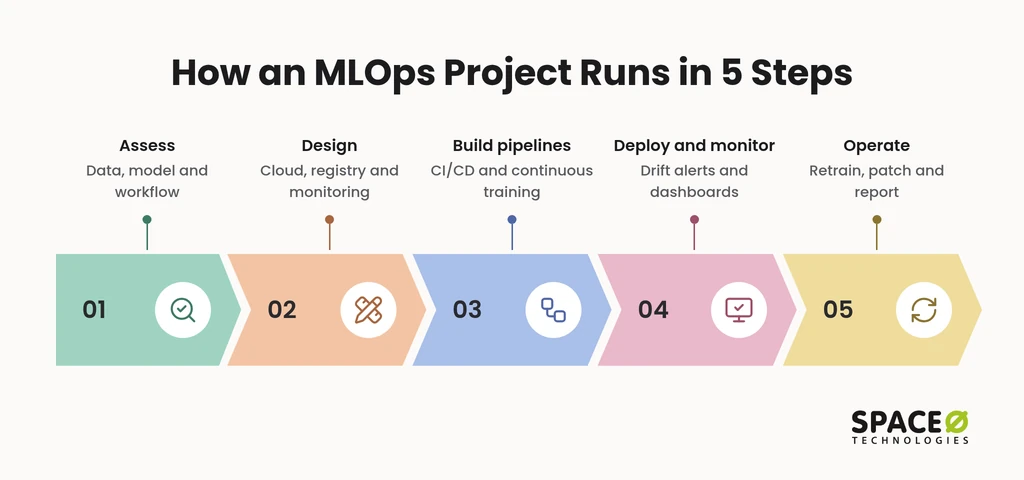
- Assess: We review your data, current model, and target workflow. We use RAG first when facts change often, and fine-tune only for narrower needs.
- Design: We choose the cloud setup, registry, and monitoring approach. We also agree on success thresholds with you.
- Build pipelines: We set up CI/CD and continuous training with release gates.
- Deploy and monitor: The model goes live with drift alerts and dashboards in place.
- Operate: We retrain, patch, and report on the model through our software maintenance services.
Tell us your cloud and use case
Share three details, and we can scope the right MLOps setup for your model. Scoping goes faster when we know where your model lives today.
- Your cloud: AWS, Azure, Google Cloud, or none yet.
- Your use case: For example, forecasting, fraud detection, or a support assistant.
- Your starting point: An idea, a prototype, or a model already in production.
Get Your MLOps Setup Scoped Free
Share your cloud, use case, and starting point with our team. We will return a scoped plan and a yearly run-cost estimate for your model.

Engagement models and the cost of running AI
Running AI in production costs money every year, so we price that work before the build starts. Many buyers budget for the build and treat upkeep as an afterthought. That gap surfaces later as an unplanned bill. McKinsey’s State of AI survey found most organizations use AI in at least one business function. Only about one-third have scaled it.
Annual maintenance for an AI build typically costs 15% to 25% of the original development cost. That recurring share applies every year. This planning range comes from our AI development cost analysis. Infrastructure and application programming interface (API) usage add to that total.
For a $100,000 build, that means $15,000 to $25,000 a year in maintenance. API usage is billed separately, and cloud hosting is scoped per project.
Which engagement model fits your project?
Pick the model that matches how fixed your scope is. Payments are milestone-based and tied to deliverables.
- Fixed Cost: Suits a clearly scoped pipeline or a first production release.
- Time & Material: Suits work where scope will shift as data issues appear.
- Dedicated Team: Suits long-running programs that cover both the build and operation.
- Staff Augmentation: Suits teams that need specific MLOps skills added.
What does the annual maintenance budget cover?
Maintenance pays for the work that keeps a model accurate and secure after launch.
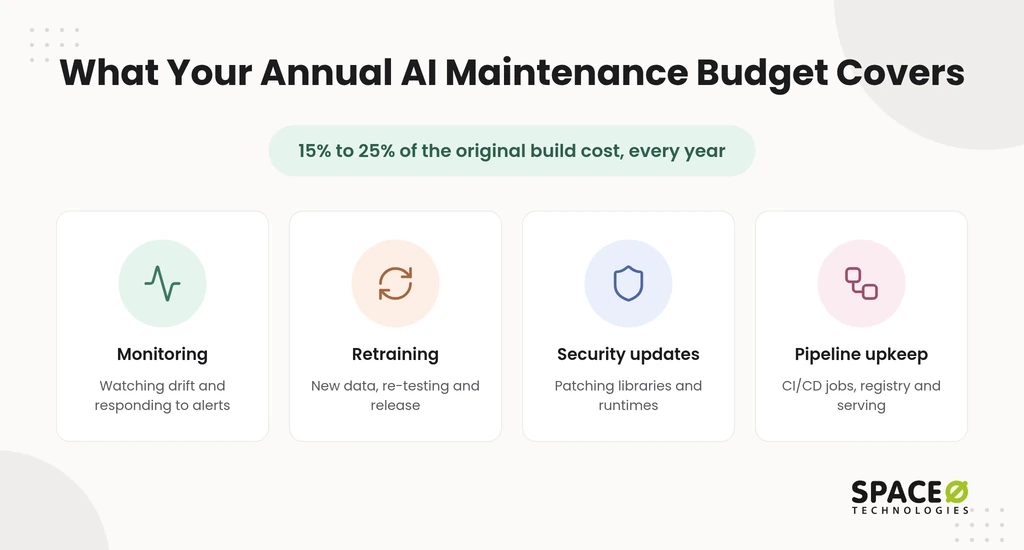
- Monitoring: Watching drift and responding to alerts.
- Retraining: Training on new data, re-testing, and releasing the update.
- Security and dependency updates: Patching libraries and runtime environments.
- Pipeline upkeep: Maintaining the CI/CD jobs, registry, and serving infrastructure.
Proof from products we have built and scaled
Our clients stay with us, and products we built have scaled to millions of users. Buyers need evidence beyond capability lists.
- Client retention: Space-O Technologies reports that most of its clients stay with it.
- Glovo: We built this on-demand delivery app. It secured $1.2 billion in funding, was chosen for Apple’s Best of 2016, and passed 30 million downloads.
- Fyule Video Lab: We built this video learning platform. It secured $1.4 million through an angel syndicate.
These products show our record of building software that scales. They are not presented as MLOps case studies.
How we keep production AI safe and accountable
Our default controls protect your data and keep people in charge of high-stakes decisions. Production AI raises hard questions about privacy and errors. Clear defaults answer those questions before launch.
- No training on client data: Your data stays out of shared model training.
- PII masking: We mask personally identifiable information (PII) before processing.
- Hallucination and bias testing: We test outputs before release.
- Human review: People approve high-stakes decisions in lending, clinical, and similar workflows.
Our guide to responsible AI development explains these controls in more depth.
Frequently Asked Questions
What should I look for in an AI development company with MLOps capabilities?
Look for one team that builds and operates the model, with clear ownership, costs, and controls. Score each vendor on six criteria. They are team structure, code and IP ownership, engagement flexibility, maintenance cost transparency, documented governance, and named cloud coverage.
Is MLOps related to AI?
Yes. MLOps (Machine Learning Operations) is the practice of running AI and machine learning models reliably in production. It covers CI/CD pipelines, model versioning, drift monitoring, retraining, and governance. Without it, a model often degrades quietly once data changes.
How much does it cost to build a custom AI solution in the US?
AI development costs range from $25,000 to $500,000+ in 2026, depending on scope. AI chatbots and virtual assistants typically run $25,000 to $100,000. A basic MVP can start from $15,000, while feature-rich MVPs reach $50,000 or more. Enterprise platforms cost more because they include custom models, integrations, advanced security, and compliance controls.
How do I turn the annual maintenance rate into a dollar budget?
Multiply the original development cost by 15% to 25% to estimate yearly maintenance. For a $100,000 build, that is $15,000 to $25,000 a year. Infrastructure and API usage are added on top. Maintenance covers monitoring, retraining, security updates, and pipeline upkeep.
What controls do I need before putting a model in a regulated workflow like healthcare or lending?
You need access control, audit trails, and human review before any model touches a regulated workflow. Use role-based access control and logs of training runs, approvals, and deployments. Map controls to your rules, such as HIPAA. Add PII masking, hallucination and bias testing, and human review of high-stakes decisions.
How do I decide between RAG and fine-tuning?
Start with retrieval-augmented generation (RAG) when your facts change often. Retrieval lets answers trace to a source document and update by re-indexing, not retraining. Fine-tune only when RAG fails, or you need a fixed response format.



 All our projects are secured by NDA




 4.8


