
 By

Contents
- AI budgets overrun because token-based usage replaces predictable per-seat licensing costs.
- Agent loops, scaling, and skipped scoping multiply spend that no build quote covers.
- Reserve 15% to 25% of build cost every year for AI maintenance.
- Set token caps, run a metered pilot, and budget a floor and a ceiling.
Key Takeaways
AI software development budget overruns start when token-based usage replaces fixed seat costs. Teams budget once, then pay for every model call and agent loop. A 2025 TELUS Digital Experience survey found that 68% of U.S. companies reported AI cost overruns in 2026.
Coding agents can run unattended and multiply that spend before anyone checks the bill. Most quotes cover the build, yet runtime and upkeep decide the final total. Finance teams then face invoices that no fixed-price forecast anticipated.
This guide covers causes, 2026 statistics, five drivers, controls, and a worked budget. Space-O Technologies has built AI-powered custom software since 2010. Use it to size your AI development cost with a floor and a ceiling.
What causes AI software budget overruns?
Most AI overruns begin when variable token consumption replaces the predictable cost of per-seat licensing. Every model call consumes tokens. That means the bill grows with usage, not with headcount.
Autonomous and coding agents add a second multiplier. Their AI agent architecture lets them run background loops that keep calling models with no person watching.
The Financial Times reported one Amazon project that ran 860% over budget. Spend passed $1 million after five months of background agent tasks. Unattended loops on metered pricing break forecasts that were built for fixed costs.
AI budget overrun statistics for 2026
Several 2026 surveys show that most organizations overspend on AI, but each survey measures overruns differently. Read each figure as a separate finding. Samples and definitions differ, so never average them into one rate. McKinsey’s State of AI survey found that 88% of organizations use AI in at least one business function.
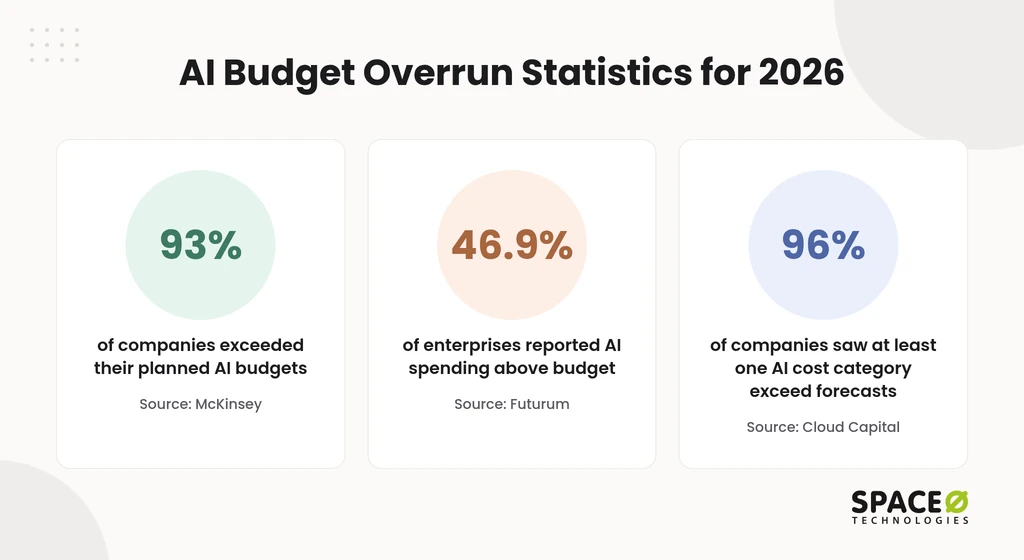
- 93% of companies exceeded their planned AI budgets, according to a McKinsey survey.
- 46.9% of enterprises reported AI spending above budget, according to Futurum research.
- 96% of companies experienced at least one AI cost category exceeding forecasts, according to Cloud Capital research.
For overrun planning, the build quote is only part of the bill. Hosting, API calls, and yearly upkeep keep adding cost after launch. Our AI cost guide puts annual maintenance at 15% to 25% of build cost.
Reserve that maintenance share before launch. Give data preparation its own line too, at 25% to 40% of the total project budget.
What are the five biggest drivers of AI budget overruns?
Five drivers explain most AI overruns: token pricing, agent loops, seat-based planning, scaling, and skipped scoping. Each one alone is manageable. Together they push actual spend far past a fixed forecast.
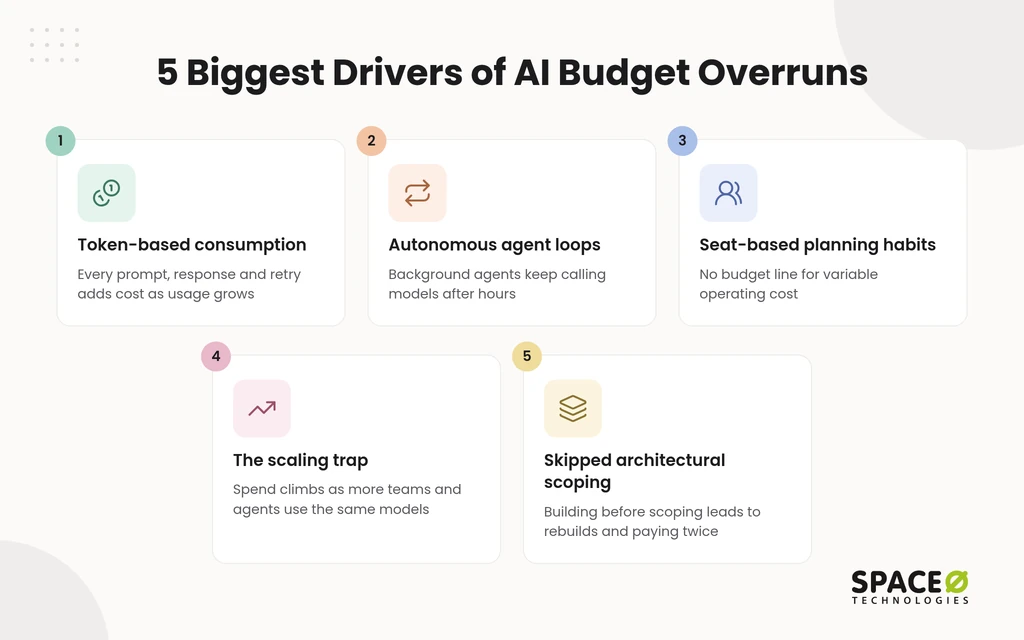
- Token-based consumption: Every prompt, response, and retry consumes tokens, so cost tracks usage instead of a fixed license.
- Autonomous agent loops: Coding agents and background automations keep calling models after hours, and the spend surfaces only on the invoice.
- Seat-based planning habits: Many finance teams still budget AI like per-seat licensing, which leaves no line for variable operating cost.
- The scaling trap: Spend climbs quickly once more teams, workflows, and agents draw on the same models.
- Skipped architectural scoping: Teams that build before scoping data, integrations, and model choice often rebuild later and pay twice.
What costs sit outside the token bill?
A large share of AI cost never appears on the token invoice, so tight token tracking alone still misses overruns. These costs land in engineering time, rework, and post-launch upkeep. A total cost of ownership view counts all of them.
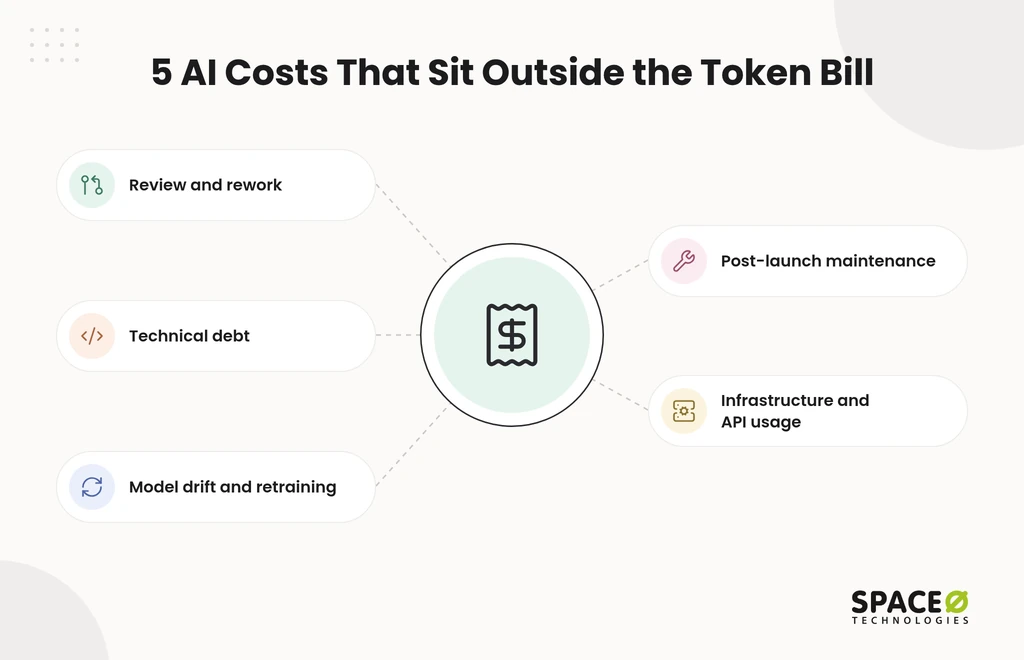
- Review and rework: AI-generated code still needs human review, testing, and fixes before it ships.
- Technical debt: Fast AI-assisted output can pile up code that costs more to change later.
- Model drift and retraining: Live data shifts over time, so evaluation and retraining become recurring work.
- Post-launch maintenance: Updates, monitoring, and security patches continue every year, which is the work software maintenance services cover.
- Infrastructure and API usage: Hosting, API calls, and integrations add to the total on top of the build.
How do you control AI software development budget overruns?
You control AI overruns by capping runtime spend and budgeting a range instead of a single number. Runtime controls stop runaway agents. Planning controls keep the forecast from being wrong on day one.
Which controls stop runaway agent spend?
Hard limits on tokens, time, and agent actions stop runaway spend before it reaches the invoice. Write these limits into requirements before the first agent goes live.
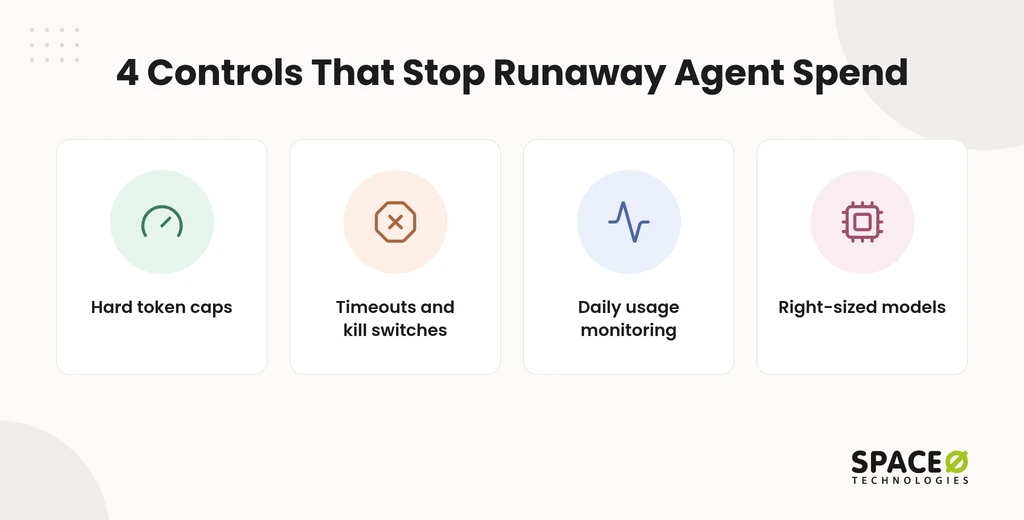
- Hard token caps: Set per-agent and per-project ceilings that halt calls once a budget is reached.
- Timeouts and kill switches: End agent sessions that run past a set time or loop without progress.
- Usage monitoring: Track spend daily by team, workflow, and agent, using FinOps practices so every cost has an owner.
- Right-sized models: Route routine tasks to smaller or open models and keep large models for hard problems.
Teams scoping AI agent development should treat caps and timeouts as core features, not later add-ons.
Which planning steps prevent overruns before the build?
Overruns shrink when the budget comes from measured usage and scoped architecture, not from a quote alone. These steps cost little next to a rebuild.
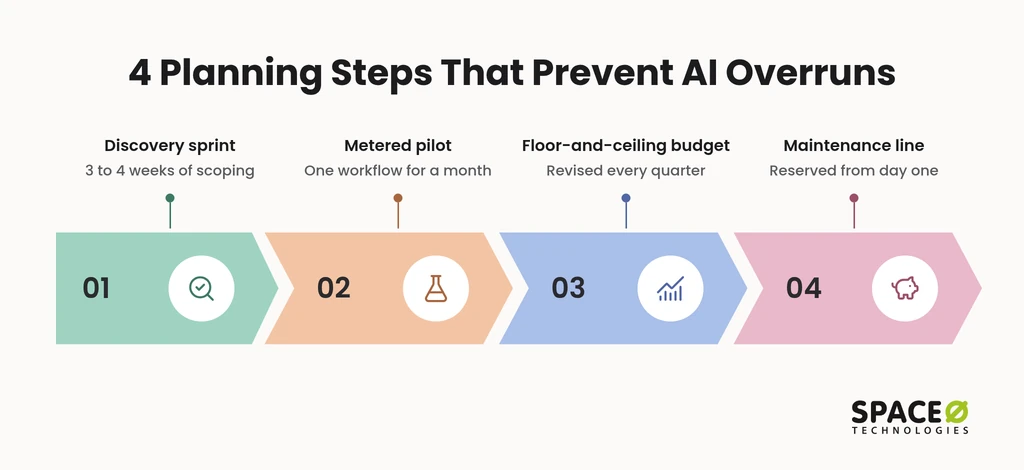
- 3-4 week discovery sprint: Scope data, integrations, model choice, and architecture before you commit a build budget.
- One-month metered pilot: Run one metered workflow for a month to measure real consumption before scaling.
- Floor-and-ceiling operating budget: Budget AI runtime as a variable operating cost with a floor and a ceiling, then revise it quarterly.
- Maintenance line from day one: Reserve the annual maintenance share before launch, not after the first surprise invoice.
Structured AI consulting services during discovery give you the architecture and usage assumptions a budget needs.
Where does a development partner fit?
A development partner fits at two points: scoped discovery before the build and a maintenance plan after launch. Space-O Technologies has built AI-powered custom software since 2010. We have served 1,200+ clients and developed 300+ software solutions.
Our 140+ in-house developers sign an NDA before the project starts. Code, data, and IP transfer to you at completion, and we report 97% client retention.
Our AI development services ship with production controls in place. These include grounding, hallucination testing, and human review for high-stakes decisions.
How do engagement models change your overrun exposure?
Your engagement model decides who absorbs build overruns, but no build contract covers your token bill. Consumption depends on live usage, and live usage sits outside any build scope. Plan for both separately.
| Engagement model | What it fixes | Where overrun risk sits |
|---|---|---|
| Fixed Cost | Scope, timeline, and build price | Change requests outside scope, plus runtime consumption |
| Time & Material | Billing for actual work, with flexible scope | Build effort grows as scope changes, plus runtime consumption |
| Dedicated Team | Team size and monthly capacity | Engagement length, plus runtime consumption |
| Staff Augmentation | Added engineers inside your process | Your team owns scope, delivery, and runtime spend |
All four models are available. On MVP builds, payments are milestone-based and tied to deliverables.
What does a worked AI budget look like?
A realistic AI budget has three lines: build cost, runtime consumption, and annual maintenance. Most quotes show only the first line. A floor-and-ceiling range, the method Kiplinger describes, turns all three into a budget you can defend.
The example below uses a scoped first version, priced on Space-O Technologies’ MVP range. A basic MVP can start from $15,000, while more feature-rich MVPs can go up to $50,000 or more.
| Budget line | Floor | Ceiling | Basis |
|---|---|---|---|
| Build | $15,000 | $50,000+ | Basic MVP from $15,000; feature-rich MVP up to $50,000 or more |
| Annual maintenance | $2,250 | $12,500+ | 15% of $15,000; 25% of $50,000 |
| Runtime API fees, per year | $6,000 | $36,000 | $500-$3,000 a month per 10,000 conversations |
| Build plus first year | $23,250 + infrastructure | $98,500+ + infrastructure | Sum of the lines above |
The API row assumes a chatbot-style workload of 10,000 conversations a month. Infrastructure and hosting are scoped per project and sit outside these figures. Confirm your own volume with the metered pilot before you lock the range.
On a $50,000 build, maintenance alone adds $7,500-$12,500 every year. Larger systems move the whole range up. Space-O Technologies’ AI cost guide puts AI development at $25,000 to $500,000+ in 2026.
Start the build line with the cost to build AI software breakdown, then add the other two lines.
Frequently Asked Questions
Why do AI software projects go over budget?
AI projects go over budget because token-based usage replaces fixed seat costs that forecasts assumed. Autonomous agents can run unattended loops that keep calling models. Build quotes also leave out runtime consumption and yearly maintenance.
How common are AI software budget overruns?
Most organizations report overruns, though each survey measures them differently. WitnessAI found that 68% of U.S. companies reported AI cost overruns in 2026. The Financial Times reported one Amazon project that ran 860% over budget. Do not average the figures into one rate.
How much should you reserve for AI maintenance?
Reserve 15% to 25% of the build cost for each year of AI maintenance. This covers updates, monitoring, retraining, and security patches. Plan data preparation separately at 25% to 40% of the total project budget.
How do you stop AI agents from overspending?
Set hard token caps, timeouts, and kill switches before any agent goes live. Track spend daily by team, workflow, and agent. Route routine tasks to smaller models so large models handle only hard problems.
Does a fixed-cost contract protect against AI budget overruns?
A fixed-cost contract caps build overruns but does not cover runtime token spend. Change requests outside scope still raise the build price. Consumption depends on live usage, so plan a separate runtime budget with a floor and a ceiling.
Should finance or engineering own AI spend?
One named person should own each AI cost, rather than finance or engineering alone. That owner watches consumption daily and acts when a cap is hit. FinOps reporting by team and workflow gives that person the visibility.



 All our projects are secured by NDA




 4.8


