
 By
By 
Knowing how to develop an ecommerce app has become essential for businesses looking to meet growing consumer demand for mobile shopping. As mobile commerce (mCommerce) continues to grow, brands are investing in ecommerce applications that offer convenient product discovery, secure payments, and personalized shopping experiences. Whether you’re launching a B2C store, D2C brand app, or multi-vendor marketplace, the right development approach can help you attract customers, increase conversions, and drive long-term growth.
Building an e-commerce app involves more than creating a product catalog. Modern ecommerce applications need features such as user authentication, product search, shopping carts, secure checkout, inventory management, order tracking, and personalized recommendations. Many businesses also invest in ecommerce development services to create a consistent shopping experience across web and mobile platforms.
The technology stack you choose directly impacts your app’s performance and scalability. Popular frameworks like React Native, Flutter, Swift, and Kotlin help power the frontend, while Node.js, Python, PHP, and cloud infrastructure support backend operations. To speed up development and avoid technical challenges, many companies hire ecommerce developers experienced in payment gateway integration, headless commerce, and AI-driven personalization.
This guide covers the complete ecommerce app development process, from validating your idea and defining key features to selecting the right architecture, integrating secure payment systems, and launching your application. Whether you’re a startup or an established business, working with a team that offers mobile app development services can help you build a secure, scalable, and high-performing ecommerce app.
Table of Contents
eCommerce App Market Statistics and Trends
Whether you’re exploring e-commerce app development or evaluating the right approach for your business, understanding the market landscape is essential. Below are three critical statistics that demonstrate why investing in e commerce application development services is no longer optional; it’s essential:
- The global e-commerce market was valued at USD 33.9 trillion in 2025 and is expected to reach USD 39.7 trillion in 2026. Driven by rapid digital adoption and online retail expansion, the market is projected to grow to USD 155.9 trillion by 2033, registering a CAGR of 21.6% during the forecast period from 2026 to 2033. [Grand View Research]
- According to recent consumer surveys, 73% of shoppers prefer using mobile apps over websites for online purchases, highlighting the growing demand for fast, personalized, and seamless mobile shopping experiences.[Cropink]
- 47% of customers prefer using live chat for customer support, making it the dominant support channel. Phone support ranks second at 21.6%, followed by email at 14%, self-service portals at 10%, and social media support at just 4.8%. [Hostinger]
Types of eCommerce Apps
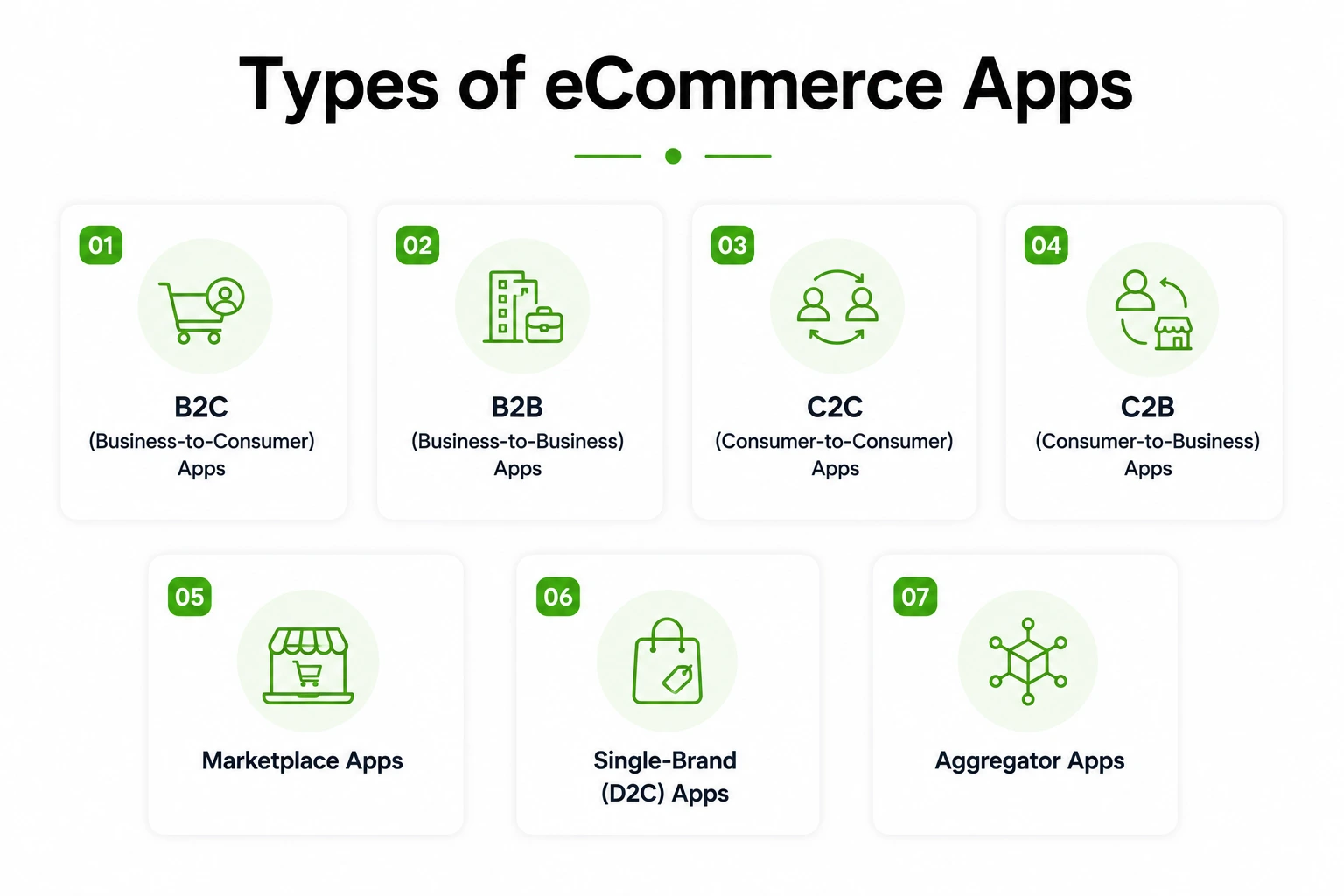
Not every eCommerce app follows the same business model. The type of app you build depends on who is selling, who is buying, and how transactions are processed between them. Before you learn how to develop an ecommerce app, understanding these categories helps you define the right features, payment flows, and user experience for your specific business model.
1. B2C (Business-to-Consumer) Apps
B2C apps are the most common type of eCommerce application where businesses sell products or services directly to individual customers. These apps focus on product discovery, personalized recommendations, and a smooth checkout experience to drive conversions.
Examples: Amazon, Walmart, H&M, Sephora
2. B2B (Business-to-Business) Apps
B2B eCommerce apps facilitate transactions between businesses, such as manufacturers selling to wholesalers or suppliers selling to retailers. These apps typically support bulk ordering, custom pricing tiers, invoice-based payments, and account management for multiple buyers within the same organization.
Examples: Alibaba, IndiaMART, Grainger
3. C2C (Consumer-to-Consumer) Apps
C2C apps allow individual users to buy and sell products to each other through a shared platform. The platform acts as a mediator, providing listing tools, payment processing, and dispute resolution while earning revenue through listing fees or transaction commissions.
Examples: eBay, Poshmark, Craigslist, Facebook Marketplace
4. C2B (Consumer-to-Business) Apps
In a C2B model, individuals offer products or services to businesses. Freelance platforms and stock media marketplaces are common examples where consumers set their pricing and businesses choose based on their needs.
Examples: Upwork, Fiverr, Shutterstock
5. Marketplace Apps
Marketplace apps connect multiple sellers with multiple buyers on a single platform. The app owner does not hold inventory but provides the infrastructure for transactions, logistics coordination, and seller management. Revenue is generated through commissions, subscription fees, or advertising.
Examples: Nike, Adidas, Glossier, Warby Parker
6. Single-Brand (D2C) Apps
Direct-to-consumer apps are built for a single brand that sells its own products without any third-party sellers. These apps offer complete control over branding, customer data, pricing, and the overall shopping experience, making them ideal for brands that want a direct relationship with their customers.
Examples: Amazon, Walmart, H&M, Sephora
7. Aggregator Apps
Aggregator eCommerce apps collect products or services from multiple providers and present them under one platform. Unlike marketplaces, aggregators often standardize pricing, delivery, and service quality across all listed providers.
Examples: Instacart, DoorDash, Uber Eats
Identifying the right type of eCommerce app for your business is the first strategic decision in the development process. Each model requires a different approach to features, payment integration, user roles, and scalability planning. Once you identify your model, you can create ecommerce app features tailored to the user journey specific to that business type.
Key Features to Include While Developing eCommerce Mobile App
A visually appealing eCommerce app means nothing if it does not convert visitors into paying customers. When you create an eCommerce app, the features you include directly influence how users browse, interact, and complete purchases. Every screen, button, and flow should be designed to reduce friction and move the user closer to checkout. Here are the features that set high-converting eCommerce apps apart from those that users uninstall after a single session.
- User Registration and Social Login: Allow users to create accounts quickly using email, phone number, or social login options like Google, Apple, and Facebook. The fewer steps it takes to sign up, the lower the drop-off rate. Offering guest checkout alongside account creation gives users flexibility without forcing commitment upfront.
- Advanced Product Search and Filters: Users should be able to find what they need within seconds. A smart search bar with auto-suggestions, voice search, and typo tolerance is essential. Combine that with multi-layer filters for price range, category, brand, size, color, ratings, and availability to help users quickly narrow down results.
- Product Pages with Rich Media: High-quality product images, 360-degree views, zoom functionality, and short product videos significantly improve purchase confidence. Include detailed descriptions, specifications, size guides, and stock availability on every product page to reduce return rates and pre-purchase hesitation.
- Personalized Recommendations: Use browsing history, purchase behavior, and wishlist data to display relevant product suggestions. Sections like “You May Also Like,” “Frequently Bought Together,” and “Recently Viewed” keep users engaged and increase average order value across sessions.
- Shopping Cart and Wishlist: A persistent shopping cart that saves items across sessions and devices ensures users never lose their selections. A wishlist feature lets users bookmark products for later, which also gives you data to trigger targeted push notifications during price drops or restocks.
- Seamless Checkout Process: Keep the checkout flow to three steps or fewer. Auto-fill saved addresses and payment methods, show a clear order summary with itemized costs, and offer multiple payment options. A smooth checkout flow is one of the most critical aspects of mobile app development for e-commerce.
- Real-Time Order Tracking: Once a purchase is made, users expect visibility into their order status. Integrate real-time tracking with push notifications for order confirmed, shipped, out for delivery, and delivered updates. This reduces customer support inquiries and builds trust in the buying experience.
- Push Notifications: Strategic push notifications drive re-engagement without being intrusive. Use them for abandoned cart reminders, flash sale alerts, price drop notifications, back-in-stock updates, and personalized offers based on user behavior. Timing and relevance are key to keeping unsubscribe rates low.
- Ratings and Reviews: User-generated reviews directly influence buying decisions. Allow customers to leave star ratings, written reviews, and photo/video reviews on product pages. Displaying verified purchase badges and sorting reviews by relevance or recency adds credibility to the feedback.
- Loyalty and Rewards Program: A built-in loyalty system encourages repeat purchases by rewarding users with points, exclusive discounts, or early access to new products. Tiered reward structures keep customers motivated to move up levels, increasing their lifetime value with every transaction.
- Admin Dashboard and Analytics: On the backend, a comprehensive admin panel is essential for managing products, inventory, orders, customers, and promotions. Integrated analytics tracking user behavior, conversion funnels, top-selling products, and revenue trends helps you make data-driven decisions to continuously optimize the app.
The features you prioritize should align with your business model, target audience, and the type of eCommerce app you are building. Whether you build an eCommerce app for a single brand or a multi-vendor marketplace, starting with these core capabilities gives you a strong foundation. You can always expand with advanced features like AR try-ons, AI chatbots, or voice commerce as your app scales.
Now that you understand the different types & must-have features of eCommerce apps, it’s time to learn how to build an eCommerce app successfully. In the next section, we’ll walk you through our proven 7-step eCommerce app development process, covering everything from market research and feature planning to design, development, testing, and launch.
Whether you’re building a B2C storefront, online marketplace, or D2C shopping platform, these steps will help you create a scalable eCommerce mobile app that delivers seamless customer experiences and supports long-term business growth.
How to Develop an eCommerce App? E-commerce App Development Explained!
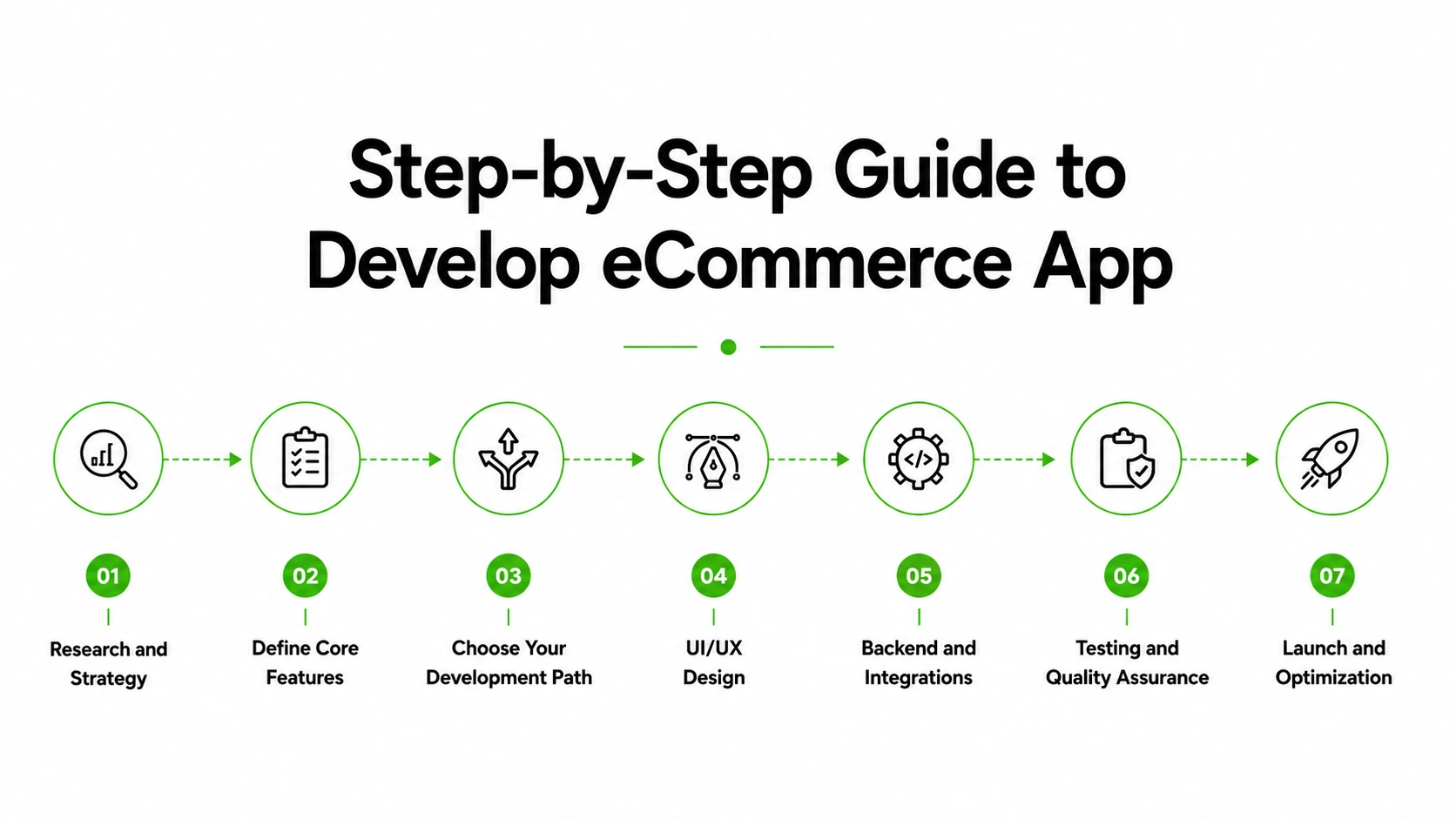
To develop an eCommerce app successfully, you must align your business goals with user-centric design, choose the right technology stack, and implement secure end-to-end shopping workflows. Building a modern mobile retail platform requires balancing speed, security, and a frictionless checkout process. The step-by-step framework below covers everything from initial strategy to launch.
-
Research and strategy
Start by defining who your customers are, what competitors already offer, and where the market gaps exist. A clear strategy at this stage prevents costly pivots during development and keeps every future decision anchored to measurable goals.
- Define your specific target audience and shopping demographics.
- Review direct competitors to identify features they lack.
- Set clear Key Performance Indicators (KPIs) like Conversion Rate and Average Order Value (AOV).
- Choose your business model: single-vendor, multi-vendor marketplace, or dropshipping.
-
Define core features
Prioritize a Minimum Viable Product (MVP) that covers the essential shopping workflows users expect from day one. A focused feature set reduces time-to-market while still delivering a complete purchase experience when you build an ecommerce app.
- User Authentication: Secure, one-tap registration using social profiles or biometrics.
- Product Catalog: Clean layout with advanced search filters, categories, and high-quality images.
- Shopping Cart & Checkout: Frictionless, maximum 3-step checkout sequence.
- Payment Gateways: Secure integrations for credit cards and digital wallets like Apple Pay, Google Pay, and Stripe.
- Order Management: Real-time customer tracking alongside an admin fulfillment dashboard.
- Push Notifications: Direct alerts to recover abandoned carts and share promotions.
-
Choose your development path
Your development route directly controls your upfront budget, timeline, and long-term scalability during e-commerce application development. Understanding the complete mobile app development process helps you evaluate which path fits your project scope.
- No-Code / AI Builders: Rapidly prototype or launch via tools like Adalo, Jotform’s eCommerce Builder, or Appy Pie. Ideal for startups looking to create a mobile ecommerce app without writing code.
- Cross-Platform Frameworks: Write one codebase for iOS and Android using React Native or Flutter. This is the most common path in mobile app development for ecommerce projects with moderate budgets.
- Native Development: Code separate apps utilizing Swift (iOS) and Kotlin (Android) for premium platform experiences. Best suited when experienced ecommerce application developers are available in-house.
- eCommerce Platform App Wrappers: Convert an existing web store (Shopify, WooCommerce, BigCommerce) into a mobile app without rebuilding from scratch.
-
UI/UX design
Design every screen with a mobile-first approach that prioritizes fast navigation and minimal friction between browsing and purchasing. A well-structured UI directly impacts conversion rates in e-commerce mobile app development, as even a one-second delay in page load can significantly increase cart abandonment. If you lack in-house design expertise, you can hire UI/UX designers to build a conversion-focused interface from the ground up.
- Apply a mobile-first design with thumb-friendly buttons and logical visual hierarchy.
- Create strict wireframes detailing the precise browse-to-purchase funnel.
- Set clear Key Performance Indicators (KPIs) like Conversion Rate and Average Order Value (AOV).
- Maximize page loading speeds, as a single second of lag severely drops mobile conversion rates.
-
Backend and integrations
Build a backend architecture that can handle concurrent users, process transactions securely, and sync data across all connected systems. Reliable API integrations between your app, payment processors, and inventory sources form the operational backbone of any e-commerce mobile application development project.
- Program your backend architecture using technologies like Node.js, PHP, or Python, hosted on cloud computing platforms that support auto-scaling and high availability.
- Implement reliable database management by linking your app to robust database instances such as PostgreSQL or MongoDB.
- Connect your inventory to existing eCommerce backends through secure API synchronization.
- Integrate shipping carrier APIs for real-time delivery tracking and cost estimation.
-
Testing and quality assurance
Test every user flow, from registration to final payment, across multiple devices and operating systems before going live. Skipping thorough QA during ecommerce app development risks payment failures, security vulnerabilities, and poor reviews that are difficult to recover from after launch. A structured mobile app performance testing process ensures your app handles real-world traffic and device conditions without breaking.
- Perform exhaustive functional testing across a broad physical device matrix.
- Verify payment gateway processing inside sandbox environments.
- Execute security audits ensuring absolute compliance with PCI-DSS data safety rules.
- Run load testing to handle traffic spikes during flash sales and seasonal events.
-
Launch and optimization
Submit your app to the Apple App Store and Google Play Store with fully optimized listings that include targeted keywords, crisp screenshots, and a clear value proposition. Post-launch, use in-app analytics to track user behavior, fix friction points, and continuously improve conversion performance.
- Prepare your assets for App Store Optimization (ASO) with crisp screenshots and explicit keywords.
- Publish the finalized product directly to the Apple App Store and Google Play Store.
- Collect in-app behavior analytics post-launch to continually resolve product bugs and cart friction.
Developing an ecommerce app is not a one-time build but an ongoing cycle of testing, user feedback, and feature refinement. The key to a successful launch lies in starting with a focused MVP, choosing the right development path, and building every feature around a secure shopping experience. If you prefer to outsource the build, evaluating the right eCommerce development companies offering dedicated e-commerce app development services can help you find a team that aligns with your project requirements and budget.
Challenges in eCommerce App Development & How to Overcome
When you build an eCommerce app, the process involves more than just writing code and launching it on app stores. From security vulnerabilities to poor user retention, e-commerce application development teams face real obstacles that can delay timelines, inflate budgets, and hurt long-term growth. Understanding these challenges early allows you to plan around them and create an eCommerce app that is reliable from day one.
1. Security and data privacy threats
Learning how to create ecommerce app that users trust starts with handling sensitive customer data, including payment details, addresses, and personal information. A single data breach can result in financial losses, legal penalties, and permanent damage to brand trust. With regulations like GDPR, PCI-DSS, and CCPA in place, non-compliance can lead to heavy fines.
How to overcome:
- Implement end-to-end encryption for all data transmissions using SSL/TLS protocols
- Use tokenization for payment processing instead of storing raw card details
- Conduct regular penetration testing and vulnerability assessments
- Stay updated with regional data privacy regulations and build compliance into your app architecture
- Integrate multi-factor authentication (MFA) for user accounts
2. Poor app performance and slow load times
Understanding how to build ecommerce app that retains users starts with performance. Users expect apps to load within 2-3 seconds. Slow performance leads to cart abandonment, negative reviews, and lower search rankings. As your product catalog and user base grow, performance issues tend to multiply if the infrastructure is not built to scale.
How to overcome:
- Use a content delivery network (CDN) to serve static assets faster across regions
- Optimize image sizes and implement lazy loading for product galleries
- Choose a scalable cloud infrastructure like AWS or Google Cloud with auto-scaling capabilities
- Cache frequently accessed data, such as product listings and category pages
- Run regular load testing to identify bottlenecks before they affect users
3. Shopping cart abandonment
Nearly 70% of online shopping carts are abandoned before checkout. When you create ecommerce app checkout flows with complex steps, hidden fees, limited payment options, or mandatory account creation, users are more likely to leave without completing a purchase.
How to overcome:
- Simplify the checkout process to three steps or fewer
- Offer guest checkout without forcing account registration
- Display all costs, including taxes and shipping, early in the checkout flow
- Integrate multiple payment gateways such as Stripe, PayPal, Apple Pay, and Google Pay
- Set up automated push notifications and email reminders for abandoned carts
4. Integration with third-party services
E-commerce mobile app development depends on multiple external services like payment processors, shipping APIs, inventory management tools, and CRM systems. Poor integration can cause order sync failures, payment errors, and inventory mismatches that directly affect the customer experience.
How to overcome:
- Use well-documented RESTful APIs or GraphQL for third-party connections
- Build a middleware layer to manage data flow between your app and external services
- Implement error handling and retry mechanisms for failed API calls
- Test all integrations in a staging environment before pushing to production
- Monitor API uptime and response times using tools like Postman or Datadog
5. Scalability during high-traffic periods
Flash sales, holiday seasons, and marketing campaigns can cause sudden traffic spikes. If you build ecommerce app infrastructure without scalability planning, it often crashes during these critical revenue-generating moments, leading to lost sales and frustrated customers.
How to overcome:
- Design the backend using a microservices architecture to scale individual components independently
- Use auto-scaling cloud services that adjust server capacity based on real-time demand
- Implement database sharding and read replicas to distribute query loads
- Conduct stress testing before major sales events to identify capacity limits
- Use queue-based processing for order management during peak loads
6. Cross-platform compatibility issues
When you create ecommerce app for users across iPhones, Android devices, tablets, and different OS versions, inconsistent behavior across platforms can lead to bugs, broken layouts, and a fragmented user experience that increases support tickets and lowers retention.
How to overcome:
- Use cross-platform frameworks like React Native or Flutter to maintain a shared codebase
- Test on real devices across multiple screen sizes and OS versions, not just emulators
- Follow platform-specific design guidelines from Apple (HIG) and Google (Material Design)
- Set up automated UI testing using tools like Appium or BrowserStack
- Maintain a device compatibility matrix and update it with every release cycle
7. User retention and engagement
Acquiring users is expensive, but keeping them is the real challenge. Most eCommerce apps lose over 75% of users within the first 90 days. Without a strong retention strategy, your customer acquisition costs will consistently outpace revenue.
How to overcome:
- Build a personalized recommendation engine based on browsing history and purchase patterns
- Implement a loyalty and rewards program directly within the app
- Use push notifications strategically for price drops, restocks, and personalized offers
- Add wishlist and save-for-later features to keep users engaged between purchases
- Collect in-app feedback regularly and act on it to improve the experience
Every e-commerce mobile application development project comes with its share of risks, but none of them are impossible to manage. If you want to know how to develop an ecommerce app that performs reliably, the key is to identify these challenges during the planning phase rather than reacting to them after launch. Partnering with an experienced eCommerce application development company can help you navigate these obstacles with proven strategies and technical expertise.
How Much Does it Cost to Make an eCommerce Mobile App?
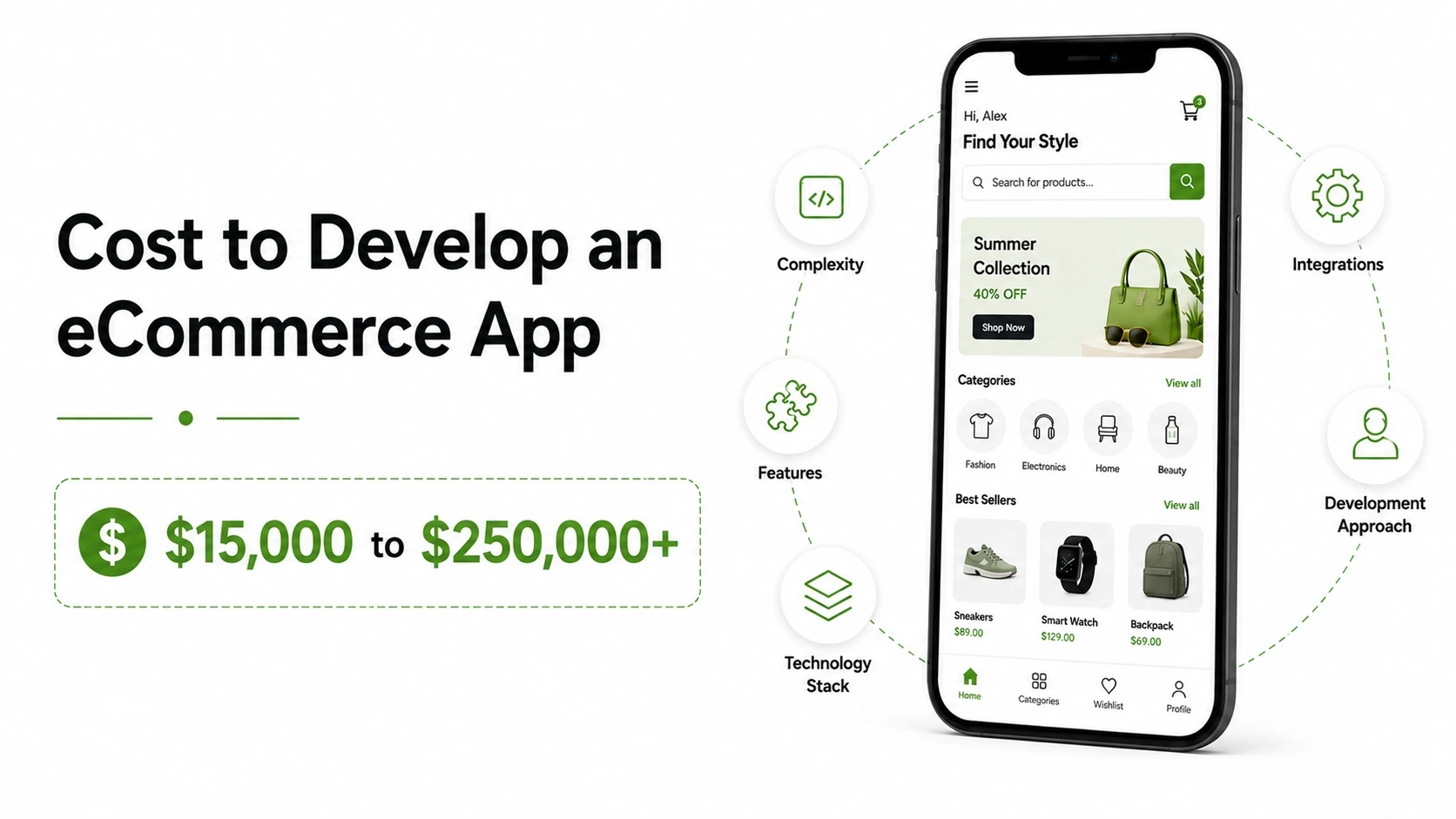
The cost of eCommerce app development typically ranges from $15,000 to $250,000+, depending on the app’s complexity, features, technology stack, integrations, and development approach. A basic MVP with essential shopping functionality requires a lower investment, while enterprise-grade ecommerce applications with AI-powered personalization, marketplace functionality, and advanced backend integrations demand a significantly higher budget.
App development costs are also influenced by factors such as UI/UX design, platform selection (iOS, Android, or cross-platform), third-party integrations, and the location of the development team.
If you’re exploring how to create ecommerce app for your business, several factors influence the overall ecommerce app development cost, including:
- App features and functionality
- UI/UX design complexity
- Native vs. cross-platform development
- Backend infrastructure and API integrations
- Payment gateway integration
- Third-party services and cloud hosting
- Development team location and hourly rates
eCommerce app development cost by complexity
| App Complexity | Estimated Cost | Example Apps |
|---|---|---|
| Basic / MVP | $15,000 – $40,000 | H&M, Zara, Adidas |
| Mid-Level | $30,000 – $50,000 | Nike, Sephora, IKEA |
| Enterprise / Complex | $60,000 – $120,000+ | Amazon, Walmart, Target |
Cost breakdown by app type
The cost of an eCommerce app varies based on the scope of features, design complexity, integrations, and overall e commerce mobile application development requirements. As functionality increases from a basic MVP to an enterprise-grade platform, the development time, resources, and investment required also increase significantly.
1. Basic ecommerce app ($15,000–$40,000)
Includes essential features such as user registration, product catalog, search functionality, shopping cart, secure checkout, and payment gateway integration.
2. Mid-level ecommerce app ($30,000–$50,000)
Adds advanced search and filtering, push notifications, order tracking, customer reviews, wishlists, analytics dashboards, and customer account management.
3. Enterprise ecommerce app ($60,000–$120,000+)
Designed for brands that create mobile ecommerce app at enterprise scale, this tier supports multi-vendor marketplaces, AI-powered product recommendations, real-time inventory management, ERP/CRM integrations, personalized shopping experiences, and advanced analytics.
Additional costs to consider
Beyond the initial e commerce mobile application development investment, businesses should also budget for ongoing expenses such as:
- App maintenance and updates
- Cloud hosting and server infrastructure
- Security monitoring and compliance
- Payment processing fees
- Third-party API subscriptions
- App Store and Google Play deployment costs
Businesses looking to reduce development costs often choose cross-platform frameworks like Flutter or React Native, which allow a single codebase for both iOS and Android applications, reducing overall development time and investment.
Now that you have an estimate of the eCommerce app development cost, let’s explore the timeline and effort required for each development phase in detail.
How Much Time Does it Take to Create an eCommerce App?
Similar to cost, the time required to build an eCommerce app depends on various factors. Knowing how to make an eCommerce app that performs well means accounting for complexity, features and functionality, technology stack, team size, and more.
Generally, eCommerce application development takes around 4 to 12+ months.
Here’s a table outlining the estimated development time for simple, medium, and complex mobile eCommerce apps:
| eCommerce App Complexity | Estimated eCommerce App Development Timeline |
|---|---|
| Simple | 2-4 months |
| Medium | 4-8 months |
| Complex | 8-12+ months |
If you have advanced features in mind, and want to get a personalized quote for your cost and timeline, contact us. Our senior eCommerce app development consultant guides you with the strategies and provides you detail with the complete cost bifurcation for your online store.
How to Monetize Your eCommerce App
Many entrepreneurs ask: “How to develop an ecommerce app that actually makes money?” The answer depends on choosing the right revenue model that aligns with your business goals and customer expectations.
Here are for popular monetization models to generate revenue from your eCommerce app:
| Revenue Model | How It Works | Commission/Markup | Best For |
|---|---|---|---|
| Commission-Based (Marketplace) | Charge percentage on each transaction. Etsy, Airbnb, Uber Eats model. | 10–20% per order | Multiple sellers connecting with buyers |
| Subscriptions (Recurring) | Monthly/yearly membership tiers with exclusive benefits | $4.99–$19.99/month | Repeat purchase categories (groceries, beauty, supplies) |
| Delivery Fees | Charge per delivery or offer tiered pricing | $2–$5 per order | On-demand food delivery and local services |
| Product Markup (Inventory-Based) | Own inventory, profit from wholesale-to-retail spread | 20–40% markup | Direct sales, specialty brands, retailers |
Choose commission-based if you want low risk and a growing marketplace. Choose subscriptions for predictable revenue and loyal customers. Choose delivery fees for on-demand categories. Choose markup if you have capital and want direct control. When you build ecommerce app revenue strategies, combining two or more models works best. Most successful mobile ecommerce app development pairs commission-based revenue with a subscription tier.
When you create an ecommerce app, start with one or two revenue streams that naturally complement your primary model. Once your core monetization is optimized, layer on additional revenue streams following ecommerce web app development best practices.
Emerging eCommerce App Development Trends in 2026
eCommerce app development is no longer about building a digital version of a product catalog. The focus has shifted toward creating active, personalized shopping experiences that keep users coming back. With customer acquisition costs rising across every channel, brands are investing in AI, augmented reality, and smarter checkout flows to increase retention and lifetime value. If you plan to build an eCommerce app in 2025, these are the trends shaping how modern apps are designed, built, and scaled.
1. AI-driven hyper-personalization
AI is moving beyond basic product recommendations. Modern eCommerce apps use predictive search, AI agents, and behavioral tracking to curate custom feeds, suggest product bundles, and adjust the interface in real time based on individual user patterns. The result is a shopping experience that feels tailored to each customer, increasing engagement and average order value.
2. AR and VR visual try-ons
Augmented reality has moved past the novelty stage. E-commerce mobile app development now includes virtual try-ons for apparel, accessories, and cosmetics, along with spatial placement tools that let users visualize furniture and home goods in their own space using device-native cameras. This reduces purchase hesitation and lowers return rates significantly.
3. One-tap wallets and biometric checkout
Integrating native payment solutions like Apple Pay, Google Pay, and one-click purchasing with biometric authentication (Face ID, fingerprint) removes friction at the most critical point of the user journey. Fewer taps at checkout directly translates to lower cart abandonment and higher conversion rates.
4. Social and shoppable video feeds
The line between content consumption and shopping is disappearing. eCommerce apps are embedding short-form, social-style video feeds where users can discover products, watch demonstrations, and check out without ever leaving the app experience.
We developed HOWTO, a shoppable video commerce app where creators tag the products used in each tutorial step. Within a month of the beta release, roughly 230 users had uploaded over 1,000 products.
5. Omnichannel synchronization
Modern e-commerce application development ties apps into physical stores, web browsers, and backend inventory systems (ERP/WMS) so that wishlists, loyalty points, cart contents, and support history follow users across every touchpoint. A customer can browse on mobile, add to cart on desktop, and pick up in-store without losing any data.
6. Headless commerce architecture
Headless commerce decouples the frontend user experience from the backend commerce engine. This allows eCommerce application developers to push UI updates instantly, handle viral traffic spikes, and deliver custom shopping experiences without being locked into platform constraints. It is quickly becoming the preferred architecture for brands that need speed and flexibility.
7. No-code and AI-assisted app builders
Platforms with AI-assisted builder tools and no-code frameworks are drastically cutting development timelines for launching baseline eCommerce MVPs. These tools allow brands to create a mobile eCommerce app in weeks rather than months, making e-commerce app development services more accessible to businesses of all sizes.
8. Push notifications as a direct marketing channel
Push notifications give brands direct access to the user’s home screen, outperforming traditional email in open rates. When used strategically for new launches, restocks, flash sales, and personalized refill reminders, they act as a free, high-impact channel built right into the app. This is why mobile app development for eCommerce now treats notifications as a core feature, not an afterthought.
Staying ahead of these trends does not mean adopting all of them at once. Evaluate which ones align with your business model and customer expectations, then integrate them into your e-commerce mobile application development roadmap as your product matures.
Ready to Develop eCommerce App for Your Business?
Knowing how to make ecommerce app projects successful requires the right blend of strategy, user experience, technology, and execution. With an experienced team and a well-defined roadmap, you can create an application that delivers seamless shopping experiences, increases customer engagement, and supports long-term business growth.
Whether you’re launching a new eCommerce business, expanding your online sales channels, or looking for reliable e commerce app development services to enhance an existing mobile commerce app, our team can support you throughout the entire development journey. From business analysis and UI/UX design to development, testing, deployment, and ongoing support, we help turn your vision into a scalable and feature-rich eCommerce solution.
Have questions about eCommerce app development or need expert guidance for your project? Our eCommerce consultants and developers are here to help. We can assist you in validating your idea, selecting the right technology stack, defining essential features, and creating a development roadmap that aligns with your business goals.
If you’re figuring out how to build ecommerce app that drives real results, our track record speaks for itself. Over the years, we have delivered eCommerce applications for businesses across various industries, helping them launch digital storefronts, optimize customer experiences, and increase online revenue. Explore our portfolio to see how we’ve built secure, intuitive, and high-performing eCommerce apps tailored to unique business requirements and evolving market demands.
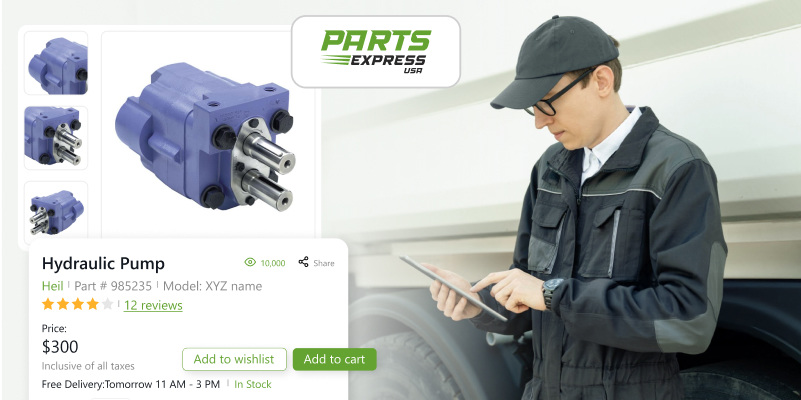
Parts Express: eCommerce Marketplace App
We developed a custom eCommerce marketplace connecting buyers and sellers of waste management equipment across the USA. The platform features multi-store seller dashboards, contract pricing for municipalities, and Stripe payment integration, built with Laravel, PHP 8.1, MySQL, and AWS.
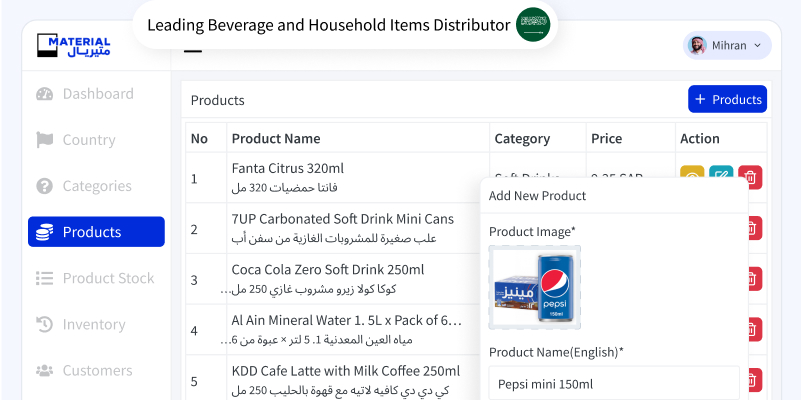
Material: eCommerce Delivery App
We developed a feature-rich eCommerce app for a leading beverages and household items distributor in Saudi Arabia, serving both B2B and individual consumers. Built with Kotlin, Swift, Laravel, and MySQL, the platform achieved 10,000+ downloads across Android, iOS, and web.
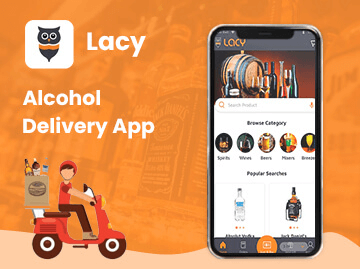
Lacy: Alcohol Delivery App
We developed an on-demand liquor delivery app for a US-based alcohol delivery service, allowing customers to order beer, wine, and liquor from local stores. The app features GPS-based delivery tracking, Stripe payments, in-store pickup, and a gifting option for sending drinks to others.
By choosing Space-O Technologies, you can be confident in the quality of your eCommerce app. So why wait? Get in touch with Space-O Technologies today and start developing your eCommerce app.
FAQ About eCommerce App Development
What is eCommerce app development?
eCommerce app development is the process of building mobile applications that enable users to browse products, make purchases, process payments, and track orders from their smartphones. It involves designing the user experience, developing frontend and backend systems, integrating payment gateways, and ensuring secure transactions across iOS and Android devices.
How much does it cost to develop an eCommerce app in India vs. US?
The cost of eCommerce app development typically ranges from $15,000 to $250,000+, depending on app complexity, features, and development location. Development rates in India generally range from $25 to $50 per hour, while US-based agencies and developers often charge between $100 and $200+ per hour, making India a more cost-effective option for businesses seeking high-quality development at a lower cost.
Should I use Shopify/WooCommerce or build a custom eCommerce app?
Shopify and WooCommerce are ideal for businesses that want to launch quickly with lower upfront costs and standard ecommerce functionality. A custom eCommerce app is better suited for businesses that require unique features, advanced integrations, personalized user experiences, or the flexibility to scale beyond platform limitations.
How do I ensure my app is secure for payments?
To secure payment transactions, your eCommerce app should use PCI DSS-compliant payment gateways, SSL encryption, tokenized payment processing, secure APIs, and multi-factor authentication. Regular security audits, vulnerability testing, and data encryption help protect customer information and reduce the risk of fraud.
Native vs. cross-platform development: which is better for an eCommerce app?
Native development using Swift for iOS and Kotlin for Android offers the highest performance and platform-specific user experience. Cross-platform frameworks such as React Native and Flutter allow businesses to build a single codebase for both platforms, reducing development costs and accelerating time to market while maintaining strong performance.
How long does it take to build an eCommerce app MVP?
Most eCommerce MVPs take between 3 and 6 months to develop, depending on feature requirements and project complexity. A basic MVP typically includes user registration, product catalog, shopping cart, payment integration, and order management features needed to validate the business idea and gather user feedback.
What are the must-have features for a successful eCommerce app?
Essential eCommerce app features include user authentication, product catalog management, advanced search and filtering, shopping cart, secure checkout, payment gateway integration, order tracking, push notifications, customer reviews, wishlists, and analytics. These features help improve customer experience, engagement, and conversion rates.
How do I avoid app store rejection?
To avoid App Store or Google Play rejection, ensure your app complies with platform guidelines, provides a stable user experience, includes a clear privacy policy, handles payments securely, and is thoroughly tested for bugs and performance issues. Following submission requirements and maintaining transparency with users significantly improves approval chances.
What ongoing maintenance costs should I expect?
Most businesses spend approximately 15% to 20% of the initial development cost annually on app maintenance. These costs typically include bug fixes, security updates, cloud hosting, server infrastructure, performance optimization, third-party service subscriptions, and feature enhancements.
How do I scale my eCommerce app as traffic grows?
Scaling an eCommerce app requires cloud computing infrastructure, load balancing, database optimization, caching mechanisms, content delivery networks (CDNs), and real-time monitoring tools. Implementing a scalable architecture from the beginning ensures your app can handle increased traffic, transactions, and product inventory without performance issues.
What are the 7 C’s of e-commerce?
The 7 C’s of e-commerce are a framework used to create effective online shopping experiences: Context, Content, Community, Customization, Communication, Connection, and Commerce. Together, these elements help businesses improve website usability, customer engagement, brand trust, and conversion rates by ensuring that shoppers can easily find products, interact with the brand, and complete purchases seamlessly.
Can ChatGPT create an eCommerce website?
No, ChatGPT cannot directly build and deploy an e-commerce website on its own. However, ChatGPT can help plan the website structure, create wireframes, generate code, recommend technology stacks, write product descriptions, develop user flows, and assist developers throughout the e-commerce website development process. To launch a fully functional eCommerce website, you’ll still need development tools, hosting infrastructure, and implementation by developers or a development team.



 All our projects are secured by NDA




 4.8
4.8