
 By
Contents
- Most AI MVPs need engineers who integrate existing models, not machine learning researchers who train new ones.
- Use contractors for tight scopes, a build partner for end-to-end delivery, and full-time hires after validation.
- Plan for data preparation, maintenance, and token spend, not just the build.
- Confirm repositories, cloud accounts, API keys, and intellectual property (IP) assignment are in your name before launch.
- Ask for deployed systems, run a practical task, and consider a short paid pilot.
Key Takeaways
Hiring the wrong AI engineer can sink a minimum viable product (MVP) before launch. Most founders learn this after weeks of lost budget. You need someone who ships working AI, not demos.
To hire AI engineers for MVP development, look for applied AI engineers. They integrate large language model (LLM) APIs and have shipped production AI. Avoid pure researchers and prompt-only demo builders.
This guide covers roles, hiring routes, costs, sourcing, vetting, and a launch checklist. Space-O Technologies has built software since 2010 with 140+ in-house developers. Use it to pick a route, or hire AI developers who have shipped before.
1. Which AI Engineer Does Your MVP Actually Need?
Most AI MVPs need an applied AI engineer who integrates models, not a machine learning (ML) engineer.
The common mistake is posting a “machine learning” role. That attracts research profiles when you need someone who ships product. Your MVP usually calls a proven model through an application programming interface (API). The work is wiring that model into a reliable app.
- Applied AI / LLM engineer: Best when your MVP calls OpenAI GPT-4o, Anthropic Claude, Gemini, or Llama. This person builds prompts, retrieval, and guardrails around the model.
- ML engineer: Best when your product depends on a custom-trained model or proprietary training data. Most founders need this later, after the MVP proves demand.
- Full-stack AI developer: Best when one person must ship the backend, frontend, and AI layer together. Software-engineering fundamentals matter as much as model knowledge.
What skills should an AI engineer for an MVP have?
An AI engineer for an MVP should combine LLM API integration with solid software engineering and cost discipline.
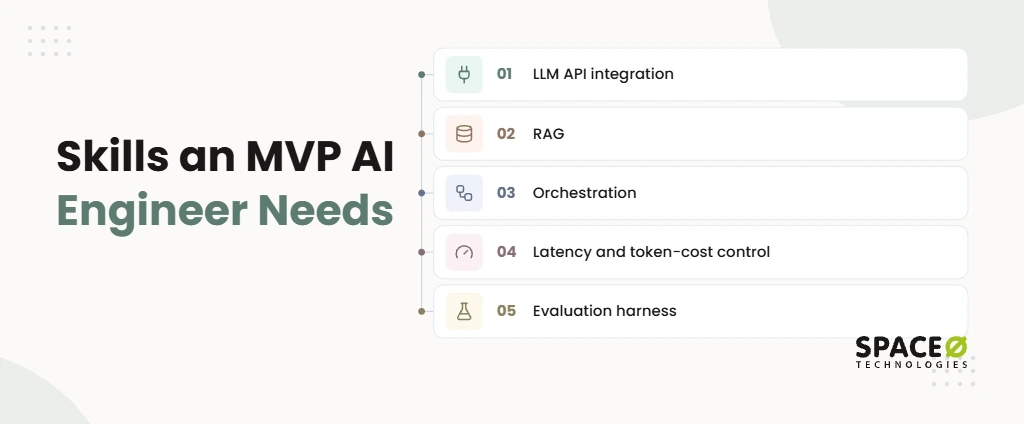
- LLM API integration: Connects model APIs to your app with retries, fallbacks, and structured outputs.
- Retrieval-augmented generation (RAG): Grounds answers in your data using vector databases such as Pinecone or pgvector.
- Orchestration: Uses LangChain or LangGraph for multi-step and agentic workflows only when the product needs them.
- Latency and token-cost control: Caches, batches, and picks model sizes so responses stay fast and affordable.
- Evaluation harness: Builds repeatable tests that catch regressions before users see them.
Keep the scope tight. A strong MVP proves one core AI workflow end to end, then adds features.
2. Choose Your Hiring Model
Match the hiring route to your stage. Use contractors for tight scopes and a build partner for end-to-end delivery. Hire full-time only after validation.
Founders lose months by hiring permanently before the product has users. Stay API-first, and keep commitments light until the MVP is validated.
Which hiring route fits which stage?
Each route works when it fits the scope you actually have today.
- Freelancer or contractor: Suits a tightly scoped task, such as one integration or a single feature. You own product management, QA (quality assurance), and handoff.
- Vetted talent network: Matches pre-screened engineers quickly, often within a few days. You still direct the work.
- Agency or dedicated team: Suits an end-to-end MVP that needs design, build, AI, and deployment under one owner. You can also hire MVP developers to run the full lifecycle.
- Staff augmentation: Adds AI engineers to your existing in-house team, inside your sprints and code review.
- Full-time hire: Fits once the product is validated and you need permanent ownership. See section 3 for market compensation.
How do the hiring routes compare?
The routes differ most on who owns the code and how your MVP grows into version two.
| Route | Code and IP (intellectual property) ownership | Production AI controls (evals, PII masking, hallucination testing) | Path to version two without a rebuild |
|---|---|---|---|
| Freelancer/contractor | Depends on your contract terms | Depends on the individual | Depends on code quality and handoff |
| Vetted talent network | Depends on network and contract terms | Depends on the matched engineer | Depends on the engineer you keep |
| Full-time hire | Yours under employment terms | Depends on the hire’s experience | Strong, if the hire stays |
| MVP build partner / dedicated team (Space-O Technologies) | All code, data, and IP transfer to you at project completion | Built in by default | Architecture planned for version two |
Where does Space-O Technologies fit?
Best for: founders who need an AI MVP built for production and scale, not a throwaway demo.
Why it fits MVPs: Fixed-cost scoped builds, IP transfer at completion, responsible-AI testing, and experience scaling Glovo. Explore its MVP development services for scoped builds.
3. What Does It Cost to Hire AI Engineers for an MVP in the US (2026)?
Budget for the build, the data work, and the ongoing run cost, not the build alone.
Budgets break when founders price the build but forget model usage and upkeep. Plan for each cost before you hire. McKinsey’s State of AI survey found most organizations use AI, but only about one-third have scaled it. Scaling is where budgets get tested.
- Build cost: A basic MVP starts from $15,000, and a feature-rich MVP runs up to $50,000+.
- Data work: Cleaning, labeling, and structuring data often takes longer than teams expect.
- Maintenance: Annual upkeep typically costs 15% to 25% of the build, according to Space-O Technologies’ AI development cost guide.
- Ongoing run cost: Token spend grows with users, so set a per-user budget before launch.
How does Space-O Technologies price an AI MVP?
Space-O Technologies scopes AI MVPs on four engagement models, so your budget matches your stage.
- Fixed cost: A clear scope, timeline, and budget for a defined MVP. Payments are milestone-based, tied to deliverables.
- Time and material (T&M): Flexible scope when requirements are still moving.
- Dedicated team: A long-term team for the build and version two.
- Staff augmentation: AI engineers who join your in-house team.
An expert reviews each estimate with you, and there is no charge for it. Request your free AI MVP scope estimate
4. Where to Find Vetted AI Engineers
Find AI engineers through freelance marketplaces, vetted talent networks, referrals, or a development partner.
The sourcing risk is a poor fit that surfaces only after weeks of work. Each channel shifts that risk differently.
- Freelance marketplaces: Offer wide choice, but you run all the screening yourself.
- Vetted talent networks: Pre-screen candidates and match quickly. Check how they test production AI, not just coding.
- Referrals and professional networks: Bring trusted signals, but they are slow and hard to scale.
- Development partners: Supply a vetted team with delivery accountability and existing processes. Compare an AI development company vs. a freelancer before you choose.
Space-O Technologies has built software since 2010 and has 140+ in-house developers. The team is an OpenAI Select Partner and AWS Partner, with Claude Certified Architects on staff. You can read client reviews on GoodFirms before you shortlist. Whichever channel you use, ask how long it takes from signed agreement to first commit.
5. How to Vet an AI Engineer for an MVP
Vet AI engineers on real, deployed work through practical tasks and a short paid pilot, not puzzles or résumé keywords.
Résumés full of AI terms rarely show whether someone can ship. Ask for proof of production systems, then watch them build.
Which interview questions reveal production experience?
The strongest questions ask candidates to explain systems they actually shipped.
- Deployment walkthrough: “Walk me through an AI pipeline you shipped. How did you handle latency, token costs, and edge cases?”
- Evaluation question: “How did you build your eval harness, and what regressions did it catch?”
- Failure question: “What broke in production, and how did you find out?”
- Architecture question: “When would you choose RAG over fine-tuning, and why?”
What practical test should you run?
Run a short, practical task that mirrors your MVP’s core workflow.
- Take-home task: Integrate an LLM API, preprocess sample data, and return structured output.
- Four-stage process: Portfolio review, take-home task, technical deep-dive, and an ownership simulation.
- Paid pilot: Run a short paid pilot before you commit to a longer engagement.
Need Engineers Who Have Shipped Production LLM Apps?
Hire generative AI developers who have launched real LLM products. Start your MVP with a vetted team ready to build.

6. AI MVP Production-Readiness & Ownership Checklist
Before your AI MVP reaches users, confirm you own every asset and have tested every risk.
Many founders launch an AI demo and discover the vendor holds the accounts. Others ship and then find exposed user data. This checklist prevents both problems.
What must you own before launch?
You should own every account, key, and line of code from day one.
- Repositories: Source code lives in a repository registered to your company.
- Cloud accounts: Hosting, databases, and vector stores sit in your cloud account.
- API keys: Model provider keys for OpenAI or Anthropic are issued to your organization.
- Code and IP transfer: Your contract assigns full code and IP ownership to you.
Space-O Technologies transfers all source code, data, and IP to you at project completion. See how AI development IP ownership and NDAs work in practice.
What must you test before launch?
You should test accuracy, privacy, cost, and human oversight before real users arrive.
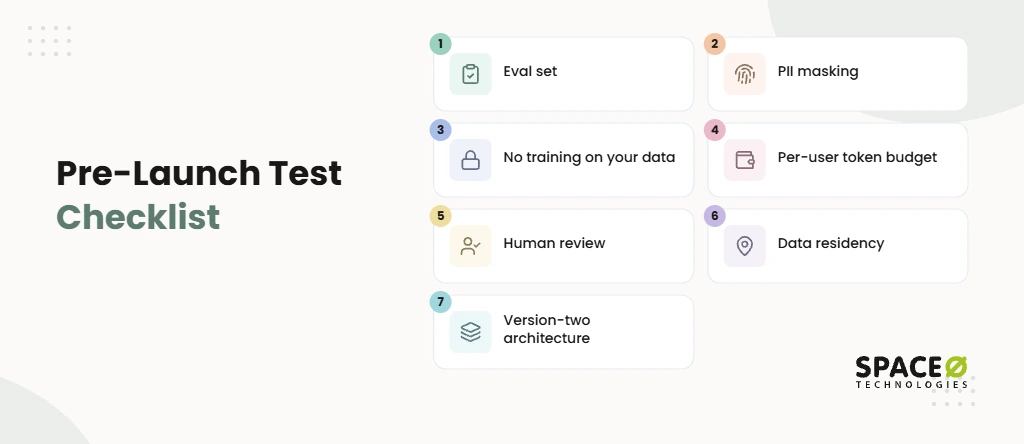
- Eval set: A fixed test set that scores answers and includes hallucination and bias tests.
- PII masking: Personally identifiable information (PII) is masked before it reaches a model.
- No training on your data: Provider settings and contracts stop your data from being used for model training.
- Per-user token budget: A cost ceiling per user, with alerts before it is breached.
- Human review: People approve consequential outputs before they take effect.
- Data residency: Data stays in the regions your compliance needs allow.
- Version-two architecture: Model calls sit behind an abstraction layer, so you can switch models without a rebuild.
Space-O Technologies applies responsible-AI controls by default on AI builds. These include no training on client data, PII masking, and hallucination and bias testing, with human review for high-stakes decisions. For the path after launch, see how to scale an AI MVP into a product.
Frequently Asked Questions
Freelancer or build partner: which is safer for IP ownership and production AI controls?
A build partner is usually safer for IP ownership and production AI controls. A freelancer’s terms depend on your contract and on the individual. Evals, PII masking, and hallucination testing vary the same way. Space-O Technologies transfers all code, data, and IP to you at project completion and applies responsible-AI controls by default.
Staff augmentation or a dedicated team: which should I choose for an AI MVP?
Choose staff augmentation if you already have an in-house team to extend. Those AI engineers work inside your sprints and code review. Choose a dedicated team if you want a long-term group that owns the build and version two. In both cases, confirm who owns the product outcome and project management.
What should I verify when a talent network says its AI engineers are pre-screened?
Verify how the network tests production AI, not just general coding. Ask whether candidates are screened on shipped work such as latency, token-cost control, and evaluation harnesses. You still direct the work, so plan your own practical test and paid pilot.
What does it cost to hire AI engineers for an MVP?
A basic MVP starts from $15,000, and a feature-rich MVP runs up to $50,000+ at Space-O Technologies. Payments are milestone-based and tied to deliverables. Budget separately for yearly maintenance, which is a share of the build cost.
Which AI engineer should I hire first for an MVP?
Hire an applied AI engineer with full-stack skills who has shipped production AI. This person integrates existing models through APIs and builds retrieval, guardrails, and evaluation. Hire a machine learning engineer later, only if your product needs a custom-trained model.
When should I hire a full-time AI engineer instead of a contractor?
Hire full-time only after your MVP is validated and you need permanent ownership. Before that, contractors or a build partner keep commitments light. A short paid pilot shows whether a candidate fits before you commit.



 All our projects are secured by NDA




 4.8


