
 By
Contents
- Choose a freelancer for small, well-defined AI tasks when your team can direct and review the work.
- Choose an AI development company for production, core-business, or regulated-data systems that need continuity.
- Weigh a freelancer’s lower cost, which comes from lower overhead, against the risk that one person’s absence can stall your whole AI project.
- Budget for data preparation and yearly maintenance, which together shape your first-year AI cost.
Key Takeaways
Should you hire an AI development company or a freelancer? The answer depends on your scope, budget, complexity, and long-term support needs. A freelancer fits small, contained tasks, while a company fits production systems.
Most founders and chief technology officers (CTOs) face this choice with a deadline. Pick wrong, and you overpay for a simple task or stall a build. Space-O Technologies has delivered AI development services since 2010, with 140+ in-house developers.
This guide compares both options side by side, then shows when each one wins. It also covers the hybrid path and the cost to hire an AI development company. It closes with first-year budget lines and questions to ask before you sign.
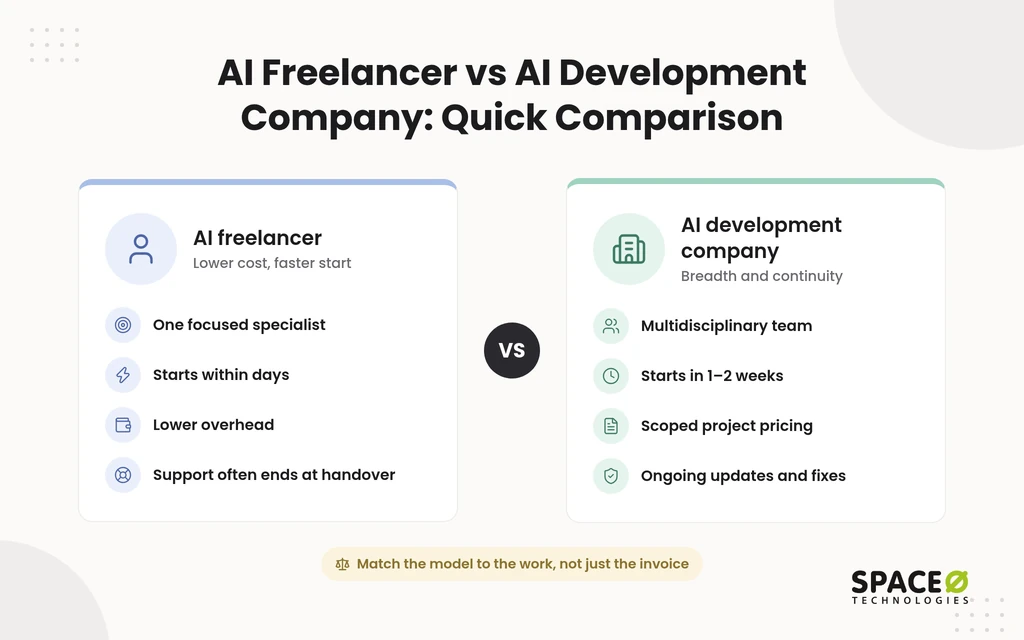
AI Freelancer vs AI Development Company: Quick Comparison
An AI freelancer gives you lower cost and a faster start, while a company gives you breadth and continuity. The table compares freelancers with outsourced AI development across ten factors that decide an AI build. The last column shows how Space-O Technologies handles each one.
| Factor | AI freelancer | AI development company | At Space-O Technologies |
|---|---|---|---|
| Best for | Small, well-defined, contained tasks, such as one model or a proof of concept | Complex, core-business, or production systems | Founders, CTOs, and SMEs that need a staged, fixed-scope engagement |
| Team coverage | One independent contractor, usually with one specialism | Multidisciplinary team: UI/UX, ML and backend engineering, QA, and project management | 140+ in-house developers |
| If someone leaves | Single point of failure; work can stop | Another developer steps in; knowledge lives in the team | Another team member takes over the work |
| Cost shape | Lower overhead; hourly or per-task pricing | Higher overall; scoped project or engagement-model pricing | Basic MVP from $15,000; feature-rich MVP up to $50,000+; milestone-based payments |
| Start time | Typically 1-3 days | Typically 1-2 weeks | Agreed in the estimate before kickoff |
| Communication | Direct with the person writing the code | Can be layered unless you ask for direct engineer access | Cadence set by the engagement model you choose |
| Post-launch support | Often ends at handover | Ongoing updates, patches, and fixes, often under a service level agreement (SLA) | Maintenance planned as a yearly budget line |
| Code and IP ownership | Depends on the contract you write | Usually set in the statement of work | All source code, data, and IP transfer to you at completion |
| QA and evaluation | Prompt testing is often manual and ad hoc | Structured QA and evaluation harnesses built into the process | Evaluation suite with continuous monitoring on every production model |
| Sensitive data | Depends on the individual’s own setup | Better suited to regulated or sensitive data | NDA signed before every project; code and IP transfer to you |
Onboarding times and cost shapes in the freelancer and company columns are directional and drawn from published market comparisons. The table shows the pattern, and the next two sections explain when each side of it matters. Statista puts the global AI market at around $255 billion in 2025, so the choice carries real weight.
When a Freelancer Is the Right Call
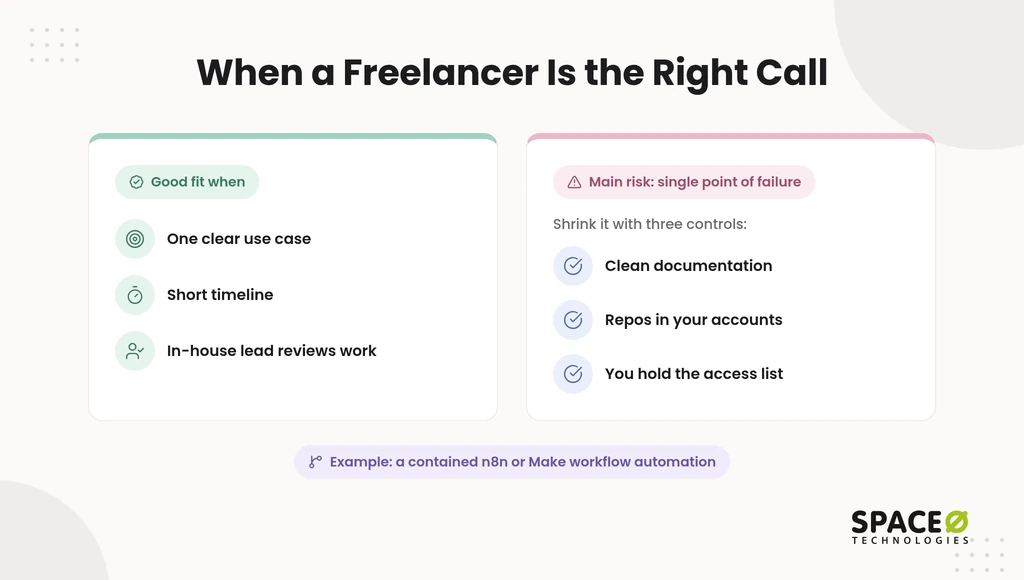
Hire a freelancer when you have one clear, well-scoped AI use case and a short timeline. Your in-house lead must also direct the work and choose the first use case for an AI agent. The budget goes into code, not coordination. A contained workflow automation in n8n or Make is a typical example.
Freelancer pros: cost, speed, and focused skill
A freelancer wins on price, start time, and depth in one area.
- Lower cost: Freelancers often charge less than development companies because they carry no agency overhead.
- Direct communication: You talk to the person writing the code, with no account manager in between.
- Fast start: A freelancer can begin within days and move quickly on a narrow task.
- Focused skill: Many freelancers specialize in one area, such as machine learning, computer vision, or natural language processing (NLP).
Freelancer cons: one person carries the risk
A freelancer’s biggest risk is that the whole project depends on one person.
- Single point of failure: If the freelancer falls ill, takes another client, or walks away, the project stalls. Engineers call this the bus factor.
- Limited breadth: One person rarely masters data engineering, UI/UX, infrastructure, and machine learning at once.
- Oversight required: A freelancer executes a brief well but rarely owns it. Someone on your side must scope and review the work.
- Limited post-launch support: Support often ends at handover, so later changes mean re-engaging or replacing the contractor.
You can shrink the single-point-of-failure risk. Require clean documentation, keep code in repositories under your own accounts, and hold the access list yourself. If those controls feel heavy for your project, that is often the signal it has outgrown one person.
Need Help Deciding Who Should Build It?
Tell us your scope, budget, and timeline. Our team reviews your AI project and recommends whether a freelancer, a company, or a hybrid setup fits best.

When an AI Development Company Is the Right Call
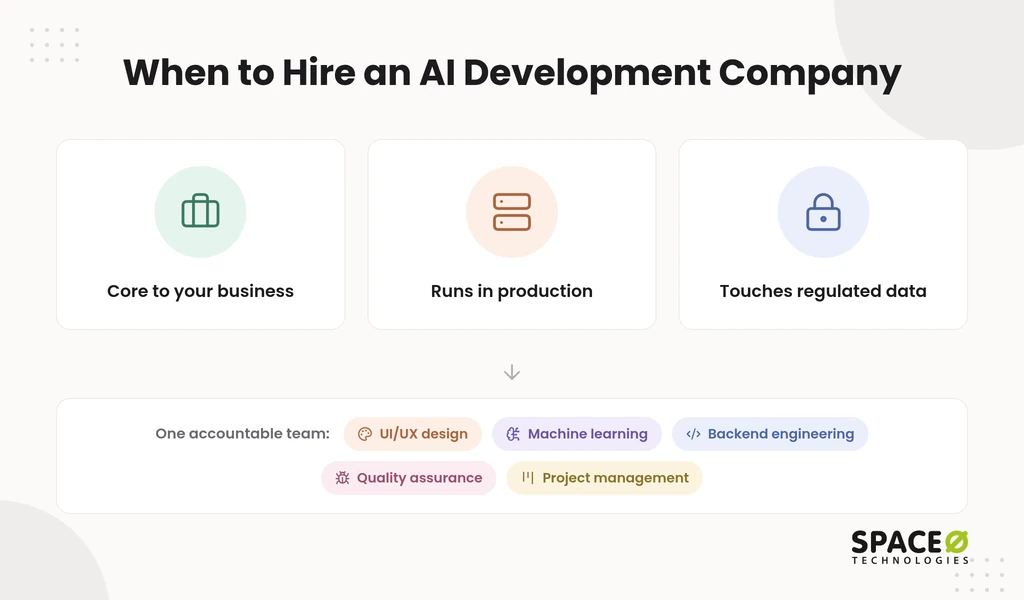
Choose a company when the AI is core to your business, runs in production, or touches regulated data. That covers multi-step agents, user-facing copilots, and systems that must not crash under load. Reliability and continuity matter more there than the lowest invoice.
Company pros: team, continuity, and support
A company brings a multidisciplinary team that stays accountable after launch.
- Multidisciplinary team: UI/UX design, machine learning (ML) and backend engineering, quality assurance (QA), and project management sit under one roof.
- Scalability: A team adds engineers as scope grows, which a solo contractor cannot.
- Continuity: If one developer gets sick or leaves, another steps in and the project keeps moving.
- Post-launch accountability: Companies ship with a plan for updates, security patches, and fixes, often backed by an SLA.
Company cons: higher cost and layered communication
A company costs more and can feel slower and more layered than one contractor.
- Higher cost: A full team and its process carry more overhead than a single freelancer.
- Layered communication: Updates can pass through a project manager unless you ask for direct engineer access.
- Slower kickoff: Discovery and team setup take longer than hiring one person.
Fixed scope and staged payments narrow the cost risk. At Space-O Technologies, MVP payments are milestone-based and tied to deliverables, so you pay as work lands. Asking for direct engineer access at kickoff removes most of the layering.
Why production AI needs more than one specialism
Production AI needs grounding, evaluation, and human review, which span more skills than one person usually holds. Grounding connects the model to your own data, often through retrieval-augmented generation (RAG) integration. That way it answers from facts, not guesses. Evaluation measures whether outputs stay correct over time. Human review means people approve consequential decisions in hiring, lending, clinical, and legal workflows.
A freelancer scoped to “build a chatbot” rarely delivers all three, whereas at Space-O Technologies every production AI project includes grounding before fine-tuning, human review checkpoints, an evaluation suite covering accuracy, hallucination rate, bias, latency, and cost, and continuous monitoring afterward.
Our AI recruitment software project, GPT Vix, shows why this takes a team. We combined ChatGPT for language processing, Whisper for video-to-text, and Synthesia for text-to-video on React.js, Node.js, and AWS Lambda. Cutting speech-to-text delay during live interviews required model, backend, and cloud work at once.
Which Should You Choose?
Choose by scope, budget, and how long the software must live. Match the model to the work, not just the invoice.
- Choose a freelancer if: the task is small and clearly scoped, and the budget is tight. You also need in-house leadership to review the work.
- Choose an AI development company if: the build is large, complex, security-sensitive, or headed for production. Continuity, QA, and maintenance decide whether it survives.
How Space-O Technologies fits
Space-O Technologies fits founders, CTOs, and SMEs that need a staged, fixed-scope engagement with code and IP ownership. We sign a non-disclosure agreement (NDA) before every project. All source code, data, and IP transfer to you at completion. You choose from four engagement models:
- Fixed Cost: Suits a well-defined MVP where the scope and deliverables are clear.
- Time & Material: Suits evolving scope that you want to steer sprint by sprint.
- Dedicated Team: Suits a long-term product build with steady demand.
- Staff Augmentation: Lets a CTO add vetted AI developers without a full hiring cycle.
Since 2010, we have served 1,200+ clients with 97% client retention. Our work includes Glovo, an on-demand delivery app that secured $1.2 billion in funding.
Need Help Deciding Who Should Build It?
Tell us your scope, budget, and timeline. Our team reviews your AI project and recommends whether a freelancer, a company, or a hybrid setup fits best.
The Hybrid Path: Prototype With One, Ship With the Other
Many teams prototype with a freelancer or an AI tool, then hand production to a company. A freelancer can build and validate a first version quickly and cheaply. Once it proves value, a company adds grounding, evaluation, and support for production use.
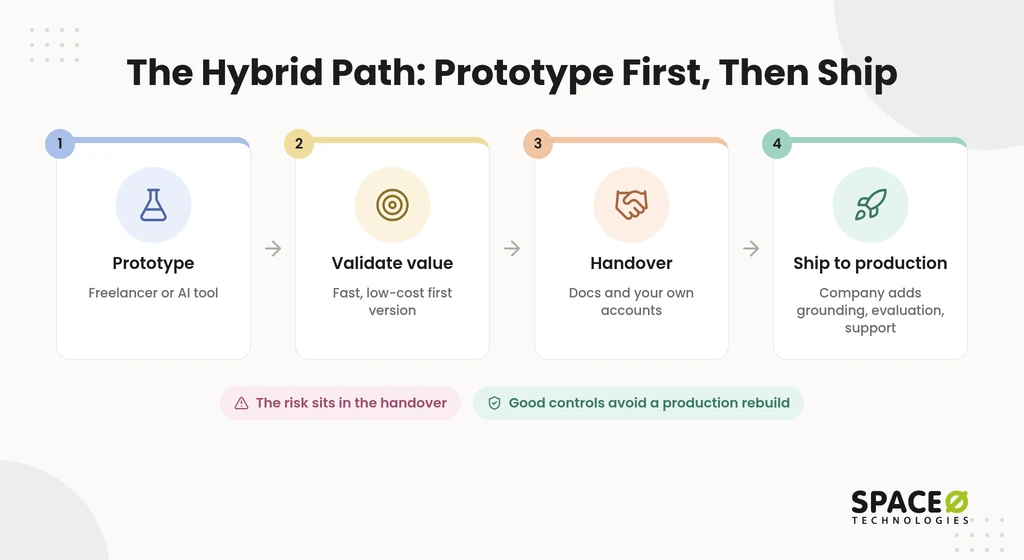
The risk sits in the handover. A prototype built without documentation or in someone else’s accounts often needs a rebuild for production. The controls from the freelancer section make this transition far cheaper, which matters for the cost picture below.
What an AI Build Really Costs in the First Year
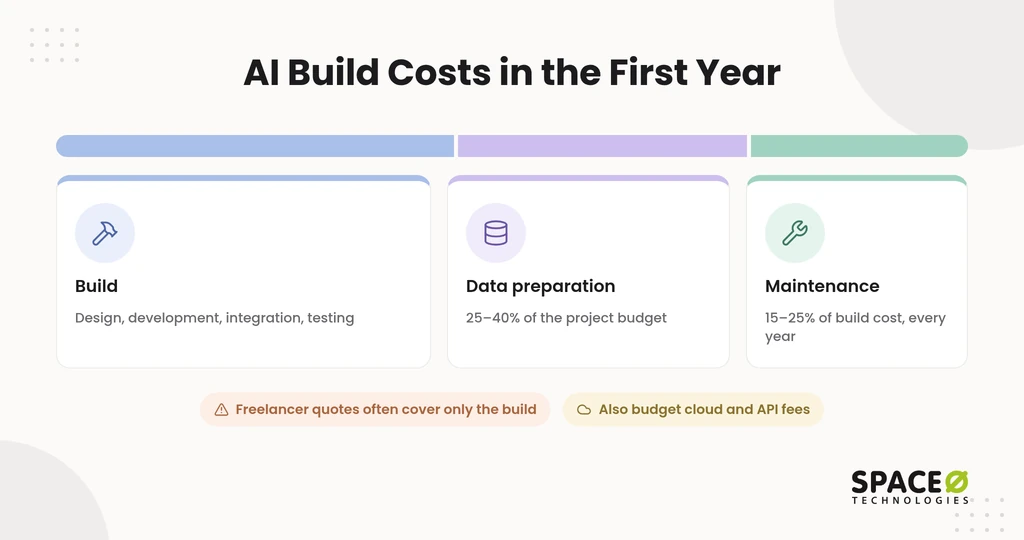
The build invoice is only part of the first-year cost, because data preparation and maintenance add the rest. Published hourly rates vary widely, and GoodFirms lists a median of $37 an hour across 11,700 AI companies. Comparing scoped totals is more reliable than comparing rates.
The gap between scoped quotes is wide. Our AI chatbot development cost guide notes that on developer forums, freelancers commonly quote $500 to $5,000 for a chatbot. Agencies quote $20,000 to $150,000.
Three cost lines to budget
Every AI build carries three cost lines, and freelancer quotes often cover only the first.
- Build: Design, development, integration, and testing of the system.
- Data preparation: 25% to 40% of the total project budget, the single largest AI development cost driver.
- Maintenance: 15% to 25% of the original development cost, every year.
Your full budget also includes cloud infrastructure and model or API usage fees. Ask every vendor which of these lines their quote covers.
Worked example with a hypothetical budget
Hypothetical example, for illustration only: a $100,000 AI build.
- Data preparation: $25,000-$40,000 of that $100,000 budget.
- Maintenance: $15,000-$25,000each year after launch.
- First-year total: $115,000-$125,000, including build and maintenance, before infrastructure and API fees.
If a freelancer quote leaves out data preparation or maintenance, your team carries those lines. Compare quotes only after mapping all three.
Knowing the full cost tells you what to protect in the contract, which is the next step.
Questions to Ask Before You Sign
Ask the same questions of any freelancer or company before work starts.
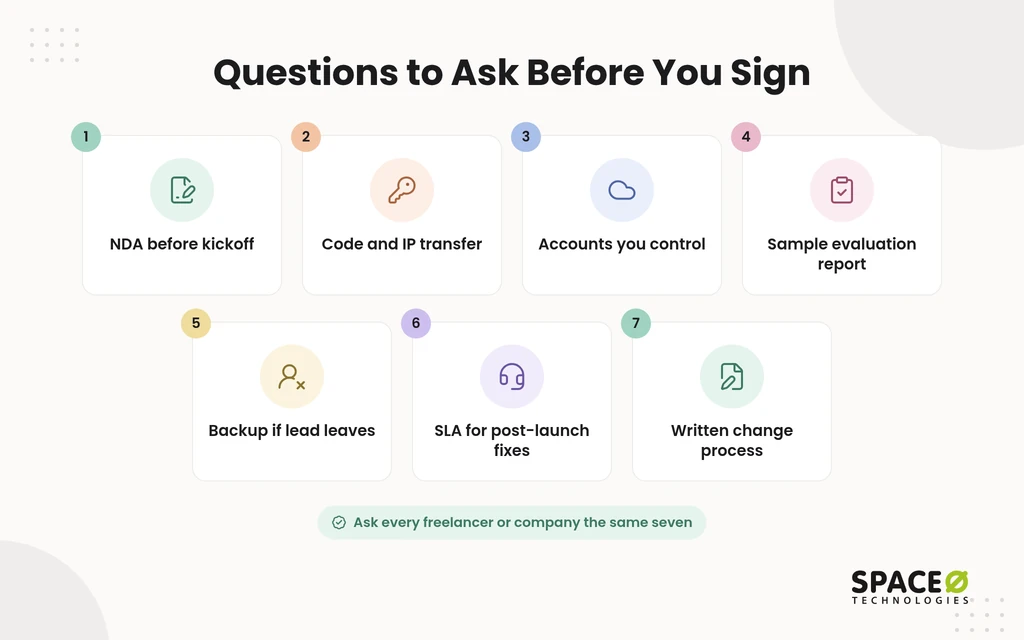
- Confirm that a signed NDA is in place before kickoff.
- Confirm that full code and IP ownership transfers to you at handover.
- Check whose accounts hold the repositories, cloud resources, and model artifacts.
- Ask how the team will test and evaluate an AI agent before launch, and request a sample report.
- Ask who takes over if the lead developer leaves mid-project.
- Agree on an SLA for post-launch fixes and updates.
- Write down how new work is scoped, priced, and approved.
A vendor who answers all seven clearly is ready for production work, whichever model you choose.
Describe Your AI Project to Find the Right Engagement Model
The fastest way to decide is to describe the project. Tell us what you are building, your budget and timeline, and whether you have an in-house technical lead. Share your project details, and our team will map the skills, timeline, and engagement model that fit.
Frequently Asked Questions
What is an AI freelancer?
An AI freelancer is an independent specialist who handles a contained slice of an AI project. Examples include one model, a proof of concept, or a workflow automation. Many focus on a single field like machine learning, computer vision, or NLP. They carry out a brief well but rarely take ownership of it. Your team needs to define the scope and review the output.
Is an AI freelancer cheaper than an AI development company?
Usually, yes, for a small task. A freelancer carries no agency overhead, so a contained job costs less. A company costs more but covers data preparation, QA, and maintenance. Compare scoped totals, not hourly rates.
What is an example of an AI task a freelancer can handle on their own?
A freelancer can handle a contained workflow automation built in a tool like n8n or Make, or a single model or proof of concept that one specialist can finish in under roughly six weeks. The scope is narrow, so the budget pays for building rather than coordinating.
What happens if the project grows beyond the original scope?
A solo freelancer cannot add engineers as scope grows, so the project slows or stalls. A company can add people to the team. New work still needs to be scoped, priced, and approved in writing. Agree on that change process before work starts, and ask whether the engagement model supports evolving scope.
What does AI maintenance cost after delivery?
Plan for annual maintenance of 15% to 25% of the original development cost. Before handover, confirm that code and cloud accounts transfer to you.
How do I handle changes and maintenance after an AI build is delivered?
With a freelancer, support often ends at handover. Later changes mean re-engaging that contractor or finding someone new. A company typically ships with a maintenance plan covering updates, security patches, and fixes. Confirm before signing that code and IP transfer to you at handover.
Can a freelancer deliver production-ready AI?
Sometimes, for a narrow scope. If the system informs consequential decisions or must stay correct over time, treat it as production work needing a team. Before you sign, ask for a sample evaluation harness or report. Also ask who will monitor and retrain the model after launch. If they cannot answer clearly, prototype with the freelancer, then ship with a team.
How do I protect my data and intellectual property?
Settle ownership and confidentiality in writing before any work starts. Ask for a signed non-disclosure agreement (NDA) before kickoff, not after. Confirm that full code and intellectual property (IP) ownership transfers to you at handover. Check who holds repository access, cloud accounts, and model artifacts during the build. Space-O Technologies works under an NDA before kickoff and transfers full code and IP ownership at handover.



 All our projects are secured by NDA




 4.8


