
 By
Contents
- Entry-tier AI agent prices differ by more than 15x across sources, so scope before comparing quotes.
- Ask for build, LLM tokens, hosting, and maintenance as separate lines in every quote.
- Budget 15% to 25% of the build cost each year for AI maintenance after launch.
- Start with a scoping call, then a consultation or discovery workshop, before any quote is fixed.
Key Takeaways
To get a quote for custom AI agent development, start with a scoping call. Mid-level agents run about $30,000-$150,000, and enterprise multi-agent systems reach $150,000-$400,000+. Entry work is priced as a minimum viable product (MVP) after discovery.
Published AI agent prices rarely survive contact with your real systems, data, and compliance rules. Space-O Technologies has delivered AI development services since 2010. Every agent quote we write starts from what the agent touches, reads, and reviews.
This page covers market tiers, consultations, discovery workshops, and how each quote line is built. Need engineering capacity first? Hire AI agent developers who join your sprints. A scoping call then turns your inputs into a line-itemized estimate.
AI Agent Prices Vary by More Than 15x Because Scope, Systems, and Compliance Set the Cost
Published entry prices for AI agents vary widely because each one prices a very different scope. A flat-price starter covers one narrow task, while higher floors assume custom integration and testing.
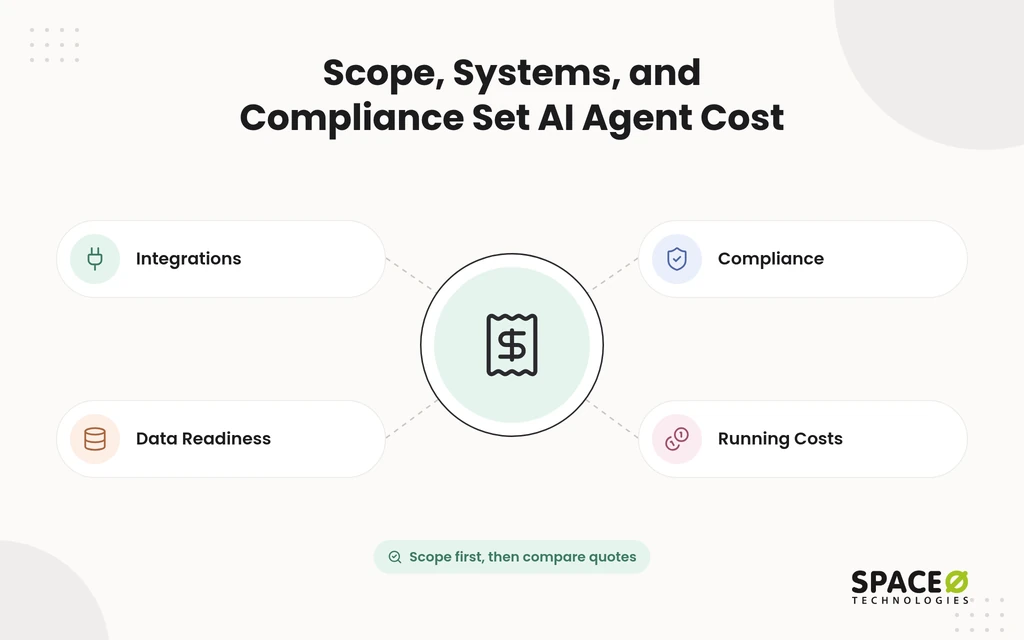
No vendor can give you an exact fixed price on the spot. Four variables stay hidden until someone maps your workflow:
- Integrations: Each connected tool, such as customer relationship management (CRM) or enterprise resource planning (ERP) software, adds testing work.
- Data readiness: Unstructured data needs cleaning first, and data preparation is often the largest cost driver in an AI build.
- Compliance: Rules such as HIPAA (health data) and GDPR (EU privacy) add audit logging and stricter accuracy testing.
- Running costs: Large language model (LLM) tokens, hosting, and maintenance continue after launch. Many price cards leave them out.
The answer to this spread is not a lower number. It is a quote that names each variable, and the rest of this page shows how we build one.
One Team Scopes, Quotes, Builds, and Maintains Your AI Agent
Space-O Technologies covers the full path: cost scoping, consultation, discovery workshop, build, and post-launch running costs. Cost planning starts before the first line of code is written. Each capability below can start on its own, and each one feeds the same line-itemized quote.
Custom AI agent cost by tier
Custom AI agents are priced in three scope tiers, set by how many tasks and systems the agent handles. The market ranges below repeat across published cost guides.
| Tier | Market range | Typical scope | Typical integrations |
|---|---|---|---|
| Entry or single-task | Varies widely by source | One task with human review on outputs | One knowledge base or one business tool |
| Mid-level or multi-task | About $30,000-$150,000 | Several connected tasks with tool use and retrieval | CRM, Slack, and internal databases |
| Enterprise or multi-agent | $150,000-$400,000+ | Coordinated agents across departments with audit trails | ERP, CRM, payment systems, and multiple databases |
Space-O Technologies’ own published ranges sit close to these market bands. A production-ready, multi-tool agent typically costs $80,000-$180,000. Our single agent vs multi-agent architecture guide puts a multi-agent system at $150,000-$500,000 and 16 to 28 weeks.
A basic MVP starts at $15,000, and a feature-rich MVP runs up to $50,000 or more. Both are paid in milestones tied to deliverables.
Beyond the four variables above, two choices move your quote within a tier:
- Model choice: GPT, Claude (Anthropic), Gemini, DeepSeek, and Llama differ in token price, accuracy, and hosting options.
- Human review steps: Each human-in-the-loop approval point adds interface, routing, and audit work to the build.
These drivers shift by agent type, as our AI agent development cost breakdown shows. With the tier in view, decide what the agent should actually do.
AI agent consultation that maps, designs, and scopes your agent workflows
An AI agent consultation helps businesses map out, design, and build autonomous or semi-autonomous AI workflows. This matters because agents go beyond basic chatbots. They plan, use tools, access databases, and carry out multi-step tasks. We run every consultation in the same four-part order:
- Use Case & Feasibility Assessment: We test whether the workflow suits an agent, define success, and mark where a person must approve.
- Architecture & Tech Stack Design: We choose models from OpenAI, Claude, or others, plus orchestration and hosting on AWS or your cloud.
- Data Strategy & RAG: We map your data sources and pick a vector database such as Pinecone or ChromaDB. We then weigh retrieval-augmented generation (RAG) against fine-tuning to find the better fit for your agent.
- Security, Compliance & Evaluation: Every model we put into production gets an evaluation suite covering accuracy, hallucination rate, bias, latency, and cost.
We choose between RAG and fine-tuning based on which one solves the problem more cost-effectively. We price consultations by scope and never quote a bare hourly rate. Our AI consulting services page maps market benchmark bands to our engagement models:
- Focused strategy or proof of concept: From about $5,000-$15,000 under a Fixed Cost model.
- Roadmap engagement: About $15,000-$50,000 under a Fixed Cost model.
- First production AI project: About $40,000-$400,000 under a Time & Material model.
- Dedicated team: About $3,000-$80,000 per month, depending on team size.
We scope each consultation and price it inside your quote. If your scope leans toward summaries or smart search rather than actions, our generative AI consulting team runs the same process. When several workflows compete for the first build, a workshop is the better starting point.
AI agent discovery workshop that ends in a roadmap your team can build
A Space-O Technologies discovery workshop turns a list of agent ideas into a scoped roadmap in three phases. You can book an AI agent discovery workshop through several providers, from specialist agencies to cloud marketplace listings. Ours is run by the engineers who would build your agent.
- Pre-workshop discovery: We review your workflows, systems, and data access on a scoping call before the session.
- Facilitated session: In a half-day or full-day session, we align your teams, map processes, and scope agentic solutions.
- Post-workshop roadmap: We deliver a prioritized roadmap with build order, integrations, compliance needs, and a line-itemized quote.
You get process maps for chosen workflows, a ranked agent shortlist, an architecture outline, and a roadmap. The workshop suits founders, CTOs, and operations leaders with several agent ideas but no agreed first build.
To book, request a scoping call, which starts as a free 30-minute consultation. We then confirm the workflows in scope, who attends from your side, and a session date. The same team carries the roadmap into an MVP and then into production, so nothing gets lost in a handover.
Turn Your Workshop Roadmap Into a Production Agent
The same Space-O Technologies team that runs your workshop scopes, builds, and maintains the agent. Payments follow milestones, and you own the full code and IP at handover.

Running and maintenance costs quoted as separate lines
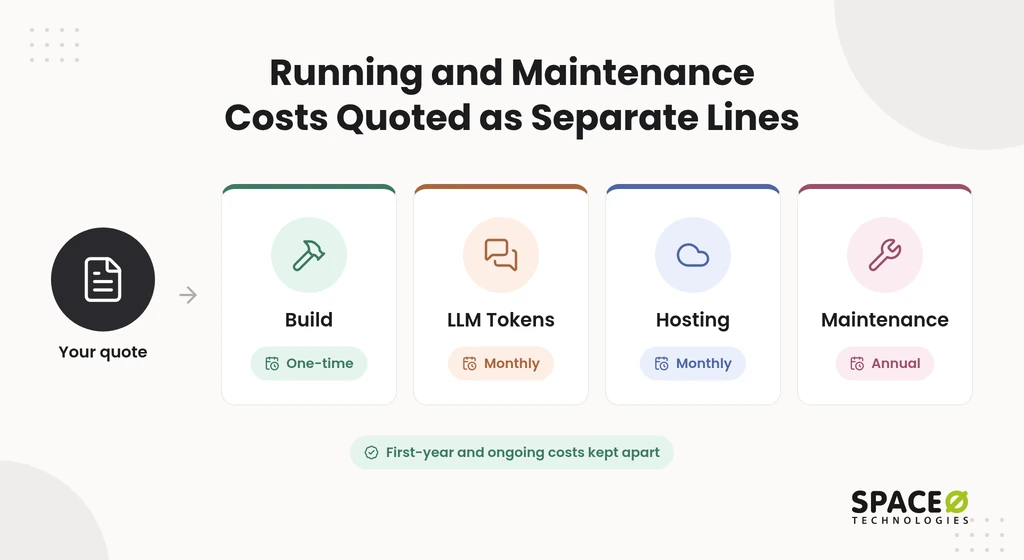
Space-O Technologies quotes build, LLM tokens, hosting, and maintenance as four separate lines, so first-year and ongoing costs stay apart. Market guides, including daily.dev, put annual maintenance at 15-30% of the initial build. Space-O Technologies’ AI development cost guide puts annual maintenance at 15% to 25% of the original cost. That range falls inside the 15-30% of initial build cost per year that market guides cite.
Token and hosting fees are billed by usage, so we size them from your expected task volume. The table shows how each input moves each line:
| Input | Build | LLM tokens (monthly) | Hosting (monthly) | Maintenance (annual) |
|---|---|---|---|---|
| Number of integrations | Rises with each connected system | Rises when tasks call more tools | Little direct change | Follows the build line |
| Data readiness | Rises with cleaning and structuring work | Little direct change | Rises with the size of the vector store | Follows the build line |
| Compliance scope | Rises with access controls, audit logs, and testing | Little direct change | Rises if data must stay in a set region | Follows the build line, plus audit upkeep |
| Human-review steps | Rises with approval screens and routing | Little direct change | Little direct change | Follows the build line |
| Expected task volume | Little direct change | Rises with every completed task | Rises with peak load | Follows the build line |
Our guide to AI agent maintenance cost after launch fills these four lines for a $100,000 build. The figures are arithmetic on published ranges, not a client quote.
| Quote line | Low case | High case |
|---|---|---|
| Build (one-time) | $100,000 | $100,000 |
| LLM tokens (monthly) | $500 | $5,000+ |
| Hosting and infrastructure (monthly) | $200 | $2,000+ |
| Maintenance (annual, 15% / 25% of build) | $15,000 | $25,000 |
Together, the running and maintenance lines add $23,400-$109,000+ a year on top of the build. Each quote is matched to one of four engagement models:
| Engagement model | Best fit | How the build line is handled |
|---|---|---|
| Fixed Cost | A scoped MVP with a clear feature list | Set price, paid in milestones tied to deliverables |
| Time & Material | Scope expected to change after early testing | Billed for time used, reviewed at each milestone |
| Dedicated Team | A long-term agent program across several workflows | Team cost for the period, with running lines quoted separately |
| Staff Augmentation | An in-house team that needs AI engineers added | Engineers join your sprints, with running lines quoted separately |
With every line visible, the remaining question is how the quote gets produced.
From Scoping Call to Signed Quote in Four Steps
Space-O Technologies moves you from the first call to a signed, line-itemized quote in four steps. Each step narrows the scope until every cost line can be named.
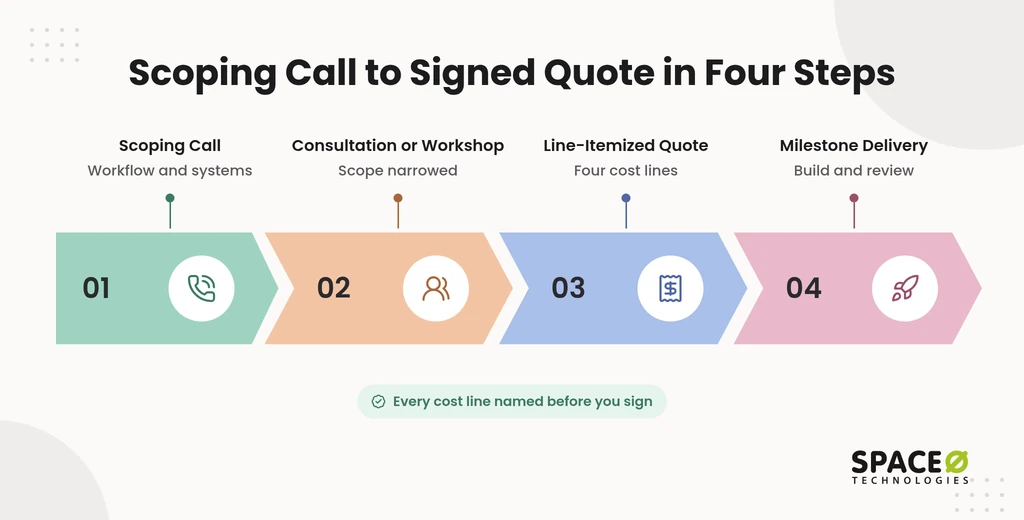
- Scoping call: We map your workflow, systems, data access, and compliance needs with you.
- Consultation or discovery workshop: We run the four-part consultation for one known workflow, or the workshop when several ideas compete.
- Line-itemized quote: You receive the four cost lines described above, matched to one engagement model.
- Milestone-based delivery: We build in milestones tied to deliverables, with evaluation and human review before launch.
Each step follows the AI agent development process we use on production builds.
Six inputs to prepare before your scoping call
Six inputs give Space-O Technologies what it needs to quote your agent.
- Workflow: The task the agent runs, from start to finish, with one real example.
- Systems: The CRM, ERP, databases, Slack, or payment systems the agent must read or update.
- Data and compliance: How sensitive the data is, and whether SOC 2, HIPAA, or GDPR applies.
- Volume, timeline, and budget: Expected tasks per month, your target launch date, and the budget range you hold.
- Engagement type: Hourly advisory, a prototype or MVP, or a full custom build.
- Platform: Any model or cloud already in use, such as OpenAI, Claude, or AWS.
These six answers turn a first call into a quote you can take to your board or investors.
Proven on 300+ Software Solutions for 1,200+ Clients
Space-O Technologies has delivered 300+ software solutions for 1,200+ clients and reports 97% client retention. Those numbers come from products that shipped and scaled.
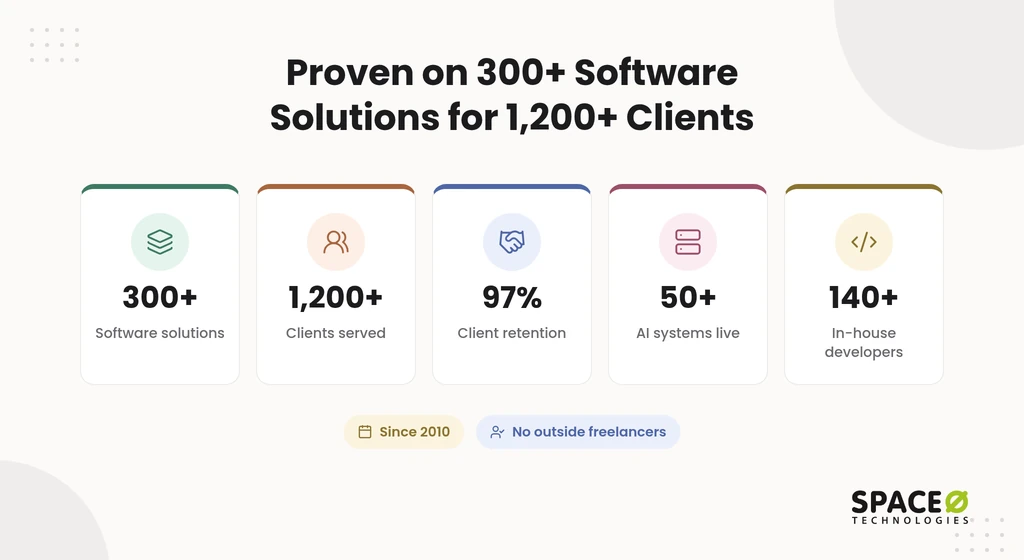
- Production AI: 50+ AI systems run in production, built by 30+ AI engineers.
- Glovo: The on-demand delivery app we built secured $1.2 billion in funding and passed 30 million downloads.
- Fyule Video Lab: The video learning platform we built secured $1.4 million through an angel syndicate.
- In-house team: 140+ in-house developers build every project, with no hand-off to outside freelancers.
Glovo was also chosen for Apple’s Best of 2016. The same delivery discipline shapes how we scope and price your agent.
Why Space-O Technologies Carries Your Agent from Discovery to Production
Space-O Technologies keeps discovery, design, build, run, and maintenance under one team, so your roadmap never changes hands.
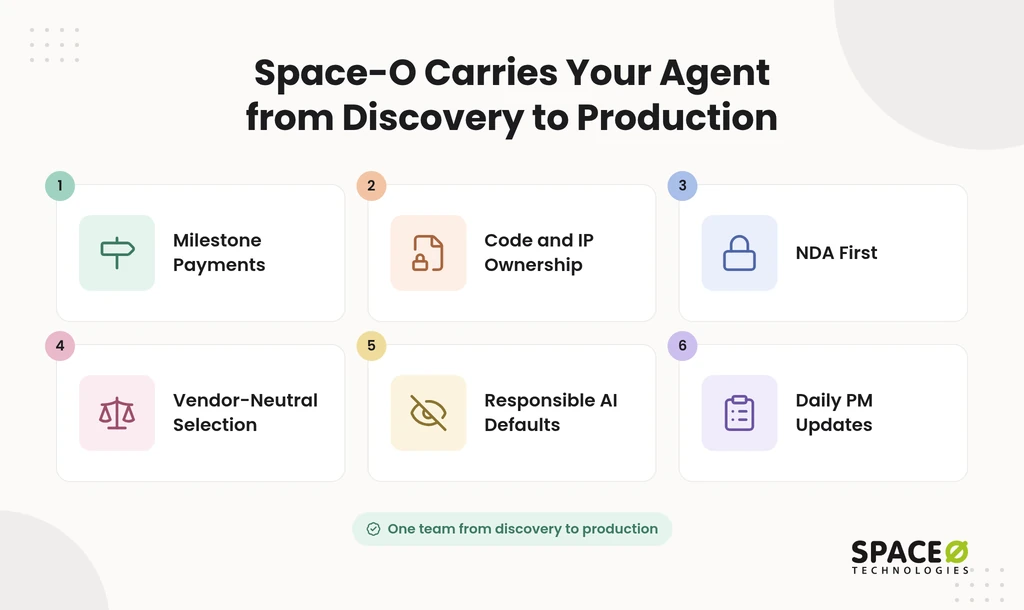
- Milestone payments: You pay against delivered milestones rather than for the whole build upfront.
- Code and IP ownership: All source code, data, and intellectual property (IP) transfer to you at completion.
- NDA first: We sign a non-disclosure agreement (NDA) before any project starts.
- Vendor-neutral selection: We evaluate all leading AI tools and LLM providers objectively, with no commercial bias toward any platform.
- Responsible AI defaults: No training on client data, personally identifiable information (PII) masking, hallucination and bias testing, and human review.
- Compliance posture: We work under ISO 9001 and ISO 27001 practices, and HIPAA-ready frameworks cover healthcare AI engagements.
- Transparency: A dedicated project manager (PM) sends daily updates throughout delivery.
- Locations: Offices in Mesa (Arizona), Brampton (Ontario), and Ahmedabad (India) cover your time zone.
High-stakes outputs in finance or healthcare need stricter accuracy testing. Automation handles the volume, but a qualified person approves before any output shapes a final decision. Our guide to AI agent security best practices explains the access and deployment controls behind this.
Get a Scoped Quote for Your AI Agent
Share your workflow and the systems it touches, and Space-O Technologies returns a quote you can plan around. Your estimate separates build, running, and maintenance costs and ties every payment to a milestone. Request your scoping call and start with a number that holds up.
Frequently Asked Questions
Can a custom AI agent connect to my CRM, ERP, or internal tools?
Yes, every system the agent must read or update adds cost to the build line. Start with the single system the first workflow needs, then add the rest in later milestones.
Do custom AI agents require ongoing maintenance?
Yes, and maintenance is the line most often missing from published price cards for custom AI agents. Space-O Technologies’ guide sets maintenance as a share of the build, so ask what missing lines cover.
How much does custom AI agent development cost?
Market ranges are about $30,000-$150,000 for mid-level multi-task agents and $150,000-$400,000+ for enterprise multi-agent systems, as of November 2026. A production-ready, multi-tool agent typically costs $80,000-$180,000, and a multi-agent system costs $150,000-$500,000. Entry-tier prices vary widely by source. Integrations, data readiness, compliance scope, and human-review steps move your number within a tier. An exact figure follows scoping.
How long does it take to build a custom AI agent?
The timeline depends on scope, and Space-O Technologies sets it after the scoping call and discovery. The number of connected systems, the state of your data, and the compliance rules that apply are the main drivers. On our published ranges, a multi-agent system takes 16 to 28 weeks. We build in milestones tied to deliverables, so you see progress before launch.
What is the process for getting a quote for a custom AI agent?
Getting a quote takes four steps, starting with a scoping call and a consultation or discovery workshop. The third step is a line-itemized quote, and the fourth is milestone-based delivery of your agent. The first call maps your workflow, systems, data access, and compliance needs. The quote then separates build, LLM tokens, hosting, and maintenance.
What information do I need to get an accurate AI agent quote?
Bring your workflow, connected systems, data sensitivity, expected monthly volume, target launch date, and budget range. One real example of the task helps most. Also note any model or cloud you already use, such as OpenAI, Claude, or AWS.
What is the difference between an AI agent and a chatbot?
An AI agent plans, uses tools, reads databases, and completes multi-step tasks, while a basic chatbot mainly answers questions. That difference changes the cost. Every tool or system an agent acts on adds build, permission, and testing work.



 All our projects are secured by NDA




 4.8


