
 By
Contents
- Start with one well-scoped agent; it gives lower latency, simpler debugging, and lower token cost.
- Move to multi-agent only at a hard wall: compliance isolation or conflicting rules from different departments.
- Multi-agent systems cost more to build and run, because tokens, handoffs, and monitoring multiply.
- Choose the simplest design that meets your governance needs, then add agents when a measured limit forces it.
Key Takeaways
Choosing between single agent vs multi agent architecture for enterprise is a costly decision. Pick wrong, and you pay in latency, debugging time, and rework. Your team needs a clear rule, not another vendor pitch.
One agent is simple, fast, and cheap to run. Several agents add isolation and parallel work, but they raise cost. The right answer depends on your workflow, governance needs, and team.
Space-O Technologies has built AI-powered software since 2010. This guide compares two AI agent architecture designs, with build and running costs. You will leave with three questions that settle the choice.
Single-Agent Architecture
A single-agent architecture runs one reasoning loop that plans, calls tools, and completes the task. It is the right starting point when one workflow needs fast automation with few moving parts to govern.
- Definition: One agent works from a single context window that holds its instructions, tools, and task history.
- How it works: The agent plans a step and makes a tool call. It reads the result and repeats the cycle until the task is done.
- Best for: Narrow domains, rapid prototyping, linear workflows, and agents that use fewer than 10-15 tools.
| Advantages | Limitations |
|---|---|
| Low latency, because there are no handoffs between agents. | Loses context when too many conflicting rules crowd one prompt. |
| Simple debugging, because one trace shows every decision. | Applies one permission set to every step, which limits isolation. |
| Lower cost, because one loop consumes fewer tokens. |
Multi-Agent Architecture
A multi-agent system (MAS) divides work across specialist agents, each with its own instructions, tools, and permissions. It fits when one agent can no longer hold every rule, domain, or access boundary your process requires. Popular AI agent frameworks support these patterns.
- Definition: Several agents cooperate on one business process, and each owns a defined slice of the work.
- How it works: Three coordination patterns dominate:
- Orchestrator/supervisor: A supervisor agent plans, delegates tasks to specialists, and checks their output.
- Hub-and-spoke: A central agent routes requests to specialist agents and gathers their results.
- Pipeline: Each agent passes its output to the next agent in a fixed sequence.
- Best for: Broad enterprise domains, cross-functional processes, and work that benefits from parallel execution.
| Advantages | Limitations |
|---|---|
| Specialization, because each agent carries a short, focused prompt. | Adds design and operating complexity. |
| Governance and isolation, because each agent gets only the data and tools it needs. | Introduces non-deterministic handoffs between agents. |
| Parallelism, because independent subtasks run at the same time. | Raises cost and latency as tokens and calls multiply. |
Single Agent vs Multi Agent Architecture: Comparison at a Glance
Single agents win on speed, cost, and simplicity. Multi-agent systems win on isolation, specialization, and parallel work. The table below compares the two side by side.
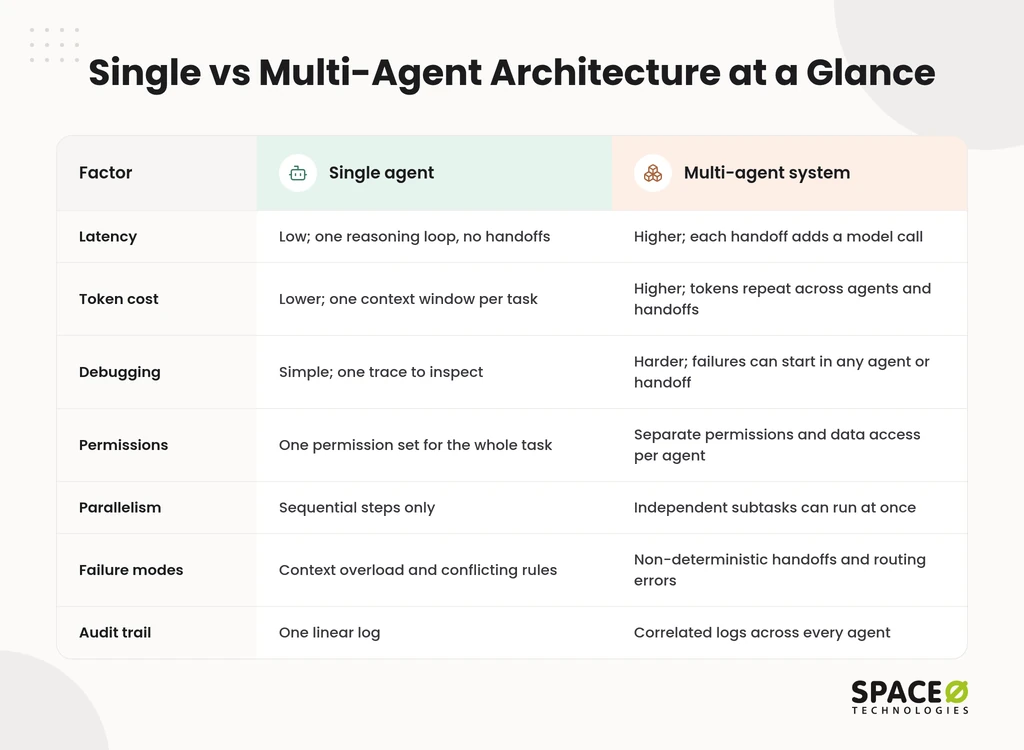
| Factor | Single-agent architecture | Multi-agent system (MAS) |
|---|---|---|
| Latency | Low; one reasoning loop, no handoffs | Higher; each handoff adds a model call |
| Token cost | Lower; one context window per task | Higher; tokens repeat across agents and handoffs |
| Debugging | Simple; one trace to inspect | Harder; failures can start in any agent or handoff |
| Governance and permission boundaries | One permission set for the whole task | Separate permissions and data access per agent |
| Parallelism | Sequential steps only | Independent subtasks can run at once |
| Failure modes | Context overload and conflicting rules | Non-deterministic handoffs and routing errors |
| Audit trail | One linear log | Needs correlated logs across every agent |
| Best fit for | Narrow, linear workflows with fewer than 10-15 tools | Regulated workflows needing isolated review steps and cross-functional processes |
How to Decide Between Single Agent and Multi Agent Architecture for Your Enterprise
Choose the simplest architecture that clears your governance requirements, then add agents only when a measured limit forces it. Most teams over-engineer at the start and pay for it in latency and debugging time. Gartner projects 40% of enterprise applications will include task-specific AI agents by 2026, up from under 5% in 2025.
Which questions settle the choice?
Three questions, one per decision axis, settle most enterprise cases.
- Task complexity: Does the workflow stay inside one domain and follow a mostly linear path? If yes, one agent usually fits.
- Governance needs: Does any step need its own data access, approval, or compliance boundary? If yes, that step may need its own agent.
- Operational overhead: Can your team trace, test, and monitor several agents in production? If not, stay with one agent for now.
An AI consulting engagement can answer these three questions against your real workflows before you commit any build budget.
Where does Space-O Technologies fit?
Space-O Technologies designs, builds, and maintains both architectures, starting from your workflow rather than a preferred pattern. We have built AI-powered custom software since 2010 for 1,200+ clients and developed 300+ software solutions.
Our 140+ in-house developers work under an NDA signed before every project. All source code, data, and IP transfer to you at completion. Our AI agent development services cover single agents and supervised multi-agent systems.
These are delivery credentials. They tell you who will build and maintain the system. They do not change which architecture your workflow needs.
Get Your Architecture Choice Validated First
Our engineers review your workflow against the three questions above. You receive a clear single-agent or multi-agent recommendation with a scoped, expert-reviewed estimate.

When Should Enterprises Move to Multi-Agent?
Move to multi-agent only when you hit a hard wall that one agent cannot clear with better prompts or tools. Two walls come up repeatedly in enterprise work.
What are the hard walls?
The two hard walls are compliance isolation and multi-domain conflict.
- Compliance isolation: A step must touch sensitive data that other steps must never see. A separate agent with narrow permissions keeps that boundary enforceable and auditable.
- Multi-domain conflict: Rules from different departments contradict each other inside one prompt. Splitting the domains into specialist agents keeps each rule set short and consistent.
Tool count alone is a weaker signal. An agent with many tools in one domain can often be fixed with better tool descriptions.
How do regulated workflows change the decision?
In regulated workflows, the question becomes who builds and maintains the review boundaries, not just how many agents run. High-stakes outputs in finance or healthcare need stricter accuracy testing and often human review.
A multi-agent design can place a human review checkpoint between agents. People then approve consequential decisions before the next agent acts. That checkpoint needs grounding, evaluation, and logging, plus a team that keeps them working after launch.
Follow AI agent security best practices from day one. Bolting these controls on after go-live is costly.
What Does Each Architecture Cost to Build and Run?
A multi-agent system costs more to build and more to run, because tokens, handoffs, and monitoring all multiply. The sections below break that cost into its drivers.
What drives the build cost?
Build cost tracks the number of agents, integrations, and governance controls your design needs.
- Single agent: One reasoning loop, its tool integrations, its prompt, and one evaluation suite.
- Multi-agent: Supervisor or routing logic, a prompt and evaluation suite per agent, handoff contracts, and per-agent permissions.
Space-O Technologies puts overall AI development cost at $25,000 to $500,000+ in 2026, depending on scope.
Space-O Technologies’ published AI agent cost ranges show the gap by architecture. A production-ready, multi-tool autonomous agent typically costs $80,000 to $180,000. A multi-agent system costs $150,000 to $500,000 and takes 16 to 28 weeks. Each standard API integration adds $1,800 to $4,300, and each legacy integration adds $4,000 to $8,500. Multi-agent interactions also produce emergent behavior that is hard to predict, so testing takes longer.
What drives the running cost?
Running cost grows with every model call, so handoffs make a MAS more expensive per task.
- Token cost: A single agent pays for one growing context window. A MAS pays for several, plus the context each handoff passes along.
- Monitoring: One trace covers a single agent. A MAS needs correlated tracing across agents to catch routing and handoff failures.
- Audit tooling: Regulated teams must log every agent’s inputs, outputs, and tool calls in a reviewable form.
On Space-O Technologies’ published ranges, monthly operating cost runs from about $500 for a simple agent to over $10,000 for enterprise deployments. That covers LLM tokens, cloud infrastructure, vector databases, and monitoring. For a mid-complexity agent at moderate volume, run and maintain costs commonly add $40,000 to $120,000 a year beyond the build. By business function, a single-function agent typically costs $2,000 to $10,000 a month to run. Finance and IT helpdesk agents cost least, while legal document review sits at the high end.
How much does maintenance add each year?
Annual maintenance typically costs 15% to 25% of build cost, according to Space-O Technologies’ AI development cost guidance. It is not specific to multi-agent systems.
Here is an illustrative example. The build budgets below are hypothetical, not quotes:
| Illustrative build | Hypothetical build cost | Yearly maintenance estimate |
|---|---|---|
| Single agent | $40,000 | $6,000-$10,000 |
| Multi-agent system | $160,000 | $24,000-$40,000 |
On these hypothetical budgets, the multi-agent system’s yearly maintenance ($24,000-$40,000) runs four times the single agent’s ($6,000-$10,000), because both apply the same 15% to 25% rate to a build cost that is four times higher. Infrastructure and LLM API usage come on top of maintenance.
How do you start small and expand?
Start with a scoped single-agent build, then expand through an engagement model that matches your next phase. Space-O Technologies offers four engagement models: Dedicated Team, Time & Material, Fixed Cost, and Staff Augmentation.
A Fixed Cost engagement suits a first, well-defined agent. Time & Material or a Dedicated Team suits the move to multi-agent, when scope is less predictable. If your team prefers to build in-house, you can hire AI agent developers to add capacity.
Frequently Asked Questions
What is a handoff in a multi-agent system, and why does it matter?
A handoff is the point where one agent passes its output to another agent. Each handoff adds a model call, so latency rises and tokens repeat across agents. Handoffs are also non-deterministic, and failures can start in any agent or handoff, which makes debugging and audit trails harder.
Can you start with one agent and split into multiple agents later?
Yes, you can start with one agent and split into multiple agents later. Starting with a scoped single-agent build is the recommended order for most enterprises. Expand only when a measured limit forces it. Examples are a compliance boundary or contradictory rules from different departments.
Who actually needs a multi-agent system instead of a single agent?
Teams whose workflows hit a hard wall need a multi-agent system. One wall is a step that touches sensitive data other steps must never see. Another is rules from several departments that conflict inside one prompt. Cross-functional processes with independent subtasks that benefit from parallel execution also fit. Regulated finance and healthcare teams often land here because they need isolated review steps and human approval between agents.
Which teams should stay with a single agent?
Teams automating one workflow in a single domain should stay with one agent. This holds when the path is mostly linear and the agent uses few tools. The same applies if the team cannot yet trace, test, and monitor several agents in production. A single agent gives lower latency, one trace to debug, and lower token cost.
What can a multi-agent system do that a single agent cannot?
A multi-agent system can give each agent only the data and tools it needs, which enforces governance and isolation. It can run independent subtasks in parallel, while a single agent works through steps sequentially. It can also keep each prompt short and focused by assigning one domain per specialist agent.
How much does a multi-agent system cost compared with a single agent?
A multi-agent system costs more than a single agent to build and to run. On Space-O Technologies’ published ranges, a production-ready, multi-tool agent typically costs $80,000 to $180,000. A multi-agent system costs $150,000 to $500,000, and tokens, handoffs, and monitoring add running cost.



 All our projects are secured by NDA




 4.8


