
 By
Contents
- Define your stack as six layers, then pick tools per layer by workload, data, and team skills.
- React.js with Next.js and Python with FastAPI remain the default frontend and AI backend pairing.
- Price the full lifecycle, since data work and integrations usually cost more than the model itself.
- Enterprise builds need a governed large language model (LLM) gateway that logs every prompt.
Key Takeaways
An AI app development tech stack is a set of layers that work together. It spans the frontend, backend, AI models, data storage, and infrastructure. The right mix depends on your business goal.
Picking tools is rarely what sinks an AI product. The trouble starts when a demo stack meets real users and real data. See how an AI app differs from a traditional app before you budget.
This guide covers all six layers with the tools teams use in production. It also covers enterprise builds, lifecycle costs, three reference stacks, and a decision table. For one team across every layer, explore our AI development services.
The Six Layers of an AI App Stack at a Glance
An AI app stack has six layers. Each can change without forcing a rebuild of the others.
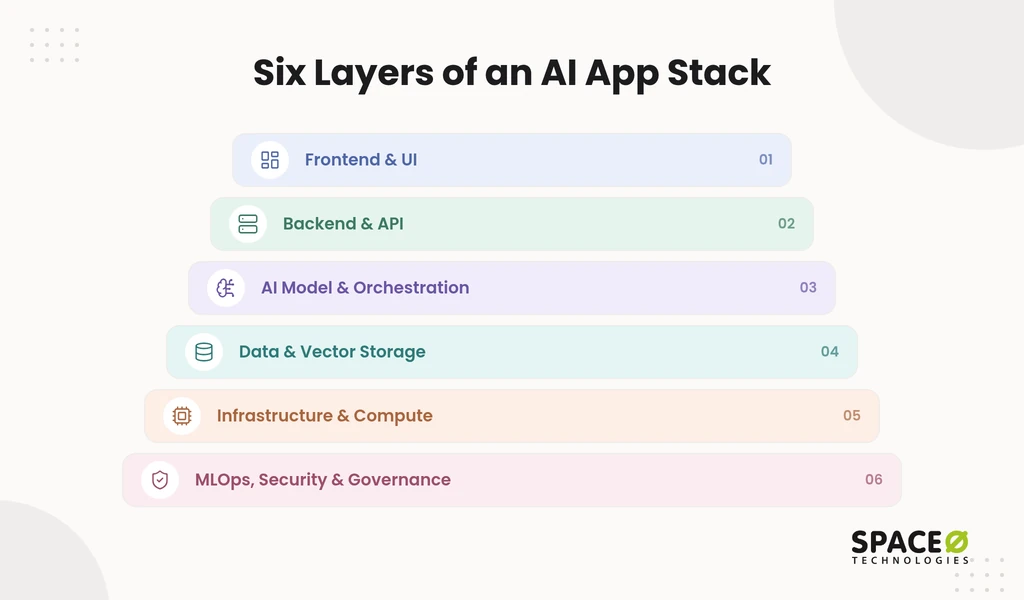
- Frontend & UI: where users enter prompts and read results.
- Backend & API: business logic, model calls, and integrations.
- AI model & orchestration: the models and the frameworks that chain them.
- Data & vector storage: app data, embeddings, caching, and pipelines.
- Infrastructure & compute: cloud, accelerators, and containers.
- MLOps, security & governance: monitoring, evaluation, access, and compliance.
The sections below take each layer in turn, starting with what users see. Because the layers change independently, you can update one without touching the rest.
1. Frontend & UI Layer
The frontend layer is where users type prompts and read streamed answers. React.js with Next.js is the standard choice. Users judge an AI app by how quickly the first words appear and how clearly results display.
- UI library (component-based interfaces): React.js.
- Web framework (server rendering, routing, and response streaming): Next.js.
- Language and styling (type safety and fast layout): TypeScript and Tailwind CSS.
- Sign-in and billing (user accounts and subscriptions): Clerk for authentication and Stripe for payments.
Choose Next.js for search-friendly pages and streaming chat in one codebase, a pattern common in full-stack development. Plain React.js suits internal dashboards behind a login.
2. Backend & API Layer
The backend layer runs business logic, calls models, and connects other systems through application programming interfaces (APIs). Python with FastAPI is the common choice for AI-heavy work. A slow or tangled backend makes every model call feel slower than it is.
- AI backend (model calls, RAG, and async jobs): Python with FastAPI or Flask.
- General backend (real-time APIs and web services): Node.js.
- Enterprise backend (existing Java or Microsoft estates): Spring Boot or.NET.
- Backend as a service, or BaaS (auth, database, and storage in one): Supabase, Firebase, or Convex.
- Model serving (self-hosted inference endpoints): BentoML, TorchServe, or NVIDIA Triton Inference Server.
Pick Python with FastAPI when retrieval-augmented generation (RAG) or data science drives the product. Pick Node.js when the backend is mostly APIs around a hosted model. Our guide to backend development tech stacks covers these frameworks in more depth.
3. AI Model & Orchestration Layer
The model layer supplies the intelligence through hosted APIs or self-hosted open-weight models. Orchestration frameworks chain prompts, memory, tools, and retrieval. Teams often lock into one provider too early, so a later model change ends up costing them a refactor.
- Hosted model APIs (fastest path to production): OpenAI, Anthropic Claude, or Google Gemini.
- Self-hosted open-weight models (data control and predictable cost): vLLM for production serving or Ollama for local runs.
- Orchestration frameworks (prompts, memory, tools, and RAG pipelines): LangChain, LlamaIndex, or Semantic Kernel.
- App-level AI toolkit (streaming and model switching in TypeScript): Vercel AI SDK.
- Training and fine-tuning (custom models): PyTorch or TensorFlow.
Start on a hosted API to prove value. Move to vLLM when data rules or call volume make self-hosting worth the operations work. Once several agents share the stack, AI agent orchestration for enterprise adds coordination and human-review controls.
4. Data & Vector Storage Layer
The data layer stores app records, embeddings for retrieval, cached responses, and the pipelines that keep data fresh. Answers are only as good as their data, so this layer is a common source of accuracy problems.
- Relational database with vectors (app data and embeddings in one store): PostgreSQL with pgvector, an open-source extension that adds vector similarity search.
- Dedicated vector databases (RAG and semantic search at scale): Pinecone, Qdrant, Milvus, Weaviate, or Chroma.
- Cache (repeat prompts, sessions, and rate limits): Redis or Valkey.
- Warehouse and lakehouse (analytics and training data): Snowflake, Databricks, or BigQuery.
- Streaming and pipelines (real-time events and scheduled jobs): Apache Kafka, Apache Spark, or Airflow.
pgvector keeps operations simple while your data is modest. A dedicated vector database earns its cost once you need large indexes or advanced filtering. Pipelines, PII masking, and lineage matter just as much, and data management for AI app development covers them.
5. Infrastructure & Compute Layer
The infrastructure layer is the bottom of the stack: cloud platforms, accelerators, and containers. Compute is where AI costs climb fastest if no one sizes it.
- Cloud platforms (managed compute, storage, and AI services): AWS, Google Cloud, or Microsoft Azure.
- Managed ML platforms (training and deployment on one cloud): AWS SageMaker, Google Vertex AI, or Azure AI.
- Accelerators (training and low-latency inference): NVIDIA graphics processing units (GPUs) or Google tensor processing units (TPUs).
- Containers and orchestration (packaging and scaling): Docker, with Kubernetes to automate deployment, scaling, and container management.
- Hosting and CI/CD (fast frontend deploys and pipelines): Vercel and GitHub Actions.
Use Vercel for frontend speed. Choose Kubernetes when you run several services or self-hosted models.
6. MLOps, Security & Governance Layer
The MLOps and governance layer tracks model quality, drift, latency, and cost, and it enforces who can access what. Without it, problems show up first as customer complaints.
- Experiment tracking and pipelines (model versions and retraining): MLflow, Kubeflow, or Weights & Biases.
- LLM tracing and evaluation (prompt quality and regressions): LangSmith, Arize Phoenix, or Langfuse.
- Infrastructure monitoring (uptime, errors, and spend): Datadog or AWS CloudWatch.
- Guardrails (input and output filtering): NeMo Guardrails.
- Identity and access (single sign-on and role-based access control, or RBAC): Okta, Auth0, Microsoft Entra ID, or Keycloak.
Governance cuts across every layer, so plan it on day one with an AI agent governance framework. Retrofitting it later costs far more.
AI-Assisted Development Tools
AI coding tools such as Cursor, Windsurf, and Claude Code speed up how teams build the stack. They are not part of the running app, and they help with code generation, refactoring, and tests. Your team still owns code review, security checks, and architecture decisions. These tools change delivery speed, not the six layers.
Add Full Stack AI Engineers to Your Team
Need React.js, FastAPI, and Kubernetes skills on one sprint team? Our dedicated full stack developers work inside your tools, sprints, and code review process.

Tech Stack for Enterprise AI App Development
The tech stack for enterprise AI app development uses the same six layers, ordered from infrastructure up. Governance, identity, and integration controls are added at every level. Enterprises rarely start from zero. Their stack has to fit existing clouds, identity systems, and line-of-business software. An enterprise AI software development company plans for that from the start.
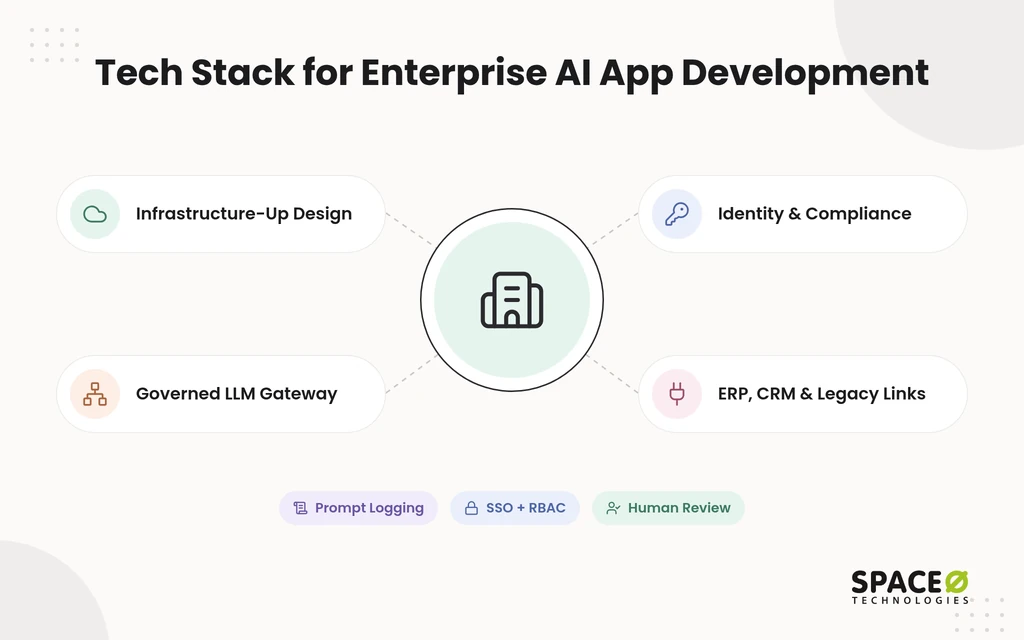
Infrastructure-up architecture for enterprise builds
Enterprise teams design from compute upward: cloud and accelerators first, then data, then models, then the application. Most standardize on one of AWS, Google Cloud, or Microsoft Azure, matching existing contracts and security reviews. GPU or TPU capacity is reserved for workloads that need it, and containers keep services portable across environments.
Governed LLM gateway and prompt logging
A governed LLM gateway is a single entry point that routes requests, applies policy, and logs every prompt. It gives security teams an audit trail and lets you switch providers without touching app code. Tools in this role include LiteLLM, OpenRouter, and TensorZero. Route all traffic through it, including internal tools. It can also fail over when one model API goes down. Treat each provider as a third-party integration for AI applications.
Identity, access, and compliance controls
In an enterprise stack, the model layer inherits the permissions that single sign-on and role-based access enforce. Retrieval then never surfaces records a user could not open. Design for HIPAA (Health Insurance Portability and Accountability Act) controls from the first sprint. Compliance should not be an audit bolted on before launch. For consequential decisions, a person stays involved. Our builds score each output’s confidence and send low-scoring answers to a review checkpoint.
Integration with ERP, CRM, and legacy systems
AI features reach enterprise data through API connectors and gateways. They link into enterprise resource planning (ERP), customer relationship management (CRM), and legacy systems. Integration is often the longest workstream, especially when you integrate AI into legacy software. Java estates can add AI through Spring AI, and other systems can expose data through internal APIs.
The enterprise stack also shapes cost. The next section covers the controls and spending that most stack lists skip.
Production Readiness and Lifecycle Cost
A production AI stack needs evaluation, guardrails, observability, and caching. Its lifetime cost depends more on data and upkeep than on the model. Pilots are cheap, but the bill grows quickly when scaling an AI proof of concept to a full product.
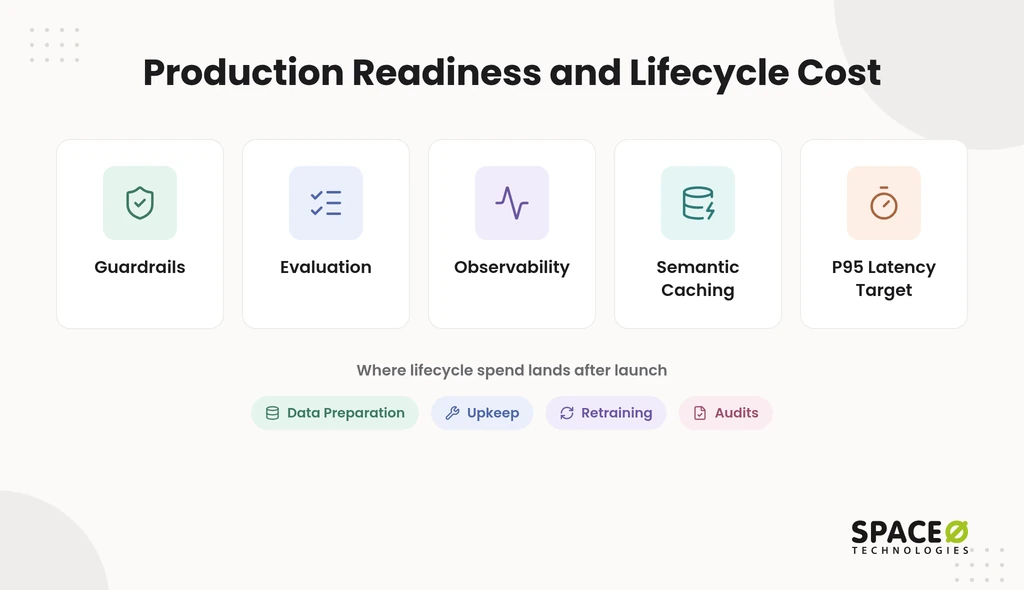
Production controls that keep an AI app reliable
No model ships until five controls are in place: guardrails, evaluation, observability, caching, and a latency target. Across the layers of this stack, our evaluation suite scores cost, latency, bias, hallucination rate, and accuracy. Monitoring keeps running once real users arrive.
- Guardrails: filter inputs and outputs before they reach users.
- Evaluation: test against a fixed set of real questions on every release.
- Observability: trace each request from prompt to response.
- Semantic caching: reuse answers to similar questions to cut cost and latency.
- Latency target: set a 95th-percentile (P95) latency goal per user action and alert on slips.
What each layer costs over its lifecycle
Most of a stack’s spend lands after launch, in data preparation, upkeep, retraining, and audits. Data preparation can take 25% to 40% of the total project budget, according to our AI development cost guide. Yearly maintenance adds 15% to 25% of the original build cost. The model is rarely the biggest line, because data work, integrations, and production engineering usually outweigh it.
The same analysis prices the recurring lines that sit under the data, infrastructure, and MLOps layers:
- Data infrastructure: $500-$5,000 a month for data storage and processing.
- Monitoring and observability: $300-$2,000 a month across enterprise systems.
- Compliance audits: $10,000-$40,000 a year in regulated sectors, depending on scope.
- Retraining cycles: $15,000-$60,000 a year to keep models accurate as data shifts.
At the model layer, token spend grows with traffic. Our AI integration cost guide puts the monthly run cost of an AI feature at $40-$1,000+. In its modeled scenarios, a $40,000 RAG assistant at $2,000 a month passes its build cost in month 15. A light-usage $40,000 build crosses around month 40. These are planning estimates, not a measured project bill.
Your first release sets the stack’s starting bill. Our MVP development services start from $15,000 for a basic build, and feature-rich MVPs reach $50,000+. Payments follow milestones.
Timelines run 2 to 3 months for simple AI solutions and 4 to 8 months for mid-level apps. Enterprise systems take 6 to 12 months. GPU workloads, low-latency targets, and hybrid or on-premises hosting raise both build and monthly spend.
| Layer | Main lifecycle cost driver | Build vs buy call |
|---|---|---|
| Frontend & UI | Design changes and streaming UX | Build the UI; buy authentication (Clerk) and payments (Stripe) |
| Backend & API | Integrations and async job handling | Buy BaaS for an MVP; build FastAPI or Node.js once workflows get custom |
| AI model & orchestration | Token usage that grows with traffic | Buy hosted APIs first; self-host on vLLM when volume or data rules justify it |
| Data & vector storage | Data preparation, pipelines, and retraining | Build pipelines on your data; buy managed vector and warehouse services |
| Infrastructure & compute | GPU hours and always-on capacity | Buy managed cloud; run Kubernetes only when your team can operate it |
| MLOps & governance | Evaluation, monitoring, and audits | Buy tracing tools; build evaluation sets from your own data |
With costs mapped, the reference stacks below show how the layers combine for common goals.
Reference Stacks by Use Case
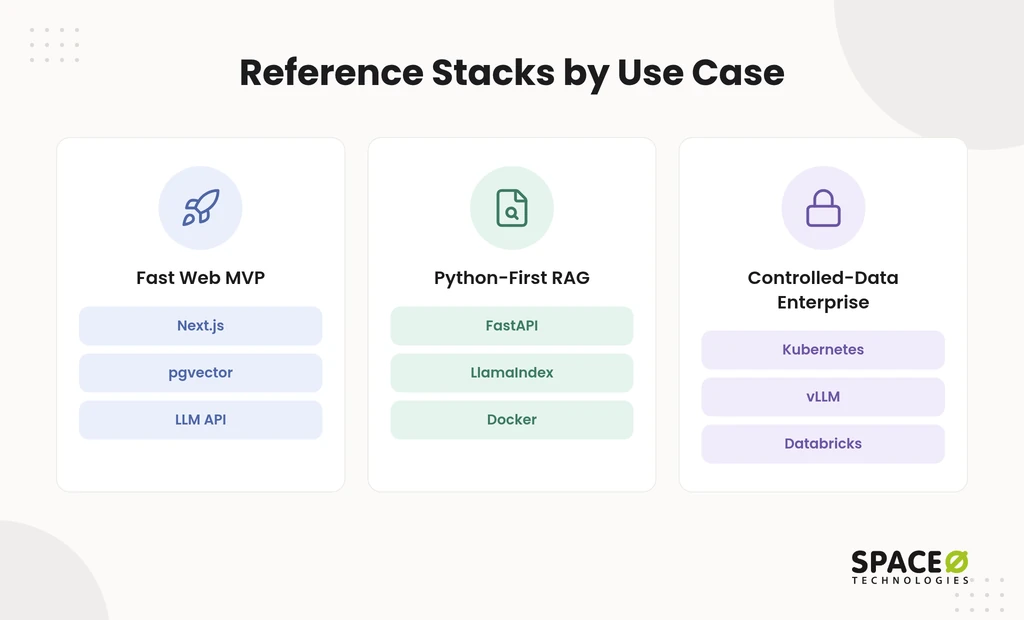
Most AI products fit one of three reference stacks: web MVP, Python-first RAG, or controlled-data enterprise. Each one swaps parts between layers without changing the overall shape.
Fast web MVP stack
A fast web MVP pairs Next.js, a BaaS or FastAPI backend, PostgreSQL with pgvector, an LLM API, and Vercel. Use Supabase or Firebase to skip auth and storage work, and call OpenAI or Anthropic Claude directly. Best for: founders who need users and investor feedback before deeper engineering.
Python-first RAG stack
A Python-first RAG stack runs FastAPI, LangChain or LlamaIndex, pgvector or Pinecone, and a hosted model in Docker. Python keeps data loading, chunking, and evaluation in one language. Best for: grounded answers over company documents, contracts, or product catalogs.
Controlled-data enterprise stack
A controlled-data enterprise stack combines Databricks or Snowflake, Kubernetes, vLLM with an open-weight model, and a React.js or Next.js frontend. The managed alternative keeps everything on AWS SageMaker, Google Vertex AI, or Azure AI. That route is faster to stand up but ties you more closely to one cloud. Best for: regulated data that cannot leave your environment.
Use these as starting points. The tables below show how to adjust them to your constraints.
How to Choose: Stack Comparison and Decision Table
Choose each layer by four trade-offs: time to release, cost to maintain, ownership, and fit for regulated data. No option wins on all four, so name your top constraint first.
Stack comparison by stage
| Option | Time to first release | Cost to maintain | Code and IP ownership | Fit for regulated data | Trade-off |
|---|---|---|---|---|---|
| BaaS (Supabase, Firebase, Convex) | Fastest | Low at first, rises with usage | You own app code; data and auth sit on the platform | Depends on vendor terms | Migration work if you outgrow it |
| Custom FastAPI or Node.js backend | Moderate | Steady, team-dependent | Full ownership | Strong | More upfront engineering |
| Hosted model APIs (OpenAI, Anthropic, Gemini) | Fastest | Usage-based, grows with traffic | You own prompts and code; weights stay with provider | Needs data agreements | Less control over model changes |
| Self-hosted models (Ollama, vLLM) | Slower | GPU- and operation-heavy | Full ownership | Strongest | Requires infrastructure skills |
| LangChain or LlamaIndex | Fast for RAG and agents | Framework upgrades to track | Full ownership | Neutral | Extra abstraction to debug |
| Direct API calls | Fast for simple flows | Lowest | Full ownership | Neutral | You build retries, memory, and routing |
Best for a funded MVP that must grow into version two without a rebuild: the fast web MVP stack with a FastAPI backend instead of BaaS, packaged in Docker.
Best for production AI where data control and ongoing cost matter: Kubernetes, vLLM with an open-weight model, a governed LLM gateway, and LangSmith or Langfuse tracing.
Decision table by constraint
| Your constraint | Lean toward | Why |
|---|---|---|
| Data residency or on-premises rules | vLLM, Kubernetes, PostgreSQL with pgvector | Data and models stay in your environment |
| Speed matters more than control | Hosted APIs, Supabase, Vercel | Fewer systems to run |
| Team works mainly in Python | FastAPI, LlamaIndex, PyTorch | One language from data to API |
| Team works mainly in TypeScript | Next.js, Node.js, Vercel AI SDK | One language from UI to backend |
| Internal tool for staff | SSO, RBAC, direct API calls | Smaller scale, tighter access |
| Customer-facing product | Caching, guardrails, LLM tracing | Cost, latency, and safety at volume |
How Space-O Technologies Approaches Stack Selection
Space-O Technologies chooses each layer from your business goal, your data, and the team that runs the system. We have built AI-powered custom software since 2010 and served 1,200+ clients. Our full-stack development services cover every layer in this guide. Our 140+ in-house developers have delivered 300+ software solutions, and we report 97% client retention.
Ownership is part of the stack decision. We sign an NDA before every project. All source code, data, and IP transfer to you at completion, so no layer ties you to us. Engagement options are Dedicated Team, Time & Material, Fixed Cost, or Staff Augmentation, and you can hire full-stack developers under any of them.
Glovo, the on-demand delivery app we built, passed 30 million downloads and was named in Apple’s Best of 2016.
Questions to Answer Before You Choose a Stack
Three answers settle most stack decisions: who uses the app, where data lives, and who hosts the model. Write them down before you compare tools.
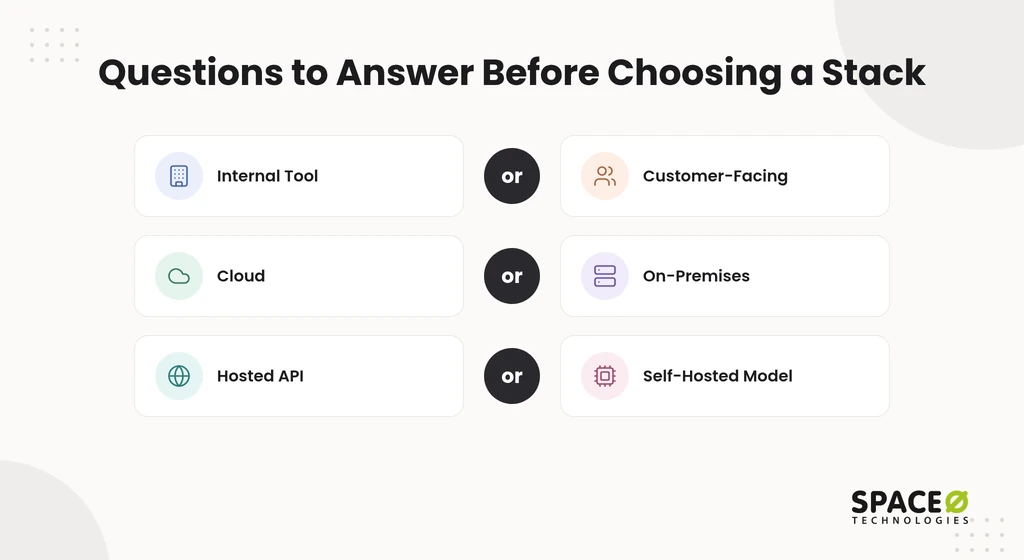
- Internal or customer-facing: this sets your access controls and how much caching and guardrail work you need.
- Cloud or on-premises: data residency rules decide between hosted services and self-managed infrastructure.
- Hosted API or self-hosted model: call volume and data sensitivity decide between paying per token and running GPUs.
If you have those answers, talk to our AI engineers about your stack. We will map each layer to your goals, data, and budget, and include lifecycle costs before you commit.
Frequently Asked Questions
What is an AI app development tech stack?
An AI app development tech stack is the set of tools used across six layers. They cover the frontend, backend, AI models, data and vector storage, infrastructure, and MLOps and governance.
Which tech stack is best for AI app development?
No single stack is best. React.js with Next.js, Python with FastAPI, PostgreSQL with pgvector, and a hosted model API suit most first releases. Choose tools by workload, data, and team skills.
What tech stack do enterprise AI apps use?
Enterprise AI apps use the same six layers, built from infrastructure up. Most add a governed LLM gateway, single sign-on with role-based access, and connectors to ERP and CRM systems.
Should I use a hosted model API or a self-hosted model?
Start with a hosted API such as OpenAI, Anthropic Claude, or Google Gemini to prove value fast. Move to self-hosted models on vLLM when data rules or call volume justify the operations work.
Which database is best for an AI app?
PostgreSQL with pgvector works well while data is modest, because it keeps app data and embeddings in one store. Choose Pinecone, Qdrant, Milvus, or Weaviate for large indexes or advanced filtering.
How much does an AI app tech stack cost?
A basic MVP starts from $15,000, and feature-rich MVPs reach $50,000+. Running one AI feature costs about $40-$1,000+ a month. Data work, upkeep, retraining, and audits add to that after launch.
How long does it take to build an AI app?
Simple AI solutions take 2 to 3 months, mid-level apps take 4 to 8 months, and enterprise systems take 6 to 12 months. Data readiness and integrations set the pace.
What is a full-stack AI developer?
A full-stack AI developer takes one feature from the UI through the model call to deployment without handoffs between specialists. AI-enabled full-stack development applies that same delivery model to AI features.



 All our projects are secured by NDA




 4.8


