
 By
Contents
- Govern AI agents at runtime; static policy documents cannot stop an agent mid-action.
- Give every agent a unique identity, scoped permissions, a business owner, and a technical owner.
- Tier each agent action by blast radius and reversibility, then attach approval, owner, and audit rules.
- Log every prompt, tool call, and decision step, and keep a tested kill switch ready.
Key Takeaways
An AI agent governance framework sets the policies, controls, and processes that manage autonomous agents. Agentic AI moves teams from static tools to agents that plan, act, and call tools. Space-O Technologies has built AI-powered custom software since 2010, with human review on high-stakes decisions.
Those agents act rather than suggest, and that raises the risk your team carries. Then the questions arrive: what may it touch, who approves, and who stops it? In our AI agent development services, those answers ship as code, not policy PDFs.
This guide covers the five pillars, the five-step rollout, and the operating model. It adds an autonomy-tier matrix that links each action to approval, owner, and evidence. Teams scoping a first build can start with our AI agent development best practices.
What Is an AI Agent Governance Framework?
A governance framework decides what each agent may do, enforces it during action, and records the result. Earlier AI governance relied on static policy documents and output review. Agents can update records before anyone reads their output, and AI agent security risks for enterprises grow with that speed, so controls must run at runtime.
Nearly every framework shares four controls. Agents get defined authority and permission limits. High-impact actions need human approval. All activity is logged, and a human-controlled kill switch can stop any agent. Gartner predicts over 40% of agentic AI projects will be canceled by 2027, partly over inadequate risk controls.
US state law adds pressure too. Confirm scope with counsel. The EU AI Act matters only if you also serve EU users.
With the definition set, the next question is which controls belong in the framework.
Core Pillars of an AI Agent Governance Framework
Five pillars cover the controls an agent needs: identity, behavior, tools, runtime, and human oversight. Each pillar closes a different failure path. Skipping one leaves a gap the other four cannot cover.
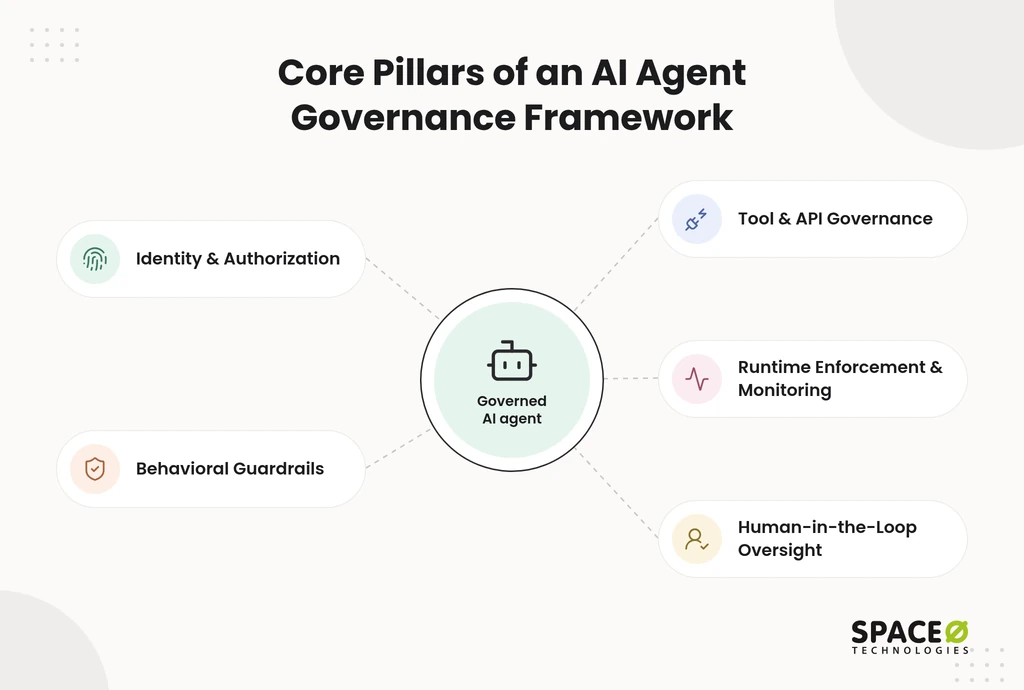
- Identity & Authorization: Every AI agent gets its own unique, verifiable identity, often cryptographic, plus role-based permissions under least privilege. This zero-trust identity stops one agent from borrowing another’s access and ties every action to a named agent. For example, an HR onboarding agent can create employee accounts but cannot read payroll data. Credential handling should follow AI agent security best practices from day one.
- Behavioral Guardrails & Constraints: Guardrails are rules that limit what an AI agent may say, decide, or attempt, whatever its prompt asks. They block prompt injection, keep personally identifiable information (PII) masked, and keep the agent on its assigned task. For example, a sales assistant agent may draft quotes but cannot offer discounts outside the approved price list.
- Tool & API Governance: Tool and application programming interface (API) governance means an AI agent calls only approved tools, within set rate limits. It also covers Model Context Protocol (MCP) servers and Agent2Agent (A2A) connections, which widen what an agent can reach. Without it, one new connector can open a system nobody reviewed. For example, an IT helpdesk agent may use the password-reset API but not the account-deletion API.
- Runtime Enforcement & Monitoring: Runtime enforcement checks each AI agent action against policy at the moment it happens. Monitoring tracks behavior, errors, latency, and token spend, and it alerts the owner when patterns drift. A human-controlled kill switch with rollback stops a misbehaving agent and reverses its recent changes. For example, a scheduling agent booking far above normal volume pauses automatically for review.
- Human-in-the-Loop Oversight: Human-in-the-loop oversight requires a person to approve high-impact or irreversible AI agent actions before they run. Approval workflows and clear thresholds decide which actions pause and who signs off. This control stops an agent from committing the business to something nobody authorized. In a PwC survey of 300 senior executives, only 20% trusted AI agents with financial transactions. For example, a marketing agent may draft a press release, but a communications lead approves publication.
How the pillars map to OWASP Agentic Top 10 and NIST AI RMF
The Open Worldwide Application Security Project (OWASP) publishes the Agentic Top 10. It lists the top risks for agentic applications.
| Pillar | OWASP Agentic Top 10 risk area it addresses | Primary NIST AI RMF function |
|---|---|---|
| Identity & Authorization | Identity and privilege abuse by agents | Govern, Manage |
| Behavioral Guardrails & Constraints | Goal manipulation through prompt injection | Manage |
| Tool & API Governance | Tool misuse and unsafe tool chains | Map, Manage |
| Runtime Enforcement & Monitoring | Cascading failures and rogue agent behavior | Measure, Manage |
| Human-in-the-Loop Oversight | Misplaced human trust in agent output | Govern |
Treat this table as a starting map. Confirm each row against the current published versions before an audit. The pillars describe what to control, and the roadmap below sets the order for putting them in place.
5-Step Implementation Roadmap
Roll out governance in five steps: inventory, ownership, risk classification, runtime controls, and audit. Many teams buy tooling before they know which agents exist. The steps below reverse that order.
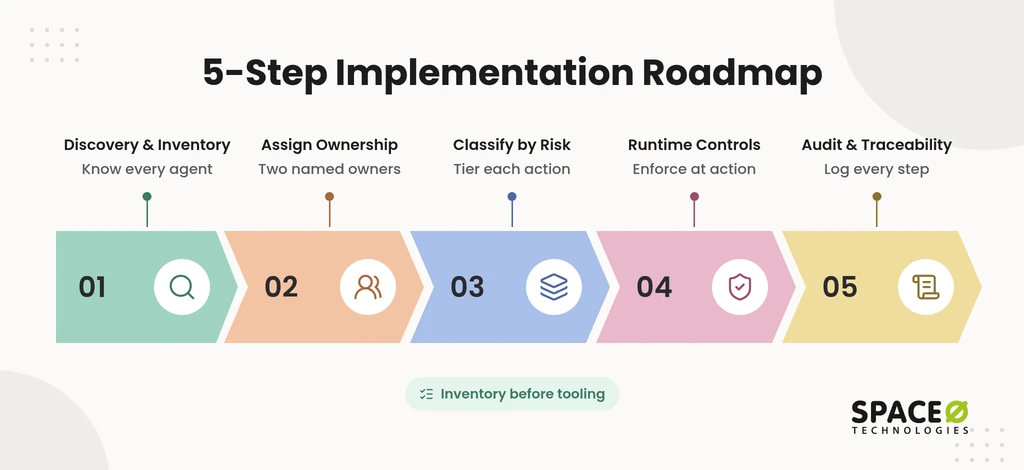
- Discovery & Inventory: Discovery means building a live register of every AI agent your business runs. The register records each agent’s models, tools, data sources, and business outcomes. It exists because you cannot govern an agent you do not know about. For example, a no-code AI agent built by a business team often first appears during this step.
- Assign Ownership: Every AI agent gets a business owner and a technical owner, assigned at creation. The business owner answers for outcomes and decision rights. The technical owner answers for code, access, and incidents. Clear accountability stops agents from running with nobody responsible when something breaks.
- Classify by Risk & Autonomy: Classification sorts each agent action into an autonomy tier, and the tier decides the controls that action needs. The autonomy-tier matrix later in this guide sets out the two tests and gives a ready template. Without classification, every action gets the same control, which is either too loose or too slow.
- Deploy Runtime Controls: This step puts the five pillars into running code: identity, guardrails, tool allow-lists, monitoring, and approval gates. The Microsoft Agent Governance Toolkit is one open-source example of runtime policy enforcement for agents. Teams on other stacks build equivalent controls into their own services. Either way, enforcement lives where the agent acts.
- Audit & Traceability: Audit and traceability mean logging every prompt, tool call, and decision step to an immutable audit trail. Owners review those logs on a schedule, not only after incidents. The trail answers who acted, on whose authority, and why. It also gives regulators and enterprise customers the evidence they ask for.
The roadmap governs agents one at a time. The operating model decides how people and agents share work across the business.
Core Pillars of an Agentic AI Operating Model
An agentic AI operating model sets how work, decisions, and costs are shared between people and agents. Governance without it puts controls on agents that no team plans around. These six elements make the controls fit daily work.
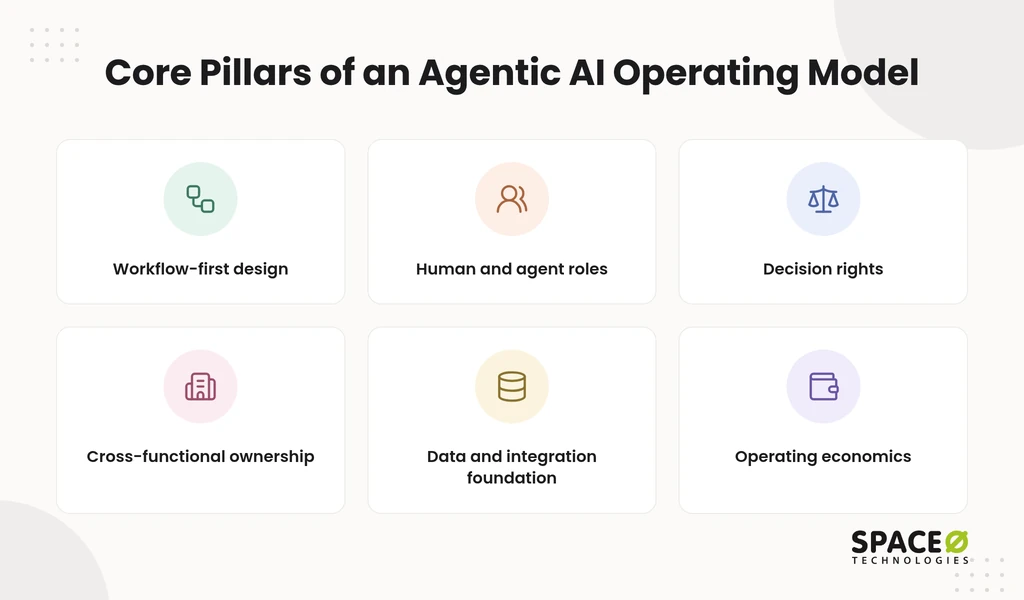
- Workflow-first design: Workflow-first design starts from one business process and decides which steps an agent runs. Steps that need judgment stay with people, and steps that follow fixed rules can stay as plain code. This prevents agents from being added where a simple script would be cheaper and safer.
- Human and agent roles: Each workflow states which tasks the agent performs, which it prepares for a person, and which it never touches. Written roles stop staff from assuming the agent covers work it does not. They also show managers where human time moves after launch.
- Decision rights: Decision rights define which decisions an agent may make alone and which need a named person. They link directly to approval thresholds in the human-in-the-loop pillar. Clear decision rights prevent disputes about who authorized an outcome.
- Cross-functional ownership: Cross-functional ownership brings business, engineering, security, legal, and compliance into one review path for each agent. No single team can judge every risk an agent carries. A shared path stops launches stalling between departments.
- Data and integration foundation: Agents need clean, permissioned data. They also need stable links to customer relationship management (CRM) and enterprise resource planning (ERP) systems. Weak integrations push agents toward workarounds that bypass controls. A sound foundation keeps every agent action inside governed interfaces.
- Operating economics: Operating economics covers token budgets, hosting, and monitoring as ongoing costs per agent. Per-agent cost limits catch runaway usage before it reaches the monthly bill. They also show whether each agent still earns its keep, which is the core of the ROI of AI agents for business.
With roles and decision rights set, the remaining question is how much autonomy each agent action deserves.
Autonomy Tiers: A Control Matrix for Every Agent Action
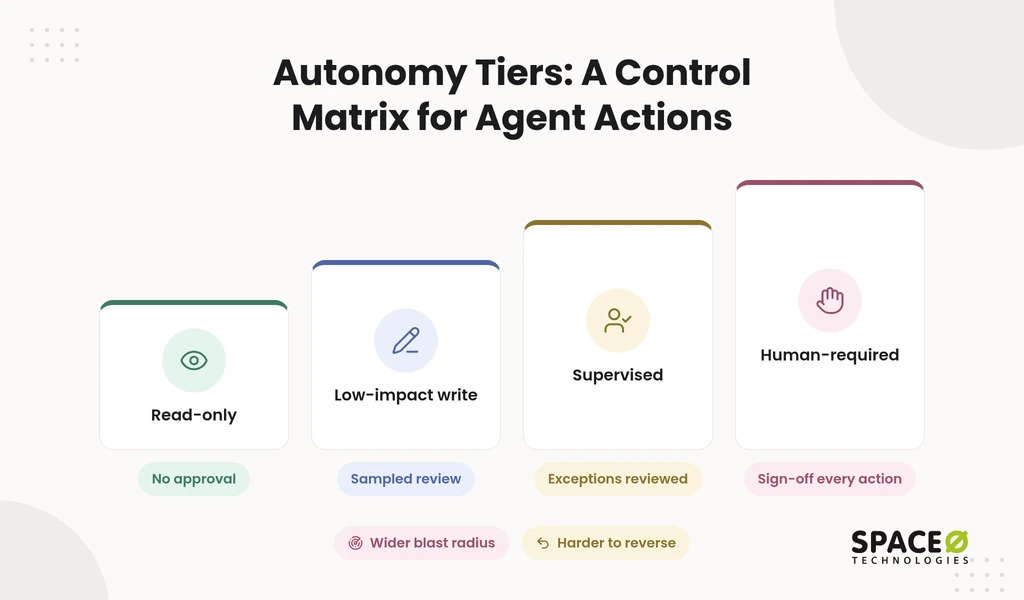
Four autonomy tiers turn risk classification into concrete controls for every agent action. Most frameworks tell you to classify agents by risk, then stop there. Your team still has to decide what each class means for permissions, approvals, owners, and logs.
Set the tier with blast radius and reversibility
Two questions set the tier: how far does damage spread, and can you undo it? Blast radius measures how many people, records, or dollars a wrong action affects. Reversibility measures whether you can undo it fully and cheaply. High reach and low reversibility always push an action toward the human-required tier.
The autonomy-tier control matrix
Each tier fixes five things: example action, identity scope, approval trigger, owner, and audit evidence. Use the matrix as a starting template, then adjust it to your own risk tolerance.
| Tier | Example action | Identity scope and tool permissions | Human-approval trigger | Named owner | Audit evidence and log retention |
|---|---|---|---|---|---|
| Read-only | Search a policy library or check a ticket’s status. | Read scopes on named sources only; no write tools. | None; alert on unusual query volume. | Business owner of the data source. | Query and source log, kept per your records policy. |
| Low-impact write | Update a CRM field or draft an internal message. | Write access to listed fields only; every change reversible. | None per action; sampled weekly review. | Business owner of the workflow. | Before-and-after values for each change. |
| Supervised | Reset employee account access or schedule a routine job. | Action tools behind policy checks and rate limits. | A person reviews exceptions and anything outside set limits. | Business owner, with technical owner on call. | Full prompt, tool call, policy decision, and outcome. |
| Human-required | Move money, sign a contract, or grant admin rights. | Agent prepares only; execution permission issued after approval. | A named approver signs off on every action. | Accountable executive for the decision. | Approval record linked to the agent’s proposal. |
Worked example: an accounts payable approval agent
An accounts payable agent spans all four tiers, so each step gets a different control. Reading incoming invoices is read-only. Coding invoice lines to general ledger accounts is a low-impact write that finance can reverse. Matching an invoice to its purchase order and queuing a small payment is supervised. Releasing a large payment or changing vendor bank details is human-required.
The thresholds between tiers come from your finance policy, not from the agent. Set each threshold, approver role, and log retention period in your finance policy before the agent goes live.
The human-required tier already runs this way in production. For a lending client, the Space-O Technologies agent only drafts an approve-or-decline recommendation with its reasoning. A human underwriter signs off on every case above the exposure threshold, so high-value decisions stay at 100% human approval while the agent handles evidence gathering and drafting.
Turn Your Autonomy Tiers Into Working Controls
Our AI agent developers build identity scopes, approval gates, and audit logging into your software. Every tier in your matrix then runs under enforced controls.

Once tiers are set, you choose how to build the controls behind them.
Build, Buy, or Hybrid? Three Ways to Implement Governance
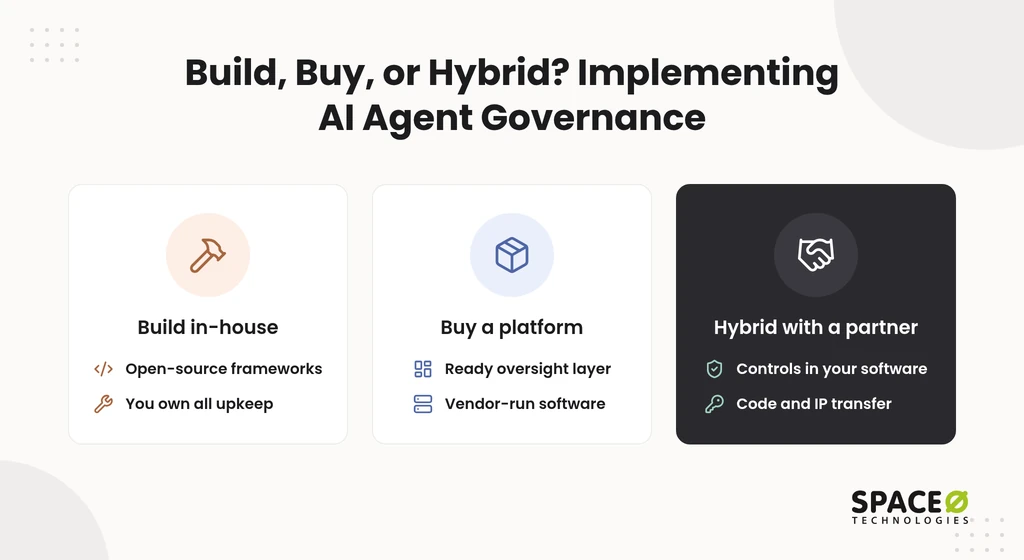
You can build controls in-house, buy a governance platform, or build a custom control layer with a partner. Each path changes who writes the code, who runs it, and what you own afterward. The entries below use the same three parts for a fair comparison.
Build on open-source frameworks in-house
Building in-house means your team writes governance code around open-source agent frameworks.
- What it is: Your engineers add identity, policy checks, logging, and kill switches around AI agent frameworks such as LangGraph, CrewAI, or AutoGen. Guardrail libraries such as NeMo Guardrails can cover parts of behavior control.
- What adopting it requires: Adopting it requires engineers skilled in security, observability, and agent design. They must also maintain controls as each framework releases changes.
- What you own: You own all code and data, along with all ongoing upkeep.
Buy a governance platform
Buying a platform gives you a ready oversight layer that sits across your agents.
- What it is: A dedicated platform, such as ModelOp, offers a live agent inventory, multi-level monitoring, and policy workflows across teams.
- What adopting it requires: Integrating with every agent runtime, staffing administrators to run it, and agreeing license terms with the vendor. Your own applications still need engineering work for enforcement.
- What you own: You own your policies and data, while the platform runs on vendor software.
Hybrid: a custom control layer built with a delivery partner
A hybrid approach builds the control layer inside your own software, with a partner doing the engineering.
- What it is: A delivery partner builds the Step 4 runtime controls and Step 5 audit logging into your agents’ systems.
- What adopting it requires: Adopting it requires a clear scope, access to your systems, and named owners on your side for each agent.
- What you own: With Space-O Technologies, all source code, data, and intellectual property (IP) transfer to you at completion.
Governing a first agent without a platform
Smaller teams can govern a first agent well by building controls into software they already run. You rarely need a platform for one or two agents. Start with an inventory entry, two named owners, a tier for each action, and logging from day one. Budget for monitoring as a permanent part of your AI agent development cost, not a launch task.
Whichever path you choose, the controls only matter once they run inside real workflows.
How Space-O Technologies Can Help
Space-O Technologies builds governance controls into the software your agents already run inside. Many teams stall because their agent works, but nobody can prove it is safe in production. We close that gap with engineering, not policy documents.
Governance also covers testing. Before launch, we evaluate accuracy, hallucination rate, bias, latency, and cost, then monitor continuously. Automation handles the volume, but a qualified human reviews and approves before any output influences a final decision.
Those controls ship as part of every agent build. Guardrails cover topic boundaries, action whitelists, escalation triggers, and kill switches. Pre-production validation includes prompt-injection stress tests and red-teaming, and agents run in shadow mode alongside human workflows before a controlled rollout. After launch, dashboards, drift detection, retraining pipelines, and rollback protocols keep each agent within its limits, while token monitoring and model routing keep costs in check. The testing is measurable: grounding GPT Vix with retrieval-augmented generation (RAG) cut unsupported answers from 22% to 4%, scored by human graders on a 500-prompt held-out set.
Space-O Technologies has served 1,200+ clients since 2010, with 140+ in-house developers. We have built 300+ software solutions and sign a non-disclosure agreement (NDA) before every project. You can choose from four engagement models: Dedicated Team, Time & Material, Fixed Cost, and Staff Augmentation. Our offices are in Mesa (Arizona), Brampton (Ontario), and Ahmedabad (India).
Next steps for governing your AI agents
Pick the starting point that matches where your first agent stands today. We can help you build any of these three:
- A risk-tiering matrix for your first agent’s actions.
- Human-in-the-loop escalation thresholds for your high-impact steps.
- A decision-boundary document that sets each agent’s limits and handoff points.
Tell us about your workflow, and you get a scoped plan for governing your first agent in production.
Frequently Asked Questions
Is there an AI governance framework for AI agents?
Yes, and you do not have to invent one. The Microsoft Cloud Adoption Framework and SS&C Blue Prism publish agent governance guidance built around the five pillars above. You can check coverage against the OWASP Agentic Top 10 and the four NIST AI RMF functions. A practical rule: if an agent lacks any one baseline control from the definition section, it is not yet governed. A good policy document does not change that.
What defines an agentic AI system?
Agentic AI acts on systems and records, while regular AI only suggests text. A quick test for any system you are reviewing is whether it can change a record or call another system before a person reads its output. If it can, treat it as agentic and give it runtime controls, even if its vendor calls it an assistant.
What is agentic AI and regular AI?
Regular AI suggests; agentic AI acts. The caveat is that one agent rarely sits at a single risk level. The accounts payable example above spans all four autonomy tiers, from read-only invoice intake to human-required payment release. Govern each action by its tier rather than labeling the whole agent “safe” or “risky.”
What is agentic AI policy?
An agentic AI policy is the written rulebook for your agents. To be enforceable, it should name the tier thresholds for each action and the approver role per tier. It should also name the log retention period. These are the same fields the autonomy-tier matrix captures. Because the Colorado AI Act and the Texas Responsible AI Governance Act set duties for certain AI uses, have counsel confirm the policy’s scope before launch.
What do we need in place before moving a first agent from pilot to governed production?
Use the five roadmap steps as a go/no-go checklist: inventory entry, two owners, tiered actions, runtime controls, and logging. The startups section above summarizes them. Decision rule: with only one or two agents, build these controls into software you already run rather than buying a platform. Revisit a platform once the inventory grows across teams.
How do we find and govern agents that business teams built in no-code tools?
Run Step 1 discovery first, since these agents usually surface there. Then put them through the same ownership and tiering steps as any engineered agent. The caveat: a no-code agent may not support a kill switch, scoped identity, or full logging. If you cannot add those controls, restrict the agent to the read-only tier until you can. Agents you cannot see or stop cannot be governed.
Who is accountable when an AI agent makes a mistake?
Every agent needs a business owner and a technical owner, assigned when the agent is created. The business owner answers for outcomes and decision rights, and the technical owner answers for code, access, and incidents. For human-required actions, such as moving money or signing a contract, the accountable executive for that decision signs off. If you cannot name both owners, do not move the agent to production.



 All our projects are secured by NDA




 4.8


