
 By
By 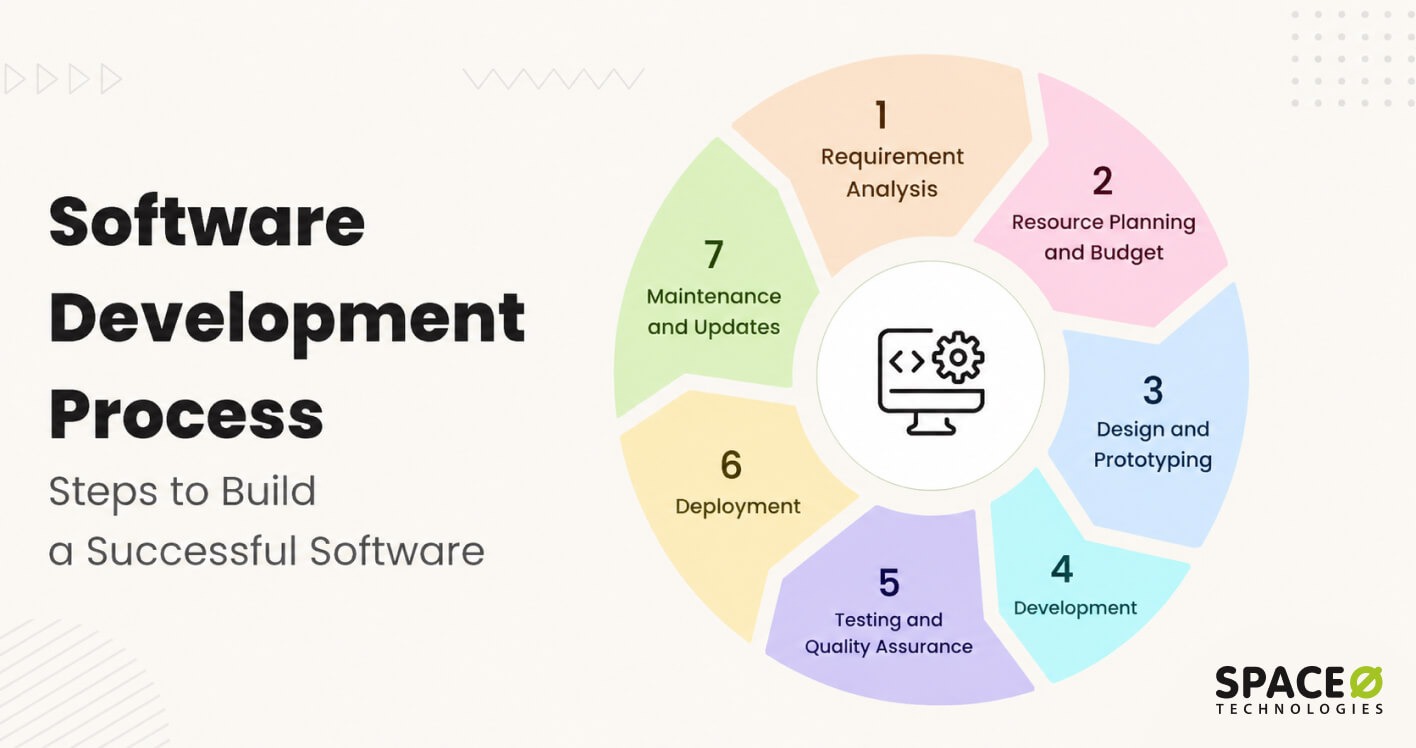
Contents
The software development process is the complete system a company uses to plan, build, test, release, and support software. Most software projects do not fail because the engineering is hard. They fail because nobody agreed on what “done” looks like at the end of each stage.
That gap is expensive. Requirements get interpreted three different ways. Design sign-off happens in a meeting nobody documented. Testing gets compressed into the final two weeks. By the time the problem surfaces, the cost of software development has already doubled.
A defined process prevents this. It tells every person in the software creation process what to build, when to build it, and who approves it. It also defines what document proves the stage is finished.
It helps to see the process as three layers rather than one list of steps:
- The lifecycle layer defines the stages the work moves through.
- The methodology layer defines how your team moves through those stages.
- The operating layer defines the people, tools, and standards behind the build.
The Software Development Life Cycle (SDLC) is the first layer only. The process is all three. That distinction matters more than it sounds, and we cover it directly in the second section.
This guide walks through each of the 7 stages, the deliverable you sign off at each one, the 8 models teams use to execute them, and where projects most often break down. If you are still deciding what to build, start with what is custom software and then return here.
What is Software Development Process?
The software development process is the full system that turns a business requirement into working, supported software. It answers more than the question of which stage comes next.
It also defines who does the work, which methodology governs execution, which tools and quality standards apply, and how decisions get approved. Two teams can follow identical stages and still run completely different processes.
The lifecycle layer defines the stages
This layer covers requirement analysis, resource planning, design, development, testing, deployment, and maintenance. Each stage produces a defined output that feeds the next one.
These stages stay broadly consistent from one project to the next. A fintech platform and a logistics dashboard both pass through them. This layer is what the industry calls the SDLC.
The methodology layer defines execution rules
Agile, Waterfall, Incremental, and Spiral all move through the same stages in different ways.
Agile teams work in short sprints with continuous feedback and tolerate mid-project change. Waterfall teams complete and formally sign off each phase before the next begins. The methodology decides your pace, your sequencing, and how change requests get priced.
This layer is where most budget surprises originate. Choosing a rigid model for an unclear scope guarantees change orders.
The operating layer defines people, tools, and standards
This layer covers team structure, engagement model, version control, testing tools, documentation depth, security review, and release approval.
It varies most between companies. It is also the layer buyers evaluate when choosing a partner, whether that means hiring a dedicated software development team or building the function internally.
Two projects can share an identical lifecycle and run on completely different operating layers. That difference is where cost, timeline, and delivery risk actually live.
How a Software Development Process Supports Business Growth
A software development process defines the steps in software development, from planning and building through testing and maintenance. Without a defined process, projects often experience unclear requirements, missed deadlines, budget overruns, and inconsistent product quality.
A well-established software development process helps organizations:
- Define clear project goals to align business objectives with technical execution.
- Improve collaboration between developers, designers, testers, and stakeholders.
- Manage time and budgets through structured planning and milestone tracking.
- Maintain software quality with continuous testing and code reviews throughout development.
- Reduce development risks by identifying issues early and addressing them before they escalate.
- Adapt to changing requirements using flexible development methodologies like Agile.
- Enhance security and compliance by following standardized development and governance practices.
- Accelerate product delivery with streamlined workflows, automation, and efficient release management.
- Simplify long-term maintenance through proper documentation, version control, and scalable architecture.
Whether you are building a startup MVP or enterprise software, a structured custom software development process improves your odds. You are more likely to deliver a secure, scalable, high-quality product on time and within budget.
Undefined Processes Cost More Than the Software Itself
Space-O Technologies has delivered 300+ software solutions since 2010. Share your requirements and get a structured delivery plan with defined stages.

Software Development Process vs SDLC: What Is the Difference?
The software development process is the broader system for building software, and the SDLC is the stage framework inside that system. The process includes the SDLC. The reverse is not true.
Most published guides treat the process of software development and the SDLC as synonyms. That is convenient shorthand. It is also why so many teams believe they have a process when all they have is a list of phases.
| Aspect | Software Development Process | SDLC |
|---|---|---|
| Scope | People, methodology, tools, governance, and stages | The stages only |
| Question answered | How does our team build software? | What phases does this product move through? |
| Covers | Team structure, engagement model, tooling, QA standards, approvals | Requirement analysis, design, development, testing, deployment, maintenance |
| Variability | Differs by company, client, and compliance need | Stays broadly consistent across projects |
| Owned by | CTO, delivery lead, engineering manager | Project manager, technical lead |
| Output | A repeatable way of working | A delivered, deployed product |
Here is what that looks like in practice.
Two teams build the same inventory management platform. Both move through requirement analysis, design, development, testing, deployment, and maintenance. Both are following the SDLC correctly.
The first runs two-week sprints with a dedicated team, automated regression suites, and a weekly demo. The second runs a fixed-scope build with formal sign-off gates and a single acceptance window at the end.
Same lifecycle. Two different processes. Two different budgets, timelines, and risk profiles.
Since 2010, Space-O Technologies has delivered 300+ software solutions for 1,200+ clients. Across those engagements, the lifecycle barely changes. The process changes constantly, based on the client, the engagement model, and the compliance requirements of the industry.
That is the practical takeaway. When you compare software development companies, asking about their SDLC tells you very little. Asking about their operating layer tells you almost everything.
Every Undocumented Decision Becomes a Paid Change Request
Our team documents scope, stage sign-off, and acceptance criteria before development starts, so change requests stay rare, predictable, and priced upfront.
What Is SDLC (Software Development Life Cycle)?
The SDLC is the stage framework within the software development process. It defines the sequence of phases a product passes through, from requirement analysis to long-term maintenance.
Every stage produces a defined output that feeds the next phase. A documented software development lifecycle process helps teams avoid scope creep, budget overruns, and post-launch failures. Some organizations pair it with an application lifecycle management framework to govern the wider product lifespan.
Here is why structured teams rely on it:
- It creates a shared roadmap that keeps developers, designers, testers, and stakeholders aligned.
- It breaks large projects into smaller, trackable milestones with clear deliverables.
- It establishes quality checkpoints that catch defects before they reach production.
- It produces documentation that simplifies onboarding, future updates, and maintenance.
- It gives project managers visibility into timelines, resource allocation, and budget use.
The process decides how your team works. The SDLC decides what the work moves through. Both matter, and confusing the two is a common reason projects lose track of scope.
The next section covers those stages in detail, including what you personally sign off at each one.
7 Stages of the Software Development Process
Each stage below follows the same shape. You get what happens, who owns it, what document closes the stage, and the mistake that most often derails it.
| Step | Stage | Purpose | Sign-off Deliverable | Owner |
|---|---|---|---|---|
| 1 | Requirement Analysis | Align the build with business goals | Requirement specification document | Business analyst |
| 2 | Resource Planning and Budget | Assign team, tools, and timeline | Project plan with milestones | Project manager |
| 3 | Design and Prototyping | Establish the technical blueprint | Approved wireframes and architecture | Solution architect |
| 4 | Development | Convert design into working code | Feature-complete build | Technical lead |
| 5 | Testing and Quality Assurance | Find and resolve defects | Test summary and defect log | QA lead |
| 6 | Deployment | Release to production users | Release notes and rollback plan | DevOps engineer |
| 7 | Maintenance and Updates | Keep software secure and current | Support agreement and update log | Account manager |
Skipping a Stage Deliverable Never Saves You Time
Every Space-O Technologies engagement assigns a named owner and a written sign-off to each stage. Tell us about your project requirements.
The software industry relies on this structure because it produces predictable quality within an agreed cost and timeline.
1. Requirement analysis
Requirement analysis is the foundation of every successful build. You may have done a basic analysis internally, but turning it into an engineering-ready specification takes a business analyst.
The core question is whether the software aligns with a measurable business goal. Every piece of software exists to make a task easier. So identify which task you are optimizing, and what the benefits of custom software development look like in your specific case.
During this stage, the team documents functional and non-functional requirements. That includes target users, their pain points, core features, integration needs, and performance benchmarks. This work feeds directly into your software development plan.
- Who is involved: business analyst, product owner, and key stakeholders from each affected department.
- What you sign off: a requirement specification document with numbered, testable requirements.
- Where it goes wrong: requirements written as features rather than acceptance criteria. “The system should have reporting” cannot be tested. “The system generates a monthly revenue report filtered by region within 5 seconds” can.
2. Resource planning and budgeting
Once requirements are locked, you decide what it takes to deliver them. This covers team composition, tools, licences, timeline, and budget.
Plan the number of project managers, engineers, designers, and QA testers required. Knowing the cost to hire a software developer makes that budget realistic rather than aspirational.
This is also the point where you choose your delivery model. The in-house versus outsourcing decision changes your cost structure, your hiring timeline, and your management overhead.
- Who is involved: project manager, delivery lead, and your finance approver.
- What you sign off: a project plan with named roles, milestone dates, and an approved budget range.
- Where it goes wrong: budgeting only for build. Testing, deployment, and the first year of maintenance are routinely left out, which is why so many projects appear to overrun when they were simply under-scoped.
3. Design and prototyping
With analysis and planning complete, the team creates the software architecture. This blueprint defines the complete software development flow, from data models to integration points.
Design covers far more than appearance. It determines how the system functions, how it scales, and how it integrates. For enterprise software development projects, the architecture decisions made here shape integration cost and maintenance cost for years.
You play an active part here. Explain to the designers how users should interact with the product. Designers translate that into wireframes using tools such as Figma, Adobe XD, and InVision. For complex flows, request a clickable prototype that demonstrates each function.
This is the cheapest stage at which to change your mind. Fixing a flow in a wireframe takes an hour. Fixing it after development takes a sprint.
- Who is involved: solution architect, UI/UX designer, and technical lead.
- What you sign off: approved wireframes, a system architecture diagram, and a confirmed technology stack.
- Where it goes wrong: verbal design approval. If nobody records who approved which screen, every later disagreement becomes a paid change request.
4. Development
Development begins only when the requirements are confirmed and the design is approved. The team writes the code, applying a range of software development tools to manage coding standards, version control, and collaboration.
How the work is sequenced depends on the model you selected. A sprint-based team ships working increments every two weeks. A sequential team builds against the full specification before any demo.
This is the riskiest part of the software building process, because it consumes the largest budget share. Regular demos are the control that keeps that risk visible.
- Who is involved: technical lead, developers, and the project manager running the cadence.
- What you sign off: a feature-complete build in a staging environment.
- Where it goes wrong: silence. If four weeks pass with no demo, the gap between what you expected and what exists grows quietly, and it always surfaces at the worst moment.
5. Testing and quality assurance
Testing runs alongside development rather than after it. Following software development best practices, the QA team checks functionality, usability, and stability at every stage.
A dedicated QA team tests each piece of code, both manually and with automated tools, to surface bugs and edge cases early.
Our comprehensive approach to software testing has been recognized by industry experts. Designrush, a platform connecting businesses with agencies, featured insights from our Director of Operations, Mr. Bhaval Patel, on their blog.
Mr. Bhaval described the testing cycle in detail:
“At Space-O Technologies, we have a comprehensive software testing cycle incorporating JIRA, Selenium, and AWS. Our dedicated QA team conducts functional, security (with ZAP), usability (using Hotjar), performance, and cross-browser tests. Emphasizing thorough testing with tools like JMeter, Calabash, and Ranorex, we strive to deliver top-quality software to our clients around the globe.”Here are the four testing types applied across most builds.
| Testing Type | Description |
|---|---|
| Performance testing | Checks stability and response time under load, using Loader.IO, JMeter, and LoadRunner. See our guide to performance testing. |
| Security testing | Verifies that the software is protected against external and internal threats. |
| Unit testing | Tests individual components using automation frameworks such as NUnit, xUnit, and JUnit. |
| Usability testing | Examines appearance, feel, and ease of use from the end user’s perspective. |
Defects are logged, prioritized, fixed, and retested. The goal is a product that runs correctly on your target devices with every agreed feature working.
- Who is involved: QA lead, testers, and developers handling fixes.
- What you sign off: a test summary report and an agreed defect log with severity levels.
- Where it goes wrong: compressing testing into the final two weeks. Defects found late cost several times more to fix than defects found during the sprint that introduced them.
6. Deployment
Deployment moves the approved build onto production servers and into users’ hands. It happens only after functionality is confirmed and stability is proven.
Many products get a staged release. A small group uses an alpha version and provides feedback. Modifications follow, and a beta release then reaches a wider audience before general availability.
- Who is involved: DevOps engineer, technical lead, and your operations owner.
- What you sign off: release notes, a deployment checklist, and a documented rollback plan.
- Where it goes wrong: no rollback plan. A release without a tested rollback path turns a small production issue into hours of downtime.
7. Maintenance and updates
The process of software development is a cycle, not a finish line. After launch, the work shifts to monitoring, patching, and improving.
Technology moves, dependencies age, and security advisories arrive. User needs also change as real usage patterns emerge, and feedback drives the update roadmap.
For lean teams that rely on outsourcing software development for startups, extending the engagement into maintenance preserves product knowledge and avoids handover cost. Structured software maintenance services cover patching, monitoring, and enhancement under an agreed response time.
We also build for scalability, so the system can expand or contract as demand changes. For a fuller walkthrough, read how we create software from scratch.
- Who is involved: account manager, support engineers, and the original technical lead.
- What you sign off: a support agreement with defined response times and a rolling update log.
- Where it goes wrong: treating maintenance as optional. Deferred updates accumulate into technical debt that eventually costs more than a rebuild.
Now that the stages are clear, the next question is how your team should move through them.
8 Software Development Process Models and Methodologies
The model you choose shapes the entire software creation process. It decides your pace, your change tolerance, and your cost predictability. Here are the eight most widely used.
| Sr. No | Methodology | Suitable For | Key Advantage |
|---|---|---|---|
| 1 | Waterfall Model | Fixed requirements and stable scope | Clear milestones, simple to manage |
| 2 | Prototyping Model | Requirements that are not yet understood | Early feedback before full commitment |
| 3 | Agile Model | Projects needing flexibility and iteration | Rapid response to change |
| 4 | Incremental Model | Large projects with long-term goals | Early delivery, staged risk |
| 5 | Iterative Model | Evolving requirements with frequent feedback | Continuous refinement |
| 6 | Spiral Model | High-risk projects needing risk analysis | Early risk identification |
| 7 | V Model | Clear requirements with heavy testing needs | Defect detection at every phase |
| 8 | RAD Model | Time-sensitive projects with fixed deadlines | Faster time to market |
1. Waterfall model
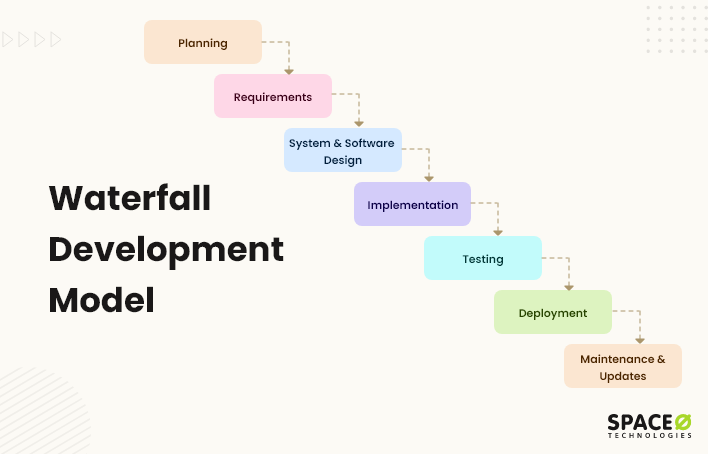
The Waterfall model is the oldest and most sequential methodology. It is also called the linear sequential model or the classic life cycle model.
Picture a staircase. You cross each step in order without skipping. The steps of software development run in strict sequence here, though testing and feedback create some overlap in practice.
To use this model, you need certainty about every detail of scope, delivery schedule, and deadline.
- Phases: planning, requirements, system design, implementation, testing, release, and maintenance.
- Who should use it: large organizations and government agencies that require full documentation and scope approval before work starts. The approach is rigid, and changing direction mid-project is expensive.
| Pros | Cons |
|---|---|
| Requirements are fixed, and the schedule holds | The approach lacks flexibility and delivery takes longer |
2. Prototyping development model
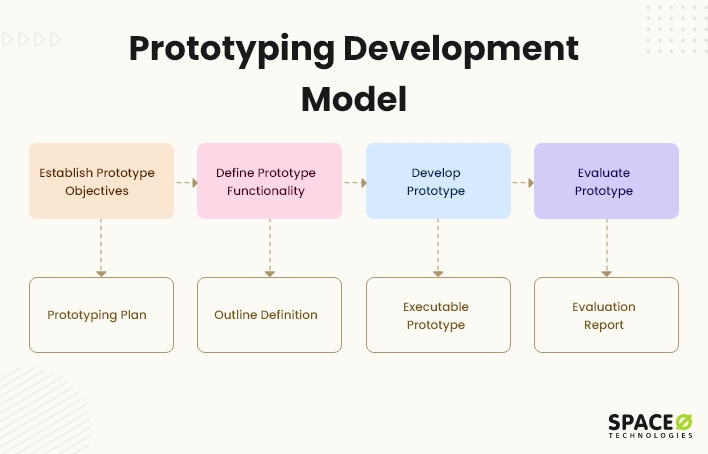
The team builds a small working prototype of the final product for users to try. That version generates feedback and validates both usability and feasibility.
Issues surfaced during prototype testing get resolved before they reach the real product. This gives developers a chance to run a risk analysis before committing to a full build.
You stay involved throughout, which means you finish the stage with a clear understanding of what users actually need.
Prototypes are usually discarded after testing. It is not unusual, though, for a strong prototype to be refined into the final product.
- Phases: establish objectives, define prototype functionality, develop the prototype, and evaluate results.
- Who should use it: any team unsure what users will respond to. Prototyping also works as a component inside the other methodologies listed here.
| Pros | Cons |
|---|---|
| Errors surface early, and user feedback improves the solution | Process complexity rises, and the timeline can extend |
3. Agile software development model
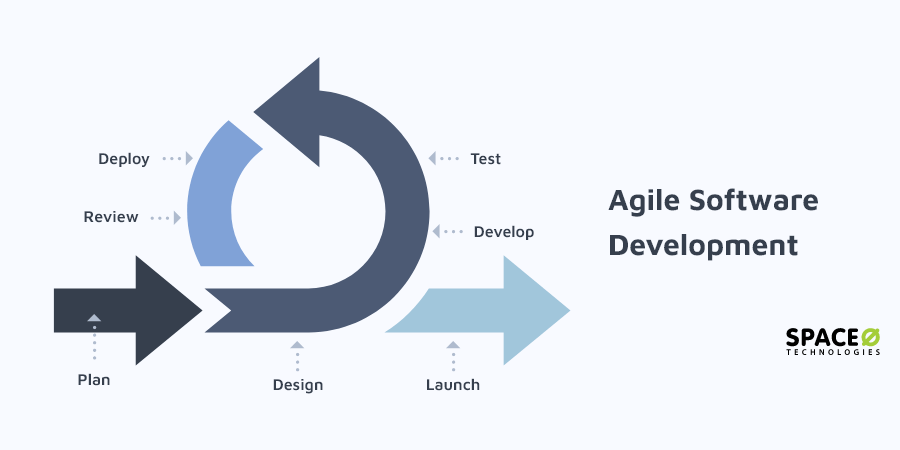
Agile is the most widely adopted methodology, and the one most top software outsourcing companies run by default. It is dynamic and iterative, which reduces defects in the final product.
It is the opposite of Waterfall. You and the development team can adjust plans as understanding improves. According to Harvard Dataverse, Agile practices also carry over into AI product development and big data work.
You do not need a complete requirements list to start. Build a set of features, check user response, then decide the next move. That protects you from investing heavily in features nobody wants.
An agile software development process depends on constant user involvement, ongoing risk assessment, and continuous improvement. Scrum, Crystal, Agile Modeling, and Extreme Programming are common Agile methods.
- Phases: requirements, design, development, testing, deployment, feedback and validation, then the next sprint.
- Who should use it: teams with flexible budget and timeline. If both are locked and immovable, Agile will frustrate you.
| Pros | Cons |
|---|---|
| Highly flexible and reaches market faster | Change can be unpredictable, and scaling is harder |
4. Incremental development model
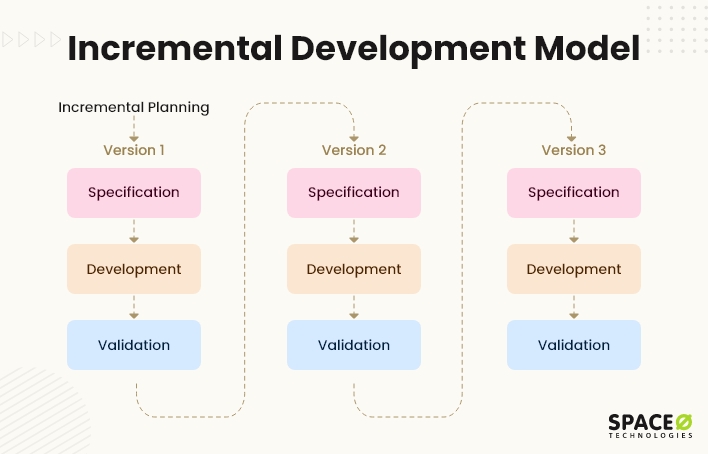
The incremental model builds software in small pieces and tests each one with users. Think of it as a series of mini-Waterfall cycles running back to back.
Each increment adds a new feature or function. It is built, tested, validated, and then the next increment begins. A minimum viable product is the clearest example. The MVP development process ships core functionality first, then expands from user feedback.
- Phases: specifications, development, and validation.
- Who should use it: teams needing more flexibility than Waterfall allows. Avoid it if you have a rigid long-term technology plan that cannot absorb change.
| Pros | Cons |
|---|---|
| Less expensive than alternatives and errors are easy to isolate | Time-consuming and requires planning for future increments |
5. Iterative development model
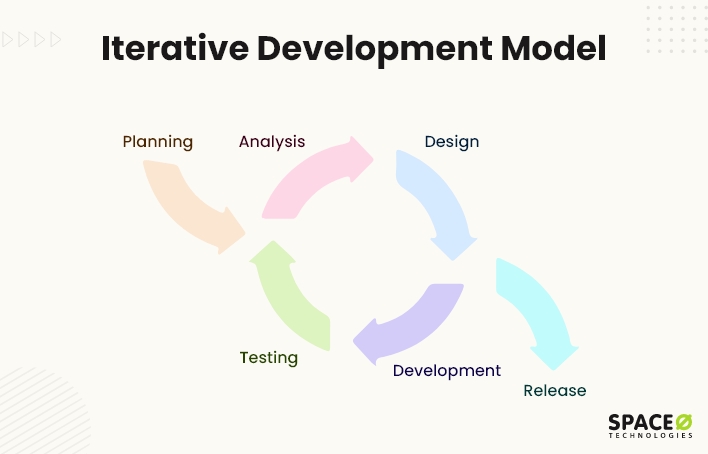
The iterative software product development process starts with a complete version carrying a basic form of every feature. You release that version, gather feedback, then improve each feature in the next cycle.
Each version moves closer to the final product. Multiple intermediate versions follow the same loop, which is where the name originates. You get an early view of the finished product, which produces sharper customer feedback.
- Phases: analysis, design, development, testing, repeat, and release.
- Who should use it: teams with flexible requirements who want to explore possible outcomes. It suits large projects and requires substantial architecture planning upfront.
| Pros | Cons |
|---|---|
| Focuses on design over documentation and cuts operating time | Higher resource cost and rigid transitions between stages |
6. Spiral model
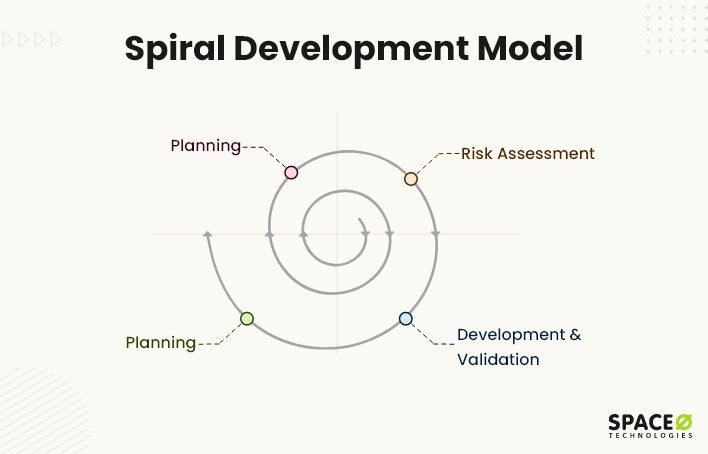
The Spiral model is risk-driven. The process curls outward rather than running in a straight line. It combines the strengths of Waterfall and prototyping, and adds formal risk assessment.
The first loop covers planning for a single iteration or milestone. The next step is an in-depth risk analysis to identify exposed areas. You then build a prototype, correct the issues, and collect user feedback. That completes one loop.
After each loop, the project scope expands. You plan again, gather feedback, correct, complete a milestone, and move outward.
- Phases: planning, risk assessment, development and validation, evaluate results, and plan the next loop.
- Who should use it: large projects where errors carry serious consequences. The model is time-consuming and expensive, so it needs a substantial budget.
| Pros | Cons |
|---|---|
| Highly flexible and suited to large complex projects | Costly in practice and inappropriate for small projects |
7. V model
The V model extends Waterfall by pairing every development stage with a matching testing phase. Requirements map to acceptance testing, design maps to integration testing, and coding maps to unit testing.
This structure catches defects as early as possible, which reduces both cost and total delivery time.
- Phases: These work better as pairs than a flat list, since the pairing is the entire point of the model:
- Who should use it: teams with fully understood requirements working in quality-critical environments such as medical devices or aviation systems.
| Pros | Cons |
|---|---|
| Fast defect detection and clear communication through structure | Inflexible to change and constant testing extend timelines |
8. RAD model
Rapid Application Development prioritizes speed, flexibility, and iterative progress. It splits development into short cycles, each producing a refined working prototype through continuous testing and feedback.
RAD works well when requirements are still evolving, which makes it a strong fit for custom software for small businesses where adaptability and quick turnaround matter most. It also demands frequent customer involvement.
- Phases: Requirements planning, User design, Rapid construction, Cutover and transition
- Who should use it: Teams working to a hard deadline with an engaged business stakeholder available throughout. RAD depends on continuous user availability, so it fails when the client can only review at milestones.
| Pros | Cons |
|---|---|
| Fast, flexible delivery with regular customer feedback | Weak requirements create structural drift and limited pre-release testing |
How to choose the right model
Your software development approach comes down to two variables. How clear is your scope, and how much change do you expect?
- Clear scope, low change: Waterfall or V model.
- Clear scope, high change: Incremental or Iterative.
- Unclear scope, low change: Prototyping first, then a sequential build.
- Unclear scope, high change: Agile.
- High risk, high budget: Spiral.
- Fixed deadline, evolving scope: RAD.
Choosing a Model Late Costs More Than Choosing Wrong
We map your scope clarity and change tolerance to a delivery model in the first consultation, before any code is written.
How the Software Development Process Changes by Project Type
The stages stay the same. The weight given to each stage changes considerably.
Startup MVP builds
Speed to validated learning matters more than completeness. Requirement analysis narrows to a single core workflow rather than a full feature map.
Design work stays lightweight, often stopping at wireframes rather than a full design system. Development runs in short sprints, and testing focuses on the critical path instead of full coverage.
The trade-off is deliberate technical debt. That is acceptable when you are testing whether the product should exist, and it becomes dangerous the moment traction arrives. Read our guide to MVP development for a deeper breakdown.
Enterprise modernization projects
Here the balance inverts. An enterprise software development process front-loads discovery. Requirement analysis expands to include data migration mapping, integration inventory, and dependency audits across existing systems.
Design carries the heaviest load, because architecture decisions determine whether the new system can coexist with the old one during transition. Deployment usually runs in phases rather than a single cutover.
Documentation is not optional. Handover to an internal team is part of the deliverable, and several enterprise software development companies treat that transition plan as a formal stage in its own right.
Regulated industry builds
Healthcare, finance, and medical device software add a compliance layer over every stage.
Requirements must be traceable, meaning every line of code maps back to a documented requirement and forward to a test case. Testing evidence is retained for audit. Deployment requires validation documentation before release.
Space-O Technologies holds ISO 9001, ISO 27001, and ISO 13485 certifications, which shape how documentation and quality records are maintained on these projects. In practice, this adds time to every stage, and it removes the risk of failing an audit after launch.
Where Software Development Projects Actually Fail
Failure rarely announces itself. It accumulates quietly at specific points in the process.
- At requirements: acceptance criteria are missing. The specification lists features but never defines how anyone confirms a feature works. Every disagreement later becomes a negotiation.
- At planning: the budget covers build only. Testing, deployment, training, and first-year maintenance are excluded, so the project appears to overrun when it was simply under-scoped.
- At design: approval is verbal. Nobody recorded who signed off which screen, so every later change becomes contested.
- At development: demos stop. Progress gets reported as a percentage instead of demonstrated as working software. The number is always reassuring and rarely accurate.
- At testing: QA is compressed to absorb development delay. A defined testing checklist is the cheapest defence against this. This is the single most common cause of poor launches, because the stage designed to catch problems is the one sacrificed to hide them.
- At deployment: there is no rollback plan. A minor production issue becomes an outage because nobody defined how to reverse the release.
- At maintenance: ownership is unclear. Nobody is responsible for dependency updates or security patches, and technical debt compounds until a rebuild looks cheaper than a fix.
Every one of these is a process failure, not an engineering failure. Each is preventable with a defined stage deliverable and a named owner.
Most Project Failures Trace Back to Stage One
Space-O Technologies runs requirement analysis as a paid discovery phase with testable acceptance criteria. Talk to us before your build begins.
How to Measure Whether Your Development Process Is Working
You cannot improve a process you do not measure. Defining steps for software development is only half the work. These five metrics tell you more than a status report.
| Metric | What It Measures | What Good Looks Like |
|---|---|---|
| Cycle time | Days from work starting to reaching production | Stable and predictable, not necessarily short |
| Defect escape rate | Share of bugs found by users rather than QA | Low and falling over consecutive releases |
| Rework percentage | Effort spent redoing completed work | Under 15% of total development effort |
| Sprint predictability | Committed work actually delivered per sprint | Consistent, within a narrow band |
| Change failure rate | Releases requiring a hotfix or rollback | Low and trending downward |
Predictability matters more than speed here. A team that reliably ships in six weeks is easier to plan around than a team that sometimes ships in three and sometimes in twelve.
Rework percentage is the most revealing of the five. High rework almost always traces back to weak requirements rather than weak developers.
Predictable Delivery Beats Fast Promises Every Single Time
With a 97% client retention rate since 2010, our delivery cadence is documented, measurable, and reported to you weekly throughout the build.
How AI Has Changed the Software Development Process in 2026
AI has genuinely compressed parts of the process. It has left other parts untouched, and honest planning depends on knowing which is which.
Where AI meaningfully helps:
- Code generation for boilerplate, CRUD operations, and standard integrations.
- Test case generation from written requirements, which improves coverage.
- Documentation drafting, including API references and inline comments.
- Code review support, catching common defects before human review.
- Migration work, translating between languages or framework versions.
Where AI changes very little:
- Requirement analysis, because the hard part is asking stakeholders the right questions.
- Architecture decisions, which depend on business context and constraints AI does not have.
- AcceptanOur software development process is designed to ensure transparency, quality, and predictable delivery at every stage.
- ce and sign-off, which remain human accountability.
- Compliance validation, where an auditor needs a responsible person, not a model.
The practical effect is uneven. AI compresses some software engineering steps, mainly development and documentation. Analysis and design retain their full weight. Teams that assume AI shortens every stage equally end up under-planning the stages that decide project success.
There is also a quality consideration. Generated code still needs review, and teams that skip that step trade a short-term speed gain for a long-term maintenance cost.
Build Your Software With a Defined Process
You now have the fundamentals: what the software development process is, how it differs from the SDLC, the seven stages and their deliverables, and the eight models available to execute them.
That understanding makes the next decision easier. Choosing between software development frameworks and methodologies becomes straightforward once you know your scope clarity and your change tolerance.
If you have questions about your specific project, or about how to hire a software development company, reach out. Space-O Technologies has built software for startups and enterprises since 2010, and we are happy to review your requirements before you commit to a build.
How Space-O Technologies Runs the Software Development Process
Since 2010, Space-O Technologies has delivered 300+ software solutions for 1,200+ clients with a team of 140+ in-house developers and a 97% client retention rate. Our custom software development process is designed to ensure transparency, quality, and predictable delivery at every stage.
- Business-first planning: We begin by understanding your business goals, technical requirements, and project scope before defining the development roadmap.
- Right methodology selection: Based on your project needs, we adopt the most suitable approach, whether Agile, Scrum, DevOps, or a hybrid model.
- Dedicated project management: A dedicated project manager oversees planning, sprint execution, milestone tracking, demos, and regular progress reporting.
- Transparent collaboration: Every requirement, milestone, and approval is documented to ensure clear communication and accountability throughout the project.
- Continuous quality assurance: QA runs alongside development using tools like JIRA, Selenium, ZAP, JMeter, and Hotjar to identify issues early.
- Secure and compliant delivery: We follow ISO 9001-, ISO 27001-, and ISO 13485-certified processes to maintain quality, security, and compliance.
- Flexible engagement models: Choose from dedicated teams, fixed-cost, time-and-materials, or staff augmentation based on your business requirements.
- Post-launch support: We continue with monitoring, maintenance, performance optimization, and feature enhancements after deployment to support long-term growth.
Our software development process remains consistent across projects while adapting the team structure, workflows, and delivery strategy to your business objectives.
Frequently Asked Questions
Is the software development process the same as SDLC?
No. The software development process is broader, and the Software Development Life Cycle (SDLC) is only one part of it. The SDLC defines the stages a product moves through, while the software development process also includes the methodology, team structure, development tools, quality standards, communication, and approval workflows that determine how each stage is executed. Two companies may follow the same SDLC but still have very different development processes.
What are the basic steps of software development process?
The basic steps include requirement analysis, design, development, testing, and deployment. Resource planning and ongoing maintenance are often treated as additional phases depending on the project’s complexity. Small projects may combine some stages, while enterprise software projects expand each phase with detailed documentation and approvals.
What are the 7 stages of the software development process?
The seven stages are requirement analysis, resource planning, design and prototyping, development, testing, deployment, and maintenance. Each phase produces a specific deliverable that becomes the input for the next stage. Following every stage helps reduce project risks, improve software quality, and simplify future maintenance.
How long does the software development process take?
Most custom software development projects take between 3 and 9 months, depending on project scope, integrations, and business requirements. A simple MVP can often be launched within 8 to 12 weeks, while enterprise applications with complex workflows, third-party integrations, and data migration may require 6 to 12 months or longer.
Which software development methodology is best for startups?
Agile is the preferred methodology for most startups because it supports rapid iteration, continuous feedback, and changing business requirements. Since startup products evolve quickly, Agile enables teams to release features faster and adapt based on user feedback. For projects with fixed budgets and strict deadlines, Rapid Application Development (RAD) may also be a suitable option.
What is the difference between the software design process and the software development process?
The software design process focuses on creating the application’s architecture, database structure, interfaces, and technical blueprint before coding begins. The software development process covers the complete lifecycle, from gathering requirements through deployment and long-term maintenance. In simple terms, design defines how the software will be built, while development covers building, testing, launching, and maintaining it.
Who is responsible for each stage of the software development process?
Each phase typically has a dedicated owner. Business analysts manage requirement analysis, project managers oversee planning, solution architects handle system design, developers build the software, QA engineers perform testing, DevOps engineers manage deployment, and support or account managers oversee ongoing maintenance. Clear ownership helps maintain accountability throughout the project lifecycle.
Should I outsource my software development project?
Outsourcing is a practical option when you need experienced developers, faster delivery, or specialized technical expertise without building an in-house team. An outsourcing partner manages recruitment, infrastructure, and project execution, allowing your business to focus on product strategy and growth. In-house development is generally more suitable when software is your core business and requires continuous long-term innovation.



 All our projects are secured by NDA




 4.8
4.8